cycling · fitness · holidays

Going with the flow, from bike packing to airbnb-ing on the Simcoe Loop Trail, sort of

The plan: a 3 day bike-packing trip on the Simcoe County Loop trail, staying in provincial parks.

“The Simcoe County Loop Trail is a 160-kilometer loop that travels through nine municipalities, reaches three major bodies of water, including Georgian Bay, Lake Simcoe, and Lake Couchiching. And, it is primarily on off-road, multi-use rail-trails!”

There are lots of videos out there of fast looking young men on gravel bikes doing it in a day. Ignore those videos. We did. We planned a three day version with time to stop along the way.

I blogged about our plans here.

But those plans were derailed a little bit when provincial parks were still subject to covid restrictions and our reservations were cancelled. I cried. I sulked for a day. And then I made other plans. My word of the year FLOW is serving me well.

What happened instead: We did three days, mostly sticking to the loop but with some deviations due to the location of our accommodations. We still brought the Bob trailer for all of our other stuff.

Day 1: Parked the car in Barrie, bought replacement frame pump that we forgot (thanks Trek Cycles), rode into Orillia on a stunning, shaded rail trail. Stopped to pick up burgers and beverages in town and then made it to our airbnb trailer. Total distance, 41 km.

Where we stayed in Orillia:

Lots to love about the trailer. Air conditioning! A shower! The owners lived in it while they were building their house and now they rent it as an airbnb. We were also impressed with how close to the Trans Canada Trail it was, just under 2 km.

Day 2:

On day 2 we had lunch at Em’s Cafe, at the 20 km mark. along with lots of cyclists.
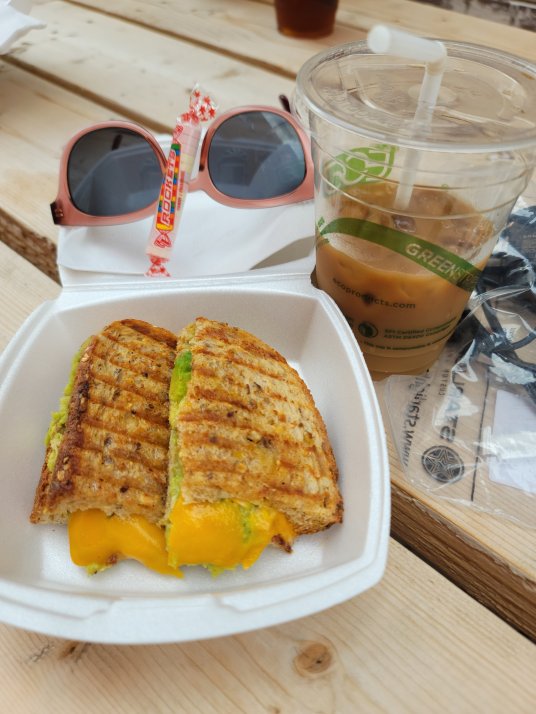
Cheese and avocado and rockets. Also iced coffee.

30 km later we rolled into Midland. Dinner was provided by friends Bill and Sarah who’ve just opened their own business.

May be an image of tree, outdoors and text that says 'CHEF BILL PRESENTS DRUNKEN JAMS, JELLIES & MARMALADES'

But after dinner we biked what may have been the hardest 25 km we’ve ever ridden. And we’ve done a lot of tough riding together. Newfoundland! The ride out of town was fine. But once we hit the country roads we encountered hills that we feel Google really ought to have warned us about. I’m not a light rider, Sarah was towing the trailer, and we weren’t on our speedy lightweight road bikes. It was a slog. We were very happy to arrive at our airbnb bunkie and discover that we could use the pool. Phew!

Total day’s riding: About 75 km

Day 3: After a breakfast of coffee and BBQ’ed crumpets we set off, nervous about hills and heat. We took it easy, stopping lots along the way for water, ice cream, butter tarts and visits with friendly dogs. I’ve got to say that riding on a heat alert day is something I usually associate with late July or August, not the first weekend in June. Maybe I acclimatize to it by then but this was just hot and humid and insufficient shade. I read this–Things all cyclists think on very hot rides— aloud to Sarah on the way home and we agree with most of them.

Total mileage day 3: 40 km

Some observations:

  • Wow. So many bugs–all different kinds. I took at least a dozen caterpillars out of my hair that were hanging from shrubs that we rode under. But also all the usual variety of flying things. The worst for riding? Clouds of midges.
  • We also saw lots of critters–a snake! a beaver! a fox! frogs! So many frogs. Also, so many birds! Lots of ‘turtle crossing’ warning signs but no actual turtles. Also, we warned about a coyote on the path but didn’t see one.
  • The upside of going with the flow was getting to do the trip but it involved more time off the trail on hilly, no-shade country roads than I would have liked.
  • We missed the Tiny Trail on our route and we’re definitely going back at some point during the summer to ride it.
  • I deliberately decided to go casual, bike dresses and my usual sunglasses, spd sandals instead of bike shoes. This way I’d feel better going 15-20 km/hr rather than 25-30, I reasoned. Nevermind all of that. Gravel and trails are hard in their own way and I should have stuck with my more technical cycling gear. It’s designed the way it is for a reason. It works.
  • I’ve never ridden this bike this far before and now I am starting to have dangerous new bike thoughts. I’m browsing lists of best gravel bikes for bike-packing.
  • There’s nothing like exhausting yourself on the bike to get a good night’s sleep. Night 1 was 9 hours and 45 minutes and night 2 was 9 hours and 55 minutes. Yawn!
  • There were a range of surfaces in the trails. Some paved, some chip, some gravel but the hardest trail we rode on was sand. That was a challenge.

Anyway, will definitely do more of this kind of travel. It feels like a real adventure even though it’s close to home and you don’t have to be gone that long to feel like it’s a holiday. Maybe next time we’ll even get to camp!

body image · fat · fitness · normative bodies

What’s wrong with “Rearranging your Post-Pandemic ‘Friendscape'”

CW: discussion of the ideas that friends’ body weights are an influence on a person and that having friends with higher body weights is less desirable (as mentioned by the NY Times), alongside criticism of those ideas.

The New York Times saw fit to print an article this week on using this phase of the pandemic to “rearrange your ‘friendscape'”, which in essence means a combo of culling, currying favor with, and ruthlessly categorizing your friends into the foreground, middle ground, and background of your life.

The idea of pandemic housecleaning isn’t new. I don’t know about you, but I’ve gotten rid of unwanted books, DVDs, CDs, and ancient clothing over the past 14 months. I’ve even moved furniture around, reshuffled the art on my walls, and have freshened up with a few new purchases.

It never occurred to me to toss out, recycle to send to Goodwill any of my friends.

A person, legs sticking out of a dumpster. Tossed by a friend? We don't know...
A person, legs sticking out of a dumpster. Tossed by a friend? We don’t know…

Of course not! Who would think this was a good idea? Well, a bunch of social scientists that the NY Times talked to did. Here are some of their thoughts:

Psychologists, sociologists and evolutionary anthropologists say it behooves us to take a more curatorial approach when it comes to our friends because who you hang out with determines who you are.

Hmmm. Who you are? You mean, I am destined to become exactly like my friends, including taking on their traits? This article seems to say yes:

Indeed, depressed friends make it more likely you’ll be depressed, obese friends make it more likely you’ll become obese, and friends who smoke or drink a lot make it more likely you’ll do the same. The reverse is also true: You will be more studiouskind and enterprising if you consort with studious, kind and enterprising people. That is not to say that you should abandon friends when they are having a hard time. But it’s a good idea to be mindful of who you are spending the majority of your time with — whether on- or off-line — because your friends’ prevailing moods, values and behaviors are likely to become your own.

In short, WHAT?
In short, WHAT?

Yes, I know. It sounds mean and absurd. Which I think it is. So does Roxane Gay, writer and columnist for the self-same newspaper. Here’s how she summed up the article:

Roxane Gay's tweet, saying "this piece really wants y'all to stop hanging out with your fat friends so you don't catch the fat. She is my hero.
Roxane Gay’s tweet, saying “this piece really wants y’all to stop hanging out with your fat friends so you don’t catch the fat. She is my hero.

What’s really going on here? For more than a decade, there have been studies looking at social networks and how to identify patterns in common among social groups. Nicholas Christakis and lots of others, through this social network analysis, argue that some traits like body weight, psychological states, and some eating and drinking habits are “socially contagious”, which means they spread through social connections. I wrote about this a decade ago with my friend Norah. Our views have shifted since then, I might add. The details are complicated and not obvious or always intuitive. For instance, same-sex mutual friend groups are more mutually influential than domestic partner or married partner groups.

How these traits spread is outside the purview of social network analysis. Other social scientists have posited views about localized behavioral norms (like eating, drinking and drug use practices), but these views are speculative, not predictive or diagnostic or useful for dispensing friendship triage advice.

In sum, though:

It’s not true that my being fat “helps make you fat” if we are mutual friends.

Being fat is a thing that some people are and some people aren’t. Talking about fatness as social contagion worry for people who are looking to assess their friendships is ill-considered and mean-spirited and not supported by evidence.

It’s also fat-phobic in the extreme, which makes it double-mean-spirited.

Ditto for depression. The last thing someone with depression needs is her friends avoiding or dumping her out of fear that they will catch it. That is wrong on all the levels. Like, even this level of wrong:

2+2=5 level of wrongness. I don't know what the lamb has to do with this, but I'm sure it's not at fault.
2+2=5 level of wrongness. I don’t know what the lamb has to do with this, but I’m sure it’s not at fault.

There’s more blah-blah about friendships in the article, but nothing that is a) worth mentioning; or b) offsets the horribleness of the above-mentioned messages.

So, what am I doing about my friendships as we emerge, many of us vaccinated?

  • I’m expressing my love and gratitude to those with whom I shared a supportive/supported network;
  • I’m reconnecting with those I lost touch with, or who lost touch with me, for reasons of PANDEMIC, y’all!
  • I’m enjoying some new connections made over the past year courtesy of zoom and social media;
  • I’m trying to pace myself in those activities of reconnection, and be understanding of those who are in a different stage of connection or reconnection or disconnection.

Life is hard, y’all. Life has been extra hard. Geez Louise– how about let’s just be friends with our friends as best we can? That’s what I have to say to the New York Times.

Readers, did you see this article? Where are you with respect to connecting and reconnecting with friends these days? I’d love to hear from you.

Book Club · swimming

FIFI Book Club: Why We Swim, by Bonnie Tsui. This week: Community

Hi readers– we’ve been reading a new book for this installment of the FIFI book club. It’s called Why We Swim, by Bonnie Tsui. We’ll be reading and commenting on the various sections of the book over the next several Fridays. We’d love to have you join us and add your comments to the mix.

Three weeks ago, we introduced ourselves in terms of our past, present and aspirational relationships with moving around in water.

Two weeks ago, we reported on the section of the book titled Survival.

Last week, the topic shifted to Well-Being.

This week, we’re focusing on the notion of Community swimming. Here’s what we have to say. First up, Kim:

This section of Tsui’s book means a lot to me, because it thinks about swimming and inclusivity. Who gets to swim? Who gets to decide who gets to swim? It’s a huge topic, and we’ve talked about it on the blog before too. Tsui’s not especially political in this text, but her status as a person of colour / an Asian woman in the US means that the issue of BIPOC access to shared public spaces arises for her naturally in the course of the narratives she weaves. It’s been interesting for me to note throughout the book, for example, that in certain cultures swimming is simply privileged, in large measure out of a need to survive: if you live in Iceland or Japan, you’re going to need to know how to stay afloat just in case. Tsui comes from a swimming family and has made her own family a swimming one too (and we learn more about that in the next section of the book, FYI). She identifies with the water, as a person of the water – and she well knows that barriers to the water for others (for example, lots of Black folks in the states) arise when those folks are not permitted, because of structural exclusions based on race or class or gender, to identify in the same way.

I find it really moving that Tsui’s narrative in this section is anchored by stories of military service-people from all over the world learning to swim while stationed in Baghdad; it’s a simple and warming story, but also and utterly brilliant reminder that the community in which you find yourself (in this case, one united by mission and circumstances, not racial or national characteristics) can have an enormous impact on the way you are permitted to envision yourself in the world. Shifting the terms by which we structure our communities can, in turn, have a large effect on how members of our communities see themselves in relationship not just to others, but to a whole host of public spaces.

Here’s me, Catherine:

This section was my favorite of the book. Why? Because swimming pools have always struck me as happy centers for communities to gather. Because the community pool can be a microcosm of society, revealing diverse activities, generations, families, teams, friendship pods and ad hoc groupings that comprise civic life. Swimming in a public pool or lake with other people makes me feel almost patriotic—proud to be part of a collective, united under the (beach) umbrella of recreation and good clean fun.

But here we see collective swimming and (more importantly) swimming lessons conducted under the worst circumstances: war and foreign occupation, run by governments and military organizations with rigid hierarchies. And yet. Jay Taylor does what he can and what he knows for everyone who comes to the lavishly decorated palace pool in Baghdad, in search of respite from the dangerous and dry outside.

Swimming is a form of recreation and a sport, but it is also a crucial life skill. Being able to swim means increased survival odds for everyone. In the US, there are huge racial disparities in swimming instruction. The rates of accidental deaths due to drowning are on average at least 3 times higher for black children than for white children.

Reading this section reminded me of just important it is to create, as a community, public spaces and programs for everyone to have access to swimming instruction and swimming recreation. I believe that it advances justice, health, civic identity, and community building.

Next is Diane:

This section triggered so many memories of people I have gotten to know through swimming. And though it was beautifully crafted, I wished there had been more stories of community. Just one chapter was not enough for me.

For example, the history of English swimming barely touches on the huge community there, swimming at Lidos, in many rivers and lakes, or in the sea – all year round. They were my inspiration for open water and cold water swimming. One of those swimmers even met up with me at a public pool in London when I was there on business.

The whole idea of access to swimming really interests me too: there’s my friend from Victoria who works leads open water swimming with a group of adults with Downs Syndrome; my local pool was built in 1924 in what was then a slum area, complete with segregated entrances, just like the pools described in the book; the LGBTQ-friendly swim club I hang out with; my years of working with women from very conservative societies and their limited access to a pool (or any sports or even education). And just last year I learned about Mamie Nell Ford – a photo of her at a “swim in” in St Augustine Florida, as the the owner of the segregated hotel pool poured acid into the water, helped spur the Civil Rights Act of 1964. I would happily have read far more about this topic.

Most of all, this chapter filled me with love for Jay and his gift for teaching and bringing people together. The anecdote about buying goggles and caps for students really struck a chord. The Canadian Embassy in Kabul has a pool too, though nothing like where Jay’s multinational swim team trained in Baghdad. It is a tiny above-ground pool, and the last time I was there, I was deeply grateful for the tether a former employee had left behind for other swimmers, because it allowed me to work out for an hour in a space not much bigger than a hot tub. It was an oasis of peace in a place where I was always on alert.

And here’s Sam:

I often think about access to swimming. My mother doesn’t swim. She didn’t learn as a child, then almost drowned going over waterfalls, and hasn’t been in the water much since. She made sure I did learn to swim. It was important given that me and my siblings were raised on the east coast of Canada, near the ocean, and holidays were often spent near lakes or ocean beaches. The real success story was the next generation. My daughter Mallory is an excellent swimmer, a diver, and a lifeguard.

I wanted more from the chapter on race and access to swimming. Each year I feel like I’m struck anew by racial disparities in drowning deaths. Here in Ontario a black teenager recently drowned in a school canoe trip and teachers claimed not to know the student couldn’t swim even though it clearly said that on his permission form for the trip. I also wanted to hear more about swimming communities and what we can do to make those communities more inclusive. Short review: glad this section was here, wish it were longer. It seems to me that swimming, access and inclusion is a topic worth a whole book!

Readers, have you been reading the book? We’d love to hear what you think.

Sat with Nat

Nat ponders a quiet Pride month

Recommended Soundtrack: A little Alexis from Schitt’s Creek

It’s June! It’s glorious weather! We are still in lockdown in London, Ontario, Canada. Gaaahhhh. Boring.

What is a queer, fit, feminist to do? No marches. No dancing. Perhaps socially distanced Pride run?

It’s likely a very quiet, close to home Pride season for me. I love that some of my favourite fitness companies are doing some great fundraising for Pride organizations.

This from The Under Belly (aka Jessamyn Stanley) newsletter:

HEY BELLIES,
HAPPY PRIDE MONTH!

Take up space and celebrate!!
The impact of the LGBTQ+ community is immeasurable around the world:
inspiring every being to be their whole self and show all their colors.
Let’s celebrate love and bloom with pride together, in-person or virtually,
at a time when it’s needed most.For us, pride means so many things.
It means being, embracing and loving your authentic self fearlessly and
to the fullest. It means giving, showing and celebrating love in all forms.
It means understanding and supporting. It means embracing the journey.
All of which speaks to our values and who we are (hell yeah!).

Pride also means giving back and making a
positive impact in your community/communities.

In that spirit, The Underbelly is teaming up with Gender Spectrum (@gender_spectrum), a non-profit organization working to create gender sensitive and inclusive environments for all children and teens. We love the important work that Gender Spectrum is doing and the positive impact being made (check out these “Gender Stories” to smile, fill your heart up, and even have a good cry!). Stay tuned to our IG page (@theunderbellyyoga) for more details on how we plan to give back with Gender Spectrum”

That kind of “pink dollar” marketing can be tricky if your fitness business isn’t 24/7 2SLGBT+ positive and inclusive. This lands solid and I love this about the Under Belly!

My favourite leggings manufacturer, Point Seven Five, donates a portion of proceeds from their Pride leggings to Canadian not for profits. Another reason to love them!

From their Facebook post:

“Thanks to everyone that has purchased leggings from the Pride Collection. I was able to donate $500 to Rainbow Railroad last night!
I plan to open the shop at the end of the month, I’ll post when it’s open so you can grab your own pair.

Next one will be going to Ten Oaks Project !
Have a charity in mind? Let me know.”

Other times I see Pride related content/items from a vendor and it feels like a cash grab. Or worse, pink washing over a company that is not walking the talk of diversity and inclusion.

Have you seen some great examples of businesses walking the walk for Pride month?

fitness

Hello foam roller, my old friend

I saw my massage therapist the other day. I have tightest glutes she’s ever seen and she didn’t mean it in a good way. My Physio isn’t impressed with my back muscles either. Steady work since the new year is grand but it’s been wreaking havoc on my body.

You may have heard the phrase “motion is lotion,” but I’ve now been told “lengthen, then strengthen.”

I have a menu of stretches each targeting a particular muscle group. They aren’t especially arduous but they take effort. This week we’ve re introduced the foam roller. Holy heck — it does a number on the IT band and the quads.

Image shows a orange cat stretching. It doesn’t need a foam roller but I sure do. Photo by Timo Volz on Unsplash

I’ve been ultra focused on increasing my bone strength, and with the pandemic, I pretty much dropped my nascent yin yoga practice. Add in a sedentary job, and my muscles have become inelastic and resistant.

Although the foam roller will never be my BFF, I can’t deny I feel heaps better after. It’s been a good reminder that while strength and endurance have their place, flexibility matters too.

— MarthaFitAt55 lives and works in St. John’s.

femalestrength · fitness · sexism · tennis

Naomi Osaka vs The Patriarchy (OR: That time a talented female athlete asked reporters to shut up and it didn’t go her way. Quel Surprise.)

So, Naomi Osaka. World #2, unbelievable tennis player, YOUNG PERSON (she’s 23 years old). She heads to the French Open, aka “Roland Garros” (we’re posh, peeps – we call the thing by the name bestowed upon the hallowed grounds, and there are tiny sandwiches somewhere, and patisserie, and LOTS OF BOOZE). She says: you know what? I would rather not do the press conferences this time, thanks. I am a tennis player at the elite level and barely an adult and my clay court game is a tricky work in progress. I need to focus, and also cope with all the feelings while focusing, which means I really don’t need to have to field a bunch of questions about my sexuality, or the depth of my human flaws, or other outright irrelevant crap after every match, thanks. For my mental health, you know, I just would rather not. It’s about the game, right?

Friends, she broke the internet. Of course she did.

Osaka in a blue-green Nike tank and black boxers, at rest, holding a tennis ball and smiling. THIS WOMAN KICKS TENNIS ASS. (This image is from her Wikipedia page, where you can also learn her native name in Japanese script.)

WTF cares if tennis stars do the damn press circuit at the Grand Slam tournaments? Their sponsors, sure. (Although the sponsors make their money back hand over fist regardless, and I’d bet my new racket that Osaka’s sponsors are finding this massive controversy, splashed all over the place online, is breaking their way.) The Grand Slam organizers too, yes: they have a vested interest in stuff always going to the plan they have so carefully wrought. So the money folks, they really care.

Beyond the economics, there are, from my perspective, two main reasons the world seems in a huge way to care about Osaka’s decision to refuse to do press at the FO. There’s the fairly basic answer, and then there’s the answer behind that answer – the nuances.

The first part – the basics – smarter people than me have already weighed in on. Writing in the Guardian sports blog, Jonathan Liew has pointed out that when stars like Osaka say ‘no thanks’ to the press, it’s another reminder – a billboard-sized, viral Twitter-shaped reminder – that the mostly-white-often-older dudes who still rule the sports pages in many conventional media outlets matter less and less and less. If Naomi has something she needs to tell me, she’s gonna tell me directly, on social. And that scares the bejeezus out of those dudes.

Here’s a screen grab of Naomi’s twitter. Go follow her. (Notice that she has 1M followers and is following 18 people. THAT IS BADASS.)

Meanwhile, also in the Guardian (NB: wholly subscriber-funded, not owned by billionaires! As a researcher it’s the paper I trust most in the world), Marina Hyde points out that Osaka’s “mistake” was to experience her mental health and address its needs while still actively competing and winning Slams – as opposed to, you know, burying that shit, blowing up in a spectacular and headline-inducing way, crawling off for a while, then coming back with a memoire. The media (hi Rupert Murdoch! Thanks for setting such an incredibly ethical example!) LOVE a case of celebrity mental breakdown and a subsection of this media will defend to their graves their exclusive right to report on these breakdowns in the most shaming and salacious ways, damn the consequences. (I urge you to read the whole Hyde piece; Marina is a comic genius and as far as I am concerned she is the reincarnation of Jonathan Swift.)

OK, now for the nuance-y bit. I’m a beginner tennis player and I only half-glance at the Grand Slams over my partner’s shoulder most of the time, but the Osaka story caught my eye because I’ve just finished going through the proofs of a new book chapter I’ve written about girlhood, gender identity, and sport. Its focus is the amazing 2016 play The Wolves by Sarah DeLappe, which follows a team of high school-aged soccer players, all young women, as they navigate a season. They are alone on stage until the very end of the play. Their pitch is their space to own and control and be messy and flawed and incredible and talented and mean little shits because they are TEENAGE GIRLS. They use that space to actualize who they are, to be better selves every practice, to dream up and then enact, in their shared embodiment, who they want to become. There are no media folks (nor anybody else) present.

A group of 9 young women in red soccer jerseys and black shorts mug for the camera on an artificial grass pitch against a black background: they are fake-posing sexy-model style with orange slices in their mouths. This is the cast of The Wolves from the 2018 Toronto production.

This is revolutionary. Why? Because, as my chapter argues, the history of women in competitive sport is a history of the male gaze freaking out like crazy. Add in girls doing their own thing, for their own benefit, and things get really sweaty in a hurry.

(I want to be clear here that “the male gaze” is a patriarchal construct, not a feature of biology attached only to actual men: it refers to how all of us humans who live under patriarchy – a social structure in which men are valued, culturally, above others – learn to look at bodies, including our own. Think about it: when you look in the mirror, as a strong and fit woman, what do you see? I see my perimenopausal hips and thighs and think, rats. What did I eat yesterday? BAM! That’s me looking through my female eyes with a male gaze.)

A graphic shows Christina Hendricks all in red, dressed as from Mad Men, with Don Draper-era guys in suits and hats looking at her. Arrows help us understand the trajectory of their collective gaze, in case we need help parsing the symbolism. THAT THING.

Sporty women are a huge problem for the male gaze. Why? They are STRONG. They are bulky – muscle-toned. They are working their bodies for a purpose other than attracting male attention – this is weird and taboo to patriarchy. (Check out stuff we’ve written here and elsewhere on the blog about Serena Williams, and also Sam’s great posts about women on bikes, to learn more.) Sporty women are also, of course, incredibly beautiful, graceful, powerful – damn fun to watch. So the upshot is: we want to watch them, with our patriarchally-trained gazes, but in the process we (even sometimes feminist humans like me!) experience serious cognitive dissonance. How can they be so incredible to watch while not conforming to patriarchal expectations about what incredible-to-watch women are supposed to look like? Are you even allowed out in public with thighs that strong?

From here – DIRECTLY – comes the now-infamous corollary dispensed by La Mostly Male Presse (again, see Serena, women on bikes, Megan Rapinhoe, you name the bad-ass girl athlete): if you’re going to compete at this high level, laydeez, we are going to reserve the right to judge you constantly, shame you continuously, and call all of your tactical choices into question. Otherwise, you make us look a bit too hard at the structures of our social systems and our heads start to hurt and we have to consider perhaps, um, making some serious structural changes. So we’re going to push you back down, down, down. Don’t be so uppity, miss tennis star. Who exactly do you think you are?

And here – HERE – is where the rubber hits the clay, so to speak, for Naomi Osaka.

Osaka at the French open in 2016, in a multi-coloured tank and black leggings, preparing to serve. She looks exhausted because she is playing intense tennis, people. Remember: this woman hits balls. Hard.

She’s young, and like all young people thrust into the limelight, she’s having to figure out some basic ontology (aka, who am I? What will I become?) while also competing at the most elite level, in the public eye. She is vulnerable and fragile like all young women who grew up under patriarchy, but to the Nth degree because tennis star (AND woman of colour, hello structural racism!!).

Add to that Roland Garros, which is a clay court surface and thus clashes with some of the strongest aspects of Osaka’s game, and both Naomi and La Presse know what’s most likely to come of any tete-a-tete post-game. Who the hell wouldn’t blame her for saying, you know, I think I’d rather play tennis than live out my existential fears on camera, so that maybe I can improve my clay court game. Ok with you?

Was her “hard no” to all press a bit OTT, maybe even a bit childish? Dunno – depends on your lived experience. When I was 23 I was only just recently not a child, so maybe a bit? #mostlynormal

Is Osaka a flawed human who let some probably nice people down in the process of making this call (for ex: occasional amazing female sports journalists who might have asked awesome questions)? Sure. She’s flawed as hell – have you seen her clay court game? Again, really not the point though, unless you feel safe tossing those stones.

What Osaka is asking, really asking, is that we hear her when she says: I’m supposed to play top-game tennis here and also face the press, all while keeping my shit together, and this combination of things is not, for me, actually possible. It’s not possible for some of my peers, too, and I wonder if perhaps we could take a look at the system and shift things so that maybe one day it could be possible, things could be kinder, and more fair for us all?

Funny how, when we ask questions just like that, the press corps and the Slam chiefs find it really, really hard to offer a good answer.

fitness

Happy World Bicycle Day 2021!

Happy World Bicycle Day from the bloggers at Fit is a Feminist Issue!

Here’s a gallery of images from the blog–fit feminists (sometimes freezing in Newfoundland, sometimes very warm without helmet in Bora Bora, in more or less scenic surroundings, all smiling) on our bikes!

What’s WBD all about anyway?

Here’s an explanation from the UN website:

Background

Acknowledging the uniqueness, longevity and versatility of the bicycle, which has been in use for two centuries, and that it is a simple, affordable, reliable, clean and environmentally fit sustainable means of transportation, fostering environmental stewardship and health, the General Assembly decided to declare 3 June World Bicycle Day.

It encouraged stakeholders to emphasize and advance the use of the bicycle as a means of fostering sustainable development, strengthening education, including physical education, for children and young people, promoting health, preventing disease, promoting tolerance, mutual understanding and respect and facilitating social inclusion and a culture of peace.

The Assembly welcomed initiatives to organize bicycle rides at the national and local levels as a means of strengthening physical and mental health and well-being and developing a culture of cycling in society.

Secretary-General’s Message for 2021

Bikes are freedom; bikes are fun. They are good for one’s health — physical and mental — and good for our one and only planet. Bikes are popular and practical, providing exercise and transporting us not only to school, stores and work but to a more sustainable future.

World Bicycle Day celebrates this great power and highlights the importance of non-motorized transport in achieving the Sustainable Development Goals and combating climate change.

Today there are an estimated 1 billion bicycles in the world – about as many as passenger cars. Their use spans the generations, from toddlers to older persons; once you learn, you never forget.

Even before the COVID-19 pandemic, cycling was a critical mode of transport, and bike-sharing programmes were increasingly common, providing free or affordable access to bicycles for short trips.

The crisis has changed transport needs and behaviour, and prompted many cities to rethink their transport systems, with bicycles playing a vital role in offering an economical and non-polluting alternative.

This further embrace of cycling must be accompanied by heightened efforts to improve road safety and integrate the bicycle into sustainable transport planning and design. Investments in city infrastructure, including protected lanes and other measure to promote safety and counter the long-standing hegemony of the automobile. As we look ahead to the United Nations Global Sustainable Transport Conference in October in Beijing, let us pledge to support cycling and make better biking a reality.

To all the world’s cyclists on World Bicycle Day, whether out for sport, exercise or an errand, keep those wheels turning!”

fitness

How I spent my pandemic lockdown

Last week Susan wrote a beautiful post about the lost year that wasn’t really lost. She invited others to talk about what we’ve gained over the 16 months of covid we’ve lived with — this frightening, confusing, cosy, exasperating, awakening, exhausting, languishing, enraging and clarifying year. (BTW, in case anyone’s counting, we’re still in full lockdown in Toronto. We’ve now had the longest continual “no restaurants (even outdoors), no hair, no gathering, no toes, no gyms, no swimming, no touching, no non-essential shopping, mostly no schools, NO TOUCHING” lockdown in the world. Our third wave is now behind us and we’re vaxxing like mad, but our premier is now locked in his own paralysis of doing the wrong thing. But never mind about THAT).

So what am I taking from this year? What were, as they say, the unexpected gifts?

  1. A stupid little daily walk really does help my stupid physical and mental health.

Cheryl posted this meme in our 221 in 2021 workout group a few months ago, and we started using the hashtag #slwfmspmh in our group for our daily constitutionals. It’s a thing. I do it almost every day. I feel better. It counts as movement.

2. It took a pandemic to really lock my body down into menopause. My now three year old post on still menstruating at 53 continues to be in the top 10 most read posts every month, but I am no longer the menstruator emeritus. Being trapped at my desk in zoom while being lashed with 20 hot flashes a day eventually drove me to hormone replacement therapy (and let’s not even speak of the vaginal atrophy — more on that horrifying phenomenon later). But I’ve crossed a milestone into cronishness, and I like it. As a friend said on facebook the other day, “the less estrogen I have, the more honest I become.” I concur.

3. Time really does move along like a son of a bitch, so you’d better get on with the things that matter. Facebook memories kept popping up this year reminding me of the Before Times, and they were always waaaay longer ago than I remembered. Wasn’t that trip to Bhutan just last year? Have I really had my little Georgia cat for four years? That — plus, you know, global doom — triggered a little tick tick tick in my head of time passing, and I finally — finally! — started working in earnest on a book I’ve had in me for a long time, about my experience with the project I’ve been running in Uganda since 2008. I’ll be blogging here a little less because of it for a while — from once a week to once a month — so I can really focus. It’s in my head even when I’m not working on it, which is the best place to be.

4. Little latin dance workouts are actually fun, and it doesn’t matter what I look like. I got a new apple watch a couple of months ago, and I was immediately enamoured. I like being bossed around by the rings, and I like the illusion of accomplishment even on days when I’m essentially pacing like a hamster in a cage. I didn’t leave my house, but I closed my rings!

I already knew I was motivated by “badges” — what I didn’t know is how much I would appreciate the free three months of apple fitness + that came with the watch, I quickly flicked away the yoga (I got my own peeps for that), the strength training (the beloved alex), the core, the spinning. But the dance workouts. The dance workouts! 20 minutes with Jhon doing a fake merengue and I’m transported to a carnivale in my head. And I’m alone, so I can pretend I’m even good at it. I feel like an 8 year old dancing completely unselfconsciously. That, I did not expect.

5. Cats can get eczema from stress. That’s not really about me and my body, but it’s really interesting, isn’t it??! Poor Emmylou had all these gross head scabs until I got a little pheromone thing to destress her. It works.

6. When you’re 56, your body needs careful tending. Over the past year, I’ve developed a shoulder impingement, Morton’s neuroma in my left foot, an unnerving infection in a finger after I had acupuncture for an arthritis node and something got in the wound, two different rounds of sciatic pain (different sides), and occasional knee pain. On top of the hot flashes, insomnia and other unsavoury menopause symptoms. But I’m a little less … annoyed… by these things this year. I tend to them — with chiropractic, stretching, release, rest. I thank my body for letting me do the things it does. And I’m grateful — so grateful — my good, strong body has gotten me through this pandemic.

My hair was so much shorter in January!

7. Yoga is always a good idea. I’ve written a lot about doing the Yoga with Adriene January program, and my teacher Amanda, and learning to do bakansa, and how the concept of drishti really helps me stay focused. I’m not always 100% consistent, but my mat is almost always ready in my living room, and that continual invitation has brought me so much deeper into my practice, into my comfort with stillness, into my body. My body has changed this year — age, menopause, stress, lockdown. All the little fiddly problems. My summer clothes from last year don’t quite fit. With my current pandemic ponytail, greying roots and cat’s eye glasses, I look like my own great-grandmother. But yoga is always there to bring me back to the essence, to show me my strength, my resilience, my adaptability, how I can keep growing no matter what.

My beloved bombtrack, with the coca cola I only drink when I’m on a long ride.

7. And finally…. my bike will always be my best friend. I got through the winter riding a spinning bike more than 2000 fake kilometres through the simulated world of zwift. I was so grateful for that. But when I got on my bike and pedaled alone on country roads last weekend? Found a place that was willing to sell me a curbside cheese sandwich? Ticked past 55 real kilometres for the first time this year? Then I was really home. That will not change.

What about you? What were the unexpected aha’s you experienced this year?

Fieldpoppy is Cate Creede, who is still in lockdown in Toronto, but was able to go on a solo adventure near Beaverton last weekend.

fitness

Wordless Wednesday: Everyone has a beach body

Image shows beach at sunset with a person in a wheelchair at the water’s edge. Words say: Everyone has a beach body, IF: 1) you have a body 2) you’re at the beach Photo credit: DailyGrabBack.com

habits · rest · running · self care · training

Navigating the Tricky Balance Between Effort and Ease

I’m feeling wobbly. I’m not quite managing the balance between effort and ease. Could be that I’m finally allowing myself to feel the full weariness of the pandemic, now that we are seeing the light at the end of the tunnel (a tunnel that emerges into an as-yet unknown future). Could be that I’ve been gorging myself on a lot of inputs, between the multiple Non-Violent Communication and Internal Family Systems trainings I’m attending, the practice groups I belong to, plus writing coaching clients, and my own workshop development and writing, plus some deep dive personal development work.  That psychic tiredness may be spilling over into physical tiredness, too. But I keep trying to push my way through the depletion into a higher energy state. This tendency is most obvious in my physical activities.

Here’s an example from a few days ago. I woke up in a hole. The voice in my head who likes to tell me I’m not enough was on a tear. Vivienne (that’s the voice’s name and yes, I give the voices in my head names) hadn’t actually taken up much air time recently. I’d almost forgotten how ferocious she can get. I headed out on a run, with the idea of appeasing her. When she’s on a bender, she wants me to sweat first, then get to some tasks. From the first step of my run, I was dragging. About 45 minutes in, I arrived at a short, steep dirt hill, where I sometimes do repeats. I thought, “No, no, no.” Vivienne said, “Oh yes.” I tried to negotiate, “Okay, but just three.” Vivienne said, “Do the full five.” Five is my usual. I did them. Vivienne’s concession in our semi-détente was to allow me to skip the plyometric jumps I do at the end of runs. Mainly, because I’d almost whiffed a jump on my last run (from tiredness). The hill repeats inside of an 8.5-mile run were enough to satisfy Vivienne’s performance standards for me that day. Almost … there was still the Peloton ride.  

The post-run ride is a new routine I’ve developed since acquiring the Peloton in December; big help reducing how stiff and sore my legs are after a run. You know that feeling when you get up from your desk chair and your legs feel cramped up and six inches shorter? I don’t get that feeling nearly as much since I started the new routine.

Vivienne and I both agreed that I should not skip the ride, my protection against the creaky feeling. But … I couldn’t muster the minimum 10-minutes I usually ride post-run. I opted for a 5-minute cool-down ride. More, I did not even start at the minimum (yet elevated) resistance level recommended. Vivienne was unimpressed by my output (output is an actualnumber on the Peloton bike). Our truce was cracking. I was trying to convince her that hey-you-got-on-the-bike-and-that’s-what-counts.   

After all, a couple months ago I wrote here about the importance of counting the 5-minute Peloton rides, because they are essential to our recovery. This day, my breezy confidence about their worthiness was put to the test. When my ride ended, all the statistics shot up on the right side of the screen, as they always do. This was not a day I wanted to see them. But, before I could swipe them away without looking, I saw it. The badge. Congratulations on 100 rides, Mina. As if to say, “Put your money where your mouth is (or more precisely where your pen was two months ago on this blog)! Not only do the 5-minute rides count. You hit your first big milestone on one.”

Other riders on Peloton organize themselves in advance to make sure they do a milestone ride live, on the hopes of a shout-out from the instructor. Still others plan around hitting a milestone live and on their birthday. But me, I don’t even know the milestone is coming, because I’m not keeping track. And when it does, it lands on the least significant ride I’ve done to date (in terms of effort). It sure felt like the universe was having a laugh, as if to say, “Hi Mina, this is The Karmic Coincidence Squad, remember when you said the 5-minute rides count? Indeed, let the ride be counted!”

Back in April, I wrote that our 5-minute rides are as important as the longer, grittier rides. Perhaps more so. Because they are a gift to ourselves. So, my gift to myself with this 5-minutes was ease. Offering grace to my legs and spirit, on a day I needed some. That is milestone worthy.

But maybe the universe was also telling me to take a closer look at how I’d gotten so far out of balance that a 5-minute ride was maximally taxing. Why am I so physically tired? I haven’t been doing significantly more than usual. In theory, I’ve been running shorter distances and making up the miles with between 10-20 minutes on the Peloton, after my runs. But am I actually running less than I would? And is the effort on the bike equivalent to the effort of running an extra mile or two? Plus, I should note the pre-Pilates spins that I’ve added in, too (which are meant to replace the casual bike ride to and from the studio in pre-pandemic times). Also, often those spinning minutes are intervals, even high intensity intervals. Maybe all those 10-20-minute tag-alongs are wearing me down?

I wrote that last sentence the next day after the milestone. As I watched the words unfurl on the page, the reality settled into my body. I’ve had 5 days now to process the message. A short spin may reduce soreness, but it does not, unfortunately, reduce tiredness. My tag-along spins may be contributing to my depletion. Sometimes a change is as good as a rest. But sometimes we just need rest. It’s time to re-evaluate my routine, it might have lost its balance.

A small bird balanced between two flower stalks, holding on with its toes. I love that one of the flowers is blown out and missing its petals and the other still has its petals–that felt right for illustrating the balance between effort and ease. KT on Unsplash

The fulcrum between effort and ease is constantly changing. Navigating a course through those uncertain waters is a dynamic, evolving practice. Hitting that milestone as I slid off the bike in a state of wet-noodledom after 5-minutes woke me up to that fact. Again.

In the past 5 days, in addition to taking it extra easy on my rest day, I scaled back on the intervals and opted for a couple of slower, steadier rides over the rainy long weekend. After my run two days ago, I spent the time I would have been spinning, stretching instead. And this morning, I hit a personal best on my ride. That felt like the universe offering me a quick reward to reinforce the message.

Recalibrate often. More ease can enable more effort.

Now the trick is to apply that to my whole life.