Book Club · fitness · swimming

FIFI Book Club: Why We Swim, by Bonnie Tsui. This week: Competition

Hi readers– we’ve been reading a new book for this installment of the FIFI book club. It’s called Why We Swim, by Bonnie Tsui. We’ll be reading and commenting on the various sections of the book over the next several Fridays. We’d love to have you join us and add your comments to the mix.

Four weeks ago, we introduced ourselves in terms of our past, present and aspirational relationships with moving around in water.

Three weeks ago, we reported on the section of the book titled Survival.

Two weeks ago, the topic shifted to Well-Being.

Last week, we talked about the section on Community.

This week, we’re turning to Competition. Here’s what we have to say.

First up, Kim:

I HATE RACES. They make me incredibly anxious. I visit the bathroom A LOT in the half hour before go time. This is probably why I never really raced my bike seriously; I’ve done some sportif races (Gran Fondos) but not lately, and I don’t miss them. So I’m incredibly glad that I am not a super-strong swimmer and would never be competitive even at Master’s level; it takes all the pressure off! That said, the idea of competition appeals a lot to me, and I found this section of Tsui’s book delightful. She ranges from stories of Olympians historical and contemporary to stories of her and her son competing in local clubs – something that brings Tsui back to her high school competitive swimmer self, and in that looking back she honours the strong middle aged woman she is. Even though I have no desire to do what she’s doing, I love and appreciate the story she tells here and felt joy in reading of her achievement.

The most satisfying part of this section for me is the end, though, when she explores the remarkable (and to me entirely unknown!) tradition of Nihon Eiho, aka JAPANESE SAMURAI SWIMMING. (I encourage you to google and watch some of the incredible videos out there – it’s hard to picture without images.) It’s a centuries-old tradition, and it values skill + stillness. In fact, at its best, Nihon Eiho is the opposite of a race: it challenges practitioners to take their time, and to develop the range of capacities required to, for example, tread water in full armour while keeping the upper body as still as possible. As much as traveling Tsui’s own trajectory back to swimming competition delighted me in this section, it’s this tradition – the framing of competition as a slowing down and a connecting with flow-as-stillness – that really resonates for me and will stay with me.

Here’s Diane:

I didn’t even know that swim clubs existed until I was in high school, because I lived in rural communities with no indoor pools. My first dreams of competition came with the 1976 Olympics and the outstanding performances of Kornelia Ender, who won four gold medals (the steroid scandals that followed were sparked, in part by her dominance in the pool). I spent the next few years in every pool I could get to, working on my backstroke and dreaming of being an Olympian. But I never entered a competition or even joined a club for decades, so I didn’t think I would relate to this section at all.

Indeed, when Tsui wrote about her anxiety and the stress of competition, my reaction was “why do it if you aren’t having fun?” But when she turned to a Master’s competition, I was right back into the book. I entered the Canadian nationals about a decade ago because it happened to be in my home city and some friends were doing it. I participated as part of their club, did a few extra practices, literally learned how to do a back stroke start the day of the competition, and had a blast. I also swam harder than I recall ever doing before. What I remember most (aside from my parents spending the day poolside to cheer on my 50 year-old self) was watching the swimmers in their 70s, 80s and 90s. Swimming is an endurance sport. If I swim long enough, I might eventually win a medal.

Like Kim, l loved the part about Japanese Samurai swimming: the Zen of swimming, aiming for a smooth stroke with minimal visible effort. That really describes my swimming (or at least my ambitions). I block out everything and just focus on the space a few inches ahead of my face, often slowing down because I am enjoying the grace and relaxation so much I forget to push forward.

Here’s Bettina:

This section resonated with me mostly through my own, very limited, experience with competitive swimming. I’ve swum a few competitions, though not very recently, and I was never much of a fan: the nerves, and also I’m not fast enough to win much of anything. But I know the feelings she describes when she talks about competitive swimming. And I love watching swimming competitions and admiring the athletes’ efficient and unbelievably fast strokes. I also enjoyed Bonnie Tsui’s telling of how US women’s competitive swimming evolved and the badass women who fought to be taken seriously.

And finally, in the section on Japanese Samurai swimming (I had no idea this existed), I was fascinated by the different concept of competition: “swimming as self-improvement”, as Bonnie Tsui calls it. “There is a Zen practice to be found here, in the motions, in the pool, in the Karate Kid ‘wax-on, wax-off’ repetition until it’s right”, she writes. This, for me, is true also of regular swimming as you work on improving your technique, on achieving an even and ever more efficient stroke. Which nicely leads us over into the next section of the book, “Flow” – to be discussed next week!

And now, me (Catherine):

Like Kim and Bettina, I’ve never been a fan of racing competitions where you have to be fast. This is because speed is not one of my athletic talents. But it’s fascinating to watch speedy athletes. I’m in awe of them, and even unconsciously move my body along with them when I’m spectating.

It was illuminating to read about Gertrude Ederley, a championship swimmer for all conditions and distances. She was clearly the Serena Williams of her time, one of the great athletes of that time (alongside Babe Ruth, notes Tsui), and one of the great swimmers of all time.

Tsui is in awe of these titans of swimming– Ederle, Dara Torres, Katy Ledecky, and Michael Phelps, among others– but is clear to note the pressures, hardships and intensity involved in world-class competitive swimming. They are not gods; they are gifted athletes who pay a big price to do what they do.

Like the other commenters, I enjoyed the Samurai swimming section. Here’s a youtube video if you’d like a peek. But my favorite section was about Tsui and her son’s parallel swim practices with their respective teams. Like mother, like son. We can love something, fear it, know it well, and discover new dimensions to it every time. That’s the big win I see here.

Readers, have you been reading the book? We’d love to hear what you think.

aging · athletes · boxing · fitness · strength training · weight lifting

Want to try powerlifting or boxing? Let Quill inspire you (Interview)

The AARP got in touch with us recently with an awesome video of Quill Kukla talking about the way powerlifting and boxing, both of which they took up in their mid-forties, transformed them. I had the pleasure of connecting with Quill recently to talk about the short video, called “Tiny Teacher Transforms into Badass Boxer.” Before I get to our chat, here’s the video:

Don’t you absolutely love it? Quill has blogged for us before about their boxing career, about discovering that they excel at powerlifting, and also their running. Over the years, their posts reveal a common theme of being amazed at what their body can do and of doing activities that they feel good about. And that’s just the sort of message about movement that we promote, endorse, and celebrate here at Fit Is a Feminist Issue.

Here’s the interview, more or less verbatim with streamlining (but no misrepresenting!):

TI: I know you had some reservations about watching the video. How did you feel when you watched the video and saw yourself doing these amazing things?

Quill: It’s complicated because the pandemic has been a really rough time. I’ve continued training in both boxing and lifting throughout the pandemic. But it’s not the same kind of training that I was able to do or the same level of intensity that I was able to do before the pandemic. And because my background life has become so much more sedentary, even aside from my training I feel as if I’m not in the same fighting shape or competitive shape as I was a year and a half ago, and it’s daunting to think about getting that back, so it’s a little bit bittersweet to see myself at my peak. But at the same time, they did a fantastic job editing it. So I really do look awesome!

TI: You said when you first went to the gym you were “undermotivated.” Why did you feel undermotivated?

Quill: I think there are really two separate reasons. One is that very early in my life I was a serious ballet dancer. That was central to my identity. And when I quit dancing I really just quit the life of the body cold turkey. My way of separating myself from the dancing was just to say “okay, I’m not a person who does physical activity anymore.” I was never in bad shape. I always walked a lot and biked and walked my dog, so I had background fitness, but I wasn’t somebody who had structured exercise as part of my life. So it felt like a part of my identity that I had cut off from myself and put into my past.

But the more interesting reason is that when I first went to the gym I went because I felt like I had a responsibility to “get fit.” Fitness was just the goal. I wasn’t trying to learn any particular skill or get better at any particular activity or take anything as an artistic practice or techné. I was just trying to increase my fitness. And for me that’s a very boring goal. It was an amorphous goal that I resented and it didn’t have any shape for me. And so when I started lifting and boxing and not “trying to get fit” but trying to get good at lifting and good at boxing, then that was my motivation because I loved those activities and the fitness came along for free. Fitness in and of itself is not a good motivator for me. In fact I kind of find it depressing. When you find something that you inherently love. If you happen also to get fit, then fantastic. But you’re doing it because you love that thing.

Ti: You talk about the “empowering thrill” of boxing. Can you say a bit more about that?

Quill: Part of that is literally chemical or hormonal. There’s a jolt of hormones that goes through your body as you punch something full speed [here Quill punched their left fist into their right palm to demonstrate] or as you lift something really heavy and make that max effort. It’s invigorating and good for your brain to feel those hormones coursing through. But also, it does feel empowering. I don’t think of boxing as self-defence at all. If I ever ran into someone in a dark ally who wanted to hurt me and I were to say “okay, punch me between here and here” [gestures to forehead and torso] boxing is not a useful skill in that circumstance. Being able to run away is a much better skill than being able to box.

So it’s not empowering in the sense that I’m going to use it for self-defence. However, it is very empowering to know that my body can take a hit and be fine, and that my body can deliver force if necessary. There is something thrilling in that feeling that my body has force behind it; it is active, not passive. It can impact the world. And moreover, the world can impact me and I’ll be fine. Someone can hit me and I’ll be fine. My body is not fragile.

Plus it’s just really fun punching things [smiles, then laughs, and then tells me they’ll show me how to punch some day].

TI: In the video you express the intention of continuing with powerlifting and boxing for many years to come. How has the pandemic changed affected your training? How (if at all) has it affected how you think about yourself as a powerlifter and boxer?

Quill: At the beginning of the pandemic, when we were in lockdown I couldn’t lift at all for months when gyms were closed. Even at the worst of the pandemic, except for a couple of weeks I have continued my boxing training, meeting people outside. I am back to both now. But taking months off of my lifting at my age was a huge hit to my ability. I lost a lot and even though I have been back lifting for months I’m still not lifting as much as I was before the pandemic. And so part of me wonders if the pandemic just did me in in terms of competition. But I’ll still keep lifting because I like having a strong body.

With respect to boxing, I’m not in the same fighting shape as I was before the pandemic, even though I’ve been training. But that I feel I can get back more easily because I’ve kept my skills up. I do intend to go back to competing in boxing as soon as possible. But my plan is to have a fight in six months or so and to keep going for as long as I can. I’ve watched people fight in their eighties. In fact, I watched a fight between an 88 year-old man and a 91 year-old man — an actual sanctioned amateur fight — and they went through to the end and they were really doing it. And so I have no intention of stopping at any point really [laughs again].

TI: Both powerlifting and boxing are really intimidating prospects for lots of people. What advice would you give to someone who wants to give it a try later in life?

Quill: For lifting–the great thing is the frustrating thing: when you start doing it you make gains unbelievably fast. Your numbers will shoot up really fast in terms of how much you can lift and your body will change almost immediately. There’s almost nothing else you can do where you’ll see such quick changes. The sad part is that that plateaus out fairly quickly. When you start you think “wow I’m lifting 20 more pounds each time I go to the gym! In no time I’ll be lifting thousands of pounds!” Everybody has that feeling. If you can even go once or twice or three times that will be enough that you will see enormous gains. All the intimidation will be gone. So my advice for lifting is “just start.” And it’s one of the absolute best sports for older people to do. There’s nothing blocking older people from excelling at it and it’s also incredibly good for your joints and your bone density. It’s a gift to yourself to do it. Do it a few times and you’ll be amazed at how fast you start getting strong.

Boxing is not like that at all. When you start boxing you’re terrible and it takes a very long time to be anything other than terrible. But people are intimidated by it because their vision of boxing is being in the ring fighting. But there are so many stages between doing nothing and actually fighting. And you can get off and stop at any stage you want.

There’s going to the gym and learning how to punch properly, and punching the bags, working on the bags to get a good workout. Some people just do that forever and that’s what boxing is for them. Past that, you can start doing partner work and partner drills, where you’re not actually fighting with anybody but you’re working with a partner and trading punches. That’s a little more intense than working on the bags, but only one step. So you can do that and stop there. Then some people go from there to sparring, and that’s where you’re actually in real time trying to land punches on a person and avoid getting punched. That’s a whole other level of intense than partner drills, but most of the people who spar never actually fight. And then there’s fighting. So you don’t have to have a vision of yourself as on a trajectory from nothing to fighting. At each stage you can decide if it’s enough for you. That makes it feel less intimidating.

TI: What about just the idea of going into a boxing gym as, in my case, a 56 year-old woman?

Quill: You do have to find the right gym. There are a lot of inclusive wonderful gyms. There are also a lot of toxic crappy gyms. Trial and error could be traumatic, but using word of mouth to find out which gyms are supportive and inclusive is important. But you’d be surprised at how many boxing gyms really are super inclusive and supportive environments.

Boxing tends to be a very intellectual sport that requires a lot of critical thinking, so people who are boxers tend to be very thoughtful. They sort of have to be. Compared to a lot of other sports I find that boxing gyms tend to be very thoughtful spaces. In 2021 most of them have had to think at some point about what it means to welcome older people into the gym, to welcome queer people into the gym, to welcome non-binary people into the gym.

We all learned about boxing gym culture from watching Rocky but the reality of boxing gym culture tends to be pretty different from that. Again, it varies. There are certainly gyms that are nothing but young, toxicly masculine men, but there is a lot of variety, including a lot that have a minority of men as members. It’s a popular sport among women, so most gyms have a lot of women.

Just in the years that I’ve been doing it it’s gone from a male-dominated sport to a not-at-all male-dominated sport. I’ve been boxing with eight women and five men, and I think that’s typical for boxing gyms.

TI: That’s encouraging! Anything else you’d like to add?

Quill: I’m a high-energy, high-emotion, high-intensity person and the difference that boxing made for me in terms of my ability to productively channel and regulate all of that energy and those emotions was absolutely transformative. I’m a calmer person. A lot of people might not realize the mental health benefits as well as the physical health benefits that you can get from doing a sport like this. That might not be true for everyone, but I think it’s not just me.

TI: That’s so great. Thank you!

I’m sure we will hear from Quill again, especially when they get back into the ring. Meanwhile, thanks, Quill! Congratulations on an amazing video. You absolutely do look awesome and fierce. Thanks for the chat and best wishes getting back into fighting form!

cycling · fitness

Reasons to Ride a Bike (That Don’t Include Weight Loss)

So one of the things I do as the person mostly responsible for our Facebook page is follow a bunch of other blogs and scour the internet for fun things to share to the page. I really like the blog GIRLBIKELOVE and when I saw HOW CYCLING BENEFITS WOMEN: 10 REASONS TO START BIKING NOW I almost shared it without reading. Almost! Phew.

Because Reason #1, is, you guessed it, weight loss. Argh! It also mentions, sigh, toning your legs.

For a wide range of reasons that’s not the sort of thing I’d share to our FIFI Facebook page.

Why we don’t we want to be seen as endorsing biking for weight loss? Lots of us on the blog are living proof that you can ride your bike an awful lot and not lose weight. See also “On yer bike” for oh so many reasons, but weight loss isn’t one of them and an older post, Big Women On Bikes. But also you might not lose weight and then quit and miss out on all sorts of other good things about riding a bike. Or you might not need to lose weight or want to lose weight and think therefore, there’s no reason to ride. Rubbish!

I asked some of the cyclists in our blog community what their favourite thing is about riding a bike.

Here are our answers:

Diane: “I would start with “it’s good for the environment”. Also, since I have a basket and panniers, it’s a convenient way to buy groceries and carry them home (much less work than walking with bags). I can use it to explore parts of the city I would not otherwise see (I am currently mapping my way to all the trendy ice cream shops so I can bike there and have a celebratory cone). It is something I can do with my family. It’s often much easier to find a place to park my bike than a spot for my car. It’s great on hot days because you always create a breeze when you cycle. It’s relatively easy on my joints. You can decorate your bike with cool stuff – goofy horn, flashing lights for safety, little reflectors on your spokes, even tassels if your heart desires. Or get a helmet with spikes or flowers or kitty ears. What other sport has that?”

Catherine: “My favorite thing about riding bikes: bombing downhill as fast as my legs, nerve and reason allow. It was true when I was 8 years old, and it’s true now at 59. It feels like flying on wheels. Who can say better than that?”

Kim: “Feeling the breeze, looking at the scenery, feeling strong!”

Cate: “On my bike, the world is accessible. I’ve ridden bikes in more than 25 countries, and every time I experience the landscape, the smells, the people, the feel of the ground, the rhythm of the wind, the ache of a hill in a way that makes me feel part of the space and community around me in a way nothing else could. I can find new places further and faster than on my feet and much more intimately than any other vehicle. Plus, what Catherine said.”

Sam:

But if you want health benefits, here’s a better list of the mental and physical benefits of riding a bike.

fitness

Are you a runner?

Do you run? Then you are a runner.

Whether you run a mile a day or you are training for a marathon. If you are smashing PRs or going slow and steady. Whether it took you 3 hours to run a full marathon or 5 (that would be my full marathon average). Regardless of whether your running shorts are a size 6 or 22. If you run on a regular basis, you are a runner.

The other day, I was watching the British television game show, Pointless, as my husband and I often do, when we don’t feel like watching an intense drama or dark comedy. Each contestant typically provides a little tidbit about themselves, as an introduction, before providing their first answer. On this occasion, a woman said “I love to run. I run 6 miles a day and I’ve run two half-marathons.” Then she gestured up and down her body and laughed, mockingly at herself, and said, “I know I don’t look like a runner.” The host, Alexander Armstrong, said, “who wants to look like a runner anyway?”

Aside from Armstrong’s response being rubbish, I said to Gavin, “ugh, it’s sad that she feels she has to qualify it. She should read Fit is a Feminist Issue!”

I used to do this too. Many times, mostly in my thirties, when I was still surprised by myself being a runner. If it came up in conversation that I was training for a marathon or similar (as it often would, because, hey, I am a runner), I would say the same thing as that contestant, “I know I don’t look like a runner.” Giggle, to make sure others knew I might be preposterous too, for calling myself a runner.

I’ve talked before (my first guest post on FIFI) about my Imposter’s Syndrome around fitness.

Here’s the thing. If you run, you are a runner. If you swim, you are a swimmer. If you do any sport on a regular basis, I would argue you are an athlete. You don’t have to perform at the top of your sport, to be considered an athlete. To me it has more to do with the importance it plays in your life and the consistency with which you practice. Let’s stop apologizing, minimizing, qualifying anything relating to ourselves (this extends beyond fitness), especially based on a false notion of “what a runner looks like” or “what fit looks like”.

Believe in yourself. Don’t make something you enjoy so much that you mention it as part of your bio, a joke directed at yourself. The more people say “I am a runner” or whatever sport they participate in, in a way that isn’t up for question, regardless of their outward expression, others won’t question that expression either.

Oh, and to Alexander Armstrong, I love looking like a runner.

I AM A RUNNER
Nicole P.
fitness

This is Why … Falling on the Ice May Have Saved My Life (#reblog)

Joanne shared this with me on Twitter and I’m sharing it here in hopes of reaching someone who may need to hear this message about high blood pressure. Joanne O’Meara (she/her) is @NeutronJo on Twitter where she’s a “physicist, professor, writer, science proselytizer, agnostic about clowns, co-founder of http://royalcityscience.ca.” Please read.

fitness · martial arts

Christine Wants To Up Her Mental Game. Any Recommendations?

I’m about a year or so away from my 4th degree black belt test in ITF TKD.

I feel good about my ability to sharpen my skills to testable levels but I really want to do some serious work on my mental game.

I want to be as confident as a possibly can when I go into that test next year.

Part of that confidence will come naturally as I practice and study in preparation for the test.

But I want to do some specific mental practice, too.

I want to be more comfortable with the intensity of preparation. I want to be less stressed in the days preceding the the test. And I want to improve my ability to visualize my actions during the test itself.

GIF of Actor Kristen Bell saying ‘Own It’
A GIF of actor Kristen Bell moving her fist to her chest and saying ‘Own It’ with an air of confidence.

To that end, I have been watching some videos and reading articles* to figure out what practices and techniques might work for me.

One thing I’ve noticed (of course) is that a lot of the sports psychology videos I’ve found are by male athletes and coaches. Their advice has been interesting and some of it has been valuable but I would like to have a broader perspective on the subject.

Can you recommend any videos or books about sports psychology/mental game/visualization that are more gender-diverse?

*And I am attending a TKD Sports Psychology online seminar in a few weeks.

cycling · fitness · holidays

Going with the flow, from bike packing to airbnb-ing on the Simcoe Loop Trail, sort of

The plan: a 3 day bike-packing trip on the Simcoe County Loop trail, staying in provincial parks.

“The Simcoe County Loop Trail is a 160-kilometer loop that travels through nine municipalities, reaches three major bodies of water, including Georgian Bay, Lake Simcoe, and Lake Couchiching. And, it is primarily on off-road, multi-use rail-trails!”

There are lots of videos out there of fast looking young men on gravel bikes doing it in a day. Ignore those videos. We did. We planned a three day version with time to stop along the way.

I blogged about our plans here.

But those plans were derailed a little bit when provincial parks were still subject to covid restrictions and our reservations were cancelled. I cried. I sulked for a day. And then I made other plans. My word of the year FLOW is serving me well.

What happened instead: We did three days, mostly sticking to the loop but with some deviations due to the location of our accommodations. We still brought the Bob trailer for all of our other stuff.

Day 1: Parked the car in Barrie, bought replacement frame pump that we forgot (thanks Trek Cycles), rode into Orillia on a stunning, shaded rail trail. Stopped to pick up burgers and beverages in town and then made it to our airbnb trailer. Total distance, 41 km.

Where we stayed in Orillia:

Lots to love about the trailer. Air conditioning! A shower! The owners lived in it while they were building their house and now they rent it as an airbnb. We were also impressed with how close to the Trans Canada Trail it was, just under 2 km.

Day 2:

On day 2 we had lunch at Em’s Cafe, at the 20 km mark. along with lots of cyclists.

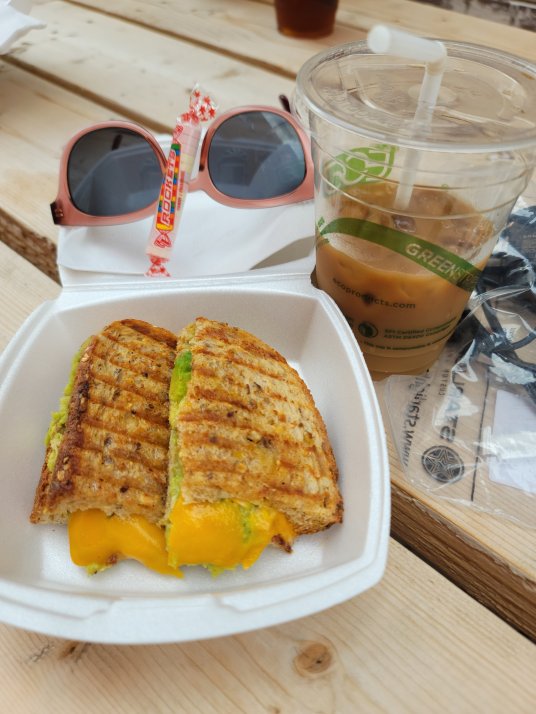
Cheese and avocado and rockets. Also iced coffee.

30 km later we rolled into Midland. Dinner was provided by friends Bill and Sarah who’ve just opened their own business.

May be an image of tree, outdoors and text that says 'CHEF BILL PRESENTS DRUNKEN JAMS, JELLIES & MARMALADES'

But after dinner we biked what may have been the hardest 25 km we’ve ever ridden. And we’ve done a lot of tough riding together. Newfoundland! The ride out of town was fine. But once we hit the country roads we encountered hills that we feel Google really ought to have warned us about. I’m not a light rider, Sarah was towing the trailer, and we weren’t on our speedy lightweight road bikes. It was a slog. We were very happy to arrive at our airbnb bunkie and discover that we could use the pool. Phew!

Total day’s riding: About 75 km

Day 3: After a breakfast of coffee and BBQ’ed crumpets we set off, nervous about hills and heat. We took it easy, stopping lots along the way for water, ice cream, butter tarts and visits with friendly dogs. I’ve got to say that riding on a heat alert day is something I usually associate with late July or August, not the first weekend in June. Maybe I acclimatize to it by then but this was just hot and humid and insufficient shade. I read this–Things all cyclists think on very hot rides— aloud to Sarah on the way home and we agree with most of them.

Total mileage day 3: 40 km

Some observations:

  • Wow. So many bugs–all different kinds. I took at least a dozen caterpillars out of my hair that were hanging from shrubs that we rode under. But also all the usual variety of flying things. The worst for riding? Clouds of midges.
  • We also saw lots of critters–a snake! a beaver! a fox! frogs! So many frogs. Also, so many birds! Lots of ‘turtle crossing’ warning signs but no actual turtles. Also, we warned about a coyote on the path but didn’t see one.
  • The upside of going with the flow was getting to do the trip but it involved more time off the trail on hilly, no-shade country roads than I would have liked.
  • We missed the Tiny Trail on our route and we’re definitely going back at some point during the summer to ride it.
  • I deliberately decided to go casual, bike dresses and my usual sunglasses, spd sandals instead of bike shoes. This way I’d feel better going 15-20 km/hr rather than 25-30, I reasoned. Nevermind all of that. Gravel and trails are hard in their own way and I should have stuck with my more technical cycling gear. It’s designed the way it is for a reason. It works.
  • I’ve never ridden this bike this far before and now I am starting to have dangerous new bike thoughts. I’m browsing lists of best gravel bikes for bike-packing.
  • There’s nothing like exhausting yourself on the bike to get a good night’s sleep. Night 1 was 9 hours and 45 minutes and night 2 was 9 hours and 55 minutes. Yawn!
  • There were a range of surfaces in the trails. Some paved, some chip, some gravel but the hardest trail we rode on was sand. That was a challenge.

Anyway, will definitely do more of this kind of travel. It feels like a real adventure even though it’s close to home and you don’t have to be gone that long to feel like it’s a holiday. Maybe next time we’ll even get to camp!

body image · fat · fitness · normative bodies

What’s wrong with “Rearranging your Post-Pandemic ‘Friendscape'”

CW: discussion of the ideas that friends’ body weights are an influence on a person and that having friends with higher body weights is less desirable (as mentioned by the NY Times), alongside criticism of those ideas.

The New York Times saw fit to print an article this week on using this phase of the pandemic to “rearrange your ‘friendscape'”, which in essence means a combo of culling, currying favor with, and ruthlessly categorizing your friends into the foreground, middle ground, and background of your life.

The idea of pandemic housecleaning isn’t new. I don’t know about you, but I’ve gotten rid of unwanted books, DVDs, CDs, and ancient clothing over the past 14 months. I’ve even moved furniture around, reshuffled the art on my walls, and have freshened up with a few new purchases.

It never occurred to me to toss out, recycle to send to Goodwill any of my friends.

A person, legs sticking out of a dumpster. Tossed by a friend? We don't know...
A person, legs sticking out of a dumpster. Tossed by a friend? We don’t know…

Of course not! Who would think this was a good idea? Well, a bunch of social scientists that the NY Times talked to did. Here are some of their thoughts:

Psychologists, sociologists and evolutionary anthropologists say it behooves us to take a more curatorial approach when it comes to our friends because who you hang out with determines who you are.

Hmmm. Who you are? You mean, I am destined to become exactly like my friends, including taking on their traits? This article seems to say yes:

Indeed, depressed friends make it more likely you’ll be depressed, obese friends make it more likely you’ll become obese, and friends who smoke or drink a lot make it more likely you’ll do the same. The reverse is also true: You will be more studiouskind and enterprising if you consort with studious, kind and enterprising people. That is not to say that you should abandon friends when they are having a hard time. But it’s a good idea to be mindful of who you are spending the majority of your time with — whether on- or off-line — because your friends’ prevailing moods, values and behaviors are likely to become your own.

In short, WHAT?
In short, WHAT?

Yes, I know. It sounds mean and absurd. Which I think it is. So does Roxane Gay, writer and columnist for the self-same newspaper. Here’s how she summed up the article:

Roxane Gay's tweet, saying "this piece really wants y'all to stop hanging out with your fat friends so you don't catch the fat. She is my hero.
Roxane Gay’s tweet, saying “this piece really wants y’all to stop hanging out with your fat friends so you don’t catch the fat. She is my hero.

What’s really going on here? For more than a decade, there have been studies looking at social networks and how to identify patterns in common among social groups. Nicholas Christakis and lots of others, through this social network analysis, argue that some traits like body weight, psychological states, and some eating and drinking habits are “socially contagious”, which means they spread through social connections. I wrote about this a decade ago with my friend Norah. Our views have shifted since then, I might add. The details are complicated and not obvious or always intuitive. For instance, same-sex mutual friend groups are more mutually influential than domestic partner or married partner groups.

How these traits spread is outside the purview of social network analysis. Other social scientists have posited views about localized behavioral norms (like eating, drinking and drug use practices), but these views are speculative, not predictive or diagnostic or useful for dispensing friendship triage advice.

In sum, though:

It’s not true that my being fat “helps make you fat” if we are mutual friends.

Being fat is a thing that some people are and some people aren’t. Talking about fatness as social contagion worry for people who are looking to assess their friendships is ill-considered and mean-spirited and not supported by evidence.

It’s also fat-phobic in the extreme, which makes it double-mean-spirited.

Ditto for depression. The last thing someone with depression needs is her friends avoiding or dumping her out of fear that they will catch it. That is wrong on all the levels. Like, even this level of wrong:

2+2=5 level of wrongness. I don't know what the lamb has to do with this, but I'm sure it's not at fault.
2+2=5 level of wrongness. I don’t know what the lamb has to do with this, but I’m sure it’s not at fault.

There’s more blah-blah about friendships in the article, but nothing that is a) worth mentioning; or b) offsets the horribleness of the above-mentioned messages.

So, what am I doing about my friendships as we emerge, many of us vaccinated?

  • I’m expressing my love and gratitude to those with whom I shared a supportive/supported network;
  • I’m reconnecting with those I lost touch with, or who lost touch with me, for reasons of PANDEMIC, y’all!
  • I’m enjoying some new connections made over the past year courtesy of zoom and social media;
  • I’m trying to pace myself in those activities of reconnection, and be understanding of those who are in a different stage of connection or reconnection or disconnection.

Life is hard, y’all. Life has been extra hard. Geez Louise– how about let’s just be friends with our friends as best we can? That’s what I have to say to the New York Times.

Readers, did you see this article? Where are you with respect to connecting and reconnecting with friends these days? I’d love to hear from you.

Book Club · swimming

FIFI Book Club: Why We Swim, by Bonnie Tsui. This week: Community

Hi readers– we’ve been reading a new book for this installment of the FIFI book club. It’s called Why We Swim, by Bonnie Tsui. We’ll be reading and commenting on the various sections of the book over the next several Fridays. We’d love to have you join us and add your comments to the mix.

Three weeks ago, we introduced ourselves in terms of our past, present and aspirational relationships with moving around in water.

Two weeks ago, we reported on the section of the book titled Survival.

Last week, the topic shifted to Well-Being.

This week, we’re focusing on the notion of Community swimming. Here’s what we have to say. First up, Kim:

This section of Tsui’s book means a lot to me, because it thinks about swimming and inclusivity. Who gets to swim? Who gets to decide who gets to swim? It’s a huge topic, and we’ve talked about it on the blog before too. Tsui’s not especially political in this text, but her status as a person of colour / an Asian woman in the US means that the issue of BIPOC access to shared public spaces arises for her naturally in the course of the narratives she weaves. It’s been interesting for me to note throughout the book, for example, that in certain cultures swimming is simply privileged, in large measure out of a need to survive: if you live in Iceland or Japan, you’re going to need to know how to stay afloat just in case. Tsui comes from a swimming family and has made her own family a swimming one too (and we learn more about that in the next section of the book, FYI). She identifies with the water, as a person of the water – and she well knows that barriers to the water for others (for example, lots of Black folks in the states) arise when those folks are not permitted, because of structural exclusions based on race or class or gender, to identify in the same way.

I find it really moving that Tsui’s narrative in this section is anchored by stories of military service-people from all over the world learning to swim while stationed in Baghdad; it’s a simple and warming story, but also and utterly brilliant reminder that the community in which you find yourself (in this case, one united by mission and circumstances, not racial or national characteristics) can have an enormous impact on the way you are permitted to envision yourself in the world. Shifting the terms by which we structure our communities can, in turn, have a large effect on how members of our communities see themselves in relationship not just to others, but to a whole host of public spaces.

Here’s me, Catherine:

This section was my favorite of the book. Why? Because swimming pools have always struck me as happy centers for communities to gather. Because the community pool can be a microcosm of society, revealing diverse activities, generations, families, teams, friendship pods and ad hoc groupings that comprise civic life. Swimming in a public pool or lake with other people makes me feel almost patriotic—proud to be part of a collective, united under the (beach) umbrella of recreation and good clean fun.

But here we see collective swimming and (more importantly) swimming lessons conducted under the worst circumstances: war and foreign occupation, run by governments and military organizations with rigid hierarchies. And yet. Jay Taylor does what he can and what he knows for everyone who comes to the lavishly decorated palace pool in Baghdad, in search of respite from the dangerous and dry outside.

Swimming is a form of recreation and a sport, but it is also a crucial life skill. Being able to swim means increased survival odds for everyone. In the US, there are huge racial disparities in swimming instruction. The rates of accidental deaths due to drowning are on average at least 3 times higher for black children than for white children.

Reading this section reminded me of just important it is to create, as a community, public spaces and programs for everyone to have access to swimming instruction and swimming recreation. I believe that it advances justice, health, civic identity, and community building.

Next is Diane:

This section triggered so many memories of people I have gotten to know through swimming. And though it was beautifully crafted, I wished there had been more stories of community. Just one chapter was not enough for me.

For example, the history of English swimming barely touches on the huge community there, swimming at Lidos, in many rivers and lakes, or in the sea – all year round. They were my inspiration for open water and cold water swimming. One of those swimmers even met up with me at a public pool in London when I was there on business.

The whole idea of access to swimming really interests me too: there’s my friend from Victoria who works leads open water swimming with a group of adults with Downs Syndrome; my local pool was built in 1924 in what was then a slum area, complete with segregated entrances, just like the pools described in the book; the LGBTQ-friendly swim club I hang out with; my years of working with women from very conservative societies and their limited access to a pool (or any sports or even education). And just last year I learned about Mamie Nell Ford – a photo of her at a “swim in” in St Augustine Florida, as the the owner of the segregated hotel pool poured acid into the water, helped spur the Civil Rights Act of 1964. I would happily have read far more about this topic.

Most of all, this chapter filled me with love for Jay and his gift for teaching and bringing people together. The anecdote about buying goggles and caps for students really struck a chord. The Canadian Embassy in Kabul has a pool too, though nothing like where Jay’s multinational swim team trained in Baghdad. It is a tiny above-ground pool, and the last time I was there, I was deeply grateful for the tether a former employee had left behind for other swimmers, because it allowed me to work out for an hour in a space not much bigger than a hot tub. It was an oasis of peace in a place where I was always on alert.

And here’s Sam:

I often think about access to swimming. My mother doesn’t swim. She didn’t learn as a child, then almost drowned going over waterfalls, and hasn’t been in the water much since. She made sure I did learn to swim. It was important given that me and my siblings were raised on the east coast of Canada, near the ocean, and holidays were often spent near lakes or ocean beaches. The real success story was the next generation. My daughter Mallory is an excellent swimmer, a diver, and a lifeguard.

I wanted more from the chapter on race and access to swimming. Each year I feel like I’m struck anew by racial disparities in drowning deaths. Here in Ontario a black teenager recently drowned in a school canoe trip and teachers claimed not to know the student couldn’t swim even though it clearly said that on his permission form for the trip. I also wanted to hear more about swimming communities and what we can do to make those communities more inclusive. Short review: glad this section was here, wish it were longer. It seems to me that swimming, access and inclusion is a topic worth a whole book!

Readers, have you been reading the book? We’d love to hear what you think.

Sat with Nat

Nat ponders a quiet Pride month

Recommended Soundtrack: A little Alexis from Schitt’s Creek

It’s June! It’s glorious weather! We are still in lockdown in London, Ontario, Canada. Gaaahhhh. Boring.

What is a queer, fit, feminist to do? No marches. No dancing. Perhaps socially distanced Pride run?

It’s likely a very quiet, close to home Pride season for me. I love that some of my favourite fitness companies are doing some great fundraising for Pride organizations.

This from The Under Belly (aka Jessamyn Stanley) newsletter:

HEY BELLIES,
HAPPY PRIDE MONTH!

Take up space and celebrate!!
The impact of the LGBTQ+ community is immeasurable around the world:
inspiring every being to be their whole self and show all their colors.
Let’s celebrate love and bloom with pride together, in-person or virtually,
at a time when it’s needed most.For us, pride means so many things.
It means being, embracing and loving your authentic self fearlessly and
to the fullest. It means giving, showing and celebrating love in all forms.
It means understanding and supporting. It means embracing the journey.
All of which speaks to our values and who we are (hell yeah!).

Pride also means giving back and making a
positive impact in your community/communities.

In that spirit, The Underbelly is teaming up with Gender Spectrum (@gender_spectrum), a non-profit organization working to create gender sensitive and inclusive environments for all children and teens. We love the important work that Gender Spectrum is doing and the positive impact being made (check out these “Gender Stories” to smile, fill your heart up, and even have a good cry!). Stay tuned to our IG page (@theunderbellyyoga) for more details on how we plan to give back with Gender Spectrum”

That kind of “pink dollar” marketing can be tricky if your fitness business isn’t 24/7 2SLGBT+ positive and inclusive. This lands solid and I love this about the Under Belly!

My favourite leggings manufacturer, Point Seven Five, donates a portion of proceeds from their Pride leggings to Canadian not for profits. Another reason to love them!

From their Facebook post:

“Thanks to everyone that has purchased leggings from the Pride Collection. I was able to donate $500 to Rainbow Railroad last night!
I plan to open the shop at the end of the month, I’ll post when it’s open so you can grab your own pair.

Next one will be going to Ten Oaks Project !
Have a charity in mind? Let me know.”

Other times I see Pride related content/items from a vendor and it feels like a cash grab. Or worse, pink washing over a company that is not walking the talk of diversity and inclusion.

Have you seen some great examples of businesses walking the walk for Pride month?