fitness

Here we go again … Lockdown 2.0 2021 edition

We are socked in lockdown mode in Newfoundland and Labrador. We had been doing well. Fewer than 390 cases around the 1st of February, and then boom — almost three weeks later, we doubled that number with an outbreak of COVID-19 variant B.1.1.1.7. and the number of cases on Feb 18 is at 803.

Our chief medical officer of health was swift and decisive. Once we knew there was a significant outbreak the city locked down in what the MOH called a circuit breaker. Two days after that, once the variant was confirmed, the whole province shut down.

Black and white image shows a weight bar with two plates, one on the bar and one on the floor. Photo by Victor Freitas on Unsplash

Yes, we had been doing well. I had returned to working with my trainer in the summer. I had missed the gym during our first wave. I missed the weights. The bar. The bands. All of it. I was glad to go back with just me and my trainer, six feet apart. Doing all the right things.

And now I am not in the gym and I expect that will be on hold for a while. What isn’t on hold is my training. No, I did not invest my own set of plates and barbells. I gathered up the various bits and bobs I have collected over time — a skipping rope, a yoga belt, TRX bands, an ab wheel, some kettlebells etc, and in a scene reminiscent of the film Apollo 13, I sent a snap to my trainer and said here’s what I have — what can we do with it? In another, I sent a list of all the exercises I could remember to do without prompting.

And now, I’m back. My trainer built me a plan, even using the odd terms I adopt to remind myself what an exercise looks like. I have a checklist, I have a plan, I even have two small portable whiteboards that I can write out my activity work for each day. I also have a good supply of dry erase markers in different colours so I can tick things off with joy and funky colours.

Image shows a table open to a planner app with a blank page. Photo by Jess Bailey on Unsplash

It’s the little things, and the big things. When I saw how likely it would be for Lockdown 2.0, I noticed I was stressed, but I was not anxious. Unlike last March when we had so little information, now we have a lot. Lockdown still isn’t a picnic but we have tools and we can make do quite well. It’s not the same, but it’s fine for what we must do to be safe and well. And I’ll take getting closer to fine over anything else. Even if I have to use a foam roller to get me there.

fitness

Tiny habits for the win …

A month ago I wrote about creating tiny habits to increase my activity. I chose the word activity on purpose. Lots of times in January, we hear people talking about their fitness goals. I have fitness goals too, but this year I wanted to try something new. Rather than think about fitness as the ultimate goal, I wanted to focus on activity.

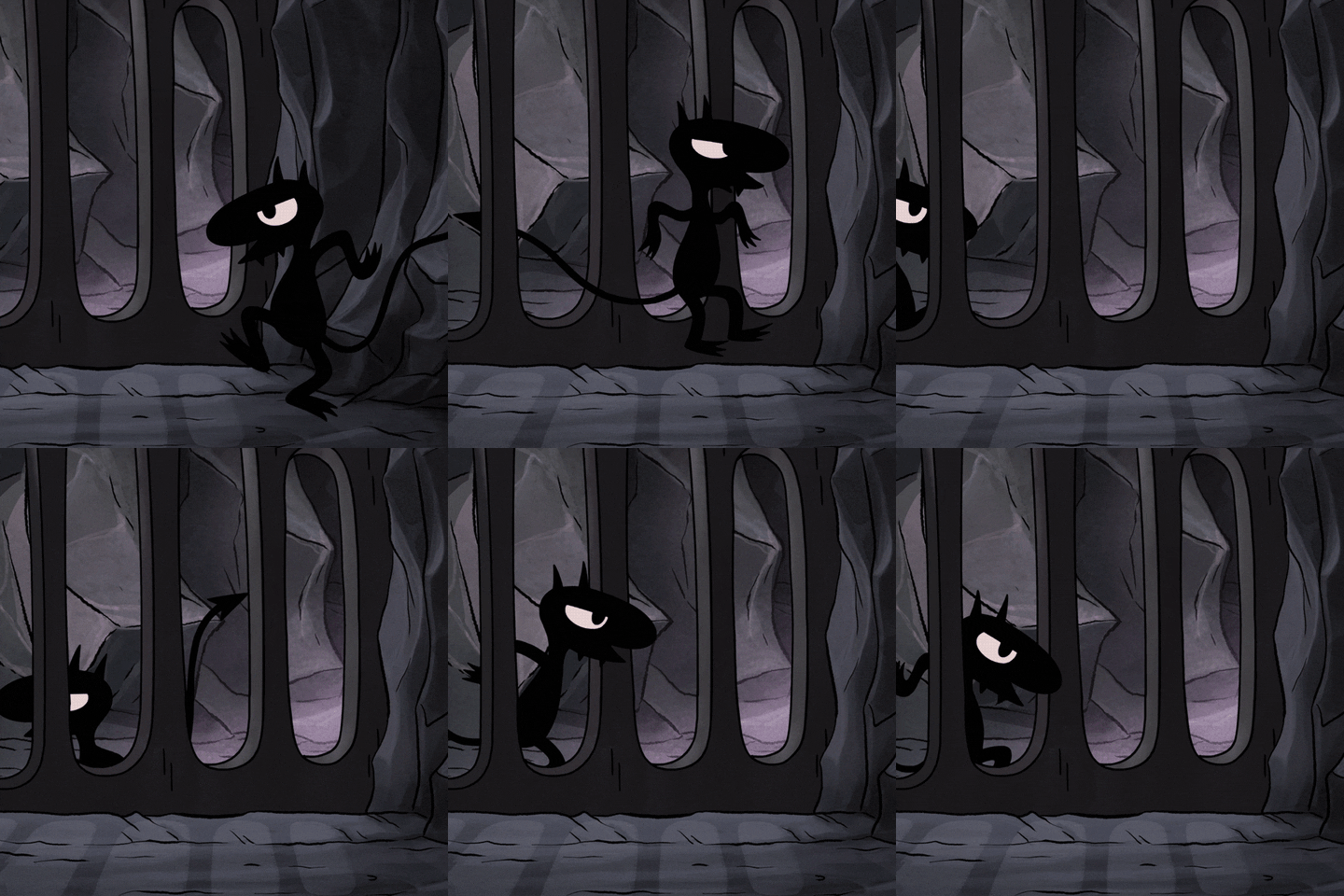
Image shows the cat-like demon Lucy jumping in and out of its cell.

My thesaurus defines activity as action, hustle, motion, movement, and my personal favourite, goings-on. Adding more activity means I tend to focus on getting out of my work chair and doing something that requires me to move. These days that means stretching, doing modified mountain climbers and high knees, and going up and down my three flights of steps as many times as I can in a day.

I’ve been tracking steps for a while with my Fitbit, and my objective analysis shows I’ve added 2500 steps a day more with adding an activity when I do three things: get a beverage (coffee or water), get a snack, and go to the washroom.

But there’s more (isn’t there always?). I have a wonky hip joint and it occasionally likes to complain. In December, I was feeling out of alignment. I have a couple of exercises I do when I feel the hip getting cranky, but I wanted a way to check it was still in place. I also brought back what my original trainer called high knees — I march in place bringing my knees up as high as I can. When I first started adding them at random times as part of three tiny habits, the hip was twitchy. Now it is not. Yay tiny habits!

I still have specific fitness goals (increase my deadlift weight by 5% for example) but I’m not going cracked trying to squat in 30 and 60 minute specific fitness sequences daily. What is happening is I am getting in about 30 minutes through five and ten minute slots. Some days I get in more, and that’s a good thing. I’ll keep the current pace until the end of the first quarter, and then we’ll see what’s next.

What are some of your activity hacks that you are trying this year? Let us know in the comments!

fitness

Get your fit on with a shovel!

I know there are other months that have 31 days but there’s something about January that seems to make it twice as long as any other month. Even though we are now closer to spring than we were to fall when the days started to get darker, it still seems like spring will take forever to arrive.

I am reminded in the dim days of this longest month of Allan Bradley’s evocative description of time stretching endlessly. In one of his lovely Flavia de Luce series, the author sends his hero off to boarding school where Flavia notes despondently that “The hours trudged by with chains on their ankles.”

The thing about January though is that it brings snow. Heavy, wet snow, and usually there lots of it. It certainly can feel like chains when you look at your drive and sidewalk.

Image shows a large Husky type dog staring grumpily at the photographer while snow is falling. Photo by Kateryna Babaieva on Pexels.com

As I write this, the forecast is calling for a big storm here on the East coast of Newfoundland, and while not quite reaching the epic proportions of last year’s Snowmaggedon, it’s enough to close schools, offices and other places of business and break out storm chips and other cozy, warming, and cheery things.

Perhaps you too live in a place where there is snow, and lots of it. The problem with snow as an adult is that it often requires removal. Here we also get wet snow, which is heavy, clumpy and when ploughed off the street, also liberally laced with chunks of ice.

So my Fit Feminist pals, let’s look at getting our fitness on with snow removal. Yes, there has been research. Mostly on men. This study from 1995 (!) had nine men either push or shovel snow from an accumulation (or snowfall) of between a foot and a half to two feet.

The researchers didn’t note the amount of energy expended but they did conclude the following: manual clearing of snow in conditions representing heavy snowfalls was found to be strenuous physical work, not suitable for persons with cardiac risk factors, but which may serve as a mode of physical training in healthy adults.

Most of the available research on snow shovelling and cardiac risks focuses on men because men are the ones traditionally doing the shovelling. Snow shovelling works your arms, your shoulders, your back, your legs, and your core. You will breathe hard so if you are the slightest bit asthmatic, you will need a face covering as well to warm the air going into your lungs.

However, some researchers suspect cardiac events may be fewer in women than men because women shovel snow differently. Until there’s actual research looking at it though, we have to accept snow removal is hard work, regardless of sex, and while there’s no appreciable difference in the exertion used with either a shovel or a pusher, you have to be careful regardless of what tool you use.

Here are a few tips for health and safety, should you not be someone who owns a snowblower or who doesn’t have a kind neighbour with one:

  1. As you would with any other strenuous exercise, warm up your muscles before you start.
  2. Dress appropriately. Dress in layers as you will sweat. Wear a hat to keep heat in.
  3. Assess any potential danger (piles of snow on the roof of your porch, your car, or trees). Also look at where you plan to throw your snow. Be kind to your neighbours.
  4. Use a shovel that works with your height and use one that is not too heavy to start with.
  5. Take frequent breaks, stretch, and hydrate.
  6. Remember to watch your back: Bend your knees and engage your abs when you’re lifting that shovel full of snow! (Thanks to Irene for posting this safety tip below!)

After you are done, pat yourself on the back. Have a hot shower or bath to soothe your muscles. Admire your handiwork. Remember, while you will probably have to do it all again in a few days, it beats the gym any day.

MarthaFitat55 has her own shovel and knows how to use it.

fitness · WOTY

Martha’s word of the year: hold fast

A few years ago, a friend introduced me to the concept of choosing a word to define my year. It’s a popular practice, with some using it to define their art practice, some to guide their planning for the year, and some others to explore the meaning and impact of that word in their daily life.

Mina and Cate have shared their thoughts on their word of the year in the last couple of days. I thought I would share mine because it represents a departure for me. Previous years I have used create, imagine, focus, and dream. This year I chose hold fast, not one word but two.

Photo by Erik Mclean on Unsplash Image shows a blue rope with a knot against a yellow plank.

Hold on its own felt too much like I wanted to put life on pause, and heaven knows, I had had enough of that feeling in the spring. A nautical term, hold fast means to stay the course, but it also means to maintain the strength of your convictions, or to align yourself to something that will help you keep moving forward.

Last year, I felt like I was often stuck fast, firmly held back by conditions or needs not within my control, most of them arising from the pandemic. This year, it seems natural to look at all the ways I can hold fast to what really matters and why. As I work better with questions, I wrote a few down in my calendar to act as prompts for the year ahead.

  1. How will I maintain my practices in fitness, work, and home?
  2. How do I maintain my focus, keep moving forward, and still hold true to my values?
  3. When must I stay the course and when must I let go?
  4. How committed or invested am I in an outcome?

The word of the year opens up lots of possibilities for thought and for action and I am excited by the power that offers for change and growth. What else might you be thinking of doing in this new year ahead? Let us know in the comments.

MarthaFitat55 writes from wet and windy St. John’s.

fitness

Big rocks, tiny habits

Last year before the old year ended and the new year began, I wrote about making my priorities the big rocks that got placed first, and then using the remaining space to fill in with other activities.

Photo by Gelgas Airlangga on Pexels.com Image shows a tiny seedling.

I was successful with some parts and not so successful with others. It’s been a strange year with the pandemic so I am not surprised some stuff I wanted to do went off the rails. However, I am not spending any time on whatifs or should haves. Instead, I am looking at what I have learned and how I can change up some of my practices and habits.

I’ve gotten into scheduling and specificity, something Christine Hennebury has written about here. Then Sam reminded me about habit-making, and I remembered a post TracyI wrote back in 2016 in which she reported on a study that debunked the 21-day rule to form or break a habit. In fact, the research says it takes about 66 days to make a new habit stick.

Sam’s reminder came in the form of an article and audio piece talking about BJ Fogg and his latest book, Tiny Habits: The Small Changes that Change Everything. Fogg, a behaviour scientist at Standford, has developed a framework that supports the hacking of human behaviour to make changes stick.

Fogg describes the foundation of his Tiny Habits framework thusly: There are three things that come together at the same time for any behavior to happen.There’s got to be motivation to do the behavior. Second is the ability to do the behavior. And the third is a prompt. The prompt is anything that reminds you or says, “Do this behavior now.” And when those three things come together at the same moment, a behavior happens.

At its simplest, Fogg’s theory about looking at your goals, breaking them down into the small steps, and identifying the tweaks (tiny habits) you can make to get you there. In his example of wanting to read more, he recommends first scaling back the goal to its smallest point: reading a paragraph a day. As it is so small, there’s no excuse to avoid it.

Second, he says to find a natural place in our daily lives to make this happen. Maybe reading is something you can do over breakfast, on the subway, or in the bath. Third, associate the successful completion of the activity with a positive emotion. It could be a little dance, a fist pump, or singing a chorus of your favourite song.

Reading this article came at the right time for me as I work on my plan for the coming year. I’ve been looking at why (motivation) I want to do certain things, I’ve been trying to be SMART (Specific, Measurable, Achievable, Realistic, and Timely) about the objectives, and I have been really looking hard at the prompts and rewards.

I’ve reupped my participation in the 221 in 2021 Challenge; in light of my desire to make activity a daily habit, I’m looking at Fogg’s principles and seeing where and how I can add a little more movement every day naturally.

What might be some tiny habits you will adopt this year to help make positive changes?

MarthaFitat55 lives and works and moves in St. John’s, Newfoundland and Labrador.

fitness

Dec. 26: Wellness Calendar (Collected Edition)

I’ve collected all the posts in my wellness calendar for you to keep handy. Wellness and self care steps are not just useful for the holidays. The winter will be tough in many places as we go through our second, third, or even fourth waves of the pandemic. There will be other holidays, other sets of expectations to manage. Please remember though, you are enough. You are doing your best. You have value and worth. Be well, stay well.

Photo by Deniz Altindas on Unsplash Image shows a stack of rocks.

Dec. 25: Make yourself a priority

Dec. 24: Read a book

Dec. 23: Enjoy a cup of tea

Dec. 22: Stuff the turkey not yourself

Dec 21: Embrace the light

Dec. 20: Feel the feels

Dec. 19: Get in touch with your senses

Dec. 18: Get close to water

Dec. 17: Try something new

Dec. 16: Unplug

Dec 15: Make a doodle

Dec. 14: Get dressed

Dec. 13: Have a cuddle

Dec 12: Take your meds

Dec. 11: Delay gratification

Dec. 10: Pick one thing

Dec. 9: Stomp, stomp, stomp

Dec. 8: Stretch, stretch, stretch

Dec. 7: Laughing is good for you

Dec. 6: Get some fresh air

Dec. 5: Move with music

Dec. 4: Take a nap!

Dec. 3: Remember to eat

Dec. 2: Stay hydrated

Dec. 1: You are always enough

fitness

Dec. 25: Make yourself the priority

I wish you all a happy day with loved ones, together or separately as the pandemic dictates. It’s hard to carry the weight of expectations, especially when socialized as women to look after everyone except yourself.

In the wellness calendar, I have offered some ideas you can try to take care of yourself. Back at the end of 2019, I wrote about setting priorities for fitness using the image of large, medium and small rocks.

As we move into 2021, we are all carrying heavy loads. Some we are just learning to carry and the burden of recent losses is painful and unsettling. Others we have adapted to their presence, and only occasionally they might poke at a tender spot to remind us what we have been grieving.

The new year will bring lots of changes, but growth is good. If we stayed in the same place doing the same thing without learning, changing, growing, we would be quite limited as humans. Sometimes people fear growth because it comes with change and experience. But the comfortable rut can become a cage.

Embrace growth for the positive change it is and let its light nurture you and support you the same way the strengthening sun will nurture new growth in the spring. Give yourself the gift of valuing yourself. You cannot pour from an empty cup. Take a little time for yourself today and every day.

fitness

Dec. 24: Read a book; eat chocolate

Icelanders have a lovely tradition for Christmas Eve. Even if celebrating on Dec. 24 is not your tradition, perhaps you may like to adopt this one.

Photo by Daria Shevtsova on Unsplash Image shows a gray book wrapped in red ribbon with a candle and some greenery.

Called Jolabokaflod, the practice involves cracking open a new book and drinking hot chocolate, or nibbling on some chocolate treat. It started during the Second World War, when paper, unlike other commodities, was not rationed. This turned into Icelanders giving books as presents (and have turned the country into a reading culture as a result) and celebrating family and friendship on Dec. 24.

If someone hasn’t given you a book, present one to yourself. Pick your favourite reading spot, curl up with a mug of something nice and hot, preferably chocolate, and lose yourself in the power and beauty of words.

fitness

Dec. 23: Enjoy a cup of tea

There’s nothing like a cup of scalding tea prepared to your taste to create a little oasis of calm in your day. Tea, or any soothing hot beverage, offers the opportunity to create a ritual.

Photo by ORNELLA BINNI on Unsplash Image shows a decorated tea cup with water and chamolile flowers steeping for tea.

The Japanese take making tea very seriously. The Japanese call it the way of tea and each step in service to hospitality adds to the experience. The English also take tea seriously, and it can range from a small snack to a full meal.

Whether you like your tea green or black, or you prefer hot water with mint and/or lemon, drinking something hot and thinking through the steps you take to prepare it are both excellent ways to create space in a busy day for you.

fitness

Dec. 22: Stuff the turkey, not yourself

The holidays are full of stress. It’s not just Christmas. I have heard from Jewish and Muslim friends that the need to make everything just so crosses all kinds of cultures and religious celebrations.

With the pandemic, many cities and countries are recommending the cancellation of office parties and the avoidance of large gatherings. Even family celebrations are supposed to be low key. But the pressure to overindulge — be it with food, drink, or even highly stimulating environments — is often present and a source of stress.

Leaving aside my omnivorous metaphor in the headline, if you are trying to maintain an even keel, too much of any thing will not go well for you.

It is okay to say no. When my child was small, we only did one thing per day over the holidays. We said thank you, wished them well, and said “maybe another time.” Once my child was old enough not to get overstimulated, I found I still enjoyed the one activity per day rule.

It’s okay to let go. Last year, with kitchen renos, sewer collapses, and annoying illnesses taking over my plans for my annual elegant Christmas Eve dinner, I created a sandwich buffet instead. It was fine, it was different, and it was fun.

You don’t owe anyone an explanation. Whatever your reasons for declining a beverage, a food, or an event, you don’t have to explain, give a reason, or ease someone else’s curiosity. You could just say, “not now, thank you; maybe later.” Or try EB White’s favourite exit: “I decline for secret reasons.”