fitness

Mina Runs the Paris 20k

A few weeks ago, I ran the Paris 20k. ‘Tis the season for half-marathons and almost half-marathons. In the spirit of fit feminism, bravos to  JenniferBettina and Nicole, who shared their race reports. 

As many of you know, my relationship with running races is not always unicorns and rainbows. These past few years, I have not been excited about signing up for races. I have enough other performance pressures in my life. A race adds one more potential for disappointment. And, given the number of years I’ve run moderately seriously, a race is an exercise in reminding myself that I will not run the times I did 10 years ago.  

Yes indeed, those feelings are all in my mind. No one cares how I do in a race, except me. I had my usual approach-avoidance for the Paris 20k, including severe foot pain on Thursday, before the Sunday event. I asked an energy healer friend, to send me long distance curative zaps for my foot. Along with the CBD balm and lots of arch stretching, by Friday afternoon my foot felt race-worthy again.

Saturday was a lovely day of half sun, a common weather pattern for autumn in Paris. I had some pre-race crankiness, which chafed throughout the day. My legs felt more tired than I’d hoped. 

Sunday morning dawned warm for mid-October. Crankiness gave way to straight up jitters. I was about to join 25,000 runners at a starting line. The instructions on just getting to our corrals were lengthy and imperious. 

I booked an Uber electric bike from up in our apartment to get to the race start, hoping to save my legs. But when I got downstairs, the battery was hanging by a cord and the bike was clearly out of service. I ended up on a Velib (the shared bike system in Paris). Then, of course, roads were closed and the closest dock for the bike was further than expected. As I jogged to the start, I kept reminding myself that I had lots of time. 

In fact, I had more time than expected. Because it turned out that it was super easy to find my access point and there was no crowd jamming the entry. People were flowing smoothly into their corrals. I had a few moments of panic once I’d made my way into the heart of the crowd. I don’t love being vacuum packed in a crowd anymore. In these unstable times (and maybe particularly in Paris, because I was here during the Bataclan attack and ended up locked inside a bar around the corner, while storm trooper types jogged by in formation outside), I get anxious about attacks. I sat on a concrete block against the fence and closed my eyes to breathe and wait.

It’s been a long time since I’ve done such a massive race. This one was as seamless as I’ve ever experienced. They began to send off groups of runners around 10 a.m. and then kept the runners flowing in waves starting every 3 minutes. When the horn blew for my start, I was running within 15 seconds. The crowd was dense for the whole race, with lots of weaving between other runners, but always manageable.  Because of the rolling starts, there was no way to gauge yourself against any other runner. Which was good for me. I settled down inside my head to enjoy the hot, sunny day and the familiar sights. 

The course was classic Paris: a cobblestone street up to the Arc de Triomphe; continuing to the Bois de Boulogne; passing through a central artery in the park; back down to the Seine; along the river on the right bank; through successive traffic tunnels; emerging each time to a new view of the city; crossing to the left bank over Pont Royal; a couple of kilometers on the pedestrian way beside the river and the final 500 meters up to the base of the Eiffel Tower. Finishing where we started.      

Mina running in hat and pink shirt

I felt good from the first step to the last. Sure, I got tired. I got hot. I wished I didn’t have my running jacket tied around my waist. And my 5k splits show that my second 5k was my fastest. Still, I didn’t fall off a cliff. The saboteurs inside my head were quiet. I felt strong and steady until I crossed the finish line. It helped that the last part of the race was on my regular Paris running route. I could say to myself—I know how it feels to run right here. 

Nope, my time wasn’t anywhere near what I was running 10 years ago. Still, I felt good about my performance and it turned out, I’d exceeded my expectation. 

I admit it—I am pretty thrilled with my result. I recognize its fragile, temporary nature. I understand its impermanence. The luck of the day. 

There’s even this tiny thought—that I have nowhere to go but down. 

At the same time, I did it. And I feel good about it. So much so, that I couldn’t resist sharing the news here. I have mixed feelings about telling you. On the one hand, it feels like a brag, to be avoided. On the other hand, it feels like we (women) are told often not to draw attention, that to celebrate our successes is self-absorbed. To downplay our accomplishments is the female default. 

We all have races we are proud of. Let’s share them and make a point to celebrate each other.       

fitness

Pain and the choice to walk or not walk

I got over, mostly, not being able to run. I am not doing so well with not walking. It feels boring and mundane to cry about it but I do cry about it. I cried in Newfoundland on the day everyone else went hiking. I could ride hundreds of kilometres but a hilly 10 km hike was way out of my range. I cry when I can’t walk Cheddar and some days when I can’t walk home from work. It’s not like I really suffer. I can ride my bike. Or a family member can pick me up. Cheddar has lots of people happy to walk him. Even the daughter of this blog’s Susan, who is studying at my university, has stopped by the help out, de-stress, and walk Cheddar.

Still though, it’s sad. (I’m looking forward to my new left knee.)

On our Facebook page I share stories of 86 year olds running the NYC marathon but here I am 55, and nervous about next weekend in New York. It makes me nervous now for the same reason I used to love visiting, so much walking. I still love the city but it feels like it’s not meant for me. It helps when I visit friends in Manhattan with their own mobility issues. They take variants of Uber and seem to get around just fine.

The thing is it’s the variability and unpredictably that gets me. I was stuck recently in downtown Toronto unable to put weight on my left leg. I didn’t have my cane or my knee brace and I was limping from place to place. Strangers gave me odd looks, like they were thinking I was alone and day drunk.

I burst into tears when I found a Starbucks and there was no place to sit. Other days it feels cranky but just cranky and I can walk a few kilometers without trouble. I just don’t know what to expect. There’s always aches and pains but sometimes it’s a dull thing in the background and other days it takes my breath away.

The choice to not walk isn’t straightforward. There are days when I just can’t but there are oodles of studies showing that it’s not making things worse to walk and might actually be helping. So when I can walk, I do. My pain tolerance has gone up and I suffer through walking when I can.I’m counting walks now in the 219 in 2019 group.

Here are three recent stories about walking and knee osteoarthritis. The tl:dr version: Walking doesn’t cause inflammation of the joint and doesn’t make the cartilage situation worse. I knew about the latter but not the former. Walking does help with joint mobility. The last story is striking because it’s about golf. When I tried it, I drove around in the buggy but according to this study I should have walked.

Do You Need to Stop Exercising If You Have Arthritis? Conventional wisdom holds that rest is key. Here’s what research says. That’s a headline from Runners’ World.

From that article: “The conclusion is that the perception about exercise being harmful for cartilage is based on misinformation, and highlights the need for better education, according to study author Alessio Bricca, Ph.D., of the Institute of Applied Health Sciences at the University of Aberdeen.

“People with knee osteoarthritis must be reassured that therapeutic exercise prescribed to prevent or treat symptomatic knee osteoarthritis is safe and, if anything, could improve cartilage composition,” he told Runner’s World. “Instead of rest and activity avoidance, these people should be encouraged, reassured, and supported to engage in physical activity.”

He added that exercise may temporarily cause pain flares when undertaken initially, but that those usually dissipate with time, especially if you’re careful to increase activity on a gradual basis.”

Short brisk walks may help prevent disability in people with arthritis

“An hour a week of moderate-to-vigorous physical activity reduced their risk of disability, the study found. Specifically, the activity reduced the risk of walking too slowly to safely cross a street by 85 percent, and their risk of not being able to do daily living activities — for example, morning routine tasks such as walking across a room, bathing and dressing — by nearly 45 percent.

By the end of the four years, 24 percent of participants who did not get a weekly hour of brisk physical activity were walking too slowly to safely cross the street, and 23 percent had difficulty performing their morning routines, according to the study.

About 14 million older Americans have symptomatic knee osteoarthritis, the most common type of osteoarthritis. About 2 in 5 people with osteoarthritis — most of whom have it in their lower joints — develop disability.

Federal guidelines recommend low-impact physical activity for older adults with arthritis, and recommend that older adults do at least 2.5 hours a week of moderate-intensity activity.”

Get off the golf cart if you have knee osteoarthritis Science Daily, April 18, 2018

” From presidents to retirees, more than 17 million people over the age of 50 golf regularly. Knee osteoarthritis, which causes swelling, pain and difficulty moving the joint, is one of the leading causes of disability in this age group. It may seem intuitive that golfers with knee osteoarthritis should stay off their feet and ride in a golf cart. But new research has found, for the first time, that walking the course provides significantly higher health benefits and is not associated with increased pain, cartilage breakdown or inflammation. “

Image description: Sam’s legs in black leggings and brown boots in a pile of bright, colourful, autumn leaves.
motivation

Lapping everyone on the couch?

I hate that expression, “lapping everyone on the couch.” I get that there is a virtue to just showing up. I also get that it’s okay to be slow. We can feel good about showing up and running slow though without the comparison to those who choose to stay home and not run at all.

You’re not entitled to feel better than people on the couch. Why even is that a comparison that we want to make? We don’t like it when the speedy people say at least they are better than the people who take walk breaks.  The couch sitters have their own plans, ideas, and reasons. See Am I really lapping the people on the couch?

I hated that expression years ago and I still hate it now. I wrote then that the idea of lapping people on the couch “rubs me to wrong way. I think it’s the comparisons thing. Yes, I’m faster than people who aren’t running! No surprise there. But it’s the assumption that I’m better than non-runners that I don’t get. I work hard not to feel smug about exercise, about fitness. I try to resist healthism and the politics of respectability. I’ve got friends who prefer reading to running, watching Netflix to bike riding, and hanging out on the sofa talking over CrossFit. I’ve even got one friend who thought she hated all exercise but later who admitted she was wrong.”

The point is that these are fine choices too. They’re not mine but you do you.

Ragen Chastain feels the same way. She writes:

“The thing I don’t understand is why it’s so important to people involved in athletics to be “better” than someone else – I’m not talking about people who choose to compete in a race. I’m talking about people who talk about lapping people on couches, and people who are sitting on couches who didn’t ask to be involved in this mess. I choose my own goals for my own reasons and I pursue them. At this time one of those goals includes running. I have no need or desire to claim be “better” than anyone else to be happy with myself and my choices.”

image

fitness · strength training · weight lifting

Breasts and the Myth of Perfect Form

There’s a lot of unnecessary anxiety out there regarding weightlifting and “perfect form.” While technique may be important to avoid injury and to maximize the benefits of a lift, I would encourage you to consider letting go of this particular worry.

There is no perfect form. There are a plurality of good forms, and they are dependent on the micro (and macro) differences in each of our unique physiologies. To illustrate this point, I would like you to consider breasts.

The presence, shape and size of breasts can change the pathway of motion for innumerable lifts, although I feel that they are most noticeable in how they impact back exercises. Take a seated, cable row–you are sitting on a bench (or perhaps kneeling on the floor), and your hands are extended straight out in front of you, gripping a cable attachment. If the distance between your hands is shorter than the width of your shoulders, it is possible for your upper arms to come in contact with your breasts. If your breasts are smaller and closer together, you may only notice a slight brushing against the inner arm; however, the larger and further out your breasts spread beyond your ribcage, the more likely you will find yourself adjusting your hand position to reduce mashing your breasts as you pull the cable towards your body. Or, another option is to adjust the pathway of your elbows so that they open “out,” away from your body instead of straight back. This is less desirable, but may be necessary, especially if you have a larger upper body in general. The “perfect” form for you is the one you can achieve consistently while targeting the desired muscles of your back and without causing undue breast squishing! If your breasts are larger and getting in the way, I would suggest a wider grip on the cable row so that you can pull back as straight as possible, aiming for a pathway of motion that allows you to squeeze your back muscles tightly without straining your elbows.

Some other examples of breasts changing a lift:
Anything “chest supported”: These exercises are performed lying forward on an incline bench. Regardless of the size of your chest, you will have to guide your elbows around the bench as you pull up. Find a cushioned bench, and pull dumbbells wide enough to get around squished breast tissue. For barbell variations, you may need to hold your hands wider than lifters without breasts.

Dumbbell chest press: Bench pressing with dumbbells gives you more freedom of movement than barbell. As a result, it is great for shoulders, elbows and other cranky joints. If your breasts extend beyond your ribcage when you are lying down, however, you will need to also move dumbbell weights a little further from your body than someone who does not have that physiology. I use a hybrid grip for these, with my hands about 45 degrees from my chest (rather than pronated, the more traditional hand position with palms facing the direction of my toes). This gives me more room (and therefore more power) to push up and also helps me avoid smooshing my breasts on the release downwards again.

Bicep curls: Two possible workarounds for these that I like–the first is to use dumbbells or single-hand grip on a cable and angle the lift slightly to the side of the body instead of to the front. The second option is to hinge your hips forward from a standing position, so that when the weight (dumbbells or barbell) is pulled all the way up, there’s about 30 degrees space between your upper arm and your chest.

These adjustments sometimes vary from what folks will claim is perfect form. However, chances are very good that the folks who make these claims are not people who have had to problem-solve lifting around one’s breasts. These variations do allow more diverse body shapes to access lifting and to make it a more comfortable experience. They also are only specific to one physiological difference–breasts!

Again, I want to stress that there is no one perfect form. I am using breasts as an exemplar of how each of our unique bodies will do lifts with good form differently, but they are hardly the only physiological difference that matters. The width and angle of your hips changes how you lift. The ratio of arm length to leg length changes how you lift. The proportion of your upper body strength to your lower body strength changes how you lift. ALL of these differences will lead to differences in your form, and none of them make you wrong. The goal is to lift in a way that does not cause you harm, does not cause you lasting pain, and helps you target and train the muscles that you are aiming to improve. Do these things, and you are using perfect form, for you!

I don’t have a good video of someone negotiating a great lift around their breasts (sorry!), but here’s one for your consideration. Watch Lamar Gant deadlift and tell me he isn’t using perfect (for him) form!

Marjorie Hundtoft is a middle school science and health teacher. She can be found perfectly imperfectly picking up heavy things and putting them down again in Portland, OR. You can now read her at Progressive-Strength.com .

fitness

What does keeping it simple look like for you?

I love this reminder that we don’t need boutique health club memberships to stay fit. We don’t need pricey gadgets or expensive clothing. We can choose to keep it simple. Memo is a very fast runner and he trains by running, a lot.

I’m not a runner but I approve of his idea. When I’m focused on keeping it simple I go to the gym to lift weights and I ride my bike and I walk the dog (when I can). That’s my baseline “keeping it simple” plan.

What’s “keeping it simple” look like to you?

burlesque · fitness

Burlesque: bawdy body positivity

I’m in NYC this weekend, visiting my friends Martin and Andrew. I love love love it here– the stimulation of street life, plus the collective enjoyment of food, drink, things, people, and sensations all knock me out. In a good way.

Friday night, we went to a burlesque show at the McKittrick Hotel, called Bartschland Follies. The creator and host of the show is Susanne Bartsch, icon of New York nightlife. She’s been everywhere: hosting parties at the Copacabana in the 80s, raising money for AIDS research with her Love Ball, and being the subject of a recent Netflix documentary.

Our Friday night outing was to see her, along with a varied cast of characters, doing a wide variety of entertaining acts. Of course there was pole dancing– one of the dancers, Opera Gaga, also sang an aria mid-dance.

Opera Gaga, singing while pole dancing.

There were strip teases, a drag king emcee, drag queen emcees, and novelty acts aplenty.

One of the other emcees, Shequida, was funny and talented (she’s a trained opera singer) and, it turns out, very nice. Here’s us– her graciousness extended to not minding fan photos in the bathroom after the show.

Me (on left) and Shequida, hanging in the ladies' room.
Me (on left) and Shequida, hanging in the ladies’ room.

I’m still processing some of the messages from Friday night’s experience. For now, here are a few thoughts:

I’ve been to mostly-male strip clubs where the performers were all women with thin bodies that conform to a very narrow notion of attractiveness and sexiness. I’ve also been to strip shows (think Chippendale’s from way back when, although apparently it still exists) with all male performers of a certain body type and age. This experience was very different from those. How?

I felt happy and comfortable and safe and secure and attracted and included in the sexy funny outrageousness.

There were so many different bodies doing so many funny and sexy things, it was hard to keep track amidst the wash of feelings. But was no need. It was all good all the time. I didn’t feel like some of the show was designated for me, and some of the show was targeted for other groups of people who weren’t like me (whatever that means). All the performers were there to appeal to anyone. Here’s a grainy photo of me with a fun dancer.

Me (on left) with a nice dancer.

By deliberately including me in the audience, the performances were (in Martin’s words) shared, not transactional. They felt (and made me feel) open, seen and appreciated. I also took this in to mean that my body, too, was seen and appreciated. And that it can continue to be seen and appreciated.

For me, body positivity is not a state I manage to embrace very often. Maybe I don’t need to. Tracy has blogged about body neutrality as another option– see some of her posts here and here.

For most purposes, I tend to agree with Tracy. But for one late night in NYC, I enjoyed a heaping helping of full-on bawdy body positivity. Thank you, Bartschland Follies!

Readers, have you had experiences with burlesque and body positive or other messaging? If you’d like to share them, I’d love to hear from you.

fitness

Invisible Women

I was walking to work the other day with my friend Mima, and I was telling her a story about being ignored in a local butcher shop. I mentioned, “you know, the invisible middle-aged woman” to which she replied “we are middle-aged?”

The story involved a “chi-chi locally grown, ethically raised meat shop” which typically has stellar service. But this day, I happened to go in midday when there was only one other person in the shop. One male clerk was assisting the other male customer. Another male clerk was in the back and after a minute or two started making his way to the front. I thought to help me, but he started chatting with the other customer. The other customer now had two clerks helping him for what seemed like a long time and I decided I didn’t need the chicken sausages I was planning to buy for dinner. One of the clerks saw me start to leave and he said “I’ll be a minute” and I said “it’s OK, I don’t think he needs both of you helping him so long while I’m waiting, but thanks.”

It may sound as though I am impatient and testy on occasion. This is true. However, I am conscious that as women get older they feel that they become increasingly invisible. In fact, later that day, I was at Metro picking up stuff for dinner. There was a massive lineup to get out because of the after-work crowd. These lines typically move pretty quickly, but I noticed a woman out of the corner of my eye, who had clearly been having a bad day. She was probably 10 years older than me, so I mean, who knows what type of slights she already experienced that day. She had clearly run out of patience that day and upon eyeing the lineup, she loudly exclaimed “this is f*cking ridiculous and dropped her bananas and a couple of other items in a huff and stormed out of the shop. I see and hear you, sister, and I hope your day got better after that.

When walking on a crowded sidewalk, or in the underground path, I often think in my head “do you not see me?” when I am trying to yield slightly to the right, but the other person is oblivious to the need to yield and I need to quickly move out of the way before getting elbowed. One of the reasons I was never a fan of dance clubs, is that I always felt that if someone was going to be knocked repeatedly, as if I was not seen as an obvious human obstruction to go around, it was going to be me. I have never felt comfortable waiting to “work in” at the squat rack at the gym, as I feel I have to make myself seen, if I want a chance to do my reps (and part of the reason I don’t go to a conventional gym). So, there was always a feeling of invisibility inside me.

I do feel as though it is happening more often, but does it happen to everyone, regardless of age, gender, attractiveness? Should I care? Just get over it? I mean mostly, I notice it and move on, but it doesn’t feel very badass (or feminist) of me to care whether I am seen or not.

I’ve heard other women lament that they don’t feel seen in the same way as when they were younger, fresher, “sexier”. That there’s no flirtatious banter or glances with men in public places. I rarely felt like I was the recipient of such (random) flirtations, or if I was, I wasn’t aware of it, even when younger, so what I am feeling these days relates to a broader sense of the world. To being seen. Period. As interesting, having something to say, something to give the world through a vocation.

Speaking of vocations, it is hard not to notice that opportunities geared towards “growing your career” or “learning leadership” skills in the corporate world tend to be geared towards younger adults who are just starting out, or people who are already in leadership roles (and looking for ways to enhance that role). I think that in an age where people are working longer than ever and typically will have more than one career, there is a gap for those of us who are still “looking for opportunities for growth” and are well into middle age. This can be disheartening if we are still looking for ways to make our mark.

Invisible Woman Syndrome, which apparently starts around 50, isn’t just a random nuisance. It is documented that it results in an absence of research, statistics, information about women’s health, particularly as they move beyond child-bearing age, which can be downright frustrating and dangerous.

One thing I know, in the scenario I described earlier in the butcher shop, I don’t feel as bad for leaving, showing my discomfort, as I might have before. I don’t beat myself up as much for acknowledging that I don’t like how I’m being treated at any given moment and stating it. I don’t think hours later, maybe I overreacted, should have stayed, shouldn’t have said what I did. As long as I wasn’t rude (I said it in a calm voice) I let it go (although what does that say about my acceptance of my own feelings of anger?). I am pleased with this evolution within myself. I’ll acknowledge any benefit of my current age/state of mind that I can.

Most of the time, I think I am at a great age/time. I love where I live. I am newly in love. I still feel as though I have time (and fortunately, good health*) to consider ways I can have purpose and be of service, whether through my career or otherwise. I am also more likely these days to seek out different opportunities, even if they are small. To say yes to things like writing for this blog.

Have you had an experience of feeling invisible that you attribute to being a middle-aged, or older woman? Does it bother you?

* kein ayin hora* – just throwing in some Yiddish there for good measure – “may the evil eye stay away”

Nicole Plotkin is a law clerk who loves to: exercise, think about what to eat next, snuggle with her dogs, and enjoy life with her wonderful husband.

Sat with Nat

Nat is definitely experiencing peri menopause

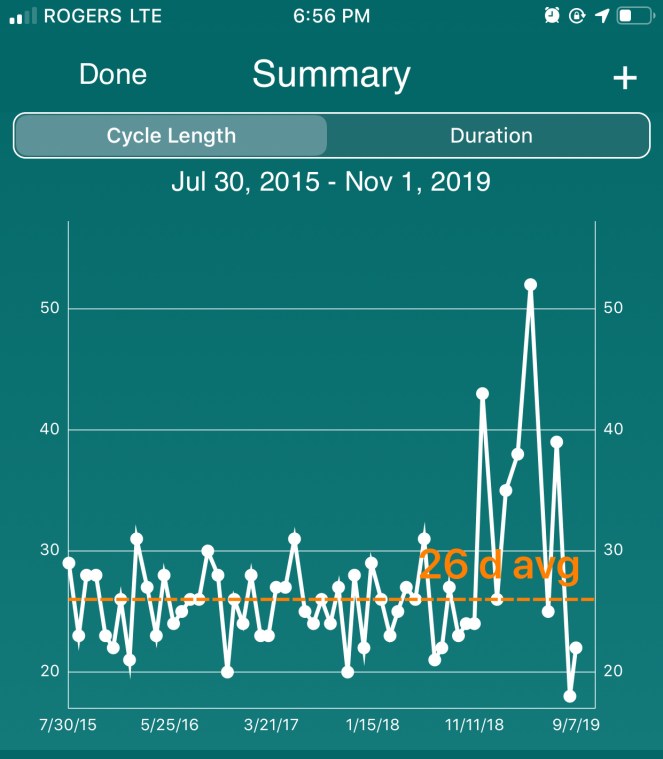
A year ago I stood in the family planning isle of the pharmacy staring at pregnancy tests. It had been 40 days since my last period. For 4 years I had fastidiously tracked my periods in a phone app. They clustered tightly between 21 & 31 days. Oh to know then that those variations were a tightly clustered data set.

On the one hand I was 44 with a tubal ligation 17 years earlier and my partner had a vasectomy around the same time. On the other hand, statistically, it was highly unlikely I was pregnant but it wasn’t a zero chance so I needed to check.

I wasn’t pregnant but it was my first skipped period that signaled the start of a year where the time between periods oscillated wildly from 18 to 52 days. There’s no planning around that data set.

My mood started to mirror these fluctuations and my sex drive skyrocketed while I also was fed up with everyone and could cry at any moment. It has been tumultuous times.

The unpredictable periods, sometimes so heavy it interfered with exercise, activities or even leaving the house were coupled with many other symptoms.

I started laughing recently when a Canadian sketch comedy show Baroness Von Sketch posted a short about peri menopause. It’s hilarious. Also at many junctions the protagonist asks “I don’t know, is it? No, it couldn’t. I still <insert young life affirming thing>”

It basically narrates the past year. But nothing is more compelling or persuasive than the graph of my period frequency.

A line graph showing a big mountain of period variations after many years of tightly clustered data.

Oh yes, I’m definitely in the peri menopause now friends. Some great advice from my friend & colleague Patti was to embrace the tumultuous times, just like I did when I was pregnant.

I’m trying. 😀

And I’m letting go of any expectations that exercise will transform my body or make it youthful. It’s simply a way to support my health & mobility while sometimes allowing me to appreciate what my body can do.

fitness · Guest Post · meditation · rest

Float Therapy: supposedly good for your well-being (Guest post)

For my latest birthday a friend gave me a coupon to try “float therapy.” I hadn’t heard of that before (even though as I just learned, Cate blogged about it over THREE years ago). It reminded me of the “tranquility tanks” from the eighties (I think it was the eighties). You may remember those sensory deprivation tanks where you would float for an hour in dark silence. Now it’s called “R.E.S.T. (Restricted Environmental Stimulation Therapy),” because, you know, everything in these days of wellness is “therapy” of one kind or another.

It didn’t appeal to me then. And I wasn’t so sure it appealed to me now (claustrophobia!). But when I checked the website I saw that you could book either a room or a pod. They seemed aware of the possibility that people might have claustrophobia, so they suggested that first timers try the slightly more spacious room over the pod.

Image description: float room, shallow tub that spans the full length and width of the room, pictured here with low blue lights and a side handle for getting out of tub.
Image description: float pod with lid open, dim blue light inside, set in a room with a chair with towels on it and a small table.

It’s supposed to be totally relaxing because you’re floating in a shallow pool where the water has over 1000 pounds of epsom salts in it (more salt density than the Dead Sea) and that means you effortlessly float. Once in your floating position you’re in a zero gravity state, and that’s supposed to relieve your muscles, central nervous system, and spine of their usual load, thus alleviating the effects of gravity on these systems. If you turn off the lights and sound and move as little as possible, you purportedly go into a state of deep relaxation. The website makes the bold claim that research has shown one hour of floating is like four hours of sleep. I guess that’s if you do it right for the whole hour instead of taking 40 minutes to settle into it.

I think the first time is almost a throw-away experience. I was a mixture of skeptical and worried. Even though the room was recommended for first timers, when the attendant showed me the room I felt claustrophobic at the mere sight of it. You enter into your own space where there is a shower and a place for undressing and leaving your clothes. The float room is adjacent to that. It resembles a very large shallow bathtub, perhaps 8 or 9 feet long and about 4 or 5 feet wide, with ample head room of at least 6 or 7 feet.

I had a brief orientation where she showed me the room and told me to keep the salt water out of my eyes, mouth, and ears (they provide ear plugs). I would have seven minutes to shower before and some time to shower after as well. I would know my session was beginning because a woman’s voice (who sounds like “Mother” from the movie Alien) would come through the speakers to tell me it was starting. The attendant also repeatedly reminded me that the floor was very slippery, both in the anteroom with shower and the floor of the tub. This proved true and made me wonder how anyone with the least bit of balance or mobility issues could do this (I don’t think they could safely get in and out of the float room alone—I had to be very careful myself).

I found it alarming that there is no panic button inside the floating room. But the attendant made it seem as if I was the very first person ever to ask about that. She said if I was really panicking I could bang on the door (which turned out to be a useless piece of advice, as I will explain in a moment).

I undressed, showered with their super luxurious bath products, put in the recommended ear plugs and the head float thing (a flat buoyant circle of floaty stuff that fits around your head for extra support), and climbed in.

When you pull the large door shut, you’re in an insulated enclosure. The floating area (the tub) extends entirely to the sides, so there is no “edge” to speak of. Just four walls. Beside the door are two buttons to control lights and music. The water is not hot or cold — 93.5 degrees F, or the “skin-receptor neutral” temperature. The air within the enclosure is about the same. The air outside, in the shower and change area, is cooler, making it a bad idea to leave the door open.

Why might you want to open the door, you ask? Well, for my part, I found it difficult to breathe. The air is thick. And the enclosed nature of the thing, with no obvious ventilation system to circulate air into it besides the door, made me afraid to let go completely for fear that I would run out of air and suffocate. I kept thinking of things like refrigerators and container trucks where trapped people die from lack of air.

Once Mother told me my session was under way, I lost track of time, so what follows are estimates. I spent the first 15-20 minutes fiddling with the lights and music. At first, I had them both on. Then I remembered it was recommended as a sensory deprivation experience, so I turned off the music and tried to dim the lights. They were a lot like those hot tub lights that change colour every few seconds. If I could’ve steadied them on red and kept my eyes closed, I think that would have been fine. But I could see the changing brightness through my eye lids and I found it distracting. I messed around with it only to discover that there were just two settings. Completely off or cycling through the colours. I tried it with the lights off.

In this windowless enclosure, when the lights go off, it is capital “D” Dark. Like, can’t see your hand in front of your face Dark. I tried to settle into it, lying back in my floating position suspended in the salty water. But the level of Darkness just freaked me out even though I had my eyes closed. So I wanted to turn the light back on. But by then I had floated into a different position relative to the door and the light switches and I could find neither. And that’s when the panic began to rise and I thought for a few moments that I would lose my mind. And I absolutely couldn’t breathe and felt sure I would die right there. Which is why the instruction to bang on the door if I panicked did me no good at all because if I could find the door I wouldn’t be panicking.

I fumbled around and then remembered that basically it was just a room with four walls and if I traced a path along the wall with my hand I would find the door handle (it was like the bar you would find in the accessible shower stall). Beyond the door I found the light switch and turned the lights back on and then opened the door for about 30 seconds for some air.

At that point I started wondering how long I’d been there and how much longer and was I doing it right and I’m a seasoned meditator so why is this so hard? I didn’t do enough research into what you’re supposed to do, so I just tried to relax as much as possible and calm my mind. And breathe, which remained difficult. I settled into it enough after about half an hour to keep the lights off, but I opened the door for air at least four or five times. Finally, with I’d say 20 minutes to go, I settled in, confident that there was enough air in the room to last me to the end and that any sense that I couldn’t breathe was actually not accurate. I could breathe just fine, salt is supposed to be good for you, and in any case it’s almost done. I only had brief thoughts of abandoning the whole thing and had already decided this would be a one-off because…why am I here?

And that’s when I floated into a state of total, zero-gravity, sensory deprived R.E.S.T. I stopped thinking “when will this end?” and drifted off into floaty, relaxing, thought-free bliss. I’m guessing about 15 minutes passed before Mother’s gentle voice coaxed me out of my nothingness. If one hour of floating is equal to four hours of sleeping, my 15 minutes of mind-free floating must have been equal to an hour of sleep. And I did feel revived and recharged, disappointed that it was over.

Getting out was a careful process of trying to climb over the edge without slipping on the floor of the tub and then the floor of the shower and changing area (which is, to me, unnecessarily more slippery than it needs to be). I got a bit of the salty water in my mouth, and it tastes like something sour and disgusting and almost rotten. I showered with the luxurious bath products again, dressed, and went out to the vanity area to fix myself as best as I could for the outside world.

I asked to see a pod before I left. One look at the pod and I knew I would not be signing up for that. But I do think I will try the room again. Now that I know what to expect I think I can settle into a good experience a lot more quickly. I liked the final feeling of weightless zero-gravity and temperature neutrality. It’s comforting and stress-free (if you can get there). I’m not sure if it’s any more or less “therapeutic” than any other thing that forces you to quiet yourself for an hour, suspending the demands of the world. But the added bonus of zero gravity and sensory deprivation invite relaxation a lot more easily than, say, an hour of Vipassana meditation.

It’s not cheap. When Cate went, she paid $39. I had a $55 gift card (because it was my 55th birthday present) and I paid a $29 top-up for my hour of floating. I’m keen to give it one more go, which is more than what I would’ve said 30 minutes into it. But the price makes it an indulgence.

Have you had a floating experience? And if so, what was it like for you?

fitness

Movement, breath, intention: an accidental foray into Qi Gong

IMG_1367Two weeks ago, at my Saturday morning cross-fit class, I pulse-squatted a baby.

Like, a real baby.  A cute one.

I did it partly for the cuteness and because she laughed in such a delightful way, and partly because the class was a bit tense because of some gym drama earlier that week, and I wanted to lighten it up a bit.  But, it turns out later, the joke was on me, because I clearly was doing something weird in my hips when I was holding her safe.

Then the next day, I got all Energetic and instead of running my planned 5km, ran 11km, which I hadn’t done for a while.  It was a beautiful day, and a great run.

Then my knees hurt.

And then my quads hurt.  And my hamstrings.  And lower back.  And neck.

I tried to switch up my workouts, do more yoga, stretch, just walk for a couple of days — and then I seemed to mysteriously pull a muscle in my groin.

I yearned for the Monday evening yoga class that used to be part of my regular week, but my studio recently switched things up, and my favourite instructor has gone missing on the schedule.  Instead of Flow Yoga with Farley Monday at 5, it was Qi Gong .

I’d heard of Qi Gong, and knew it was mostly an energy practice (Qi translates as chi, or chee). I had some notion that it’s one of the things Chinese people do in parks.  It didn’t seem outwardly “vigorous” — so I decided maybe getting in touch with my chi might halt the rampant disarray in my soft tissues.  (I also scheduled a therapeutic massage).

With no idea what to expect, I hauled myself over to class.

The instructor — a white guy named Mike — was super welcoming to newbies, and explained the purpose behind the practice as he guided us through a few sequences.  Qi Gong is basically intersected with Traditional Chinese Medicine, and is designed to balance the different matrices of energy in our body.  If you’ve ever had acupuncture, it’s aimed at the same meridians — to open up the flow between them.  Or, in western terms, increasing the flow or oxygenation of synovial and lymphatic fluids and blood.  There is an increasing body of evidence (in the western way of knowing) for the value of Qi Gong (and the sister practice of Tai Chi) for bone loss, immune function, physical function and agility, anxiety and cardiopulmonary function.   

The movements were deceptively simple — what might look like from the outside like a stretch, or a reach, or a gentle twist, or an undulation — but I noticed heat building very quickly in my body, and difficulty really focusing on the full range and balance of some of the movements.  Mike led us through three versions of each movement or sequence, starting first with the simple movement, then adding breath, then adding intention.

One of my biggest challenges was following the note that we should be the only ones who could hear our own breathing.  I’m used to Ujjayi breathing in yoga, or focused pilates breathing, both of which become an energy of their own.  In this Qi Gong practice, it was supposed to be attentive and focused breathing following my own energy — but quietly.  That was surprisingly hard for me.

Something in my body recognized that I was doing … something… that opened up… something.  Especially in the dragon tail bit.  I didn’t feel like I was “getting it,” exactly, and the aforementioned groin issue didn’t love the stance.  But something… was happening, and I liked it.

We finished the class with what Mike described as a “qi shower” (lots of tapping and slapping different meridian points), and then a yin practice of holding a “ball” of energy between our curved palms.  I didn’t feel much in the qi shower, but the ball of energy became surprisingly real.

I’m still a little bemused by it — I think I still have a block about the value of any kind of exercise that unfolds from the inside of the energy rather than from more aggressive movements.  I.e., — is it a workout if there’s no potential to hurt myself?  And the moments where I felt any kind of flow were — not surprisingly for a first foray — few.  But there was … something.

If I can get over my notion that being deeply present to my body “isn’t exercise,” I’ll give it another try. ]

Have you done Qi Gong or Tai Chi?  How was your experience?

Fieldpoppy is Cate Creede, who lives and overuses her fascia in Toronto.