fitness

The sit-rise test: trying to get up to save my life

At yoga class last Monday, our teacher showed us a deceptively simple move she calls ” just stand up”. You sit cross legged on the floor (or a yoga block) and then get up to a standing position without using your arms. Or (as in my case), you don’t.

I found this task both practically and conceptually impossible while sitting on the floor. Sitting on one yoga block, I couldn’t do it cross legged ( although I could imagine doing it, and actually did it with legs wide apart). Once I sat cross legged on two yoga blocks I was able to stand up, albeit ungracefully.

Now I find that some researchers consider this yoga party trick to be a good predictor of all cause mortality– this is, how long we are likely to live.

Guess I’d better get my affairs in order now.

The test in question is called the sit rise test. Here’s a description from a USA Today article:

The goal is to get down and back up from a sitting position with minimal support. It can be used in all age groups, and results are based on a scale of one to 10. Score three or less and your risk of dying is five times greater over the next five years.It may look and sound easy, but here’s how it’s done.

You cross your feet, and go into a seated position. That’s five points. Coming back up is another 5. But you can lose points really fast.You lose a point for each hand, arm or knee you need for support. Take off a half-point when you lose your balance at any time, either on the way down or coming back up.Total them all for your final score.

If you have bad knees or hips, don’t try this alone.

Researchers in Brazil did this test on 2002 people aged 51–80. They claim that lower sit-rise test scores were associated with higher mortality risk.  Predictably, the popular press picked up on this, splashing the bad news across the headlines with glee.  The Daily Mail delivered the message in most dramatic fashion.
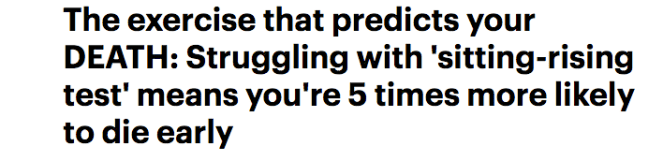
News article caption, reading: "The exercise that predicts your DEATH: Struggling with 'sitting-rising' test means you're 5 times more likely to die early"

They get points for the all-caps use of the word ‘death’, but I’m not buying it. Why not? A few reasons.

When I went to the source– the study itself-– I saw tables that show increased mortality risks for groups with lower sit-rise scores.  Groups that had to use hands or knees a lot  to aid sitting down and/or standing up had an average risk 5 times higher than the group that did this task with little aid by hands or knees.  Does this really mean that not being able to do this means you’re 5 times more likely to die than the get-up-easily group?  NO.  When you look at the table with the results, we also see that the average age of the low scorers is 71, whereas the average age of the high scorers is 59.  You can see this same info illustrated in this very interesting graph:
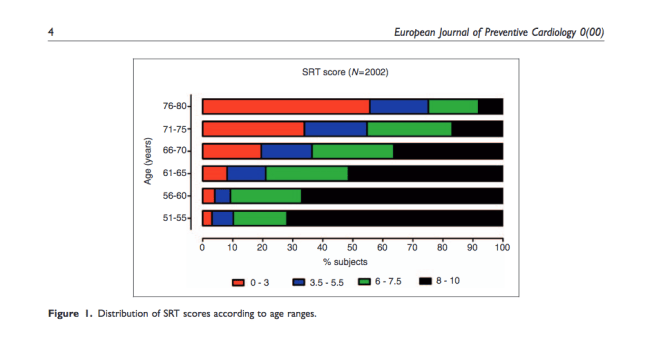
Graph from the European Journal of Preventive Cardiology article showing the division of sit-rise test scores across the age groups in the study.


What this data seems to show is that younger age groups had higher sit-rise test scores.  What is more interesting to me (and I think should be to all of us) is the trend we see in the red bar (low scorers).  From ages 51–60, low scorers are a small part of the group.  It would be interesting to try this on younger people too– I bet there will be a small percentage of low scorers there, too, for a bunch of reasons.

At 61–65, the percentage of low scorers increases but is still small.  However, starting at 66–70, the percentage doubles.  And for each age group after that we see big increases in the low score groups.  This tells me that at certain age thresholds, mobility really decreases.  This is a call to action– people in those groups can use some programs to help maintain their flexibility, balance, agility, leg strength, etc.  But this is no news.  And it’s not a sign (or a new sign) that definitely shows death risk– it just shows that aging brings with it some decreases in function that can and should be addressed through exercise programs and aids in homes and public places to make them safer for older people.

Other limiters: people with knee problems and arthritis won’t score well on this test regardless of age. People with shorter legs tend to score better (except for me, apparently). Also this test was done on a small and mostly white population in a culture where sitting in the floor isn’t commonly done. It’s not clear how it would play out on other populations and in cultures where movement patterns differ. In addition, the test couldn’t be applied to people with a host of varied disabilities, so it doesn’t seem generalizable.

Sam posted about this test a while ago here.   Since she does Aikido, she’s pretty good at rolling around on the floor and getting up without using arms or knees. In yoga, we  work on a variety of balance and flexibility and strength skills.  I like them–  for me,  they are fun personal challenges. But if my body resists some of them, instead of shopping online for funeral urns, maybe I’ll work on some other strength and flexibility moves instead.

For instance: a kayak party trick I’d like to master is being able to stand up in your boat without immediately tipping over. In my women’s kayak classes (see my post about it here) they showed us how to do this, and some people did it ( with a person stabilizing their boat, and some on their own). I felt way too awkward even to try. But now I’m thinking that getting more comfortable with moving and lifting and balancing my body under unusual conditions is probably very good for it and me. So I’m going to keep my eyes open for interesting new body balance and strength challenges.

Just out of curiosity, can you do the sit rise thing? What do you think about this test? Do you have any physical party tricks you can or want to do? I’d love to hear from you.

aging · athletes · competition · race report · racing · running

Competitor or Coach? (Guest Post)

by Claudia Murphy

I’ve been struggling lately with my exercise routine. In the last couple of years belonging to a fitness group has helped me to avoid a pit of depression, so I have been feeling perplexed that what seemed like a lifeline has now become quite a challenge. Even if I can get myself to show up, I don’t enjoy it or even enjoy having done it.

I am 65 and have been working out with a group of long distance runners for a couple of years. They are a great group of people. They have been very kind and accepting– downright encouraging. Even at my bluest, there is something amazing about high intensity workouts at 5:30 am with positive and affirming people.

But in the last few months, I have been facing motivation issues. There could be several reasons.

First, I have been dealing with a chronic and persistent pain in my left hip. I have pursued multiple diagnosis and treatment options, including orthopedics (MRI, cortisone shot), physical therapy, massage, chiropractic therapy and acupuncture. The consensus seems to be that my left hip and adjacent areas need strengthening. But in the meantime, running, walking, and yoga, and even sitting all hurt. It is easy to feel discouraged.

Second, internalized ageism has become a significant force in my mind. I am one of the oldest in my fitness group. Still quite competitive, I often feel as if I’m losing. I can’t run as fast as I used to run. I can’t run as fast as most of the younger people in the group. I haven’t yet figured out the antidote to this aspect of aging.

Third, I’ve been fighting a giant battle against oppression in the workplace. Here, I’ve had to be very deliberate in guarding against internalized sexism and ageism. I have had to consciously remember my own significance and value. I have had to repeatedly decide to quash the oppressive thinking. My vigilance has been focused on this fight.

In the middle of all of this, without awareness, negative self-talk crept into my exercise time. I found myself thinking “you are too old, you look ridiculous, you are embarrassingly slow.” And these thoughts seemed true at the time, even justified. I looked for evidence to support them. Is it any wonder that my routines became less fun, less satisfying?

I’ve had to become more vigilant about this self-talk. I can be my own coach. I can replace my own negative feedback with something more positive. I find it helps to aim for messages that are somewhat neutral while still being encouraging. My mind revolts against “you are the best” But “go Claudia” or “you can do it!” work pretty well.

I recently tried this strategy in a 10K race, with some mixed results to be honest. I had signed up to run as a member of a relay team in the 2017 Fargo Marathon. About a month before the race, we discovered that the legs of the relay were not very even. One team member would have been required to run 8.5 miles. None of the team members wanted to run that far. So we decided to switch our registrations to the 10K. Even this decision felt like a bit of cop out. Last year I had run a half-marathon at this time. While it is true that I had only been able to do so with the help of a cortisone shot, I still struggled to feel OK about running a 10K.

The night before the race I was still struggling with feeling positive about running. My husband held out the perspective for me by reminding me that not that many women my age could run a 10K. He also agreed to drive me to the race and to cheer me on. The day of the race the weather was perfect. It was cool and clear. We arrived early enough to witness the start of the race for both the marathon runners and the half marathon runners.

I had a good start and ran well. I kept my mantra forefront in my mind—“go Claudia.” Since we shared the route with either the marathon runners or the half marathon runners, there were people out cheering us on for most of the route. There was music blasting or bands playing, even though it was quite early morning. I had two young women tap me on the back as they passed me by telling me that I was doing well for someone so old. (BTW this is not a very helpful way to support an older runner.)

I finished in 1:12:09, 8th in my age group of women 65-69, 37 of us running the race. I was staffing a women’s leadership development conference that weekend and decided to wear my hoodie and medal throughout the day to force myself to celebrate my achievement.

Ageism is nasty. But it helps if I do not participate in my own oppression. This is an ongoing battle for me. I would like to be able to be my own best supporter. What strategies work for you?

Claudia Murphy is a philosopher who is semi retired but still teaching part time at Minnesota Technical and Community Colleges.  She is also likes to run, bike, garden, cook and knit.

accessibility · Guest Post · health

Katherine’s Wibbly Wobbly Walk (Guest Post)

From zero to completing a sponsored walk raising over £400 for hypermobility syndromes.

In 2011, after years of pain, exhaustion, worry and doctors’ visits, I was diagnosed with hypermobility syndrome, a hereditary connective tissue disorder. I experienced a bizarre mixture of contradictory emotions- relief, joy, excitement, shock, fear, hope…. my main hope was a referral to physiotherapy. I had three appointments, and the gist of it was: “You don’t need any help”. “Hypermobility can’t cause pain. Your pain is because you are so overweight and unfit. Lose weight and do some exercise”, I was told.

Over the coming weeks, I ran what I’d been told over and over in my mind. I remembered how I had been working out daily while I got steadily sicker. How severe the pain had been when I was well inside the “healthy” weight range for my height. How it was the pain, frequent injuries and bone deep exhaustion that caused me to reduce my activities.

I thought about how hard I’d worked to get to where I was then, from being barely able to walk in 2008 due to an ankle injury, followed by 2 years of painful foot problems. I knew what the physiotherapist was saying wasn’t true- hypermobility syndrome does cause pain- painful, weak joints is a primary symptom of the condition. I also knew that it wasn’t true that inactivity and weight gain were the cause of my situation. But the important question was- how could I fix this on my own? I wanted expert help to find a way to sneak up on my body and rebuild my fitness, without increasing the pain and fatigue to intolerable levels, and without keeping injuring myself and going back to where I started, something which had happened many times in the past.

So I educated myself. I joined the Hypermobility Syndromes Association and too part in their forum. I googled. I joined online support groups. I listened, I talked, I discussed, and I began my journey, with much trial and error and very, very slowly. I increased my walking, I saved up and found a secondhand elliptical and started doing 5 minutes at a time. I bought pilates DVDs.

By September 2014 I’d made progress. My joints were more stable and I had a little less pain and was a little less exhausted. That was when I came across the No Excuse Mom 12 week challenge. My tummy squiggled with butterflies as I wondered, could I really attempt 12 weeks of regular workouts? What was I thinking? My progress had ground to a halt and I knew I had to push harder. Maybe committing to the challenge, doing it alongside others, was what I needed. So I signed up.

The first few weeks were something of a nightmare as I struggled to keep up with my other commitments and manage to do regular cardio, pilates and strength training. Thankfully, I am a very stubborn person when I need to be! By the time I reached the end of the 12 weeks, it seemed a little easier, and I kept going, hanging on and hoping to see results.

Fast forward to 2017. An idea had been growing in my mind for some time, to do a sponsored walk to raise funds for the HMSA, to thank them for the work they do to support people with hypermobility syndromes and in raising awareness of these greatly under-diagnosed conditions. I decided that now was the time. I chose a route- a 9 mile circuit on local moorland, taking in steep and rugged up and downhills, slippery and boggy areas and rocky passes. I set up a sponsor page and before I knew it, the date of the walk arrived.

The weather was bright and breezy, perfect for hiking. I set off, with trepidation but determined to just keep walking no matter what, until I reached the end. I wasn’t prepared for all the emotions I experienced. There were times of intense boredom, periods of elation and feeling utterly victorious, interspersed with weariness and anxiety and then back to joy and a feeling of being completely at home out on the moorland. The last mile, down a steep rocky path, was almost intolerably painful and my muscles were too fatigued to properly support my knee joints. I had to resort to stepping very slowly and carefully sideways and sometimes sitting down and sliding on my bottom. But five hours after setting off, I arrived back at my starting point, I made it!

That day, I proved to those who have been critical of me that I can be strong and determined and overcome challenges to achieve my goals. But more than that, I proved that to myself. As is common for those with invisible illness, I’ve heard discouraging messages from those who don’t understand or accept the difficulties I face. I’d also listened to those kind of messages from within myself, partly due to difficulty accepting my condition- “Maybe I’m not really ill, maybe I’m just weak and lazy, if I just push harder I can lead a normal life” and so on.

I believe that it’s only when you’ve looked around and experienced it seeming like every door is closed and locked in your face, that you really know what that is like. I want my story to be encouraging, but you will never hear me say, “Anyone can do it” or “Nothing is impossible if you try hard enough” or “If I can, you can”. I know the reality of living with chronic illness or disability is that many things are out of reach, locked behind those closed doors. Part of living the healthiest possible life is acceptance of that reality. But I also believe that most of the time there is something we can do, some tiny change we can make, that can lead to more babysteps of progress, and one day we can find we have achieved something we thought we never would.

I can’t say where my journey will take me now. I am continuing to work hard at becoming as fit and helathy as I possibly can be, so that I can lead the most full and active possible life with my family. But maybe tomorrow will be the day I get another injury that severely limits my activities for weeks, months or even years. There are no guarantees when it comes to health and fitness, especially for those with bodies that are more vulnerable than others One of my dreams is to run a 10K, something I used to do with my beloved dad when I was a teenager, But at the moment, a short and very slow run results in several days of painful and scary instability of my knees, so I may need to find a more practically feasible goal!

Some links:
NHS page on hypermobility syndrome http://www.nhs.uk/Conditions/Joint-hypermobility/Pages/Introduction.aspx

Hypermobility Syndromes Association http://hypermobility.org/

My Virgin Giving page http://uk.virginmoneygiving.com/KatherineBaldwin

Wandererssong is Katherine, is a fitness freak who is fat, forty-something and a mum of four. Some of her other passions are- books, crime dramas, druidry, horse racing, biomedical science, Orphan Black, her schnauzer, campaigning for social justice, and all the music.

aging · clothing · fitness · Martha's Musings · training

When tools help

by MarthaFitat55

Last month, I invested in a pair of knee sleeves after trying a borrowed pair for several training sessions. I said I would comment on the results of any changes that I observed.

First the qualitative results: I noticed right away that when I wore the knee sleeves, I felt more comfortable squatting more deeply. My trainer noticed this too. Goal of ass to grass is well underway!

What I didn’t expect was how I would feel in between sessions when I didn’t wear knee sleeves. There was an obvious decrease in knee pain from the grumpy left knee, and I also noticed that my hip joints didn’t ache. I don’t know why this is happening but I am thinking that my knees are being retrained in how to support my body.

With my knees feeling better able to support my body, I feel more comfortable in completing certain exercises, so much so, my trainer has added a few variations in the split squat department. I have been doing more cage squats and heavier weight goblet squats and my ability to get closer to the ground and feel more comfortable there has increased too.

In the last week of May, I recorded the following records in my notebook:

Bench 42 kg/ Squat 186 lbs/Deadlift 101 kg

By June 5, with almost three weeks of training using the sleeves complete, I achieved the following PRs:

Bench 48.5 kg / Squat 200 lbs/Deadlift 105 kg.

The squat is particularly pleasing as it represents a 14 lb jump. The bench represents an unofficial provincial record too.

If you have been thinking about incorporating some of these tools, like the sleeves or belts to increase your core stability and to support your (possibly aging) joints, then perhaps my experience may give you the extra push you need.

I’m happy I made the investment. They have made a difference for me in a short time, and I am looking forward to seeing what this summer’s training will produce in both qualitative and quantitative results.

— Martha is a writer getting her fit on through powerlifting.

fitness

Gwyneth’s GOOP and the fallacy of the “appeal to celebrity”

The other day I saw an article entitled, “Dr. Christian Jessen: Clean eating websites like Gwyneth Paltrow’s Goop ‘indistinguishable from pro-anorexia websites.’” Dr. Christian Jessen is a British TV doctor, much like our Dr. Oz (I’m guessing). He presented a popular UK show called Embarrassing Bodies, which is apparently a show where people with “embarrassing bodies” (with ailments usually thought to be taboo) can get help:

Throughout its numerous series, Embarrassing Bodies has set out to aid people who have a variety of medical issues. These issues tend to be taboo or misunderstood. With the help of its patients and the diagnoses of its doctors, the show tries to make common medical issues, especially those that are “embarrassing” or sexual, understood and to debunk myths surrounding them. The programme’s method of tackling these issues has caused great success and has attracted large numbers of people to its website.

I can’t vouch for the show and I can think of a zillion ways in which it could go horribly wrong and involve all sorts of body shaming (just the name for example suggests an uncritical view of what counts as an “embarrassing” body). So don’t come away thinking I’m all for Dr. Jessen either.

But, I’m less concerned about Dr. Jessen or even about whether what he says about Goop is true, close to true, exaggerated, or false (I doubt it’s totally false since the site does promote “clean eating,” about which I have expressed a great deal of skepticism). What I’m mostly concerned about, actually, is “why does someone like Gwyneth Paltrow have so much influence when it comes to health and wellness?”

In a word: celebrity. Gwyneth Paltrow is a beautiful and even likeable celebrity. She’s a thin, glamorous, academy-award winning actor and style icon. This we know to be true. And for all that, she has gained a great deal of unearned credibility and influence over people’s health choices.

Jessen says of sites like Goop,

“When you look at the actual medical side, the health side, they so rarely are promoting anything that is even vaguely healthy.

“Look at Gwyneth: You know, the crap that she writes, it’s just overwhelmingly mind boggling for a doctor to see that – the number of people following it and going along (with it) is just terrifying.”

The “extreme diets” hailed by celebrities, which often exclude entire food groups such as wheat and gluten, are are being falsely presented as healthy, he added, and can become a guise for teenage addiction and eating disorders.

Jessen is critical, as am I, of “fitspiration” or “fitspo.” A lot of it is thinly-cloaked “thinspo,” which is itself thinly veiled pro-ana or pro-mia (pro anorexia and pro bulimia) in its messaging.

Okay, so let’s get back to the point about celebrity. In philosophy there is a fallacy called “the appeal to authority.” way back in the early days of the blog, I wrote about this in relation to Dr. Oz. You appeal to authority when you accept something as true because “so and so said it.” Now at least Oz and Jessen are doctors.

In Gwyneth’s case, her “authority” rests on even thinner ice, namely, her fame. So whatever the status of anything that appears on Gwyneth’s Goop, it doesn’t get a speck of actual credibility from the fact of Gwyneth saying it.

Now I understand that it’s a celebrity game. Oprah plays it well and has used it to her advantage as a major shareholder in Weight Watchers. Celebrity diets are big money. And they don’t work (see here for my thoughts on celebrity diets not working). And that’s why Sam wants to hug Oprah.

So appealing to authority is a fallacy. And appealing to celebrity? Well fallacies don’t really come in degrees, but if they did I would venture to say it’s even more of a fallacy.

I asked this before and I’ll ask it again: does a celebrity endorsement make you more or less likely to take a health claim seriously?


fitness

Sam counts steps with the over achievers!

I’m on holidays in Madrid. And today, in the way one does in large European cities, I walked a lot. Really a lot. Like 21,855 steps. The only day I’ve achieved a higher step count from walking alone was last year at this time in Edinburgh. Those were also very hilly steps. But today’s steps were also warm. It was so warm in Madrid that they’ve cancelled the afternoon bike tours of the city that we’d planned on doing.  So I am tired. My feet hurt. I’m drinking lots of water and feeling a sense of achievement.

I am looking forward to logging my daily steps. You see I’m doing this workplace health and fitness step counting challenge. I blogged about it here and Tracy wrote about decision to try it again after hating it last year here.

I’m on a team that is composed of multi sport athletes. We’re not just walking and counting steps. We’re also swimming, running, and biking. Me, I’m mostly just biking. (My biggest step count day was the day I rode over a 100 km.) It’s a team of over achievers. Given that a few of us are training for Ironman distance events our numbers are high. My very big day in Madrid is still below the team daily average step count of 23,500.

It’s funny being the weak link. But in a bunch of ways it suits me. What do I mean exactly by being the weak link?

I’m not doing that badly. My average daily step count is about 15,000 (that includes a conversion they do for cycling.) My biggest day yet was over 40,000. Not too shabby right?

There was one challenge day we were supposed to mark as a team by picking a day and aiming for 150,000 total steps on that day. We didn’t need to pick a day. This team does that everyday.

So do I feel guilty dragging down the team average? No. I feel motivated. I probably wouldn’t feel motivated if I were the high achieving member of a team. I might even get annoyed at people on my team who weren’t trying.

I like riding people who are faster than me, lifting with people who are stronger than me, and so on. So in this I’m motivated by step counting with the big dogs.

How about you? Are you motivated by riding with people who are faster, having workout buddies who are fitter? Or does that just depress and demoralize you? I know it works different ways for different people? What’s your way?

fitness

A long bike ride in my future? Sam dreams of Sweden


I’m no fan of bucket lists, see Bucket lists bug me, but there are some rides I’d really like to do. One of them is the Vatterrundan, THE WORLD’S LARGEST RECREATIONAL BIKE EVENT. I found out about last year when I was at a conference in Sweden (Children’s Rights – origins, normativity, transformations, prospects, Linköping University, June 7 – 9, 2016) and asked the conference organizer Bengdt Sandin  about the sign pictured above. He enthusiastically told me all about the event as he’d done it several times in the past.

It’s 300 km and is held at a time of the year when there’s lots of daylight in Sweden. My usual worries about running out of light were somewhat allayed.

Vätternrundan (pronounced vet-turn-rund-an) is the largest recreational bicycle ride in the world. The 300 km course follows the shoreline of the beautiful Lake Vättern and early starters can see the sun set and rise over the lake during the ride.

Vätternrundan starts and finishes in Motala, Sweden, whose population swells to three times its size during the cycling events. The cyclists, their friends and relatives and the thousands of bicycles create a festival atmosphere, making the bike ride that extra special. Many cyclists return year after year to be a part of this large and welcoming cycling community.

The course appeals to all sorts of bicycle enthusiasts and the level of service along the course is very high. Word of this well-organised event has spread far beyond the borders of Sweden. More than 50 different nations is represented.

Because Vätternrundan is a recreational ride, no winners are listed. Instead cyclists wear a timing chip that registers their individual times. These times can be seen under Results. Everyone can check what time they started, when they passed the check points and what time they arrived at the finish in Motala.

There’s more about the history of the event on its Wikipedia page.

Here’s a shot of the lake around which the cyclists ride:

image

What appeals to me? It’s not a race but it is a challenging distance. I’d have to train up to it. It’s a beautiful, friendly part of the world. And also I love breakfast and coffee in Sweden.

I’ve even blogged before about my dream of doing this ride!

What’s your big, dream event? What attracts you to it? Why?

fitness

When ‘vegan’ becomes code for ‘disordered eating’

sliced strawberries banana and blueberries
Image description: Blueberries, strawberries, and bananas. Photo by Suzy Hazelwood on Pexels.com

I know people think that going vegan means you’re going to lose weight. I mean, how could a person possibly gain weight when there’s hardly anything they can eat? Lately, I’ve read something even more alarming than the (false) assumption that going vegan will make you thin.

The more alarming thing is that there are “vegan” bloggers who recommend the vegan diet for minimizing or getting rid of menstruation. Why? Because they think there’s something not right or natural about menstruation. It’s a sign of a “toxic” diet they say.

Freelee the Bananagirl is a vlogger on YouTube who follows a 100% raw vegan diet and touts as one of its benefits that she lost her period within one month of starting it. If a painful or heavy period is the sign of a toxic diet, then raw vegan is…you guessed it…clean! Raw vegan blogger Miliany claims that women and girls have been “brainwashed” to believe that losing their periods is a bad thing when, she says, a “non-menstruating body indicates the body is clean.” I’ve already blogged at length about why the whole idea of “clean” eating is a crock.

If you couple clean eating with this idea that menstruation, one of the most natural things in the life of many women, is somehow bad for you, then you can get some idea of how removed from reality the proponents of this type of veganism for this type of reason really are.

Loss of periods, also known as amenorrhea, is a symptom commonly used to diagnose the eating disorder anorexia nervosa. It’s just not medically sound to claim that periods are a sign of ill health.

Dr Jackie Maybin, a clinical lecturer in obstetrics and gynecology at the University of Edinburgh, warns against changing your diet in an attempt to alter your menstrual cycle.

“It’s difficult to recommend a strict vegan diet without investigating hormone levels and endometrial health in these women,” she says of bloggers like Freelee and Milliany. “It’s likely that the complete absence of periods—amenorrhea—indicates that ovulation is not occurring and could have a significant negative impact on reproductive health.”

According to this post, Freelees post about using raw vegan eating to eliminate your period is extremely popular even though it was posted over 8 years ago. A more recent clip she posted about heavy periods being bad for you has had over 250,000 views.

I’m vegan. I didn’t lose weight when I became vegan nor did I do it to lose weight. I stopped eating animal products for ethical considerations having to do with the unnecessary suffering and cruelty towards animals that is a systemic issue in industrial animal agriculture. I didn’t lose my period when I become vegan and that’s a good thing.

Vegan is not necessarily about “clean eating.” And clean eating is not necessarily a healthy approach to eating. Indeed, it can lead to orthorexia, which is an eating disorder characterized by an obsession with “healthy” foods.

Medical opinion is that it’s not a great strategy to try to control or lose your periods by eating an excessively restricted diet.

Maybin warns that a very restrictive diet or excessive exercise can also lead to a condition called hypothalamic hypogonadism. “In menstruating women, the brain sends signals to the ovaries to produce hormones to regulate the endometrium. This results in ovulation and, if pregnancy does not occur, menstruation.

“In hypothalamic hypogonadism, the body assumes a state of stress and shuts off the signal from the brain to the ovaries. This reverts the body to a pre-pubescent like state, where pregnancy is not possible as the ovaries temporarily shut down and menstruation does not occur.

“If this state is maintained long term, women can have problems due to low estrogen levels, e.g. risk of loss of bone mineral density and osteoporosis.”

While she says that not enough research has been done to know exactly what effects diet can have on menstruation, it makes sense that a “healthy balanced diet”—i.e. one that does not excessively restrict certain food groups—is good for all women and their periods.

So while I’m not one to recommend against going vegan, I do recommend against adopting fanatical restrictions for the purposes of ceasing menstruation if you’re a menstruating woman.

Have you, like me, noticed an increasing tendency to co-opt the label “vegan” and use it as code for disordered eating?


yoga

A question for our community: Which animal would you most like to do yoga with?

As you know, this blog, if not all the bloggers, has been a big supporter of goat yoga. We’ve written about it often.

Today when I posted about cat yoga on our Facebook page, Tracy said she thinks that it makes more sense than goat yoga. She shared the story and added, “Much better idea than the perplexingly popular yoga with goats.” Tracy’s not a goat yoga fan. To each their own. But that got me thinking.

What animal would you most like to do yoga with?  This is different of course than that animal doing yoga!  (See Animals doing yoga better than me.and Penguin Yoga.) Bonus points if you can share why. What about yoga with that particular animal attracts you?

I love what my searches for unicorn yoga turned up!


fitness

Bathing suits may be bulls**t but Sam isn’t impressed

Hilarious Moms Explain Why Bathing Suits Are Bullsh*t.  You’ve seen it, right?

I like saying “bathing suits are bullsh*t.”It’s new to me this swearing thing.

Lots of friends shared this video about women trying on and complaining about bathing suits. I wanted to like it. “You know what’s sexy? Joy.” Yes. I liked that bit. But I could do without the jokes about the guys with hairy backs and the claim that men can wear whatever they want at the beach. They can’t.  See Men it isn’t junk  and Men, meet normative thinness .

It’s true things are easier for men but fat guys can’t wear whatever they want at the beach without mockery. And then there’s all the poking fun at fashion trends for men this year, whether it’s rompers or lace shorts. You know what. Wear what you want, or wear nothing at all, and be happy.

And I could really do without the joke that women who do wear the skimpy cut out suits are responsible for their kids acting out at school. They’re not.

So yeah. I like the bonding over bathing suit season but let’s not throw others under the bus while we’re doing it.