Ankle mobility. Dr Em’s diagnosis and initial therapeutic advice was that the injury that seemed to come from skipping (and before that, loaded front squats) actually stemmed from poor ankle mobility. (This was not the first time I have been tripped up by my ankle mobility). So my first exercises (her recos) were for ankle flexion.
ankle mobilization that I can’t find online: kneel on a mat (or the floor) with one foot on the floor, the other kneeling; move the angled foot squatting, knee over toes, keeping your foot on the floor, and using your hand and body weight to increase your range of motion. make sure you are tracking the knee in alignment over the toes.
slow squats, loosely holding TRX for balance, practicing that same alignment and range of motion, and recruiting your glutes and hamstrings as you come up; if you can feel engagement in your inner thighs and core, you are shifting the pattern
The rest of this is from Alex; it’s been super super helpful to me — along with her encouragement and support.
Before anything else, start with one set of 6-8 SLOW body weight air squats. Check in with yourself and perform the following self-assessment:
How tight does each hip feel from 0-10?
How tight do my hamstrings and inner thighs feel from 0-10?
How tight or stuck do my ankles feel from 0-10?
After this self-assessment, complete the following sequence on ONE side of the body (ideally the tighter feeling side):
A) KB hip flexor smashing- lying on your front, the handle of the KB will “sink into” your abdomen, just above the hip bone. Play with the angle as needed, spending more time on any “radiating” or particularly sore spots.
(2-4mins)
(Editorial: see that look on my face? this is super painful. It is also super super super effective).
B) KB hip adductor smashing- lying on your side, drape your top leg over the handle of the KB. Keep the angle of the KB handle perpendicular to the inner thigh, and start with the handle as close to the upper thigh as possible. Extend the leg fully and then bend at the knee, keeping as much weight on the handle as you will allow. Gradually shift the handle down your leg, completing a few flex and extensions at each point until the KB is just above the knee.
(2-4 mins)
C) KB calf smash- sitting on the floor, place one calf on top of the KB handle, starting with the handle just above the Achilles’ tendon, or a few inches above your foot. Similar to the smashes above, place as much weight as you can handle onto the KB and slowly roll your ankle around (full circles, flex and extend the foot, and roll the leg side to side). Gradually shift the KB further up your calve, repeating these motions every few inches. Spend more time on particularly sore areas as needed.
(2-4 mins)
When you are done these three mobility exercises, re-do your body weight squat assessment. Do you notice any changes? Where do you feel the biggest changes?
Complete the other side of the body, then reassess your squats one more time.
After these mobilization exercise, Alex has given me a menu of stretches, including lunge and twist, banded glute bridges, inchworm/downward dog, and banded side steps — followed by activation for whatever movement I am going to do.
After two weeks of focusing on this repair work, I’m back to almost normal. In my lower back, anyway. I do have a sore throat, cough, headache and slight fever.
We live in interesting times.
Fieldpoppy is Cate Creede, who is trying not to touch her face in Toronto.
CW: mention of diets and quoting of bogus articles’ judgy and false statements about body sizes and ages and (oddly enough) heights.
I don’t necessarily hate internet exercise advice; often I can pick and choose the good stuff from the bin of otherwise useless or ill-fitting or totally-not-for-me tips, and go about my merry way.
Not today, though.
Nope, not today.
Why not today? I came across (courtesy of Sam), a pair of totally bogus 2019 exercise articles:
First of all, what’s with the titles? The first one seems to be enlisting unnamed third parties for rounding up the 40-year-old women and subjecting them to fitness-inducing procedures. Thank goodness I’m no longer 40 is all I have to say about that.
Of course that’s not true; I have a lot more to say about that.
I’m just getting started…
And the second article– is it curious that such a thing (namely, short women “staying in shape” — ew!) is possible? Or is there a darker tone of skepticism here?
Moving on… I have to tell you, these writers really know how to hit you with the lede. Here’s the over-40 article opener:
If you’re a 40-year-old woman who wants to get in shape, it’s crucial to do workouts that are targeted to your changing body and slowed metabolism levels. As you age, it’s normal to experience muscle loss, stubborn belly fat and reduced energy levels (hurrah, getting older!).
It’s a miracle I had the energy to keep reading.
The short-women article opens with encouragement:
Every woman should strive to stay in shape, no matter her height.
Well, that’s a new twist on fitspo. Then, there’s some carefully couched phrasing about exercise and eating (did they call in the lawyers on this?):
In general, shorter women will need to aim for a lower weight than taller women, which may mean that you need to exercise more or eat less than they do.
This woman isn’t sure what’s coming, but she’s not happy.
Both articles start from the premise that “getting fit” (which also means for them getting thin) is going to be, at best, a grim uphill battle, involving lots of hard workouts and very restricted eating. Both articles make false statements about how exercise will help reduce belly fat (BO-GUS!) and how exercise will result in lowered body weights (DOUBLE BO-GUS!).
The worst part of the getting-women-over-40-fit article is this: it assumes that 40-something women aren’t or can’t or wouldn’t otherwise be athletes, or physically active, or functionally able to do all sorts of vigorous sports and activities. So it offers a grim regime of exercises, all aimed at staving off the dreaded belly fat. This makes me sad.
Luckily, none of what that article says is true or necessary. We of the over-40 women’s roundup group have loads of fun activities open to us. Just look at our blog for ideas. Or these recent pictures of me (in my mid-50s) attempting all sorts of moving-around-things:
Me as banana, in a costume cyclocross race a couple of years ago.
Me trying out aerial silks yoga (which I didn’t love, but not because I’m old).
Janet and me on lunch break during a fun day of ocean kayaking.
Can all sorts of activities be done over 40? Yes.
Will there be belly fat? Yes, probably.
Does that inhibit movement and render one incapable of activity? No.
You know what? I’m going to go out on a high note here and not talk about the short-women screed. Okay, I can’t resist sharing this one totally bogus tidbit:
Short women will do well in Ashtanga yoga, which requires you to move from pose to pose in the space of one breath to the next. Your compact shape will enable you to move in and out of poses more quickly than taller women.
I’ve taken a lot of yoga classes, and must say I don’t recall shorter colleagues moving in a blur around me. If you are either a) shorter and move with ninja speed; or b) have witnessed examples of a), please do share your story with us.
This March, in a special collaboration with Machines for Freedom, women are taking Zwift by swarm. Find out about the ride schedule here.
Pink swarm jerseys
I’ve been riding in Zwift for awhile now but mostly it’s been with friends in the real world, riding side by side in the bike studio, while also riding together virtually. Hi Sarah and Susan and Ellen and Kim and David and Jeff!
That’s fun and for me it’s the closest thing to a real world weekend ride with friends, right down to the brunch afterwards. But on weeknights friends aren’t always free and Sarah’s workdays can end pretty late. So when I saw the social media campaigns around Machines For Freedom March women’s social group rides in honor of International Women’s Day I thought I’d give it a try.
Sam at the Bike Shed
How was it? Fun! The hour passed quickly which I like. I was there early because I was worried about missing the start due to a technical glitch. But I wasn’t sure once I joined the event if I’d get to warm up and how that would work. I didn’t want to ride away early in the virtual world of Watopia. Luckily though there were virtual trainers in addition to the real world trainer my bike was hooked up to.
There was some chatter and introductions by text that scrolled on the right side while we waited. There were about 50 women there early, more joined later, and I don’t know the total number. When you’re riding in Zwift you don’t much care about speed as watts, and about watts per kilo. This ride was advertised at 1.5 watts per kilo. Speed in cycling is all about power and weight but I like it that it shows your watts per kilo and your watts but people have to do some math to determine your weight.
I was nervous about getting dropped and so I took off far too fast (classic problem, rookie mistake, I’ve done this in the real world too) and I was at the front with a bunch of speedsters. I slowed down and tried to wait up for the main group and that didn’t work. Or I wasn’t patient enough. You guess. Anyway, I sped back up and met up with the front group. We slowed down to the advertised watts per kilo and rode together for most of the ride. Sarah joined us at the 2/3 done point (traffic on her way home from work in Toronto) but she couldn’t join in an the official event. That made communication tricky as she could see virtual me but I could only see event participants.
There was a ride leader with a yellow cone floating above her head and a ride sweep with an orange cone. You could see them in the list of riders on the right.
Zwift photos. Me on my virtual blue trainer. Above me and my gang of fellow cyclists all wearing the spiffy pink kit.
The ride hosts were excellent and answered lots of beginner Zwift questions.
Like, why do people have blue things stuffed in their back pockets? (Answer: They are “ride-ons” or the Zwift equivalent of “likes.” They appear as floating thumbs up over your ride and land in your jersey pocket.)
There were lots of Canadians on this ride. The time of day made sense for East coast folks. It was 8 pm EDT. But there were also people from warm places and that surprised me. Turned out there were a bunch of the riders who were quarantined for covid-19 reasons and this was the only kind of group riding they could do.
The way things are going Zwift could be a busy place over the summer. Road cyclists sometime joke that in the summer Zwift is a ghost town but for triathletes doing laps around Watopia. (I would never say that. Some of my best friends are triathletes.) That might change this year.
I’ll definitely try to ride with them again. I confess I’m even tempted to buy the kit. My avatar got the virtual version free for doing the ride and I can buy the IRL version from Machines for Freedom. Isn’t capitalism wonderful?
“This special jersey is part of the HIVE Collection, a collab from the badass bees at Machines. Bees are a symbol of light, power, celebration and community. They thrive with the hive and are led by a Queen. Busy and hardworking, they always find time to stop and smell the roses. Sounds just like the women we know, and love to ride with! All women will unlock the HIVE Collection limited edition kit after completing any event in the series. The kit, along with a cap and water bottle, are also available for your IRL rides here!”
What’s different this time? We’re inviting you to join us. Read along and put your contributions in the comments. It doesn’t need to be a lot. A few sentences, a few paragraphs, whatever you’re moved to write.
The Joy of Movement
Here’s our thoughts about Chapter One “The Persistence High” and we look forward to hearing what you thought about it in the comments section below.
Sam
I’m so glad we’re reading a happy book. These aren’t easy times and I need something positive and uplifting to sustain me. Kelly McGonigal describes her book as a “love letter to exercise.” The theme of the book are the connections between exercise and happiness. Chapter One looks at the “persistence high.”
McGonigal doesn’t call it “runners high” but that’s the thing she’s talking about. I confess that while running (and riding) make me smile, as a person who doesn’t use mood altering drugs I hate the “high” talk. I confess I kind of glossed over McGonigal’s discussion of “exercise induced endocannabinoids” and went straight to the social bonding material.
The second part of Chapter One discusses the connection between exercise-induced euphoria and social bonding. McGonigal likes that idea that being physically active can enhance co-operation and help us extract even more joy from working as a team or helping others (30). There are some lovely examples of people who run as part of a group and feel better for both the running and the social connection. Her theory is that the good feelings of exercise enhance the social pleasures of sharing and co-operating. Regular exercise allows for more feelings of closeness and connection, companionship, and belonging.
Does this seem right to me? It certainly matches my experiences of group riding, group exercise in CrossFit communities, team rowing, canoe trips with friends and family and so on. But I am, by temperament, a social exerciser. I liked this chapter but I wondered about my friends who are solitary distance cyclists (hi Cate!) or who like to run ultramarathons and who train many hours alone, because that’s the why they like it.
I’ll confess that the academic in me also wanted more studies and footnotes. But it’s not that kind of book and that’s okay.
Christine
I confess, I was predisposed to like Joy of Movement. Two of McGonigal’s previous books ‘The Willpower Instinct’ and ‘Yoga for Pain Relief’ are in view while I type this. I like her writing style and I enjoy the way that she makes connections between ideas.
So, when I received an email promoting ‘Joy of Movement.’ I literally squealed.
If you read our posts for Nia Shanks’ ‘100 Day Reclaim,’ you know that I am puzzling out why it is so hard for me to be consistent with exercise and what part my ADHD plays in that challenge.
I found some very useful tools in Shanks’ book and, even just 62 pages in, I am finding some very satisfying ideas in McGonigal’s.
While I currently work as a writer/storyteller/life coach, the questions and interests that led me to my career are rooted in my anthropology/archaeology degree. I am interested in people, how we connect, how we work together, how all of our current patterns came into being over time.
So, McGonigal’s interconnected discussion of human evolution, social connections, and physiology and how they all play a role in the joy of movement is exactly my kind of thing.
A few challenges:
Like, Sam, I am a bit wary of some of the language in the discussion of a ‘runner’s high’ but I found the section very intriguing and useful.
I am also wary of how people might interpret the discussion of the Hadza, an African hunter-gatherer group, and see them as some sort of mythical ideal rather than as an example.
McGonigal avoided this pitfall and warned us against some aspects of it. However, I have taken too many anthropology classes that cautioned against the risk of idealizing another cultural group (it’s an easy trap to fall into) so I kept wondering about the possibilities of that as I read.
I also couldn’t help but wonder about whether someone whose movement is restricted would be upset by some of the ideas in the introduction. I understand (and am thrilled by) the fact that this book is about finding the joy in movement. However, some of the statements in the first chapter about how movement is our only way of interacting with the world and about how movement is connected with the most basic human joy did make me think about how those concepts would affect someone who is unable to move. Obviously, one book is not going to meet the needs of all audiences and, of course, McGonigal will expand and explain her ideas throughout the book, so this is just a question and not at all a condemnation.
The great stuff:
Those things aside. are some of the ideas in the book that resonated for me, so far:
Movement strengthens our feelings of community – I am thoroughly intrigued by the idea that the ‘feel-good’ results of certain intensities of exercise carry over into a desire to connect with other humans. And, the fact that she gets into a discussion of how things like sharing food and putting in a group effort further builds our sense of community makes this thread of ideas useful for me as writer, as a storyteller, and as a coach, in addition to how it helps me think about exercise.
A runner’s high is actually a ‘persistence high’ – Even though I struggle to be consistent, being persistent is one of my strengths. Once I get started, I can and will keep going until the task is done. (For someone with ADHD, this can lead to other challenges, but let’s stick with the positive here.) So, this idea that my persistence, when consciously applied to exercise could have even more rewards, is very inspiring. I’m very interested in the concept of additional physiological/psychological rewards for our movement efforts and the fact that it may have an evolutionary basis.
‘Continuous Moderate Intensity’ is the goal for feeling good – I know that short bursts of intense exercise can be good for me and that I sometimes enjoy them. However, I have trouble making myself start a high intensity session. Reading McGonigal’s information about the psychological benefits of continuous moderate intensity reminds me of the fact that I need to be exercising for about 10 minutes before it starts to feel good. I regularly forget that fact so this reminder, grounded in a kind of scientific discussion that is familiar to me, is helpful and motivating.
Group effort, personal effort, and feeling good- One of the examples that McGonigal uses to illustrate her ideas is a gym in London that is structured around its members doing collective good with their exercise. They run together toward the site for a community project, or their individual runs take them to visit someone who need their help and company.
One of my most satisfying days recently was the day I spent helping to shovel people out after a storm. I worked with various groups to excavate people’s cars and driveways and by the end of the night I had plenty of activity minutes, lots of energy, and the great feeling of a job well done.
Given my schedule, I can’t always do group projects like that but I have been looking for ways to do it more regularly. This section of the book put me right back into that ‘helping out’ feeling and reminded me that I have to keep an eye out for those opportunities.
Collective Goal – At another point in this chapter, McGonigal mentions a person in a spin class who feels like everyone in the class is working toward a collective goal. I love the idea of that and it matches my experience with Taekwondo – one of the few places in the world where you would say ‘nice work’ to someone who has just kicked you in the head. I’m really interested to explore how the positivity of a collective goal shows up for me in other forms of exercise and how I can use it for motivation.
There are many more useful and enjoyable pieces of the book, of course, but my section of this review is already a bit too long so I am going to leave it at that.
I am looking forward to reading the rest of Joy of Movement.
Catherine
Before I get started properly, I want to say how fun it is to read a book with others, commenting and reading others’ comments along the way. It motivates me to keep going and keep reading and writing—my own form of a “persistence high” that McGonigal talks about.
Like Sam, I don’t like the use of the word “high”, both for the reasons she gives, and also because I don’t experience what I would call a “high”. It’s rather a feeling of relaxing into the pleasure of the activity. When I used to train for bike races (more than 10 years ago), I found that 23 minutes into my workout on my bike trainer, all of a sudden I’d notice a drop in heart rate while expending the same effort. I noticed this outside as well. These days, it takes longer—probably 30—35 minutes— but I start to feel lowered anxiety, more relaxation, more pleasure, and less effort to go the same speed. It tends to persist, with some shifts with stronger efforts, but then the pleasure comes back in abundance. I find myself laughing after big efforts, and laughing while flying down hills. Is that what McGonigal is talking about? Maybe.
Her discussion of the ways we benefit by doing physical activity in groups was familiar and encouraging. However, the GoodGym group was doing a bunch of activities that account for the feelings of bonding, connection, self-satisfaction, etc. Any of us at any level of physical ability will benefit from volunteering in groups, helping others, working to improve the environment and providing services for those in need. Like Christine, I felt like people with physical limitations would feel less included in this section. I look forward to reading more, in part to see what McGonigal will have to say about movement and activity for all.
One more comment: I would also liked to have seen some study references, but I know it’s not that kind of book. In 2017, I wrote a post called Running is Contagious? It depends on who and where and when you are. (https://fitisafeministissue.com/…/running-is…/)
It cited a study that showed asymmetric patterns of motivation among runners’ groups. In short, when a slower runner reported a run, it motivated a faster runner in a group to go running, but not the other way around. Paying attention to the social dynamics of our activity groups may be just as important as belonging to them. But, I am getting ahead of myself and ahead of McGonigal, too. Let’s see what she has to say next week.
Now it’s your turn. What did you think of Chapter One? Let us know in the comments below.
Sam and her scrappy cat clawed pink yoga mat with Cheddar!
Like many of the Fit is a Feminist Issue bloggers I’m a fan of Yoga with Adriene.
I like this review of Adriene’s yoga videos because it mentions one of my favourite things about YWA, Benji!
“Adriene Mishler isn’t the only star of Yoga with Adriene. Her fans love her sidekick, Benji the blue heeler, almost as much as they love downward dog. Adriene Mishler exudes plenty of mushy-gushy spiritual thinking, but the yoga evangelist embraces something else, too: self-deprecating humor.”
There’s something about Benji that makes me connect with Adriene and feel like I can do this without getting all self-conscious and serious. We’re two women and our dogs, moving our bodies on our mats. We’re making time for yoga in the middle of our lives, lives that include canine companions.
For me, at home exercise almost always involves Cheddar. All my walking is walking with Cheddar. And getting down on the floor with Cheddar is always a popular move. He likes the company.
Since I’ve decided to stay clear of the gym and the yoga studio in these times of the novel coronavirus, I’m going to be doing more yoga at home with Cheddar in weeks and maybe months to come. Wish us luck!
I’ve blogged about Cheddar and yoga before. See here. And planking with Cheddar too. He’s a very photogenic dog.
Goodbye gym. I’ll be back but in this time of the novel coronavirus, I’ve decided to take a break.
We all make our own risk decisions and I get it that others will decide differently. That’s fine. This is my call given that I live with a vulnerable person and I work out at a university gym with young people who may be sick and not notice. I’ve read lots about gyms and safety and I know this is a conservative decision.
Just remember, it’s not just about you. Jeff makes that point about the larger social good pretty well in the context of conference travel in this blog post over at Boating Adventures.
In the meantime, I’ll be riding my bike (inside and out), planking with Cheddar, using our home TRX, doing Yoga with Adriene, and maybe doing a home kettlebell routine. I’ve never been a great home exerciser but all the knee physio I’ve been doing might have turned that around.
I’ll stay in touch. Wish me luck!
Share your decisions about changes you’ve made to your life, the what and the why, in the comments below, but let’s also respect each others’ choices. These aren’t easy calls to make. We’re all getting by, doing our best. And washing our hands lots.
This week I’ve shared a post with my online teaching community, The Activist Classroom, about Sarah DeLappe’s amazing 2016 play, The Wolves. The play follows nine powerful young women, 16- and 17-year-olds, through their indoor soccer season; in it I find a different kind of future to the one that Elizabeth Warren imagines when she fears, in her primary concession speech on 5 March, that we might need to wait four more years for an American woman to come into real power.
If you’re wondering how to inspire your teenage daughter – OR your teenage son, or young people of all genders around you… and maybe yourself too! – this post is for you.
Last night, Elizabeth Warren dropped out of the 2020 Democratic primary race, leaving Joe Biden and Bernie Sanders to duke it out for a shot at Agent Orange in November. She was the last of a remarkably diverse group of contenders, ground-breaking numbers of whom were women. I read, crestfallen, all the commentary on the “fall” of Warren last night and this morning, as it tried to remind me that, in the end, being smart, experienced, level-headed, and a powerfully galvanizing public speaker was not enough, is never enough, for a women to overcome the “electability” factor.
Sitting at lunch yesterday with a feminist friend and colleague from the states, we commiserated; “I don’t think we will see a female president in our lifetime,” she said.
These are The Wolves; keep reading. (Photo from the Howland Company production at Streetcar Crowsnest, Toronto, October 2018)
As she reached the final stages of this primary race, Warren stood unabashedly for every smart and capable woman who has ever been asked to stand down, implicitly or explicitly, because of her gender. She was a warrior on the stage, calling out privilege and hypocrisy. In one of my favourite moments from the primary race, she asked an Iowa debate crowd to look around them: “Collectively,” she said, the men on stage with her “have lost 10 elections. The only people on this stage who have won every single election that they’ve been in, are the women, Amy and me.”
True to this fighting form, Warren’s concession speech last night spoke directly to the pedagogical consequences of her departure. “One of the hardest parts of this,” she said as she conceded the competition, “is all those little girls who are going to have to wait four more years.”
Four more years? Or right f#$king now? The Wolves burst forth off Broadway in September 2016.
Given America’s penchant for supporting diversity in theory, and then choosing male, White supremacism in practice, I’m not sure four more years (as my friend and colleague noted) is going to do it. And the US is hardly alone here; Canada has had but one female prime minister, Kim Campbell, and she was the “fall guy” who took the political hit after the collapse of Brian Mulroney’s neoliberal Tories in the early 1990s. There are lots of other examples I could cite from the political landscapes of the so-called “developed West” (Julia Gillard, anyone?), but I’m getting tired just thinking about it.
(Thank heavens for, and long live the reign of, Jacinda Ardern, and shout out to the amazing women fighting for political justice in so many other countries around the world.)
So: let’s turn away from politics for a bit, and let’s think about that charge of four more, long years.
What can, and will, our young women learn in those four years about their strength and their power, as well as about the consequences of that old patriarchal saw, “likability”? How might we foreground – give space and light and air and time to – the former, and use them to challenge the misogynist perniciousness of the latter? What tools are already in place for us to share different kinds of lessons about our collective feminist capability, about young women’s overwhelming strength?
It so happens, this week of all weeks, that I spent part of Monday reading a terrific play, The Wolves, by Sarah DeLappe. The Wolves follows the eponymous team of indoor soccer players, nine 16- and 17-year old young women, through the winter bowels of their season. They warm up, play, and warm down again; get sick and get better; discuss the difficult material they are learning in school (the show opens with a volley about the ethical complexities of the Khmer Rouge!); talk frankly about both their bodies (pads or tampons?) and about their creepy coach (who once asked them to warm up in their sports bras… He never appears on stage; he’s plainly not a factor in their incredible on-field success.). Finally, they weather a terrible accident together.
Contrasting shots of the same moment, Still Life with Orange Slices: off Broadway, left, and at Streetcar Crowsnest, right.
Across five scenes we watch them be, variously, athletes, students of the world, and complex individuals, together; there are tougher girls and quieter girls, the brainy girl and the new girl, but nobody is a stereotype – no-one is just one thing. They are a group, finding their (incredible, near-unbeatable!) strength together, coordinating their play together, growing into their power together. They are vulnerable but they are also a team of winners – and they know it.
I’m currently writing about The Wolves for a collection of essays about sports and performance; I was invited to contribute by colleagues who know I have a side-line in feminist sports writing. (If you’re reading this on Fit is a Feminist Issue, please check out The Activist Classroom, my other online home!) I gamely said yes to this invitation because the topic interested me, but I didn’t suggest The Wolves as my focus; the editors handed it to me, and until this week I hadn’t realized what a remarkable piece of teaching – let alone what a great piece of drama – it is.
Lots of young women have poor memories of grade-school gym class, and conflicted, if not difficult, memories of playing on sports teams as adolescents or teenagers. My own memories of childhood softball and floor hockey, high school track (VERY briefly), and university rowing (ditto) are of a reproduction of failure: I was larger than the average girl, I felt awkward in my body, my hand-eye coordination was a bit crap, and I received the kind of feedback from coaches (as opposed to, say, actual coaching from coaches…) that reaffirmed my cementing view of myself (fat/uncoordinated/not a good enough girl on-field or off). Eventually, even when I think (now) I could have succeeded brilliantly (track; rowing), I gave up, because I couldn’t overcome that inner sense of failure – not just failure as an athlete, but failure as a woman.
(Side note: none of the coaches I worked with helped, not women nor men. Amazing how well we reproduce patriarchy on the sports field, when we aren’t thoughtful about our words and actions! I can empathize fully with the Wolves; I’d have left my coach in the stands too, if I could have.)
Hard play means conflict; negotiation; team work is hard. But these sisters are doing it for themselves – no creepy male coach required.
The Wolves ends with the kind of plot twist you might expect in a lesser piece of work, but as in its handling of young women athletes, here it defies expectations. Nothing gets wrapped up. Fights are not resolved; they are just sidelined while the team holds space for one another, with imperfect generosity. The young women warm up, move their bodies together, and talk. Then, all of a sudden, one of the team’s moms appears.
She is the only “adult” in the show, and she’s onstage only for about five minutes. But this is long enough for her to interrupt this young women’s space, this circle of astroturf and passing games and honest, difficult girl talk. She seizes the space, not aware at all of how she’s usurped it. The teammates sit and listen, stunned but unfailingly kind. Eventually, she leaves, and they elect to chant their battle cry. Huddled together, faces away from us, their song builds, their bodies bounce, then jump, then fly: WE. ARE. THE. WOLVES. WE! ARE! THE! WOLVES!
Rehearsing for The Wolves in New York, 2016.
I wonder, this morning, whether Elizabeth Warren is maybe that soccer mom at the end of the play. Whether she has perhaps underestimated the circle of women around her, misread the signs. Do we need to wait four more years to put a woman into “real” power, to overcome the ridiculous bullshit that is the “electability” factor? Maybe, but maybe not. Perhaps we need to look away from the old messaging, and perhaps we also need to look toward new spaces to locate the women’s power that we can’t yet fully see. In Sweden, Greta Thunberg started skipping school, sat down in front of a government building, and started a global movement. On their suburban astroturf in the dead of winter, The Wolves sounded their battle cry, and changed the shape of “girl plays” forever.
Let’s listen to these powerful young voices, honour them in the spaces they have adopted as their seats of power, and encourage them to re-conceive what power means – over the course of these next four years, and beyond.
One of my favorite things about the 220 in 2020 group which we’ve all blogged about lots is how it motivates me to do new things. When I bike commute or walk the dog, often that doesn’t feel like it’s enough on its own to count as a workout. Sometimes I add on knee physio exercises or a bit of yoga, but I’ve also been adding on planks.
I’ve been using an app to do that, Plank Workout, which syncs with GoogleFit. Here’s a review of the app which weirdly mentions weight loss even though the app itself doesn’t mention weight loss at all.
“Plank workout is another great plank challenge apps for android and iOS users. It provides different plank variations to help you lose weight, gain strength and get a stronger core. It comes with three different difficulty levels for weight loss for both men and women. You can easily customize your training plan according to your own preferences. It provides customized workout which reminders help you make planking a daily workout routine. One of the best feature of this app is to provide detailed instruction, animation, and video guide.” From Best 10 Plank Challenge Apps.
I’ve blogged about working at home in the time of the novel coronavirus. Sarah and I are installing a TRX hook in the dining room. And certainly Yoga With Adriene and the plank challenge will be part of that. I’m not sure how happy I am about that. I’ll miss the gym if it comes to that but Cheddar will enjoy it! He likes to plank and do yoga with me on the floor.
Things I like about it: It’s a short time commitment. I can do it while supper is cooking. I’ve got a yoga mat in the living room and I can do planks in my work clothes. The gradual increase in difficulty is good so far. I’m just at the beginner level. My view might change when I go up to moderate or advanced.
This weekend I write to y’all from Ogunquit Maine, where my book club getaway is in progress. We’re a group of friends who enjoy books, each others’ company, cooking and eating yummy food, and movement.
I feel deeply connected to these women. We play multiple roles in each others’ lives: work colleagues, co-authors, confidants, cycling buddies, yoga friends, and of course fellow literary critics…
Yes, we are discussing a book this weekend (Good Morning, Midnight, by Lily Brooks-Dalton; IMHO definitely worth a read), but the main business of this retreat is to take time off from the world (no, we’re not talking about the world AT ALL in this post) and eat, sleep, talk, move, laugh, and talk some more.
What have we been up to? Friday it was a brief ride for some and clamber on rocks for most of us near the Nubble lighthouse. It was windy and cold– I mean, it’s March in Maine. Duh. But it was fun, even with a few very cold sprinkles of rain (worse than snow in my view). Then food prep, fireplace attention, puzzle-solving, lazy chat, and eventually, tottering off to bed.
Rachel and me, on rocks at the Nubble lighthouse which was (unfortunately out of the shot).
Saturday was much more active. A couple of friends had their bikes and trainers in their cars, so did intervals outside in the cold on the deck (perfect), accompanied by rock music (my favorite tune was Rock You Like a Hurricane).
Michele and Rachel, smiling and pedaling on their trainers on the cold but sunny deck.
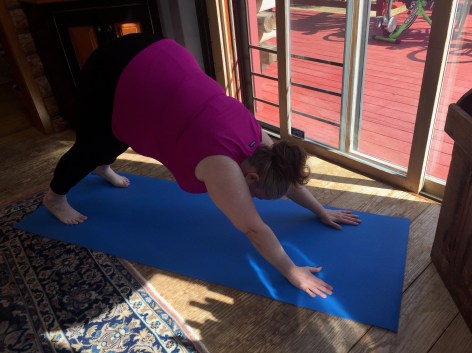
I didn’t bring my bike setup, instead opting for the ease of a yoga mat. I had a good view of the cyclists from inside (except when in down dog). Norah joined me for a nice morning stretchy workout.
Me in downward facing dog on my mat inside the house.
Others decided to do walking meditation in the woods, appropriately bundled up for the weather.
Kathy, coming back from her walking in the woods meditation.
Mid-afternoon we headed to the beach. The wind had died down, and the almost-full-moon was rising.
Almost-full-moon, rising over the ocean in Maine.
There was some cavorting.
Me, posing by the ocean.
As I finish up this post, I’m wondering if there’s any message here other than “hey, my very nice friends and I are having a very nice weekend in a very nice place.” Hmmm. I think I have one:
Life is tough. Bad things happen all the time, and a big bad thing is happening now. We are hearing a lot about how to deal with this and other big bad things. Let me add one more way: if you have the time and the space and it feels safe to do so, spend some easygoing time with people you care about.
Kathy, me, Michele, Lisa and Rachel in front of the Nubble lighthouse (before Kim and Norah arrived).
Readers, what are you doing to deal with big bad news these days other than reading and listening and talking constantly about it and washing your hands? I’d love to hear from you.