Sat with Nat · weight lifting

The Power of Positive Peer Pressure

I’m very lucky to have a workplace gym. I haven’t always made good use of it. Last fall when my regular workout buddy was no longer able to join me I made a new weight lifting routine. It sat on my workstation until a week into January.

That first week of January a laughing group of my colleagues passed by me on the way to the gym late in the afternoon. I smiled and chatted then was delighted when they invited me to join them.

It took a couple tries until I had all my gear at work and my calendar cleared. Six weeks later it’s a habit. Not everyone can make it every day but we block the time in our calendars and check in. It’s very positive.

Our goals are as diverse as our ages. I think we span 4 decades with the youngest in her thirties and at least one of us is 60. We are all women in leadership roles. Our workout styles & preferences are varied. Some of us prefer virtual classes. Others, like me, a weight lifting routine.

I really appreciate being part of the group, the camaraderie, sharing tips & tricks and seeing the skills and competences we have in the gym.

I find going to the gym very challenging. I don’t like the mirrors everywhere. I struggle to be a beginner…AGAIN. What I love is how this opt-in-supportive and positive peer pressure has helped me get to the gym 4-5 times a week. It’s feeling really good.

A picture of a red and white puppy with half dropping ears and her tongue sticking out

This photo is in no way related to the post but my new dogpanion Lucy is just too dang cute not to share.

Book Club · Book Reviews · fitness

Join the Fit is a Feminist Issue Book Club!: We’re reading The Joy of Movement

Joy of Movement

We’re reading a new book and we’re inviting you to join us!

You can buy the Joy of Movement here or from a local bookshop or your favourite online retailer.

What’s the plan? Christine, Catherine, and I are reading a chapter a week, for seven weeks and writing about it here. We did that for Nia Shank’s book The 100 Day Reclaim: Daily Readings to Make Health and Fitness as Empowering as it Should Be. And we liked it so much we’re doing it again. Read what our reviews looked like here.

What’s different this time? We’re inviting you to join us. Read along and put your contributions in the comments. It doesn’t need to be a lot. A few sentences, a few paragraphs, whatever you’re moved to write.

When do I get started? Reading? I’d recommend this weekend! Commenting? We’re starting Tuesday, March 10th. Our review post will usually goes live at 2 pm EDT.

Is it a good book? Actually, we don’t know yet. We’re reading it week-by-week with you. It *looks* like a good book. That’s why we chose it! But we’ll see.

Feel free to drop in or drop out at anytime. This is a fun, informal gathering of feminist friends interested in reading books about fitness. If you’re interested, let us know in the comments to this post.

We’d also appreciate suggestions of other books to read and review as we go.

fitness

Motivation to rest

I have been attending a yin yoga class for seven weeks now, and it’s been a very productive approach to managing my hip issues. Each week the yogi picks a theme we reflect on as we engage in the poses.

keren-perez-T0XVVMvMx_Y-unsplash
Image shows an older white woman sitting on a mat with her legs crossed and her arms clasped together. Photo by Keren Perez on Unsplash

Last week the theme was motivation. Exercise-reluctant me went “great, another way to engage with feeling fit and well.” Given the volume of snow that has fallen in the region, being motivated to do anything can be a struggle.

As we started in our first pose, the Butterfly, my mind mimicked the moves of the namesake insect. My thoughts went flitting from one flower to another, thinking briefly on the myriad of things I have to do in the run of a day and also my week.

As we shifted into the next pose, I realized the yogi had also shifted her focus. This whole class was about motivating ourselves to respect rest, to be motivated to embrace its power to heal and energize.

I’ve been looking at sleep and rest for a while now. I’ve written about it here with respect to tracking tools. There’s also some solid research looking at the links between sleep deprivation and increased rates of obesity, diabetes, heart disease and depression.

But I had never really thought about motivating myself to rest. In this class, I came up against some of my resistance to rest especially when ill, or over extended. There is a tendency to expect women to push through whatever ails them.

Part of my issue is that I often see sleep or naps (as much as I love them!) as time lost, as time away from getting the things that matter done, instead of seeing rest as something that is really important, in and of itself.

It’s a distinction that we need to make. When I look back at the last seven weeks, I realize that the yin yoga practice has become a way to give myself permission to rest, to make a space in my week where restoration is actively pursued.

We sink into poses, we rest in the slight movements or changes of position we need to achieve the tension required to support the stretch, the lengthening of ligaments, the relaxation of the fascia.

In this practice we end the session with shavasana, or corpse pose. Its purpose is to remove any tiredness resulting from the effort of getting in, stretching, and getting out of each pose and to rest in the space where our minds are calm and we no longer flit about from topic to issue, from need to crisis.

How we get into that pose is deliberate, focused on ensuring we have what we need to rest actively instead of passively. Do we have blocks to support our knees? Shall we use bolsters on which we can rest our legs? Are our heads comfortable and our necks supported appropriately? Are we warm enough?

Making rest a priority, through sleep, through naps, and even through yoga, matters not just for health but also fitness. My trainer says sleep is the best way to heal. If I want to perform better in the gym as well as in my daily life and work, rest has to become one of my big rocks.

What about you? Do you need motivation to rest? How do you achieve peace and relaxation in addition to good sleep? Tell us more in the comments.

MarthatFitat55 lives, works, plays and rests in St. John’s.


fitness

Is there a feminist response to Covid19?

“Illness is the night-side of life, a more onerous citizenship. Everyone who is born holds dual citizenship, in the kingdom of the well and in the kingdom of the sick. Although we all prefer to use only the good passport, sooner or later each of us is obliged, at least for a spell, to identify ourselves as citizens of that other place.” — Susan Sontag, Illness as Metaphor

Sontag wrote Illness as Metaphor in 1978 (and a follow up about HIV a decade later), arguing that our way of talking about illness (her primary example was cancer) demonizes our relationship with our bodies, positions us as victims and paralyses us from making thoughtful and informed choices.

Sontag keeps coming up for me as we navigate the world of a potential pandemic. Most of the people in my world — and at this moment, all of the blog authors — are in the kingdom of the well. We are (mostly) not immuno-compromised, financially sound, and have access to functioning healthcare. But the all-pervasive, constant flood of updates about covid19 has located us metaphorically in the kingdom of the sick. And this is causing some serious paradox and disorientation for me.

Quick note: I’m of two minds about writing this post. Like everyone I know, I’m feeling overwhelmed by the whole topic, and would actually just like to think and write about enjoying handstand practice and whether ice cream is a good idea or not. On the other hand, NOT talking about it feels like I’m trying to enjoy a peaceful bike ride while pretending there’s no pack of dogs howling around me. Everything seems to get mediated back to this topic — my work is up in the air, so I’ve had to change plans for to travel in May; I work in healthcare (though I’m not a clinician or a scientist), so every work conversation comes back to screening, or whether there are enough masks, or meetings that are postponed for “pandemic planning.” Friends in other parts of the world (Italy, Seattle) are experiencing shut downs, being asked to work from home, etc. Everyone is trying to find good answers in the face of high uncertainty.

The very purpose of this blog is to foster a lifelong inquiry into what it means to have a feminist relationship with our bodies, with fitness and with health. And I keep finding myself critiquing the discourse around covid19 and my own response to it from my foundational lens of intersectional feminism. So here are a few of my encounters and my response.

My first encounter: stigma and racism. A couple of weeks ago, when most of the cases were still located in Wuhan, a friend posted on social media about “coughing while Asian,” describing an incident on public transit where she’d been stonily glared at while coughing into her scarf. I was unsettled — though I guess not surprised — when I watched a dozen people pop into her feed to tell her that wasn’t fair because she was “clearly Canadian” and didn’t look like she’d just come from China. Right, good Asians (assimilated, whatever that means?) and bad Asians (what even is that?). Time for an allyship moment in the comments section.

My second encounter: a more complicated exploration of the feminist stance on economic impact. I was talking to a friend who noted that she had canceled a planned workout class because she had cold symptoms; the gym responded that cancellations are subject to forfeiting the class fee. “Shouldn’t they be encouraging people to stay home if they feel sick?”, she wondered.

As a general stance, of course this makes sense — we should be encouraging people to stay home if they’re sick, advocate for paid sick leave, and, if we live in a part of the world without funded healthcare, waive the fees for testing and treatment of coronavirus and other similar illnesses. So far so good. But how does this theoretical stance play out when the person you are asking to bear the cost is a small business owner, like an independent gym? And what are the ethical implications if someone chooses to take advantage of a virus-spawned discount, like cheap flights? And do those ethics change if this is a person for whom this presents a rarely affordable opportunity to travel?

My third area of musing: empowerment and choice. This is the biggest one for me. The essence of what we are all engaged in in this community is that in our relationships with our bodies, we are self-defining what strength means to us, what powerful means to us, what fit means to us. We critique dominant discourse about weight, about beauty standards, about gender, about aging, about cultural expectations. We are developing a new and agile vocabulary around personal choice-making.

And yet, I’ve noticed a pressure in the public discourse around covid19 to take blanket stances about how other people should behave. (Again: locating us all in the kingdom of the ill). Of course — and I will repeat this multiple times — if you are in a place with an outbreak and you are asked by public health authorities to stay home or avoid gatherings, you should do that. But if you are not, that blanket rule doesn’t apply.

It’s true that “social distancing” — limiting movement and large gatherings — is one of the primary means of containing a highly transmittable illness. And as ethical and accountable members of our communities, if we are asked to stay home, we should. But if we don’t have personal risk, and if the public health voices are asking us to be thoughtful, we shouldn’t be making those decisions for other people.

In my world, one of the biggest discussions is about traveling, with many voices suggesting that the ethical thing to do right now would be to limit travel. For me, it’s an important thing to consider — but not a position I want to take on behalf of other people. Again, awareness of my privilege. For some people (like me), travel is a common experience — for others, it’s something to plan for years for. I have yet another friend with an upcoming honeymoon, a holiday she’s looked forward to and saved for for years. People have said to her “you should cancel your plans.” This stance means they’re not seeing her a person, but as a disease vector. Which, right now, she is not. As I write this, we have zero community-based incidents of covid19 transmission in Canada. Her plans are not to go to any of the places currently experiencing a significant outbreak.

This will possibly change, but at the moment, any risk related to my friend is purely theoretical. The official stance from public health voices in Canada right now is that the biggest concern about travel is being disrupted and possibly quarantined — not about contracting the virus. So doesn’t that come right back to thoughtful personal choice?

Of course we need to be informed and cautious — we need to track the emerging science, we need to speak up in the face of racism and stigma, we need to be thoughtful about the economic impact of global and local disruption, and we need to support the public health system and response that limits the spread. We need to make our own informed choices about travel, and basketball games, and staying home if we feel ill. We should practice self-care if we need to limit our exposure to the barrage of info. And most of all, we need to be kind to each other — not to let our own anxiety shut down other people’s processes of making personal, informed choices.

Uncertainty is hard, and we want rules. That’s natural. But the vast majority of us are actually living in the land of the well. And we need to make our own thoughtful, informed choices about how we enact that wellness at this point in history.

Fieldpoppy is Cate Creede; next week she’ll be back to writing about her SI joint and exploring tricep ring dips.

Fear · gear · yoga

First Time Ever Surfing

I’ve never boogie boarded. I’ve never really body surfed. I’ve never skateboarded. So, when friends convinced me to take a surf lesson a couple of weeks ago in Costa Rica, I was flat out scared. Surfing felt like going straight to the big time, without any warm up in small venues. It was no help that my friends were proudly showing me scrapes, cuts and bruises on their legs and lips. Yes, they were all big smiles and it’s-so-fun and you-should-try-it. But was it really fun? (If you’re a Bojack Horseman fan, you can read that last sentence with Mr. PB’s voice.)

I wasn’t scared of the inevitable humiliation of being a beginner. I am more proud of being a beginner at my age (53) than I am embarrassed by my total lack of skill trying something I’ve never done. I was scared of injury and in my worst pre-lesson moments a vision of being conked out by a surf board and drowning presented itself as a possibility, alongside all the other theoretically lesser bodily harms. Pain was a factor, yes. But more than that, I didn’t want to be out of commission for all the sports I love (and consider to be my mental health support). Especially, as I’d be getting back from Costa Rica in time for my last weeks of cross-country skiing, likely until 2021.

But … I like to think of myself as a gamely person. Also as someone who doesn’t run away from every fear she has (I’ll sit with my fears in meditation sometimes). I said yes, to prop up that particular aspect of my self-image.

That’s how I found myself prone on a surfboard on the beach, pretending to paddle with my arms and then push up quickly to a standing position. So easy on the beach. Kind of like a quick-quick transition from yoga’s chataranga pose to warrior one, with cupid-like arms.

Oh, and if you’re a surfer, I will also mention that I’m goofy. Yes, my goofiness pre-dates surfing, but now it’s been certified.  For non-surfers, that means that my back foot on the board is my left foot. To determine which foot is your back one in surfing, launch yourself into a sock-slide on a smooth floor and notice the position of your feet. Right foot back is regular. Left foot is goofy.

All this beach practice was one thing. You will not be shocked to learn that it’s a whole different story in the water.

Since there are no pictures of me surfing and I didn’t want a random woman from Unsplash (also–what’s with all the giant breasts and tiny bikinis when one searches “woman surfing” on Unsplash??), this is a picture of Tamara surfing bigger waves than I did (by Cat Slatsinsky). I interviewed Tamara for my book and this picture is in it.

Nosara is supposed to be one of the easiest places to learn how to surf. From my vantage point of absolutely no expertise, that sounds plausible. Over the course of my first hour on the surf board, I stood up and surfed to shore four or five times. When I say “surf”, I’m using that term loosely, to describe what might not be immediately identifiable to the outsider as surfing. Picture everything in frame-by-frame slo-mo on tiny waves and you’ll have an idea of my version of surfing. An exhilarating challenge, yet also just playing. Plus, ocean. Plus, deliciously physically tiring.  

Yes, I fell off the board more than I stood on the board. Yes, I seem to still be discovering bruises I hadn’t noticed and can’t remember exactly which mishap caused them. Not to mention the carpal tunnel syndrome ache in my left wrist from guiding the board through the waves walking out to where I was going to theoretically catch a wave. And yes, I was scared each of the two more days I surfed. But not scared enough not to do it.

Because my friends were right; I reveled in the total liberation of the novice. With no expectations of how things should be, the experience of right now is super charged. Every victory is epic.

I will surf again. Some extra items I’ll acquire before then: a water-worthy hat with a 360 brim and a chin strap; ultra-zinc-y sunscreen for my face and the backs of my hands; water shoes to alleviate fear of sharp shell cuts; maybe even a surf shirt that isn’t too big.

Because I found the surf shirt I wore at my apartment a while back, after so many guests had come through that I claimed it as my own, instead of contacting every different person to see if they’d mislaid a surf shirt (why had they even brought it on an NYC trip? Surf shirt owner—if you are reading this and it’s yours, happy to send it back. I only wore it three times for extremely light surfing).

To offset total novelty, I also did a lot of mat yoga in Costa Rica (I say “mat” because these days I usually I do aerial yoga, easier on my hamstrings). How could I not? Nosara is overflowing with yogis. I took my first class at The Gilded Iguana, where I was staying. The studio was small and gorgeous, reminiscent of a glass-enclosed tree house. Disconcertingly, the class ended up being private, because I was the only person to show up. In this land of yoga, the studio was so new that it hasn’t caught on yet (check it out if you go!). That was an intense class. Then, on the instructor Violeta’s recommendation, I went to two other classes at different places, with teachers she loved. At the first class, packed with 20 and 30-somethings, in full yoga retreat mode, I was initially daunted. They would all be so much better than me. They were all so young. Then I thought, wait, I’ve been doing yoga since before they knew how to walk. The classes were excellent—one with Emily at Bodhi Tree and the other with Zack at Harmony. The studios were beautiful, shaded, open-air, wood-floored oases. The wind was up during one class and we practiced to the soothing clicks of bamboo trees knocking against one another.  

By the time I boarded the plane home, every muscle in my body was exhausted. That’s a good vacation, for me. 

Yesterday, I was out cross-country skiing, one of my absolute faves (no offense surfing). When I got to the top of my most-loved climb, I paused to take in the view and breathe, and once I’d caught my breath, breathe in some gratitude for the gift of the ski.

fitness · nutrition

#InMice and OJ

I finally got to use the hashtag “InMice” on Twitter. What’s it mean?

From It’s just in mice! This scientist is calling out hype in science reporting:

“Mice form the basis of all biomedical research. As the quintessential model organism, they are perfect specimens in which to study all sorts of human conditions. But just because a drug performs well in mice, that doesn’t necessarily mean it’ll have the same result in humans. Science journalists and press releases — as translators of these findings — often fail to clearly demarcate that line.

A new Twitter account hopes to make that line much clearer. Last Friday, tweets from @justsaysinmice started making the rounds on Twitter and they quickly went viral. Every tweet — all 11 of them so far — follows the same pattern: A news story or press release with a sensational headline is tweeted out, with two simple words tacked on top: “IN MICE.””

The story that caught my eye was on orange juice, partly because of a playful ongoing argument with a friend who is quick to remind me and others that OJ is the nutritional equivalent of coke. Not evil, but not exactly health food.

But this story suggested we’d been missing out.

“A new study from London’s Western University suggests drinking two-and-a-half glasses of orange juice a day could help prevent heart disease and diabetes. Researchers have found a molecule, called nobiletin, in sweet oranges and tangerines that significantly reduces obesity and can reverse its negative side-effects.“Obesity and its resulting metabolic syndromes are a huge burden to our health care system, and we have very few interventions that have been shown to work effectively,” said Murray Huff, PhD professor at Western’s Schulich School of Medicine & Dentistry in a statement.”

Hmm. But read on and the results were only shown in mice.

So I tweeted.

Medical researcher and occasional guest blogger Dr. Savita weighed in.

Sounds like unless you want 20g of sugar and you just want the health benefits, if the results work out in humans and not just #inmice, there are better ways to get it.

OJ coming at you!
OJ coming at you!
fitness · illness · weight lifting

Fitness in the time of pandemics: Working out alone or together, at home or at the gym?

It feels selfish to be writing about fitness from the perspective of staring down a possible pandemic, but I confess when I think about home quarantine from my self-interested point of view, exercise is one of things I think about. It’s not just keeping my fitness I’m worried about, though there is that. Working out and movement feel like they’re central to my emotional health and mental well-being.

That’s not all I think about of course when it comes to the possible coronavirus pandemic.

Over on Twitter, I think about covid-19 from the perspective of an academic administrator.

I worry about it a lot as a humanitarian crisis.

I worry about it as a problem for society when I have friends tweeting about cheap airfares. I think there’s an obligation to do all that we can do to slow down transmission of the virus. Likely that means staying home.

As a feminist philosopher, and as a human being, I worry about how quickly people move to say that covid-19 isn’t that dangerous because it’s only really a threat to the elderly and those with underlying conditions. What does that say about which lives we value?

I like this reframing.

I worry about political systems, especially south of the border, and the need for affordable health care, paid sick leave, and testing.

Lots to worry about but I like it that’s there’s some practical things we can all do to prepare.

Again, I like the framing this piece on preparing for pandemics as a pro-social action offers us.

“Be ready? But how? It seems to me that some people may be holding back from preparing because of their understandable dislike of associating such preparation with doomsday or “prepper” subcultures. Another possibility is that people may have learned that for many people the disease is mild, which is certainly true, so they don’t think it’s a big risk to them. Also, many doomsday scenarios advise extensive preparation for increasingly outlandish scenarios, and this may seem daunting and pointless (and it is). Others may not feel like contributing to a panic or appearing to be selfish.

Forget all that. Preparing for the almost inevitable global spread of this virus, now dubbed COVID-19, is one of the most pro-social, altruistic things you can do in response to potential disruptions of this kind.”

But back to fitness. And back to just thinking about why I might do if I had to spend stretches of time isolated from others.

I take it there’s no reason not to ride my bike out alone in the world. I can carry my own snacks. While big races are being cancelled, there is no reason not to ride outside of big crowds, assuming I’m not actually quarantined.

There’s also Yoga with Adriene and walks in the woods with Cheddar. Both will be just fine even if I’m staying at home more to avoid public gatherings.

I’m not sure what I think about working out at the gym, especially the student gym though. And I’m not sure what I think about yoga in the close quarters of the studio.

Lots of photos of walking in the snow with Cheddar and a bonus friend’s dog. Hi Emilie!

I also belong to a 24 hour discount fitness club. Maybe I could go there and take disinfectant wet wipes, wash my hands often, and work out there in the wee hours? I’m not sure. I’m considering buying a set of dumbbells for home use.

A gym, Photo by Mark Bertulfo on Unsplash

Certainly we’ll set up our home TRX.

Here’s the fitness routine of quarantined racing cyclists!

What are your thoughts about the gym in times of avoiding crowds and germ-y surfaces? I’m still thinking this through. I’d appreciate your thoughts.

If you’re still thinking about what all of this means for you, I recommend following Helen Branswell on Twitter and following STAT news on coronovirus. Normally that’s behind a paywall but it’s free now for that topic only. Also give The Coronavirus isn’t going away a listen.

fitness · strength training · weight lifting

Women, Are You Ready to be Weird?

Are you ok with not fitting in, or would you rather blend in with the crowd? If you are watched, noticed, and possibly commented upon by your community, would that derail you from your pursuits? If these discomforts don’t deter you, ladies may I suggest you take up weightlifting?

Early stage weirdness requires being willing to wander around the weights portion of your gym not sure what to do. You’re going to have to guess how much weight you can lift and you’re going to have to wonder how to do the lifts correctly. You will mess up. You will stand out. Not because you are new, because there’s always someone new, but likely that someone is male and many males have an armor of “fake it ‘til you make it.” So, I suggest you do the same. Strut in there, fake some competence, and walk out knowing you started on your journey.

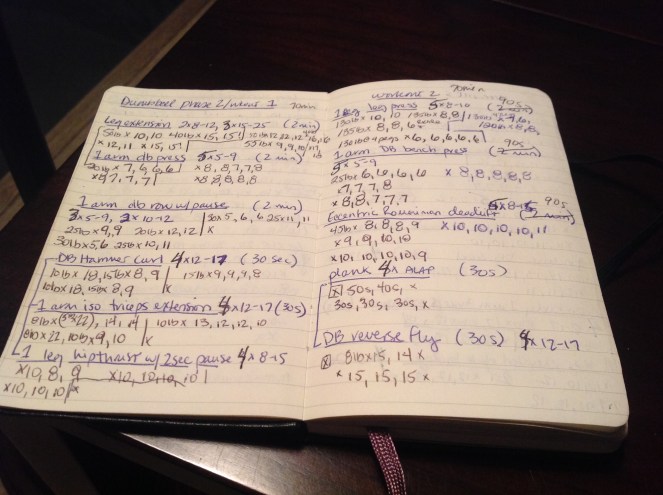
As you develop some competence and confidence, those who are sincere in their pursuit of weirdness will likely need to begin to log their work at the gym. You will be less weird if you do this on your phone, but those who are aiming for purity will begin to carry a workout log book. The log book will allow you to switch up your workouts day to day and week to week and see your progress as you go. There can be real celebration in this form of weirdness, because you will have concrete evidence of your growth. As you move up in weights, away from smaller dumbbells towards larger ones, or begin using the barbell and adding weight on the bar, you can see that you are getting stronger. This is wonderful! It will also make you different, as only a small percentage of those around you will be working out with such a sense of purpose and focus. Expect people to ask you what you are writing down in that little book.

This intermediate stage of weirdness also includes some changes you may choose outside of the gym. You might find that you want more protein at each of your meals, which can require feeling different from the other ladies when you go out for brunch. No longer are you splurging on the pancake plate and hashbrowns. No, you need to get your protein in, so how many eggs does that omelette contain? And can you add some smoked salmon to it?

You may decide you like wearing tank tops, even though the women around you are always talking down about their own arms, shoulders and bust. You know you don’t look like a model, but you’ve become proud of what your body can do and it’s fun to show off a little bit. That pride is wonderful, but it isn’t normal. You will stand out. Dig in deep to this weirdness!

You may try new things that you’ve only seen online or learned from a trainer. Maybe you do dynamic tension, wrapping huge rubber bands around the bar before you squat or bench press. Maybe you begin lifting in minimalist shoes or even just in specially designed lifting socks. You take the risk of trying all the rep ranges–you don’t let your ego force you to go heavy every time nor allow your fears keep you with lighter weights and high rep ranges.

Standing out in the crowd really takes on a whole lifestyle change somewhere along the way. At this point, when you walk into the gym, you are going to walk with confidence to the heavy weights and then begin to do things few around you are willing to do. You will stand out as you set up your bar with weight plates. Your confidence and sense of space–that you own that place in the gym at least as much as the next guy, and maybe more so because you’ve earned it from dedication and hard work over a long period of time–this will make you different from the people around you. They will notice. Some of them will find you inspiring. Others will feel challenged by your existence and may try to cut you down. This can be a real test to your ongoing pursuit of weirdness. How will you respond if a man, through his actions or words, suggests that your work is less valid than his? Are you ready to be really weird and stand up for yourself, loudly and where all can witness it?

You may need to stand up for your weirdness with family and friends, too. Are you ready to defend your choices to your mother who is worried you’ll hurt yourself? If it applies to you, are you ready to answer the question, “How does your husband feel about you getting so strong?” to a well-intentioned but totally off-base friend? These challenges are real, but they are worth it. In exchange for standing out in these ways, for being labeled and harassed, you will have the confidence of knowing you are living a life in tandem with your values. You can feel mentally and emotionally stronger by persisting to explore the limits of your physical strength.

Are you willing at this point to dig in deep to your weirdness and pursue real strength? You could choose an elite level of weirdness and possibly try to even GAIN weight and get BIGGER? Would you eat more food than you need so that you can pack on some muscle? Those who get to this level of weirdness are pushing the boundaries of what is expected of women, and as they show up in their bodies every day, they are making a statement about who they are and what place they are creating for themselves in the world. It is not easy to buck expectations for femininity at every meal. Few will understand your goals. Even fewer will be sympathetic if you find it challenging. “Poor you, you can’t gain weight. I feel really bad for you.”

Are you willing to stand out even within the strength-pursuing crowd and avoid the quick fixes and half-baked solutions? Go evidence-based and feed yourself the fuel you need, do the work, and trust the process? It’s a long game, and there will be folks who seem to be your peers suggesting things that you need not do to reach your goals, things that are potentially harmful and are certainly unsustainable. Again, you can find inner strength as you gain in knowledge and confidence.

Succeeding at being consistently weird is a lifelong journey. At not all stages of your life will you be willing to push being different from others to the same degree. It’s ok to let your weirdness ebb and flow with other priorities in your life, but know that this is a goal that can really change who you are and how you interact with others in powerful ways. And it’s worth it. Taking up more space and owning it, having confidence and competence, will improve your life. So ladies, are you ready to be weird?

Marjorie Hundtoft is a middle school science and health teacher. She can be found standing out in the crowd, picking up heavy things and putting them back down again in Portland, Oregon. You can now read her at Progressive-Strength.com .

Image description: A photograph of a workout log, with the names of exercises and the weights, sets and reps recorded below them.
self care

The persistent demands of early morning self-care: what to do?

I used to hate challenges; you know, those 7-day/30-day-read-a-book-a-day-type challenges. I’ve written here about my problems with them. But in the past couple of years I’ve found some ways they work for me. The 220 workouts in 2020 group has taught me a lot about how to use the experience of being in a challenge to examine, motivate, question and reshape how I do physical activity. A bunch of our bloggers are in this or similar groups and have written about challenges (most recently Martha’s post here).

My friend the New York Times has talked me into trying yet another challenge– their new new 30 Day Healthy Habits Challenge. It’s a combo of advice bits about movement, eating, social connection and mindfulness. (CW: it also suggests a form of dieting that may trigger some with a history of eating disorders, so do be warned).

One thing that keeps tripping me up with this challenge (and other such general self-care advice) is this: I’m supposed to do a whole bunch of things, many of them FIRST THING IN THE MORNING.

Challenges are big on doing things in the early morning. It appears that, upon waking (or in my case, being lurched into consciousness by my loud alarm), I’m supposed to

  • meditate while sipping my coffee
  • use my newly-selected mantra for said meditation (which, if I had one, would be “I just need coffee now”)
  • do gentle yoga
  • do a short workout
  • take some time to plan my day, arranging periods of quiet and reflection and physical activity and eating nourishing food in a mindful way and connecting with friends and family and taking a self-compassion break and developing a gratitude practice and reading a novel and taking a bath before getting in bed at 9:30pm

First of all, I am not a morning person. This is not me:

Drawing of person doing impossible yoga position while smiling in bed.

I’m more like this:

Silly but true-to-life meme of animal in bed, with words “when your alarm goes off and you’re deciding whether to go to work or fake your own death”

But seriously folks: self-care regimens are very heavy on first-thing-in-the-morning activity. But even for those who ARE morning people, there’s a limit to the amount of time we can devote to early-morning self-care. For one thing, there’s a limited amount of early-morning time, and we all have to get a lot done before heading to work, school, and other important things we do during our busy days. For another, we have other priorities– like writing or reading or housework or other important tasks that have to be done sometime as well.

So I’m asking you, dear readers: how do you decide what to prioritize in that precious period (whenever it is), first thing in your morning? I’d love to hear from you,