Look what I got for Christmas, a beginner’s guide to goat yoga. Hey, I’m not a beginner. I think I’ve been three times. I’m a fan. But still, it’s a fun book. Thanks Mallory!
We’re currently heading to Florida to ride our bikes for a week. But it won’t be all bike riding. We’re thinking of going here on our rest day, Dancing Moon Goat Yoga. We’ve packed our yoga mats for Yoga with Adriene. After 20 hours driving, with one overnight stop, we’ll definitely need it.
The last time I went to goat yoga I didn’t want to give the baby goat back!
I went to a studio/farm just outside London with my son Gavin and they actually let us stick around after and bottle feed the baby goats and tuck them into bed.
Yesterday I went to ropes yoga (at my local studio Artemis Yoga) after a very long break (mainly because of scheduling conflicts). It was exciting and a little nervous-making to be back; I’m still recovering from cold and bronchitis and a month of very little physical activity, so I’m definitely not operating at full strength. But I love this practice—it appeals to my inner 8-year-old who enjoys climbing, hanging upside down, and trying new things.
The teacher, Pam, is a great instructor. She’s attentive, very knowledgeable, and offers loads of modifications in a low-key way. She also keeps the class moving at a good pace, which is not always easy when you’re using a lot of props (blocks, blankets, sometimes chairs) and moving ropes around and tying knots.
This class for me was an exercise in acceptance:
acceptance that I’m not recovered from this chest cold/bronchitis, so I can’t exert myself as much as I would like;
acceptance that my strength/conditioning are what they are at this moment, which will determine what my ropes practice is today;
acceptance that my body has a history of injuries (shoulder surgery for rotator cuff tear, to name one) and vulnerabilities and hard limits (there are some poses my body flat-out refuses to do);
acceptance of being seen and being helped while doing this practice– I was feeling a bit dizzy, so didn’t do the headstand inversion; instead Pam suggested a standing rag doll pose on the wall that felt good.
I didn’t take any pictures yesterday, so I’m reblogging my previous ropes yoga post so you can see how things are set up. I highly recommend this kind of class if you have an opportunity and like to climb and explore space, limits and what your body might be able to do with them.
Me, I’ve never been a word of the year person. I’m not sure why. Does it seem too “woo” for me? Too new-age-y?
That’s the thing. I might say that but I have chosen words. On my very first blog, way back on in the days of Friendster, I wrote a post called “My 40s are for FUN.” The theme of my 30s had been FAMILY, I said. Later, I planned my 50s to be about FITNESS. Enter this blog.
I’m also seeing a massage therapist who asks each session if I want a word for the purposes of focus. Last week after way too much time in conference chairs and airplane seats it was SOFTEN. He repeats the word while working out all the knots in my muscles and makes my knees just a little bit happier.
But this is my first time assigning a word for the year. I tried doing it during my stint with Precision Nutrition but it didn’t feel right. But this year a word struck me and that word is FOCUS. (What’s up with all the F’s? I don’t know. Sorry.)
Why FOCUS? Well, it’s a challenge for me. I like to juggle a lot of different things. I often read three of four books at a time. Watch a couple of shows. Have lots of different writing projects on the go. And I’m that way with physical activity too.
But this year I need to focus. I have one goal in mind which is getting ready for total knee replacement surgery next year. It’s not going to be easy. I have to keep up the physio, stay active, and do everything with knee health in mind. There’s no wandering off in pursuit of other goals. Everything has to be about my knee.
I need to practise saying things like, “that’s not the best thing for my knee and right now I need to give priority to my knee.” Focus.
I need to not do things, like certain yoga poses, that I can do but that hurt my knee. Focus.
I need to walk the right amount to help the joint but not enough to hurt it. Focus.
I’ll work out hard but then I need to carefully plan enough rest and recovery. Focus.
After I’d chosen my word, and written this post, along came Adriene. Perfect.
Watch “Home – Day 23 – Focus | 30 Days of Yoga With Adriene” on YouTube
As I mentioned in our 100 Day Reclaim review post on Tuesday , I thought this post was going to be different.
My part of the country had a HUGE snowstorm on January 17. As in, 93cm of snow, 140+km/hr winds. This cluster of cities and towns on the Avalon peninsula has been under various forms of a State of Emergency for the past week and, as Martha noted in her post yesterday, it’s been a challenge.
In front of my house on January 18. A.K.A: Oh, there was a storm? Really?
Before the storm hit, I suggested to the other bloggers that I would write a post about my fitness efforts during and after the storm. I thought I would spend the stormy hours alternating between writing and exercise and get all kinds of things done and then, afterwards, I would rack up some serious strength training and cardio shovelling out my driveway.
The thing is, though, that you don’t really realize how much snow 93 cms is. You may understand it as a measurement but, until it is falling, you don’t really understand what it feels like.
The storm was so intense that it was disturbing on a visceral level. I got caught up in weather updates and social media posts, and I couldn’t shut out the sound of the wind. I felt that, even inside the house, I was being buffeted around, as if something terrible could happen at any second. I couldn’t write, I couldn’t make myself exercise, I couldn’t seem to settle into any specific activity.
The only exercise I did during the storm was yoga (I’m one of the people Cate mentioned in her post about Yoga with Adriene’s Home practice). That practice was great but it wasn’t all that I had planned.
I did go out after the storm and start to help to shovel the driveway but I sank in a drift that was up to my hip and managed to hurt my knee while getting myself back out. I had to take it easy for the rest of the day.
Now, as I mentioned in the 100 Day Reclaim post that is linked above, I was kind to myself about the whole thing. After all, you can only do what you can do, and there is nothing to be gained by judging yourself harshly.
So, I focused on the things that I could do.
Once my husband and sons had some ground cleared outside, I went back out to help shovel (keeping my foot on a stable surface meant less pressure on my knee.) I shovelled for short spurts, alternating where my hands were on the shovel, until the driveway was clear.
Here I am, smirking away in front of a snowbank. As one does.
I kept up with my yoga.
I did lots of stretching.
I let my knee recover.
By Wednesday, I was back to my full shovelling strength and I spend most of my day helping to shovel people out. In the morning, I joined a group of neighbours helping to excavate someone’s car. In the afternoon, I helped my brother-in-law (who has a snow clearing business) break up the snow in someone’s driveway so it would fit into the snowblower.* In the evening, I joined a local ‘snow brigade’ – a group of volunteers who were accepting requests for help – and we dug out someone’s basement apartment.
On Wednesday, my Fitbit logged 17,433 steps, 11.3kms, and 275 ‘active’ minutes. Most of those steps were with a shovelful of snow in hand.
It was an incredibly hard day but it was also, somehow, really energizing.
I get why people with ADHD could thrive in jobs with intense physical labour. This was challenging enough to keep me engaged, it had a good social component, and it gave me the opportunity to help people without having to overthink the details.
I was tired at the end of the day (and even more so on Thursday) but it was very satisfying and it gave me some more insights into my plan to increase my fitness levels.
It turns out that I feel really great after exercising for a long time.**
And, I apparently enjoy functional fitness – I find the repetitive nature of strength training really hard on my brain. It’s not that I don’t want to put in the effort, it’s that I find it so boooooring that I have trouble making myself start it in the first place. I like being strong and I want to work toward greater strength but I need to find ways to get there without having to fight my ADHD to do the work. I’m still figuring out what that might look like but the insight is still important to me.
The physical effort I have put in this week – in yoga and in snow removal- has made a difference in how I feel, both mentally and physically. I want to keep those gains so I will be following Nia Shanks advice to keep taking action toward my goals – the thinking part will develop as I go along.
Please note: I recognize that there is a lot of privilege involved in being stuck in a State of Emergency and having the leisure to reflect on how it affects my fitness. This situation has uncovered a lot about food insecurity in the communities in my area and I have done what I could to support those who were working on the front lines to ensure that people had the supplies they needed in these dire circumstances. In this post, I focused on my fitness because this is a fitness blog, not because that was all I thought about.
*Snowblowers can only chop up snow that is the same height as the blower itself. Snow that’s higher has to be chopped down to an appropriate height. Chopping snow is not quite as hard as shovelling it but it is still pretty hard work.
**Perhaps you have always known this about yourself but my ADHD likes to dissuade me from starting anything that is going to be ‘too long’ or ‘too hard’ so this realization is really important for me.
Youtube video of the cast of Cheer performing their Daytona routine on Ellen, January 22, 2020.
I watched Cheer a couple of weeks ago before anyone was writing about it or even really talking about it. I had run out of new episodes of The Good Place and wanted something to watch while I waited a week. Cheer caught my attention among the many possibilities.
It’s a six episode documentary series on Netflix that focuses on the championship cheerleading team from Navarro College—a two-year junior college in the small town of Navarro in Texas. It’s a gripping account of the training leading up to the national competition in Daytona, Florida.
Before the end of the first fifteen minutes you can see that these are athletes if there ever were any. The young women who serve as the “flyers” or “top girls” are masters of aerial acrobatics, balance, strength, and endurance. The young men who serve at the base, hurl the women up into the air, balance them on their shoulders and even their up-stretched hands, and catch them before they hit the ground. Meanwhile, the young women and men who perform tumbling routines have the speed, grace, strength, skill, and endurance of the most gymnasts at the most competitive levels.
The physical toll on their bodies—of the top girls / flyers and the catchers and the tumblers—is sometimes hard to watch. Imagine repeatedly landing, even if it’s on the intertwined solid arms of two strong men, after falling from great heights. Imagine being the base team members who catch them. The documentary audio picks up the thud of the impact. Imagine balancing your team mate on your shoulders (both the men and the women do this). Imagine doing this while you yourself are balanced on someone else’s shoulders. The result, especially when they’ve practiced and practiced and hit the moves as intended, is a mesmerizing routine that has the viewer thinking “how do they do that?!” Cheer gives is some insight into the “how.”
Of course if you’re offering six episodes, you need some human interest and drama. So of the 40 athletes on the team, the filmmaker focuses on the stories of fewer than ten — all of whom have some sort of hard luck angle — as well as the coach, Monica, born and raised in Navarro, and as tough a coach as you can imagine. She is competitive and perfectionistic, because that is what is required in order to win in Daytona. You have 2 1/2 minutes to do the routine. Period. It has to be perfect. And difficult.
I give big points for the depiction of the level of athletic skill and fearlessness required of all of the members of the team. The coach is also impressive in her focus, demandingness, and ability to cultivate a relationship of trust that makes team members not just able to follow her orders to do extremely dangerous and daring stunts, but also able to come to her with “life stuff.”
I’m not going to give an in-depth critique and analysis, but the focus on the hard luck cases (particularly Jerry, La’Darius, Morgan, and Lexi, but also Gabi whose parents come across as taskmasters), while showing how people can overcome adversity at times felt exploitative. Both Jerry and La’Darius are young African American men. La’Darius had a difficult childhood where he was bullied and taunted and shamed for his sexuality (he is openly out as gay in the documentary). Jerry lost his mom to illness and is probably the single most likeable person on television right now because of his endlessly positive and accepting attitude. At one point it looks as if he’s going to be “on the mat” for Daytona but then he is taken off the next day and he surmises that his “chance” was really just to give a wake-up call to La’Darius, who needed to smarten up. Morgan was basically abandoned by her parents as a young teen. She looks up to Monica (the coach) so much you get the impression she would do anything that was asked of her (and she does when she is a top girl).
Though of course there is drama in the very story of training for a championship—will they be ready in time? Will they win? How will they overcome THIS injury (there are lots) or setback (there are lots)? — the momentum for a six episode series (as opposed to one feature length documentary) really comes from developing narratives around these five or six young people who are overcoming adversity and having a chance to shine.
The other thing worth noting is the despite there being a small number of African American men as catchers, spotters and tumblers, the women are almost all tiny, thin, and white—there is virtually no departure at all from the cheerleader stereotype among the women in the show, except perhaps Lexi who is a formidable tumbler who is able to pull off the same floor stunts as the men (which is apparently unusual).
And while they focus on the few whose lives have been difficult, there are another 30+ team members whose families had the financial wherewithal to enable them to be active in all-star cheerleading throughout their lives. Despite the narrative angle, therefore, it’s misleading to suggest that the Navarro team is a motley crew of kids from difficult life circumstances, saved from their terrible fates by Monica. This is not to trivialize the good she does do. Nor is it to minimize the manner in which these team members, despite adverse life circumstances, along with the rest of the team, are incredible athletes who accomplished something wonderful (regardless of the outcome—-and I will not reveal it here!).
Rather, it is to note that building drama around the handful of kids who had a tougher go doesn’t necessarily depict with accuracy what competitive cheerleading at that level is typically like. Like any sport, most of the team members are groomed from an early age and are able to compete because their families could afford their extracurricular activity.
That said, Cheer is worth watching. I watched one one-hour episode a night for six nights and each time I looked forward to it. I truly cared what was going to happen to the team. And I understand that a documentary can’t spotlight 40 people and be successful. There need to be stars, people in secondary roles, and the unnamed “rest of the team.”
Whatever you think of Cheer, you can’t deny that these are all underrated athletes worthy of recognition. What they do is an amazing feat, hard to watch at all, but impossible not to view with awe.
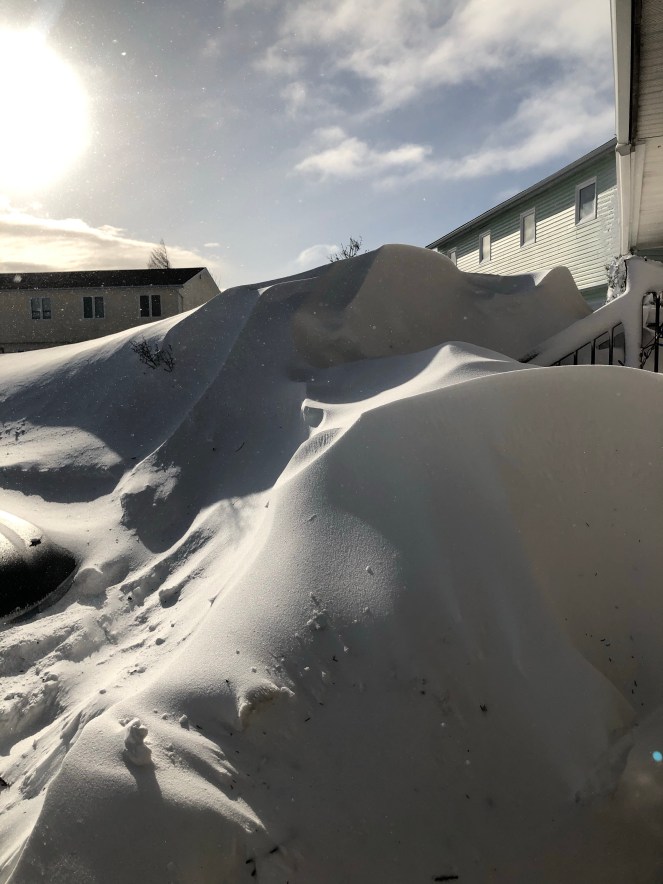
We’ve had a lot of snow here in my part of the country called Canada. In 24 hours, we got more than 70 cms (about three feet) and we listened to winds upwards of 160 kms (about 90 plus miles an hour) blow all that snow. Imagine a hurricane, but instead of rain, we got snow.
The day after, when drifts filled the driveway and blocked the front door. Image shows a huge pile of snow in front of a red garage door.
As I write this we are still under a state of emergency (SoE) and that limits how we can move around the city while we dig out from underneath.
Truth be told, I don’t want to go anywhere; I don’t want to negotiate any slippery hills either as a driver or pedestrian; and I certainly don’t want to deal with the cold and the wet.
I have enjoyed my enforced break. I read two books. I planned meals carefully knowing we couldn’t go shopping for food if we ran out. We checked on senior neighbours in our ‘hood and friends and family who weren’t nearby.
Then I worried about people without phone, computer, or even an entrance or exit to their homes because the snow barred them in. But I found a place where people were helping and that worry got redirected.
Mostly, I thought about resiliency and how we (I) moved through different stages. First wondering about the snow, the wind and the power — would it go? would the roof blow off? would we be trapped? Then thinking about solutions and how to solve each of the problems I encountered.
When I wasn’t thinking, I was trying a number of relaxation strategies both to calm and improve sleep. It seems silly to think about, but excepting for a couple of bed time tricks to get me to sleep, I hadn’t spent any time during my walking hours about applying calming strategies to help me function.
I know there are multiple approaches out there but they weren’t top of mind. When you can’t go anywhere (January 24 will be our seventh day under the SoE), you are willing to try anything to be more effective in your work, including relaxing.
My trainer says sleep is the best healer and I agree. I also have learned how to focus on the task at hand by running through the steps in my mind. This week, I realized I really like breaking things up into component parts and understanding what each piece does to lead to the successful execution of the whole action. I think that’s why I have come to enjoy yin yoga so much. Each pose has a specific purpose and effect.
I am not sure why it took me this long to figure out on a conscious level something I’ve been doing subconsciously for a very long time. However, it’s offered me lots of scope for reflection.
Our snowstorm may have been a huge inconvenience but in retrospect, it offered me a chunk of time to pause, even stop the relentless focus on outputs and review the beauty of the process.
— MarthaFitAt55 lives in St. John’s and is delighted at the possibility of snowshoeing once the SoE is lifted.
Diane Leonard, Grand Master of the Maui Marathon, Sunday, Jan. 19th, 2020.
Malindi Elmore, from my home town, smashed the Canadian women’s marathon record on Sunday, running a blistering 2:24:50. Canadian Running observed that it has been a spectacular year for Canadian women runners. Twenty records have fallen over the past thirteen months. In Houston, as Malindi was crushing the marathon, Natasha Wodak became the first Canadian woman to run the half marathon in under 70 minutes.
Fingers crossed, Malindi will run for Canada in Japan this summer, and I know the Kelowna running community will be glued to the live stream when she races. The success of our home-town superstar reflects the achievements of a larger group of amazing women runners of all ages and stages. Liz Borrett, age 80, ran the Boston and London marathons back to back last April, winning her age group at both races. Christy Lovig was the top Canadian woman at the New York marathon in November. Diane Leonard, age-group winner of the 2017 Boston, was declared Grand Master of the Maui marathon the same day Malindi broke the tape in Houston. Kelowna is home to Cindy Rhodes, six-time winner of the Victoria marathon.
I have often speculated that there is something in the Okanagan water that makes for such greatness. But having run with the Kelowna Running Club for the past two years, I’m pretty sure it’s about the running community, a community that has fostered women’s running for decades, even when running—especially the marathon—was all about men. The loneliness of the long-distance runner is well documented, but in this place, everyone has your back, whether it’s Park Run or Boston that you want to race.
When I moved to Kelowna, my friends in Ontario warned me: “Those people out there, they’re not kidding.” And it’s true—they aren’t. They race to win. And racing to win is not for everyone. But the joy of racing, at any level, is the about the joy of testing your limits. And for me, testing limits and gaining confidence in the face of adversity (currently, the fresh hell that is the marathon), is part of the feminist work I undertake as a daily practice. The women of Kelowna push me forward when I want to step back. Of my half marathon performance in the fall, a running friend observed, “I thought you would do better.” When I say these words to myself, they are part of a language of self-criticism and defeat. When I hear them from a friend, they motivate me to reach the standard she has set for me. The same is true on a long run. When a Boston veteran tells me I had better pick it up for the last five kilometres of a 20 km run, you can be sure I get my ass in gear. I run harder because the women of Kelowna believe in me, even when I don’t believe in myself.
On Sunday, while Malindi was chasing her PB in Houston, I was running a half marathon in California, and Diane was running her full in Maui. I thought of my fellow Kelowna women as I ran, knowing that all three of us were suffering. As I reached mile ten, a woman came up on my shoulder. “Let’s pass these guys,” she said, nodding at the men in front of us. In that moment, I remembered what is distinctly feminist, for me, about racing. Women prove, by their efforts, that they have great strength, strength that often goes unrecognized and unrewarded in our culture. We prove that we are determined to overcome the barriers we encounter. We prove that we will get to the finish line, one way or another, with the help of our friends and allies. Approaching the end of my race in Pasadena, I saw a young woman in front of me struggling. “You’ve got this,” I said as I came up beside her, and she took off. I kept her in my sites as I ran for my PB. I was doing my thing, and she was doing hers. But we were doing it together.
I’m staying at a beautiful resort in Tucson, Arizona. I love it here in the desert. I’ve come here twice to ride my bike in the winter. See here and here.
But this year I’m not here to ride my bike. I’m here for the annual Workshop in Normative Ethics, hosted by the Philosophy department at the University of Arizona. It’s a great conference and it’s at this very lovely resort/conference center. Thanks Mark!
From the article, “According to a new study, wealthy men and women don’t only live longer, they also get eight to nine more healthy years after 50 than the poorest individuals in the United States and in England.”
“In both countries, wealthy women tended to live 33 disability-free years after age 50 — eight to nine more than poor women, the study found. Wealthy men tended to live 31 disability-free years after 50 — eight to nine more than poor men.”
Wealth mattered more than education and more than social class.
I guess I’m not shocked. Here in Arizona, I was struck by the very fit seniors staying at this resort. I listened in on their tennis lessons while reading some conference materials outside. Nice to have a keen coach giving you advice on your serve. But there’s not just tennis here. There’s also golf. And swimming. And biking. And hiking trails. And a gym.
The other thing that’s got me thinking about wealth is my knee replacement. I’m waiting nearly a year and a half for it in Canada. I know people in Canada who don’t wait. They travel south to the US for joint replacements. I even looked up prices. It was easy to look because I’ve posted so much about it on social media that there are many ads in my newsfeed for American hospitals marketing their wait free services to Canadians. $49,500. Wow. Guess, I’m waiting.
The knee replacement will be covered fully by my province’s health plan when it happens. Note though that none of the conservative strategies–injections, knee brace, physio–are covered by that plan. Instead my workplace benefits paid for that. I’m very grateful.
But if I were an American without health insurance or if I had benefits didn’t cover the full cost of knee replacement and I was trying to juggle launching three twenty somethings with my own pain and lessening activity levels, chances are I’d wait for surgery longer than the wait here in Canada. Waiting means, for most people, being less active.
I’m wealthy by most measures but I’m not “fly to the US and pay out of pocket for joint replacement” wealthy. I am “knee brace and physio” covered by workplace benefits wealthy. But it all seems very clear to me that in terms of staying active, wealth makes a difference.
And I guess I’m not surprised that wealth means both more years of life and more healthy years but the number of years did surprise me. Colour me naive. I know. Also, I’m curious to see what the results would be in Canada.
Following my frustrations with finding a small multi-sport watch and the premature demise of my Apple Watch (which had been the compromise solution for my small-wrist problem), I’m pleased to report I’ve opened a new chapter in the saga.
As of a couple of weeks ago, I’m the owner of a Garmin Forerunner 245 Music, and so far I’m very happy with it. Yes, it is chunkier than the Apple Watch, but it’s still just about OK on my wrists. It actually hasn’t bothered me at all – I suspect this is because the Apple Watch acted as a “gateway drug” to my wearing larger watches and I was already sort of used to a large-ish thing round my arm.
Black Garmin watch on Bettina’s wrist.
It also has some pluses over the Apple Watch, which I’m either already enjoying or looking forward to: + Battery life. I charged the Apple Watch every night, but the Garmin lasts at least a week. This is phenomenal. + Music. I bought the AW on the speculation that an autonomous app for Spotify was coming that would allow me to listen without bringing my phone along. Not so. Apparently they’d rather push Apple Music on people by refusing to do this. I have Spotify Premium but don’t want to pay for two music streaming services. Garmin has such a standalone app, though I have yet to try it. I think it will be very nice on solo runs. + Sturdiness. The Garmin looks like it just might survive a fall of the kind that killed my AW (I’m still not planning on trying that out). + Sports stats. I prefer the way Garmin presents those to the AW ones. It seems cleaner to me and less gimmicky. Though there are definitely some gimmicky tracking features, like the “body battery”, I could totally live without, but I recognise that this is entirely down to my personal taste. YMMV. And I like the way the stats are presented mid-exercise more. The display is easier to read while running than the AW one. I also still need to explore all the sports functions it has! I haven’t taken it on a bike ride yet, for instance.
There are also some aspects where I preferred the Apple Watch though: – Size. The Garmin is noticeably bigger, though as I said above, it hasn’t bothered me that much – Look. The AW was sleeker, and it was really easy to switch out the sports wristband for a more elegant one, e.g. for fancy work events. I think in future, I will appear watchless at such occasions. Not a big deal, but it is nice to have a watch around for these. I’ve never been one to own multiple watches, but I might rethink that philosophy and buy a small, nicer-looking watch for “fancy times”.
And then there’s one difference I’m neutral about: = Smartwatch functions. The AW is clearly a smartwatch with great sports functions, while the Garmin is clearly a great sports watch with smartwatch functions. I’d gotten used to some of the smartwatch functions on the AW and turned others off, but I’m also not missing those I did use all that much. I still have my phone for reminders etc. So far, I haven’t been in a situation again where I wanted to send a text from my watch – doesn’t happen often, so I can live without that feature.
I haven’t regretted my purchase. Overall, so far I feel like the Garmin’s skew towards the sports functions is more in line with what I wanted than the AW was. Let’s see how it goes!
I’m sporadically doing Yoga with Adriene this month. Usually it’s Adriene and her dog Benji and me and my dog Cheddar on our respective mats.
I’ve loved all the photos of people doing yoga at home with kids, with dogs, and with cats too. People are sharing them on social media. This weekend I’m doing Yoga with Adriene in a conference hotel in sunny Tuscon, Arizona. The big upside? Space and time to myself.
I realize that paying for yoga classes in a studio is one kind of privilege. Another kind of privilege is having a house with space to do yoga at home. The only room in our house with yoga space is the living room and it’s usually occupied. I’m self conscious, really self conscious, doing yoga with an audience, even a family audience. Also people talk over Adriene’s instructions.
Starting next week, for the first time in twenty seven years, I’m going to have an empty nest. No kids at home once the youngest goes away on a university exchange to Australia. Maybe his room can be the at home yoga studio?
Where do you do yoga at home? Who keeps you company?