fitness · research

Getting Fit at the Library (guest post)

This post is by Pamela Hayes-Bohanan: friend, colleague, and librarian extraordinaire. Read and enjoy, and don’t forget to check out the reference (properly formatted, of course). -catherine w

So, what does a librarian know about fitness anyway? Just as she doesn’t need to be an expert in chemistry to find the boiling point of iron (2750.0 °C; 3023.15 K; 4982.0 °F btw) she likewise doesn’t need to be an expert in exercise and nutrition to assist someone with locating the best information to help them help themselves.

As a reference and instruction librarian for the past 25 years, I have helped people do research on more topics than I can possibly remember. Sometimes I’m helping with a course assignment, but often the information is for personal use. It is hard to balance between helping someone simply find what they’ve asked for (a trendy new diet book perhaps) and wanting to do some real education with them about where they can find better or more evidence-based information on healthy eating, nutrition, and weight loss. Ultimately, however, it is my job not to judge, so if someone wants a recipe for a Paleo Shamrock Shake I will do my dangdest to find it, and I won’t roll my eyes or smirk, either. (And if I piqued your interest, here’s the recipe. Do trust me, though, that no caveman ever drank one of these.)

What I can do via this blog post though is provide some guidance on how to navigate the proliferation of information that one will find on just about anything, whether they ask for it or not. How can you tell if the advice you’re receiving is something to heed? There are several things you can look for to help determine its worthiness.

The first thing to do is to check your own bias. Are you only looking for information that supports what you already believe, or want to be true? If you want good information start with an open mind and be prepared to broaden your horizons.

Once you find some information consider the source. Remember that just because you trust the person who shared the link, tweet, or blog post, it does not necessarily follow that the information is trustworthy.

Look for an author name and organization attached to the site. Then LEAVE the site and start sleuthing. See what else you can find out about the person and/or organization. Once you start your investigation look for things like: What are the authors’ credentials? Do they have other publications? Do they have a medical degree? Or is there something (anything) else that leads you to believe they know what they’re talking about? Are there news stories, or reviews of the people or organizations you are researching?

Don’t take shortcuts. Often people are taught simple rules regarding domains. (e.g. It’s okay use .org, .gov, or .edu sites; don’t use .com). Organizations each have their own biases and need to be researched. For instance the National Rifle Association and Moms Demand Action both have .org domains, and each provides a very different view on gun control from the other. Government information is influenced by lobbyists (many of whom represent commercial interests), and government sites are vulnerable to the whims of the head of state as well. Not all educational institutions are created equal, and even scholarly research published on university websites may be influenced by religious, or political motivations. Commercial sites shouldn’t not necessarily be dismissed. Aggregated subscription databases found at your library are commercial websites. So, my rule of thumb is: eschew facile rules of thumb.

Another question to consider is whether the website is collecting information about you. Are you required to provide personal data in order to access the site? If so, the site may be more interested in gathering information than providing it. Also be aware that sites that appear to require you to enter more information may give you a choice to not provide it, but may make the opt-out button hard to find. Keep looking, it may be below the scroll line, or placed on the left side of the screen rather than the right side where more people look for it, or it may be timed to appear only after a few seconds have elapsed.

Finding information is as easy as typing some words into Google. Taking some time to determine its veracity is a not only worthwhile endeavor, it is, as Daniel Levitin says in his book A Field Guide to Lies, part of a deal we need to make with ourselves:


We’ve saved incalculable numbers of hours of trips to libraries and far-flung archives, of hunting through thick books for the one passage that will answer our questions. The implicit bargain we all need to make explicit is that we will use just some [emphasis in original] of that time we saved in information acquisition to perform proper information verification (p. 253).

If you want to give your brain a real workout, visit a library and ask a librarian for more information on evaluating information, and using it wisely.

Reference
Levitin, Daniel. A Field Guide to Lies: Critical Thinking in the Information Age. Dutton, 2016.

219 in 2019 · fitness

30 days of workouts left: update on 219 in 2019 challenge

The 219 in 2019 Challenge has been a big project for a bunch of us bloggers here at Fit is a Feminist Issue. Samantha hit 219 in late September and is closing in on 300. Cate passed 250 workouts in September, then sailed on by 300 in early November. Her goal is 350 by the end of the year.

Two persons, one of whom is indicating approval by a sign saying woo hoo!

Now to me. I decided to count workout days rather than individual workouts, as I wanted to track my workout consistency over time. As of Sunday Nov 24,, I’ll be at 189 workout days, 30 days shy of my 219. There are 37 days left in which to complete my 30 days of workouts.

Well, okay then.
Well, okay then.

Here’s the thing: I’ve always been a just-in-time delivery gal, and I think this challenge is no exception. Last year I finished my 218 in 2018 Challenge on… wait for it… December 30. Yes, I had one day to spare. I was hoping to hit 219 earlier this year, but I will make it by Dec 31.

Here’s another thing: this year went better than 2018 with respect to workouts for me, even though I had a bunch of medical setbacks early this year. One reason why things went better is that I decided to count workouts based on how I was doing and what I could manage. A lot of times it was just some walking around campus and yoga before bed. When I was laid up with a sprained ankle, it was stretching on the bed. Or PT, which admittedly became a big workout over time. This summer it was bike rides, some swimming, some hiking, walking on beaches and in woods and by lakes, etc. And always yoga: yoga at home on my mat in the living room, yoga at my local studio Artemis, yoga on vacation in hotel rooms and on visits to unfamiliar studios in other cities. That’s been my favorite thing about being a part of this challenge: it’s challenged me to come up with fun and new ways to be active while traveling. And I love that.

Here’s a last thing (for now, until I hit 219): I’ve found that it can be hard to stay focused on being active at home. Life gets hard and tiring and stressful, and it can sap me of energy and motivation. I was less active than I wanted to be. There you go.

Okay, really last thing: this will come as no surprise to you, dear readers, but what has helped me get as close as I am today– 189 baby!– is planning to be active with friends. Making yoga or cycling or walking or hiking dates with people helps get me up off the couch and onto the saddle or into the woods or yoga studio. And it makes me happy. So thanks, friends!

Where do you feel like you are, readers, with respect to your workouts in 2019? Do you have goals for the end of the year? Are you moving along, stumbling, recovering, contemplating? I’d love to hear from you.

189!
fitness

N+1=5; microholiday with folding bike

I’ve had folding bike envy since Sam acquired her cute pink Brompton, and it got even fiercer when Kim joined the, well, fold with her sporty blue tern. She showed up to meet me for a play about a month ago, riding jauntily from union station after taking the GO downtown. She looked so spritely I immediately wanted one.

There’s something about a Not Serious bike that brings out the playful adventurer in me. Last week Facebook tossed up a memory of me riding a cute bike on a Caribbean holiday, wearing a bikini top and a pair of shorts, eating a red twizzler, no helmet. I look delighted with the world.

As even a casual reader of this blog may know, I already have four perfect amazing bikes: a baby blue vintage CCM from the 70s with a flowery basket; my excellent and reliable commuter Opus; my beloved Specialized road bike; and my recent acquisition, the indomitable Bombtrack that took me through Newfoundland and across Lithuania this summer. Let’s be clear: I did not need another bike. But the part of me that yearns to be that bare headed, flip flopped woman eating a twizzler by the ocean needed a bike that would evoke that feeling.

So I did a little research and discovered that Tern makes a relatively affordable bike with 20 inch wheels that fits into a rolling case with minimal disassembly. In a fit of impulsivity, I bought it.

I had a work trip to Vancouver coming up, and I needed a little bit of time on the bike, on the sea wall. I’ve been a bit worn to a frazzle lately. I’m in that paradoxical place where my life is great but I am just overwhelmed,with too much on my plate. Usually I am good at juggling time, slipping things in at the last minute but with a certain amount of grace, but the time/ space continuum has been a bit unbendy of late. I needed to breathe. So bringing the bike to Vancouver for the half day I had off felt like an adventure.

Of course it’s never as easy as it looks — the nice rolling bag is out of stock, and I ended up needing to pack the bike in its shipping box. And when I arrived at my air bnb, I was greeted with a strict rule of no bikes in the elevators. (Also no pets in the whole building, ever! Who are these soulless beings who hate bikes and cats? And, apparently, firefighter? In a city with a transit disruption and no Uber or Lyft? But I digress).

I charmed my way into my place, and did the minor reassembly I needed to do (basically I had to take the front wheel off, deflate the tires and do some folding), and then brazenly took it down in the elevator. (So shiny and pretty! I hated that it made me eye people with suspicion in case they would follow me and yell at me).

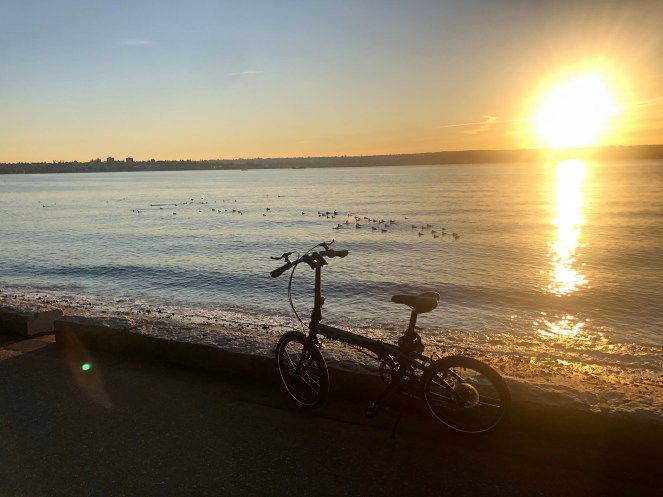
I rode through the busy streets and around the sea wall in Stanley park, a pilgrimage I have to do every time I come here. Things just become clear, here. It’s where my soul is nested.

There was a detour around prospect point and I ended up pushing the bike up a steep switch backed hill, and ended up on the trail beside the road for a while. I learned about the bike’s brakes on a downhill, and I found myself again.

I rode the wrong way back around to the beach where the buffleheads, the ducks of my soul, congregate. I remembered what oxygen feels like.

Basically, it was a micro holiday. I rode around the park, and then later through the sad landscape of the downtown east side, and found the perfect trattoria a friend sent me to. A date with some amazing handmade ravioli and a novel, just me and my bike.

When I woke up, there was more work related email hell. But the microholiday reminded me that I can keep pedalling, to keep looking around the next curve.

What kind of microholidays feed your soul?

fall · running

Bettina tries orienteering: an exercise in priorities

Yesterday, I was supposed to go on an orienteering run during lunchtime. Two members of my workplace’s running club had organised it to see if this was something people were interested in doing more frequently. It sounded cool, so I signed up. In orienteering, you try to find a series of waypoints marked by little flags that are indicated on a map. The goal is to find all waypoints in as little time as possible.

I rocked up to the start already frazzled: this week is the busiest week of the year for us in terms of work – we have a very important conference next week – so the days are currently long and packed. I was given a map and shown a photo of what the little flags looked like. My colleague also explained that each flag would have a little needle punch hanging off it with which to punch a control marker on my map to indicate that I had indeed found the respective waypoint. Each waypoint had a number. Here is a picture of the map (I was supposed to find control points 1, 7, 4, 6, 8, and 9):

Bettina’s orienteering map: a criss-cross of lines on a paper with the pink lines indicating my intended route and the control points (the control points outside of the pink route were for a longer course that was also on offer).

Then my colleague marked my starting time on a paper and off I set. I found the first waypoint well enough (they made it easy). Here it is:

Control point 1: an orange and white orienteering flag dangling off a fence, with a red punch stamp attached to it.

But then things got tricky. I wasn’t exactly sure how to read the map: were all the tiny trails in the forest on it, or only the bigger forest roads? Was what I was looking at the trail we usually took? Because I was generally stressed, and I didn’t have a lot of time, I was impatient. At some point I suspected I’d missed a turn, so I went back on myself. I started losing confidence in my ability to read the map. Then the next people caught up with me (they ran as a pair) and we tried to find the marker together. We thought we knew where it could be, but we were wrong.

At that point I decided to give up. I would’ve loved to go adventuring in the forest, but I just didn’t have time today: I had to get back into the office. And I wanted to get at least a bit of a speedy run in: all this back and forth looking at the map, doubling back on my way, and trying to find markers that weren’t there was stressing me out more rather than giving me the distraction I needed.

Three fellow runners in the distance, on an autumnal forest road strewn with fallen leaves. These three went just for an ordinary run without orienteering – maybe I should have just joined them!

So I decided that getting a good run in, even if it was going to be short, was my priority, and to stuff the orienteering. I left the other two guessing and looking for the control point and set off on my own. Initially I was frustrated with my inability to get the map right and with the time I had already lost: why the hell hadn’t I decided to just go for a normal run in the first place? (Answer: I had wanted to try this because it sounded fun, and also, I had committed to writing this post 😉 .)

But as I settled into a rhythm and ran on through the foggy autumnal forest on my own, I calmed down and started enjoying myself again. This is why I run: the fresh air rushing into my lungs, the regular rhythm of my feet, the focus on maintaining that rhythm – it clears my mind. I’m happy I made the right choice. Had I continued to try and find the control point, I would have gotten more and more stressed and frustrated, and felt guilty about taking too long of a time away from the office on top.

On my way back, I also found another flag (number 8), at which point I finally understood exactly how the map worked: even the tiniest almost invisible trails were marked on it and I hadn’t expected that, which is how I lost my way in the first place. When I got back I had a quick chat with the organiser who promised we’d do it again. I’ll be there – hopefully with more time and a better experience!

fitness

Enjoy the festivities, eat the food #tbt

As the holiday season gets underway, we’re sharing some of our past posts on the topic of festive food and fear of fat. As Tracy says in this post, just relax and enjoy the food.

Guest Post · sports nutrition

Gamechangers promotes plant-based sports nutrition but doesn’t change the gender game (Guest post)

You may have heard about the documentary called Gamechangers, streaming now on Netflix, about athletes who go against the received view that a meat-based diet is necessary, opting instead for a plant-based approach to sports nutrition. It’s produced by a group of big names in film and sport: James Cameron, Arnold Schwarzenegger, Jackie Chan, Lewis Hamilton, Novak Djokovic, and Chris Paul. It features former UFC fighter and combatives trainer for the US military, James Wilks.

Wilks gets injured and while laid up for six months starts exploring dietary means of optimizing his recovery. He stumbles upon an astonishing research finding: the Gladiators of ancient Rome ate a mostly plant-based diet. The Gladiators! The manly men who fought to the death in the Colosseum. This blew Wilks’s mind. In his words: “This shocking discovery launched me on a five-year quest for the Truth in Nutrition, modeled after Bruce Lee’s Truth in Combat philosophy: ‘Research your own experience, absorb what is useful, reject what is useless, add what is specifically your own.’ Beginning with this mindset, I put every preconception I had about nutrition to the test, traveling to four continents to meet with dozens of the world’s strongest, fastest, and toughest athletes, as well as leading experts on athletics, nutrition, and anthropology.”

The film follows his quest to obtain more information about the “shocking discovery” that you can be a strong and successful athlete while eating a plant-based diet. If you can get past the extremely masculine orientation of the types of athletes and the type of athleticism represented in the film, it’s got a positive message for those of us (including me) who think that the future is vegan.

But the machismo of the film is so very present. Two female athletes make an appearance: indoor Olympic track cyclist, multiple US gold medalist, and plant-powered athlete, Dotsie Bausch, who is the oldest athlete in her sport ever to win an Olympic gold medal; and Australian sprinter, Morgan Mitchell.

Much the film follows storylines and research that appeals more to stereotypically masculine interests. We follow Patrick Baboumian, and his training to secure the title of “strongest man in the world” and Scott Jurek, ultra-runner who is conquering the Appalachian Trail. There’s Olympic weight-lifter, Kendrick Farris. We also get to hear from Arnold Schwarzenegger (I liked that part because I have liked Arnold ever since Pumping Iron, though I much preferred Pumping Iron II: The Women). And the of course there is the man at the centre of the film, James Wilks, who is trying to get back into his game. An additional story line follows his father, who has some serious cardiac issues during the filming of the documentary and also decides to give a plant-based diet a try.

We are presented with research that is designed to prove that you can get strong eating plants. That’s a good message. There is a further attempt to make the case that you can get healthier in all sorts of ways. The New York Fire Department offers some of its members a guinea pigs for a short study (I think it was six weeks) where they had a raft of medical test, then followed a plant-based diet for a few weeks, and then had the same tests and their cholesterol had improved, their weight had dropped, and they felt better. Wilks father experiences improved cardiac health. Doctors such as Dr. Dean Ornish (founder and president of the non-profit Preventive Medicine Research Institute and featured in the film) and Dr. Neal Barnard (President of the Physicians Committee for Responsible Medicine) not featured in the film) have maintained that a plant-based diet can reverse heart disease.

Three collegiate athletes allowed their erections to be monitored while sleeping. The night they ate a vegan burrito instead of a meat burrito they had dramatically more frequent and harder hard-ons. Their reactions to their test results make for a hilarious scene because the researcher is all business but everytime he says “penis” and “erection” the young men lose their shit and start blushing and giggling and trying to look serious.

A good portion of an NFL football team switches over to plant-based eating when one of the team members starts bringing vegan meals prepped for him by his chef wife, Charity Morgan. Soon a bunch of the guys are special ordering the same meals and she’s delivering them at lunch time.

The thing is, the film is an effective agent for change in its way. It offers a compelling narrative against a diet built around animal products, and that new narrative challenges strong contrary opinion. Since watching it, I know of at least three people, two of them men and one a woman triathlete, who have decided to give plant-based eating a try. And it’s been recommended to me multiple times by friends and acquaintances. I myself am strongly in favor of more plant-based eating, not just for health and performance reasons, but for environmental and animal cruelty and exploitation reasons. In fact, my latest project is focused entirely on veganism and making a case that you can be imperfect at it and still be considered vegan. So of course the message of the film is attractive to me.

It would have been great if there were less machismo at the core of the film because while it’s in the business of smashing stereotypes (about athletes and meat) it could’ve gone further and challenged more stereotypes about diverse forms of athleticism and also diverse athletes within male-dominated sports. For example, they could have included some women who are vegan bodybuilders like Jehina Malik. Or Australian boxer, Emily Jans. And they could have mentioned tennis superstars Venus Wiliams and Serena Williams who are both vegan. Or the surfer Tia Blanco.

They could also have done more to include evidence that the types of studies they were doing would have similar results for women. I remember learning about the way women’s health has been underrepresented in a lot of medical research because it was assumed, wrongly, that findings from research trials in which all the subjects were men would equally apply to women. This turned out not to be the case, and in some very significant areas, for example, with respect to risks for and symptoms of heart attack and stroke. So it does concern me that the “experiments” (in quotes because they weren’t full-blown studies) in the film only had men as subjects. I think we are right to wonder whether there are any relevant physical differences that yield different nutritional and performance results for different bodies.

This is not to say it’s a terrible film. I’ve seen it twice and it has its moments. But given the power and influence of the executive production team behind it, and the incredible reach Netflix enables, it would have been a great moment to change more than one game.

If you’re interested in trying plant-based eating or already do it but need new recipes, Dotsie Bausch’s website has some great recipes. You can find them here.

If you’ve watched Gamechangers I’d love to hear your impressions. I’m honestly the only person I know who had anything but a completely positive opinion of it.

fitness

Appreciating adaptability

A friend shared this link to a news article about women who climbed mountains wearing long skirts. It has some pretty cool pictures including this one:

mountain climbing
Lucy Smith and Pauline Ranken of the Ladies’ Scottish Climbing Club, Salisbury Crags. c.1908 Image shows two women wearing long skirts climbing a pretty rugged cliff face.

I like the photo a lot, mostly because it reminds me that women were doing cool fitness things more than 100 years ago, and they did them with basic equipment.

It occurred to me that we invest a lot in equipment when perhaps we don’t need too. My favourite workaround to kettlebells is to fill empty detergent bottles with water. Later, when I get more ambitious, I can fill the bottles with sand to increase the weight. I have also recycled a broom handle to help me with certain back stretches.

What is your favourite workaround for home-based gym equipment? Let us know in the comments.

MarthaFitat55 lives in St. John’s.

fitness

Our new look! A blog image makeover

There have been big blog changes around here and we’d love your help. As you, our regular readers, know, Tracy has left the blog. We’ve gone from being a two person team, to being a team with guests, to being a team with guests and other blog regulars, to being a full-on team thing. Here’s our new schedule. And if you, a blog reader, ever want to write a guest post, drop me a line.

Where’s the “help” come in? Well, we’re updating our visual image. It used to be we were represented on social media with a series of photos of Tracy and me but that no longer fits who we are. I’ve been playing with images and adding the FIT IS A FEMINIST ISSUE text but I’d like some more variety.

Do you play a competitive sport, such as hockey or soccer? Rowing? Got a photo? Send it our way. How about roller derby? Power lifting? Golf? Skipping? Whatever gives you joy in movement and has a photo you’re happy to have associated with the blog, send it my way. My email address is the guest post link above. Better yet, send a bio along, tell us how long you’ve been reading and following and we’ll include that too. We used to have a “reader spotlight” feature and it would be nice to revive that.

219 in 2019 · holiday fitness · holidays

Sam is on a countdown!

A US route sign that reads “45.”

How many days are left in 2019? I’ve been Googling that question for awhile and comparing it to the number of workouts I have left in the year if I really do aspire to make it to 300 workouts in 2019.

Originally I was aiming of course for 219 in 2019 but that number went by a while ago. In a weird way my injured knee has helped with daily exercise because I just have to pay attention to doing physio and making sure I get the kind of movement that helps my knee. Keep moving and don’t give in to arthritis pain, is the latest advice. I’ve written about that in a post called Pain and the Choice to Walk or not Walk.

As of today there are 45 days left in 2019 and I just logged my 260th workout. It’s Sunday so I worshipped at the church of Zwift, riding 27 km in one hour in virtual London, England. Doing some basic math here that means I’ve got 40 workouts left and 45 days. Given that I also aspire to one day rest day a week, the math should work out perfectly.

I’ve often enjoyed having some sort of challenge through the holiday season to keep me focussed on exercise and not letting that be the thing that gives way in the face of all the extra socializing, shopping, hosting, wrapping, cooking excetera excetera. In the past I’ve done running streaks from American Thanksgiving through until New year’s short distances say 1 mile a day. My running days are over so this is probably a better focus for me anyway.

What will the next 40 workouts look like? My guess is we’ll be spending some extra time in the virtual cycling world of Zwift given a bit of extra flexibility around my work hours. I’m either walking or riding to work most days and doing some extra activity to make that count either yoga at home or planking. Sarah and I were talking this morning about making it out to the hot yoga studio in Guelph finally. And I’ll be sure to get some weight lifting in as well either with a personal trainer or on my own.

Wish me luck!

fitness · sleep

Why is being well rested the privilege I’m too embarassed to talk about?

“I’m having a busy start of the university year and I rode my bike in a 100 km Gran Fondo on the weekend. I also slept 10 hours last night.”

I nearly posted that to Facebook in September after a busy weekend but I didn’t. It wasn’t the riding my bike that felt like boasting. It was the sleep!

I thought about all the blog followers and FB friends whose lives don’t allow 10 hours of sleep. I decided not to share.

These days I often go to bed early Sunday evening and begin the week pretty well rested, knowing that I can’t do it every night. I’ve got a lot of privilege in our society. I’ve got a lot of education and an amazing job. But the one privilege that I’m shy about admitting is that I’m often pretty well rested.

I don’t harp about my sleep habits mostly because I don’t want the late night Netflix watchers among you to think that I’m judgey. I’m not. I’m definitely not at all judgey about people with small kids, caring for elderly parents, or working long hard shifts. The thing is for me, I get tired in the evening and I have a hard time staying awake. If I put on Netflix I’d be “zzzzzz” within minutes. I joke that sleep is my super power. I get really tired in the evening and I feel like I can’t stay awake. We talk about the need to prioritize sleep but I often feel that I don’t have a choice.

I read this from the Nap Ministry about developing a sleep practise and I think the going to bed early on Sunday is definitely part of my sleep practice.

” Insight into your faithful Nap Bishop’s rest practice.
1. I do not rush or overbook my calendar. I view my calendar with intuition and I have never been lead astray by my intuition. Rest allows you to connect with what you really feel and know. Grinding keeps you in a cycle of trauma.
2. I will not argue or debate with anyone on social media. You will never worry me. Arguing takes away from time I can use to nap. It is a radical act for a black woman to decide and practice a “no arguing/debate” policy because most people use these platforms to argue and most people assume they have access to black women for this role. The theories of the Nap Ministry have close to 20 years of practice/research and 4 years of graduate studies in one of the top seminaries in country. If you wanna argue or don’t agree, don’t follow and go start your own organization and blog about it.
3. I rest everyday for at least 30 mins to an hour. I book my calendar so that it is possible. I may nap on the couch, stare out a window, rest my eyes while “

Photo of the Nap Bishop from their Facebook page

What’s your sleep practise look like? Do you have any commitments about sleep like the ones that Nap Bishop makes?