The word “permission” has come up a lot lately in my conversations with friends: permission to do less, to let people down, to get it wrong, to make mistakes,…in a word, permission to be human instead of a perfectly programmed machine. Most of the women in my life struggle with giving themselves this permission. We look around as see that our friends are too hard on themselves and then roll our eyes when they say the same of us. Guilt is the unhappy tag-along that shows up when we don’t allow ourselves the breathing space required to be human. Today’s Throwback Thursday is about exercise guilt and how to lose it. Enjoy!
Month: January 2018
Come Launch with Us!

Save the dates!
April 28th, 2 pm, Landon Branch Library, London, https://www.facebook.com/events/1989041398016560/
May 3rd, 7 pm, The Bookshelf E-bar, Guelph, https://www.facebook.com/events/533108120399198/

A modest proposal
When women turn 50 in Ontario, we get a happy birthday message from the provincial government that lets you know it’s time for a mammogram, a pap smear and a colorectal cancer screening. Yay, happy birthday, you are officially old.

Recently, in my consulting life, I’ve been working with several professions that fall into the rehabilitation/ mobility realm, and I’ve developed my own little pet project that I would undertake if I were the minister of health: a comprehensive mobility assessment at the age of 50, and the development of a personal plan for strengthening and sustaining mobility.
I have been thinking about this a lot as I’ve entered my 50s, and started experiencing the weird stiffnesses and aches and changes in metabolism that come along with this decade. I’ve noticed an increasing number of my peers who can’t comfortably walk up or down two or three flights of stairs. I’m not talking about people with the kind of injury or deficit where they might already be seeing a physiotherapist or other mobility professional — I’m talking about the “move it or lose it” kind of agility and strength.
I’ve been thinking a lot about the need to sustain mobility as we age. There is a lot of evidence that physical activity in older people is a critical part of preventing disease and sustaining wellness, maintaining independence and creating a good quality of life. If we can’t move our bodies in some ways, we’re at greater risk for diabetes, high blood pressure, heart disease and depression. If we don’t feel comfortable walking a few blocks, there are fewer and fewer activities available to us. Mobility is critical to aging well — which is one of the main points of this blog’s existence.
And, there is almost nothing in our current primary healthcare framework that focuses on fostering agile aging. We are screened for the biggest problems inside our bodies — cancer, heart disease, diabetes, and there is an increasing focus on health promotion (participaction and the carrot app, anyone?) that encourage individuals to take action. But my suspicion — supported by anecdotal evidence by my colleagues in cardiac rehab and mobility professions — is that most of those programs are going to sweep in people who already see themselves as physically active in some way, or if their health providers have told them to become more active.
I think there would be huge benefit in providing a safe, supportive framework for an assessment by a healthcare provider focused on mobility (physiotherapist, athletic therapist, occupational therapist) at the age of 50 or so, and the development of a personalized plan for each person, focused on aging with the greatest mobility. We don’t all need to climb mountains or do endurance runs or ride our bikes across Estonia. But I do think that aging with the greatest agility, strength and ease available to each of us is more accessible than some people think.
Right now, for the most part, access to the services of physiotherapy and these kinds of professions fall into the 30% of healthcare in Ontario that are privately funded, not publicly supported. If you have a benefits plan that covers physiotherapy, a comprehensive assessment in your early 50s and goal-setting personal plan is accessible. But most people are only referred to physios when they are already injured, and for those of us without this kind of funding, it’s never on our radar. I think making planning for long-term mobility a normal part of aging should be something we all do — and it should be an integral part of our health system.
What do you think?
Sam shelves her ego to go spin with students
So I’ve moved jobs, moved universities, moved gyms, and moved physio clinics. So much change!
At my old physio clinic we began with time on the spin bike which seemed to help with knee mobility and made the other exercises easier to tolerate. This physio clinic is more hands on, less tech. There’s no giant “game ready” ice compression thingie, no ultrasound, no TENS unit, and no row of spin bikes.
Western’s clinic is full of injured student athletes and physio students. The Guelph clinic is more low key, more staff focused it seems. There isn’t a sports medicine clinic with x-rays and surgeons etc attached either.
I can do without the other stuff but I miss spinning before physio.
Monday I noticed that I had physio at at the university clinic at 7 pm and there was a spin class, 530-630 pm in the gym which is in the same building. Woohoo!
Actually it wasn’t just a spin class. It was Cycle-Yoga. 30 min of spinning followed by 30 minutes of “yoga for cyclists.”
The students were all student age, 18-20 or so. The instructor though was closer to my age. Actually her taste in music put her older than me. Whenever she gave instructions she said it was okay not to listen and just do your own thing. She told the class that she had teenagers and was used to that.
We bonded over knee injuries and agreed I’d just do my own thing, like the teenagers. Right now that’s no heavy resistance and no standing. Instead, I focused on high cadence and that seemed to work okay.
I stayed in the back and I was surprised at how little need I felt to impress undergraduates in a spin class. I was wearing bike shorts. I had my bike shoes. I thought I might struggle with keeping up and with not doing stupid things that hurt, like standing. But no, not so much.
Maybe in my 50s I’m finally growing up?

Death and diet culture
Michelle Allison, the Fat Nutritionist, wrote on Twitter, “I first made the connection between social hierarchy, health, and the fear of death many years ago, as a teenager, but it became really explicit to me in online arguments about body weight and health just a few years back. It was so obvious that people constructed hierarchies……of “better” and “worse” people (along lines of body weight, presumed lifestyle choices, and other health indices) as a way of convincing themselves that they wouldn’t ever do something as gauche as GET SICK AND DIE. A lot of this came from various alt-right types and corners….I remember one of my twitter friends responding in the most perfect way ever to these attempts at bullying with “That’s right, in this land of immortal highlanders only the weak die,” or something like that. It cracked me the hell up, but it also pointed to something crucial……which is a theme running through alt-right and neoreactionary ideas, a sort of ubermensch or superhuman ideal, but in the updated format of transhumanism or the technological singularity. (If you have no idea what I’m talking about, it’s okay, I kind of wish I didn’t.)”
I’m interested too in the extent to which fear of fat is really just a version of fear of death.
I teach courses on death, and on feminism and death, and as someone who shares the feeling, I’m interested in our fear of death.
If that’s where our fear of fat comes from, fear of death, those of us who preach body positivity have our work cut out for us.
See the full thread on Twitter here.

Pack up your snowshoes and trek it all away (Guest Post)

By Wendy Boucher
I’m 48, I have a phenomenal seven-year-old girl, I’m a Western science student, and my boyfriend of 2 years dumped me via email in October. The day after Christmas he tagged me in a Facebook post stating that he hoped I got coal for Christmas, quickly followed by a post announcing his new relationship (complete with loved up pics).
What did I do, you ask!?
Did I send a poisonous rebuttal? Cry in my ice-cream bucket? Call my girlfriends and formulate a plan to photo shop hearts around a pic of me and my super cute 38-year-old guy friend – who has a crush on me – and post it on my Facebook page? Nope. None of the above.
I threw on some lipstick, packed a light lunch, a big bottle of water, my iPhone, and… my snowshoes. My German Shepherd cross, Kyah, was down for the adventure so we dropped my girl off at her dad’s house, and drove to FanshaweConservation Area. It is there in the wilderness, trekking the 21k loop around the lake that I always find me. My independence. My strength. My love for myself. And I lose the marionette strings that those who hurt me have attempted to control me with – including social media passive aggressive shots.
The first 5 km found Kyah and I taking selfies amongst the many snowy footprints of other hikers. The scenery was a massive contrast to urban London, and the sun painted the snow silver. I was still frustrated but felt the anger begin to drift into apathy.
The second 5 km saw my spirits lift considerably. I saw far less signs of human life along our path which made me realize that not many people can walk this far. I am one of the elite winter hikers. I shout out, “I am woman”. My best friends are my strength and my loyal canine. Hear us roar.

When I reached the 10 km mark (which means I continue the 11 km to my car, or turn around and trek 10 km back to my car) I had been hiking for 2.5 hours. I was committed either way. I thanked my fitness level, the mental endurance I learned from 10 years of adventure racing, and the fact that emotional pain drove me to this awesome place of a natural endorphin high. I found myself singing “Let It Go” as I trekked amongst a long corridor of evergreens. I was the Snow Queen of the Fanshawe forest.
The third 5 km discovered the power within me. I found no prints in the snow, was forced to load myself onto my snowshoes, and my dog lead the way with her keen sense of smell. She guided me through the woods sniffing out the trail with her 300 million olfactory receptors. She became my compass as well as my social support. My strength was waning but my spirits were jubilant. “You’ll never see me cry… the cold never bothered me anyway.”
Sadly, everything but my strength fell apart after that. My water bottle was plugged with ice, my phone died, my dog began to limp from the ice between her toes, my snack was a cold solid rock (I totally forgot that everything outside freezes at -15 – and I am outside), and I was still 5 km from my car. I began to think.
Remember what happens when you work out? You tear your muscles, just a tiny bit, all over and this is what makes them stronger. Your tiny muscle fiber tears heal, and you get larger muscles. So, when you heal – you are stronger. So maybe in order for us to become emotionally stronger, we have to hurt a tiny bit all over. So maybe we need to think of emotional pain as the post-workout-aches, take an ibuprofen, and in a few days we will actually will be stronger, look fitter, be healthier, and be a better version of ourselves.
As I was thinking, I cut off the trail opting to take a country highway back to my car. I didn’t want to die in the woods as darkness was quickly approaching and my time in the cold was nearly up. A silver Audi pulled up alongside my popsicle self and that of my icicle dog. The man and his fiancé that I had spoken with an hour earlier in the woods recognized Kyah and I and recalled that I had told them where our car was. He jumped out and told me that I was a million miles away from my car. He helped me with my backpack, threw it in the trunk, and like a big brother, escorted me to the front seat of their toasty vehicle. We are all Facebook friends now. He has since told me that his motto is “leave no hiker behind”. Wow. There are amazingly helpful and unselfish men out there. My faith has been greatly restored by this one.
Kyah and I gratefully welcomed the warm drive back to our car. She was curled up on my lap licking her paws as the angel-couple and I chatted about our hikes.

Sure, I didn’t do the whole 21k trek, and I didn’t do it all alone. And yes, the powers-that-be had to send me help when I needed it. But guess what? I’m smiling. I made new friends. I’m healthier. I’m leaner. And I have a great story to tell. All because I channeled a bit of emotional pain and used it to fuel adventure, kick-start fitness, and promote a healed mind.
Get out there and tear some muscles.
Wendy is currently a student at Western University and studies Biology and Psychology. Her passion is ecology, animals, and outdoor fitness. Summers are spent mountain biking, paddling, backcountry camping, and hiking. Winters are spent snowshoeing and bird watching. Wendy has a seven-year-old daughter who helps keep her young and fit at 48.
Winter running? This year I just can’t even
It was only a month ago that I posted “Bracing myself for winter running…again.” I was all gung ho, talking about how once I got into the swing of it, I was all “yay!” about winter running. You can dress for it. You feel hard core. It’s great for bonding with others who brave the outdoors. And so on.
But this year I just seem not to be able to do it. I mean, I did that one run back in December. And then I went to the Bahamas for three weeks. I spent the majority of my time going for leisurely walks on this beach:

Here I am strolling with my parents (“strolling” is the operative word here, nothing too exerting):

As you can see, it’s warm. And relaxing. And there’s no “bracing yourself” required for this. So after three weeks of that I came back to cold and snow. And I actually missed the worst of it, but still.
The first morning I did a short stint on the treadmill, just to get the juices flowing again. The next day, I had a run scheduled but I noticed that we were due for a brief thaw the day after. So I postponed it until the day of the thaw, and ventured out in the brief window between too cold and freezing rain. It wasn’t bad actually. If the whole winter was going to be like that I think I could handle it.
But alas, soon enough the thaw froze over and the ground just became treacherous. And then windy again. And cold. I couldn’t bring myself to run outside on Sunday morning, so instead I went again on the treadmill.
I went to the beach later in the day on Sunday with a friend to take some pictures, but this time it was a much different beach experience because Lake Erie was frozen solid. There was literally no visible surf. See:
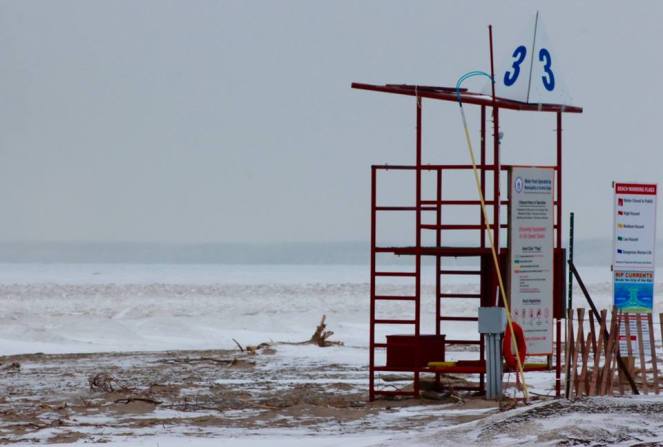

Does it not look cold? I admire winter runners. I’ve been one myself in the past. But as long as it remains windy and icy and cold I just can’t fathom spending any length of time trying to run outdoors. Don’t get me wrong, I like being outside. Tonight I went for a walk in the snow and it was just beautiful. But this year, for running, not so much.
If you have any words for me that might help change my attitude about winter running this year, please send them my way! I want to be able to get out there again, but realistically, it looks as if I’m going to spend more time this winter on the treadmill more than I have in the past.
Famous Blue Gymsuit (Guest Post)
I didn’t like phys ed in high school when I went in the early 70’s. I didn’t like it for many reasons.
I didn’t like the outfit the girls were compelled to wear – a weird blue onesie made of non-stretchy cotton that buttoned up the front and had a completely unnecessary belt in the middle. I guess somebody thought it was cute.
There were elastics in the short-short legs that poofed them, bloomer-like, around our legs, presumably to protect our modesty from the boys. I guess they thought a glimpse of underwear as we cartwheeled would be terribly distracting. It wasn’t like they were ever close enough to see us, so I don’t know.
I was plump, and sprouting big boobs, and the largest size we could get barely buttoned across my chest. It fit like a sausage casing. It had no give whatsoever, pulled up into my butt crack when I bent over and showed embarrassing sweat stains magnificently. It was completely uncool.
As a self-conscious teenaged girl, this was the single most humiliating garment I could be asked to wear. “Why can’t we just wear t-shirts and shorts? I’d wear t-shirts and shorts!” I whined to myself.
Then there were my boobs. They were already inconveniently large, and there was no such thing as a sports bra, so my regular bra had to unsuccessfully keep them from bouncing uncomfortably as I ran. I ran as little as possible. I could walk, and did, for miles, recreationally and to get to school, but running was not something I did voluntarily, and walking was not something we covered in gym.
My shoes, like everyone’s, were canvas flats with no arch support. Nobody had ever heard of orthotics. After a little pounding, my feet killed me too.
We were introduced to various sports by putting us on a field or in the gymnasium with the appropriate equipment and a rundown of the rules, and then turned loose to play. Since many of the team sports had running as a primary activity, you can imagine how that went over with me. Since I was short, fat, not too co-ordinated and not very fast, I did not have any of the qualities that made me a valuable player. I always got picked last.
As a bookish and introverted child, this just made me feel more apart from my schoolmates, and “school spirit” was something I regarded with amused contempt. I had no interest in watching other people do things I had no interest in doing myself. I didn’t see the point. You couldn’t have paid me to go to a school sporting event.
They did try to expose us to a few unusual things like golf, where I enjoyed the walk but not losing my ball in the rough, and archery, which I liked quite a lot but my boobs didn’t. Getting whacked with a bowstring was no fun. They introduced us to karate, where a guest teacher stood a boy in front of him and pretended to kick him in the face. At that point in my innocent young life, I did not yet understand why I might want to kick someone else in the face. It did not appeal to me.
They gave us curling rocks made of coffee cans full of cement with bent pipe handles and got us to curl. I was cold and unimpressed. They tried orienteering, where we could get confused by maps and compasses as we ran up and down hills. That was also a big “no” from me.
It wasn’t till I was well out of school that I realized that there were physical activities that I had done on my own or with my family that I actually enjoyed – it was just that none of them happened at school. I loved being in the water to snorkel in the lake, I loved to ride my bike, and walked for miles as I’ve mentioned. I loved to dance though I was shy about it, but the thought of having to stuff myself into a leotard to do it was a definite deal-breaker.
The Participaction program started when I was in high school, and, of course, being unathletic in the various high-school ways, I bombed spectacularly. It confirmed to me that high school gym was not for me, and I skipped it as often as possible.
I think my biggest problem with my high school gym experience, aside from the horror that was my gym suit, was that I don’t recall being given any real information about HOW to do any of these things. How to get stronger, run faster or jump farther, how to learn balance and agility, how to develop the mental toughness to deal with teenage insecurity and body shame. You just got good marks if you were already good at something – already strong, already fast or flexible or co-ordinated. Working to improve the abilities of chunky little klutzes like me were just a waste of everybody’s time, not the point of physical education. I learned some of these things on my own, doing things I enjoyed as an adult. I’m glad I did, but I wish I could have learned them as a basis for adding activities as I went on.
A lot of people point at team sports as a way of learning how to work as a team, learning to hone your own performance and contribute to a group effort, and I’m sure that’s true. They think of it as learning valuable skills for the workforce, but I’d suggest you could learn some of the same things by learning music and playing in a band. I’m not convinced team sports are good for every kid. They need not be held up as an ideal. There are other ways to learn those things.
I know things have changed. I am currently in the process of helping decide on a suitable high school for my stepdaughter for next year, and so we’ve been visiting various places in Toronto. I see that they offer fitness centres as well as basketball and football, and my stepdaughter tells me that they don’t emphasize team sports as much as just showing up and doing something.
The gym suits are long gone, and shorts and t-shirts are fine for everybody. There are sports bras for those who need them, and much better shoes with more support. Being a bit sweaty might actually be cooler now. Kids in general seem to be taught to have less body shame and more confidence in themselves. I hope they are being taught that living and moving in their bodies is a source of pleasure and joy. I hope they’re being taught how to do it in a way that lets them do it for the rest of their lives. That’s what I would want.

Alison Reid is always a little surprised at what she’s actually done, considering she’s often been rather sedentary. Over her 61 years to date, she’s been involved in: walking, hiking, swimming, snorkelling, sailing, cycling, kendo, karate, weight training, and drumming (see also – marching while playing a heavy instrument). She’s also tried running, cross-country skiing, shooting, boxing, and almost falling off a horse. She is pretty much recovered from multiple pulmonary emboli in both lungs about a year ago, but is still working on recovering strength and stamina. She is currently hoping to improve her knife throwing skills. She lives in Toronto.


