accessibility · cycling · disability · fitness

Safe cycling is a disability rights issue

I had a bit of a moment on Twitter last week.

I shared the tweet below and added, “Indeed. I’m someone who can ride a bike 100’s of kms but can’t walk more than a single km. My bikes are many things to me but they are also increasingly mobility aids. Safe city cycling is a disability rights issue. “

Four hundred+ likes and dozens of retweets and lots of new followers later, the virtual dust settled. It seems I’d hit a nerve. The thing is safe cycling isn’t just about the young and the fit and the able bodied.

I’ve written about this before.

I started to notice it when my knee got really bad and I was walking with a knee brace and cane. On two feet I was definitely a person with a disability, recognizably so, but put me on a bike and whee, zoom! I started to ride between meetings in campus. I bike to work even though it’s just over 2 km.

Sometimes I explain when people express surprise that I ride when I live so close. Other times I just let it go.

This was all pretty natural for me. I’m a cyclist. It’s part of who I am. But I can imagine that for lots of people who pre-injury or pre-chronic condition didn’t ride a bike, it wouldn’t be obvious that cycling is a great way to get around. Lots of people, watching me walk, were shocked that I could ride a bike.

When I ride a bike for disability reasons, I feel like I’ve joined a community of people who wheel rather than walk. That includes mobility scooters and wheelchairs and tricycles. Walk your bike? Um, what if I can’t? No ramp? We’re all in trouble.

Since then I’ve bought a Brompton which I travel with so I can get around in other cities. I take it in places, folded, walking, but often it would be easier if I could keep riding. It needs an accessibility/mobility device sticker!

I see people with scooters like this one using them inside and I’m jealous.

A man with a blue shirt and khaki pants sitting on a mobility scooter.

What are the big takeaway points?

  1. Not everyone riding a bike is able-bodied in virtue of riding a bike. We often stereotype people on bikes as young and able-bodied. From this article on bikes as rolling walking sticks: “For two out of three disabled cyclists, riding a bike is easier than walking, easing joint strain, aiding balance and relieving breathing difficulties. According to recent research by Transport for London, 78% of disabled people are able to cycle, while 15% sometimes use a bike to get around. “
  2. If you have difficulty standing or walking yourself, you might be surprised at how much better riding a bike feels. In my case it takes the weight off my joints and relieves almost all of the pain. Plus, I’m mobile.
  3. For municipal planning, safe bike lanes aren’t a luxury. Lots of people need to wheel around rather than walk. Safe cycling is a disability rights issue.
  4. “Walk your bike” isn’t always a good thing. That assumes that everyone can walk their bike. That’s simply not the case.

Once I started to pay attention to bikes this way, I started notice that there are lots of different bodies, with lots of different abilities out there on wheels.

accessibility · body image · disability · fitness · inclusiveness

Better language for inclusion needed: Not “all bodies can…”

As most of you know while this blog is very much a group project, I pretty much run our Facebook page solo. (I do get some help with moderation. Thanks blogging team!) But in general I read things that I think will interest our followers and I throw them on the page pretty quickly. I make mistakes. I learn things from our readers. I apologize.

Why have the page? It’s a great way to reach a broad audience and build community. Posts that aren’t shared there aren’t nearly as well read as posts that are. Also, there are a ton of stories that come across my newsfeed that I don’t necessarily want to write about but that I think will interest our readers and followers.

Yesterday I shared this story about plus sized outside adventurers. I commented “all bodies are outside bodies.”

But of course there’s reason to be wary of “all bodies” language. Our bodies vary a lot in shape and size and ability. One reader commented, helpfully, that we need better language around inclusion. She has ankle injuries and instability and can no longer hike and misses it.

Hey, me too! I can’t walk very far these days without my knee brace and even with the brace hiking on uneven ground is out of the picture. Now I didn’t say “all bodies are hiking bodies” I deliberately said “all bodies are outdoors bodies” because I was thinking of recent attempts here in Ontario to make provincial parks and beaches wheel chair accessible.

But I get the general point. I feel it when people say “it’s never too late.” Yes, as a matter of fact sometimes it is too late. I’ll never run or play soccer again.

So we want to make sure plus sized bodies are included so we say “all bodies” but not all bodies can do all things. What’s your thoughts about better language for inclusion? Do you mind all bodies talk? How about “all bodies are good bodies?”

accessibility · fitness · Guest Post · motivation · race report · running

Julie’s Lulu 10K – in which the swag was good and Anita and Tracy were voices in her head (guest post)

by Julie

Last Saturday I embarked on the Lululemon 10K I would say that I am not too much into material things but for those that know me would say that might be a stretch when it comes to Lulu! I like to do races for the company and the swag but this race I only had the swag as my company, Anita and Tracy, have been globe trotting and training for the 30 K the past few months. 

I have to admit I have not run as often as I should but when I do I run hard for like 5 minutes and crash when I am on my own. Anita is the pacer of the group and without her I am often lost. When alone I often call this my ‘run like hell’ and die runs or sprint and walk. Tracy is the one that often motivates with her interesting and passionate discussions and the things I have gained from the both of them can not be measured in words.

Image description: full body shot of three women, Julie, Tracy and Anita, dressed in summer running gear (shorts, tanks, and running shoes), blue sky and trees in the background. Taken a couple of summers ago after a Sunday run.

I was a bit nervous but I had done a lengthy run 2 weekends before with Anita (almost died but survived) and I was going out every other night for my run and die sprints. So I felt confident and I approached it with the attitude of once I have the shirt I only have to finish and they had walkers at the end so no shame. 

I was grateful to learn that there was a pace bunny, incredibly people these pacers, just ask Tracy and I how grateful we are to have Anita to ‘slow us down guys.’ My approach that morning was no technology, no phones, no watch, other than my fossil time telling and no monitoring devices. Just me, the ground and 10 000 other racers.

I felt good and we started early so this bode’s well for me and my bathroom habits so off I went, alone, into the running coral. I pulled into the Green coral for the 61-75 minutes and found a bunny. It was typically crowded and the weather was exactly perfect, not too hot or sunny and I was dressed right. When we started to go I felt strong and listened to Anita in my head telling me to hold back and slow it down. No need to burnout I did this once and it was very self defeating. 

I passed the markers with pretty good ease and tried to stick to a 10 min run and 1 min walk as I normally do but I was feeling good after 20 minutes so I kept pace behind the bunny with only about 3 walks for less than a minute for the total race. I could hear Tracy in my mind commenting on the pacing and the feeling of the race, there were bands and singers, lots of energy and at one point I passed a series of spin cyclists biking and cheering us on. I wondered what Tracy would have thought she likes to see these things along the race and  there were the giant angels with donuts, the dancers and of course the witty signs. However, with all of this I looked up and saw that 7 km had gone by with a fair bit of ease so I picked up the pace and rounded the bend to the uphill.

I remember this from my Scotiabank Race a few years back but I was strong, calm and Anita was there chanting in my mind to keep a steady pace. I hit the top of the hill and with 2 km left to go I picked it up more and the crowds were a bit heavier. I was a bit frustrated by the lack of runners etiquette with many slower runners going 4-5 wide and it was difficult to pass. No one was moving to the right and a couple of times I almost ran into people in mid stride on the left side of the lane who just stopped. I was tired but used a few tricks Tracy told me about in her training (1,2,3,4 …I can run a little more, 5,6,7,8 … keep on going get to the gate … 9,10 do it again!) 

I rounded the bend and saw my chance and took off for the finish. 

I finished the race in good time 1 hour and 3 minutes!! The worst part of the race was the finish line where everyone stopped before hitting the third marker and then the crowds came to a slow crawl. It seemed to take forever to get the medal and there were people just crowded everywhere. One could not go left or right. They handed out Sage essential oils and some snack bars but I did not get these as I was not able to see anyone in the mosh pit of a finish line. I got my banana and tried to get to an exit which was impossible. They handed out boxes of what I learned later were dry and dusty donuts but the box was neat. It took about 20 minutes to go from the finish line to a clearing. 

All in all I was so happy with my time and my t-shirt and I purchased some extra swag at the end with Toronto 2019 and coordinates on them so that was a nice $$$ takeaway. 

Would I do it again? Given the distance from home it is a bit more $$ but if you make it a bit of a trip and like the gear then it was fun. I am happy with my time and I got my banana! I also learned that the people you run with over time become a part of your race and inspire you in so many different ways. No technology made it better I think as I was not focused on a wrist watch and I instead felt my feet on the pavement, my breath in the air and my friends in my mind. I will rate this one a success and on to my next race or Sunday run with Tracy and Anita (if they are up for the challenge)!

Julie Riley – Fitness enthusiast at times reluctantly but always a team player! Runner, CrossFit and general city walker who also teaches yoga on the side. Julie is passionate about working on her healthy choices one day at a time without judgement of the setbacks!

accessibility · body image · fitness · SamanthaWalsh

Body Diversity (Guest Post)

By Samantha Walsh

Saturday was the Protest against Divisiveness with @connectionarts. It really was not a protest, but more of an installation. The event was to draw attention to the need for unity and collaboration.

Each model was able to pick their own slogan. I picked “Human Diversity.” I think this speaks to the need to value disability and that the notion of one standard body is a myth. Additionally, difference makes us stronger as a society.

The event offered an opportunity for onlookers to better understand why folks would be compelled to participate in body painting. My friend @elisabethalicee was my artist. (There were more models than artists.) I think she did a great job. The installation took place in time square and there was a mile long parade after to the flat iron building.

This was a very different experience than the other two events I have participated in. There was a lot more media. Folks in Times Square were a lot more vocal and sometimes rude. The day overall was great. However, I did end up putting clothes on part way through the parade, because I was at the back end of the parade and at points felt unsafe.

Overall, the experience was great and gave me a lot to think about. Another cool feature of yesterday is I have done enough body painting that I now know some folks from the past. Additionally, I met a really cool fellow disabled woman, she and I were steadfast in the feeling that representation matters.

I am so pleased Human Connection Arts is in my life.

Samantha Walsh is a Doctoral Candidate in Sociology. She also works in the Not-For-Profit Sector.

You can read all of Samantha’s posts here.

accessibility · body image · cycling · Fear · fitness

Sam gets told “Get off the road fat bitch” and mostly feels sad and confused

It had been one of those days.

My university age son, home for the summer, has a summer job that has his alarm go off at 5 am. I get up with him and mostly that’s great for my summer schedule.

He rides his bike to work and packs his lunch. It’s a physically demanding job and there’s no food there.

Except this day he got part way to work and remembered that his lunch was on the kitchen counter. Return home, retrieve lunch. Then he got back on his bike but his chain fell off and it wouldn’t go back on. This time I just drove him.

I got to work later on my bike and remembered that I was almost out of Synthroid. I had thyroid cancer a few years back and take Synthroid everyday now. That’s okay, I think, the pharmacy is open until 6 and the last thing on my calendar ends at 4 and I can bike there.

Except it was one of those days. I checked the pharmacy hours. They close at 5 on Fridays and they’re not open all weekend. I checked my calendar and the last thing ended at 430. Yikes.

Needless to say it was a speedy bike ride through traffic. But I made it. Whee! Zoom! Yay! I left the pharmacist feeling fit and powerful.

But leaving the pharmacy there’s a four way stop. I’m great at four way stops. I don’t go straight through. I stop and wait and take my turn. I make eye contact with drivers. That’s easier at four way stops than it is at intersections with lights, less time for phone checking.

So two cars go and it’s my turn and the driver next up at the sign on the other corner signals for me to go. Nice. Clear communication! Except the guy in the oversized pick up truck behind him (why is it an oversized pick up truck every time?) starts honking. “Don’t wait for her! Go! Go!”

Nice guy waits anyway and I proceed through the four way stop. Next through is angry pick up man who continues honking, roars out of the intersection and yells some variant of”Get off the road fat bitch” at me. It’s always “fat bitch.” Okay, you can tell I’m fat but how do you know I’m a bitch, I wonder. I’m on a bike. Even though I’m smiling, I guess that’s enough to merit the bitch badge.

I’ve written about this before, this abuse hurled at cyclists, especially women, maybe especially larger women. I’m genuinely sad and puzzled.

I’m sad and puzzled a lot these days as I struggle to understand the world around me and our collective political choices. Things seem so mean and small minded. I understand wanting less government and a balanced budget. I don’t understand the right wing populist politics that’s around these days with its not so thinly veiled racism and transphobia. The anti-immigration stuff makes zero sense to me.

I try to get inside his head, the guy who bought the large pick up truck and is now driving through a neighbourhood full of speed bumps and four way stops. What’s his world like?

I also want to defend myself. I’m exercising. Surely that counts? Surely even if you think I’m awful to look at because fat, I’m out there exercising and that’s better than sitting at home or driving a car?

But I stop myself. It doesn’t matter what I’m doing. I deserve respect as a person. I don’t need to be a person exercising to merit non-abusive treatment.

Friends joke about making the small penis hand sign at him.

But the thing is I’ve always thought that was unfair and body shaming to men with small penises. I’ve got a thing about treating men’s bodies with respect too.

May 27 was Bike to Work Day here in Guelph and June is Bike Month. I’m pretty immune to drivers hurling abuse at me but I tried imagining if the insult did get beneath my skin what that would feel like. What would it feel like to be new to bike commuting? When the angry aggressor is driving a large heavy metal box that can go fast and hit hard, and you’re a woman who has been hit hard and yelled at by men before (that would be most of us) it’s especially frightening.

In the end I land on the usual line of “some people are just jerks”and move on. I’m angry though that male jerks in particular feel free to comment on women’s bodies and yell at us from their vehicles. Mostly though in sad and puzzled. And I think we need a signal for toxic masculinity that doesn’t rely on body shaming.

accessibility · fitness · monthly check in · motivation

Sam’s monthly check-in: What’s up, what’s down, the April version

What’s up this month? The weather has been miserable this spring! I usually hate March and love April but not so much in 2019. It’s certainly affected my plans to be regularly riding outside now. And my knee pain has affected my ability to dog hike with Cheddar very much.

I’ve been commuting by bike to work but otherwise not really riding outside. It’s been cold, and wet, and windy. The last I can take but the other two have kept me inside Zwift-ing away into April.

As a result I’ve also been spending a fair bit of time inside at the gym: personal training, weight training on my own, rowing, knee physio, and fancy stretching. I love having the university gym so close to my office. It’s probably not the best gym for me but since the best gym is the one you actually go to, it’s best for me right now.

The rowing machine is my fave piece of cardio equipment at the gym and I start most days there with a 2 km warm up at a moderate pace. For me that’s 10 minutes for 2 km, or 2:30 for 500 m, My speedy pace is 2:00 for 500 m, or 2 km in 8 minutes. I’m not doing 2 km tests these days or racing in ergattas but I still love the rowing machines as my go-to piece of cardio equipment at the gym. My heart rate goes up. And most importantly, my knee doesn’t hurt.

I’ve also been doing lots of fancy stretching. I love being able to reply to emails while the machine holds me in a stretch position.

The other machine that I’ve discovered that’s hard but not knee punishing is the Jacob’s Ladder. See photo above. The thing is I like tough, challenging workouts. We can debate whether it’s right to say that I like suffering or whether endurance athletes are really all masochists or whether it’s okay to dub your indoor cycling space your pain cave. It’s been tough for me to find things that don’t aggravate my knee but are still challenging in the way that I like athletic activities to be. I miss CrossFit!

What makes it such a tough workout?

See Jacobs Ladder climbers reach tough fitness rewards.

“Jacobs Ladder, a moving, angled, climbing machine, may be named after the Biblical stairway to heaven, but it packs such a challenging workout people have dubbed it the stairway to hell.

Fitness experts say users of the fitness machine, which is a favorite among Army Rangers, Navy Seals, and “The Biggest Loser” television series, reap total body, calorie-busting rewards.

“It’s a great and tough cardio piece,” said Neal Pire, an exercise physiologist with the American College of Sports Medicine. “Picture a step mill that combines the lower and upper body, and you have Jacobs Ladder. Except instead of steps, you have rungs.””

Here’s an argument for preferring the JL to your treadmill.

In April I’ve also come to appreciate some of my personal features that have helped me slog through this winter with my badly arthritic knees. It’s not just toughness though people say that about me and I’ll nod. Toughness isn’t enough given the nature of the problem. It’s also creativity and being positive when things are difficult. It’s funny because I know those characteristics are true of me in other areas of life but I haven’t thought about it in the fitness context.

Looking forward to spring and the warm weather coming up!

#deanslife · accessibility · standing

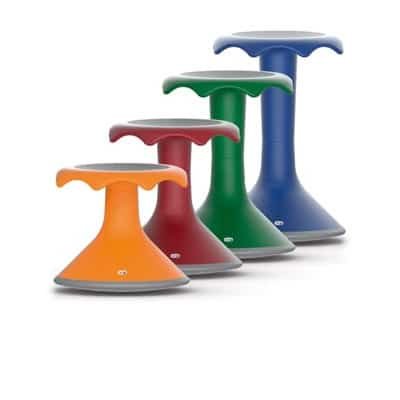
Not all sitting is the same: Sam’s new stool

Image description: A row of stools of different heights and colours, orange, red, green, and blue.

There’s an awful lot of news about sitting in the fitness media. The latest bad news about sitting is that sitting too much can undermine the effects of exercise. Chronic sitters become, over time, less responsive to the effects of training.

For the latest in my newsfeed see New Data Shows We’re Still Sitting Way Too Much. Does Exercising Cancel It Out. Selene Yeager writes: “All hope is not lost, however. Though previous research has found that multiple days of being extremely sedentary makes you resistant to the benefits of a bout of exercise, a newly published study on so-called “high sitters” (those sitting more than 6 hours a day) shows that consistent exercise can indeed counteract the ill effects of lots of forced chair time: It’s just a matter of getting regular activity. “

Sitting is of interest to me and my arthritic knees. On the one hand, my knees don’t hurt when I’m sitting so that’s good. But on the other, if I sit fit any length of time my knees hurt more when I get up. And then there’s my back. I used to hurt my back all the time and sitting was one of the problems. That was the reason I got a standing desk in the first place. See Celebrating my standing desk. I still use it some of the time but not as much as I’d like.

All of this means I’m sitting more than I used to. I was reminded the other day that not all sitting is equal. Active sitting is better than just flopping. People can be against chairs but not against all sitting. Back when I first considered getting a standing desk, friends recommended getting a hokki stool instead. They’re wobbly and good for those of us who fidget. You’re sitting but not keeping still. It’s active sitting.

Here is how the manufacturer describes the stool: “The HOKKI is an ergonomic stool that transforms stationary sitting into an activity, ideal for brainstorming sessions and other active sitting environments.”

Image description: Sam’s new purple hokki stool.

My friend Wayne described it this way,
“It’s a chair for people whose spines like yoga (and/or who don’t like sitting still, and are prone to slouching and leg-crossing in a normal chair).”

This month I started to get nervous about all the sitting I’m doing. I don’t want to put my back out again. And then, out of the blue my daughter Mallory asked for a hokki stool for her birthday. I thought of Wayne’s advice. I reread my old blog piece on active sitting. I ordered one for me too and it arrived today.

I’ll report back and let you know how it goes.

What’s your choice? Do you sit in a chair or do you have another way of sitting?

Image description: A thin, young woman with long straight blonde hair wearing black clothes and sitting on a hokki stool. (All the women on the hokki stool website looked like this.)

accessibility · aging · fitness · yoga

Sam has become “that person” in the fitness class!

Years ago I remember watching a woman in a yoga class at the Y who seemed to be just doing her own thing.

The instructor would tell us what to do and sometimes free spirit lady followed along and at other times not. I was puzzled. Why even come to class if you’re not going to do the thing the instructor is doing? What’s that even about?

Zoom ahead twenty years and OMG I’ve become that woman in yoga class. I was at bike-yoga at the university. The instructor kept demonstrating postures I can’t manage. Some are ones I’m positively told not to do. Instead whenever the pose was one of the forbidden/impossible ones I did my own thing.

My knees were happy. I was having a good workout. But some of the university students looked at me in a funny way. I think they thought I didn’t hear or see what I was supposed to be doing. And then it dawned on. I was free spirit yoga lady.

I’m okay with that. I’m with Cate that knowing your body and what it needs and doing that is one of the joys of aging.

How about you? In group fitness classes do you ever do your own thing? How does it feel?


Photo by Annie Spratt on Unsplash
accessibility · body image · disability · normative bodies · SamanthaWalsh · standing · wheelchairs

Samantha stands and has complicated feelings about it (Guest post)

By Samantha Walsh

On the weekend I went to @abilities_expo for work. It’s a trade show of disability related services and products. A company called wheelchair88 was showing a standing wheelchair. It was a manual wheelchair you could lock then move the wheelchair into a standing position. You can’t move once you are standing.

Thoughts on standing straight from someone who has never stood straight…

I forget how old I was when I stopped thinking I would be more beautiful if I was standing. I know I was older than 20, but younger than 25.

I forget how old I was when I stopped thinking I would be more powerful if I could meet someone’s eye. It was older than 25, but younger than 33.

I know as a child if asked to draw a picture of myself, I would draw a standing person. I did this till I was 6 or 7. After that I often drew people using wheelchairs, but would still draw myself standing.

I know by grade 4 I started drawing pictures of me using a wheelchair, because I started playing wheelchair basketball and often drew about that for school.

When I was young I had lots of surgery and different interventions so I could stand and walk. It’s interesting that the mark of success for doctors and therapists was always that I could hobble or shuffle. Standing would be an all encompassing lactic acid filled experience.

I am often surprised it is still the gold standard. Facebook and YouTube videos depicting folks with disabilities who vowed to walk to get diplomas; walk down isles; stand for first dances. I have adult friends whose parents refused them wheelchairs. In turn they have internalized that standing, walking, shuffling is best.

A wheelchair to me offers liberty and a stable fast painless way to move. Even with all this I was seduced by the opportunity to stand straight. I picked an outfit I was curious about seeing standing. I compelled a coworker to take pictures.

Standing felt unnatural. My head was too high. My legs don’t go straight the brace had to force them. My spine curves from sitting so it hurt. To me the social significance of standing comes from a culture that privileges a specific kind of body. I feel grateful I no longer understand my own posture as inferior.

Today was interesting…

Samantha Walsh is a Doctoral Candidate in Sociology. She also works in the Not-For-Profit Sector.

You can read all of Samantha’s posts here.

accessibility · fitness · traveling · walking

Sam’s very sad thing

I’m in New York as I start this blog post. I love this city. I even almost lived here and I often wonder what that life would have been like.

How did I almost live here? I had an on campus interview at Barnard College in 1993. That was actually my first visit to New York though the geography was super familiar to me from from television and movies. So “almost” is a bit of a stretch but it’s always felt like it might have been my home. In my “inner life” it’s been an alternate home. Montreal too, but that’s another story.

Over the years I’ve visited often, running in Central Park when I was a runner, but mostly lots and lots of walking. One of the things I love about the city is walking. It’s a walking person’s city. And I’ve often thought that when visiting I don’t need to make a special effort to get exercise because I love being outside and I love walking. That’s one of the ways I’ve identified with New York.

This visit was different. I arrived here this time with sore knees–plural! both of them! And it could tell it was going to be a tough time. Even with my knee brace on I was struggling. I was so slow and this isn’t a good place for slow walkers. Sarah carried bags lots of the time which also hurt my self image because I think of myself as the strong person who lifts and carries things for others. But not while walking. Not this trip. Thanks Sarah!

We defaulted to the subway for quite a bit of our about town travel but unlike Barcelona there weren’t always escalators and elevators available and often they were out of service. Here is my Highline selfie. It was tough going up and even tougher going down as the elevator was broken, awaiting repair.

Image description: Sam’s Highline selfie. Sam is a white woman in her fifties with wild blonde, brown, and silver hair. She’s wearing a black linen jacket and large black glasses.

You get the idea. Painful knees and I city I love to walk around. No amount of ibuprofen helped and I kept coming close to tears. It made me remember the knee surgeon’s advice when I mentioned loving walking. He said something about loving it in smaller doses and finding other things to enjoy. When it come to steps, for me, more isn’t always better.  When I see friends post about walking a zillion steps, I confess I’m jealous and that’s not an emotion I like in myself.

Next time I’m either renting a city bike or bringing my own Brompton. Well, in fact next time I’m here it’ll be for the 5 boro bike tour and I’ll definitely be riding, not walking.

I’m also feeling better about knee surgery! So there’s that.

I still had a great visit and this trip reminded that I don’t just love New York because of walking. While here we saw a great play, Hurricane Diane , reviewed here. We went to the opera! Tosca! And I stopped by the SVA Flatiron Gallery.

Here’s to a well-rounded life with lots of opera, and theatre, and art, and books.  And great food. And a little less walking. While that’s sad, it’s not sad overall. Really it’s hard to complain about a life that contains weekend visits to New York for fun and beautiful music.

Image result for met opera house