I have talked here before about how badly I do running uphill. I could run downhill, I could run on a flat course, but uphill – no, no, and no. But since I was told that the only way to improve my uphill endurance was to… run uphill, I’ve been working on my hills, and while I still haven’t been enjoying them, things have been looking a bit better of late.
I had previously entertained the thought of running to work on several occasions. The problem was: I work up a very steep hill, and I never thought I could actually do it. It was the sort of idea that would float into my head only to be immediately dismissed as completely unrealistic. I had visions of myself arriving at the office completely exhausted (if at all) and being essentially useless for the rest of the day. Check out the elevation profile of my commute to get an idea of what I was up against:
Graph of the elevation profile of my run to work, showing an overall elevation of 285 metres with a very steep uphill slope at the beginning.
Then, a month ago, I tried trail running at a mountain sports festival and unexpectedly enjoyed it a lot more than I ever thought I would. I had been quite nervous about even attending the workshop because I was afraid I’d be “that person” holding back the entire group and making a sad spectacle out of herself. This was decidedly outside of my comfort zone, so I was very relieved when it turned out the others had similar concerns (and, I will admit, also because I realised that I wasn’t the slowest group member).
But I think what helped the most was the instructor’s explanation of trail running as “basically a mixture of running and walking – you run when you can and you walk when you can’t or the terrain gets too difficult”. It made me feel much better about slowing down for a particularly steep climbs. Part of my problem with hills before was that I would beat myself up about having to walk when the going got too tough. Walking was “not allowed” in my mind. But all of a sudden, walking was allowed, nay, encouraged. I felt more at ease about those hills immediately.
Bettina, looking a bit nervous in anticipation of her first run commute, equipped with a trail running backpack complete with a water bladder.
After that first positive experience with trail running, it was only a question of time until I attempted my first run commute – the time it took for my little trail running backpack to be delivered. When it finally arrived (I wanted a very particular one and it took a while to get here), I decided to try it out right away. The day before, I took an extra outfit to work and left it in the closet in my office for the next day, and the following morning I suited up in my running outfit and backpack. I carried some water, my glasses, keys, and a small makeup bag with the bare necessities to make myself look presentable for a day at the office. Luckily we have showers at work, so that wasn’t going to be a problem.
And the only thing I regret about it was not having run commuted before. It was fantastic! I’ve done it twice now, and the first time I only stopped for a few breaks when I had to check the map on my phone to make sure I was still on course. On the second run, I found a slightly less steep route (actually the one shown in the elevation chart above) and only stopped once to briefly check the map! Granted, the uphill bit is very slow going, but I actually found I could do it without walking. And I was rewarded for it all with a beautiful route along little paths through the woods and gorgeous sunrise views over the river valley.
Gorgeous sunrise view over the valley with Heidelberg castle in the foreground and the river Neckar in the back, framed by trees.
I’m still optimising the route and my equipment (I ditched the water the second time because I found I didn’t need it), but it feels great to arrive at work with 5k already under my belt and the prospect of breakfast and a coffee while I do early morning emails. Unfortunately, because of the days getting shorter, I anticipate being able to do this maybe another two times this year before it gets too dark in the mornings to run in the woods. I won’t be doing it every day either, since I do other sports on other days, so at the moment once a week seems like a good routine.
I’m really pleased with my new adventure! Sometimes pushing one’s boundaries is just so worth it. I’m curious to hear from you how you’ve pushed your comfort zone when doing exercise. What was holding you back? How did you overcome that? And did you like it when you did?
Yesterday Tracy re-blogged her ode to intuitive eating and while I’m really happy it works for her and I’m glad that her days of disordered eating are over, I’ve got lots of worries about intuitive eating. Here’s my list!
Edit: There was a late week surge in interest regarding this topic so it has become a group post. My contribution is first.
Susan:
Sam helpfully suggested someone blog about this article the headline of which reads:
Negative memories of gym class may last into adulthood
And to which I responded:
May? MAY?!
Gym class for me was a nightmare. I was a kid who had been driven to school for all my elementary years. The physical education program at that private school was, shall we say, minimal. I was not involved in sports of any sort. At the time, I don’t think my parents valued physical activity very much. They valued school and education and good behaviour. I was excellent at those things and I focussed on my strengths. So did they.
Consequently, and how could they know this at the time, I was set up to fail in middle school gym class. I was that kid who was picked last for the team, why wouldn’t I be? I was the kid who was afraid of the ball, who had poor coordination of my rapidly growing limbs, who thought she was ugly, who had boobs before everyone else. . .you name it.
The most striking part of this article for me is this quote:
“The most surprising thing about our research was the vividness of [memories and the] emotional impact. This tells us these were transformative experiences,” senior author Panteleimon Ekkekakis of Iowa State University in Ames told Reuters Health by phone.
People’s gym-class memories “had some degree of influence on their self-perception and … the degree of their sedentariness,” said Ekkekakis.
Vividness. My memories are vivid and full of “can’t”.
I can’t run fast
I can’t do a hand stand
I can’t do a cartwheel
I can’t do the splits
I can’t catch a baseball
I can’t do a flexed arm hang
I can’t do a push up
I only got a Participation Badge in the Participaction program. Yup, I’m bitter.
There is, however, some hope as the article goes on to say:
“We’re not saying the experiences are deterministic and that one negative experience is going to determine a person’s physical activity level for the rest of their life,” he said.
And they are correct. I eventually found that I enjoyed single person sports (skiing, horseback riding, biking, and yes, slow running). More importantly, I found environments and people to do these things with that were supportive and not derisive. But I also had a supportive family and a secure socio-economic environment so I was insulated from this experience. I suspect that a less privileged kid might not fare as well. That didn’t seem to be parsed out, at least in the news article.
The article also talks about the shifts in physical education over the years. Certainly, my daughter and son’s experiences were not as negative as mine. There was way more choice in activities, cooperation, support and a lot less shame. You got marks for trying hard, not being good. My daughter even took gym in grade 10. . .ELECTIVELY. I was shocked and proud of her. She enjoyed being physical during the day. It was fun and an easy good mark. There was no shame involved in her experience and that isn’t because she is the volley ball star. Also, her out gay teacher brought in her kitten, which she received from her partner instead of an engagement ring. I mean. . .!!!!!!! If that was my gym class, my vivd memories would be of kittens and good times in yoga. I was jealous and happy for her.
I think that gym class is so impactful because it deals with the body at a time in life where the body is a source of about a bazillion complex things. It’s growing in all the places, it represents your coming adulthood and gym class exposes the body and it’s capacities. If you are worried at all about it (and seriously, who isn’t), then you are vulnerable. Kids are vulnerable. Gym class isn’t ever a neutral experience and we should be so very mindful of that.
I still cannot do any of the things in the list with any facility. I can do 5 push-ups and I haven’t tried the flexed arm hang lately. I can’t do any of the other things at all. However, I don’t feel bad about that any more because of all the other good stuff I can do.
So there, gym class. You didn’t break me. Keep smartening up.
Raise your hand if you sucked at gym!
These girls were having some fun! I love their hair. I think I’ll get a cut like it tomorrow 🙂
Mina:
My most vivid memory of gym class is this: When I was around 15, I got kicked out for wearing shorts and a t-shirt that didn’t match. Not wearing the gym uniform would have been forgivable, or so my gym teacher told me, as she escorted me from the gym. But apparently I had chosen to wear a t-shirt that clashed so appallingly — a bright red T worn with the purple uniform shorts—that my teacher couldn’t even tolerateme in class. At the time I was pretty proud of myself for that fashion criminality, because I didn’t like gym class and I took some pleasure in tweaking my teacher, who didn’t bother to hide the fact that she didn’t think much of my athletic abilities. Just for the record, I was fleet-ish as a kid, but would have required some encouragement.
I sometimes fantasize about an athletic competition with that gym teacher — me, at my current age and ability; and her, at her then-age and ability. I know that’s not the most generous thought. In fact, it might be one of my only revenge fantasies.
Sam:
Early gym classes weren’t so bad. I loved my nun teachers and they taught me to jump rope and took us outside to play. I loved that they wore jeans and snowpants under their habits. I remember them laughing as we whooshed down the hill.
But serious gym class in late elementary school and beyond was awful. There were a lot of tears. The story was that I was clumsy and uncoordinated and not very good at sports. Stories are powerful. Other people started them but they became my stories.
I got a concussion running an obstacle course in grade 6 when I stood up too soon running through a metal tube. That resulted in a visit to hospital. I lost consciousness and threw up a lot. My parents carefully woke me up on the hour after I came home from hospital. That event fit the narrative and gym teachers stopped pushing after that.
I rode a bike. I loved ice skating and took figure skating lessons and swimming lessons. But I associated gym class with fitness tests and with team sports. Also with being chosen last. Over time I accepted the label of book worm and brainiac, since I was in the gifted class from grade 6 thru to grade 9. I signed myself out of gym class for “menstrual reasons” as much as possible.
Later after I came to love running, riding, weight lifting I even came to reconsider my loathing of team sports. It took awhile to get over gym class but I did it. I still get angry when I think about the childhood goods that I missed.
Bettina:
In school, my feelings about PE class varied considerably depending on what we were doing – I enjoyed basketball, I didn’t mind handball and football, and loathed athletics, dancing and volleyball. I loved swimming, because I swam in a club outside of school and was guaranteed to get good marks. But above all, it depended on the teacher. For years, I had one who loved all the things I hated, and made us play volleyball all the time. The pain on my forearms! And the misjudged distances that made me miss the ball because I have astigmatism and refused to wear glasses that might get smashed! In the summer, we’d have to run outside and she would stand in the shade, water bottle in hand, and shout “keep smiling!” as we shuffled along in the sun. I hated her, and I hated gym class with her. Luckily, I was able to practice sports outside of school that I actually enjoyed. I tried lots of things as a kid – gymnastics, badminton, you name it. Swimming stuck. But because I tried out so many things early in life, I’m still not scared of trying my hand at something new. I think if your only point of reference for what sports are like is gym class, it is very, very easy to be put off exercise for life. In that sense, where I grew up we were extremely lucky because there were lots of affordable outside options to do things that you weren’t necessarily taught at school, or taught badly.
Susan Again:
Thanks to my fellow bloggers who contributed their feelings and experiences. What resonates most for me about these contributions is the need for fun and playfulness instead of a focus on skills acquisition. All our skill in sport has come from liking what we are doing and all the disincentives seem to be about critique and technical achievement minus the love. Hopefully the science is catching up and best practices will continue to include fun and kittens. But maybe not kitten yoga. . .
We blog a lot about working out and different kinds of training here. And lately with all the book media Sam and I have talked quite a bit about our Fittest by 50 Challenge. One of my proudest achievements, that I started back at in earnest during the Challenge, had nothing to do with workouts and training. It was putting the scale away, stopping tracking and monitoring food in an external way, and committing to the principles of Intuitive Eating. As I reported as last summer drew to an end, it only took 27 years but I finally made it! And I’m happy to say that I’m still there. No longer do I obsess about what I’m going to eat, when I’m going to eat it and how much of it I’m going to consume! Yay for freedom from obsession! p.s. I realize it’s not an approach for everyone but it’s definitely changed my life (made me a lot happier). Here’s last summer’s post about it. If you’ve spent your life obsessed with food, eating, and weight, it may be worth a shot. #tbt
January 1 2018. I went to a special New Year’s Day yoga class. The city streets were quiet and shut down, giving the class an air of muted carnival. The instructor wasn’t one I’d had before but I knew him by reputation – young, very enthusiastic, with a devoted following. This morning he was particularly enthusiastic as he broke open the new year. He was so enthusiastic that when we were all lined up on our mats, he commenced to give everyone a New Year’s hug, moving steadily but exuberantly down the rows of predominantly female students.
I am not a casual hugger at then best of times – I’m never sure exactly when to let go and how tight is too tight – and this was not the best of times, because I don’t really do the festive season, which is a whole story that doesn’t belong here. So when I perceived the teacher working his free-hug routine, my first reaction was – “aagh, there’s a sweaty man in a unitard, and he’s heading for me!”. My second reaction was clarified aversion – I do not want to give or receive a hug. I do not want to act happy and affectionate, not here, not now, not with this person.
The roots of this aversion go back decades. Growing up as a cisgendered middle class white girl, what I disliked most about normative femininity was the pressure to perform emotions. This almost always took the form of display of happiness and delight, coded as “being nice”. I learned that girls and young women (older women could exempt themselves) were expected to go through our lives in the public eye showing the audience that things were good, better, best, amazing, and that we were thrilled to be here. We smiled, we were super-sweet, we did that rising-intonation thing when we spoke, and in doing so we tacitly reassured everybody that the world was just as it should be.
I believe I was suspicious of this imperative from early years, although I was quiet about it. When I started to read literature in high school, I discovered that other people had been so before me and had articulated it much better – Voltaire’s Dr Pangloss, who proclaimed that this was the best of all possible worlds in the face of abundant evidence to the contrary, seemed a male version of the girls and women I knew who in public deemed everything sweet, delightful and fabulous.
Pangloss is played for laughs in Candide, but the fate of Cordelia in King Lear showed that the stakes of performing emotions are high. Cordelia, famously, cannot “heave [her] heart into [her] mouth” when her sisters are announcing their fulsome love for their capricious father when he demands shows of daughterly affection (King Lear, Act 1 Scene 1). Her father makes it clear that he wants the same from her, and offers her “a third [portion of his estate] more opulent than your sisters – Speak”. Cordelia answers, “Nothing”. “Nothing will come of nothing”, her father responds ominously, and within a couple of acts Cordelia is dead and the kingdom is in ruins, stemming from the moment when she refused to be nice.
Being driven out of your palace and murdered in prison is a dramatic outcome of not performing a happy emotion, but as I moved from literature into sociology, I learned that there were names for the subtler dangers of the performance. Acting out emotions that we do not actually feel, over a lifetime, may collapse the distinction between what we show and who we are. Arlie Hochschild called this “deep acting”, studying the social-psychic lives of flight attendants (then called “hostesses”) whose embodiment of warm, smiling hospitality leavened by sexiness, for the benefit of paying passengers, became indistinguishable from the subjective experiences of the attendants (1983). Hochschild correctly identified this as “labour” – smiling and looking gracious was hard work which generated a profit, at the expense of the worker. Kurt Vonnegut put it more starkly: We are what we pretend to be, so we must be careful about what we pretend to be (1961).
And now, back to yoga.
A yoga class may seem an odd place to object to a hug. Yoga is not only very physical but also very inter-physical. We students are constantly being manipulated (in the neutral sense of the word) into stances and postures which are challenging to maintain, and which do not just involve neutral parts of the body like hands and feet but the more undignified and intimate bottoms and bellies. We accept the physical indignity as a necessary part of learning the bodily discipline of yoga.
But the New Year’s hug crossed the line between discipline and performance. It required the embodiment of affect which I did not particularly want to embody with these people at this time. A blurry lifetime of gendered conditioning seemed to hang in the air around me, where it met an insurgent but implacable stream of stubbornness. Lear’s Cordelia could not heave her heart into her mouth; I could not hug the yoga teacher.
Although this teacher was a mild and benign fellow, my embodied response was self-defensive. I remembered the straight arm block from Red Cross lifeguard training decades ago, a move meant to push back a drowning swimmer who might drag the lifeguard under. My straight arm block diverged into a firm handshake, and the awkwardness of physically repelling a perfectly harmless yoga teacher dissolved into a convivial greeting. He looked a bit puzzled but wished me a happy new year, I reiterated same, and the moment passed.
What tipped my actions in that moment? I think it was a cliché of parenthood that ran through my mind. What would I tell my daughter to do? What would I want her to do if someone wanted to touch her and she didn’t want them to? The good or bad intentions of the other person would be beside the point – the point is that you should do what you need to do in order that you don’t get touched when you don’t want it. Shake hands with the yoga teacher, produce a firm “No” to the importunate boyfriend or girlfriend, deliver a swift kick if required. Lear commanded his daughters to show a face of love, would I ever command mine to embrace?
Cordelia died because she didn’t act nice in the way enjoined by people around her. We might die a little bit if we do. In order to live, we may step out of the hug. Happy 2018 to you, yoga teacher. And now we continue with the class.
References:
Hochschild, Arlie (1983) The Managed Heart: Commercialization of Human Feeling. Berkeley: University of California Press.
Vonnegut, Kurt (1961) Mother Night. New York: Fawcett.
54 is just fine so far. I turned 54 last Friday and spent the weekend celebrating. See Happy 54! Celebrate Sam’s Birthday Season. There was a lot of cake but also a lot of friends and family and adventures. Thanks to everyone who took part and helped organize!
On Sunday fifteen friends and family members went rafting on the Grand River with me. Here’s a review of the activity, note though that we were on the shorter, faster section, from Edon Mills to Paris. So much fun. I’d definitely do it again. You can hang with people or go off on your own. Definitely though bring lots of snacks, sunscreen, and things to drink. It wasn’t all about floating leisurely down river. We had a headwind and in some sections if you didn’t paddle you went backwards. My sub-group didn’t paddle much. We were committed mostly to not paddling. It took us the full 5 hours.
Often we rafted up and appointed the people at the edges the chore of paddling.
At one point I landed up in super shallow water and could neither paddle nor float. I got up out of the boat and tried to walk it downstream but nearly lost my boat, paddles, and pfd in the water. Luckily Sarah rescued me! Thanks Sarah!
You can rent kayaks, canoes, large rafts for groups of people, or individual rafts like the one below. Despite the paddles they aren’t actually that maneuverable. And they’re definitely not speed machines.
But they are a lot of fun, especially through the fast sections.
On Saturday, a group of us rode our bikes 54 km to celebrate my 54th birthday. We chose the country roads east and south of the university being careful to avoid campus because it was move in day. In the end it turned out to be 52 km due to detours but I pedaled around the block a few times to make it an even 54.
Kim didn’t join us for the ride but came along for cake.
Best of all, my former PhD student Mark stopped by with his daughter who is starting university at Guelph and his son who was along for the ride. The teenagers gave us flossing lessons. No video though!
All in all, a happy birthday weekend full of friends, family, cake, and birthday adventures.
The image above is from Instagram. It’s my tried and true, very old and very dusty, cycling sandals. I loved the contrast between my bright shiny pink toenails and my shabby sandals.
Speaking of images, my newsfeed is full of photos of kids going back to school with their smiles and shiny faces, new backpacks and new running shoes. I love back to school.
I don’t buy a lot of back to school stuff these days since the weather won’t get cooler likely until October. I got a new Chrome messenger bag last year and I love it so there’s no new backpack equivalent on the horizon either. But, I was super excited to put new spd cleats into my new spd sandals. They’re my go-to summer commuting footwear for cycling. I usually change sandals when I get to work. They are totally utilitarian and not at all work appropriate.
People love to mock them. It’s true they are ugly. They aren’t good for actual mountain biking. Mud, sticks, rocks, etc. But those of us who love them for commuting and touring love them a lot. See A love letter to the spd sandal.
About my sandals I wrote, “My road bike has Look pedals, but my cyclocross bike has SPD. They are not the femme-est sandals in the land but they work. I keep fancy sandals, in colours other than black, in my office but often I don’t change.”
My old pair are very old. They’ve been me through 10 summers. But they’re ripped and torn and not fully functional any more.
I was so happy when Sarah found me a new pair. (They’re also a bit of niche item, hard to track down.)
So my big back to school excitement was my new spd sandals.
How about you? Did you but a new back to school thing? What is it?
Image description: Black Shimano spd sandal. Tag reads, “turn every ride into an adventure.”
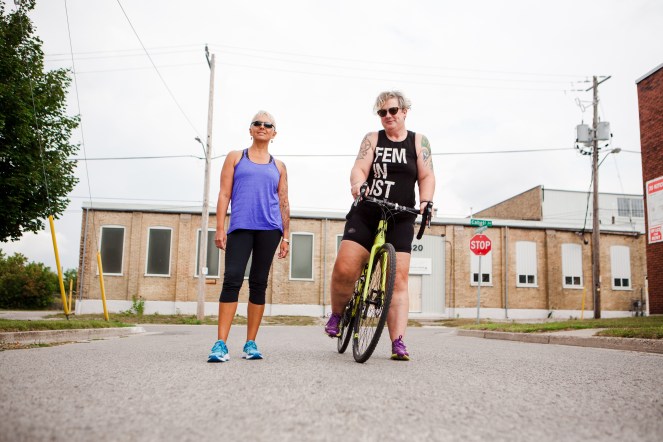
Image description: Low angle urban street shot of Tracy, standing in workout clothing, Sam, in workout clothes with a black tank top that says FEMINIST, on her bike, standing with one foot in the pedal. Stop sign and building in background.
Sam and I did another TV thing the other day, and it was great to have an opportunity to visit her in Guelph, where she’s heading into her ninth month of the big new job! We had to be in the same room to Skyped in to do a taped interview for Daily Blast Live! It’s a TV show that is syndicated across over 40 stations in the US and also shows on YouTube and Facebook. We’ve learned a couple of things about TV and interviews in general since the book came out and we’ve done some media. One is that TV interviews are super brief and you have to get to the point really quickly. Here’s our Daily Blast Live segment, which was only a 5 minute interview to begin with and then got edited down to about 2:30.
The other thing we’ve learned is that, especially for the women who interview us, the book really resonates with the interviewers in a personal, non-journalistic way. Even in the parts that they kept, this interviewer was enthusiastically committed to our book and its message. But throughout the five minutes we were chatting with her, she expressed a personal identification with the book and its message several times.
This particular interviewer didn’t turn to a sad personal story. But we have had many an interview where at a certain point the person asking the questions switched from her journalistic role to her own life, her struggles with body image, fitness, dieting, and weight loss. It’s never a happy story. At least so far it never has been.
We don’t feel great about the sad stories, but it’s not as if it’s news to us that many (most?) women have a vexed relationship with their bodies, workouts, and food. So it’s encouraging when our feminist fitness message resonates with anyone, even the journalists who are interviewing us.
Some of my favourite images from sports photography can be found in Howard Schatz’s 2002 book, Athletes. In his provocative work, Schatz photographs Olympic athletes from various sports in black, form-fitting clothing. Arranging them side-by-side, Schatz reveals the various shapes of the athletic female body. There are many ways of reading these images—I am not here to claim they are unproblematic—but the aspect I choose to focus on is how all of these women, in their varying shapes and sizes, represent strength.
I think society has a terrible time accepting physically strong women—women whose musculature is visible and takes up space. (The recent events surrounding Venus Williams come to mind.) We have adjectives for these types of bodies: “broad,” “big-boned,” “stocky,” and “handsome,” for example. But none of these words is meant to be flattering. (Brianne of Tarth, anyone?) As a 6’0’’ woman myself, I struggled well into my thirties with the question of how to be present physically in a room. I knew I wasn’t petite, small, or particularly fragile. I took up space—a lot of it.
For me, everything came to a head when I turned 36 and gave birth to my third child via c-section no. 3. The doctors who prepped me for surgery marvelled at my enormous baby bump, as if it were something glorious and Amazonian. I’ll never forget their astonishment when my beloved Quinton arrived, weighing in at 11 pounds, 1 ounce. I had given birth to a toddler. As for me, postpartum I had never been so heavy nor so chronically in pain. So, I decided I should do what any 36-year-old classically-trained musician would logically do: I decided to take lessons. I hired myself a brief stint with a personal trainer.
I arrived at the gym assuming my trainer would put me on the treadmill—what I had previously been urged to do to “slim down”—and yell at me in an emotionally-uplifting and inspiring way. (Reality tv wouldn’t steer me wrong, right?) But after five minutes of warm up, my trainer turned off the dreaded machine and led me to the free weights. She walked me past the familiar, dainty weights I had compulsively selected in past group exercise classes, and instead handed me the heavy “barbells” from the middle of the rack. Incredulous, I lifted. After a few sessions, it felt great.
In the first weeks working with this trainer I gained fifteen pounds…of muscle. And I grew strong. She quickly learned that we shared an interest in facts and physics. Together, we talked about everything from nutrition, to metabolism, to body mechanics. Herself being 5’4’’ and a competitive body builder, she looked at me and saw a remarkable template. It turned out, the construction of my previously-loathed body meant that I could actually accomplish some pretty remarkable things. She helped me to understand that my metabolism prioritised muscle and would grow it and protect it prior to burning off fat. This celebration of my construction was surprisingly new. And the strength training was far more effective in slimming me down than anything else I had ever done.
My trainer changed my life. She taught me what strength looks like—male or female. So many bodies that I would have previously thought were “bulky” actually belonged to incredibly strong, powerful women. I was astonished—considering myself a fairly educated individual—at how little I understood about the female body. And as I eliminated my fear of weights and of growing bulky, I also began to enjoy being myself a lot more than I had before. Exercising gave me a hobby that helped me moderate anxiety, eliminate chronic pain, play with my children without fear of “putting my back out,” and embrace failure as something amazing. In fact, failure in the gym is key. It is the best way to make you stronger.
Three years later, I still lift, although this summer I began running again as a chance to tackle new challenges. I cannot imagine life without regular exercise, and I talk with my children about strength and being strong. I fear, as a society, that there are far too many instances to undermine women’s ideas of strength, which, as Schatz’s image reveals, can come in many forms. And make no mistake, one doesn’t need to lift the heavy stuff to be a power house; strength manifests itself in remarkably different ways. Improving how I celebrate strength has been essential to improving my outlook on life, making me all the more excited to drive toward that next failure.
Kimberly Francis is Acting Associate Dean of Research and Graduate Studies at the University of Guelph, where she is also an Associate Professor of Music and a passionate feminist musicologist. She’s not ashamed to say that Taylor Swift, Guster, and many, many tracks from Big Shiny Tunes can all be found on her workout playlist.
When you’ve been blogging for six years you notice trends. It’s September and I’m nervous about losing the evening light. I’m sad about losing some of my favorite activities. And worried about the effect of fall dark on my mood. I’m also happy about riding in the fall, cooler temperatures, no big goals, and beautiful colours.
Those are feelings now and they are also frequently the topic of fall blog posts through the years.
You can get a sense of the flavour of fall sadness by reading this piece The Summer That Never Was. It beautifully connects end of summer melancholy with thoughts of mortality.
I suspect that the way I feel now, at summer’s end, is about how I’ll feel at the end of my life, assuming I have time and mind enough to reflect: bewildered by how unexpectedly everything turned out, regretful about all the things I didn’t get around to, clutching the handful of friends and funny stories I’ve amassed, and wondering where it all went. And I’ll probably still be evading the same truth I’m evading now: that the life I ended up with, much as I complain about it, was pretty much the one I chose. And my dissatisfactions with it are really with my own character, with my hesitation and timidity.
2. Autumn and evening dark: The pictures at the top are from the last weeknight of Snipe racing. We barely got two races in before we lost our wind and our light. It’s too dark now in the evening to make it worthwhile to start racing at 6:30. There are some weekend afternoon races but the regular Tuesday night club races are done for the season.
Last week I got caught out on my bike without headlights. I forgot how early it was getting dark now. I won’t do that again.
Partly for me it’s also about driving. Because of my eye condition, I can’t drive at night. When night comes before work ends, my life can feel pretty limited. It’s a good thing I ride my bike well into the winter. I’m also walking distance from work, downtown, and the mall.
I’m thinking about this CBC piece on end of summer sadness and the positive effect of thinking of September as a new start.
I’m going remind myself how much I love to ride in the fall by actually doing it. Because amid all the fall sadness there’s also quite a few expressions on the blog of how much I love to ride my bike.