fitness

Movement in four times

A month ago, I tried to haul myself out of bed and the room spun.  Violent, sudden, a ship hit by a giant wave.

My business partner has vertigo and I recognized it immediately.  I laid still, searching on my phone for what to do, tried the epley manoeuvre, made it to the bathroom and fought nausea while brushing my teeth.  Because Danny has this, I knew that this is something that can be treated by a physiotherapist, and I called the specialist clinic and — magically — there was a cancellation.  I took motion sickness meds and made it to the clinic, had my head and body moved around at different angles while wearing a virtual-reality-like set of goggles that measured my eye movements, felt like I was falling, felt better.

I left with two diagnoses:  benign paroxysysmal positional vertigo (the sudden, overwhelming world spinning) and unilateral vestibular hypofunction (more chronic, the signs of which I’d been noticing for a couple of years now).  I also left with some eye exercises, a greater appreciation for physiotherapy and with an unfamiliar sense of fragility.  Every time I moved my head for a couple of days, I felt a whirl, felt something in my brain, felt like I had to move very carefully.

I’m not used to that, feeling my brain and my body from the inside out.  Like I can feel the shell of my brain outlined inside my skull, feel gravity outlining a force around my body.

Recalibrating

For the next few days, I walked through my workdays as if I was underwater.  “My multi-tasker is broken!” I lamented.  I had literal vertigo, but was conscious of the metaphorical vertigo – life moving fast, in fragments.  So much work, so many screens, so much input, pace of life.

Four days later, I took my fragile, gravity-heavy self on a plane for a two part trip:  Uganda for a wedding and the Kyrgyzstan to visit friends who are living there temporarily and to attend the world nomad games.  (More about the games next week).  I’ve written before about how much I love to run when I’m traveling, and I’m in the middle of my “218 workouts in 2018” challenge.  But when the world moves around you every time you nod your head (and apparently I nod my head a lot — I’m so agreeable!), you have to adjust.  I’m not the best adjuster.   I had to rethink what I take for granted, how I orient myself to moving my body in new spaces.

Moment 1:  Running in rural Uganda

IMG_2512

I run a learning and development project for youth in Uganda, and our social worker was getting married.  The first few days were a lot of driving, a lot of celebration, a lot of meetings, a lot of dancing.  Dancing felt safer than I expected.

Then, the morning I was leaving, I had a spare hour — and I was able to go out for a run.  I was in Kasese in the western part of Uganda, nestled in the base of the soft, unsung Rwenzori mountains.

I started out from town down the road to Kilembe, one of my favourite runs in the world.  It’s gently uphill for the first couple of kilometres, few cars, just people walking and riding on small motorcycles about their business.  I ran through loud singing from the large church as I left town, and then suddenly, I had company.  Three kids.

Zavier, Juliet, Kenneth.  Sometimes kids run with me when I’m traveling, but usually only for a minute or two.  These three stayed with me for 15 minutes until I paused for water, then rejoined me on my route back.  I pulled the headphones out of my phone and played music with a strong drumbeat to accompany us.  Another two older girls, in dresses and “slippers” (flip flops) joined in for a kilometre or so.  They all split off, suddenly, with a quick “bye.”  I jogged back to my hotel, physically grounded for the first time in weeks, ready for a nine hour drive.

Moment 2:  Dancing in Kyrgyzstan

One of our first nights in Kyrgyzstan, we were having dinner in an Uzbek restaurant that had a tiny dance floor.  A song came on that — rarely, bizarrely — prompted me to jump up and dance.  A guy was doing very specific moves, which I imitated.  Unbelievably exhilarating.

Several days later, we were walking around the cultural village at one of the sites of the World Nomad Games.  “My” song came on.  I had my friend’s two year old on my back but I started jiggling around anyway.  Felix loved it and kept cackling his toddler laugh.  I did some of the moves I’d learned and suddenly I was surrounded by a group of Kyrgyz kids and young people — videotaping me on their phones.  I laughed and danced harder.  I think I’m on kyrgyz youtube now.

A bit later, the same day, the same song.  I started to move my arms and an older woman laughed and started nodding.  Within seconds I was surrounded by a bunch of women dancing with me, all of them laughing and applauding.  When it ended, they hugged me.

IMG_0317 2

I later found the song and discovered that the lyrics translate as “dance the song of the land you are in.”  I can’t imagine a better mantra.

Moment 3:  Walking the seawall in Vancouver

I flew home 24 hours to Toronto, then three days later flew to Vancouver for work.  The edges of my vertigo are still with me, a dizzying shadow following me when I stand up quickly, really feel my butt in my chair, move my head quickly.  I’m doing my gaze training exercises, but I can barely locate my body in time and space, sleep all over the map.

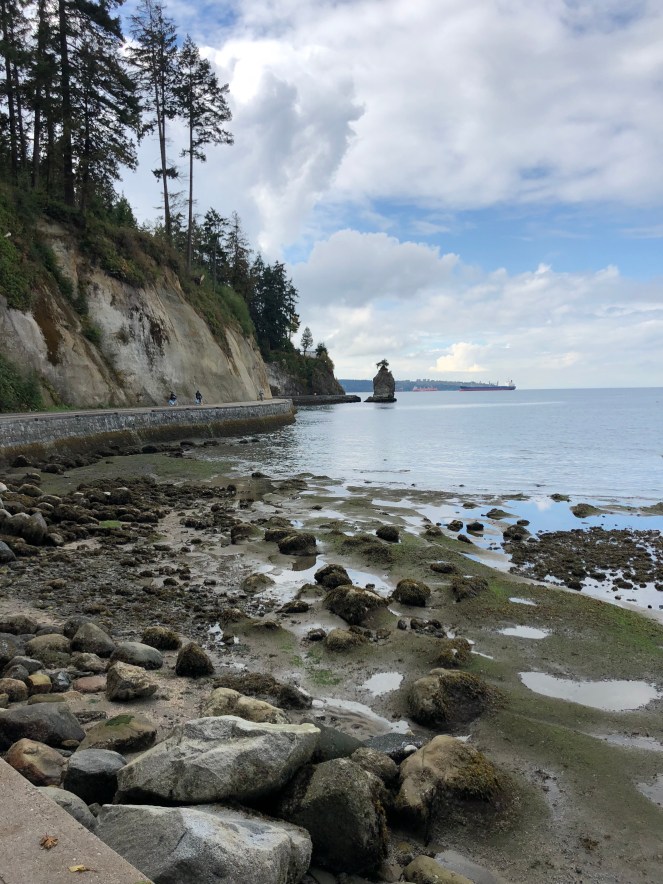
After I did the prep I needed to do for my work, I went out to the seawall in Stanley Park for a walk.  I knew I didn’t have a long run in me, but I wanted to feel the full span of the city where it juts into the sea.  I knew it would take about two hours, and I started out with podcasts in my ears, listening for “something inspiring.”
IMG_3991


About two kilometres in, I pull my earbuds out.  I let the soundscape wrap around me.  Quick lapping of the waves.  A soft burr of seaplanes.  The squeaking of a bike coming in the other direction.  The whish of bike tires.  Different languages rising and ebbing as I pass people.

IMG_3992


The harder I listen, the more dimensions I hear.  My own feet.  Snippets of conversation.  Boats in the distance.  I look more deeply into the beach.  Big herring gulls, a crouch of grey heron, the caw of crows.  I remember birding with my ex and learning to notice the small, invisible birds.  I look closely at a gull and realize it’s trying to swallow a purple seastar whole.  “What on earth are you going to do with that?”

I walk the 11 kilometres around, jog two more so I can meet my friend for coffee on time.  My body shifts as I run, working hard, working well, but no longer listening.  Brushing past the world.

I pay attention to that.  When I need to slow down and listen, when I should dance, when I should run and move fast past the world.  When I should pull out the earbuds and just breathe.

Fieldpoppy is Cate Creede, who lives in Toronto when she’s not roaming the world.  She blogs here the second Friday and third Saturday of every month.


fitness

Tired of Losing Sleep over Menopause? HRT Could Be the Answer #tbt

It’s been four years since I started HRT to help me with some of the changes that came with menopause. I know it’s not an option that everyone can take, but I am very fortunate and pleased that I was able to consider and pursue it. As I said in this post about HRT from four years ago, menopause isn’t a health issue but it sure can compromise our sense of well-being when we’re no longer sleeping, breaking out in hot flashes, and lose sexual interest. If you’re interested in possible solutions, and if HRT is among them, read on.

feminism · fitness

Serena Williams and the multiple ways of policing black women’s bodies

I didn’t watch the US Open women’s finals match. Maybe you didn’t either.  But we have all been witnesses to the explosions, accusations, blaming, denials, excuses and dismissals of charges that Serena Williams was unfairly and too severely penalized for her behavior during her match with Naomi Osaka. Osaka won the match, 6-2, 6-4. If you want to read more about the details, that will be easy– you can’t be on the internet without tripping over at least five articles about the match and the reactions to the match.

Full disclosure:  We here at Fit is a Feminist Issue loooove Serena Williams. Why? She’s strong and graceful, arguably the best tennis player in history, and one of the best athletes in living memory. We are in awe of her abilities and accomplishments.

We also love her because she is a woman who not only endures but in fact flourishes, despite constant attacks on her person.  By ‘person’, I mean her actual body.  Some men in charge of tennis in France criticized Serena’s catsuit, claiming that it failed to respect “the game and place”.

Mina blogged about it: Let Women Wear What They Want

I have to show that fabulous catsuit to you, just in case you didn’t see it.  Or even if you did. It is functional as well as fab– it has compression fabric to help prevent blood clots, for which Serena has a susceptibility.

Serena Williams in a black compression catsuit, about to hit a tennis ball, on the clay courts of the French Open.

Serena’s body has been analyzed, objectified, criticized and condescended to for years. In a New York Times article from 2015, tennis coaches and top female players spoke about how they were glad that Serena was accepting of her body type. Yeah, well, this body type had won Wimbledon 6 times. I blogged about it.

Repeat after me: athleticism is beauty; athleticism is beauty…

This time Serena is being policed for arguing with an umpire and reacting strongly (breaking a racket and calling the umpire a thief for penalizing her one game for a previous code violation). And things have gotten ugly.  I mean really ugly. Australian cartoonist Mark Knight’s racist depiction of Serena brings to mind early 20th century distorted images of African Americans. Here’s the link if by some chance you haven’t seen it.  It’s horrifying and racist and misogynist.

In addition to the racialized misogyny that Serena lives through, there are other aspects of racism that this match highlights.  I cannot speak to them here, but I point you to this article from the Washington post about rules, policing, black people, and Serena.  In short, it says this:

  • Serena broke some rules.
  • Lots of tennis players break rules.
  • How and when and how much of a penalty is meted out is a matter of discretion for authorities.
  • An authority gave out a very harsh set of penalties based on his discretionary choice to Serena, a black woman.
  • Authorities commonly give out very harsh penalties (including death by shooting) based on their discretionary choices to black people.

The article ends this way:

Rather than fool ourselves about the universality of rules, we should question the vast and often unchallenged use of discretion in both sports and criminal justice.

Thinking about the ways our bodies and our behaviors get policed is necessary for finding ways to change the rules and change the unjust ways power and discretion are meted out.

Thanks for reading.


Guest Post

How Gym Class Ruined My Life (Guest Post)

Last week Susan Tarshis posted about gym class and many other bloggers also had to chime in–we had very strong feelings–and it became a group post. Now our readers and guest bloggers are moved to share their stories. I’ve got about five more people in the queue who want to have a say! But first, here’s Sally. 

by Sally Hickson

I grew up moving every two or three years or so in accordance with my dad’s career. One of four and then five kids, moving from the Eastern Townships of Quebec to St John, New Brunswick, to Ottawa, to Calgary, back to Ottawa. One thing you learn from this is that education is a provincially regulated undertaking, so curricula change from province to province – you can be ahead in Quebec and behind in St John, as I learned when the rest of the class had ready responses to the mysteries of something called the ‘multiplication tables’. I sat there praying the teacher wouldn’t call on me since I had no idea what they were doing. My brother later explained it to me using the handy tables they printed on the backs of Hilroy copy-books.

Strangely, however, or perhaps not so strangely, when we moved from somewhere to somewhere (I really can’t remember the sequence) I was accelerated from grade three to grade five, based on my advanced literacy, although I remained ‘behind’ in math for the rest of my school career (I’d learned the ‘wrong’ way to do long division, for example). So there I was, eventually, in sixth grade in Ottawa, two years younger but taller and larger than the other kids, and suddenly plunged into full-blown gym class. I have to explain that in the Quebec Catholic school system we didn’t really do gym; that was for the Protestants. At JFK school, during physical activity time, we wore bloomers over our tights and ran around for a few hours each week, but there was nothing systematic about it. I don’t recall taking gym in St John at all, which might have had to do with the fact that the school wasn’t really big enough and we’d spilled out into portable classrooms scattered around the back lot.

Anyway, in Ottawa I soon realized I was in way over my head. I was a big girl, not fat, but tall and solid, physically mature for my age, and completely without any kind of organized gym experience. The class consisted of boys and girls and we had to wear shorts, which was humiliating because I was bigger than the other girls and uncomfortable about my body. In one of my first classes the gym teacher, who went by the improbable name of Mr Jolly, lined everyone up to do ‘vaulting’. I had no idea what he meant but I lined up with everyone else. It seemed to consist of running very fast, then up a little ramp with a springboard and flying over the ‘horse’. Everyone seemed to touch the horse on the way over, giving themselves an extra little boost, legs spread out to either side. Do gym teachers still indulge in this barbarism? I hope not. Anyway, I was worried. I was pretty sure my legs didn’t work that way. I balked and said no. The teacher said ‘try’. He knew there was nothing worse than being the new kid and appearing to be a crybaby. Remember, everyone was watching. I took a run at it. I’m not sure exactly what happened. I think I just hit the horse broadside and it flew apart. I wasn’t hurt, but the astonished silence quickly turned to titters and giggles. Mr Jolly looked slightly surprised – he probably saw his career passing before his eyes.

Things went downhill from there. Rope-climbing – I just swung around sitting on the knot. I was good at sit-ups, mostly because it didn’t involve leaving the ground. Hopeless at everything else. Team sports were especially bewildering, and that started a year of team captains sighing and saying ‘I guess we’ll take Sally.’ In the middle of it all, at the age of ten, my period started. I now had an occasional medical excuse, but gym class remained a nightmare because of the laughing, the teasing, my inability to be as ‘good’ as the other kids. I had a brief moment of hope when a fat boy appeared, but he became the vicious ringleader of the teasing, I suppose in order to deflect attention from himself. Outside of gym class he was actually pretty okay, and I knew how much the other boys made fun of him. I started getting sick a lot and the gym teacher recommended to my parents that they find me a psychiatrist. That was the last straw for my dad – I’m not sure what he said to Mr Jolly but, from then on, I was allowed to go to the library during gym class.

I’ll never forgive the junior high girls coach (by then they’d separated us from the boys) who made each of us do a gymnastics routine in front of – wait for it – ALL of the grade sevens. I did three agonizingly slow somersaults to a smattering of giggles and ironic applause. I felt hot all over, conspicuously incapable. I remember exactly what that felt like. When I started high school we moved to Calgary and I discovered that, at that time in Alberta, a female student had to be able to run a twelve-minute mile in order to graduate (for boys it was 10 minutes). By that time I had a partner in crime who trailed around the track with me long after the others had gone inside. We were both convinced we’d still be in high school in our 20s, running in the twilight.

I can laugh about it now but, in all seriousness, gym class ruined my life. It made me feel bad about myself. For me, it was a horrible, nasty, twice-weekly ritual at which I was the main sacrifice and there was nothing I could do about it until I cracked that twelve-minute mile and was finally allowed to leave gym class behind. The worst thing was that it made me hate my body, and the second worse thing was that it made me reluctant to try sports or exercise of any kind because I was convinced I could not be good at anything. Through my 20s, 30s and 40s the very idea of walking into a gym gave me a knot in my stomach, the gym class feeling. And my struggle with my body is not so much how I look but how I feel about how I look, again the gym class feeling that I’ve been carrying around with me since the age of ten. In my 50s, I’ve finally started letting go of that feeling, but it hasn’t been easy. After all, that ten-year-old is still part of me and she still hates gym class.

Sally is an art historian, professor, department chair, Italophile, film buff, heavy metal AND country music enthusiast, and fitness newbie.

fitness · season transitions

Sam is Telling New Stories, Like Celebrating 50 Years in Canada

It’s back to school and fall is approaching. I know it’s weeks off yet but university classes are back on and the leaves are turning. I looked back on past posts recently and blogged about the themes: dark, sadness, and fall riding.

I worry that stories take on a life of their own. We create ourselves through narratives and while we can’t just make stuff up, we do have some choice about the stories we tell. I’m looking for happier autumn stories.

The good news in my life is how much I’m enjoying my big new job. Deans at Guelph get to meet lots of students and so the first week of term has meant attending a lunch for all of our big scholarship winners and giving a demo first year lecture to 200 students on philosophy and death.

On Labour Day Monday Sarah and I helped to host a college wide lunch for first year students, and then most recently I was seen and photographed (thanks Sandy!) serving free ice cream to all students, new and returning, with other members of the senior admin team.

What’s not to like about free ice cream?

Chocolate, vanilla, and vegan rainbow sorbet.

I know this isn’t about fitness per se. But it is about new stories. The fall seems more celebratory with my Dean’s hat on. I also get to wear my academic regalia in September at a ceremony to formally welcome the first year class. The President admits them to the university and then there are welcoming remarks by the mayor of the city and the Provost. It’s really nice.

This weekend my mother and I are also celebrating 50 years in Canada. We’re having a party on Sunday called From Grand Falls to Guelph. It’s almost exactly fifty years since we emigrated from England. I was four.

Here’s my mother, my grandmother, me, and my little sister encountering lobster.

So I’m focusing on the new, trying to stay positive, and looking forward. How about you?

If you’re also subject to seasonal sadness, the Guardian has this great list of 18 things to try to combat fall blues. Some are obvious such as trying a new activity (swimming!) and spending more time outside. I also like the idea of day trips and the suggestion of allowing for more unscheduled time. Summer was busy!

This CBC piece on September sadness recommends thinking of fall as a new start but as a lifelong academic I do that anyway!

accessibility · cycling · fitness

Women and e-assist bikes… Sam has some worries

Image description: A white women’s arms in a white sweater resting on her legs. She’s wearing white bottoms with large white polka dots. Her hands are nervously clutching the fabric. Photo by Unsplash.

So first I hated electric bikes. I blogged about it. “The ones I hate are like bloated overgrown scooters on steroids with vestigial pedals. As far as I can tell no one actually uses the pedals. They’re just there to make the thing legally a bike. As the ad for e-bikes at a shop near my house says “Ride with no license, no insurance, and no registration.”

But not all e-bikes are like that. The best are like regular bikes with e-assist. You still pedal but it’s easier going uphill. Then I thought about it again, read some stuff and changed my mind. See Sam is sorry she was a bit of a fitness snob about e-bikes.

I learned about the fitness benefits of e-biking and thought about people riding long (for them) distances, especially carrying heavy stuff (groceries, children, etc.).

Then I talked to some women about their new e-bikes and got all worried again. The thing is it’s only women who are talking to me about e-assist. (Maybe men are also buying these bikes. I don’t know. They aren’t talking about, not to me anyway.) My women friends and acquaintances are claiming that without e-assist they’d never make it up hills. I know that’s not true. Hills aren’t my fave thing either but I’ve learned to live with them and make it to the top on my own steam. They say that now, and only now, they can keep up with their male bike riding partners. Maybe? But you could ride with other women. Or you could train and get faster. Don’t get me wrong. I’m glad they are buying bikes and getting out there. But I am genuinely surprised at the insecurity that seems attached to the decision to buy an e-bike.

Some of them, it seems to me, could have bought lighter, more expensive road bikes.

Maybe I’m fretting for nothing. I am glad more people are riding. It’s still good exercise and it’s great for the environment.

Thoughts? Have you considered an e-bike purchase?

fitness · motivation · race report · racing · running

Have you amazed yourself lately? Try consistent effort and see where it takes you [aka Tracy’s epic 10K]

Image description: Ellen and Tracy selfie after MEC 10K. Ellen on left, blond hair with straight bangs, smiling, white tank; Tracy on right, smiling, short blond hair, sunglasses atop head, smiling, pink and purple tank, white earbuds cord hanging around her neck; trees and parked cars in background.

One thing that I’ve loved about the past six years since Sam and I started our Fittest by 50 Challenge and created this blog to document it is the way I’ve actually amazed myself.  When I was 48 and we were just embarking on challenge, I didn’t think of myself as an athlete at all. And definitely not as a runner.

Well, fast forward six years, well after the end of our challenge (Sam and I hit 50 in August and September 2014, respectively), and just two weeks shy of my 54th birthday. On Saturday morning at the MEC 10K race at Fanshawe Conservation Area I put my summer of 10K training to the test. My last race was in early June when I did the Guelph 10K with Ellen and Violetta. There, I ran with Violetta and had the goal of running a continuous 10K, no walk breaks. My time: 1:10:01.

This time I wanted to break 1:05. That’s a lot to shave off a race time, just so you know. Indeed, I confess to feeling as if it wasn’t going to happen. I trained consistently through the summer, following weekly training plans developed for me by my running coach, Linda from Master the Moments.  They were tough some days, with long interval repeats of 800m to 1K at uncomfortable paces. But I did them.

That’s when I started to amaze myself, actually. I would set out to do one of these interval workouts and think to myself, “Linda has got to be kidding if she thinks I can hit those paces for that length of an interval!” And by the time I had about 6-8 weeks of training under my belt, I was routinely hitting the prescribed paces, often even going faster than she asked me to go for all or almost all of the intervals. And that was despite a hot, muggy, uncomfortable summer.

Linda said to me a few weeks ago that she really thought I hadn’t yet reached my athletic potential. My first thought, “Coaches are supposed to say those sorts of things.” But she actually meant it. She doesn’t like to get too hung up on race time goals, but she believes that consistent effort in training can pay dividends on race day.

So I went into the Saturday race with the hope of breaking 1:05 but lacking the confidence that I would. Ellen came in from Guelph the night before to do the event with me.

Saturday morning was the first day in months that presented perfect running weather. Perfect! Cool but not cold. Light breeze. Zero humidity. When we got to Fanshawe Lake Conservation Area and parked the car we were cutting it close to the start time. We asked someone in the parking lot which was to the start line and she pointed in the right direction and then said, “Are you Tracy from Fit Is a Feminist Issue?” And then she talked about how she’s been following the blog and she likes it and she’s planning on power walking the trail race. I always get a kick out of meeting people who love the blog! So that sort of charged me up and we wished each other well in our respective races.

I am the kind of person who has to pee before movies, classes, runs, and yes, races. So as we walked past the bathrooms I told Ellen I needed to go in and she could go ahead. She said she’d wait but when I got out I couldn’t find her. Now we were really close to the start I thought, so I wandered over the to start area and saw a bunch of people with red race bibs like mine milling about. I milled about with them and Ellen was nowhere to be seen. After a couple of minutes, I asked some one if this was the 10K road race. Guess what they said? “They left a few minutes ago!”

Bam, I was outta there. Looking back, I wonder if that late start without a cohort to run with lit a fire under me that made me not just break 1:05, but come in at 1:04:25, a personal best for me!

I ran strong and continuous for the entire 10K. I eventually did see Ellen on her way back (it was 2x out and back for 5K each time, so we passed each other three times in all). I went in with a few strategies that served me well:

  1. I left my Garmin on my belt and vowed not to look at it after the race started. I wanted to check my stats later but I wanted to run by feel not the external cues of the Garmin, which can mess with my head.
  2. A friend of mine who has done a couple of iron distance triathlons said he gets through them by smiling (I’m sure it takes a little more than that, but whatever). I remembered that and decided smiling would be a good strategy. It wasn’t hard to do because I really did feel amazing on Saturday.
  3. This might sound strange and obvious, but I committed to pushing myself just enough to be able to sustain what felt like a strong pace but not so much that I would lose steam before 10K was over. I figured I could turn on the extra power near the end when I knew I didn’t need to have anything left in the tank.
  4. I absolutely didn’t want to walk at any point, and I made that decision ahead of time so there would be no question if my mind started to play tricks on me.

So, without the Garmin, smiling, pushing my pace, and committing to a continuous run, I ran the fast flat course in perfect weather. I could feel that I was running strong and steady. Instead of thinking I needed to walk, I actually felt pretty jazzed by the building momentum. I hit my rhythm and stayed there pretty consistently after 3K.

My younger faster colleague, Miranda, turned out also to be doing the 10K, and it was great to see her a few times and also at the end with her partner (also a colleague) and one of their kids. I got cheered on by a few other runners who know me through the blog and the book but whom I don’t know in person. At about 7K, one woman running towards me said she read and loved the book and that I was her hero! That almost made me cry but then I knew crying would slow me down so instead I let her beautiful comment motivate me (“you’re someone’s hero! Act like it! Go faster!”). Thank you to the lovely soul who said that to me.

When I hit the final turnaround and realized I only had 2.5K to go, which, come on, is hardly anything, I felt so good. I made a final decision that when I got to about 1K to go I would turn off the music and give it my absolute all. And I did just that.

When I crossed the finish line I hit “stop” on the Garmin. True to my word, I hadn’t looked at it since the race started. It read 1:04:31, not far off my chip time of 1:04:25. I was amazed. Seriously.

Now it’s true that had the conditions been different — a more humid day, a hillier course, less support from others, maybe even an on-time start — it wouldn’t have been the same. But whatever. I did it. I broke 1:05 and shaved almost 1:30 off of my previous personal record, set way back in 2014 at the Halloween Haunting when I was in top condition after my fittest by 50 triathlon season.

Between breaking my 10K record and consistently doing 3 sets of 12 pull-ups at the weight training studio, I’m feeling pretty amazed at the evolution of my athleticism. Confident and strong. Yes, I realize that 1:04:25 is not an epic time for some people. Lots of folks come in under 60 minutes for their 10K, some even under 45 minutes, closer to 30. Wow! I am truly in awe of those sorts of times. But I am also in awe of progress and personal milestones, and I think it’s okay to be impressed with ourselves sometimes!

That feeling will carry me to my next goal, which is to take the continuous running to a new distance–the half marathon. That will be a new challenge, but I think I can do it if I run smart at the Scotiabank Waterfront Half Marathon in October. I have the time goal of 2:25 in the back of my head. I will follow that pace bunny. But my main objective is to run continuous. Again with no Garmin. Between now and then I will stay consistent with the training that Linda has laid out for me.

Sam and I sometimes laugh about how boring our message is. No dramatic magical transformation that happens overnight. Just a moderate, easy going approach. Start small, put in consistent effort, challenge ourselves a bit, and see what happens. It really does yield amazing results, even if they kind of creep up on us.

Have you amazed yourself lately? I’d love to hear about it in the comments.

fitness

Couch to 5K – an update (Guest Post)

A photo of Cheryl, a white woman with a lime green scarf and a dark sweater and cute, short spiky hair.

Thanks for all the encouragement on my couch to 5K journey! I’ve been keeping at it these last few weeks, although sometimes the intense heat in Toronto has been challenging. There were a few days when I decided it was too hot to run, and other days when I managed to get a run in while there was cloud cover or when it cooled down right before or after a rain shower.

Today I wanted to share some more thoughts I’ve had on running since I last blogged, specifically on the question of when to run. This is another thing that I’ve found a bit more difficult than expected. Technically, going for a run outdoors is something I can do any time. But in reality it’s a bit more complicated than that. Runs have to fit around my other obligations and basic life necessities – like working, eating and sleeping. Running too soon after a meal has proven to not work well for me, so after eating I need to wait for an hour or more if I want to be comfortable. I also prefer to run when it’s light out, for my own feeling of safety, and I try to avoid the hottest parts of Toronto summer days.  That’s a lot to consider and plan around!

I know that early morning runs are a great option for some folks, and I’m all for that if that works for you. But getting up early to run before work is something that I just can’t make myself do, so that’s off the table for me. (Morning can be hard already, as that’s a time of day when I regularly experience a lot of anxiety and/or morning depression). I know it would be a series of failed attempts, and that wouldn’t do anything to help me feel good or achieve my goals.

Given all that, here’s what I’ve found works best so far – running in the late afternoon, after work and before dinner. To help with this, on run days I try to leave work a bit earlier than usual, which has also been great for my work/life balance. Weekends are a bit easier, although it depends on how many other activities I’ve packed into the days, as I tend to try to fit a lot in. I aim to do one run each weekend and two during the week, and I usually manage to do at least two out of three, and sometimes all three. So my 8 week program may take more like 10-12 weeks, and I’m ok with that.

At this point I’ve completed week 5, day 2 of the training program, and the next day will be a 20 minute run with no walk breaks. The longest run without a break so far in the program has been 8 minutes, so I’m nervous and excited to see how running 20 minutes non-stop feels. And I’m also open to giving myself a walk break if I need one, because here’s an important thing I realized: I want this program to fit me, rather than trying to make myself fit the program. I’ll let you know how it goes!

About me: Feminist, bisexual, LGBTQ health researcher, book lover, drummer, introvert.

fitness · motivation · swimming · training

You can love a thing and always suck at it. That’s okay. Also in not unrelated news, Sam starts swimming lessons.

Susan gave me some framed pictures from our cruise for my birthday, photos of me in the water. Such happy memories from our cruise. Thanks Susan! I look really happy. And that’s the thing. I love being in the water. I’m not scared of fish. I’m not worried about drowning. I can tread water and float really well. It feels great moving in the water.

But you’ll never see that smile indoors. And swimming, here in Canada at least, is mostly an indoor activity. Also, my swimming isn’t at a level where it’s a fitness activity. I’m not sure why, bad technique probably, but unlike running and cycling, I don’t seem to get faster with training in the pool. When I trained with the university students’ triathlon club I was the anchor person of the slow lane. New people came and then after a time moved up to a faster lane.

Then last week this article made its way into my newsfeed, Revel in the joy of doing things you’ll never master.

And I wondered, could I enjoy swimming without getting any faster? Does everything have to be about speed and improvement? Couldn’t swimming just be pleasurable even if I remained a slow swimmer?

I begin swimming lessons later in September. I’ll let you know how it goes!

In the meantime here’s me 11 years ago, with Susan, after the Kincardine Women’s Triathlon. I was happy but I was also last out the water of those who weren’t rescued. The thing is I was in zero danger. No need to rescue me. But I was just slow, as usual. Maybe that’s okay.

Maybe part of my learning to love swimming means getting comfortable with staying in the same place?

How about you? Do you have a thing you’re not good at but that you love anyway?

Susan and Sam, 2007

athletes · fitness

Are there any elite female athlete-doctors? Yes, but they’re not easy to find

Today I was listening to an NPR radio show I like called Only a Game. I like it because it covers lots of different sports and lots of athletes of different ages, dis/abilities, competition levels, etc.  This week’s show included a segment on US National Football League players who went to medical school during their playing careers.  This May,  Canadian Laurent Duvernay-Tardif, an offensive lineman for the Kansas City Chiefs, graduated from medical school with his MD. He’s gotten a lot of press for this impressive accomplishment, but it turns out he’s not the first NFL player to combine an athletic career with medical school.  If you’d like to hear more about it, check out the podcast.

When a male pro athlete does anything else in addition to working as a pro athlete, it’s big news. John Urschel (also Canadian) played pro football for several years while working on a PhD in mathematics at MIT.  He retired from football in 2017, partly because of a JAMA study on CTE, a degenerative brain condition linked to multiple concussions. He’s now a full-time graduate student.

These stories got me wondering: there must be women pro and elite athletes who have done the same thing. I got to work, googling here and googling there.  These women are not easy to find.  But they are out there.

American diver Abby Johnston won a silver medal at the 2012 London Olympics and was a medical student at Duke university while competing at the 2016 Rio Olympics.

Canadian Caroline Park trained for and competed with the South Korean women’s Olympic Hockey team while she was medical school at Columbia University. She’s had to juggle her schedule and take some time off, but has support from her family, the hockey team and school officials.

I found information about a handful of  mostly Olympic women athletes who then went on to become physicians. All of them were Canadian or American.  There was nothing– NO-THING– out there (that I could find) about female athletes from other countries who combined training and competition with medical studies.

The reason why I’m writing about my failure to find relatively easy access to this straightforward question— which female athletes trained and competed during medical school– is that there could be a number of reasons why I can’t find anything.  And none of them bode well for female athletes who have ambitious educational plans. Here are some possibilities to explain.

Except for tennis, women pro athletes’ salaries are much smaller than male athletes’ salaries.  Want some figures?  There’s very nice (and graphically pleasing) information by Adelphi University. Since women athletes have less money to begin with, they may not be able to afford medical school during training and competition.

Olympic female athletes often come up through secondary and university systems, or government-sponsored sports organizations. The time and commitment requirements are enormous.  The male athletes who talked about combining sports and study had to overcome significant objections, and play down their scholarly activities. Women athletes likely faced even more hurdles and had less support. So it may be the case that there are fewer women who were able to pursue such a combined program.

Or, maybe there are many examples all over the world of women athlete/doctors, but they get no press.  Google doesn’t care about them because the media doesn’t think it worthwhile. Yes, that’s a cynical view.  I mean, it’s possible that I just did some lousy searching.  But I don’t think so.  After all, in the course of my online searching, I did find this:

Former pro basketball player Shaquille O'Neal, receiving his doctorate in education from Barry University.
Former pro basketball player Shaquille O’Neal, receiving his doctorate in education from Barry University.

It’s cool that pro basketball legend Shaquille O’Neal graduated with a doctorate in education. But I want to know about the women, too.  Why?

Frankly, it’s a thrill for me to see high-profile women who excel in athletics and academics at the same time.  It motivates me to do my best to continue down those dual tracks in my own life. And I can use some motivation. It’s hard to push through inertia, time constraints, injuries and/or other limitations, and other wild cards that life throws at us.

No, I’m not planning on pursuing another degree and taking up a new sport or amping up one I already do. But it’s nice to see superlative achievers out there. And I want to see those women. I’ll keep looking.  If you know of any cases, please let us know in the comments.