fitness

Is there anything wrong with “luxury gyms”?

Last week our Facebook page lit up with a discussion of luxury gyms in response to an article that appeared on Vox. The article in question, “The case against luxury gyms like SoulCycle,” took issue with luxury gyms because “the rich are getting fitter while the poor are falling behind.” Exercise inequality — of access, of opportunity, of expectation — is an important social issue that we have written about before.

We’ve talked about the exercise gender gap and we have also talked about the expense of maintaining an active lifestyle: exercise equipment, gyms, studios, and so forth. There’s all sorts of privilege associated with even having the option of taking up traditional fitness activities.

The article draws attention to two trends in American fitness:

On the one hand, new cycling, spinning, yoga, barre, and CrossFit facilities are popping up in cities all over the US, and now make up about 35 percent of the US exercise market, according to the International Health, Racquet & Sportsclub Association (IHRSA). The fitness industry overall generated $25.8 billion in revenue in 2015, up from $20.3 billion in 2010. Much of that growth is coming from these newer boutique facilities: membership at studios like Flywheel and SoulCycle exploded by 70 percent. There’s a big segment of the population hungry for new health and fitness options.

However, poor people get about half as much exercise as the rich. The latest fitness “trends” are available to the population segment who, arguably, need them the least. The emergence of “boutique” outlets, the article argues, further entrenches exercise inequality. These establishments make activity less accessible rather than more accessible:

“We privatize physical activity,” Elaine Waxman, a senior fellow at the Urban Institute, told me, “instead of investing in good public spaces where everyone can run safely or community centers with free yoga.”

The article notes further that these types of studios tend to specialize. Yoga here. Spin there. And they fulfill a social need as well, encouraging a sense of belonging to a community or “a tribe” of like-minded folks who are equally passionate about spinning. Or yoga. Or pilates. Or aerial gymnastics (if that’s what it’s called). Etc.

The article goes on to say:

But let’s be clear: A defining characteristic of the tribe using these workout spaces is affluence. It’s people with a good deal of disposable income — and an interest in fitness — who can pay to use these facilities. According to Vogue, they’ve even been relegated to the sphere of status symbol. “It’s become very much a brand in itself, the kind of sport and exercise you do,” Candice Fragis, senior buyer at Net-a-Sporter, told the magazine. Another spinning enthusiast said, “It’s like the only acceptable lifestyle brag.”

The Facebook discussion generated an expected range of opinion on the central claim, which I take to be that these gyms perpetuate exercise inequality and are for that reason making a net negative rather than positive contribution to our society. Not all inequality is unjust, but if the inequality arises from oppressive social conditions, then we should regard it as suspect. Of course, some wondered whether simply having such options necessarily negates other more accessible options.

The fact is, as this niche market grows, public funding for community programs, public spaces where people can get out and be active (like bike paths, walking and running trails, public pools, exercise parks) in a safe environment, are becoming less of a priority.

It’s natural to wonder whether luxury studios mitigate against affordable or free options. As a Canadian, I’ve seen this type of question comes up a lot in discussions of “two-tier” health systems and “two-tier” education. Though we do have some privatized options and services, the Canadian sensibility on these things–which I’ve embraced all my life–is to make them available to all.  The thinking is that if we start making better services available to those who can afford them, the public system will decline. And that decline can have not just class-implications, but also race and disability implications.

Of course, gyms and studios have never been part of a public system in the same sense as health and education, but there is something of the same attitude lurking in the background when we question the impact of luxury gyms on more affordable options.

A couple of people in the comment thread on FB noted that it’s possible to get active without ever joining a gym. But some pointed out that they do in fact need a gym. There are all sorts of reasons it might be a good option: lack of space to workout at home, or the need for instruction and guidance, or the added motivation of going somewhere to work out are all possible reasons that joining a gym or studio might be a good option. Not everyone has the wherewithal to stick to a plan all on their own.

Others commented that time is another precious factor in living an active lifestyle. Someone whose financial situation forces them to work two jobs or longer hours in one job, to live further from their workplace and therefore to give more time to their daily commute, to live in an area where it is not as safe or where there simply are no gyms (whether they can afford them or not) within walking distance–may not have the time to incorporate activity into their lives on a regular basis. Time is a privilege.

Luxury gyms are elitist and exclusive. There is no getting around that. But so many of the activities we associate with an “active lifestyle” are available only to a privileged few. The equipment, the training opportunities, the events themselves come with a hefty price tag. It’s simply false to think that an “active lifestyle” is not more available to the affluent.

For my part, I think there are good reasons to continue supporting more accessible gyms and public spaces. One of the reasons I continue to maintain my membership at the Y is that I like that they offer subsidized memberships to people who can’t afford the regular price.  I’ve been impressed with the fitness park in Fort Lauderdale, a public park on the beach with a number of workout “stations.” It’s free (though the parking is not) and easy to find. But of course, located on prime beach front, it’s in a very high end neighborhood with pretty much no affordable housing within walking distance.

Despite my ideals and my support of the Y, I do maintain a class-pass at a hot yoga studio and I pay for one-on-one personal training as well. While I wouldn’t call either a “luxury gym,” I can’t deny that these are privileges not available to all who might benefit from them.

The real issue is, how can we make adequate opportunities more available, while still recognizing that some people’s life circumstances make finding time for physical activity low on their list of priorities because of more basic needs not being met. The social and political issues associated with the privilege of even being able to lead a “balanced” life that includes leisure figure large in this conversation.

The authors end their article with a great question: “It’s time to start asking what else we need to invest in to spread exercise opportunities more equally. As the rich get fitter, what are we doing for the rest of society?”

It’s an important conversation and we’ve just scratched the surface of it here. What do you think about luxury gyms, affordable and accessible fitness opportunities, and exercise inequality?


fitness

Cat’s “Weight Loss Resolution Resistance”

Image may contain: 2 people, people smiling, people standing and outdoor


Cat of Cat Inspired has been working on a project about why not everyone is choosing weight loss as a New Year’s resolution. Here is Cat talking about the project.

She writes, “Though toxic weight loss & diet culture surrounds us all the time, it seems to run even more rampant in January. This year, I want to share as many voices as possible expressing why they aren’t focused on losing weight in 2017.  As the month goes on, I hope the number of these quotes will grow! They will if you contribute! You can do so here: https://form.jotform.com/63617582269163 Many thanks to the folks who have contributed! Please feel free to tag yourselves and share!”

www.catinspired.com/resolution-resistance

https://www.facebook.com/555008401273753/photos/…

Image may contain: one or more people and text

fitness

Sam learns to ski, slowly, down very small hills

It’s all Sarah’s fault. Okay, and Stephanie’s. They’ve succeeded where others have failed. They got me to put on downhill skis and go down a hill. A very small hill. But a hill. 

I’ve been saying no to downhill skiing for years. I first said no when my high school boyfriend Barry asked me to go. It seemed scary and expensive. But mostly expensive. 

Later when Jeff asked me I had views about exercise. I wanted outdoor activity that scorched calories, got my heart racing from effort rather than fear, and kept me warm. I took up cross country skiing and continued declining all offers of downhill.

But I have women friends now, my age, who downhill ski. They know me and they say I’d like it. They tell me there’s some transfer of skills from cycling.

I was intrigued when Stephanie blogged about going from cycling to skiing. 

See Conquering imaginative fear: From cyclist to skier (Guest post) – http://wp.me/p2H8o1-C9P

I loved her advice to talk to ski instructors directly about my fear. She says she tells them straight up that she’s no daredevil, she doesn’t like speed, and she’s a coward.

Me too. Me too.

My instructor for my beginner lesson was a cheerful, determined, and patient young woman named Andrea. She’s sixteen. She’s a francophone anxious to practise her English so she can go out West as teach skiing. By the way, her English is excellent. She’s also a triathlete and does sprint distance races with her mom. 

Andrea taught me to make a pizza with my skis, with bigger slices to slow down. I learned to turn too. All very exciting. But it’s my plan to take this very slowly. I’m going to focus on mastering these skills. It’s okay to be slow. I’m focusing on having a solid skill base before I try tricky things like getting on and off a ski lift. (That looks terrifying.)

I’ll tell you more later. But for now I’ll tell you that I tried it and it was fine, even sort of fun. 

Watch out world.

fitness

Fat biking: A photo essay

So it was part of my winter fitness plan to play in the snow more often. This past weekend I got to do just that. Yay! I love being outside and because I get cold so easily I need to do very active things to make that happen. It’s part of my strategy to make friends with the Canadian winter.

Sarah and I rented fat bikes from a shop near Mont Tremblant and explored the trails. Fun!

On Facebook I asked one question though, “Dear mtb’ers and fat bikers: What is it with trails right along the *edges* of rivers and steep ridges? The woods and the water are just as beautiful a few feet away from the edge.” I think they like the danger. Me, I like the beautiful scenery and moving outdoors in a way that keeps me warm.

(Side note: Turns out when we looked at the maps over coffee one morning this week that the scary “edge of ridge overlooking the river” trail was marked “black” for advanced. We felt better once we saw that all the trails we’d ridden that day were blue or black. I personally felt better about walking the bike across the skinny bridges.)

Yes, I fell a few times. Whee! Thump! I’ve got some bruises. I always do. But falling in the snow felt just fine.

Is it a good workout? Well, it’s no replacement for time on the indoor trainer. That’s true. But there is only so much of that I can take. My average heart rate was 130 something, not as good as running or cross country skiing but better than walking or sitting on the couch. Also, my cheek muscles hurt from smiling and that’s got to count for something.

Here’s some information on the trails.

I’m still on the fence about buying a fat bike. They’re expensive and I think it’s something I’ll continue to do a few times each winter. Renting is easy and there’s no need to lug a fat bike around.


See past posts:

Winter Biking: So Hot Right Now!

Fat bikes: Taking a break from the trainer to go riding in the snow!

fitness

Lessons from Florida: Cold weather running is all about the gear

On Sunday morning I woke up to complaints about the weather from all over the place. In the north, people lamented the wind chill and the winter driving conditions. But I’m in the south, in Florida right now, and yesterday my weather app showed that it “felt like” 5 degrees C in the morning. As some aggrieved friends in the south said, the weather came as a bit of an affront.

Now, to me, 5 degrees C is usually great running weather. I’ve been suffering a bit here in the heat and humidity, and given a choice between cold-weather running and hot-weather running, I’ll take cold. I know how to handle it: I throw on my light winter tights, a t-shirt, and a long-sleeved top or jacket, maybe a buff to cover my ears, and away I go. But I’m in Florida. And I packed for Florida. That means my gear is all about tank tops and running shorts. Nary a long sleeved running top in sight. So there was just no way I could get out there first thing in the morning.

I did get out for a walk in the morning though, throwing on a pair of jeans, layering a tank top, swimsuit cover-up (for it’s longer sleeves!), lacy cardigan, and a shawl that I always put into my luggage when traveling because I’m all too familiar with the air conditioning blues. I wore thick socks and running shoes and still I felt the cold.

People on the beach path dealt with the cold in their own way. Some were indistinguishable from the winter runners I pass on the only city-cleared path in London, Ontario — with their winter tights, gloves, toques (yes, I saw folks in toques–that’s Canadian for a winter hat for those who don’t know). I would have been content with a long sleeved shirt. I saw one woman who had her own lacy cardigan over a running tank. Clearly she was traveling to Fort Lauderdale for the weekend and didn’t want to forgo her Sunday run despite not packing appropriately for it.

I waited it out until later in the day when the temperature climbed to a comfortable 18 degrees C. Yes, the wind was still gusty. At one point I almost lost my hat. Some people still had on their tights and their jackets and sweaters. But it was nothing like what Anita was experiencing up in Collingwood. We touched base that day and she said the windchill was a biting -21C.

All of this got me reflecting about how it really is all about the gear. And the good thing about winter running is that usually, you can gear up for it. If it’s very icy, you can wear your yak traks. If it’s cold, add a layer or three. My usual mid-winter top layers include an undershirt, a wicking t-shirt, a long-sleeved technical shirt (thickness depends on temperatures), and a running jacket that’s cut longer in the back to cover my butt.) If it’s very cold and windy, the jacket with appropriate layers under it does the trick. Put on some gloves and a hat or an ear warmer. In the very brutal conditions, you can even wear a face mask (or go inside — we all have our limits).

You can’t gear up in the same way for summer running. I did my 21K training run on Thursday last week on a very hot and humid morning. It just about killed me. I stuck mostly to the beach walk and felt immense gratitude for the showers at regular intervals along the beach. I needed them. I’ve got my fingers crossed that we won’t experience the same conditions next week in Key West for the Half Marathon.

So yes, it’s all about the gear. Even a relatively balmy cold snap in Florida can defeat a Canadian used to much colder temperatures if she doesn’t have the layers she needs.

What are your winter running gear go-tos? And if you’re from somewhere warmer, like Florida, do you keep some back-up stuff on hand in case unseasonable cold hits?

fitness

Let’s hear it for the weekend warriors!

Image result for weekend warrior meme


I’m not a true weekend warrior though from time to time I lapse in that direction. See Weekend Warriors go Digital and A work week without exercise and weekend warrior syndrome.

But here’s good news for the weekend warrior. It turns out that exercising just on the weekends may be enough to prevent early death. According to this report on the CBC as little as 1 moderate session a week is enough to reduce all-cause, cardiovascular disease and cancer mortality.

From the CBC story,

“Weekend warriors” — adults who perform the recommended amount of 150 minutes of moderate or 75 minutes of vigorous activity in one or two sessions per week — were found to have a risk of death from all causes about 30 per cent lower than inactive adults.

Researchers in England set out to investigate the risk of death from all causes, cardiovascular disease (CVD) and cancer was associated with physical activity patterns.

“I think it’s important to reassure people that if they are a weekend warrior, if they are only exercising once or twice per week, and it’s of moderate or vigorous intensity, then that’s good enough,” study author Gary O’Donovan, of Loughborough University, England, said in an interview.

Read the rest here.

image


body image · fitness · Guest Post

What Tabletop Gaming Taught Me About Feminist Fitness, Inclusiveness, and Body Image (Guest Post)

by Kimberly Brumble


This time of year, when a lot of people are re-committing themselves to various fitness goals, the tabletop gaming community is also abuzz with discussions comparing fitness trackers, sneaker purchases, couch to 5k plans, and the elusive 10,000 steps.  However, unlike a lot of January fitness adopters, the tabletop gamers are training to play a long game with goals cumulating out in mid summer and even early September.  Why?  That’s convention season, and suddenly thousands of people who are passionate about a hobby that involves sitting around a table for 4-6 hours at a stretch will need to also be able to walk 10,000 to 20,000 plus steps in a single day, probably also lugging bags full of games and gaming materials with them, for 12 to even 20-hour stretches at a time.  These are folks, like me, who take their sedentary hobby so seriously they will begin training 6 and even 9 months out to get the most out of the Best Four Days in Gaming.

Hello, I’m Kimberly Brumble.  I’m a philosopher of science.  In my free time I hike, cycle, run, and lift heavy things.  But also once a week for 5 hours I’m a dwarven fighter trying to save Golarion one axe swing at a time.  Yep.  And I live for it. And sitting around a table pretending to be a super-human elite who can do all sorts of things I can’t has changed how I experience fitness.  Our journey begins…

Let me backtrack and give a little background on me and my hobby.  Tabletop gaming centers around playing games on, you guessed it, a table rather than a screen.  These games range from complex board games like the wildly popular Settlers of Catan and Arkham Horror to role playing games (RPGs) like Dungeons and Dragons (DnD) or Vampire the Masquerade.  Also popular are miniatures games like War Hammer, deck-building card games like Magic the Gathering, party card games like Werewolf, and so on.  Basically, if you can play it on a table, it probably has a following which attends conventions like GenCon.

If you had caught me 2 years ago, I would have told you that my dalliances with board games began and ended with an ex-boyfriend trying to explain Catan to me, which I experienced much like this.  And then at his suggestion observing his friends play the game, which went much like this.  When the guys finally did let me play I was so bored I sabotaged my own budding civilization in the first hour so I could go do something else at the party.  Much of my experience of board gaming was at first shaped by 1. the weird gendered dynamics involved with learning mechanics-heavy games and 2. playing the wrong games for me.

RPGs and card games and I didn’t fair much better. As a queer geek gal growing up in a yet-to-be-hip Portland, Oregon, of the 80’s and 90’s, I could never get invited to play DnD or Magic the Gathering for two reasons: 1. I was a girl and 2. I didn’t “look” geeky enough to seem “safe” to invite.  A common trope in 90’s geek culture.  Apparently it was scary enough to invite Cool Guys, let alone sporty girls.  I mean I was also plenty geeky (I’ve read the Silmarillion…multiple times…which is something even among Tolkien dorks), but I was also sporty and artsy, and geek culture had yet to  become so mainstream that people who looked like me got invited to the game table.

Fast forward to two years ago when a bunch of grad students in my philosophy department decided to start a game night.  Our goal was two-fold: 1. have a good time in small-town Indiana without spending money and 2. try to build a better, cooperative climate in our hyper-competitive, socially-challenged cohort.  A weekly gaming night morphed into a 2+ year DnD campaign–which I am still skyping into thousands of miles and two countries away–and passion for tabletop gaming.

DnD will change your life.  There has been a lot written about the social and even professional benefits of RPGs in terms of team-building skills, empathy and community building, and even writing, but for this post I’m going to focus on how it changed my experience of fitness.  That’s right: if you are still reading this, my fellow jocks, DnD changed how I experience fitness.  Here’s how:

First the bad: Tabletop gaming lives up to some of the stereotypes.  Committing to a long-running DnD campaign (Pathfinder, actually, for my fellow RPGers reading) meant committing to sit at a table for 4-6 hours a week, during my free time.  That’s time that I used to spend hiking, cycling, and running.  I now spend it sitting.  That doesn’t mean I don’t still do those things, but I don’t do them on Saturday afternoons (when we currently game).  It’s not more time spent sitting gaming than many people spend in a week watching TV, but there it is.  Also, there are snacks.  Lots of snacks.  Which is great.  And not.

But here is the good (and maybe surprising):  plenty of us gamers are still really active people during the rest of our lives.  What’s more, I have found that gaming and gaming culture has some nice benefits for people, and particularly femme-type people, who are also into fitness.  First of all, DnD campaigns in general involve a lot of action. Even if the players are sitting, they are imagining fighting, swimming, climbing, and doing so, so, so much walking.  Ever read or watched Lord of the Rings? Yeah, it’s like that.  And actually, you can just walk into Mordor.  It’s pretty much the only way to do it (eagles aside).  So even if you play a very squishy (that’s DnD speak for non-athletic and easy to hurt) wizard, your character is probably pretty fit and occasionally making climb, swim, acrobatics, and wilderness survival checks and, generally…hopefully…dice permitting, passing most of them.  On top of that you can choose to play a character who uses physical abilities rather than magic primarily to get shit done.  In our game I play a fighter–and I don’t use magic, just a lot of strength and agility and stamina.  Which is nice, actually, because it kind of motivates me to think about and maintain those physical abilities IRL as well.  Characters “level up” and improve their abilities, which makes them better at doing more stuff, and I have gone from thinking about fitness as maintenance, or beauty, or a duty, to “leveling up” with regard to my IRL physical stats.  Charisma (charm, social skills, beauty) after all, is its own stat.  Strength, agility, and constitution have nothing to do with how you look in the world of DnD, and that’s kind of liberating, especially I think for women and femme-type folks.

Speaking of gender and stats, in DnD the gender of a character does not determine their base stats or how stats progress. Men, women, and every other gender imaginable start with the same base stats available to them.  That means your average human in DnD has a strength of 10, dexterity 10, and constitution (hardiness) of 10.  It’s up to you to change those scores as you build your character and play the game.  For me, a gender-fluid woman who has struggled my whole life with gendered norms and expectations about fitness, that was a revelation.  If I didn’t have to go into DnD with gendered expectations about my own abilities, maybe I didn’t need to bring those to the gym/mountains/cycle track either.  And what I can imagine has a big impact on what I find myself able to do and be.

Finally, I want to say something about the world of DnD and gender with regards to the DnD races.  If you have consumed any high fantasy media you are probably aware that much high fantasy post-Tolkien comes stocked with some standard-issue (and often less standard-issue) fantasy “races.”  It’s important to note that these “humanoid” races do not and probably should not track real-world human concepts of race: we are talking elves, humans, dwarves, gnomes, haflings, orcs, and the like.  While they do come preloaded as tropes with their own set of representational problems, others have also argued that thinking about these issues in fantasy can also open dialogue about issues in media representation of real racism, cis-sexism, hetero-sexism, and ableism.  One thing which fantasy races have done for fans of the genre is to provide us with a multitude of alternate images of different genders as strong, agile, and beautiful people.  In my own experience as a stocky, muscular woman standing 5’2’’, I have found myself drawn to characters with similar builds; thick legs and powerful arms can be beautiful too.  Or not.  Because beauty is not compulsory for effectiveness.  Not even for bards.  Body diversity matters.  Even in fiction.  And especially in a genre in which men and women have so often been made to look like this:

conan

It’s powerful to see them depicted in a range of bodies.  Like this:

And the same has been true increasingly for men as well:


Feels good to go post-human, yeah?

So to sum up, tabletop gaming has brought new perspectives on fitness for me as it has slowly taken over my non-academic life: I think about my fitness in terms of being able to do things I want to do (like walk around a convention all day lugging heavy gaming manuals, something my DnD fighter would consider par for the course), or improving my ability scores (rather than punishing myself or maintaining or striving for some abstract appearance-related goal).  What’s more, it’s expanded how I and many gamers imagine strong, capable, competent, optionally beautiful, and powerful bodies- both ours and those we inhabit in our dream-lives saving imaginary worlds, one Saturday afternoon at a time.


kb

Kimberly “Berly” Brumble is a PhD candidate at the University of Calgary. Her research focuses on how uncertainty in climate modeling effects decision-making and how decision-making under “deep uncertainty” involves both scientists and policy-makers in the environmental sciences and geophysics. She enjoys hiking, camping, cycling, cycle camping, running, canoeing and kayaking, lifting heavy things, and pretending that the Canadian Rockies are the Misty Mountains on weekends. She is also pretty serious about illustrating and painting. She has recently discovered playing in, writing, and running rpgs. Catch her next year at GenCon on her recurring panel “Philosophers Play Pathfinder.”

Uncategorized

Riding in the Mountains of Laos

As this posts, I’m flying home from a month in Asia — a few days in Bangkok, then cycling trips in Sri Lanka and Laos.  I blogged a little bit about the Sri Lanka trip [here] and [here].  I loved the Sri Lanka trip but it was a bit intense — difficult riding, we got lost a lot, and there was a group of 10, and that’s a lot of time for introverted me to spend in company. I ride when I travel to be alone with myself, and to be present in the place I find myself, and it’s harder with a big group.

I landed in Luang Prabang in Northern Laos on New Year’s day, and was instantly wrapped in a soft calm.  I wandered around the old town, had a massage, and ate excellent food.  One night, as I ate a sublime vegetarian curry, I watched my server dreamily catch and release raindrops on his fingertip off the yellow awning over the terrace.

The four day bike trip in the mountains of Laos was wrapped in the same kind of mindful softness.  Northern Laos is remote — there’s only one road from Luang Prabang in the centre to Vientiane, the capital a few hundred kilometres south.  We rode that one main road about 250 kilometres, through twisting, curving climbs and downhills, and flats through tiny villages, subsistence farms, small rice paddies.  My group was small — just me and a female couple from Australia a little older than me.  They were easy-going and riding-seasoned, and the flow was simple.  We mutually agreed on van transfers on rain-slick mountain roads, shared awe and long photo pauses.

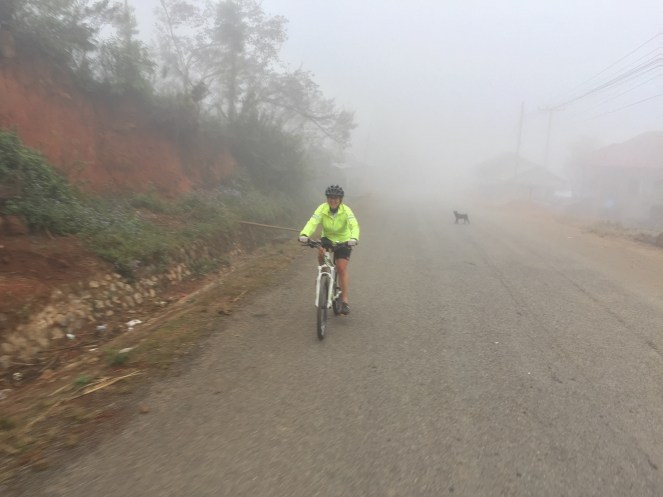
Half of the ride was in the mountains, often in mist, surrounded by waves of dark green sharp hills, clouds settled down around us.  Climbs were long, but affable and gentle, occasional trucks and motorbikes, but mostly just us, the road, the mist, the mountains.


The softness of this kind of riding makes me more porous, and the world around me flows in. In every village, children come running from the side of the road to shout “SABAIDEE!” (Hello!) and high five us — sometimes a little too hard.  Pigs escape from their pens by the side of the road.  People bathe at the cold village taps, men in their underwear, women wrapped in sarongs, children naked.  I stop to watch the sad drama of a group of people attempting to lasso a cow with a makeshift vine-rope after it’s been injured by a car.  Notice that babies are wrapped to men’s bodies as often as they are to women’s.  Pedalling into a land and soundscape that isn’t accessible any other way.

In Phousavan, we spend the morning at the market then at a little exhibit learning about the devastating impact of the US bombing of northern Laos during the American/Vietnam war.  It’s horrifying history — many bombs were dropped on Laos because they couldn’t reach the Vietnamese targets and couldn’t return with full loads; there were rules of engagement in Vietnam about civilian targets, but because Laos wasn’t technically at war, they didn’t apply.  There are unexploded bombs everywhere still in Laos, and the napalmed hills won’t grow anything for 200 years. [Good piece on this  here].

The three of us are quiet after the morning, and when we start riding, we soon end up in mountain cloud and fog.  It’s hard to see, but my body needs to move, to be fully present in this place to make a little bit of human connection with the stories we’ve heard.  The other two women get in the van, but I ride, carefully up and into the mist, feeling the cold.  The guide tries to have the van follow me closely but I ask him to move on.  I want to be alone with the road, responsible for my own safety.

In the mountains, the villages are mostly raised thatched huts with woven roofs; as we get further south, houses become more prosperous, made of cement or brick and with electricity, satellite dishes. Roadside stands shift from selling firewood and occasional bananas to selling oranges. In the mountains, people walk between villages carrying bundles of sticks, firewood, in bags braced by their foreheads. In the valley, there are more motorbikes and bicycles leaned up near the road as people tend their crops.  The people in the mountains have almost nothing, barefoot children hopping because the road is so cold on their feet.  I wasn’t properly prepared for this level of chill and I’m often shivering;  they are huddled around tiny bucket fires.

The final day of riding — the 15th day of riding of my trip — is nearly 100k. We start out in Phoukoun in the mountains climbing for an hour, then descend through the hills to the valley. I have a couple of skids on curves that remind me to pedal cautiously (I crashed the first day on gravel in a curve, unfamiliar with the brakes on this bike), then I’m on my own for most of the ride.  I’m so grateful for a body that lets me do this, feel this place through my pores, my own effort and openness rather than through the window of a van.

I notice one little girl walking her bike up a hill and I call out Sabaidee!  She sees me and hops on her bike, starts to race me up the hill.  At the top, she extends her hand for a high five and we hold hands for a brief moment.


img_1722

Just before we get to Vang Vieng, we stop at a bridge over the Nam Xong river. There’s a little monastery high on one edge, and the mountains that have wrapped around me all afternoon crowd close.  My feet and hands are sore, but I stop, feel gratitude, know why I do this.

img_1740


fitness · fitness classes

Throwing money at the problem: my kayak investment plans for 2017

In 2015 I spent more time kayaking with friends. I started venturing into the ocean and discovered (unsurprisingly) that sea kayaking is a whole different world, requiring not only skills I didn’t have, but skills I didn’t even know about. My first foray into open ocean (with waves and currents and big rocks to maneuver around) was a real eye-opener. It was, frankly, scary to me. But after some time, I came to enjoy—even revel in—the incredible beauty of an ocean environment. While still being a bit scared, I admit.

In 2016, I did some kayaking here and there, and then took the plunge (literally—man, is the water in Maine cold!) by doing a weekend intensive sea kayaking course with Maine Island Kayak (and of course my friend Janet). That course did two things for me:

1) It made abundantly clear how much I DON’T know about sea kayaking, like understanding tidal current, wave and weather effects. Oh, and navigation. And being actually comfortable and roughly in control of my boat bobbing around in the ocean.

2) It gave me a clear plan if I do want to develop my sea kayaking skills. I need to learn to roll a kayak, get comfortable in the boat under a variety of conditions, do lots of practicing of all sorts of techniques, and above all: log more time in a kayak on the water. This means I really need to buy my own sea kayak. Sure, you can rent them, but it limits you in where you can put in, or you have to transport it somewhere else and return it, etc. Streamlining the process of doing a sport makes that sport more doable.

So, for 2017, I’m investing some time and money on the following:

Rolling classes: I’m taking some indoor pool rolling classes with Kevin at Rock Paddle Surf Kayak in Salem. Last year I did one rolling class. And in the fine tradition of 2016 sports lessons, I learned how much effort and time it’s going to take for me to learn to roll (namely, a LOT). So this year I signed up for a series of 3 classes. I may have a partial roll by then, but certainly it will help move me forward.

Another weekend intensive: Janet and I are going to do the 3-day East Coast Paddlesports Symposium near Charleston in April. This is the perfect venue for me. The water will be warm, I can rent a boat and necessary gear easily, and it offers a big variety of on and off-water courses for a bunch of levels. This means Janet can go off and learn to fight sharks with her paddle while I work on rolling and other handling techniques in warm (did I mention the water is warm there?) water and under adult supervision. I learned so much from 3 days of intensive instruction last year that it’s worth some time and money to do it again this year. And likely I’ll go back to Maine for more kayak instruction and paddling in lovely Casco Bay (even though the water is cold…)

Possible/likely/uh… sea kayak purchase: I’ve been hemming and hawing for a year about buying my own sea kayak, but this is probably the year to do it. Kayaks are like bicycles: you can spend a little money ($700ish) or a lot of money ($5000+). I haven’t figured out what my entry-level boat will be like, but I will be asking around and trying out different ones. Kayaks are also like bikes in that you buy an entry-level one, and then can trade up. Or out—like bikes, kayaks come in multiple designs for multiple purposes: touring, surfing, fishing, etc.

Unlike bikes, though, a kayak cannot be stored in my (non-walk-in) basement, because it will be at least 15 feet long. So I have to leave it outside or talk a friend into storing it at their house. Not all the details have been worked out yet, but the process is moving along.

It’s a bit daunting, diving headlong into a new or different sport. I’ve been toying with sea kayaking for a while now. I guess it’s time to put my money where my mouth is.

Readers, what experiences have you had with deciding to plunge in (or not) and devoting some time and money to a sport or activity? Was it hard? Was it easy? I’d love to hear from you.

Sat with Nat

My 2017 Stop Doing List

Natalie and her partner, wearing a silver cardboard hat with Happy New Year written on it, smile at the camera
Marking the new year with my sweetie
I was sitting at Sam’s table one night chatting with Amanda (who has guest blogged here too!) when she asked if I was interested in joining a choir with her. I burst out laughing. In my mind’s eye a giant plinko chip ricocheted off all the things that are happening in my life, there was no time to take on a new thing. 

Some years I make resolutions for the new year. Often I make fitness changes around my birthday in October as the weather changes. And sometimes, like this year, I make a stop doing list. 

I have an overachiever A-type personality which can be a superpower and a giant, toxic liability. So, in the spirit of me doing me and you doing you, I thought I’d share (in no particular order) my 2017 Stop Doing List. 

1. Stop glorifying being busy

I get a buzz off being mildly overcommitted on my calendar but that is quickly followed with feeling tired, overwhelmed and exhausted. This is my tried and true path to being depressed as fuck. Fuck that shit. Busy can be good or bad but being busy doesn’t have to be tied to my self worth. 

2. Stop beating myself up over missed workouts

I’m committed to a Tuesday and Friday workout class at lunch. My workmate Anthony has invited me to do cardio with him on Mondays and Wednesdays. I’m spinning at home Thursdays and Saturdays. 

My work schedule is flexible but I don’t book my meetings so sometimes I can’t make a class. 

My kids are 15 & 17. It’s an oddly intense parenting time and things come up last minute. I’ve decided being there for them this year is especially important as my partner will frequently be on the road for work. 

Also I don’t have to hit every workout to be fit or to be taking care of myself  or to be a good person. Perfectionism is my path to procrastination and self sabotage. Fuck that shit. I’m not aiming for perfection, I’m aiming for a good quality of life physically and mentally. 

3. Stop apologizing for being a hot mess

My brain is not wired for schedules or knowing what day it is. I’ve this weird mental myopia where the next 24 hours are really clear to me and I can totally see where I need to be in 6 months. Between those two time brackets I seriously have no idea what’s going on. 

I use my calendar at work and at home to get the important appointments and kind of herd my family to things like haircuts. That’s all I have in me though, so I’m often a hot mess. 

My friends have chosen to love this about me. I often miss things because I thought it was next week or I forgot to put that Facebook event in my calendar. I’m trying but now I’m also accepting this is how I move through the world. 

To those who love me, thank you for accepting my quirky, uneven, mostly there for you self. My name is Natalie and I’m a hot mess. I will explain myself but I’m done apologizing for this. 
That’s it!

So I’m focusing on my physical and mental health and making time for naps and snuggles. 

I hope your fitness stuff is going well. Have you done a Stop Doing List? I’d love to hear of you have what was on the list. 

Also any thoughts this post has provoked as I get a big hit of happy when folks interact with what I write.