athletes · blogging · fitness · injury · monthly check in · motivation · sailing · weight loss

Sam’s monthly check-in: What’s up, what’s down, the July version (CW: long, some sad bits, some discussion of weight loss)

Down, is of course, my knee

Saw the surgeon and his team on Monday. I’ve been crying on and off since.

The easy bits are that I got another shot of synvisc under my kneecap. What is it and what’s it for? “SYNVISC is a viscosupplement injection that supplements the fluid in your knee to help lubricate and cushion the joint. SYNVISC is for people with knee osteoarthritis who have not received enough pain relief from diet, exercise and over-the-counter pain medication.”

Read more here.

I’m also still wearing the knee brace and it’s helping on days when I’m on my feet a lot. I spent the weekend in New York and even though I took the subway more than usual and hopped in a few taxis for good measure, I still got 13,000 steps in on Sunday including a walk through Central Park. Thanks knee brace. I did some shopping for more leggings for under the brace and for short skirts and dresses to wear over the leggings. The brace presents some fashion challenges and I’m warmer than usual with black leggings on no matter what.

Image description: A photo of Sam just outside Central Park. I’m wearing black leggings, sandals, a sleeveless black jumper and a purse over my shoulder. Also, a knee brace. I’m smiling and the sun is shining.

I’m still going to physio and doing lots of knee-supporting exercises.

I still meet the conditions for knee replacement surgery (in both knees actually though only the left hurts) but neither of the surgeons I saw recommend it. I’m too young and I’m too active. The surgeons made me laugh, which is something, given the general message they had to deliver.

They said they like to make people happy. The person they make the most happy through knee replacement is somebody who arrives in their office, sad and older. Someone who just wants to walk to the grocery store without pain, the kind of person who says they want to lead a normal life, get a decent night’s sleep, and not suffer all the time. Knee replacement apparently makes that person very happy but they said for someone like me it wouldn’t make me happy.

Why not? Because I want to regain function and their line on knee replacement is that you shouldn’t do it to regain function, you should do it to lose pain. Also, knee replacements don’t last very long maybe 20 years and I’m young. I want to do things like ride my bike and some patients after knee replacement have difficulty bike riding because they don’t have the full range of motion back necessary for riding a bike.

So, no.

Instead they discussed a different surgery called high tibial osteotomy. That surgery involves breaking bones and resetting them so I have a bigger gap in my knee cap on the side that’s in a lot of pain. It’s a good sign that the brace helps because this does surgically what the brace does mechanically. But it’s not a permanent fix. There’s a chance the other side of my knee will become painful as arthritis advances. So it’s good for 2-10 years maybe. Also, it’s big deal surgery. Like knee replacement it’s months and months of recovery. I’d trade off 10 years of active living without pain for six months painful time consuming recovery but I’m not sure about 2 years. There are no magic globes I can peer in to see the future.

I’m trying to decide. See them again in three months.

In the meantime my fit feminist friend Sarah is having that same surgery. Wishing her well.

But the other depressing piece of news from the surgeons was the strong recommendation of weight loss, both as a way of avoiding surgery and as essential to recovering from it. Either way I should lose a lot of weight. It will definitely, they say, help with pain relief. The pain is all about weight bearing. That’s why downstairs is harder than up. It’s all about force on the kneecap. And as far as motivation goes this is pretty horrible pain. Like pain that makes hard to think about other things.

Now as I’ve said before I wish that it were the case that medical reasons for weight loss changed the facts. But that’s not so. Your body doesn’t care how good, how “pure” your motivation is. It’s still tough. It’s tough losing weight and tough keeping it off.

I don’t have any choice but to try. The worse case scenario is that I lose it, gain it back, and more and need knee replacement surgery. But that’s the same worst case scenario I face now. I’ve lost significant amounts of weight in my life, 70 lbs in grad school, 60 when I turned 40. The trick, the hard part, is keeping it off. This time, if I actually lose weight, I’ll be unicorn training, learning the habits of people who actually keep weight off.

Don’t worry. This won’t become a weight loss blog. Likely I’ll save any angst, any updates, to my monthly check in posts. I’ll also add content warnings.

I thought about leaving blogging but making this pain manageable and movement possible is a big part of my life right now. And I’m very much still a fit, feminist just one who is coping with injury and aging and hoping to keep in moving.

Wish me luck.

Up, still Snipe racing

It can be tricky moving around in a small boat in ways that don’t hurt my knee but I’m learning how to do it. I haven’t raced a small sailboat ever. All of my sailboat racing experience is on relatively big boats so this is new to me. With all the knee misery, see above, it’s good to have something new to focus on. It’s fun and exciting and lots to learn.

cycling · fitness

Sam’s bad knee cures Sam of a bad bike habit

I confess. I’m a masher.

I like big gears and slow pedaling.

I’ve written before about my ambivalence with the beast language that gets used to describe my riding style. I’d rather be a lightweight fast pedaling gazelle. But I’m not.

My cycling coach got a call one day from a friend saying his Garmin must be broken because the average cadence on his ride was in the low 80s. He wasn’t going slow. He averaged over 30 km/hr. But he got the speed by pedaling slowly in big gears.

I’m like that too. Yes, I can sprint and then I pedal faster but my usual road ride cadence is slower than that of those with whom I ride.

That’s not how cyclists are supposed to do things.

What’s mashing? What’s the alternative?

See here.

“Pedaling furiously (with a high cadence) on a low gear is called spinning, while pedaling slower (low cadence) on a high gear is called mashing. Both can get you to high speeds — so why do the best cyclists prefer spinning?

The prevailing theory is that spinning is a more efficient use of your strength and energy. Many cyclists revert to mashing, however, because it feels faster. But, not only does mashing produce more lactic acid, it predominantly uses what’s called fast-twitch muscle fibers, which fatigue faster than slow-twitch fibers (used in spinning) [source: Williamson].”

Why do I end up mashing? Partly it’s because I can. I have strong legs and can push big gears. Lots of riders can’t. Uphill it feels like my only option. I weigh a lot so I need the power.

The thing is it’s better to get spinning fast and then increase gears. Keep your cadence high. That’s what I do when I sprint.

When I was riding on the track on a fixed gear bike increasing cadence was the only route to more speed. A cycling coach at the velodrome suggested that when training I put a spinnier, smaller gear on my bike to improve my cadence. It nearly killed me. I had a hard time keeping up with my usual peers but it worked. My cadence improved and when I switched back to my usual gear I got faster.

So what’s happening now? Pushing big gears with slow cadence hurts my knee. Not a big surprise given all that’s going on with my knee. Naturally I’ve been moving into smaller gears and upping my cadence. I lost the cadence sensor on my bike a few years ago. I might just get it back and be deliberate about improving my cadence.

Watch me spin! Whee!

family · fitness · injury

How was your weekend?

Selfie of Sam with white bike helmet and her Sweet Ride Cycling bike jersey.

I’m not training for anything these days. I’ve got the one day version of the bike rally that I’m still hoping I can do. Please, please sponsor me here! But really my main goal is staying active while managing my knee issues, avoiding pain and surgery.

This means that my workouts look like a little haphazard. They’re more like active lifestyle than anything you’d call exercising or working out. It’s definitely not training. I’m still having fun.

Catherine’s post on Sunday really resonated with me.

This weekend I logged two workouts over the weekend in the 218 in 2018 group I’m part of.

97. Short hike through fields and meadows, lots of moving things around, mini archery lesson.

My son Gavin got a new bow and we took it to Sarah’s family farm so he could practise shooting into balloons, hay bales, and dirt piles.

98. Bike 30 km to cheer Tracy in her Guelph 10 km running race. Great to have her in my new town. A group of us got together for brunch after.

How about you? What did you get up to this weekend?

A picture of Sam trying out her son’s new bow. She’s wearing wide leg blue pants. There’s a backhoe in the background.
accessibility · aging · disability · injury · motivation

An apology: A thing Sam thinks she needs to stop saying…

My life has changed a lot since we started the blog and the fitness challenge. There are things I say when we’re promoting the book that now strike me as wrong or at least not as simple as that, or maybe even naive.

Things feel a lot more complicated since osteoarthritis and advanced cartilage degradation made me a candidate for knee replacement.

It’s hard to get a more nuanced message across when you’ve just got four minutes on television so I’ve been sticking with the simple story but the truth is I know it’s not so simple. I’m not staking out a position here or defending a claim other than than claim that things are messier than I thought. I do know the blog can handle more complexities than the media buzz around the book can take. So you blog readers get the messier story.

Maybe after the book promotion I have to stop saying “if you don’t love it, don’t do it.” There are a lot of things in life that I do but I don’t love. These days a lot of exercise feels to me to fall into that category. Knee physio can be tedious and sometimes painful. And I do it most days. There’s no way to love it. You watch Netflix to distract. You give yourself rewards for finishing. I need to do it but there’s little joy in it.

Instead, I take pride in my grit and determination, in my resolve.

See When exercise isn’t fun.

Why am I doing it? Not love of the thing itself that’s for sure. Partly to be sure it’s instrumentally justified in terms of continuing to do things I love. Canoe camping, hiking, biking. I want to keep these things in my life.

But it’s also instrumentally justified in terms of basic movements, like walking to campus, between meetings, getting in and out of chairs.

To suggest that we approach all exercise from this “loving it” perspective comes from an incredible place of privilege. I had that privilege. I don’t anymore and I’m sorry if I sounded insufferable, naive, and smug.

I saw it again today, by the way, in an online body positive fitness community of which I’m part. Someone offered the advice to another community member to do whatever brings joy to your heart. And the thing is I too reject the imperative that we all have to do joyless exercise to tame or unruly, overweight bodies to keep them in line. I also know though that life is complicated.

Just as Tracy rejects body positivity as just one more demand, I’m coming to feel that way about “if you don’t love it, don’t do it.” No one loves knee physio. It’s okay not to like it and to do it anyway.

It’s okay to be angry and sad and roll your eyes at people who say they just don’t feel like running this morning. You don’t get to yell at them that at least they can run and tell them to just go do it because you can never run again. Just say it in your head. That’s what I do.

It’s okay to think, “I’m tough and I’ve got this” instead of I’m doing this because I love it . Because that’s what’s true: I’m tough and I’ve got this.

Maybe that’s true for you too. I’m sorry for saying you have to love exercise. You don’t. Right now, a lot of the time, I don’t. And that’s okay too.

aging · disability · health · injury · monthly check in

Sam’s monthly check-in: What’s up, what’s down, the May version

May! Finally warm weather. The best thing about May is riding my bike. It was 50 km the first week and 60 km the next . Weekdays I’ve been exploring my new home, Guelph, after work and running errands on bike. That’s what’s up. It feels great.

**********************************

Not so much “up” is my left knee. It doesn’t feel great.

I met with the knee surgeon again. Total knee replacement still looks far away. At least I hope so. See 9 Things No One Ever tells You About Getting a Knee Replacement for details. We’re still seeing how things go with the goo injections and the brace.

I’m wearing the brace for walking. I’m doing physio still. And I’m riding my bike. That’s all good.

The surgeon and his team are busy telling me that all the activity I’ve done isn’t responsible for my knee osteoarthritis. They do also tell me never to even say the word “running” again. Fine. See Sam struggles not to run, ever!

But they do say I’d be in less pain if I lost weight. More seriously they say that losing weight would help me put off total knee replacement. That’s big.

Now they used to also say that knee patients should lose weight first, before the surgery. See Researchers Find Weight Loss Not Necessary for Joint Surgery

But if you think you must lose those extra pounds before a knee or hip replacement, think again, as researchers with UMass Medical School found long-term relief from joint replacement surgery was almost the same in obese and non-obese patients.

“The conventional wisdom is that the lower your body weight, the lower your body mass index, the better you will do in joint replacements, and there has been an increasing push to say that if you are obese you should not have joint replacement – either knee or hip replacement,” Dr. David C. Ayers, chairman of orthopedics and chairman and professor of orthopedics and physical rehabilitation at UMass Medical School, said Thursday.
Dr. Ayers is the co-author of a study reporting the findings published last month in the Journal of Bone and Joint Surgery.

“What this study shows is that people who are overweight and are obese get the same type of pain relief and improved function that non-obese patients do,” he said.

Surprise! Fat people are people. Fat bodies are bodies. And knee pain hurts a lot no matter what your size.

The old wisdom sounds just like, “You’re fat so must pay the price! Suffer! No knee replacement for you!” Doctors can be jerks.

But in my case we’re not talking about weight loss before surgery. The issue is weight loss to put off the necessity of joint replacement. Total knee replacement is worth avoiding. Right now knee replacements last 20 years max. So if all goes well, I might need a second one. It’s big painful surgery with a very lengthy recovery time. I don’t want to do it twice.

See here. Point 1: “For many, weight loss is a basic but crucial way to help avoid knee surgery. Shedding just 15 pounds can cut knee pain in half. And should you need arthritis knee surgery later, you’ll decrease your risk of complications and reduce strain on your knees, which will make your rehabilitation go more smoothly.”

So, what to do?

I’m reading a lot about knee pain and weight. No surprise there!

But I’m also researching weight loss for medical reasons. Maybe like me you thought that weight loss is hard but once you’re told you need to lose weight for medical reasons, you just do it.

I’m here to tell you the sad news that it’s not so simple. Your body doesn’t care what your motivation is. It’s not like it ignores the diets for beauty’s sake and pays attention to the diets for urgent health reasons.

I think when I was younger I even thought it would be good to have a medical reason to lose weight because then you’d be serious about it and just do it. I could be a feminist and be skinny because I was dieting for health reasons. Bah.

Now I have very good reasons, I’m being serious about it, and I’m still struggling.

Tracy and I were chatting today about whether it ever makes sense to talk about weight and weight loss on the blog. It’s not something we talk about much. It’s a blog about fitness not weight and shape and we’re very keen to distinguish these things. In this case though weight loss isn’t a goal that I want to result from my fitness efforts. Weight loss may be necessary to keep me active.

We’re all about staying fit and strong in midlife and beyond. That’s the overarching message of our book. But given my knee and the state it’s in, staying active may mean losing weight. I’m trying. I won’t post much about my successes and failures. I know that’s too much for those of you with histories of disordered eating. Even though I’m one of the larger bloggers here, that’s not me. I like food and my relationship with it. But I also feel the need to be honest on the blog about what’s up with me fitness wise.

Have you had or contemplated having knee replacement? Have you struggled with medical reasons to lose weight? Tell me your story

*************************************

Also, hello May, I’m tentatively making plans. There are plans afoot for bike/boat holidays, for canoe/camping trips, for long bike rides. I love the summer and I’m going to enjoy it.

accessibility · inclusiveness · injury

Three stories about my knee brace

Story 1. I met a woman at the university in the Starbucks line with a bright red knee brace. I thought of my friend and co-blogger Martha Muzychka who said she’d get a bright red one if she had to have one. We chatted about the relief of knee pain, surgical alternatives, and joint replacement. She’d already had hip replacement and sounded like she wanted to avoid more surgery for awhile. She talked about lifting weights and we shared stories of leg strengthening exercises that leave the knee out of it.

Story 2. I’m still wondering why people are aghast at the knee brace and instantly see it as a bad thing. I now have some inkling of how people with wheleechairs feel about that reaction. I’ve had some many versions of this conversation.

Other person: OMG you’re wearing a knee brace. That’s horrible. When can you stop wearing it?

Me: Look at my terrific knee brace. I’ve got zero knee pain when wearing it. Watch me hop on the injured leg.

Other person: Oh.

Story 3. I was walking to the CBC the other day asking Front Street in Toronto and had to navigate my way through a crowd of baseball fans. A very happy young male Blue Jays fan says “Hey lady with the knee brace. I got one too. Up top. High five.”

Such polite sports fans. #Bluejays
What’s the brace about anyway?

Samantha Brennan's photo.

disability · fitness · injury

When exercise isn’t fun: Sometimes it’s boring and repetitive, painful, and not the least bit joyful

My new physiotherapist tells me that I’m tough. She also says I’m determined.

That’s the kind of praise I need these days.

Because contrary to our usual message, I’m not exercising these days because it’s fun or joyful or at all social. I’m doing a lot of boring, repetitive, sometimes painful exercises, mostly by myself, in order to regain basic knee function so I can do things like climb stairs and get out of chairs without grimacing. I’m also making time for it when I am super busy and when the exercising part doesn’t feel like a reward at the end of a long day. It’s more like punishment.

So when Tracy wrote yesterday that “our number one piece of advice for anyone is to find activities that you enjoy” I admit that I kind of flinched. Because my life isn’t like that right now. Right now I am doing a lot of physio. My knee hurts. I’m resolute and determined to get back on my bike even though I’ll never run or play soccer again. Aikido? Maybe. I’ve got hope for cycling. We’ll see. I’m in mourning a bit for my former self!

In my Facebook memories newsfeed a happy photo came through of the Run for Retina 9 years ago. It’s me and cousin Tara doing the 5 km. Look at our smiles! Look how happy we are!

tara

I’m not sure why I am telling you all this, except to find company and to reassure those of you, who like me, who are in pain, that you are also not alone.

I do exercises to support my knee function to my pain tolerance and then it’s all ice and ibuprofen after. I’ve missing the Fowler Kennedy game ready ice and compression thingie. I want one for home!

Yesterday, I was balancing and marching and doing squats on a bosu ball. See here for how that helps.

So contrary to our usual message of “if you don’t love it, don’t do it,” this is me saying, it’s not always fun or joyful or social and sometimes you need grit and determination and you do it anyway. That’s part of my character, a big part of who I am.

What was Tracy’s message last week, life on life’s terms? Something like that.

aging · athletes · cycling · injury

Bonus mini blog post: Sam sees some hope when it comes to her knee and riding a bike

I know many of you have been following the saga of my knee with interest and concern. I feel like I’ve got a whole community watching out for me and wishing me well and cheering me on.

Tonight something really good happened.

Here’s what I posted on Facebook.

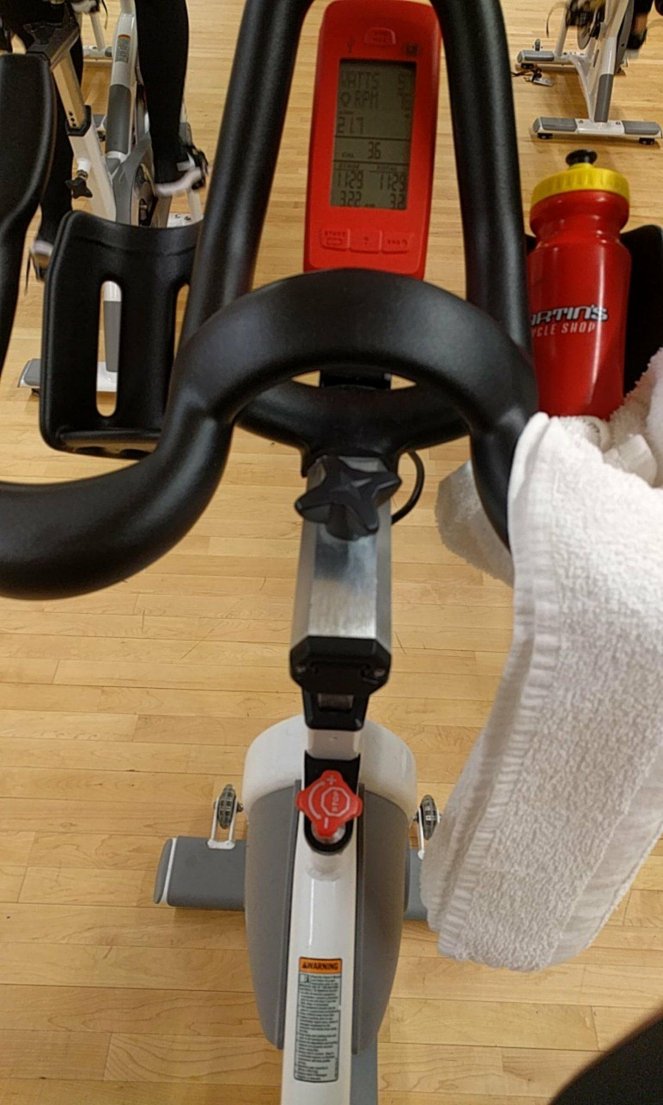
Feeling hopeful. Really hopeful. First time on the spin bike without any pain when pedaling while standing. No pain while using big gears either. Phew. There’s hope.

The last time I went to a spin class I could spin in easy gears well enough but it hurt to put resistance on and it hurt to stand. So I didn’t do those things.

But today, nothing. It felt fine. I kept stopping, expecting it to hurt but nothing. I did sprints. I did hills. I did max wattage drills. All felt good. Well, except for the getting sweaty and out of breath part.

It was only a 45 minute class, not the 90 I’ve usually been doing over the winter but I walked home after feeling happy and strong.

And actually I felt so good I stuck around for the 30 minute core workout after.

Yay! There’s hope.

aging · injury · Uncategorized

Sam’s left knee: An update

Note: At some point soon I hope to have things to blog about besides my left knee! Promise.

The surgeon looked at my x-rays and my MRI and said, “Ouch. That must hurt.”

There’s pretty much no cartilage and no meniscus left apparently. I’ve run out and there’s no growing more. I’ve got bone rubbing and grinding on bone and that hurts.

On the treatment side, things have gotten better with physio but there’s still too much pain and I can’t do lots of the things I used to love.

Hence my visit to the knee expert.

I told the doctor I’d given up soccer. I’ve also given up running and Aikido. But I don’t want to give up long hikes, bike rides, skating, skiing etc.

He tells me that I’m an easy candidate for total knee replacement given the amount of damage to my knee but he worries that I’m too young and too active.

Instead, we’re going to try to fend off knee replacement for another ten years, maybe even fifteen.

Here’s the plan:

Step 1: Try Monovisc injections

Basically it’s injecting lube into the joint. They’re $400 and it’s not covered by our provincial health plan but it is covered by my benefits. Again, I’m feeling lucky. No risk. Some people find huge relief this way. Others not so much. We’ll see. I had the first one today. Weirdly not painful but strange feeling.

Step 2: Unloading knee brace

For long walks and other activities that strain the knee, I’m getting a custom knee brace. They are supposed to work well, if you use them. Lots of people don’t. They’re clunky and not that that easy to get used to. On the upside, I don’t need to wear one at work, just walking to and from. Also, I’ll wear it on long dog hikes. Might be a great argument for commuting by bike. Again, thank you benefits.

Image result for unloading knee brace
Photo of an unloading knee brace. This is the Precision Pro brand but they all look like this. There are no “dress” versions.

Step 3: Physio, physio, physio

I’m so lucky to have good benefits.

Step 4: High Tibial Osteotomy

If all this doesn’t work, I’m also a good candidate for another surgery that falls short of knee replacement and buys me some years. It’s recommended for younger, active patients. (I like that description.)

“Osteotomy literally means “cutting of the bone.” In a knee osteotomy, either the tibia (shinbone) or femur (thighbone) is cut and then reshaped to relieve pressure on the knee joint. Knee osteotomy is used when a patient has early-stage osteoarthritis that has damaged just one side of the knee joint.”

See here.

“A high tibial osteotomy is generally considered a method of prolonging the time before a knee replacement is necessary because the benefits typically fade after eight to ten years. This procedure is typically reserved for younger patients with pain resulting from instability and malalignment. An osteotomy may also be performed in conjunction with other joint preservation procedures in order to allow for cartilage repair tissue to grow without being subjected to excessive pressure.”

And here, complete with an animation of the procedure.

In the meantime, I’m thinking strategically about saving my knees, what’s left of them, for the things that I love. No more knee damage for the sake of training. More on that thought later!

Image result for knees
WebMD’s diagram of knee anatomy