athletes · body image · fitness · gender policing · inclusiveness · Martha's Musings · Olympics · racism · sexism · stereotypes

Women, sport and sex tests: Why Caster Semenya matters a great deal

Many years ago I had the good fortune to work with a board full of fabulous women representing a wide diversity of interests, experiences and backgrounds. One of the women had competed in the Montreal Olympics. She described for us one day what it was like to be subjected to a sex test. Her emotions were palpable, especially the anger.

In fact, we should all be angry, for the women athletes in the past whose physical embodiment was questioned and for the women athletes of today and in the future. The policing of women’s bodies, from what they wear to how they are portrayed, is widespread in all aspects of society, not just sport. However, women who excel in sport and wish to compete at the highest levels are subject to scrutiny that goes above and beyond the sort leveled at all athletes when it concerns drug enhancements. This kind of scrutiny has now been enshrined with this week’s decision from the Court of Arbitration for Sport in Switzerland in which they ruled against middle distance runner Caster Semenya’s appeal of the IAAF’s move to enforce new regulations regarding athletes differences of sexual development (DDS). In particular, the IAAF says female athletes who have higher than usual levels of testosterone must take drugs to reduce those levels to even the playing field.

Semenya’s career in track has been dogged by constant allegations that her achievements in the sport are unfairly won. Curiously, US swimmer Michael Phelps, whose body produces less lactic acid, is deemed to be exceptionally fortunate to be born with this genetic advantage.

And yet, no one is suggesting Phelps should take drugs to enable his body to produce more lactic acid so his competitors have a more equal opportunity.

We cannot forget that along with the sexism this decision against Semenya perpetuates, it is also supporting a racist assumption on how black bodies perform compared to white ones. Acclaimed tennis champion Serena Williams has been constantly challenged on her accomplishments and her body size, shape and presentation. This CNN article gives a great overview about the biases against Williams, including the assumption that her excellence erases her female identity.

The belief that Williams and Semenya are so good at what they do, they cannot possibly be women is one that has long been used to attack women who excel in sport. But it seems particularly pervasive in its use against black women. Semenya’s body naturally produces more testosterone than is usually found in women. Yet the research is unclear how natural testosterone affects performance compared to artificial hormones used to enhance performance:

“What’s clear is that there is solid evidence that men who take excessive doses of testosterone … do get a competitive advantage clearly in sports related to strength,” said Bradley Anawalt, a hormone specialist and University of Washington Medical Center’s chief of medicine.The problem, said Anawalt, is that attempts to try to quantify that competitive advantage in naturally occurring levels of the hormone are “fraught with difficulty in interpretation.”

The CAS decision was meant to clarify and instead muddied the waters even further. They upheld the IAAF decision but said they should take more time to implement. They agreed with the concept of the rule DDS athletes should reduce their testosterone, but were concerned about the effects on athlete’s bodies. They said it was fine for the IAAF to apply this rule to athletes racing under 1000 metres but athletes running longer distances were fine.

The Semenya case has implications that are far-reaching. We know women have been over-medicated, often to their detriment. We know that chemical castration has been used to manage pedophiles. But Semenya is neither depressed nor a criminal. She is an athlete performing her best with the tools she was born with.

That the IAAF and its head Sebastian Coe have created an environment in which Semenya can be neither her best or herself is untenable. I am glad Canada’s Minister for Sport has called out this decision. We need to have conversations about sexism, racism, and transphobia in sport; more importantly we need action. Follow #HandsOffCaster or #LetHerRun, among others, on Twitter; sign this petition; become informed; and make your views known and heard.

clothing · fitness · inclusiveness

Inclusive sport and the sport hijab

Last week in the midst of jet lag and a bad cold acquired on my way home from India, I experienced appropriate outrage and disappointment when I read the story about the French sport store Decathlon bowing to political pressure on the issue of the sport hijab.

Much like the banning of the beach burka (see my post about that here), this move smacks of islamophobia and racism. The highest court in France ruled the burkini ban to be out of order on the grounds that such bans violate fundamental liberties. See our post about that here.

Yes, there is the human rights issue. But there is also the issue of inclusive sport. The manner in which clothing discourages or prevents women from participating in fitness activities and sport operates on a continuum. Sometimes it’s for religious reasons, such as the head covering. Other times it’s for reasons of modesty, or even body shame. A great deal of our sport apparel is clingy and requires body confidence.

Making more sport apparel that affords opportunities for participation in sport for more people is a good thing. The argument that the hijab is necessarily an oppressive religious requirement is old news, based on Western intolerance and even ignorance. Many a Muslim feminist wears a hijab and manages to exude fierce strength. The creation of a head covering that is lightweight enough to be comfortable for running is a positive step for inclusive sport. That a sport store, which one would expect to be proactive in making sport accessible to more people, would cave to the will of xenophobic politicians is sad indeed.

When I was in India I attended a conference on Feminist and Gender Studies in a Global Perspective. I presented a paper entitled, “Can You See Her Now: Photography and Empowerment.” The central argument in the paper, inspired in large part by the inclusive fitness theme that permeates this blog, is that photography can play a positive role in challenging stereotypes, changing expectations, and empowering women. It can do so not just by representing diverse women in empowering ways, but also by putting cameras in the hands of women, including women who occupy marginalized social locations. For example, the organization, Lensational, provides camera equipment and training to women and girls in marginalized communities in the global south. The aim is to allow them “to share their unheard stories, gain confidence, and develop a base of strength.”

Another organization, The Sisters Project, created by Alia Youssef, “combats negative stereotypes of Muslim women by showcasing the diverse stories of inspirational women across Canada, while also creating a space of inclusion and belonging for all self-identifying Muslim women to embrace and celebrate their unique identities.”

Muslim women engaging in activities like running and beach volleyball, riding motorbikes, doing all manner of things that the stereotype of the “veiled woman” doesn’t include, helps to change the expectations of what they are all about. The promotion of unique identities allows these women to be individuals, too.

It’s sad that rather than allowing difference in sport, some people would deny women opportunities to participate based on religious objections.

Along with the burkini and the beach volleyball uniform, the sport hijab strikes me as a win for inclusive sport. For that reason, it should be available, not contested and banned. As the highest court in France said of the burkini bans, making an issue of this is tantamount to violating Muslim women’s fundamental freedoms.

What do you think of the sport hijab and other sport wear that departs from the usual uniforms for women in sport?

accessibility · aging · inclusiveness · injury · weight loss

Sam is checking in for February, #monthlycheckin, cw: mention of weight loss

Good news!

My knee survived a week in Europe with many days of mega steps. I paid a lot of attention to how it felt, wore the knee brace sometimes but not at others, took anti inflammatory medication regularly, and stretched lots. Sarah helped lots too.

Now that I’m back home physiotherapy continues, massage therapy continues, personal training continues, and I’m back to my bike on the trainer, bike commutes, and dog walks. All of that counts, except the massages, on my quest to workout 219 times in 2019.

I’m so happy to see all the hard work paying off.

Next up: NYC 5 Boro Bike Tour in May.

After that, lots and lots of training before our 10 day bike tour of Newfoundland in June.

Bad news!

Weight loss is hard. (We all know this.) You might think that if you had a serious medical reason to lose weight, then you’d do it. But your body doesn’t know your motives. It doesn’t care what your intentions are. It’s super hard.

Wish me luck.

addiction · advertising · alcohol · fitness · food · inclusiveness · Martha's Musings

Canada’s New Food Guide

By MarthaFitat55

Health Canada released its long awaited update to its food guide this week and the response has been swift. Overall I quite like it, and I wrote about it here in my bi-weekly column. The old food guide was prescriptive (eat something from these four food groups and here’s how much). The new food guide is much more aspirational and as I wrote, it reflects diversity in food choice and food culture.

I thought I would pull together a bunch of responses to the guide in this post. The Globe and Mail has several pieces I liked, with the first from one from Andre Picard, the Globe’s health reporter, in which he looks at food insecurity and the food guide’s recommendations. Leslie Beck, the Globe’s dietitian commentator, offers up her thanks for Health Canada’s building a guide on science while Ann Hui also of the Globe and Mail, provides a good overview of the key changes here.

Cassandra Lszklarski from the Canadian Press focuses on the guide’s position on alcohol. Health Canada has stepped away from recommending milk as the preferred beverage and tells us to drink more water. At the same time, it is also came out strongly against alcohol consumption (non drinkers shouldn’t start for example). Previous guides highlighted the sugar and calories in alcohol, but this version talks about the links between alcohol and obesity, cancer, and addiction.

Yoni Freedhoff looks at the implications for institutional change. On Weighty Matters, Freedhoff’s blog, he wrote how the new food guide is a radical departure from previous more modest iterations:

“Whether it was consequent to past criticisms, or the insulation of the revision process from the food industry, or a change in leadership, or some combination of those and more factors, the 2019 Food Guide is incredibly different from all of its predecessors. Gone is dairy as its own food group (that doesn’t mean the guide is recommending against dairy consumption), gone is wishy-washy language that excused refined grains, gone are explicit recommendations to consume 2 glasses of milk and 2-3 tablespoons of vegetable oils daily, gone is overarching fat-phobia, gone is juice being a fruit and vegetable equivalent, gone is the notion that sugar-sweetened milk is a health food, and gone is an antiquated nutrient-focused approach.”

Freedhoff also talks about what to do next, now that the food guide is out without its dependence on food-based marketing recommendations. In this post, he looks at what needs to change for good healthy food policy to happen. Freedhoff describes them as hills but they include removal of fast food from schools, a national school food policy, a ban on food marketing to children, implementation of a soda tax, removal of front of package claims, and an overhaul of supplement regulation.

The food insecurity issue is one that I will be looking at in the future, but in the meantime, I am excited by the new food guide and what it means for reflecting diversity and health on my plate.

What do you think? How important has the food guide been in managing your nutritional needs? What do you like or dislike about Health Canada’s guide?

— Martha Muzychka is a writer living in St. John’s who swims, lifts and walks as much as she can.

body image · fitness · inclusiveness · media

Fat babies deserve heads

We’ve written about it before. See Is the end in sight for headless fatty photos?  and No more headless fatties, why not use images of active fat people and Why the “headless fatty”.

I thoughte  it was getting better! But not for babies, The reporter in this case actually replied citing privacy concerns when it comes to infant images, But I’m pretty sure I’ve seen regular size babies with faces.

Why does it matter? What’s wrong with headless fat imagery? It’s this idea that it’s so shameful to have a body like this that we shouldn’t show their head or face in the media. But fat bodies belong everywhere. In the gym, in the classroom, on the runway, and in a diaper in the media.

body image · eating · fitness · food · inclusiveness · media

Samin Nosrat’s “Salt, Fat, Acid, Heat” redefines cooking shows in the best way

Cooking shows… some are great and some less so, but many of them – at least until recently – have had one thing in common: if they were about high-level cuisine, they were mostly male (and white). If they were about everyday home cooking, they were mostly female (and also white). In the past couple of years or so, this has slowly begun to change. Netflix has been at the forefront of this development with its original productions. Ugly Delicious was still mostly male, but at least less white. Chef’s Table still explores a lot of male, Western white chefs, but also really interesting women and people from countries outside of the traditional Michelin star circuit (Ana Roš from Slovenia, for instance, Musa Dağdeviren from Turkey, or Cristina Martínez, a Mexican chef living in the US undocumented).

But BAM, up shows Samin Nosrat, author of Salt, Fat, Acid, Heat, and with her Netflix-produced show of the same name, changes everything we know to be true about cooking shows. Nosrat, an American of Iranian descent, explores these four key elements of great cooking through the lenses of different countries. The Salt episode takes place mostly in Japan. For Fat, she goes to Italy. Acid is set in Mexico, and finally Heat focuses on her own kitchen. She is genuinely curious and appreciative of everything the locals she interviews for her show tell her, and constantly relates it back to her own culinary upbringing, but without overpowering the stories of her interview partners.

Mussakhan.JPG
No direct connection to Salt, Fat, Acid, Heat, this is a meal that’s been a favourite in our household lately: Mussakhan, a Middle Eastern dish that involves chicken marinated with red onions, lemon juice, and sumac. In Samin Nosrat’s words: “It’s so good!”. Make it, you won’t be sorry (recipe here).

She’s unapologetic about her own enjoyment of food. Samin Nosrat’s relationship to eating seems so healthy and natural. It’s so good! she exclaims again and again, and you can’t not start salivating as you watch. I mean, imagine – a whole episode about fat without one single remark along the lines of ‘guilty pleasures’, ‘I shouldn’t really’, ‘just this once’…?! In a cooking show presented by a woman? This is unheard of. She even asks for more. This is how it should be, but too many times sadly it’s not.

In a world where women are constantly shamed for enjoying food, where exercise is frequently framed in terms of dieting and weight loss (women must work out so they can eat), and where talking about food in public is still defined by gender and racial stereotypes, Salt, Fat, Acid, Heat is huge. It’s refreshing, genuine, and heartwarming. Highly recommended! Also, you can get some of the recipes from the show on its website. A-ma-zing.

(Other people have written much more eloquently than I ever could about the impact of this show, see e.g. here, and here.)

athletes · inclusiveness

She’s got game (at Guelph)!

A new initiative at Guelph, my new university home, is starting and it’s right up my alley and so people keep talking to me about it. I like that. She’s Got Game will officially be launched on October 18th, extending our school’s ethos of diversity and inclusion to sports.

See https://twitter.com/uofg/status/1052242772244217857?s=19

“Join us as we celebrate the exciting launch of U of G’s She’s Got Game initiative! She’s Got Game is committed to fostering gender equity and encouraging women and girls to excel in sports. It aims to help girls and women acquire tools to succeed on and off the field of play by engaging the community, informing policy and fundraising.”

There are lots of different pieces to this initiative. Some of it I’m indirectly involved in, like developing experiential learning opportunities for university age student athletes who will partner with the girls. Other bits I’m just a consumer. I love that Planet Bean partnered with them to make and sell Gryphon Blend coffee which benefits girls and women involved in athletics at Guelph. It’s great coffee and a great idea. 

Learn more about the initiative at www.shesgotgame.ca.

accessibility · climbing · fitness · hiking · holidays · inclusiveness · nature · running · traveling · yoga

Women, mountain sports, and privilege – thoughts on an all-female sports festival in Austria

Two weeks ago, I attended the Women’s Summer Festival in Ischgl, Austria. It’s basically a three-day summer camp for female adults. You can sign up for lots of different sports workshops, including yoga, mountain biking, climbing, hiking, the full works. All of it women-only, set very scenically in the Austrian Alps. I’d read about last year’s edition and it sounded like a ton of fun: a chance to try out new things, meet people and spend a few days frolicking in the mountains? Sign me up.

IMG_3594.JPG
View over a lush green alpine valley, from the beginning of our via ferrata.

I agonised for a while about my choice of workshops – there’s no way you can do them all – and finally put myself down for a via ferrata (complete novices), trail running (beginners), morning yoga (all levels), and an all-day hike (experts). Aside from yoga and hiking, I decided to do things I hadn’t done before, so for instance bouldering fell by the wayside in favour of the via ferrata. And I was too much of a chicken for mountain biking. Somehow, the thought of hurtling down a mountain on two wheels terrifies me a lot more than the thought of being suspended above a precipice secured by nothing but a fixed steel cable and two carabiners attached to my harness through a via ferrata set.

f16d49f8-f3e3-4a9c-b9eb-182e60926933.JPG
Bettina in full gear, taking a well-deserved sip of water after completing her first ever via ferrata.

The classification of levels, I later learned from fellow participants, stumped not only me. How do you know you’re an “expert” hiker, rather than an “advanced” one? As I’ve mentioned before, I have my share of athletic impostor syndrome, so I was mildly terrified of both the trail running (should I have signed up for the “complete novices” one?) and the hiking tour (what on earth had made me think I was an expert? The hubris!). If anyone still needed proof that women tend to underestimate themselves, they only had to attend this festival. Nearly everyone rocked up with the same self-doubts.

But these shared concerns actually ended up making for an incredibly supportive environment. Everyone cheered each other on and kept encouraging others. It had been a long time since I’d seen two people as happy as two women with vertigo after crossing an incredibly scary suspension bridge on our trail run, fuelled by gentle coaxing from our guide and the supportive cheers of the other participants. It was wonderful to watch.

IMG_3706.JPG
The really quite scary suspension bridge we had to cross during our trail run, complete with some runners from our group approaching in the distance.

The other thing I’d been a bit wary of is going by myself. I wasn’t organised enough to enlist anyone else to come with me, and I’m not exactly a social butterfly – my small talk is limited and I tend to get incredibly intimidated by people I think are cooler than me, which is pretty much everyone. I ended up really, really enjoying myself, both in terms of the activities and the company. I met some very nice people, and the activities were great. In fact, both the via ferrata and trail running (who would have thought, considering how badly I do running uphill!) left me hungry for more.

The morning yoga was beautiful, and the hike was out of this world stunning – three three thousand-metre summits in one day! With bright sunshine! And incredible views! If I were to do this again, and I’m definitely keeping this option open, there are plenty of things I didn’t get around to doing: a more challenging via ferrata, bouldering, more hiking, and maybe, just maybe, even some mountain biking?

IMG_3751.JPG
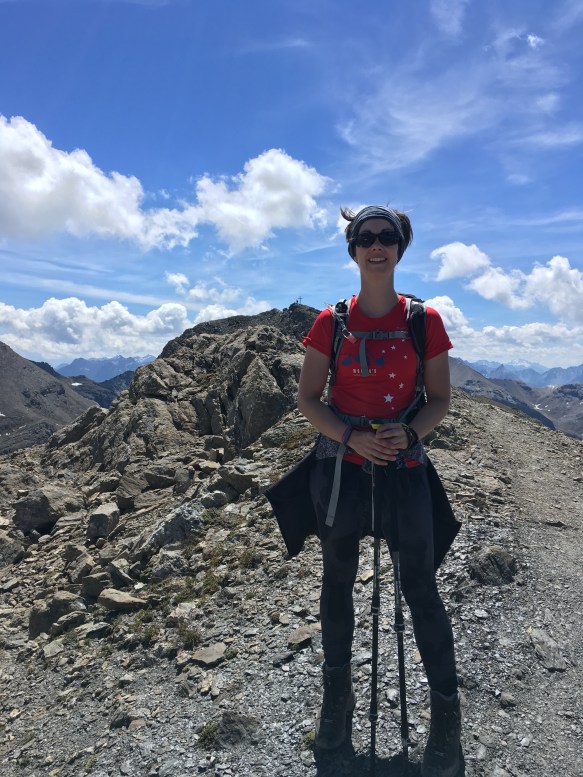
Bettina in a red t-shirt and hiking gear, beaming widely with one of the summits she climbed during her all-day hike in the background.

There was a framework programme too, to keep yourself occupied while not attending a workshop, with ad-hoc activities such as TRX training, massages, pilates, etc., and you could even get your nails and your hair done if you wanted (I opted for the nails, which I usually never do or get done, and also because there’s not much you can do with my hair). In the evenings, one night there was dinner at a local hut, which ordinarily is a hip après-ski joint, and another night there was a concert with a local band in the festival tent. And as these things are wont to go, there were exhibitors peddling the latest trail running shoes, hiking poles, outdoor and yoga clothing, etc. You could also try all these things in action, which was fun, though it didn’t motivate any purchases for me.

The whole thing was a very enjoyable affair, but I wouldn’t be a good feminist killjoy if I didn’t have some issues with it. This was obviously not a free event. The all-in festival pass set me back just under 280 Euros, and I treated myself to a nice hotel in addition. There was the option of booking just individual workshops, but they also weren’t super cheap. There was a goodie bag for those who’d booked the festival package that contained some ecologically very dubious plasticky giveaways (although in fairness, there were some great quality ones too that I’ll definitely be using). And diversity at the event was limited to cis-gendered almost exclusively white, almost exclusively able-bodied, relatively fit women who could afford to be there, and a bunch of invited press, bloggers and social media influencers who were there for free (disclaimer: I wasn’t one of them).

In other words, we spent three days oozing privilege from all pores. Is this inherently a bad thing? Probably not. We had a lot of fun and it was great to completely disconnect from the news and the heat wave gripping the rest of Europe for a few days, being active among a bunch of very nice, like-minded women and pushing our comfort zones in a highly supportive environment. The event is absolutely fantastic in that it lets you test the waters with new activities that might otherwise be quite intimidating, which I think is very important in getting women to be more active. But it’s important to be aware of that privilege – and of the fact that if you were insecure about doing any sort of exercise, you probably wouldn’t sign up for a three-day mountain sports festival in the first place, so a substantial threshold is still there.

IMG_3762.JPG
Enjoying these views was part of our privilege: panorama of the Alps with some flecks of snow in the sunshine.

And things could be done to make the event more inclusive. One could think of travel stipends, marketing the event a bit differently to attract a more diverse crowd, and so on. Again, the organisers are a for-profit company that makes money with this, so it’s not surprising that it’s all a bit commercial, and all things considered, the commercialness is very low key – you’re not forced to buy anything or partake in any activities that aren’t your jam. And yet. A bit more of an effort in making the event more diverse and accessible would be very welcome.

Will I go back? Maybe. I had too much fun not to contemplate a return next year. I’ll keep you posted – and if I do, perhaps it will be in some fit feminist company? Would be fun.

accessibility · body image · fitness · gender policing · inclusiveness · swimming

Being Naked in Public, pt 2: languages of instruction

Back in December I wrote a post about being naked in public, three ways: in new “universal” change rooms in pools in my city of Hamilton, Ontario; in the same kinds of spaces (with WAY more cubicles and tight corners) in London, England; and in a public spa and thermal bath complex in Konstanz, Germany (few cubicles; lots of comfy nudity).

My questions in that post revolved around etiquette, protocol, expectation, and the cultural labour these spaces appear to be doing towards supporting inclusive, body-positive community (whether or not they are actually doing that labour).

Today, for the first time in a while, I returned to one of the facilities here in Hamilton that have converted to M/F/U change spaces; I was overbooked and had to skip my usual Friday swim (which happens at an older facility not yet renovated to include a gender-neutral room).

To my surprise, when I swanned toward the universal change room entryway, I found this:

fullsizeoutput_1046

(A sign, posted on a green cinder-block wall, that reads: “Change in dressing cubicle only; clothing or bathing suit myst be worn at all times outside dressing cubicle.” The images on the sign include a green circle around a woman’s body clad in a one-piece swim suit and a man’s body clad in swim shorts; and a red circle with a strike-through against the images of the same bodies, with one-piece and shorts off to the side. Note: I snapped this photo from the change-room threshold, which is barrier-free and opens onto the lobby. I made sure no bodies were nearby in order to respect the “no photography in change rooms” rule.)

I stopped for a minute, a bit gobsmacked. New sign; aggressive sign.

NO NUDITY! DO NOT EXIT THE CUBICLES NUDE! THIS IS A GENDER NEUTRAL SPACE!

OK, so that’s not exactly what the sign said. But it might as well have.

locker-room-etiquette-sign-s2-1269

I googled “gender-neutral change room etiquette” and this list of do’s and don’ts turned up. It is haranguing: be neat, tidy, and for god’s sake cover up your freaking horrific human of a body; don’t be lazy, slow, or glowery. Get the fuck out ASAP. Sounds familiar.)

I’m trained as a literature scholar and a scholar of theatre and performance; that means I read cultural texts for their nuances, for a living, and try to make sense of what they aim to accomplish amongst actual, human lives.

My pool’s universal change-room sign said the following to me.

The bright blue that backgrounds “Change in dressing cubicle ONLY” sets that text off in sharp relief. All-caps for ONLY is scolding typography, as though to say: DO NOT DARE LEAVE YOUR CUBICLE NAKED! It is fairly patronizing and deeply shaming.

The images are workmanlike and designed to be read across languages and cultural contexts (more or less; only North American Christianity could, if you ask me, dream up such a blatantly unsexy way to render human nudity). The communication is meant to cross language barriers because there are lots of immigrants in our community (I witnessed one Chinese-language speaker interacting with a lifeguard this afternoon, for example), and the sign is obviously in part, if not primarily, targeted at them.

So tick the xenophobia box too, please.

The sign makes no mention of the showers – my personal favourite part of locker-room-sanctioned nudity – but we can guess the implied protocol.

What to make of this?

Well, on a purely pragmatic level, I’ll tell you what I made of it in the split second it took me to decide what to do with my body upon encountering this sign.

I realized I could be my nude and joyous post-swimming self only in the women’s change room, so I went there.

And here’s the rub, the sad bit, the loss: I had to choose between body-positive feelings, and the gender-neutral change room.

Some neutrality; some body positivity!

gnr

(Another image that popped up in my google search. It reads, in a plain, sans-serif font: “A gender-neutral restroom designation means this restroom is safe for transgender, gender non-conforming, genderqueer people, as well as people of all gender identities and expressions. If you choose to use this restroom, you are aware that it is a safe space. Please refrain from gender policing… If you are uncomfortable using a gender-neutral restroom, please use any of the other restrooms, as this is your privilege.” NOW THIS SIGN I CAN SUPER GET BEHIND.)

I thought a lot about the change-room sign incident after I left the pool. I thought, too, about the several FFI community members who fed back about my original post and noted they would not be super comfortable nude in mixed spaces.

I realized that my biggest problem with the sign wasn’t the message it was (sort of, maybe, clumsily?) trying to communicate.

The problem was with language, and its intention.

The sign is trying, I think, to say this: DO NOT GET NAKED IN FRONT OF PEOPLE WHO DO NOT WANT TO SEE YOU NAKED. ALSO: DO NOT GET NAKED AGGRESSIVELY.

This is, totally, a worthy goal.

But the language also, therefore, assumes predation, assumes a lack of tact and generosity on the part of body-positive users; it assumes that all bodies in the space share a sense of nudity-as-shame, nudity-as-aggression. Which isn’t true.

So in the car on the way to my next gig, I started thinking about how I might phrase some similar caution in a more welcoming, dare I say body-positive-positive, way.

I came up with this:

This change room is a gender-neutral, body-positive space that welcomes people of all identifications.

Please use the space in a way that respects the privacy and comfort level of others around you.

Thank you!

(I’m not sure about imagery. I’d love suggestions!)

The language I’m proposing states what I hope are the deep intentions behind the creation of the space: it’s for everyone, care-fully. I think that’s the idea behind gender-neutral spaces in Hamilton-area pools; I’m not sure, though. (My sense from the sign I encountered today is that they might be souped-up “family” change rooms. Sigh.)

It also places the responsibility for fair use on a community of users, acting together in everyone’s best interests. (This is called democracy, btw. At least to me.)

Are you alone in the space? Go nuts! You do you! Get naked, sing ABBA. Rock on.

Is someone in the space with you who seems more modest, shy? Perhaps calibrate your ostentation to remember that they also share this space, and that your ostentation might be taking up more than its fair share of that space, for them.

Is someone in the space with you who might be nervous about your presence? That’s ok – they are here because they have trust and faith. Be you, but not aggressively. Instead, assert your good will toward that person.

Is someone in the space with you who might think you are unnerved by them? That’s ok – it’s part of the process of becoming a community. Be you, welcomingly.

This is just one shot – my shot – at a better way to say what needs to be made clear in gender-neutral spaces: some protocol for what to do once you’re inside, but not in a way that assumes a normative sense of embodiment, nor that assumes body-as-shame.

Do you have examples of, or suggestions for, gender-neutral change-room etiquette? I’d love to hear!

Yours swimmingly,

Kim

body image · equality · fitness · inclusiveness · Martha's Musings · stereotypes · training · weight stigma

Weight bias and obesity interventions: no easy answers

IMG_4443
A person wearing a black swim dress and pink flip flops gets ready to swim.

By MarthaFitat55

A while ago I had reason to consult with an anaesthetist. We went through the risk assessment and had a chat. The clinic nurse had told me the team might have some questions because of my weight.

Fair enough. I could hardly fault them given what’s involved in going under, so to speak. But I was cautious because context is so often missing when numbers are thrown around, especially numbers relating to the Body Mass Index (BMI).

According to that scale, one originally developed by insurance companies, I am obese. Anaesthetists aren’t fond of having to deal with obese people. So we had a chat and it was actually quite good.

Here’s the thing: I eat reasonably well, with almost all the required fruits and veggies, high fibre foods, lower fat choices, more fish and legumes, and less red meat and alcohol, our health system deems the better diet to follow.

I’m also pretty active. At the time of the chat, I was weight training twice a week, swimming two to three times a week, taking a trail walk lasting more than an hour weekly, and looking to get my steps in on a daily basis.

The doctor asked me about the weight training, and I ran through the numbers: bench was around 48kg, deadlift was around 105kg, and squat was 97.5 kg. So those numbers tipped the deal. If I could do all that, then I wouldn’t have any trouble, they concluded.

It made me think though. For the past ten years, I have acted on the guideline about eating less junk and focusing more on whole foods while being more more mindful about how active I am.

Truth is, I’m not prepared to starve nor am I prepared to add any more hours of activity (in fact I am at or past the threshold for the recommended 150 to 300 minutes of moderate to vigorous activity per week already).

At the back of my mind, I always believe I should be able to do more, and yet I can’t. It bugs me when I hear facile comments repeated in every weight loss inspiration story shared by the media. We all make choices, but some times even the good choices don’t make that much difference.

When SamB shared an article about how such tag lines like “Eat less, move more” contribute to weight bias, I was intrigued.

And I felt vindicated. Despite all my efforts in the gym, in the kitchen and yes, in my own mind, when I ran up against health professionals, who looked at numbers like BMI as reliable indicators of health, I felt my work was not enough, nor good enough, to make the difference society expected in my body shape.

Nor am I the only one. Canadian Obesity Network researcher Ximena Ramos Salas looked at obesity prevention policies and messages. She tested the messages with people living with obesity and what she heard was illuminating.

The short form is those messages don’t work. They are neither helpful nor accurate.

“Saying obesity is simply an issue of diet and exercise trivializes the disease. It makes those living with obesity feel like it is a lifestyle or behavioural choice, and therefore their fault. This causes them to feel judged and shamed, and to internalize the stigma of weight bias.”

Ramos Salas also reported “People told me that the public health messages were not relevant to their experiences. They didn’t relate to the messaging, they felt it didn’t consider other factors that contribute to their obesity that are unique to them, like genetics, mental health, medications and so on. It did not reflect the challenges that they faced while trying to manage their weight on a daily basis.”

I think these are two useful insights that should get more attention. But the best message arising from the research Ramos Salas is engaged in is this: “Not everyone who is big has obesity. People come in different shapes and sizes, so the idea that we categorize people based on their size as ‘healthy’ or ‘unhealthy’ is not accurate.”

I was fortunate I met with a health professional who was open to hearing about my numbers intead of relying on a flawed indicator to make a decision about my health status. Too many people though do not and some actually close that door themselves because they are not confident they will get the care they need.

For me, my conversation with the anaesthetist helped validate my choices about the fitness path I am on even though assumptions about weight and health by others may have forced the issue. I may never meet the biased image for health and fitness such weight stigma imposes, but I know I am doing the best I can given my circumstances. To suggest otherwise is limiting and dismissive.

— Martha is a writer and powerlifter in St. John’s.