Shortly after coming home from my work commute the other day, I found that my partner (and cat) could barely stand to be around me. I was being a total grump—tired and irritable. Why?
I had spent the last two days commuting by car (an hour each way, plus more travel between sites), then sitting for hours at desks that were not my own. Being vehicle- and desk-bound used to be my work-a-day norm. But, after only a few days back at work, and despite all the travel, I felt unusually sedentary and yuck.
A woman hunched over her laptop at a desk. Posture posture posture!
I have worked from home during most of the COVID-19 pandemic. This means I’ve had the luxury of walking or exercising before or after work (most days!), and taking short stretch breaks anytime I’ve needed to in a private and comfortable space of my own. More control over how, where, and how much I sit.
You may be thinking—with all this privilege, 5 hours in the car over 2 days is not, relatively speaking, a big deal. Boo hoo, Elan. (At first I thought that too.)
Yet, because I am trying to be mindful and notice things more, I realized maybe I hadn’t prepared myself sufficiently for what back to work would feel like for my body.
Reminders are for people who need reminding. Here is a brief list of reminders for how I might show up more prepared for my return-to-work days a (and be less of a grump around those I love afterwards).
Leave 15 minutes earlier than I need to and park at the far end of the parking lot to have time to walk and stretch before sitting in the office.
Bring more water and veggie snacks than I think I will need in order to stay hydrated (and avoid the snack machine).
Schedule in-person meetings to end 10 minutes before the hour, and use that time to get up and move around, perhaps reacquainting myself with the buildings and their outdoor spaces.
Assess the ergonomics of my seated position in my car and in my hoteling office work spaces—try to notice my posture and pack what I need to adjust myself.
Make time to stretch before getting back into my car near the end of the day.
That’s me, third car on the right.
What else could help me to manage feelings sedentary and grumpy during return to work? Please share your ideas in comments below!
Not having much stuff with me is one of the things I loved about my sabbatical years in other countries. I arrived with a suitcase of clothes and wore them for the year. I had a few work outfits, a few hanging out at home outfits, some bike clothes, a bathing suit (not 7!) and a raincoat. That was about it. I spent a lot less time deciding what to wear and since I only brought clothes I really liked with me, I was pretty much always happy with my choices.
Simpler life on sabbaticals suits me and while I haven’t been able to make that work at home, I’d like to try.
I’ve also been stress shopping in pandemic times and I’d like to stop that. In terms of pandemic stress bad habits, it’s not the worst but who really needs a nap dress or a #workfromhome llama onesie! I also now own Pride Hunter rainboots AND bright pink UGG rainboots, and leopard print crocs with fur inside. Really, that’s enough frivolous footwear for a lifetime.
Sam’s frivolous footwear
Animated Sam in her llama jammies onesie
Regular readers know that I’m a critic of fast fashion and I used to teach about the ethics of consumption in the context of fashion. While I mostly buy made in Canada clothes, not fast or inexpensive, there’s still not much good in owning as much clothing as I do.
I also hope to get rid of stuff I don’t actually wear. Possibly that might include the nap dress. Lol.
Sam in her summer nap dress
Finally, I’d like to put some money away for travel once the pandemic travel panic eases a bit and I feel like, for me, the bother/pleasure is right again.
Why not?
I get a lot of pleasure out of clothes, and clothes shopping, and putting outfits together. Why quit one of things that makes me happy? The thing is I’m curious. Can I get a different sort of pleasure working with what I’ve got? That’s its own sort of sartorial challenge, right? I confess I was tempted by Nicole’s challenge, wearing the same dress for 100 days, but when I went to the website that sells the wool dresses connected to the challenge, I somehow ended up with three different styles and colours in my cart. I don’t think moderation is the path for me here!
Why blog about this here?
Well, mental health is health and we write about well-being broadly construed here on the blog. I like Mina’s description of making room in her head for thoughts other than shopping. Also, there are some fitness implications. See exceptions below! Most importantly thought putting it out here makes it real, makes it more likely that I will stick with it. I’m also taking all shopping apps off my phone. Do you have any other advice to make this easier? Wish me luck!
Any exceptions?
I will make exceptions–say if my cycling shoes break–or if I need a new pair of cycling shorts. I’ve been shopping for a new non-underwire bra for work clothes and while I am hoping to snag one before the 1st of July. If I don’t, then that too will be an exception. I am not putting off the challenge for the sake of finding a decent bra.
A cute cat waving goodbye
Goodbye Luc Fontaine, goodbye Lesley Evers, goodbye Fluevog and Poshmark too (used clothes are still clothes…)!
June 21st is many things. It’s summer solstice, it’s also National Indigenous Peoples Day — a day for all Canadians to celebrate the diverse cultures, unique heritage, and contributions of First Nations, Inuit, and Metis peoples, and it’s International Yoga Day.
Laura is celebrating International Yoga Day with a standing balance flow. She writes, “Are you up for a fun (I think) standing balance challenge? Here is a short (<10 mins.) flow, taught by me.”
Bonus content: her dog Trudy demonstrates a beautiful execution of “Sleeping Dog Pose” throughout this video.
And balance is also in the news days these day as a marker of health.
“If you have difficulty standing on one leg, it could be a sign of something more serious than overdoing it at the office summer drinks party. Middle-aged and elderly people who cannot balance on one leg for 10 seconds are almost twice as likely to die within 10 years than those who can, research suggests.
How well a person can balance can offer an insight into their health. Previous research, for instance, indicates that an inability to balance on one leg is linked to a greater risk of stroke. People with poor balance have also been found to perform worse in tests of mental decline, suggesting a link with dementia.
Now an international group of experts from the UK, US, Australia, Finland and Brazil have completed a first-of-its-kind, 12-year study examining the relationship between balance and mortality. Although the research was observational and cannot establish cause, its findings were striking.
An inability to stand on one leg for 10 seconds in middle to later life is linked to a near doubling in the risk of death from any cause within the next 10 years. The results were published in the British Journal of Sports Medicine.
The findings are so stark that the researchers, led by Dr Claudio Gil Araujo of the Clinimex exercise medicine clinic in Rio de Janeiro, suggest a balance test should be included in routine health checks for older people.
Unlike aerobic fitness, muscle strength and flexibility, balance tends to be well preserved until the sixth decade of life, when it starts to wane relatively rapidly. However, balance assessment typically is not included in health checks of middle-aged and older people, possibly because there is no standardised test for it. Until now there had been little hard data linking balance to clinical outcomes other than falls.”
I did it! I just earned my 4th degree black belt in ITF Taekwondo!
I have a version of this post-test photo where I am smirking but I was so tired that my smirk made me look unhinged rather than mischievous so I chose this ‘pretty damn pleased with myself’ one instead. Image description – Master Scott Downey, Me, and Master Cathy Downey right after the test. They are both looking polished and professional in blue suits with white shirts and yellow ties, I am grinning and looking appropriately sweaty and disheveled in my white dobok and we are all standing in front of an International Taekwondo Federation flag.
The longer version goes like this:
After deciding that I was going to be bold about my test, something shifted in how I was preparing. I stopped trying to do things perfectly and started trying to do them well, started trying to feel more comfortable with my movements.
For me, being bold wasn’t about pretending I wasn’t nervous, it was about forging ahead anyway, about showing up with everything I had.
I had a few little spots of worry on Saturday when I just couldn’t make small sections of a few patterns work but I reached out to my TKD friends for reassurance and recruited my husband and my eldest son to help me.
My husband watched a YouTube video of one pattern while I was practicing it in the living room and let me know when my movements didn’t match. My son sat with my pattern instruction book in hand and read me the descriptions of certain sections so I could be sure I was moving correctly.
Me in my car before the test. I was trying to take a goofy photo but ended up looking more ‘resigned to my fate’ than I actually felt. I was a bit nervous but leaning a bit more toward excitement – or at least excitement to finally be done! Image description: a selfie of Christine, a white middle aged woman with a round face and chin length curly brown hair and green-framed glasses. She is sitting in the driver’s seat of her car, wearing her white dobok and smirking.
Overall though, I was far less nervous than I usually am. Deciding to be bold was one factor in that and the changes in my ADHD meds since my last test is definitely another but I also think that I am finally reaching the point in my training where things are coming together for me. I am more easily able to explain the purpose of my movements and I can more clearly see the connections between the theory and the practice in TKD.
That’s not to say that I am doing everything perfectly nor that I am applying my theory to every movement. Everyone in TKD is still a student, just some have more practice than others. As a 4th degree black belt (!) I am more advanced than many but I still have lots to learn.
Usually the morning before one of my tests would be a complete blur of nervousness and practice and stress. This time, though, I decided that my only practice would be to read the movement descriptions for my last three patterns. Instead of practicing and then hyperfocusing on small mistakes, I did yoga and meditated and drew a magic symbol on my wrist.
When I was testing for lower ranks, I used to do things like dyeing a strip of my hair and/or paint my nails the colour of my upcoming belt. For my last few tests, I have painted just my thumbnails black (to remind me to focus), but this time I drew a B for bold on my wrist and then put a star and a spiral next to it.
Sharpie tattoos don’t hold up well to three hours of exertion. The magic worked though. This was taken while I was relaxing on my patio at home after the test. Image description: My left forearm with a ‘magic’ doodle drawn in green sharpie. The drawing is an upper-case B (for bold) with a spiral (for releasing stress) on the left and a star (for effort) on the right. Behind my arm you can see part of my right leg (in black leggings) and my right foot (which is resting on my left knee) as well as parts of my patio, my yoga mat, and the grass in my yard.
A black belt test has a lot to it. I had 18 patterns to do (luckily two students were testing for 5th degree so I didn’t have to do any of the patterns alone at that point), then we did step-sparring (a coordinated attack/defense demonstration), self-defense, endurance drills, and a solo step-by-step demonstration of a pattern identifying the purpose of each movement. After all of that, we try to break some boards.
I did not do my patterns perfectly. Throughout the pandemic, we stopped doing the loud, rhythmic breathing that helps us execute our movements effectively, as well as keeping us all on track. I haven’t even been practicing with it much at home because I was afraid that I would unconsciously use it during class when I wasn’t supposed to. We have only recently gone back to including the breath sounds and we’re a little out of practice with it. And, it turns out, I have been practicing my movements just a little too slowly. The combination trying to speed up a little, adding my own breathing and being able to hear everyone threw me off a little in a few early patterns and then REALLY threw me off for my newest ones.
Since I was concentrating on remembering the movements and remembering to breathe loudly, I didn’t have enough mental space to ALSO choose to ignore everyone else’s breathing and movements. ADHD, after all, is not actually a deficit of attention, it is (among other things) an inability to decide where your attention should be focused. Between nervousness, the challenge of performing newish patterns with an audience while being graded on them, and the addition of the breath factor, I didn’t have the capacity to tune other people out.
But thanks to my instructors’ patience, and a healthy dose of perseverance for all concerned, we got through (and, for the record, I wasn’t the only one making mistakes, which was a comfort.) And even though I was a little slow in my movements, I did my final pattern effectively and I was VERY proud as I shouted the pattern name (Choi Yong) after the last move.
I felt sharp and purposeful for the step-sparring and self-defense and drills, and I was happy with my step-by-step pattern but I was THRILLED with my board breaking.
I did a speed-break hook kick, a 360 back kick, a flying side kick (with a slight modification to minimize jumping), a middle twist kick, and then…and then…
I BROKE A BOARD WITH A PUNCH!
At my very first board-breaking test (about 8 years ago), I tried a punch for my hand-technique but I didn’t coordinate all the elements of the movement properly and I really hurt my knuckles. Since then, I have broken boards with my elbow and my knife-hand (the side of your flattened hand) and my sidefist (aka – the side of your fist) but I couldn’t convince myself that I had the power to punch through a board.
I tried for my last test. In fact, I was supposed to jump up and punch two boards in succession but while I hoped to fluke into it, I didn’t really expect that it would happen.
This time though, I wanted to do it. And because my brain is getting better at applying my theory to my movements, I could think clearly about what I had done wrong before and make a good choice about how to make it work this time.
I used a reverse punch – which means that I had my left leg forward but I was punching with my right hand – so I could generate speed and power without having to move my feet (sometimes the choreography of footwork gets me tangled up.)
I lined myself up, measured my distance, and punched clear through the board as if I do it every day.
It felt like the biggest victory of a marvelously victorious day.
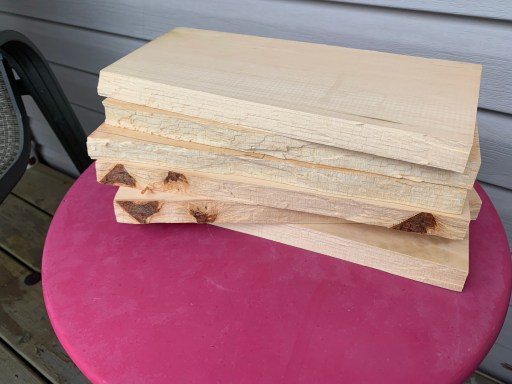
And this isn’t even all of my boards – these are just the pieces I took home. Ki-YA! Image description: a stack of pieces of pine board that have been broken in two by my kicks and punches. The stack is sitting on a red table outdoors.
Getting ready for this test was hard work. I’ve been learning and practicing all through the pandemic – sometimes in person, sometimes on Zoom. During that time, I have been dealing with a variety of challenges in all areas of my life but throughout it all, TKD has been a great way to take care of myself – giving me an external focus that had all kinds of personal benefits. I’m really grateful to have that outlet and I am grateful for the support of my instructors and my fellow students as I train.
Thank you to Master Scott Downey and Master Cathy Downey for the instruction and support, to Ms. Reid and Mr. Dyer for the instruction, trouble-shooting, and encouragement, to Ms. Vere-Holloway for the extra practice, to Mr. James for the encouragement, to Mr. Lake, Mr. Abbott, Mr. Hooper, Mr. Power, and Mr. Codner for holding all of those boards, and to Ms. Gathercole for the empathy. Special thanks to Steve and Alex for helping me with my last few practice sessions, to Lori Savory for choreography help, and to Team Codner for the on-site encouragement.
Congratulations to Ms. Vere-Holloway, Mr. Power, Ms. Gathercole, Mr. Abbott, Mr. Lake, Mr. Codner, and Mr. Hooper for your hard work and for your success yesterday!
I’ve been nervous about having signed up for it this year. The training is hard, the fundraising is hard, I’m getting old, I’m waiting for knee replacement surgery, I’ve got a big job, and the rally takes a lot of time. Maybe those days are over? Nothing last forever, right?
I know some of that anxiety is unreasonable. I’m actually not that old. My knee is a disaster but otherwise I’m in pretty good shape. I know some of the anxiety is related to having lived through the pandemic. But it’s also hard figuring out what’s reasonable and what’s not. And whether or not it’s reasonable the anxiety is certainly real.
I tell people that doing one day of the rally isn’t that hard. Lots of you could do it right now. The hard thing is getting up the next day and doing it again. I blogged about the ‘toughness’ of the rally here: How was it? Could I do it? Reflections on the bike rally.
It’s true you don’t need to ride that fast but in a way it’s harder to ride slowly. It’s more time on the bike.
I like the rally experience best when I’m in good shape. I get into the campground with energy to put up my tent and go for a swim. I get a massage, I stretch, and enjoy a delicious vegetarian dinner.
Here’s one my favourite stretches of road on the rally:
Long Sault Parkway
So this weekend, I put some of my jitters to rest. Sarah and I rode 70 km on Saturday with Jeff who is town having helped with a boat delivery, and on Sunday we rode 97 km on a bike rally training ride. We did the thing I was nervous about, ride one day and get up the next and do it again. And it was fine. Better than fine. Both days felt great. My knee was fine.
Yes, it was a bit of slog out to Musselman Lake on Sunday with some hills and a headwind but we made it just fine and the ride back, with a tailwind, was glorious. It was also great to see bike rally friends again.
It helps that lots of them are my age. I’m not alone in being nervous about doing this thing again after a break. Thanks to the pandemic we’ve all had a break.
One of the stereotypical beliefs about aging I recall learning as a kid is that older people don’t need as much sleep. Now that I am an older person, I am questioning this – a lot!
I am sleeping less, but definitely not because I need less sleep. Most days, I am physically quite active. I’m well past the stage of waking up because kids need feeding (or are late getting home).
I stay up too late and wake up too early. Sometimes I can blame the cats demanding food, but not always. There are other reasons too: arthritis pain, tiny bladder, muscle cramps, the state of the world and what that means for my kids (because you never stop worrying even when they are grown).
Sam’s solution of middle-of-the-night Wordle doesn’t work for me. Wordle just leads to Globle, Worldle, Nerdle, Waffle and Flaggle, and then eventually to social media, on-line solitaire, news from around the world, and sometimes Duolingo.
I know from experience that if I could just get myself to bed earlier, I would have a better chance of longer sleep. I get really sleepy in the early evening, but then perk up and stay awake until midnight if I don’t go to bed right away. The 5 am wake-up is constant.
But how to do that? Some of my exercise choices can’t be moved because evening classes are the only option. A book or magazine can help, if it isn’t too interesting – but why would I read a boring one? Camomile tea works well, despite the risk of tiny bladder consequences.
How I feel in the morning, surrounded by some of the things that help and hinder my sleep. Image is of my grumpy-faced cat, sprawled over a beige stuffed animal on a pillow, with a dull book on the bed.
Dear readers: help! What are your suggestions for building an earlier bedtime habit?
Today is Father’s Day in many places around the world. In the US we are also celebrating Juneteenth, which is now a federal holiday and in many states (including mine– MA). Here is some information about Juneteenth, from this NYT article:
Juneteenth, an annual commemoration of the end of slavery in the United States after the Civil War, has been celebrated by African Americans since the late 1800s.
President Biden signed legislation [in 2021] that made Juneteenth, which falls on June 19, a federal holiday, after interest in the day was renewed during the summer of 2020 and the nationwide protests that followed the police killings of Black Americans including George Floyd and Breonna Taylor.
On June 19, 1865, … Gordon Granger, a Union general, arrived in Galveston, Texas, to inform enslaved African Americans of their freedom and that the Civil War had ended. [This] put into effect the Emancipation Proclamation, which had been issued almost 2 1/2 years earlier, on Jan. 1, 1863, by President Abraham Lincoln.
Early celebrations involved prayer and family gatherings, and later included annual pilgrimages to Galveston by former enslaved people and their families, according to Juneteenth.com.
Today, while some celebrations take place among families in backyards where food is an integral element, some cities, like Atlanta and Washington, hold larger events, including parades and festivals.
What better way for the blog to commemorate this double holiday than to celebrate black fathers and daughters? So, let’s look at some father-daughter teams that celebrate family strength, grace, power and speed of movement.
“The Greatest” Muhammed Ali and his daughter, boxing star and champion Laila Ali. In an interview not long after her father’s death in 2016, Laila Ali said this about him:
“Not too long ago, I said, ‘Mom, you know, do you really think daddy was really, really proud of me? Or do you think he was just trying to make me feel good, like, girl, you’re bad and all that kind of stuff?’ She’s like, ‘No. Your dad really was proud of you.’ She’s like, ‘You changed his mind about boxing and women in sports.’ And then she’s, like, ‘That was big because you know your father, he’s very hard headed.’ And I was like, ‘You’re right. I did. You’re right. I won that battle against Muhammad Ali.'”
Laila and her father, sports legend Muhammed Ali.Laila Ali, holding her WBC/WIBA Super MIddleweight World Title belt.
Pro tennis star Sloan Steady, daughter of NFL running back, the late John Stephens. They were not in contact with each other until Steady was 13. They stayed in touch until his death in a car accident when she was 16. You can read more about their relationship and her growth as a top-level tennis player here.
Sloane Steady with her US Open winner’s cup on the cover of Sports Illustrated.The late John Stephens, New England Patriots running back. He died in a care accident when Sloane was 16.
Venus and Serena Williams and their dad, Richard Williams. There is a lot written and broadcast about the tennis legends Serena and Venus Williams and their father’s role in developing and supporting their tennis careers which I won’t try to summarize here. I like the hugging, though.
Serena hugging her dad while Venus applauds Venus and her dad hugging on the tennis court.
Finally, here’s former NFL offensive lineman Bubba Paris and his daughter, pro and Olympic and college basketball powerhouse Courtney Paris. Bubba helped the San Francisco 49ers clobber the Denver Broncos in the Superbowl, 55-10. Ouch.
Courtney is the only player in NCAA history, male or female, to have 700 points, 500 rebounds, and 100 blocks in a season. She was a star player for Oklahoma, an Olympian, and then played for the WNBA, leading the league in rebounds two years in a row. She’s now an assistant coach back at Oklahoma. Courtney’s dad isn’t at all surprised at her success. Below is from a 2004 interview, when she was still in college:
“I knew at an early age that basketball wasn’t for me,” Bubba said. Courtney Paris put her father’s hoops skills plainly: “He’s a horrible basketball player!”
On the other hand, “Courtney is so gifted; she has the ability to be the next Michael Jordan, the female version,” Bubba Paris said. “She has a mental toughness she is prepared to face anything.”
Bubba Paris and Courtney Paris. I think she gets her focus from him.
To all the fathers and daughters (including my own late father Billy Womack, who was an amateur golf champion), I wish you a happy Father’s Day. And to all of us in the US, Happy Juneteenth!
Well, here I am back for my monthly update. This month I also didn’t make it to the aquafit classes that had me so motivated to write for this blog, back in February. I have continued to have many extraordinary things on my plate. In addition to looking for permanent work, I have reengaged with academics in a way I didn’t see coming and I have found deeply satisfying. I am also an avid vegetable gardener, and spring is a season of much work.
So this month, as I realized I wasn’t chiseling out the 3 hours to get to the pool, I made some different choices. I was already active in the garden, so I started paying closer attention to my Fitbit and aimed to get my heart rate up and keep it there. Guess what? It worked! I was able to sustain a cardio heart rate while digging and raking. I also made an effort to walk my dog at a pace I would ordinarily have avoided.
This is me in my happy place – the garden!
A few weeks ago, I read something about how when people are very inactive, the key is to get active in tiny steps. I felt quite reflected in that post. For most of my life, movement – especially brisk physical effort – was not my friend. When I could avoid it, I did. This year I can feel that shifting, and I’m finding some joy in the grind and the sweat. Hey – I’m 51! It turns out it’s not too late.
SO, I’m not sure when I’m going to get back to the pool. I *think* I am going to have time this summer, and it really is fun to do aquafit in an outdoor pool. But I know that my garden is full of vegetables needing tending. And I know that I am leaving (tomorrow!) for a solo camping adventure at Pinery Provincial Park.
This is my dog Finn. Walking him as made a real difference in my life and my relationship with activity. He made himself this bed to lie in while I garden!
I’m trying to hold to the belief that my body is mine, to use and enjoy and sweat in as I please. To remember that hey, it’s kind of fun to work hard sometimes. And to remember that small activity is activity, and for me that’s really something. I was fascinated to read that Diane also gardens and sees the fitness value of it. I was also really, really pleased to notice that this past month, as I got more active, my hips hurt less. Honestly, I’m kind of excited now about this little journey I’m on. Thanks for tuning into it.
Image description: Four green letter tiles spell out the word REST against a white background. Photo by Sincerely Media on Unsplash
It’s been a weird two and a half years. I say that because my 2020 started with a wicked snow hurricane, and it just carried on from there. It’s also been a busy time even with the pandemic. Lots of family responsibilities, some new adventures (hello beautiful greenhouse!), and a few undesirable results of getting older (back again, wonky hips?).
I like coming up with ways to keep myself focused. I used to do it while studying (cramming) for exams in university and later when I needed reminders of anything I didn’t want to forget. Lately, I have become delighted with the alarm function on my phone and I made a novel discovery I could use actual songs from playlist to sound the alarms instead of the preset list of ring tones. If you hear Peter Gabriel’s Solsbury Hill, that would be my reminder to do my piriformis stretches.
I got into doodling during the pandemic and found it a great way to track key insights from meetings. I give nicknames to my warm up exercises (I startled my trainer once when I asked them to check my form on the waitress exercise, so called because I felt like one holding a tray up high while balancing on one knee).
Mneomics is what they call these tips formally — they can be pictures, songs, acronyms — whatever helps you retain and retrieve information. I was chatting with a colleague and she commented about a discussion they had concluded at work, saying she hoped “they would give it a rest.”
Now you wouldn’t think an idiomatic expression would prompt a rethink about priorities, work-life balance, and so on, but it did. A rest is a pause, a space in which one refreshes, recovers, rejuvenates. If you give something a rest, you are suspending the discussion, allowing space for something else to move in.
I decided I need to give things in my life a rest too by elevating the things that matter. The next half of the year starts in two weeks and my focus is going to be on REST — Reclaim, Exhale, Stretch, and Time.
I’m going to reclaim my head space by reading more books and making more things. I’m going to focus on exhaling, remembering to breathe, focusing on deliberate movement, and maybe, just maybe starting meditation. I’m going to stretch more, and not just my body, but my mind as well. It’s good to challenge old ideas and try new things. Finally, I’m going to make time for fitness a bigger priority in my weekly calendar.
REST. I think the next six months are going to be good.
The past twelve months of my life have been overflowing with adventures and exciting changes. In May 2021, I began to realize that my beloved London, Ontario community would not be my home forever. But I wasn’t sure what my next steps would look like.
In late August, I hopped on my trusty pedelec (pedal electric assist cycle) loaded with camping supplies and headed north along Lake Huron. At that time I assumed I’d be back in London by November or December, but had no plans set in stone.
In mid-October, I was biking from Wikwemikong to Manitowaning when I snapped a milestone photo showing 1200km on my trip odometer. Although I continued on to Kagawong & Ice Lakes afterwards via a bus-bike combo, in many ways it marked the end (or at least nearly the end) of my first bike camping adventure.
A week later I was supposed to catch the last ferry of the season back to Tobermory… but I didn’t want to leave. In the short time I’d been on Manitoulin, I had already begun to feel a sense of belonging. Community care, breathtaking beauty, and changing scenery around every corner make Manitoulin a place unlike any other that I came across in my travels.
Several weeks of stealth bike camping increased my comfort with making decisions based on rapidly changing contexts, rather than trying to plan everything in advance. Manitoulin feels like where I need to be during this season of my life. So I took a leap and unexpectedly moved to Northern Ontario via bike camping!
This December sunset bay photo feels like a warm winter hug! To the left, a few trees are silhouetted against a pastel pink sky. A couple islands can be seen on the horizon line. A thin row of rocks poke through ice which reflects the sky near the horizon, but is covered with snow closer to the shore line. The shore has patches of snow interspersed with sand and tufts of grass. On the left side of the foreground is the corner of a weather worn wooden fence, with tall dried grass spilling out to the right and gradually thinning out. Despite the busyness of this photo, it somehow feels inviting.