Dancing · Fear · fitness

Dancing Alone

I am interested in how dancing connects us with others, such as when dark dancing provided a community for dancers during the isolation of the COVID-19 pandemic. At the same time, dancing with others can also inhibit us, especially when we fear that others see us as bad dancers out on the dance floor.

Today, my post today reflects on the people who need neither community nor coping mechanisms—they dance boldly and fearlessly to music around others, even if they dance alone.
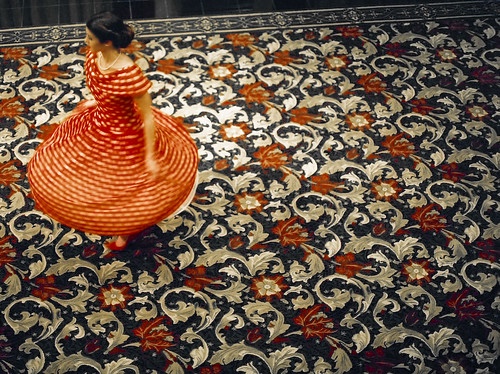
Woman in red dress twirling alone on a coloured rug
dots dancing alone on a busy pattern” by supermattzor is licensed under CC BY-ND 2.0.

Dancing with himself

Recently I was at an outdoor country music festival stage show—supporting a friend who was supporting her partner who was in the band. The set started for about 30 people sitting or standing in the warm sun.

Soon I noticed someone dressed in cowboy hat, jeans, and boots who had started dancing at the side of the stage. He looked about 80. He was the only person dancing. I gestured to my friend over to him, and she said, “Oh, that’s Bev. He always dances, no matter what music is playing.”

I learned more: Bev has special notoriety among local musicians for coming out to so many shows and always, always dancing. Bev has even been featured in a music video by my friend’s old band.

Jenn Marino & the Hearts – Got Me Movin’ featuring Bev Camp

Not dancing but watching

Watching Bev shuffle out moves like a one-man line dancer, I thought about the (very few) number of times I was brave enough to be the first one up and dancing. I get my itchy feet from my parents, who have always loved music and for years enjoyed two-stepping and square dancing. But the risk of being seen as the weirdo dancing by herself has, more often than not, kept me rooted in my chair.

Some guy in front of me pulled out his phone, training it on Bev rather than on the band. When the guy noticed me noticing him, he smiled and gestured towards Bev in a conspiring way, like I should agree that Bev was making a spectacle of himself dancing alone, so it was ok to record him.

Before the set was over, Bev had moved closer to centre stage, continuing to dance as if he didn’t even notice anyone else was there. We all noticed him, but nobody joined him.

Dance like no one is watching

I didn’t speak with Bev, but I guess that he doesn’t dance at live music to make a spectacle of himself. Bev is there for the music. Maybe he does it to maintain muscle strength and agility, or maybe he just no longer fears what other people think. Maybe Bev doesn’t feel he as if he is dancing alone: his dance partner is the music.

Perhaps dancers are gawked at and teased by those who want to dance but lack the courage to do so. I am still not always able to (as the platitude goes) “dance like no one is watching.” But I will cheer on Bev and others like him, and maybe enjoy the music a little bit more, knowing there are beautiful, brave people who don’t need anyone’s approval to just go ahead and dance.

fitness

Biking Accessibility

A few years ago, my workplace started undergoing a major refit, including a completely renovated cycle parking area. Cycling was a popular option because there is extremely limited parking, and the bus schedule can best be described as “whimsical”.

The stated goal of my workplace was to encourage cycling as part of an effort to reduce greenhouse gases. To do that, we needed something much better than the old open area with bicycles crammed in higglety-pigglety.

Employees were consulted several times. At each of the sessions I participated in, someone raised the issue of accessibility and the importance of doing a GBA+ assessment. GBA+ is an analysis of gender, race and accessibility implications for a planned policy or activity. They are mandatory in my work. More importantly, they are welcomed as a way to help us identify both positive and negative impacts of what we propose to do, design strategies to avoid or mitigate the negative ones, and measure the results.

Based on the reaction of those leading the consultations, we were not confident that our concerns about the bike area design where registering, or that a GBA+ analysis would be done.

Fast forward past the pandemic and today I finally experienced the results of those consultations.

I bonked my head on the security gate as I struggled to keep my bike upright while swiping my ID card and then get through a weird combination of revolving door and bike gate. Fair enough; I do work in a place where security is a concern.

Then I got to the second set of doors and swiped again. The doors don’t open so I can walk my bike through; I need to pull them open with one hand, while trying to roll my bike through. Sure, that’s not much worse than getting my bike into its storage spot at home, but the work doors are much higher and heavier than my basement door, and it would have been easy to install an automatic door opener as the default.

Then a third door (more of the same) before finally arriving at the glory that is our new bike area. I am reasonably tall (5′ 8″) and fit. I have some upper body strength from swimming. I worked up more of a sweat trying to get my bike onto the lowest of the racks than I did cycling to work.

Row of bikes stored vertically. Mines is the blue and white CCM in the middle, about 4 inches off the ground.

There is no way that someone smaller or less fit that me could manage this. I felt ready to cry with frustration. After I finally got it in place, I noticed that some people had abandoned the racks altogether, and parked their bikes in the few free areas.

Bicycles parked in a row in an area mated by yellow paint.

So if I were a cyclist with a cargo bike, ebike, tricycle, trailer for my kids because I dropped them at daycare on the way, where would I park? Those with physical limitations would struggle with using the racks even if they could use a regular bicycle.

My building doesn’t need anything like the 8,000 bicycle spaces in this Utrecht, Netherlands parking garage, but it could certainly have used something like the system where bikes are rolled into place and then lifted up to various heights. Accessible and even more space efficient!

Two cyclists parks their bikes in the world’s largest bike parking garage in Utrecht, Netherlands, on Aug. 21, 2017. (Michael Kooren/Reuters)

fitness · Science

Is marathon running good or bad for hearts? And whose? And how? Science doesn’t know yet.

Newspaper reporters just love lurking around medical conferences, or so it would seem. Not willing to wait for papers to come out in journals, peer-reviewed and edited over time, journalists are showing up incognito at ballrooms of large hotels, consulting schedules, jotting notes and taking names.

The thing is, though: just because some group of researchers gives a talk with a particular result, that doesn’t mean that result is true, or applicable, or important or generalizable. Sometimes it takes a while to figure out what’s going on; there’s often a period in which different studies yield conflicting results. That’s common in real science. It may take a while for a more accurate picture to come out.

And so it is with a recent study about the relationship between endurance sports and what’s called “vascular age” — something to do with stiffness of arteries, which is bad, and an indicator of greater risk for vascular disease. If that wasn’t helpful, maybe this graph will clear things up:

Tables on how to derive one's vascular age. Easy-peasy, right?
Tables on how to derive one’s vascular age. Easy-peasy, right?

You might think that running marathons would be good for your arteries (I don’t know why; uh, why not?). Way back in January, a study came out saying just that.

According to a new study … researchers found that training for and completing a marathon, even at relatively low intensity levels, was associated with reversing age-related stiffening of the body’s main artery, the aorta, and helped to reduce blood pressure.

… researchers tracked 138 untrained and healthy first-time marathon runners over the course of a six-month period ahead of the 2016 and 2017 London marathons, including two weeks post-marathon….

The results found that for first-time long distance runners, training and completion of the marathon was associated with reductions in their blood pressure and aortic stiffening — which is when the arterial wall begin to fray due to stress.

Older, slower male marathons saw the most improvement. Researchers noted that while they only recruited healthy participants for the study, “those with hypertension and stiffer arteries might be expected to have an even greater cardiovascular response to exercise training.”

Well okay then. I’m happy for all those first-time marathoners. You go with your non-stiff arteries!

But wait– 5 months later, the news turned grim, at least for male marathon runners. According to another group of researchers, endurance sports like marathon running can increase vascular age by up to 10 years for men. But for women who ran marathons, their vascular age improved. Here are the deets, from a news article published this week:

Running marathons could age men by as much as a decade, research suggests... The study of males aged 40 and over who had taken part in at least 10 endurance events, found that their major arteries were far stiffer than would be expected for that age group.

However, the study of more than 300 regular athletes found the health of women who took part in endurance events improved. Female athletes had a vascular age around the same as their actual age and, by one particular measure, their vascular age was six years younger than their true age.

Scientists said the study… could not explain why the impacts of such events differed between men and women.

Okay, so some researchers gave a talk at a conference with some preliminary results that they can’t explain. Fair enough; this is legit practice at conferences. But I wouldn’t consider it news, much less important news, much much less worthy of the headline “Running marathons could age men over 40 by a decade”. Nope.

Sometimes, in fact most of the time, we need to wait for science to do more work and reach a solid consensus about what’s going on and why and for whom. this is one of those times.

While you’re waiting, it seems okay to rely on existing standard health advice, which is that exercise is good in many ways for us. More than that I shouldn’t say, lest some reporter is lurking around the corner…

You never know who's listening in from around the corner... picture of Mr. Bean behind a brick wall.
You never know who’s listening in from around the corner…

ADHD · martial arts

Christine’s Plan for her Belt Test: Being Bold

Cast your thoughts back to the beginning of May when I had a great plan for how I was going to steadily work toward my next black belt test on Sunday, June 19th.

I was so young and foolish then. That was back before a series of migraines (or was it just one long migraine?) and the associated pre & post symptoms kept me groggy and out of sorts for over two weeks in the first part of May.

GIF of two dogs at a car window. At first you see one alert dog looking out the window and then a second rises slowly next to the first, looking disheveled and only half-awake.
Guess which dog represents me in early May? Image description: a GIF of two dogs at a car window. At first you see one alert dog looking out the window and then a second rises slowly next to the first, looking disheveled and only half-awake.

And that was before the perfectly reasonable amount of work tasks I had scheduled for those two weeks had to be jammed into the week before I had to travel to the other side of the country for a conference. And it was before I was travelling, and at a conference, and then off to a writing retreat, and then off to teach a workshop, and then teaching another workshop. And it was before my knee decided to get cranky for a few days and before my back got jealous and did the same.

So, let’s just say that my slow and steady plan was not at all feasible.

Instead, I had to follow a nooks and crannies plan – jamming patterns and practice and exercise and theory into any little space that I could pry open in my schedule.

GIF of a Tetris screen
A visual representation of me fitting practice into my life over the past few weeks. Image description: a GIF of the videos game Tetris in which blocks of various colours fall from the top and you have to move a mass of pre-existing blocks around to let the new ones drop into a space where they will fit.

I had to use persistence (which, when I can activate it, is one of my superpowers) to just keep plugging away at everything and trust that it would work out.

I did my written theory test last week and I did quite well. I’m proud of the fact that I was able to work out some of the correct answers by applying my knowledge, even when I didn’t *know* the answer for sure.

All the physical testing will be on Sunday and even though I haven’t been able to do things the way I meant to, I still feel good about it.

I wasn’t able to physically practice as much or as often as I had planned to, but I did extra mental/visualization practice whenever I had a chance.

During my physical practice, I alternated between focused practice on my most recent patterns and directing my energy towards sharpening some fundamental movements that will improve my technique overall.

A GIF of a villain from the Austin Powers movies shouting ‘Fire the laser!’
Pretty much what my brain looked like whenever I started practicing. Image description: Frau Farbissina, a villain from the Austin Powers movies, a small woman in a suit with her hair in a business-like updo, is shouting ‘Fire the laser!’ while Dr. Evil, another villain, reacts.

And now I am down to just a few days of practice and I want to spend them wisely.

As I was planning my week, I was tempted to try to create an epic schedule of practice and exercise, but, luckily, a more sensible part of my brain prevailed.

Instead, I plan to do daily yoga, daily practice for my patterns and for other specific movements, and to do some specific stretches and rehab exercises for any persnickety body parts. I’m going to work smart, and work as hard as I need to, but I am not going to run the risk of exhausting myself before my test.

Normally, I go into belt tests reminding myself that ‘chance favours the prepared’ but right now that aphorism is drawing my attending to the gap between my intended preparations and my actual preparations. Focusing on that gap will NOT help so, instead, I have been reminding myself of another saying, ‘fortune favours the bold.’

On Sunday, I am going to show up bold.

In fact, I am determined to boldly go where I have never gone before – into the mental and physical space of being a 4th degree black belt.

A GIF of a character from the animated series ‘Star Trek: Below Decks’ saying ‘That’s boldly going.’​
Yep, just watch me! Image Description: A GIF of Boimler, a character from the animated series ‘Star Trek: Below Decks,’ saying ‘That’s boldly going.’

So, if you were thinking of wishing me luck for Sunday, please wish me boldness instead.

After all, that’s the best way to get fortune to favour me.

Ki-YA!

fitness

Movement Monday isn’t Magic but Move Anyway, but only if it works for you

Movement Monday Yoga Version

I’m not sure where Movement Monday came from but it seems to be a thing. On the internet anyway.

There’s also #MotivationMonday.

There’s a lot of pressure on Mondays. It’s also international bench press day.

International bench press day

I’ve always been a fan of getting to the gym on Monday. It sets the tone for the week. I blogged about it here.

But I also want to say, especially to the weekend warriors among us, that it’s okay to rest Mondays. There’s nothing magical about Mondays. Because the worry is when you build something up to a big and important thing and then if you miss it, you think the whole week is ruined.

It’s OK to miss a Monday. Embrace the small failure, don’t make it a big one.

But it’s also OK if making Monday a Big and Important Thing works for you and it’s a great way to kick your fitness week with a bang, then do that.

The point is that Movement Monday is a tool. If it works for you, have fun with that. Share the Movement Monday Memes. Go big on the bench press. Run, run, run!

An aside: I shared Krista Scott-Dixon’s latest thing on TikTok to our Facebook page and she makes the same point about fitness trackers. They’re not the boss of you. They’re tools. I think it’s the same point. Movement Monday isn’t a fitness imperative. It’s a motivational tool that works for lots of people.

But if moving Monday doesn’t fit your life, that’s OK too. I remember when my kids were little thinking that just making it through a Monday was a big achievement. Everyone got to school or daycare? Great. In that stage of life I treated my week, at least in fitness terms, as starting on Tuesday. Monday was too much all on its own.

Your Monday night be Movement Monday or it might be Meh Monday.

Happy Monday whichever way you roll!

A baby, it’s chest day
I’m here to make your Monday a little better. Cute dog.
fitness · meditation

Catherine’s favorite meditations from the Ten Percent Happier App

Hi everyone! You know this already: I’m a big ol’ booster for the Ten Percent Happier App. What can I say? I’ve got the zeal of the relatively-new convert. I’ve been meditating almost daily for 2 years now, which in the grand scheme of things isn’t that long. But it’s long-to-me, and makes me feel happier. Maybe even more than 10% happier, honestly.

So, I thought I’d share some of my favorite meditations with you. It’s not so much that I want to promote particular teachers or particular apps, but rather that there are certain kinds of meditations I keep returning to, that center or ground or soothe me. Others lighten my burdens. Some are just fun mental explorations. So here goes, in no particular order.

“I need to chill out right now” meditations:

Jeff Warren does a Ten Good Breaths meditation. I love love love this. It lasts 3 minutes. It’s focused but also a little on the light side, with a smidge of humor. Here it is on YouTube:

I also really like Diana Winston’s meditations for a moment of panic. There are 1-10 minute-long options. I’ve used them when I’ve worked myself up into a serious lather. They emphasize noticing the body sitting, feet on the floor and then awareness of body parts that are feeling quiet (like hands or feet). I couldn’t find a free version, but here’s a 5-minute breathing meditation by Diana on the UCLA Mindful Awareness Research Center site, which has lots of free guided meditations.

“I need to wake up” meditations

I used to think that meditating first thing in the morning was useless because I’d immediately fall back asleep. It never occurred to me that mindfulness and focus could help me make the transition to wakefulness. Some of the techniques use body scans, an introspective check-in (e.g. how are my emotions this morning?), or even a gratitude practice (e.g. what are three things I’m grateful for right now/in the next hour/in general).

Every morning, when my alarm goes off, I hit snooze once. Then I turn on one of the morning meditations for 5 or 10 minutes. It helps me adjust to the reality of leaving my bed sooner or later…Joanna Hardy has my go-to morning meditations on my app. She’s got a lot of online talks and guided meditations accessible here, and below is a very strange video but worth spending a minute on (keep watching for the breathing dog):

One the one hand, there’s that universally annoying saxophone music. What is that song, and why hasn’t it been banned? On the other hand, there’s that dog. Is it just me, or is his breath making heart-shaped humid patterns? Awww….

There’s also a coffee meditation, where you are drinking coffee and meditation by design. Yes, I do this often, too.

I need to get in touch with my breath” meditations

These meditations are the meat and potatoes (as it were) of meditation apps, workshops, practices. Focusing on the breath is the foundation of mindfulness meditation. Every meditation teacher has their own variations, but for my money, no one does the classics like Sharon Salzberg. I love her reminders that whenever we come back to awareness after getting drowsy, bored, or distracted, that’s the work– that’s why we’re here. We come into contact with our own experience of ourselves, breathing, over and over again. That’s it.

Here’s Sharon leading a large room of people in a short and simple breathing meditation:

I do these sorts of meditations anytime I want to take a break, stop, and focus for a bit. It helps me reset myself, and it’s also restful and refreshing.

“I need to deal with scary emotions” meditations

These sorts of meditations are ones I do when I have a bit more time to process some difficult emotions or issues I might be facing. It could be that I’m anxious about an upcoming work event, or worrying about a member of my family. Maybe I’m avoiding dealing with something that’s too daunting. I’ve found that if I sit and meditate, something will come forth; I don’t know what in advance. But I’ve never been sorry that I did them.

Jess Morey does a great meditation in which she guides us to find a place in our bodies that feels calm, settled, grounded. Then we visit a feeling or belief or memory or a part of the body where there’s anxiety or disturbance. We don’t stay there long, but while there, just pay attention to how it feels. Then we go back to the grounded settled place. this repeats a few times. You can find a version here— look for dis/comfort. It’s 11 minutes long.

“I need to find something good, like right now” meditations

I like meditations that confront difficult emotions, but sometimes I want to see the light, the hope, the optimism that I know it out there (all news coverage to the contrary). For this, Sebene Selassie is who I turn to. Here’s a discussion and guided meditation from the Ten Percent Happier folks (the meditation starts at the 5-minute mark).

We are living in a glorious age of apps, podcasts, substacks, self-styled videos of all durations, and of course old-fashioned YouTube. I happen to like the features of Ten Percent Happier and don’t mind paying for it, but there are loads of free meditations everywhere. It’s kind of fun (for those of you who are meditation-inclined) to venture forth and explore what and who’s out there.

Meditator-readers: what are your favorite meditations? Where does one find them? Whose do you like best? I’d welcome any tips on new or familiar voices.

camping · cycling · family · holidays

Bettina goes on holiday

Yes, you read that right. After two plus years of pandemic and nearly two years of life with a little one, we are going on holiday. As in, travelling somewhere that’s not to see our family, or visit friends (we are, in fact, going to visit friends on the way, but we’re also going to be on our own for a bit).

We’ve rented a camper van and will be cruising around Dutch campsites. We’re taking our bikes (the adults) and trailer (the toddler), in the hopes that it will stop raining for long enough that we can do some cycling tours through very flat landscapes. This may not sound very adventurous, but right now I think it’s going to hit the sweet spot of being active but not overexerting ourselves, and fun for everyone in the family. We also have a kite, beach toys, and swimwear – not that we’re planning the brave the North Sea (though who knows?!), but the weather forecast really isn’t great, so if it won’t stop raining, at least we can go to the indoor pool.

When you read this, we will actually already be on our way back, but I’m writing this post before we even leave, since I don’t know how much Internet we’ll have along the way (the campsites all promise wifi but I also honestly don’t know how much I’ll feel like posting when the alternative is frolicking around a campsite or the beach!

I’m very excited about this trip.

Do you have holiday plans already? What are they?

challenge · fitness

On Challenges

I’ve been thinking about challenges lately. The kind we encounter, yes, but also the kind of challenges we issue ourselves or the ones issued by others that we choose to take up. In the fitness world there is no shortage of challenges available – do x activity for y days, run/ride/move xx miles in yy amount of time, etc.

When I learn about a challenge that gets my interest I often have good intentions. I’m a planner and a procrastinator, so give me an opportunity to create a “challenge plan” in my calendar or excel spreadsheet and I’m a happy human. My enthusiasm for these types of challenges often wanes quickly once I’ve finished mapping it out though. I do best with more flexible challenges where I get to do different activities, but I think the bottom line is that I don’t really like to be told what to do or what I “should” be doing. I also do better with long-term challenges where I can take a (sometimes lengthy) break and still reach my goal.

June calendar showing dates 22 through 26
June calendar showing dates 22 through 26. Photo by Behnam Norouzi on Unsplash

I recently learned that Robin Arzon, a Peloton fitness instructor, posted a “31 day challenge” to move 30 minutes every day in June. Honestly, what caught my attention about this is that there are only 30 days in June… Admittedly, I did not see her original post and received 2nd hand information about it, but when I looked it up I noted that it did extend into July 1 to get that final day in there. I’ve been looking for something to “motivate” me to move a bit more, having just wrapped up a busy season at work and coming back from a short vacation where I noticed my energy level and willingness to explore on foot were both flagging. Figuring if Robin can stretch into the next month I could just go ahead and start on May 31, I jumped right in with a bike ride and yoga class. I was enthusiastic. I was excited. And then came day 2. I didn’t sleep well. It was rainy. My house is under construction and the noise is deafening. My dogs are a nervous mess because of the noise. By 2pm the workers had called it on account of the weather and the dogs and I were in a napping heap on the couch.

Amy’s two dogs resting on a gray couch with gray blankets. One dog is brown with an orange collar, the other dog is white with lots of black spots.

I could have let myself feel guilty about that decision. In actuality, I did have a small twinge of guilt. But I’ve been doing a lot of work on my internal monologue about listening to my body without letting thoughts about what I “should” be doing overtake what I need in a given situation. I know I can push through and do a 30 min tired, cranky workout but it may make me enjoy movement less (and resist it more) the next time if I don’t listen to what my body is really saying.

Looking at my journal I note that I have several “challenges” that I am tracking for the year. I’m part of the FIFI “222 in 2022” group and I’ve set a personal bike mileage goal for the year. I have also challenged myself to meditate daily and to read more books this year than last. I’m trying to get a research manuscript off to the publisher by year’s end, and dang if that isn’t both a challenge and challenging!

I know my success rate at challenges is often influenced by how challenging life is throughout the duration and I try to stay attuned to the rhythms and cycles of my schedule. I try to be compassionate with myself and to examine why I wasn’t able to complete a challenge from a neutral place, not from one of “failure” or good/bad judgements.

As for today, I write this on day 3 of my (and Robin’s) 30 in 31 challenge. I have the energy and the time to work some movement in while the pups and I retreat from the noise and mess in our upstairs cocoon. As for the rest of the month, we’ll see how the challenge and the challenges fare.

Amy Smith is a professor of Media & Communication and a communication consultant who lives north of Boston. Her research interests include gender communication and community building. Amy spends her movement time riding the basement bicycle to nowhere, walking her two dogs, and waiting for it to get warm enough for outdoor swimming in New England.

commute · cycling · fitness

Big hills as barriers to bike commuting: Creative solutions

Many years ago I was chatting with an Old South neighbour who also worked at Western University in London, Ontario and who aspired to commute by bike. We agreed that the bike path to campus along the river was was beautiful and safe and that many factors (no stressful traffic, no expensive parking, time in nature before and after work, environmental reasons, and daily exercise) made biking the obviously best choice.

But, she said, what about the big hill out of the park up to the bridge?

What about it?

I confess though it’s short I was annoyed by the hill out of the park because at the time I was riding a fixed gear bike. I had to take a run at it and sometimes there were people walking on the path and slowing down on the fixie was problematic. But even on the fixie it wouldn’t stop me commuting by bike.

The neighbour was worried she’d need to walk the bike up the hill. I don’t think it would be necessary given that her bike had gears but even so, it’s a pretty short hill to walk up if you have to. But the thing is she was embarrassed by the idea of walking her bike up the hill and that alone was possibly enough to keep her from riding. She felt she wasn’t in good enough shape to ride to work if she couldn’t make it up the hill.

Me, I think it’s okay to walk your bike up the occasional hill. See Sam changes her thinking on walking her bike up hills.

I also think most casual cyclists don’t learn to use their gears. I see people struggling and have to resist yelling, “Shift!” at them.

The biggest factor though isn’t either of these things. It’s that hills intimidate us. I loved Julia’s recent post about hills.

The same is true for commuting to the University of Guelph from the Northside of the city. People comment all the time that they’re impressed I ride up the Gordon Street hill. I don’t quite say “what hill?” but it’s true it’s not much of a hill. I slow down for it but even my Brompton easily makes it up Gordon. It’s annoying but as hills go, it’s not much of a hill.

Here’s the Gordon Street hill:

So my standard view on hills and bike commuting is a)use your gears, and b)if you run out of gears, it’s ok to walk your bike.

I guess my view about hills and urban commuting changed a bit when I lived in Dunedin, NZ for a term while on sabbatical visiting The University of Otago. There the hills were steep enough that some routes just didn’t make sense by bike. I lived in an area that people referred to as the city rise. That meant I had a long set of steps up to my house from the street below and my bike commute would have been a very fast downhill to work and likely walking the bike uphill for at least part of the way home. Needless to say, I walked.

Steps to our house, groceries down below
— in Dunedin, New Zealand.

Getting around town in Dunedin it was never enough to know how far away anything was. Distance wasn’t the most important measurement. I once set out on my road bike to get to the velodrome in Mosgiel–just 20 km away. I gave myself an hour (normally fine on the road bike) neglecting to see that something aptly called Three Mile Hill was between me and there. I was late, obviously, and too tired to do much riding when I got there. And after that I drove like others riding at the velodrome, which felt all wrong to me.

Other than gearing, or e-assist, what would help make cycling more accessible in really hilly cities?

Cork is considering a lift like the one in Trondheim

See here, ‘Bicycle lift’ proposed to help cyclists climb steep 14% street.

Here is the story of the lift named Trampe,

What’s your opinion about hills and bike commuting?

commute · cycling · fitness

My long way to work

A turtle, a wet cyclist, and a tree fallen across the bike trail

My normal bike commute here in Guelph is a little too short. It’s just a couple of kilometers. I’d walk it except I can’t because of my knees.

I’ve also been missing my London commute along the river on the bike path.

Guelph has a river and a river side bike trail but it’s not the most direct route to work. This past week I put all these facts together and starting riding the long way to work. Up the riverside bike path, and then down through the Arboretum to my office. It’s about 5.5 km. That’s still shorter than my 7 km London commute but it’s enough to make it feel worthwhile getting on the bike.

Today I saw a turtle and a giant tree that fell on the path. That’s much more interesting than my neighbourhood route.

There’s also a very pretty wooden, covered bridge on my route.

Sam, the bridge, and her bike

It was a good idea anyway. It’s a much nicer ride. But it’s part of getting ready to ride the Friends for Life Bike Rally in August. I’ve always thought that the hardest part of the rally isn’t the distance you ride each day, it’s getting up and doing it again. So daily riding is definitely part of my training plan.

I’m increasingly nervous about getting enough riding time in. I don’t want to struggle with both knee pain and fitness. Every weekend from here on in, rain or no rain, I’m going to be training.

I’m also struggling this year with fundraising. You can sponsor me here. Please, any amount helps. I’m about a third of the way to my goal.

Sam’s strava report on her way to work