There’s an ad in my newsfeed that seems to greet me each morning. It’s an ad for very modest bathing suits targeted to older women. Each morning it makes me grumpy.
The bathing suits are fine. They’re not to my taste. (That phrase makes me smile because it’s what my kids used to say, when young, and served with a dish they didn’t like.) So no judgement, you wear one if you want, I won’t say a thing. They’re just large and drape-y and cover a lot of skin.
Writes Martha, “It’s sad because not ten minutes after I started searching for a link, I got an ad in one of my news feeds for Bathing Boomers swimwear, swimsuits marketed to mid-life and older women to camouflage their “lives well lived.” The web copy says the goal of the company is to help women feel dignified, stylish and confident by hiding all the problem areas (the jiggly bits and bumps).
Here’s a newsflash: you don’t make women feel confident by saying parts of their body are a problem. I think I’ll add Nova’s ad to my happy video stream just as a reminder that all bodies are beautiful in their own way and we don’t need to hide anything regardless of how we are shaped.”
Now there are all sorts of reasons for preferring more coverage, protecting against sun exposure being an excellent one. But that’s not the reason this company offers. Instead, their pitch is making life more relaxing by covering up our aging flesh.
The ad reads: “It’s a long overdue gift for women of a certain age who are ditching the denial and diets and now can look at a glass of wine without seeing 300 calories in every pour. We are all on board for a concept that embraces aging bodies, bat wings and all.”
A gift? Last I checked they’re for sale and we buy the swimsuits.
Bat wings? Older women don’t have batwings. We have arms. Some are large and some small and they come in different shapes. Arms don’t need labels. They’re arms. That’s all.
Last week I read the book Healthy as F*ck by Oonagh Duncan, which focuses in large part on how to create and sustain habits that work for you to support your health. Near the end of the book, she talks about identity and the strong need that people have to stay consistent with our own definitions of ourselves. The context here is how reinforcing our healthy habit loops helps strengthen our identity of being “Someone Who Does This Shit” – whatever that shit may be.
It occurred to me after reading this that being a person who exercises regularly has become a solid piece of my sense of self, and I can tell you most emphatically that in the past it was not. As recently as 2 ½ years ago I struggled to get myself to be physically active – it was something I sometimes did (and had a hard time with), and it was not part of my self-concept. And now here I am, someone who strongly identifies as a person who moves.
This transformation has happened for me gradually since July 2018 when I read Sam and Tracy’s book Fit at Mid-Life: A Feminist Fitness Journey, and decided that I was ready to make some real changes. My first step was taking up running that summer, then I took part in a Fit is a Feminist Issue challenge in the fall, and in the new year I started a 219 workouts in 2019 Facebook group, which rolled over into a 220 in 2020 group. In 2020 I also started working out regularly in group sessions with an awesome trainer (Ali MacKellar) whose approach reflects my values and who creates community around this work. Building my fitness habits with the support of other fit feminists has been instrumental in making this change possible for me.
So after finishing the book and realizing that movement has really become part of who I am, I sat down and did some math based on the tracking from the 2019 and 2020 groups.
First let me tell you that I move my body in lots of ways – running, cycling, and sweaty HIIT sessions, as well as walking, yoga, and bellydance. My loose criteria for what counts as a workout for the purpose of tracking is basically any form of intentional movement of 25 minutes or longer. Why 25 minutes? For the simple and not-at-all scientific reason that 25 minutes is the length of many of the Yoga with Adriene sessions I do. So it keeps things easy for me.
View of trees in foreground and Toronto cityscape in background, from an evening run in November
In 2019 I hit 219 workouts right at the end of December, which means I worked out an average of just over 4 times every week that year. Wowee, I thought, good job Cheryl!
So far in 2020 I’ve done 270 workouts as of November 15, which is an average of 6 workouts a week. Umm, I’m sorry, what?? I work out 6 times a week?? On a regular consistent basis?? Me?? I had to double check the math, as this seemed like this couldn’t be possible. And yet it is. As you can tell, this was actually a shocking realization for me.
Doing some form of intentional movement most days every week has become a regular part of my life, even more so during a global pandemic where there’s less incidental movement happening for me. Every week I make a plan for what workouts or activities I’m going to do and when, as part of the list of things that I just automatically do. Planning for physical activity, and following through on those plans, have become habits.
Seeing these numbers drove home the realization that who I am has changed. For the first time in my adult life I am “Someone Who Does This Shit” when it comes to moving my body, and I feel really good about that.
I imagine that this has already been reinforcing my habit loop, as I have become a person who works out 6 times a week without being aware of it. I wonder if the more conscious realization of it will reinforce it even more?
I’m curious about other folks’ experiences around this? Is movement/exercise something you *do*? Or does it feel more like its part of who you *are*? And either way, how have you created habits that work for you?
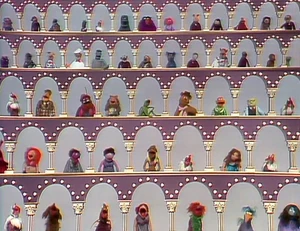
Yes, I know there are multiple platforms that allow people to connect in on line virtual environments, but I do really like Zoom and I love the opportunities to play with the word “zoom” and popular culture. Like the title of this post for example, riffing on the Talking Head’s song, Life During War Time.
Image features the famous Muppet Show character arches, looking very much like Zoom galleries.
But to get down to brass tacks (does anyone ever use that phrase or is it just me?), or to use the words of the immortal Aretha Franklin, who’s zooming who these days and why?
Most of us use online platforms for work and play. We can connect with friends and family, we can sign up for all manner of courses from quilting and cheese tasting to yoga and pouring acrylic. The possibilities are endless. I myself have been using online environments to learn new quilt techniques, to plan and deliver on different projects, and to connect with far flung friends and nearby colleagues.
There has been some research on the impact of all this zooming, teaming (Microsoft), meeting (Google) and Facetiming (Facebook) to name a few. National Geographic produced an extensive look at the impact of what it called “Zoom Fatigue” on humans. The magazine concluded virtual interactions are hard on the brain. Here’s why:
Zoom gloom: Humans communicate even when they’re quiet. During an in-person conversation, the brain focuses partly on the words being spoken, but it also derives additional meaning from dozens of non-verbal cues, such as whether someone is facing you or slightly turned away, if they’re fidgeting while you talk, or if they inhale quickly in preparation to interrupt.
In the virtual environment we tax the brain and that leads to fatigue. We can reduce the fatigue by turning off the camera or by switching to the telephone and walking outside at the same time.
What about meetings that require a video component? Throughout the pandemic I have been signing up for courses on how to deliver training in virtual environments. So along with the fatigue that comes from the brain trying to manage various signals, in training sessions, we are also asking the brain to take on something new.
I’ve learnt a lot about ice breakers, how to manage introductions (especially when you have several pages of screens of tiny blocks representing individual people), and how to chunk up your content so it isn’t all talking, all slides, all the time.
Recently I had a breakthrough in a learning session. I couldn’t figure out why I felt so perky after a two hour class. Yes, the facilitator chunked up the content; yes, there was prep work beforehand so we could get comfy with various creative tools; and yes, we had small, medium, and large breakout sessions with fun exercises.
It came to me that the facilitator included an exercise in each class that required us to move. I usually give people a 15-minute break to step away from the screen, to get a drink of water or a snack. I have even suggested they take a quick stroll outside.
But how do I know people in my sessions actually do what I recommend? I don’t. Chances are they are checking their emails, responding to a family (human or animal) need etc.
In both sessions, after our short break, we did an exercise: one involved mirroring the movements of another person on the screen (it didn’t matter who) for about a minute and half. Another asked people to make a pose and three people got numbers. The leader mixed up the numbers and we replicated what each number represented. The leader got faster and faster and then we collapsed in laughter.
In both examples, this embodied exercise shifted focus and restored energy. If you study or follow Chinese (and other Eastern cultures) medicine, the concept of chi, or energy flow, is very important. Practitioners of tai chi use particular movements to restore balance and redirecting energy flow to different parts of the body.
Photo by Mauro-Fabio Cilurzo on Unsplash Image shows a person in silhouette with their arms outstretched against the setting sun.
Do you have to do this only in a group? I don’t think so. As an experiment, I turned off my camera on a recent video call. I spent a minute just playing the online version of Simon Says from my last class by myself. The 60 seconds of movement re-shifted my focus enough that I could return to my call and pay attention. I’ll probably try this more often to give myself an energy boost instead of grabbing another cup of coffee and I am definitely incorporating it into my online meetings and training sessions.
What about you: how are you managing with zoom fatigue?
MarthaFitAt55 lives in St. John’s and works pretty well anywhere the ether will take her.
The Transgender Day of Remembrance falls at the end of Transgender Awareness Week this year. Here at Fit is A Feminist Issue we are marking the day by making space to remember those who lost their lives from transphobia.
Image shows blue, pink, and white stripes denoting the Transgender Pride Flag.
This week Nicole and Cate both shared insights from transgender individuals about their experiences, especially within the fitness realm. Nicole shared a link on being an effective ally at the end of her interview with Jordon. This link here gives useful tips on how to create a welcoming environment that also focuses on safety (the website also has it available in French). Take a look at your workplace and your own personal space to see what steps you can take to ensure translives are affirmed, respected and recognized.
Tonight’s Zwift race, a team time trial which was three laps of Watopia’s Hilly Route, was for me an exercise in technical difficulties. Also, hills. And a smaller roster than usual of teammates. But mostly technical difficulties.
I began with my phone at 5 percent battery and the threat of losing discord loomed large. I plugged the phone in but it doesn’t charge that quickly. Discord matters because it’s how we communicate who is next up in the sequence of riders, how we’re feeling, how long a pull we want to take at the front and so on. There might also be some crying, swearing, and whining. We agreed I’d use the app to signal with my avatar’s arm if I lost Discord and wanted to skip my turn at the front. We had a set order of rotation of riders and in theory it ought to be okay with one of us out of communication.
Here’s me at the start. On the left, my avatar is in yellow TFC kit, with a pink Zwift academy hat and socks. On the right, actual me looks nervous about the race. My team lost two riders at the last minute. One didn’t get in the start pen in time and the other got stuck at work. I had been telling myself that I only needed to do two laps and that we could send the four best climbers ahead on our third time up the KOM. This is now no longer true. Gulp.
Left: Avatar Sam in the pen before the race start. Right: Actual Sam on her bike looking worried.
In the end my phone stayed charged. But I had bigger problems. My internet was wonky and I kept losing everyone on the screen. For about half the race it looked like I was riding alone. I had to use the listing of riders on the right hand side of the screen to “see” where I was in the group. Pacing was a challenge. I kept going off the front because my big worry was being dropped. It wasn’t until the final lap that I could consistently see my teammates which is strange and challenging in a team time trial.
We also lost a teammate tonight who got dropped and isn’t coming back next week. I feel bad about that and wish I could have explained better what was going on. Teams are hard work that way.
All of this reminded me of my worst technical glitch ever, completely losing power in a race and getting dropped. I wasn’t sure what happened until Sarah and I looked at the trainer after. The extension cord plug which leads to the trainer had come unplugged.
Here’s our high tech fix!
A plug held in place with electrical tape
Anyway, in the end we did okay technical glitches and all.
I recently became aware that it is Transgender Week of Awareness in Canada, which takes place during the week of November 13-19 this year.
Transgender Awareness Week brings trans people and their allies together to learn more about advancing advocacy.
I am committed to being an ally, and educating myself about how to do so in the best way, to any group that is seeking equality and facing oppression. This is not limited to being a trans ally. But this topic is near and dear to my heart, because one of my favourite people is a transgender woman. I was 22 when Jordan was born and she was one of the first babies I spent a lot of time with as an adult. Jordan gave me the nickname “Auntie Uh-Uh” because I sang Barney’s “if all the raindrops were lemon drops and gum drops, oh what a rain it would be”, and then you stick your tongue and sing “uh, uh, uh, uh, uh, uh, uh, uh, uh”. Jordan liked to do my hair and play along with the children’s TV show Comfy Couch.
It has been a privilege to watch Jordan grow up and discover her true identity. She has always been an old soul and we have always had a special bond. When she told me that she is a transgender woman when she was 19, it did not come as a surprise to me. I believe I said something to the effect of “you are Jordan and I love you”. And then she told me more about her self-discovery process.
Jordan is now 26 and she is more inspiring than ever. I have watched, with admiration, as she has taken steps to become more comfortable in her body. She has done so with grace, determination and maturity beyond her years. I also know that it has not always been easy. I am sadly aware of the discrimination she can face, on occasion, from people who do not understand, or who “other” people they do not understand. In this respect, my instinct is to make sure she is OK and support her. I also feel it is partly my responsibility to help educate other people, when they are willing to learn, about the transgender experience. I would like to help people understand that transgender people are just like your friends and family members who you have known your whole life and who are the same people inside, regardless of how they express their gender. There is nothing frightening or strange about it if you take the time to understand. If nothing else, I hope people can learn to lead with kindness when facing something they do not understand and respect the wishes of the people involved who are asking for respect.
A beautiful picture of Jordan in an off-the-shoulder white sweater.
When I thought about writing something about Transgender Week of Awareness, for this blog, naturally I thought of Jordan, but also that the post should relate to the topic of the blog, which of course is feminist fitness and wellness. The gym is not always a comfortable or safe place for the trans community. This is an issue that has inspired many gyms across North America to create LGBTQ2-positive spaces. Alistair wrote about fitness as a trans man, for the blog, earlier today.
I asked Jordan questions about her experience at the gym and also if there is anything she would like to say about Transgender Week of Awareness. She graciously answered my questions below.
Nicole: How has your experience been at the gym?
Jordan: As a transgender woman going to the gym, my experience hasn’t always been easy…It has taken me years (four to be exact) to get to a place where I felt comfortable as well as familiar with my surroundings. At first it was really hard, because I wasn’t on hormones, I was a little more aware of my body, the gym clothes I could wear in comparison to other girls, and the right amount of makeup that I felt I needed to wear to feel passible while still appropriate for the gym. Over the years, since I have started on hormones, I can wear less face makeup and also have become a bit more familiar with my surroundings, so the novelty of being there and being transgender has faded. I like to keep to myself mostly at the gym, but I have acquired a few acquaintances in the changeroom – women who wave and we chat about our lives briefly – none of them caring about the news of my transgender-ness , just happy to see a familiar face – as it should be.
Nicole: Are there thoughts you would like to share about Trans Week of Awareness?
Jordan: Its great that Trans Week of Awareness exists, to help educate and shine light on the needs of the community. I am happy to live in a world where I am seeing change – slowly but surely – through lived experience as well as though the media. We have come so far as a group of people and a culture, being visible and accessible. However, there is a lot of work to be done still in the world.
I thank Jordan for sharing her thoughts for the blog.
Nicole P. lives in Toronto with her husband and two dogs. She’s running outside, cycling on her indoor bike and doing outdoor HIIT classes, and otherwise, hunkering down for this pandemic winter.
It’s Trans Awareness Week, and like Nicole, I wanted to bring in a voice we don’t usually hear on this blog. I interviewed my dear friend Alistair via email; most of this post is his words.
First, just a brief introduction?
I’m Alistair, I’m one of your friends and I’m a white trans guy with passing privilege, and a chronic disabling illness. I’m 40, for perspective.
Can you tell me a little bit about how your relationship to fitness has been related to your experience of being trans?
Growing up, I wasn’t involved in organized sports, but I was involved in dance and theatre as a young kid. As I approached puberty, my only experiences with fitness came in the form of PE class, which was uncomfortable for me – I was Very Bad at Being A Girl, and sex-segregated environments always left me feeling like an alien, though I didn’t understand why at the time.
I came out as a lesbian at 19 and presented in a progressively more butch fashion as time went on. The first time I experienced fitness in a positive way was in the explicitly feminist environment of the Toronto Newsgirls Boxing Club in the early 2000s. Founded by a queer woman as a body-positive female boxing club, this was a space in which my larger, study body became an asset – in boxing, the more mass you have, the more force you can deliver at the end of a punch.
When I joined the group of amateur boxers training to compete, the dynamics of the gendered space became inescapable; on the weekends when the recreational classes happened, the Newsgirls were the only people in the boxing gym. On weeknights, the competitors shared space with an almost entirely male boxing club. We constantly had to assert ourselves to maintain our space to work out, or we would be gradually squeezed away from the equipment and floorspace. We also learned to constantly watch out for each other, because while people like me were mostly invisible, feminine-presenting women attracted a lot of attention from the boxing club guys, and usually not in a good way.
Life factors and injury resulted in a drift away from the boxing gym. I gradually put on weight over the next five years or so while physical fitness took a back seat to other things, exacerbated by the fact that I wasn’t comfortable in any fitness space available to me (university athletic centre, YMCA, commercial gyms). My gender presentation became increasingly masculine, and wearing a chest binder was not, for me, compatible with exercise (constriction, temperature increase, chafing as sweating happened, etc etc.) As a visibly queer, masculine-presenting woman (at the time) I got harassed in women’s bathrooms enough that even considering using changerooms was always extremely difficult.
What, if anything, has shifted since you transitioned?
When I came out as trans at 32 and began to transition, those spaces were out of reach entirely. There was a “family changeroom” that was available at the Y but you had to ask for access to it, which never felt good to me – once you start being read as male, you need to be careful about entering spaces designated ‘family’ if you don’t have children with you. Once I started testosterone, my voice and facial hair started to change, but I didn’t feel safe in the mens’ rooms either. I’m a sweaty person, so changing after working out isn’t something I can skip, and at the time I was reliant on public transit so it would be a long ride home in wet clothes.
Alistair at his wedding in 2016
My first partial access to fitness settings came after I had completely healed from my top surgery (double mastectomy with reconstruction). Getting rid of the chest binder let me at least take a full breath while exercising, and having a flat chest made changing in the mens’ room possible, if not always comfortable.
I’m extremely lucky in that I have passing privilege now – I’m always read as male by people I interact with. In fact, most of the time people think I’m a straight white cis man, which is its own kind of uncomfortable. Even my overweight body isn’t othered, because the rules are different for men. In any context that doesn’t involve genitals or taking off clothes, I’m almost always safe.
What are you doing now for movement?
I didn’t find a fitness modality that works for me until earlier this year, and it turned out to be one I never would have expected: a kind of dude-yoga developed by a former professional wrestler who severely injured his back doing pro wrestler things and was desperate to save his career. He didn’t go back to pro wrestling, but his yoga-without-the-woo system developed a life of its own, with workouts accessible via DVD or app. It’s yoga with an emphasis on isometric exercise: increasing your heart rate by maintaining full-body muscle tension while holding poses and moving through series (use of a heart-rate monitor is encouraged so you can tell how hard you’re working). Most importantly, it is endlessly modifiable no matter what your level of fitness, injury, size, or disability – seriously, there’s a series of workouts for people who can’t get out of bed. The founder has a big, barky personality that’s not to everybody’s taste, but he is also surprisingly positive and gentle in attitude, and the guided workout clips are full of unexpected pep talks while you’re sweating through a plank pose.
This system seems to work for me in a bunch of ways that others haven’t. As a person who was once operating at a much higher level of fitness, I tend to get warmed up, think “oh this is good, I can do more” and then overdo it and can’t move for two days, so systems like Crossfit that exalt maximum effort aren’t a good fit for me. This is the opposite, embracing the idea that something is better than nothing, and that consistency leads to slow incremental improvement. So, if I overdo it one day, I can increase the modifications the next day but still complete the workout, giving me the benefits of movement and exercise, and perhaps most importantly, I can experience success and a feeling of accomplishment. Another incredibly important factor is that I can do this at home by myself, where I can pause if I need to, I don’t have to wear a shirt, there’s nobody to see me shaking and walrusing around on my yoga mat, and I don’t have to use the mental and physical energy to go to a different location and be around people.
Alistair with his groomspeople, me and Naomi
What do you pay attention to to determine if a space is welcoming or safe for you to work out or do a sport in? (Suddenly I’m reminded of your axe-throwing bachelor party).
Safe space can be really tricky, and there’s a complicated sort of calculus around safety. Vibe is a key if difficult-to-define factor — is it “girl power” or feminist? Are there safe space signs and symbols (triangles, rainbows*, explicit statements of safe space or ‘everybody is welcome here’)? What does the staff look like? Do people have pronouns on their nametags? Most importantly, are there individual spaces available for changing and showering, and do you have to ask for access to those spaces?
*This is why I have a big problem with people appropriating the rainbow for “we’re all in this pandemic together.” That symbol already has a specific meaning, and it’s a critical safety indicator for some people.
I’m safe in my passing privilege, until I’m not. My top surgery scars have faded and I’m furry enough that they’re not terribly obvious, but that doesn’t help me if I accidentally drop my packer (prosthetic penis) while I’m trying to change out of my wet bathing suit quickly and facing a corner (believe me, silicone bounces).Bathrooms are ok, until the stall doors don’t lock, or there’s no toilet seat, or twenty-seven urinals and one stall (I’m looking at you, Rogers Centre), or everything in sight is covered in urine and there’s no toilet paper. Men are generally fairly good at minding their own business in bathrooms – thanks, latent homophobia! – compared to the policing that happens in women’s spaces, but the threat is always there. NB, this is nothing compared to the dangers that trans women face in bathrooms.
What one thing do you wish people knew or understood about what it means to navigate health and fitness as a trans person?
I have two things.
First: private spaces for anytime nakedness is involved are critical, and they need to be freely accessible. That lone one-person bathroom stall or ‘family changeroom’ isn’t available to me if I need to ask Ryan at the front desk for the key, outing myself in the process.
Second: There are as many ways to be trans* as there are trans* people, but for lots of us, transition isn’t so much an event as it is a mode of existence. I came out as trans and began my transition eight years ago; I told people to call me Alistair, I legally changed my name and gender marker, I started hormone replacement therapy and had top surgery because those were the right decisions for me and I was lucky enough to have access to them. However, I’d still be trans* if some or all of those things hadn’t happened.
Eight years later my body is still changing, and I can’t say that my transition is complete because I may decide to have further interventions later. I’m in a constant state of becoming – I think we all are, but for some of us it’s more explicit.
Remember pandemic summer? It now seems a glorious idyll, compared with the stingy light emissions, dead leaves and cold reality of mid-November. It’s all headed downhill from here. And not in a good way.
This picture may seem unrelated, but a) it’s a downhill mountain bike; and b) it conveys a grim coolness, to which I aspire.
During those lazy hazy days of late summer, I wrote a blog post about prepping for winter, in which I laid out some ideas for ensuring cozy continuous COVID-free contact with friends and family. Visions of patio heaters and down-filled onesies danced in my head, and the prospect of changes in temperature seemed like no problem at all. We just throw heating appliances and polartec fleece at the problem, and it vanishes.
Several months later, I’m finding that plan A isn’t the solution I hoped it would be. Friends and I are still meeting outside some, but as winter gets closer, the cold and damp is less inviting as a backdrop for leisurely socializing. I yearn for the coziness of my living room, with its comfy sofas and soft throw blankets and smoke-free fireplace video, courtesy of Netflix (I prefer the one with no soundtrack– just the crackle sounds).
Crackling fireplace on Netflix.
So, I’ve ditched my previous plan and am now working on Plan B. This new plan consists of the following:
Running a HEPA air purifier in my living room/dining room area to help reduce aerosols (I picked one after reading extensive reviews on this site);
Having a supply of both N95 masks and high-quality disposable masks for guests to wear while inside my house;
Arranging my living room/dining room area for comfortable and generous social distancing;
limiting guests to one or two others at a time;
limiting or giving up meals together inside (so to maintain mask wearing inside);
limiting my circle of guests to a very small number of them;
Faithfully Zooming with a larger circle of friends to keep in touch, even when the Zooming itself seems like a chore;
Reminding each other that this isn’t forever– there will be spring and vaccines and ebbing of caseloads, as is the way of things.
IMPORTANT DISCLAIMER: I’m not making any claims about the benefits or risk reduction of any of these actions I’m taking. In particular, the combo of air purifier and serious mask wearing indoors for a small number of people is just something I’ve decided to try. And, it’s based on reading and talking with knowledgable folks. But, this is an area of great uncertainty and unknown risk. I’m doing me here. You do you.
I’m taking on whatever risks that go along with this plan because I really value and need social contact of various sorts with the people I care about, and I’m making this call. It’s possible (even likely) that things will change and I’ll have to come up with Plan C. Luckily, there’s an entire alphabet at our disposal, so we can pivot and shift and improvise as we learn what does (and doesn’t) work.
Readers, what are you winter pandemic plans? Are you all-outdoors-or-bust? Are you doing some indoor socializing? I’d love to hear what ideas you’ve come up with.
My mornings usually start by putting on the kettle for a strong cup of tea. As my tea steeps, I putter around: letting the dog out, making breakfast, taking my meds, the usual morning stuff. Then I sit down to drink my (very strong) tea and eat breakfast before doing my work.
But, I always have trouble moving from first-thing-in-the-morning mode into start-my-work mode. Part of the issue is that I work from home (I know lots of people recognize the inherent challenges in that these days), and I work for myself, so the beginning of my day is not clearly defined. I can dawdle over my tea or I can do a load of laundry, or whatever before starting work.
Given my ADHD, that’s a dangerous zone for me. It’s all too easy to lose time and discover that it is way past time to be at my desk. Once the start of my work day gets thrown off, I can end up feeling off-balance all day.
Obviously, that’s no fun. So, for ages, I have been experimenting with ways to make the transition from home to work a little clearer.
And, lately, I have found help from a strange source – delayed caffeine.
A few weeks ago, I was rereading part of Daniel Pink’s book ‘When: The Scientific Secrets of Perfect Timing’ and I noticed that he recommends not having caffeine first thing in the morning. The reasoning behind this as follows:
“The moment we awaken, our bodies begin producing cortisol, a stress hormone that kickstarts our groggy souls. But it turns out that caffeine interferes with the production of cortisol – so starting the day immediately with a cup of coffee barely boosts our wakefulness. Worse, early-morning coffee increases our tolerance for caffeine, which means we must gulp every more to obtain its benefits.” (p.46)
The solution according to Pink is to have your caffeine an hour or so after waking up because your cortisol has kicked in by then and the caffeine will have an added effect.
So, I’ve given it a try for the past couple of weeks and I’ve noticed a real change in how I feel in the mornings.
It’s a little difficult to describe but there is a definite difference.
My shift from first-thing grogginess to being fully awake is more gradual and the process just feels better.
And since my caffeine infusion is coming later in my morning routine, it is no longer the marker of ‘time to have breakfast.’ Instead, it has become the marker of ‘time to start work’ and I am finding it easier to get to my desk.
The caffeine right before work might be part of the reason it has been easier to get started but the improvement might just be because of the change in routine.
Either way, I feel better about my mornings – the way I wake up and the way I start work- and that has increased my overall sense of well-being.
That’s definitely worth waiting an hour for my tea.
I still a bit grumpy in the mornings but not as grumpy as this robot, who, according to the other side of my mug, is grumpy because they disapprove of dropping the Oxford comma.
How do you feel about caffeine first thing?
Would you ever experiment with delaying that first cup?
Tonight was the last race in a Zwift series in which I’d been participating. Race series like to mix it up so no one kind of cyclist is favoured. Some weeks are hilly, some weeks are flat, and some are mountainous. You probably guess where this is going.
I’ll ride flat. Whee! I’ll even ride hilly. But I tend to give a pass to routes described as mountainous. Tonight’s route was even called The Mountain Route. It’s 29.5 km but with 682 m of climbing. Ouch.
The Mountain Route
There was a lot of chatter in our team about who was and who wasn’t going to do the race. I tried the “I’m washing my hair that night” line but I was encouraged to give it a go. We’d cheer each other on on Discord. It would “fun” they said.
In the end, I tricked myself into it, telling myself I could quit if it took me more than an hour and a half.
And I was heartened by encouraging words from teammates during the ride. Sarah also cheered me on and brought me cookies as I got to the last climb up to the radio tower.
I did it and I finished and I think I came third in D category. Well, I think I came third. I can’t say for sure because Zwiftpower is down. Zwiftpower is the race results site for Zwift races.
It was, for me, a long steady effort. It was also proof that I can climb even if it’s not my favorite thing. Sometime over the next few days I’m going to check out some of my in real life climbs and see how they compare.
Oh, I got some new Zwift badges. I got the 100 km an hour Daredevil badge for descending the Epic KOM. And in the warm up before I got the badge for exceeding 700 watts in the sprint which I couldn’t resist.
I will sleep well tonight even with all of my now usual pandemic fretting and worrying.
Night all!
I’m glad I got way out of my comfort zone and did a challenging thing.
Here’s a few more race photos:
Sam climbing a mountain, mostly alone, with lots of time in the red zone!