cycling · fitness

Changing of the guard: one bike out, one bike in

This weekend has been, for many social media watchers, All Olde England all the time. Yes, you probably heard something about a wedding; I think it was in the papers. Royal weddings are prime occasions for wallowing in the excesses of British pomp and parade. But for my money, I prefer the traditional, always-in-style changing of the guard in front of Buckingham palace. Maybe it’s because I was in marching band in high school and college, but I love me some bright uniforms and shiny brass buttons (but not those bearskin hats– read more about them and where they come from here).

If you’re not up on the British changing of the guard, here’s a photo to help (and of course the wikipedia page, too):

The changing of the Queen's guard at Buckingam palace, with red uniformed guards on horseback.
The changing of the Queen’s guard at Buckingham palace, with red uniformed guards on horseback.

Although it is undoubtedly less newsworthy, I thought I’d share with you, dear, readers, my changing-of-the-guard story.  I own 5–6 bikes (depending on how you count), which may seem to some (okay, almost all) people like a lot. Hey, bikes are like shoes– you need different ones for different occasions. And, of course, for all cyclists, the correct number of bikes to own is n+1, where n is the number of bikes you currently own.

What I said above.
What I said above.

A less-well-covered story, though, is the story of letting bikes go.  We do this for lots of reasons: a bike might no longer fit well (because of injury or other body changes); we upgrade to a fancier model; we send it as hand-me-down to another; or, it’s just reached the end of its bike life. Such things happen, and all have happened to me.

But this time, I have to admit that I’m letting a bike go for more personal reasons.  The fact is, I just couldn’t make the relationship work. So it’s time for it to go be with someone else. I’m talking about my Brompton folding bike.

My Brompton folding bike, in all its orange and celadon-green glory.

I bought it in December of 2016 with glee and anticipation of many memorable trips with it– to conferences, on vacation, to work, and who knows where else. I wrote about it here on the blog.

But you know, sometimes relationships just don’t work out. I tried hard to make friends with this bike. I rode it around town, put it in the car to ride it other places, and even took it to a conference in Atlanta.  Boy, did that not go well. You can read about my airline-induced bike fail here.  The fact is, I just didn’t like riding it.  Period.

However, just as some relationships end, others appear on the horizon. I had just made plans to sell the Brompton to my new friend Christy (who’s super-psyched about it– yay!), when my friend Rachel texted me to ask if I was interested in buying her year-old gravel bike. It’s too small for her, and she thought it would fit me. What is a gravel bike?  You can read here about it, but it is a bike built like a road bike, but with disc brakes.  And it’s meant to be ridden on a variety of terrains– on and off road, and takes bigger tires.  Here’s the one Rachel offered to me– a Salsa Warbird:

A Salsa Warbird, with shimano 105 components and a white frame with  red, orange an yellow stripes. Gorgeous.
A Salsa Warbird, with Shimano 105 components and a white frame with red, orange an yellow stripes. Gorgeous.

And here it is in my dining room:

Same bike as in above pic, but it's mine, all mine!
Same bike as in above pic, but it’s mine, all mine!

Yeah, I bought it. I love it. It rides beautifully, and it will carry me back into the woods, which I’ve not been riding in for some time. Yay!

So, one bike out, and one bike in. I’m preserving the bike status quo, and three people– me, Rachel, and Christy–  get a new bike to work into their rotation.  Oh, yeah, of course Rachel has to replace the Salsa Warbird with another gravel bike (I think she may get the same model but in a bigger size).

Have you recently let go of or acquired a new bike, boat, or other important-to-you gear? I love hearing people’s happy (and also bittersweet) stories.


cycling

Sam snubs the royal wedding and goes for a bike ride around Bremen instead

Truth be told, the wedding hadn’t even been on my radar. Bike riding in Bremen had been pretty much since I booked my flight. I was done work Friday but flying home on Saturday rather than Sunday, no matter which way I tried to do it, cost $1500 more. It’s not my personal money, sure, but I’m extra frugal when it’s university money/tax payer money that I’m spending. I didn’t watch the wedding but I’m sure the royal couple feel the same way. Given the government spending cuts and austerity measures in their country I’m sure it was an inexpensive, low key affair.

Upshot: I had a Saturday free to spend on my own in Bremen.

Yes, I was in the right time zone for the wedding. I didn’t need to set a 4 am alarm. But at heart I’m a serious person with political views about the monarchy and there are things I can’t set aside those politics to do. I know lots of you can. That’s fine. I haven’t watched a single royal wedding, not even Charles and Diana’s. I can’t enjoy Las Vegas or Disney ironically either. It’s just who I am. I’m with this columnist, if it’s a guilty pleasure I’m after there’s Netflix.

On a more positive note, I’m also someone who has been enviously watching people ride bikes in Bremen all week, getting more and more excited about Saturday. Each morning I walk by the hotel’s rack of loaner bikes and think about getting to take one for a spin. I’m here with other people though and they’re enjoying the walk to the university and so I just watched and waited for Saturday. I’ve been walking a lot here! 16,000 steps yesterday. My knee is tired and I’m ready to ride a bike instead.


Some observations about riding here:

Most everybody rides a bike. The word “cyclist” as an identity term just doesn’t make sense. It’s not a special thing that some people do. It’s just how people get around. Old people, young people, people in fancy clothes and heels, people in their athletic wear, professors, politicians, plumbers, and students.

There are great bike paths, separated from cars and from pedestrians. The bike routes are well mapped. They’re also well used and busy. While Cate is riding in one of the wilder places on the planet  I’m riding in the land of super organized bike infrastructure.

Today I was out on a Saturday morning joined by families on bikes running errands, lots of older people going about their day, and mobs of children riding around with friends.

People have great bike skills that at home only experienced “cyclists” have . On a cold day I laughed to see most people riding no-handedly with hands stuffed in coat pockets. Today it was warmer and sunny and I saw how they acquired those skills, using their phones while riding. Again, I think if you’ve been riding a bike since you were a toddler you get good at this.

Ditto the skills for riding in large groups of people. Most everyone seemed good about passing, shoulder checking, traffic light etiquette, etc. It was a bit hard for me at first to trust kids on their bikes but they knew how to do this.

Friends who walk here say to watch out for the bikes. On some sections of the bike path, it runs besides the walking path and you need to stay where you belong. Don’t accidentally walk on the bike bit, I’m told. Prepare to be yelled at in German.

Helmet use seems to be on the rise. I’d say about 1 in 10 people were wearing helmets. Mostly they were people who had lots of stuff and looked to be on bike tours or they were road cyclists, in kit, on fast looking bikes.

The bikes all look very sensible, with step through frames, chain guards, internal shifting, baskets etc. My hotel bike had both regular brakes and coaster brakes. It came with a rear carrying basket and a big lock. The seat height was easy to adjust. Fun and easy to ride around town.

Here’s some photos from my ride. Enjoy!


Canal with bike paths running along either side


Sam’s bike path selfie, no helmet! Messy hair


My hotel bike!


Bike path through the park. There were paved options as well.


More path through the park


Here there are pedestrians too


Here the bikes and horses share the path. Horses on the right, bikes on the left!


Cars! There was a lot of warning that there were cars allowed in this section of the park.


More signs!


Beautiful park with paths for everyone
Love these bike paths!


I stopped at a local bike shop and bought a German bike bag for my rack at home. They didn’t speak English but we all spoke bike so it worked out okay.
traveling

Paro, Bhutan

“I want to walk to the monastery and the dzong.”

It’s my first full day in Bhutan, and I’m alone with my guide Chador for a few days. We are visiting sites around Paro and hiking in the Haa Valley; then the other four people from our group join us for a 7 day cycling trip.

Paro is a tiny town in narrow valley. Before we began our descent, the pilot warned us about sharp turns and flying very close to the mountains — this is normal, he said.

The wing of a plane seems to brush against a small mountain as it lands

Nothing is “normal” about Bhutan, though — it’s completely unlike any place else. Tucked into the Himalayas between Tibet and India, it’s a landlocked kingdom that became a constitutional monarchy at the hands of the same king who invented the notion of the national happiness index. Then he retired and handed the kingdom over to his son.

It’s a Buddhist country of just over 700,000 people that closely guards its quiet culture — you cannot visit without being part of a tour organization, and you have to pay a visa fee for every day you’re here. The money goes into universal education and healthcare. Unlike other places I’ve been where government sanctioned guides are to guard against tourists finding out too much, Bhutan requires guides to protect the country from the commercialization of the backpacker culture that sprawls over Asia.

Being a mountain kingdom, even the valleys have significant altitude for someone who lives at sea level. I’ve been training all winter to be comfortable riding and walking here, but I’m still fretting about the mountain passes. So I ask Chador if we can walk up to the museum that — being a former watchtower and dungeon — is perched high above the town.

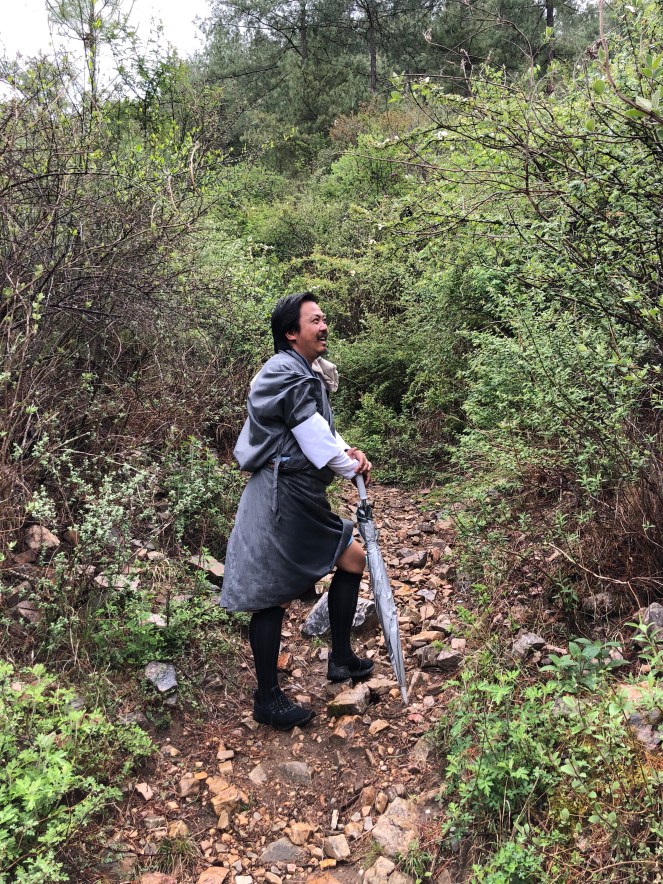
Chador takes me up the “shortcut” from the Dzong (Fort) to the museum. As I find myself brushing scratchy bushes out of my face, the road above us fenced off, I realize we took a wrong turn. We both laugh, slipping around in a suddenly muddy track, a light rain falling.

At some point, I have to use my hands to keep from falling, and we arrive at the museum entrance covered in sticky brown mud. I wipe my hands on the wet wipes I have in my daypack and then surrender my phone and camera to go into the museum.

We watch a video of ceremonial dances and tour the dozens of masks, tapestries, statues, wildlife exhibit. The national animal is a takin, a creature with “the body of a cow and the head of a goat.” The national flower is the wild blue poppy.

This is clearly my place.

This is what all of those hours in a dark spinning studio, the 115 workouts since January 1, have been about. Being free and powerful in my body, to find energy that gets closed up in my tight work life.

We will be riding for several days, but for the first time, I haven’t brought anything to record my distance. I want to just be on the bike, in the mountains, on the muddy trail.

In my own body, finding every step. In a magical land, cultivating patience and openness.

Fieldpoppy is Cate Creede, who blogs here the first Friday and second Saturday of the month. She lives in Toronto when she’s not exploring the world.

feminism · fit at mid-life · fitness · racing · running · training

On Running My First Marathon (Guest Post by Alison Conway)

by Alison Conway

Image description: Alison on left, smiling, with short hair, sunglasses, and a t-shirt hugging a friend, longer hair, also smiling, stadium stands in the background.

[Note from Tracy: Alison sent me this in April and her race was a few weeks ago. Congrats, Alison!]

Eighteen months ago, Donald Trump became president of the United States and I wrote here about my determination to limit my running time so that I could devote more energy to politics. Most immediately, my goal was to become active in the civic affairs of my home town.

Life had other plans for me. A year of upheaval included new jobs across the country, the sale of the home where I raised my children, the turmoil of a big move. My father became ill and he died. That family home was cleaned out and put on the market. It was, let’s say, a wrenching twelve months.

Through it all, running kept me grounded. Or rather, my running families kept me grounded. My Ontario friends ran with me in the weeks and months of packing and grieving. They convinced me to sign up for a spring 2018 marathon as a goal to work toward, whether or not I ran the race. I found a running club in my new home town and the folks in that group went out of their way to help me find my feet. I ran miles and miles through the roads and trails of my community, learning its spaces and hearing about those who live there.

As the ground under my feet was shifting, so too was the ground underneath American politics. Out of the ashes of the election arose the phoenix #metoo and a widespread protest against workplace harassment and sexual violence. From the Women’s Marches of January 2017 onward, energy and momentum built as women filed complaints and shared their stories.

When people remark on the difficult year I’ve had, I have often noted that running saved me. I began to wonder if it wasn’t doing more than moving me forward. The feelings I have toward the women who have helped me move and those who are helping me settle in British Columbia feel like the basis of a larger, collective feeling that has emerged in a wider sphere, one that helps women act together in an effort to shift cultural norms. It is, for me, both about harnessing anger and generating laughter. It is about looking down the road toward the goals that might take a while to reach.

A friend once said, casually, “Anyone can run a marathon. You just have to train for it.” What that remark misses is how difficult it is to train for a marathon: the discipline it takes to get out there day after day, week after week, in terrible weather, on days when other demands weigh heavily, when your mind says, “Enough.” There was a moment, maybe a month before the marathon, when I felt bone-tired. But I had friends waiting to run with me, so out I went.

Last month, race weekend arrived and I flew back to Ontario to meet the women who first encouraged me to sign up. One was injured, so couldn’t race—but she drove me to Toledo, OH, anyway. Another had just raced the Tokyo marathon, but she came along, too. They went over every detail of the race. I was shown how to make arm warmers, out of socks, that could be thrown away on the course (who knew?). They listened to me fuss and fret. They told me I could do it.

When I pulled on my arm warmers, the morning of the marathon, I felt like I was pulling on my armour. It was an armour I would not have been wearing, had it not been for the friendship of women, those who inspired me with the examples they set. It was an armour built, too, by the new friend who sent me a card, a week before the marathon, filled with messages of advice and encouragement; by the marathon veteran in my new running group, who slowed her own pace to help me speed up mine; by the colleague at my new job who trained with me, week after week, through rain and snow. It was the armour made by women everywhere who fight for the right for women to move freely in public spaces.

My marathon was a run of joy and gratitude, supported by the women who cheered me on as I faced down the miles. I have come out of a challenging year stronger and wiser. I can take that strength and wisdom into my community and help to make the changes that need to be made. The ground beneath my feet is made up of so much more than pavement. Mostly, it is made up of the feeling that emerges when women believe in each other: love.

body image · diets · eating disorders · fashion · fitness · Martha's Musings

We are more than a collection of parts


kyle-pham-648683-unsplash
Women being active and not worrying about thigh gap, or hip cleavage, or any other nonsense Photo by Kyle Pham on Unsplash

It’s tiring to be female in this world. I can only speak from a cis-perspective, of course, but it occurs to me, that howsoever you come to identify as a female, there is an endless list of things you must have or prevent if you are to present acceptably as female.


First it was thigh gap, that space between a woman’s thighs — the wider it is, the thinner and more desirable the women. Then it was the concave navel. Now we have a new one: hip cleavage, or what I knew as high cut underwear or swimsuit bottoms to show off the hip bones.

We are all familar with the term cleavage as associated with breasts. Plunging necklines in dresses are designed to show off cleavage. There are right ways and wrong ways to show off cleavage in the upper body.

Too much in the wrong way means you end up with sideboob reveals; too much in the right way means you may risk a wardrobe malfunction and subject unsuspecting bystanders to a glimpse of the “girls.” These days, the focus, and perhaps the parts in question, has shifted to the underboob (I can hardly wait to see if there is an upper boob!).

Regardless of the terminology, the prinicpal issue is that women continue to be divided into parts. Perhaps it’s the legs (although it and the toes had cleavage back in the day). Let’s not forget the butt or the breasts, with fashion dictating whether they were perky, ample, lean or sleek.

When I used to deliver media literacy sessions to high school students, we would talk about the techniques used to separate, disconnect, and isolate girls and women from their bodies. Instead of being seen as whole, unique individuals with our own kind of beauty, women and their bodies are broken into parts and given meaning and value by others.

The obsession with thinnness as a beauty standard has fueled anxieties and nurtured the development of eating disorders; sadly, girls and women continue to starve themselves to fit a largely artificial construct of “female” beauty.

In Canada, those of us who work in health promotion talk about the vitality message — eat well, be active, live smoke free, and support mental wellness. Being active offers tremendous health benefits and it makes me sad to see fitness being used negatively to coerce women into creating and maintaining a body shape that is not natural to them.


clarke-sanders-249798-unsplash
Another picture of fabulous women not caring about articifial body constructs. Photo by Clarke Sanders on Unsplash


Focusing on hip cleavage is just another stick we use to bash away at ourselves. It’s a stick handed to us by the arbiters of fashion and trends (I keep meaning to ask, who died and made them the rulers of the universe?) and quite frankly, I’m tired of it all.

We need to rewrite the script and start talking positively, frequently, and loudly about all the good things we can with our bodies: how strong our legs are to drive our bikes and our feet on our runs; how powerful our arms are so we can lift, wheel, and strike; how big our chests can be to ensure we can take in the oxygen we need to keep going; how wide our hips can be to birth children or to cuddle them.

We are enough as we are. In fact, we always were. Let’s remember that.

— Martha is a writer and powerlifter in St. John’s.


accessibility · disability · fitness · illness · injury

consider pain: why the social model of disability fails (reblogged)

We don’t reblog a lot around here but sometimes something just strikes me as so right and so important I want to share it. As I’ve been thinking about injury, disability, living with pain, and trying to come to terms with my left knee, I’ve been thinking about the social model of disability. Here’s Andrea Zanin on what the social model of disability leaves out.

I’m hoping to get Andrea to guest blog here about her return to yoga and biking and other things after years ago coping with pain and very serious health issues for many, many years.

But we can start with this. Thanks Andrea.

fitness

How the fitness challenge took the fight out of me #tbt

Oh, the corporate fitness challenge! ‘Tis the season where everyone st work is getting their trackers ready for the 100 days of counting steps. And guess what? True to my word, I’m not doing it. Because I tend to experience FOMO even over things I don’t want to do, I’m posting what I wrote last September at the end of the challenge. This is to remind me that I really meant it.

Do you like fitness challenges that last 100 days or more? Do you like counting steps?

accessibility · disability · inclusiveness · injury · traveling · walking

Bremen, so many steps, happy tears, and academic travel

It’s summer. I’m in Europe. It’s part of the rhythm and flow of academic life. What’s new? This visit I’m here in my Dean’s role rather than as researcher/writer/philosopher. We have an exchange program with the University of Bremen, involving faculty, grad students, and undergraduates. I’m here with the former Dean to meet the people and learn all about Bremen and the Bremen Guelph connection.

It’s also the 10th anniversary of their Institute for Quebec Canadian Studies.

Just as academic life has a pattern and rhythm so too does the blog. It’s time for the annual post about how much more I’m walking in Europe. Here’s my day on Tuesday.

15,000 steps is a lot of steps given that it included a full working day.

On the one hand, I love living even temporarily in a less car reliant culture. I love being part of a community in which exercise is part of everyday life. But I also worry about access and inclusion and where this leaves people who aren’t so mobile.

I raised the worry in this blog post about walking lots while at a conference in Berne Switzerland four years ago. I blogged about it again from Sweden two years ago (see here) also Scotland and Innsbruck, Austria also two years ago.

It’s a thing I note and wonder about and enjoy all the while worrying about disability. That said, European friends tell my worries about disability are unfounded. What’s your experience? Do you use a wheelchair? Have you traveled around European cities? How did you find it, recognizing that Europe isn’t one place?

The worry, well founded or not, got personal this year traveling to Germany with my injured knee. I noted that the agenda for my campus visit to the University of Bremen included a two hour walking tour of campus. I was frightened I’d have to decline. It’s a big change in self perception and identity.

And the big day of walking was fine. Thank you knee brace. I got all teary wth relief.

(The emotional moment was likely also due to the movers who’d been signed up to do our move phoning me to say they couldn’t do it after all. It’s the busiest weekend of the year for movers, they say, and my agreement made back in April didn’t count for anything. Sigh. Luckily the company who came in second for the bid was willing to take it on.)

But I have wondered how I would have coped had my knee not been in good shape. I’m going to have to learn to advocate for my mobility needs. Lots to learn. I also had an experience in the airport with airport security as my knee brace sets off alarms. I told them it would hurt to take it off and send it through security and they didn’t insist.

The one thing that did hurt was my feet. I haven’t been walking so much in sandals and the weather was warm.I ended up with blisters. The next day I swapped for running shoes and ended up looking very much like a North American tourist. The German women faculty members would have appreciated my Fluevogs. They wear great shoes but I’m not sure how they manage to combine the funky footwear with walking so much.

What do you wear when walking lots, when you’re in urban environments (not hiking) and want to look both stylish and comfortable?

diets · fitness

So many bad diet headlines, so little time…

There’s a lot we already know about dieting, namely:

  • No matter what cockamamie diet we dream up, it is both true that  1) someone probably can lose weight temporarily with it; and 2) almost no one can keep weight off with it.

Imagine my 1) lack of surprise; and 2) skepticism when I saw a headline saying “lose weight by eating as much rice and potatoes as you want– no, really”. This news (and I use that term lightly) story reported on a 14-week study done on participants in a UK-based  commercial weight-loss program called Slimming World vs. a control group that did self-led calorie reduction using standard nutritional materials.

The idea behind the study was to see if eating less-energy-dense foods (of which carbs are included) could result in more weight loss, lower appetite and fewer food cravings.  And indeed the experimental group did lose more weight on average than the control group (13 lbs vs. 7). However, we don’t know that it was because of what they ate, as the experimental group had lots of attention from the researchers, peer-group support, and other treatment that (according to the study) may well have influenced the outcome. In addition, the subjective reports of appetite, satisfaction with the program, and cravings were more favorable than those of the control group. But again, they knew they were the experimental group and identified as a group.

I might add that many of the important health metrics (blood glucose level, blood pressure, etc.) didn’t differ between groups.  However, one difference in the study caught my eye:

RMR significantly decreased in the SW [experimental] group but did not change in the SC [control] group.

What’s RMR?  Resting metabolic rate. The above line says that those in the Slimming World diet plan group ended up with a lower metabolic rate than those in the control diet group. That’s not good. That’s really not good. That’s one of the many bad effects on bodies that engage in dieting. It’s bad because it means that your body’s rate of energy consumption is lower, meaning that you burn calories at a lower rate.  This is part of the reason why most people who diet regain all the weight they lost and then some.

What can help raise the RMR? Several things, but the easiest is exercise, which can contribute to increased muscle mass.

So what are the salient results from my reading of this study?

  • You can indeed eat potatoes, rice, etc. in amounts you want. (We knew that already).
  • Being part of a group with shared goals (whatever they are), may help members feel committed to and satisfied by the group’s activities.
  • Dieting often results in lowered resting metabolic rate, which has significant negative effects on bodies.
  • Exercise has no such negative effects on bodies; in fact, exercise raises RMR.

If you’re looking for eating advice from me, here’s something that looks good– this whole-wheat roti with bananas and peanut butter.

What are you finding yummy these days? I’d love to hear from you.

Whole wheat roti with bananas and peanut butter. Mmmmmm...
Whole wheat roti with bananas and peanut butter. Mmmmmm…


athletes · injury · martial arts

Pennington vs Nunes vs Protecting Athletes (Guest Post)

At UFC 224 on Saturday, bantamweight champion Amanda Nunes defended her title yet again, this time against Raquel Pennington, whose biggest claim to fame was probably a decisive victory over her former Ultimate Fighter coach Miesha Tate in 2016. Pennington was clearly the underdog going into Saturday’s fight, and, while she remained in the game until her TKO in the fifth round, Nunes was obviously dominant.

The controversy here came when, after taking some extremely effective knees during the fourth round, probably breaking her nose, Pennington told her corner that she wanted to be done. Instead of throwing in the towel, her corner told her to push through and throw everything she had at the match. While she stayed active through the beginning of the round, some strikes midway through reopened her bloodied nose. After she went to her knees, the referee stopped the match, giving the TKO victory to Nunes.

The MMA world is extremely divided over the corner’s decision to put Pennington back in the cage. Nunes, Pennington’s opponent, but also her friend, spoke out against the decision, saying that her coach had failed her. On the other hand, Miesha Tate (who has fought both of them) defended the corner, saying that it had allowed Pennington to lose with dignity. Pennington’s fiancee Tecia Torres, said more recently that both of them agreed with the corner’s choice as well. I admit that I, personally, feel some force from both sides of the debate. As a former athlete, I can appreciate being pushed not to quit, even when I might want to. But as a current coach, I don’t think I would be able to send an athlete back out if they really wanted to quit and were at risk of being seriously injured. Now, I don’t coach at nearly these levels, so that makes a difference. But in my experience, an athlete who doesn’t want to fight any more is at serious risk of being hurt or knocked out.

One thing I haven’t seen talked about that much, though, are the gender dynamics of what happened. Now, it is not at all unusual for fighters to be injured in the course of a match, and for decisions to be made about whether or not they can continue. Nor would it be the first time in which a fighter or coach has wanted a fight to be stopped midway through in order to concede. And I genuinely appreciate how well the UFC handles having a women’s division, without excessively sexualizing or patronizing the athletes, and with women headliners being a typical occurrence. But I think that bloodied and bruised women affect us more than bloodied and bruised men. I also think we are much more likely to automatically frame injured women as victims. So I wonder how much that gender dynamic and the idea that we need to protect women (even from other women) shapes the discussion of whether Pennington’s corner should have stopped the fight.

Noticing that the discussion might be gendered doesn’t really tell us what should have been done, though. Maybe as a sport, MMA needs to do a better job of protecting athletes, even from themselves. There are plenty of long time veteran fighters still active in competition who might be at risk of serious brain damage from knockouts. Maybe if we notice that our protective inclinations kick in more when we see women with bloodied faces, we should wonder why we don’t feel more protective of men in similar conditions.

It should be obvious at this point that I’m very much in favour of women competing in traditionally masculine sports, like combat sports. But maybe one side effect of that could be to question some of the taken-for-granted aspects of masculinity associated with these sports, and whether they’re really good for anyone. Persevering is good, but likely not when it causes major bodily harm. Do we want to treat going out on your shield (so to speak) as virtuous?

Readers, what do you think?