cycling

Urban bike adventures, Part 1, in which Sam and Sarah carry their bikes through the mud and live to tell about it

Sam’s story:

Where I am not this week: South Carolina for bike training camp (See my blog post about camp last year.)

Sigh.

Where I am this week: In Ontario

But, the good news. Spring arrived early. And I’m riding outside. Since I didn’t abandon everyone to go off riding for ten days, I decided it was okay to go off riding for a weekend with Sarah. And while Toronto isn’t South Carolina I decided it was time I got used to riding there since I’m leading training rides for the Friends for Life Bike Rally this spring and summer.

Urban adventure, Part 1

You can see our route here. The plan had been to do the Friends for Life Bike Rally’s Rouge Valley route. I was a bit anxious to try out these routes in advance of a group ride. While I’ve got good group riding skills and I’m happy to lead,  it’s been a few years since I’ve ridden in an urban environment.

How do London and Toronto compare for riding? Well, on the commuting side I envy Torontonians. There are just more cyclists and more bikes lanes. Also city traffic means you’re often keeping pace with the cars. I like that. It’s mostly easier to get in and out of traffic. No one is moving very fast. I like that too. But on the distance riding side, wow, London wins hands down. Just five or ten minutes and we’re out on deserted country roads. They go on for miles.

Our first urban ride got off to a rocky start.

The ride was supposed to start from Warden Station but since Sarah lives in the east end we were just 10 km away. Seemed a shame to ride the subway with our bikes for that kind of distance. And there was even a bike path to take us there that ends right at the station. Perfect!

Or so we thought. Little did we know that the bike path is under some serious construction. Gravel turned to mud and then serious mud and gravel. The kind of mud that you sink into while trying to carry your road bike. The kind of mud that oozes through cycling shoes into your socks. The kind of mud that contains leaves that gum up your cleats and your pedals and possibly your brakes and your rear derailleur. We started talking about bike washing at about the halfway point.

Well, after the point of no return we saw two people headed towards us on mountain bikes. They asked if the trail was passable. For you, yes!

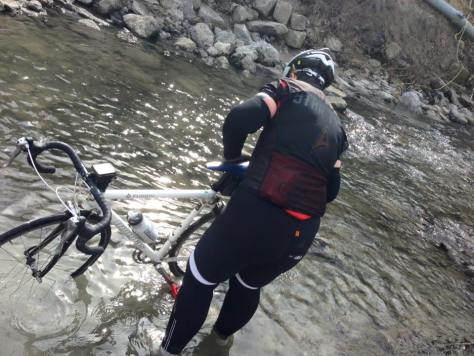
We stopped and washed shoes and pedals and got leaves out from under our brakes at the river but even that wasn’t enough. We had to stop and get water at a gas station to really finish the job.


bike5
“Ew. My white bike shoes are getting dirty!” says Samantha. Sarah, “But look the sun! It’s a gorgeous day.”


bike6
Washing bikes off in the stream.
bike8
Obligatory ‘smiling in the face of adversity’ selfie

Okay, that was the muddy start.

But once we had rinsed the bikes and cleats we had a great ride through Scarborough along the bluffs overlooking the lake and along the Martin Goodman Trail through the Beach neighbourhood to home.

Cycle route 4 was well marked and had some great rolling hills and scenic vistas. (That’s a bit of a bike rally in-joke. Sorry. We made up some new hand signals when I did the rally a couple of years ago including one for “scenic vista.” Hi Jenn! Hi Stpehanie!)

I rode slowly back along the multi-use pathway. Long boards, kids, and dogs scare me on my road bike. Luckily that left me lots of energy for my first Toronto QOM! Thanks Strava. Boultbee is mine! (For now.)

Now here’s Sarah’s story:

I grew up cycling in Toronto, both for fun and to commute to various summer jobs. I know that riding on the streets of the Big Smoke can be … intense … so I wanted to ease into things by introducing Samantha some of the hidden treasure of Toronto’s cycling infrastructure, the informal network of multi-use trails that thread their way through the city’s many ravines.

I’m glad that the plan for the day was for a low-key adventurous ride to check out one of the bike rally training routes, because Samantha wasn’t kidding about the serious construction part. It turns out that our path through Warden Woods to the station was … well … gone. Victim of a “Section Restoration”, which is part of the never-ending task of maintaining city’s watershed, stabilizing and naturalizing the river banks to improve aquatic habitat and reduce flood risk :  http://www.slideshare.net/fullscreen/TorontoPCU/pic-2-display-boards/18 Necessary and noble work, sure, but I do wish they’d have posted a sign! We could have turned around and gone the long way instead of wading through mud from one patch of gravel road to the next until we ended up in a giant mud puddle with a large backhoe in the middle of it. Yikes!

Samantha was remarkably patient and good natured about wading into frigid Taylor Massey Creek to wash enough mud off our bikes and shoes to make it safe to continue. I may have bought some apology chocolate along with water to fill our bottles which we’d emptied washing the last of the gravel / concrete out of our cleats. We improvised the rest of the ride, eventually finding a great new route that bypasses an unpleasantly scary section of suburban Kingston Road.
It wasn’t the day that we’d imagined, but once we threw our plans to the wind, we managed a beautiful ride nonetheless. That said, now that I have been reminded the hard way of the importance of checking routes out before taking a group on them, I’m eager to go back and recce the Rouge Valley route sometime very soon!

How about you? Have you had any bike trips that didn’t go exactly as planned? Any urban adventures you want to share?

yoga

Why is there no hot yoga on Saturday nights?

yogaI was planning my weekend exercise and I generally like to do hard things in the morning and gentle things at night. So usually that’s run/bike or Aikido in the morning and hot yoga at night. But my scheduling runs into a problem on Saturday. There’s no hot yoga at my local studio on Saturday night.

Why not?

Oh right. That’s because the clientele are mostly in their 20s and have social lives on Saturday night.

My guess is that Yoga Girl instructor is out dancing at clubs. (Well, at least that’s what I imagine twentysomethings are doing. Why? Because it’s what twenty year old me was doing and what I miss about being that age.)

I think that if yoga studios started a Saturday night class (HINT! HINT!) they’d find they have an older clientele. Someone might prefer that. I mean, besides me.

I like teaching early morning university classes for that same sort of reason. They draw a different crowd. Generally speaking smart, motivated students take morning classes. They’re keen on the subject. They’re not there just because it’s a good time of day.

So, Saturday night yoga should be a thing! Make it early enough, 8 pm?, and you can even go out dancing after. Not me. I’ll be at home curled up in bed with a book.

Actually, I think I’d go out dancing if there were early dancing and no alcohol bars. That’s my kind of fun. I also like bands that start before 9 pm and end before midnight.

How about you? When do you like to do yoga? Morning or night? Weekends or weekdays?


cycling

Want to ride bikes with us for a day? You know you do….

Here’s your chance to ride with some of the Fit is a Feminist Issue bloggers. We’re Switchin’ Gears. That’s our Friends for Life Bike Rally Team name. Susan and I are the team co-leads.

You can meet a bunch of the bloggers from Fit is a Feminist Issue. Not just Susan and me…

There’s also Nat and Cate and Catherine and Sarah…

We’re hoping to lure more of you–other guest bloggers, commentators, and readers–on to our team for the 1 day version of the rally. If you’ve never done a metric century before this could be a great summer distance goal. In terms of goal setting, it’s also at the end of July so that gives you lots of time to train. There’s a lovely lunch break, dinner, and a dip in the lake at the end. I loved the mass start and police escort out of Toronto.

As Susan put it on Facebook, “Do you want to participate but can’t commit to the whole enchilada? Try a sixth of an enchilada and do the one day ride (120 km and a whole lotta fun times) The fundraising minimum there is $650. That isn’t too bad.” (There’s a lot of help and advice with the fundraising.)

Here’s the official info:

Inaugural One-Day Ride
Sunday July 24, 2016
#F4LBR18

Participants will be invited to register for this amazing experience and get a taste of what the Bike Rally is all about. This fully supported event welcomes Participants of all ages and skill levels to share their passion for cycling while supporting their friends, family, and neighbours living with HIV/AIDS.

Registration for the One-Day Ride has begun and includes payment of a non-refundable fee of $40 until the Bike Rally Official Launch party (Jan/Feb – TBD) and $50 after that.

Features:

  • The opportunity to make a difference in the lives of people living with HIV/AIDS by raising critical funds for the Toronto People With AIDS Foundation
  • Fully supported day of cycling (road support, return transportation, organized meal and snack breaks)
  • Training (bike skills and maintenance, fundraising, nutrition)
  • Return transportation from Port Hope
  • Regular social events year-round. It’s called the Friends For Life Bike Rally for a reason!

Benefits:

  • You will have transformative impact on the lives to people living with HIV/AIDS
  • Cycle in safety with your friends, new and old, and family while being cheered on by supporters along the way.
  • Learn all the nutritional and technical skills and tricks to cycle at peak performance…and it never hurts to know how to change a flat tire!
  • After an exhilarating day of cycling and an amazing arrival experience, we will bring you back to Toronto in the comfort of an air conditioned coach.
  • There is no doubt that you will make friends!
  • What else would you do with family and friends on a Sunday in July?

Upon registration:

  • Every Rider will make a commitment to fundraise a minimum of $650 by Departure Day.

  • Riders are encouraged to participate in scheduled training rides and workshops with supervision from our skilled training coaches and support team to help Riders achieve their goals.

Interested? It’ll be a super fun day.

Find out more here.

Join now and you’re in time for our second team social. Details on registration!

If you decide to join up, let us know in the comments…

If you’ve got any questions, ask away…


susanandsma

body image · feminism · fitness · Guest Post · training · weight lifting

Strength Training and the Feminine Ideal (Guest Post)

ryan1I’ve always been fairly healthy, exercising at the gym and playing team sports. I started working out properly about 6 months ago; and by properly I mean strength training, with a trainer (thanks Ashley Woodward) at the gym, and eating right. My aim was to get healthier, stronger, and build more muscle (because guns, right?).

I started because I saw many of the women I admired lifting heavy shit, running marathons and kicking butt. And so I thought there must be something to this. Turns out there is!

When I started I was doing squats on a Smith Machine with nothing but the weight of the bar, and deadlifting with two 20 pound dumbbells. I now squat nearly 90% of my body weight, and can lift 180 pounds off the ground (last week I was even bench pressing more than the dude next to me. It felt awesome!). These weights are nothing on what some people lift, and it will always be a work in progress, but I am the strongest that I have ever been and it feels great!

But it feels great not just because of the physical strength (which really is terrific) or because how healthy and awake I feel, but also because of how empowering it is. For me, going to the gym is not political. It’s a reward and time out from thinking about philosophy and other things in my life. But hell, I am sick to death of people embracing and promoting the view of the ideal woman as soft, demure and weak. Comments like “yes, I admire her strong physique, but all that muscle really isn’t feminine.” Why is the feminine ideal weak? Why are people promoting the view that what it is to be a woman is incapable?

When I first started working out people said to me “be careful, you don’t want to get too muscly,” “you don’t want to get roped into that bodybuilding stuff”; as if I was some defenceless maiden threatened by the deceptive, predatory, throbbing bodybuilding association (I faced similar warnings about getting my PhD, “careful, you don’t want to live your life with your head in the books, hidden in the library,” “you don’t want to give up your chances of a family and a wedding”). These comments were said with love, but what is communicated is clear: we women are not the protectors but the protected.

Strength training is a great way to say F that, and to see just what you can do, rather than what you are told you can and should do.

nanette Back shot

Nanette Ryan is a PhD candidate in Philosophy at Georgetown University.  She is primarily interested in moral and political philosophy, epistemology, and their intersection.

fitness

‘Eat’ water, don’t drink it -Can’t we get anything right?

I’ve written about drinking water before. You know, the age old question of how much water we should consume.

It’s puzzling. In that blog post I went over the standard advice to drink lots and lots even if you’re not thirsty. And I looked at more recent research that says we’re all now over hydrating and causing health problems with too much water.

What about “drink when you’re thirsty, stop when you’re not.” Can’t we get anything right?

Now new research says we should “eat water, not drink it.” You know, orange slices and watermelon at half-time in soccer games and cucumbers and tomatoes fresh off the vine after. That’s the idea.

Dr Howard Murad, associate clinic professor of medicine at the University of California, Los Angeles, and author of The Water Secret writes, “Healthy hydration is about the water you hold in the body, not the water you drink that passes straight through.”

He explains that, in fact, drinking too much water can actually be detrimental as it can deplete the body of vitamins and minerals by flushing them from the body too quickly.

But the water consumed via food is absorbed differently. this is because it’s surrounded by other molecules that help it get into our cells more easily, and work to keep it in our system longer.

“When we eat water-rich foods, we absorb water more slowly because it is trapped in the structure of these foods,” says Dr Murad. “That slow absorption means the water in food stays in our bodies longer, and brings a multitude of additional benefits.”

Again, as with last time, I’m sticking with drinking when thirsty. Except when I’m on the bike. Then I just drink, thirsty or not.

There’ll be no cucumbers in the back pockets of my bike jersey. I promise you that.

cucumber-background

cycling

Daylight savings and cyclists: Yippee, yahoo, and whee!

coffee daylight savings time: I know lots of you don’t like Daylight Savings Time.

I’ll be with you drinking lots of coffee at work tomorrow. I just got the news that my teen son is working at a March Break camp for the early shift. We need to leave the house at 7 am. Ew. And walk the dog before that. Double ew.

The bright side is lots of time for early morning writing. That’s good.

And I love Daylight Savings Time. Why? More time in the evening to ride.  I can get home from work and get on my bike and not worry about riding in the dark.

Participaction Canada gives time in the evening to play outside as a real bonus of Daylight Savings time. There are clearly gains in fitness when people have more sunlight after work to hike, bike or play sports. I’m with them.

Starting this week–thank you weather gods–I’ll be riding in the evening OUTSIDE. No more time on the trainer in the basement for me. YIPPEE! Official rides led by cycling coach start next week but I’m heading out this week with friends. Who can resist evening light and double digit temperatures?

How about you? How do you feel about Daylight Savings Time?

yippee


fitness

Guess I’ll Di(v)e another day

Last week I was in Puerto Rico, where I had gone to do two days of open water certification dives to complete my scuba certification.  I was all set, with my new mask, fins, snorkel, booties, reservations, and a week of vacation ahead of me in the tropics.  What could possibly go wrong?

Wrong thing one:  pervasive, overwhelming fear.  I blogged about this last week— how my pool course had gone awry, or at least felt like it had, leaving me lacking in self confidence about heading back into open water (even though I love love loved it the first time around).

Wrong thing two: pervasive, overwhelming cold virus.  Even as I was doubting my nerve to do the open water dives, I was getting sick.  And not just scratchy-throat congested sick (which is enough to scotch any dive– if you can clear your ears, you can’t dive); I had a full-on flu-like virus with fever, chills, body aches, headache, wracking cough, and the kind of misery that calls for BED. NOW. 6 days later I’m mostly recovered, but that was a whopper of a virus.

Wrong thing three: pervasive, overwhelmingly bad weather for beginner diving, making at least one day of my proposed dates for certification not possible.  Much of this week, there have been surf and wind advisories for the Puerto Rico north and east coasts, with rip currents, 25–30mph winds, 10 foot seas, 10+ foot waves, and low (10 foot max) visibility underwater.  In fact, snorkeling excursions around the east coast of the island have been canceled since Wednesday (including ours for today) because of high seas and low visibility.  Because of the low vis and big swells, the local scuba place took out only very experienced divers Tuesday.  That would not include me.

However, that’s only half of the story.  Some very right things happened this week, too.

Right thing one: a boatload of support from you, the Fit is a Feminist Issue blog community.  I cannot express how grateful I am for all of you who wrote in with advice, support, encouragement and your own stories of love and fear of the elements (mostly water but some rocks, too…).  From scuba instructors to fearful but persistent swimmers, you offered  reality checks–yes, it’s normal to be nervous and anxious before OW dives, as well as advice– you are in charge of your dive, and you can pull the plug at any time.  And people shared their own stories of facing fears and responding to them in lots of ways.  Thank you– it means a lot to me.

Right thing two: arrival of friends Janet, Rachel and Kate for the second half of the vacation.  There’s nothing like having friends around to lift a person out of cold- and canceled-plan-induced doldrums.  Since Wednesday, we’ve been doing some beaching, walking in the rainforest to a waterfall, and even going on a nighttime kayak tour to see the bioluminescent plankton in a nature reserve.  Ample fun has been had.

Right thing three: upcoming opportunities for certification and other diving in near future.  I’m headed back to Australia for a work project in August, so if I don’t get certified sooner, I can do it then.  I’ll likely do at least one pool session as a refresher and confidence builder.  And I’ll schedule in some diving there, both off the coast of Sydney and up on the Great Barrier Reef as well.  Must go back to visit those giant clams.

Screen Shot 2016-03-12 at 1.25.41 PM


food · Sat with Nat

Food is a feminist issue

I’m very privileged to be able to have choices about the food I eat. I remember my mother telling me about her family getting a box of oranges as a special treat at Christmas. I remember how my dad shooting a deer in the fall meant the difference between having a good year or not. 

These are not my concerns today. Today I worry about my teenage sons getting too many of their calories from carbs or protein, not if they have access to food. 

Sam sent me this article about organic produce:

http://modernliberals.com/organic-food-industry-pinnacle-white-privilege/

I have to agree with many of the points. Often the “organic” label is used to jack up the price of food with little return on investment.  There are a few studies that indicate organic foods are cross-contaminated with pesticides from other foods during shipping. (Ya, look it up)

I’m one of those annoying white women who encourage folks to buy local, organic produce when you can. Why? Not for health benefits because many of those claims are unsubstantiated. Ya. You might be being fleeced if you go to a chain supermarket and buy organic foods. Sorry!

But there’s a thing about choosing local produce when you can. Want to be fit? How about, when you can afford it, buying locally grown food? It reduces your carbon footprint and supports your local economy. 

I can’t be fit if I can’t drink the water in my tap or breathe the air in my city. So for me buying local food that is organic is about supporting agricultural practices I want to see. Small scale farming helps me feel connected to the people that grow my food. My food fuels my body to move me forward. 

These things matter but if you need to buy 3 for a $1 instant noodles to hit your caloric intake please don’t let my preferences bring you down. You get to decide what you eat and what you like to eat. 

As a kid I picked fiddleheads and in season berries. We didn’t call this foraging, it was just how we got our food. Now I get to buy all kinds of things. Will I buy in season organic food?

Heck ya!

Do I think it will make me incredibly healthy? No. Not really but it might just help tip the table to less egregious forms of agriculture and that is enough for me. 

I am under no illusion that my small gardens in my urban yard will fully feed my family. I grown some of my own food simply to appreciate the sheer enormity of what is involved in growing my food. I buy local when I can, organic when I can’t and respect that these are incredibly privileged choices to make. 


fitness · Guest Post

Redefining women’s strength and power

Almost a month ago, my friend went to the national powerlifting championships in Regina. Her partner had shared the live stream link and I was able to tune in and watch her flight along with a couple of other sets.

My friend did well, in both equipped and unequipped events, and brought home medals. Other women and men from my home province also did well, and the sport got a nicely deserved uptick in interest and huzzahs for these achievements.

There was some pretty impressive weight lifted in that competition room, but more than anything, what struck me as I watched, was how different each lifter’s body was.

There were tall lifters and short ones, lean and stocky types, older and younger athletes. Along with diversity of body types, there was diversity of ethnicity and location.

Everywhere across Canada, all kinds of women are taking on powerlifting. Quite a number of them are doing it competitively and it’s a beautiful thing.

The fact is many athletic competitions featuring women offer a big dose of glamour. Take figure skating. Despite the amount of power and strength needed for the sport, figure skating commentary about women most often focuses on grace, physical beauty, and the cute tights and flippy skirts.

I can’t honestly tell you what the amazing women in Saskatoon wore. I do remember their lifts.

I remember the ones that had to return the bar to the rack without completing their lifts.

I remember the ones that powered through their lifts, some of them raising loaded bars the way I lift a piece of toast for a bite — effortlessly.

I remember the ones who struggled fiercely, with even the commentators joining in with encouraging words and murmurs until at last the bar was raised, pressed or deadlifted to success.

It didn’t matter what the athletes looked like unless it was to explain about a point of form that lost them the pass to the next lift. It didn’t matter what they wore except when it came to explaining the difference between equipped and unequipped lifting.

What mattered was that they worked hard, that they focused, that they picked up the heavy things and then put them down again.

These women were inspiring and they were marvelous. I wish more people had a chance to see these achievements on the platform, but I most especially wish our kids in schools could see more women who are as strong and as physically fit as these women were.

It is really important that we see female strength in action. I think it can have a profound effect on your own perception of what you can or cannot do when you actually see different kinds of bodies performing at top capacity.

Too often we let all those negative stereotypes of how women should look and be as athletes dictate the boundaries of our own engagement with fitness. Watching those women in Regina reminded me how better we all would be if we let go of those old limiting ideas and instead embraced a new definition of what it means to be a strong, fit woman.

— Martha Muzychka is a writer and consultant living in St. John’s who has recently turned to weights as a way to get her fit on.

fitness

On Surprising Ourselves #tbt

This “Throwback Thursday” post about surprising ourselves seems like a good companion to today’s post about Thrills. It also takes me back to a time when it was summer, I was on the boat, the pace of life was more relaxed, and I wasn’t even 50 yet! Enjoy!