Yes, I know I’ve complained about them for years. And mostly, during the year, I don’t see them. But this year, for the very first time, they don’t even seem to be making a New Year’s appearance.
My Facebook newsfeed is full of ads for accountability journals and productivity tools. Where are all the January 1st weight loss ads? Has Facebook declared me too old for them? (Is that a thing?) Too feminist for them? (That seems too sophisticated for a social media tool to get.) Too career focused to care about my weight? It’s liberating and puzzling all all the same time.
The Getting Stuff Done planner looks pretty good but it includes food tracking and exercise tracking and I hate mixing streams.
Also, all that pink. But look! It comes with a rose gold pen. But is it a good pen? (Friend David says “no.” He says, “It’s a free pen. There are no good free pens.” He’s a serious pen snob though and I’m only a moderate pen snob, more particular than anything else I’d say.)
Do you have any great tracking tools, whether for productivity generally or fitness specifically to recommend? I like both paper and electronic, for different purposes.
Image of red “getting things done” book and an acer notebook on a white cloth background Photo by Anete Lūsiņa on Unsplash
I work as a strategic planner as well as a communications strategist and trainer/facilitator. In the last few years, I have jotted down a series of goals as an informal strategic plan for myself. This year I decided to take a couple of days to be more structured about how I plan as I want to achieve some specific things by 2020. (As a side note, there isn’t anything really special about that date for me lifewise, but I like round numbers and that one appeals to me.)
I have five categories in my plan: work, home, family, relationships, and fitness. This isn’t a priority listing. My plan is a series of circles, and these overlap and separate over time.
When I first began working on fitness as a goal to get me to 55, it was pretty simple: I wanted to show up. Five years later, I still show up, but I have refined my approach somewhat. In past years, I have added learning how to do pull ups, how to get up from and get down to the floor, and increasing the weight on the bar for deadlifts, squats and bench. I also wanted to mix things up so I added swimming and yoga to the mix. The past six months have been busier than I expected with work and family commitments, and more times than I liked, fitness fell by the wayside.
Thus the need for a more focused approach, because I know when my life gets busy, the time I set for fitness can get chewed up by other Imporant Things.
I decided to apply the questions I use when I help organizations develop their own strategic plans. I ask three questions to get started: why do you want to do this? what will you achieve? and how will you make it happen? I then ask two supplementary questions: when will this happen and where?
Image shows a spiral-bound, lined notebook with a fountain pen resting on a blank page. Photo credit: Aaron Burden, Unsplash
My why is pretty clear: I want to be healthy and active for a long time. My what is also pretty straightforward: I want to be fit and active. The how is also known: I like weightlifting, I enjoy the flexibility of yoga, and swimming gives me a way to connect with my body differently than the weights or mat can offer. I’ll be identifying some key benchmarks in these objectives, because measurement is a way to keep me focused and accountable.
My biggest challenge is the “when” as there are many demands on my time. The drafting of a strategic life planning document gives me the opportunity to make certain promises to myself and those promises are getting plugged into my calendar so I have away to be accountable.
Over the coming months I’m going to track how my plan is working. What are you thinking about doing in 2019 to keep you on track with your fitness goals?
It was a quite chilly minus 12, so I popped outside yesterday, without a coat, and stood in the driveway for a good 10 minutes, shivering. All in all, I’d call that a good day of exercise.
There was an unseasonable cold snap, you see. It was too icy for a bicycle ride, and too cold this early in the season for my as-yet non-acclimatized body to cope with its usual meandrey hour-long walk. Ah, but a good shiver… that’s some good calorie-killing time well spent.
Why? I was following advice, of course. I found it on the internet. Even better, I found it on a media website. Of a sort, anyway. The write-up is all about the horrors of winter weight gain. Ten pounds, on average!
To wit: « The shift to colder, winter weather often makes us feel lethargic and deters our motivation to go outside.
« But before you pull over the blankets or curl up by the fire to watch your favorite show, you should consider the potential benefits of cold-weather workouts.
« Exercising outdoors in colder weather has numerous health benefits. The average winter weight gain ranges from 5-10 pounds, Senior Director of Clinical Nutrition at Mt. Sinai Rebecca Blake told Accuweather. » That’s a weather website that makes money money as an app on my phone (and perhaps, on yours , too.)
Oh, there’s a lot of good stuff in the story. Winter exercise offers a bit of vitamin D via the faint sunlight exposure. It helps keep your body stronger in terms of immunity from colds, etc. The chill keeps you awake and cool, helping with temperature regulation. I buy all that.
But in the end it’s all about the thin : Winter exercise helps « ease fears of potential winter weight gain.»
It turns out that being outside in the winter can switch that terrible, horrible no good white belly and thigh fat into the Best. Fat. Ever. Yes, behind door number two you’ll find a transmogrification of the nasty bad stuff into the fantabulous calorie-burning brown fat. (Don’t ask me, it’s some miraculous sciencey thing.)
But when it’s very, very cold, I often just say no.
Thank goodness there’s this short-term option.
« Shivering, a mechanism to produce heat, also burns a significant amount of calories. Studies have shown that people expend five times more energy when shivering, compared to when they are resting. »
Now if I could just convince myself to stand outside every horrifically frigid winter day in shorts… why then, life would be perfect. Sadly, I am walking outside while wearing an undershirt today, and am therefore much fatter than I should be.
Damn.
Eleanor Brown lives in Quebec, and as the Gilles Vigneault song goes, « Mon pays, c’est l’hiver » (my country, ‘tis winter).
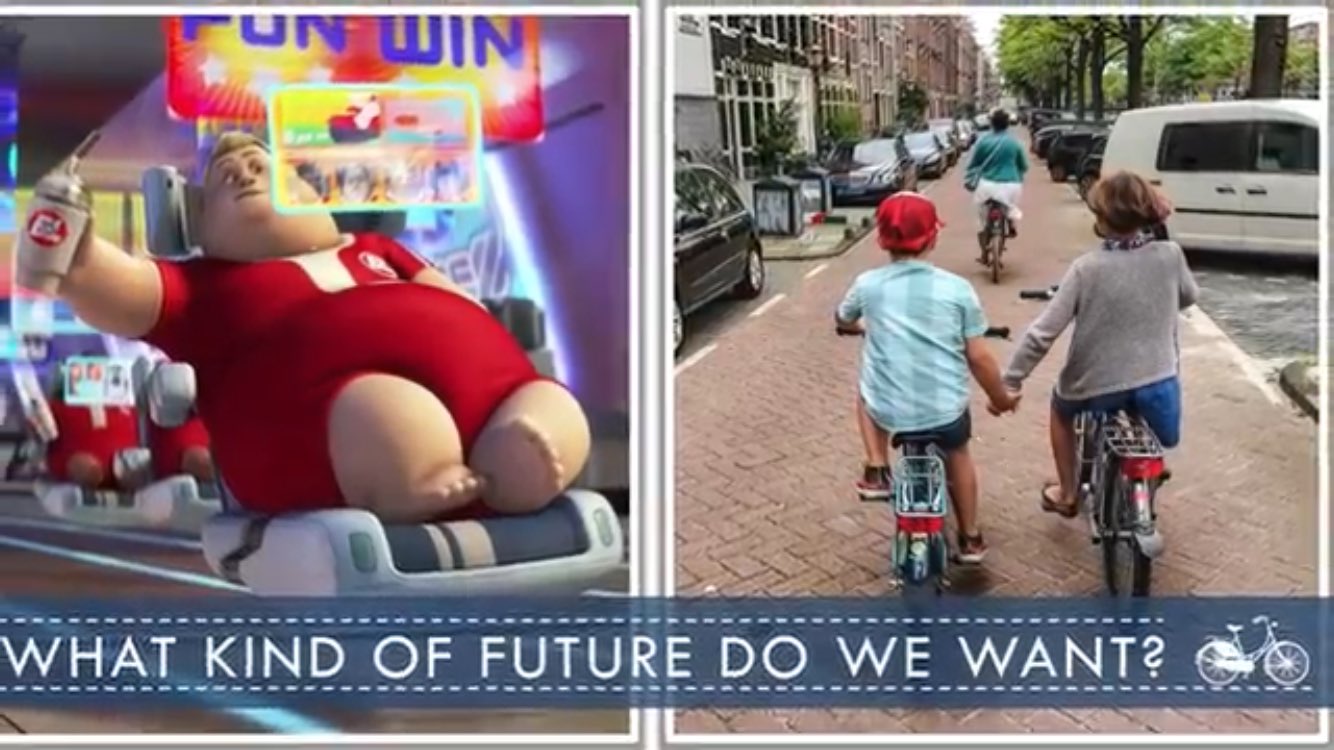
I put it that way–“said to be from”–not because I like that feed, though I very much do, but because although a number of people have shared it and attributed it to them, I couldn’t find it there when I looked. (Update: Found. But they just retweeted it from someone else. I’m glad.) This contrast between fat drivers and thin cyclists drives me up the wall.
Modacity life is about this: “In the summer of 2010, our family made the conscious decision to sell the family car, embarking on a new and enlightening adventure. Forced to move to a multi-modal commute, relying on public transit, walking and a great deal of cycling, we quickly realized the benefits of living a ‘car-lite’ lifestyle, not the least of which was the increased human interaction with the city we call home. Using writing, photography, film, and the power of social media, we used this revelation to communicate a more human image of multi-modal transportation. Together, we now strive to educate people and cities about the inherent benefits of moving away from a car-centric transportation model, to a more inclusive one that is accessible to people of all ages, abilities, and economic means.Promoting the public health, environmental, and social benefits of walking, cycling, and public transit, our goal is to improve on the great strides already made in many cities, creating a more open and welcoming environment for residents and visitors alike.”
The Brunlett’s had a book launch in Guelph and I loved the launch. I’ve enjoyed reading the book.
Anyway, anyway, there are lots of wonderful reasons to ride bikes. It’s great for the environment. It’s great for your mood and for your physical health. Just so many reasons…
But on behalf of larger cyclists everywhere, I just want to say IT WON’T NECESSARILY MAKE YOU THIN.
Want an example of how to talk about public policy and bike advocacy without false promises and fat shaming? Look here.
From that interview, ““I got started working on transportation issues, which came about mostly because I love the fun and freedom that comes with being able to ride my bike and walk around my neighborhood. But when I talk about bicycling from a public-health perspective, it’s easier to emphasize the health and financial benefits of obesity reduction. Which is just plain silly; I don’t want someone to take up bicycling just because it will help them lose weight. That’s a recipe for disappointment and frustration and doesn’t support sustainable healthy choices.”
Bright red maple leaves against a blue sky. Photo by Unsplash.
What’s up…
Here’s the fun, easy thing. I’ve started swimming lessons and I’m excited about that. I love learning new things though I feel like I have been learning to swim my whole life! And maybe that’s okay. We’re working (so far) on breathing and kicking. I feel like I am learning lots, I’m not hopeless, and I feel like someday I might be able swim lengths of the pool again. The lessons are semi-private and the other student is a 4th year undergrad, an international student, hoping to learn to swim strokes. The instructor is also a senior undergrad and we’re all having fun. The lessons are short–30 minutes–but twice weekly and I can come early and stick around after for extra time in the pool. This weekend I’m shopping for a second fitness-y, swimming pool type bathing suit and new goggles. Woohoo!
Here’s the thing that’s hard to talk about, doctors and weight loss. I met with a family doctor with some experience/expertise in the area of weight loss. Why? Well, less knee pain is the short answer. But also better surgical outcomes and quicker recovery if I go that route. I also stand a better chance of avoiding knee surgery until the inevitable knee replacement many years down the road. I know doctors recommend weight loss for everything but in this case–I’ve read a bunch of the journal literature–I think they’re right.
So in my case I’m not being extra active in order to lose weight. I’m trying to lose weight to preserve my level of activity. There’s nothing magical on offer. The best diet is the one you can live with. I knew that going in. Weight loss is tough. Read Everything You Know About Obesity is Wrong if you want to know how tough. But with my active lifestyle which I love up for grabs, I have to try. The odds aren’t great. I know that. Given my size and the knee problems, I qualify for weight loss surgery. I declined. I also qualify for appetite suppressing medication. Again, for now, I declined. I might try it later. Instead I’m using MyFitnessPal and tracking all the things, trying to find a lower calorie life I can live with. I like this, from Yoni Freedhoff,
Now, you should know that I too have a weight-loss agenda. It’s fairly easy to describe. In a nutshell, I don’t believe that there’s one right diet to suit everyone. In my clinical practice, as well as in my book, I embrace the fact that there are dozens, if not hundreds, of factors that influence an individual’s chances of long-term success. Low fat, low carb, keto, paleo, intermittent fasting, vegan, Mediterranean, meal replacement, whatever – there are success stories out there with each and every diet that exists.
While I’ve seen proof of this in my own clinical practice, you don’t have to take my word for it. Instead, look no further than the National Weight Control Registry for evidence that, when it comes to successfully keeping weight off long term, everyone’s different. The massive database established in the 1990s tracks why and how over 10,000 people have managed to keep an average loss of 67 pounds off for over five years. And there, as I’ve described, there isn’t one answer.
The one thing successful dieters have in common is that they reduce their calories on their new diets and like their lives and diets enough while on it to sustain its adoption for good. So, while it’s true that you might be able to lose more weight, or to lose weight faster, with one diet versus another, unless you keep living with it forever, that weight’s coming back when you head back to the life and diet that you actually liked before you lost.
To put it even more succinctly: If you promote the notion that there’s one right way to lose weight or live healthfully, you’re part of the problem. The more weight you’d like to permanently lose, the more of your life you’ll need to permanently change. And, when it comes to something as pleasurable as food, merely tolerable lives just aren’t good enough. What’s best for you is undoubtedly worst for someone else.
I reviewed his book, The Diet Fix, here. I’m seeing a family doctor, Aric Sudicky who as part of his training did a placement with Yoni Freedhoff.
At no point have I felt like I’m not believed about what I eat and my current level of activity.
Where am I? I started at 240 lbs for my all time winter high and I’m down to 225. I’d like to get down to 175, which is still solidly in the ‘overweight’ category for my height. But I’m pretty muscular and the normal range 121-158 lbs are weights I haven’t seen since elementary school me! I’ve been keeping my weight loss updates to the monthly check-ins, complete with content warnings. Tracy and I are pretty committed to keeping weight loss talk to a minimum. But I’ve been writing about it at all because it’s very closely tied to my desire to stay active.
Two different knee surgeons say that no matter what I’ll never run again and though weight didn’t cause that (lots of skinny people have osteoarthritis–it’s not caused by my size) if I want to keep walking, hiking etc I need to lose weight. You can read about my left knee here. You can read more about it here.
Given that it’s tied to me having an active future, I feel like I want to write about it. The content warnings should help people avoid it, I hope.
Why is it so hard to write about weight loss? Why?
I know what’s hard about it for me. For years I’ve been happy and active at a larger size, sharing the message that you don’t need to be thin to be fit. I’m not throwing that message out now this larger body isn’t serving me so well. There are so many imperatives to lose weight. See Wishing for weight loss. Looks, caring about pay and teaching evaluations even, and so many medical arguments that aren’t true. So many reasons I reject. But then there is this one, pain. It’s awful and urgent and I want it to stop.
Here on the blog we often make the distinction between athletic and aesthetic values when it comes to exercise goals. We’re about the former, not the latter. You know, run to improve your 5 km time not to lose those last five lbs.
That said, you do you.
Our worry is that appearance, in particular weight loss, is a lousy motivator. See here. People try. It doesn’t work. And then they stop exercising even though it’s good for their mental and physical health to workout.
But looks and performance aren’t the only games in town. You might also care about health.
At the elite level health and performance might come apart. They often do. Lots of athletes train in ways that aren’t great health wise. At the other end of the spectrum, the kind and amount of exercise recommended for health might not have much effect performance wise.
Health goals might also conflict with appearance goals. I was chatting with some young people this week about the latest news about health and ultra low carb diets. Interestingly, they didn’t care. The news wasn’t that ultra low carb diets don’t work for weight loss. The news was that they are bad for your health. Low carb dieters don’t live as long as people who eat a moderate amount of carbs.
But, said the young person, who cares about living long? I’d trade five extra years of life for ripped abs. My low carb diet is about being shredded not about being healthy. If low carb is key to weight loss, who cares if it’s bad for your health? I have a few Facebook friends who feel the same way. Some want just to be skinny. Others want to look muscular and chiseled.
I don’t want to argue the facts of it here, that is, really low carb versus moderate carb diets, but I am interested in the relative weight we give to looks versus health and longevity. And it’s interesting to see the weight loss set admit it’s not about health really after all. It’s about chiseled abs. Fine.
So where do you stand? Are you in it for the abs, the long life, or for winning the competition, whatever competition that is?
Lately I’ve been thinking that what gets left out of these goals is a broader definition of health, one that includes functional fitness, pain free living, and mental well being.
Lots of people are applauding this story that’s been making the rounds this week.
I liked Yoni Freedhoff’s comment on Twitter about this study, and the resulting media attention, that anyone who thinks this is good news has probably never tried to sustain a commitment to an hour a day of exercise.
Also, in the news is this story about the weight reducing benefits of bike riding. Now I love riding my bike as much as the next person but I find hours and hours on the bike don’t make much difference to my weight. I reread the story more carefully and it turns out the weight loss benefits of cycling amount to 1.6 pounds. I’m not sure that anyone who is concerned about losing weight cares much about 1.6 pounds.
Saw the surgeon and his team on Monday. I’ve been crying on and off since.
The easy bits are that I got another shot of synvisc under my kneecap. What is it and what’s it for? “SYNVISC is a viscosupplement injection that supplements the fluid in your knee to help lubricate and cushion the joint. SYNVISC is for people with knee osteoarthritis who have not received enough pain relief from diet, exercise and over-the-counter pain medication.”
I’m also still wearing the knee brace and it’s helping on days when I’m on my feet a lot. I spent the weekend in New York and even though I took the subway more than usual and hopped in a few taxis for good measure, I still got 13,000 steps in on Sunday including a walk through Central Park. Thanks knee brace. I did some shopping for more leggings for under the brace and for short skirts and dresses to wear over the leggings. The brace presents some fashion challenges and I’m warmer than usual with black leggings on no matter what.
Image description: A photo of Sam just outside Central Park. I’m wearing black leggings, sandals, a sleeveless black jumper and a purse over my shoulder. Also, a knee brace. I’m smiling and the sun is shining.
I’m still going to physio and doing lots of knee-supporting exercises.
I still meet the conditions for knee replacement surgery (in both knees actually though only the left hurts) but neither of the surgeons I saw recommend it. I’m too young and I’m too active. The surgeons made me laugh, which is something, given the general message they had to deliver.
They said they like to make people happy. The person they make the most happy through knee replacement is somebody who arrives in their office, sad and older. Someone who just wants to walk to the grocery store without pain, the kind of person who says they want to lead a normal life, get a decent night’s sleep, and not suffer all the time. Knee replacement apparently makes that person very happy but they said for someone like me it wouldn’t make me happy.
Why not? Because I want to regain function and their line on knee replacement is that you shouldn’t do it to regain function, you should do it to lose pain. Also, knee replacements don’t last very long maybe 20 years and I’m young. I want to do things like ride my bike and some patients after knee replacement have difficulty bike riding because they don’t have the full range of motion back necessary for riding a bike.
So, no.
Instead they discussed a different surgery called high tibial osteotomy. That surgery involves breaking bones and resetting them so I have a bigger gap in my knee cap on the side that’s in a lot of pain. It’s a good sign that the brace helps because this does surgically what the brace does mechanically. But it’s not a permanent fix. There’s a chance the other side of my knee will become painful as arthritis advances. So it’s good for 2-10 years maybe. Also, it’s big deal surgery. Like knee replacement it’s months and months of recovery. I’d trade off 10 years of active living without pain for six months painful time consuming recovery but I’m not sure about 2 years. There are no magic globes I can peer in to see the future.
I’m trying to decide. See them again in three months.
But the other depressing piece of news from the surgeons was the strong recommendation of weight loss, both as a way of avoiding surgery and as essential to recovering from it. Either way I should lose a lot of weight. It will definitely, they say, help with pain relief. The pain is all about weight bearing. That’s why downstairs is harder than up. It’s all about force on the kneecap. And as far as motivation goes this is pretty horrible pain. Like pain that makes hard to think about other things.
Now as I’ve said before I wish that it were the case that medical reasons for weight loss changed the facts. But that’s not so. Your body doesn’t care how good, how “pure” your motivation is. It’s still tough. It’s tough losing weight and tough keeping it off.
I don’t have any choice but to try. The worse case scenario is that I lose it, gain it back, and more and need knee replacement surgery. But that’s the same worst case scenario I face now. I’ve lost significant amounts of weight in my life, 70 lbs in grad school, 60 when I turned 40. The trick, the hard part, is keeping it off. This time, if I actually lose weight, I’ll be unicorn training, learning the habits of people who actually keep weight off.
Don’t worry. This won’t become a weight loss blog. Likely I’ll save any angst, any updates, to my monthly check in posts. I’ll also add content warnings.
I thought about leaving blogging but making this pain manageable and movement possible is a big part of my life right now. And I’m very much still a fit, feminist just one who is coping with injury and aging and hoping to keep in moving.
It can be tricky moving around in a small boat in ways that don’t hurt my knee but I’m learning how to do it. I haven’t raced a small sailboat ever. All of my sailboat racing experience is on relatively big boats so this is new to me. With all the knee misery, see above, it’s good to have something new to focus on. It’s fun and exciting and lots to learn.
I looked good, if I do say so. A snazzy new pink dress. Pink lipstick. Blonde wild curls.
It had been a humid day, the best kind for making perfect curls.
Here’s a serious selfie and a smiling selfie complete with photobombed bunny ears.
No big deal, right? Except after the concert I met up with a friend who was seated on the floor of the church. I’d been in the balcony. We met over coffee and cake in the church parlor.
And then it began.
“How much weight have you lost? You’ve lost weight, right? You’re practically slipping away into nothing. I couldn’t recognize you you’ve lost so much weight. How much weight have you lost anyway?”
Now to be clear, I haven’t lost much weight. Maybe five pounds since the whole talk of knee replacement surgery began back in November. That’s less than one pound a month, if I quickly do the math.
Here’s the post where I talk about the knee surgeon’s recommendation that I lose weight to help avoid surgery.
I weigh more than 200 lbs. Even if I’d lost more weight, I’m hardly slipping away into nothing. I’m pretty solidly, largely here.
I think that night I did look great but I don’t think it was about weight at all. Nice dress, good hair, pink lipstick and toenails! But if you look good, it must be that you’d lost weight, right? Sigh.
And what’s with this “slipping away into nothing” talk. Why is that a good thing? Can’t women, shouldn’t women, proudly take up space?
I’m curious friends, followers, and readers, how to you handle weird, well meaning weight loss comments? What do you say?
None of this is true about my current set of health practitioners. But they took awhile to find. Right now I’m halfway between jobs and cities and I’m looking for a new family doctor to start. It’s tough. And here’s why!
1. They believe ridiculous things about me. See this article about doctors and bias against larger patient. “Much research has shown that clinicians have biases related to overweight and obesity, conditions that affect more than two-thirds of U.S. adults, Dr. Gudzune said. “[With] the magnitude of the effect of obesity in our country, a substantial number of people are experiencing health care disparities as a result,” she said. Studies have consistently shown that physicians associate obesity with such negative attributes as poor hygiene, nonadherence, hostility, and dishonesty, Dr. Gudzune said. “These types of attitudes are pervasive. It’s not just in the U.S. … [but] physicians across the world as well: Australian, Israeli, European physicians. … These attitudes have been documented as far back as 1969, and they continue to persist up until today,” she said. In surveys of primary care physicians, more than 50% view patients with obesity as awkward, unattractive, and ugly, Dr. Gudzune said. “They have less respect for patients with obesity. They also believe that heavier patients are less likely to follow medical advice, benefit from counseling, or adhere to medications, which are some of the things that are really critical in thinking about managing obesity,” she said. She added that these attitudes may extend to other health professionals, such as medical students, nurses, and nutritionists.” Not fun.
2. They prescribe weight loss for everything. The evidence bar is very low. If there’s even a small chance that weight makes a difference, they mention it.
3. They don’t believe my attempts at trying to lose weight. I just haven’t tried hard enough apparently. It’s as if once a have a serious medical reason, like putting off knee replacement surgery, I’ll snap to it, get down to business, and the pounds will just melt away.
4. They don’t have anything useful to say about how to lose weight. See this post on unwanted weight loss advice. “Why do doctors weigh patients and offer weight loss advice? Other than “eat less and move more” which is kind of like the weight loss equivalent of “buy low and sell high,” what recommendations do they make and why?”
6. They never believe my blood pressure readings or my cholesterol levels. I’ve had a complete work up with a endocrinologist who gave me a clean bill of fat health but still, it’s an uphill battle being seen. See this post and this one.
I know Catherine and Nat have blogged here about issues with doctors. I often think, hey we’re all strong feminists with serious amounts of post secondary education and some good attitudes, we’re white, English speaking, able bodied, if we have problems with doctors what’s it like for other women who don’t share our bundle of privileges? If you’re a larger person, what’s the medical world like for you. We want to know.