Uncategorized

Whose natural beauty is it anyway? (Part 1)

I’ve been drafting this post almost since we started the blog, waiting for conclusions to form. In the way that people like me do I’ve been trying out arguments in my head and then responding to them, hoping to settle on an answer. I’m not there yet. So this is part one of a three part meandering blog post. Please chime in and help!

So I began this series of thoughts with my very first trip to Algonquin, more than 10 years ago now.

On our way out Laura and I remarked on how few women there were out there, especially once you got past the first couple of portages. It was October (not warm) and by the time we got to “our lake” the only other people we saw were young men, clad in Gortex, draped in bear bells, running the portages. They seemed like another kind of being entirely!

Laura and I laughed about it and then we talked about carrying canoes and strength and how lucky we felt being able to do this trip. The back country of Algonquin is so beautiful, so rugged, and I wanted to share. But most people can’t do trips of this sort. You need skills (thanks Laura, and Susan, and Mallory, and Sarah for teaching me) but you also need a certain level of physical ability. In addition, you need to be comfortable sleeping in a tent, on the ground, and in some cases bad weather.

It felt like a reward for our fitness, something our physical fitness allowed us to do. But there’s also a lot of luck involved.

Laura learned canoe tripping from her father but on his last trip into the park, it was Laura’s turn to lead. Her dad has MS and I was moved by Laura’s story of paying her father back for the gift he’d given her by taking him in the canoe and doing all the work.

It’s a sign of something being special that those of who love a place and an activity really want to share it. Susan took me on a canoe trip the very first time we spent any amount of time together. Susan’s blogged here too about her trip with her teenagers and her mum. Recently Sarah and I took Jeff on his first canoe camping trip.

So we want to spread the word and share this beauty. It calls to you that way. But you can only share it with some people. So part of me wants the back country to be more accessible. My last trip had steep portages and ankle deep mud. You needed a certain kind of strength and balance to pull it off.

But if it were easier, more accessible. it wouldn’t be the same. We wouldn’t be there alone, on our lake.

A friend’s wife said she’d love to come with, if there were a four star hotel in the middle of the lake, that you could helicopter in to. We laughed. But she was serious. Why isn’t that a thing, she asked. I wasn’t sympathetic.

So on the one hand, why is this a treat reserved for the fit and the non-disabled and the rugged? Should there be some easy ways in and out for those who can’t canoe and portage in? Why couldn’t it be something we all get to experience? On the other hand, there’s the quiet and the solitude, and the care and concern for the environment that’s part of back country canoe camping. How to strike a balance between those values and the value of accessibility?

Uncategorized

Mini cupcakes? Really, Google Maps? (Guest Post)

by Megan Dean

No, Google Maps, I do not want to know that my walk to the post office will burn off a “mini cupcake” worth of calories. This is not useful or motivational or even innocuous information. In fact, it kinda ruined my afternoon.

I have put a lot of effort into keeping “calories” out of my life. I don’t read fitness magazines, I actively ignore the screen on the elliptical machine, I avert my eyes from nutrient breakdowns on prepared foods and recipes, and avoid diet conversations like the plague.

I never expected Google Maps to invade my carefully cultivated calorie-free mental space with unsolicited information about my afternoon stroll, accompanied by a stupid little emoji.

In any case, I KNOW how many calories a 20 minute walk burns. It is etched into my mind and taking up space there permanently, as is the number of calories in an apple, a slice of angel food cake, an egg, a cup of vegetable soup.

I know this because I have spent hours of my life calculating how many calories I ate in a day and how many I burnt off. It has take me years of work, thousands of dollars of therapy, and a good number of self-help books (shout out to Feeling Good: The New Mood Therapy!) to stop quantifying all my daily activities in calorie form.

Reducing everything to calories might be helpful for some people but for me it’s soul-crushing, pleasure-destroying, time-wasting bs. It flattens out my life, and makes me feel I need to earn the right to eat.

No thank you. Cupcakes can be delicious, walks can be pleasant, these things shouldn’t be interchangeable, exchangeable, or commensurable.

So, shove it Google Maps. I’d rather ask for directions, and I’m an introvert.

Megan Dean is a PhD candidate in Philosophy at Georgetown University, and a pre-doctoral fellow with the Mellon Sawyer seminar “Approaching the Anthropocene: Global Culture and Planetary Change.” She really likes eating and considers that an achievement.

Uncategorized

Helmets, usually, but not always, and that’s okay

This photo of the new leader of the New Democratic Party was making its way through my social media newsfeed. I love it.

But some friends worried about the lack of helmet. Not me. I don’t always wear a helmet. I’ve rented bikes in Amsterdam and not fussed about a helmet, for example. Here’s proof:

And I’ve written about helmets too even though it’s a debate I hate getting into. Mostly I wear them. On my road bike, always. But on a coaster bike, going slowly, I sometimes go without. Bottom line, it’s about choice.

Also, insofar as helmets mark cycling as a special scary activity they result in fewer people on the road. Yet the single biggest variable that affects bike safety isn’t helmets. It’s the number of people on the road. It might be safer overall if everyone put on a helmet for riding but that’s true of walking too. See Women, cycling, and safety in numbers.

Uncategorized

Glowing with critical mass (Guest post)

by Joy Cameron

Remarkable
Exhilarating
Spectacular

Electricity sizzled through our fleet
As 100 plus rode through the street

Glow sticks
Monkey lights
Spokey dokes and more

Bicycles – art in their own right –
Became canvases in the dark night

Community ignited
Fear abated
Excitement swelled

Cyclists as far as you could peer
Our Critical Mass extinguished fear

Last weekend, I joined London’s 3rd Annual Glow Ride! The timing was significant for me – happening just a few days after the anniversary of a collision that continues to impact my life. Four years ago a driver hit me while when I was cycling at night. It took a long time to start feeling secure riding on the road during the day, and even longer to feel safe riding at night. This Glow Ride felt like the perfect way to confidently have fun biking at night, celebrate how far I’ve come in my recovery, and just to have a great time after what is sometimes a painful anniversary week for me.

The Glow Ride was all that and so much more! Pulling into our meeting spot, I was eager to see how many people had come. Blinged out bikes and cyclists were everywhere! With at least 120 cyclists, this was undoubtedly the biggest gathering I had ridden alongside. As we pulled out onto the street, my amazement continued, “There are so many cyclists!” Being part of a critical mass ride was incredible. All ages and skill levels were out having fun on their bikes!
I felt exhilarated the entire time and adrenaline pumped through me until after midnight. The last London ride of this size was the 2015 Tweed Ride. London, let’s not wait two years before we come together like this again!
Huge thanks to the volunteers from London Cycle Link who organized this great event, and to the London Bicycle Café for providing a secure spot for our bikes afterward during Nuit Blanche!

Joy Cameron enjoys cycling, painting, and tai chi. She deeply values community, and treasures time spent with loved ones. In 2014, she founded Bikes n’ Brains as a response to a collision she was in. Since then, she has enjoyed getting to know many individuals from London’s cycling community. She is excited to be pursuing a social work degree at King’s University College.

Photos by Steve MacDouell.

sleep · Uncategorized

Yawn: Catching zzzz’s and the politics of sleep

This week’s news. We can’t get by on 6 hours sleep a night. If you say that, you’re just kidding yourself. Also, lack of sleep is causing heart disease and cancer and Alzheimers.

Grim news, right? I have a good weeks where I get 7+ hours of sleep each night but lately I’ve been struggling. Thanks menopause and hot flashes.

Often these stories in the news talk as if the problem with getting adequate amounts of sleep were universal and it’s true we all need sleep. However, it’s also true that who gets enough sleep and why is partly about about sexism, racism, the divisions of work in the home, and the gap in income between the rich and the poor. Sleep tracks privilege.

I’ve ranted before about rich, white people whining about lack of sleep when really the sleep gap is all about race and income.

It’s not just a little bit less sleep either. Black Americans get a lot less sleep than white Americans. In fact, the difference in sleep quantity between the two groups may be enough to explain the difference in life expectancy between the two groups.

“The racial inequalities in the US are stark, but none are more damaging than the health gap between blacks and whites. On average, blacks die at a significantly younger age than whites.”

Here is a recent report on sleep differences between black and white Americans, Nobody Sleeps Better Than White People, Says Study

Thursday we learned something truly astonishing: White people, unburdened by racism, sleep pretty damn well.

According to a new report from the Centers for Disease Control and Prevention, about 65 percent of Americans polled said they usually get at least seven hours of sleep per night, the benchmark recommendation. It’s self-reported data, not confirmed with any kind of tracking, but it’s fairly consistent with other estimates, the CDC says.

When the responses were broken down by race, they found that non-Hispanic whites had the highest rate of healthy sleep duration, at 66.8 percent. Close to 66 percent of Hispanics got seven-plus hours, as did 62.5 percent of Asians and 59.6 percent of Native Americans. Black people were at 54.2 percent, and multiracial people were at the bottom, with 53.6 percent. Overall, people who were employed and college-educated slept better, too.

Sleep and our lack of it is both anxiety producing and deeply connected to other kinds of oppression and injustice.

At the same time, we’re also in the midst of unbelievable sleep marketing aimed at the wealthy and the health conscious. I don’t mean to mock individuals but the imperative to sleep is commercialized in ways that target and discipline there anxious and the well off.

Do soul cycle spin classes, visit the yoga studio, see your personal trainer, and now be sure to schedule restful classes as well.

Tired after a long day the office and all that yoga? Try cocooning classes. Really.

Here’s one person’s description:

If I were to describe my ideal workout class, it would be one during which you get to just chill the f*ck out. In this dream class, people would be far more concerned with de-stressing than getting their heart rates up—it would be all about clearing your mind and reaching a meditative state of peace. In fact, you could almost take out the pesky workout part entirely. The AntiGravity Cocooning class at Crunch is pretty much that dream, realized.

Image result for cocooning classes

If cocooning still seems like too much work and not enough rest, you can even just skip the cocoon and go straight to napping class. Again, really. Napping classes.

That’s right, now you can pay for 15-minute stretching exercise followed by a 45-minute nap in an “ideal temperature” room full of strangers, and still call it “going to the gym.”The organizers call it “Nap-Ercise” and they say the class will: “reinvigorate the mind, improve moods, and even burn the odd calorie,” which is just abstract enough for it not to be false.

The sleep industry is big bucks these days.

So while some people are working two or three jobs or living in unstable arrangements and not getting enough sleep, other people are anxiously taking napping classes. Me, I’m still a fan of napping in hammocks while camping. Or on trains, planes, but not automobiles.

It’s a very weird world we’re living in.

The philosopher Cressida Heyes is thinking and writing about sleep these days. You can view her slide show of sleep images here. She writes, “My next project will be a series of essays on sleep. Stay tuned.” I’m looking forward to hearing what she has to say.

Uncategorized

Riding in the Mountains of Laos

As this posts, I’m flying home from a month in Asia — a few days in Bangkok, then cycling trips in Sri Lanka and Laos.  I blogged a little bit about the Sri Lanka trip [here] and [here].  I loved the Sri Lanka trip but it was a bit intense — difficult riding, we got lost a lot, and there was a group of 10, and that’s a lot of time for introverted me to spend in company. I ride when I travel to be alone with myself, and to be present in the place I find myself, and it’s harder with a big group.

I landed in Luang Prabang in Northern Laos on New Year’s day, and was instantly wrapped in a soft calm.  I wandered around the old town, had a massage, and ate excellent food.  One night, as I ate a sublime vegetarian curry, I watched my server dreamily catch and release raindrops on his fingertip off the yellow awning over the terrace.

The four day bike trip in the mountains of Laos was wrapped in the same kind of mindful softness.  Northern Laos is remote — there’s only one road from Luang Prabang in the centre to Vientiane, the capital a few hundred kilometres south.  We rode that one main road about 250 kilometres, through twisting, curving climbs and downhills, and flats through tiny villages, subsistence farms, small rice paddies.  My group was small — just me and a female couple from Australia a little older than me.  They were easy-going and riding-seasoned, and the flow was simple.  We mutually agreed on van transfers on rain-slick mountain roads, shared awe and long photo pauses.

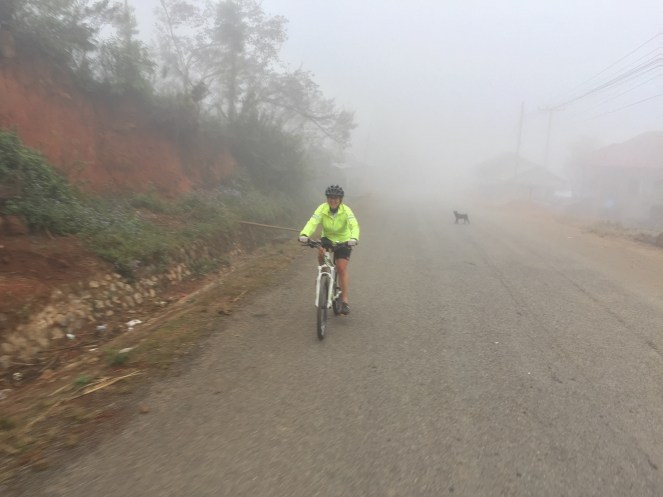
Half of the ride was in the mountains, often in mist, surrounded by waves of dark green sharp hills, clouds settled down around us.  Climbs were long, but affable and gentle, occasional trucks and motorbikes, but mostly just us, the road, the mist, the mountains.


The softness of this kind of riding makes me more porous, and the world around me flows in. In every village, children come running from the side of the road to shout “SABAIDEE!” (Hello!) and high five us — sometimes a little too hard.  Pigs escape from their pens by the side of the road.  People bathe at the cold village taps, men in their underwear, women wrapped in sarongs, children naked.  I stop to watch the sad drama of a group of people attempting to lasso a cow with a makeshift vine-rope after it’s been injured by a car.  Notice that babies are wrapped to men’s bodies as often as they are to women’s.  Pedalling into a land and soundscape that isn’t accessible any other way.

In Phousavan, we spend the morning at the market then at a little exhibit learning about the devastating impact of the US bombing of northern Laos during the American/Vietnam war.  It’s horrifying history — many bombs were dropped on Laos because they couldn’t reach the Vietnamese targets and couldn’t return with full loads; there were rules of engagement in Vietnam about civilian targets, but because Laos wasn’t technically at war, they didn’t apply.  There are unexploded bombs everywhere still in Laos, and the napalmed hills won’t grow anything for 200 years. [Good piece on this  here].

The three of us are quiet after the morning, and when we start riding, we soon end up in mountain cloud and fog.  It’s hard to see, but my body needs to move, to be fully present in this place to make a little bit of human connection with the stories we’ve heard.  The other two women get in the van, but I ride, carefully up and into the mist, feeling the cold.  The guide tries to have the van follow me closely but I ask him to move on.  I want to be alone with the road, responsible for my own safety.

In the mountains, the villages are mostly raised thatched huts with woven roofs; as we get further south, houses become more prosperous, made of cement or brick and with electricity, satellite dishes. Roadside stands shift from selling firewood and occasional bananas to selling oranges. In the mountains, people walk between villages carrying bundles of sticks, firewood, in bags braced by their foreheads. In the valley, there are more motorbikes and bicycles leaned up near the road as people tend their crops.  The people in the mountains have almost nothing, barefoot children hopping because the road is so cold on their feet.  I wasn’t properly prepared for this level of chill and I’m often shivering;  they are huddled around tiny bucket fires.

The final day of riding — the 15th day of riding of my trip — is nearly 100k. We start out in Phoukoun in the mountains climbing for an hour, then descend through the hills to the valley. I have a couple of skids on curves that remind me to pedal cautiously (I crashed the first day on gravel in a curve, unfamiliar with the brakes on this bike), then I’m on my own for most of the ride.  I’m so grateful for a body that lets me do this, feel this place through my pores, my own effort and openness rather than through the window of a van.

I notice one little girl walking her bike up a hill and I call out Sabaidee!  She sees me and hops on her bike, starts to race me up the hill.  At the top, she extends her hand for a high five and we hold hands for a brief moment.


img_1722

Just before we get to Vang Vieng, we stop at a bridge over the Nam Xong river. There’s a little monastery high on one edge, and the mountains that have wrapped around me all afternoon crowd close.  My feet and hands are sore, but I stop, feel gratitude, know why I do this.

img_1740


Uncategorized

Friends for Life Bike Rally, Day 3! Oh no, that smell is me. #F4LBR

It’s Wear Red Day (previously known as Red Dress Day) and everyone is all gussied up!

Team Switchin’ Gears in the morning. 

Oh and let’s not forget our new best friends, the Bike Rally mechanics who’ve been such a huge help. 

It was a morning with earlier packing times and departure but also no rush to do the 50 km in to Kingston as lunch and rooms would not be available until noon.  The sun was out, a welcome change from the Day 2 Deluge. 

We rode together as best we could until the break at 25 km. With a lot of riders it can get tricky on busy roads. After 3 days of cycling without hot showers I realized I smelled very strongly. No matter how carefully you pack the used gear the smell permeates all of the clothes in the bin. Mix that fermented body odor with gastrointestinal upset and a dab of diaper rash creme and you’ve got a mighty pungent perfume. 

Traditional team photo in Kingston

So tonight we do laundry, shower, eat with metal utensils with ceramic plates while sitting indoors. 

Thankful for a morning with less logistics.

We continue to gather pledges to fund PWA’s mission. You can donate here

Uncategorized

Obikire (Guest Post)

It’s overcast and hot and the air is thick with the acrid smell of the charcoal used for cooking fires.  I’m running down a rutted red dirt road, with far more pedestrians than vehicles.  Women with bundles of baby on their backs and goods on their heads, men standing idle in clusters with heavy bicycles and rattling motorbikes, children walking to school, many people walking with machetes or pangas, off to hard labour for the day.

The few vehicles that pass are crammed with people, four to a small motorbike, a dozen in the back of a small truck.  An agricultural population on its way to work.  I’m a bit ashamed of my thick body and the privilege of running for pleasure, because my life is too easy.

The Rwenzori mountains are thick green and stunning.  The foothills I’m running through slow me down, along with jet lag, a week of tropical heat, gut rot, intense work.


I’m in rural Uganda, working on a volunteer project I am the director of.  Nikibasika.  Meaning “It is possible” in the local language. It’s my 9th annual visit here, and our team has spent the week working with the students in the learning and development project.  Most are not children anymore — they are young adults, and much of our work this week has been about one-on-one career and education planning, and serious talks about relationships.  One of the girls who recently graduated from the project has had a baby.  She is 20 but without a husband and no stable work yet.  We talk about her and the older girls come up with a formula for success:  School + Job + Money + Marriage + Two years and THEN babies.  They turn it into a mantra and repeat it back to us.

Being in this community makes me more of the self I want to be, all the time.  I love these kids as my own, and know their fears and hopes and faults, who is creative and who is practical, who teaches the younger kids.  And when I’m with them, I’m all spirit and heart and head, working constantly to manage and parent and be a friend in 1/50th of a year.

And now the other three Canadians are gone, and I have an hour to myself.  I finally run, and I am in the heart of the real community the kids in the project are enmeshed in.  Ours are lucky — we support them through three years of post-secondary school and a three month leadership/career program, and learning how to do community service.  They were street kids — or “sweet kids” as Phionah calls the ones that they are now helping.  They are glowing.  And I can run and make meaning of this work, of this week.


I greet the local people on the road with Obikire, good morning in their language.  Every one of them smiles.  One man holding a live chicken under his arm grins broadly.  A man standing idle with his bicycle sings out Reduce your Speed!  The ladies giggle.  One old man with a machete resists my attempts to charm and scowls at me and demands “give me 5 shillings.”  It’s less than a penny he’s asking for.


I run up the rutted hill that has defeated me before, so slowly.  I feel all of the people who walk so far to work for $30 a month, who are still hacking at maize or long grasses with machetes when they are old.  Who are thrilled to have their one chicken to sell. I appreciate how hard the young people in our project work, how open their hearts are, how they let me in.  I run and sweat and find my body again, grateful.


[The major source of funds for Nikibasika is the Triadventure (tri, a 3 day run or swim, paddle and cycling event in August.  This is an all volunteer effort with amazing outcomes and all of the money goes to the project in Uganda.  Canadians get a charitable donation receipt if you sponsor me at https://www.canadahelps.org/en/pages/nikibasika-development-program-66/. Thanks :-))

Sat with Nat · Uncategorized

Fitness as speedy recovery from injury?

This Wednesday I played another pre-season game with my soccer team. I got to meet a few more folks and it was a gorgeous evening. We were playing against the same team as the week before. 

We decided some warm up passes, shots on net and stretching should be part of our pre-game routine. During the first half I noticed we were all moving a little slower than the week before, keeping effort in the 60-80% rather than the all out 100% peaks. 

Near the end of the first half I pulled my left calf and it snarled into a visible knot. I joined another teammate who had pulled his groin, we were both feeling grumpy about being injured and on the sidelines. 

I tried stretching it out, massaging and got to the point I could walk a bit but there was no way for me to get back I the game. I left early feeling pretty bummed out. In the shower I tried some static calf stretches and I could feel the knot starting to unfurl. 

I read up on cramping and, of course, it’s due to demanding more than what my muscles can do. The solution, more activity!

The next day I hobbled the 2 km walk into work, gingerly exploring the edge of my range of mobility. It hurt but wasn’t debilitating. I didn’t take the stairs. That night I walked home, put a hot water bottle on the knot then rolled it out with a narrow roller. 

tools of injury recovery: A535 rub, spikey red ball, narrow roller and large foam roller.

Friday morning my gait had smoothed out, with just a mild limp. I could do the stairs. I stretched when I thought of it. It occurred to me that while cycling, walking, gardening, yoga and sometimes running are not specific enough to the movements in soccer to prevent injury they certainly have meant a speedy recovery. 

There’s a risk inherent to any activity. I think the couple days of discomfort are nothing compared to the suffering associated with not being active (like chronic pain,heart disease and type 2 diabetes).

It’s pretty amazing how easily I can get hurt AND recover, bodies are amazing. 

fitness · Uncategorized

Less is More… Or is it?

Minimalism (or at least talk of minimalism) seems back in fashion now. Probably everyone has heard of Marie Kondo’s wildly popular book on decluttering one’s house (and life). We are advised to keep only those things that “spark joy”. In other words, it’s out with this:


clutter


and in with this:


zen

But what about sports or physical activities?  Should we embrace minimalism in our physical regimens?  Or variety  as the spice of fitness life?  Is less really more, or is more more?

I’ve recently taken on 3 additional sports/activities to my movement regimen. Last year I restarted kayaking, and have really enjoyed it. In January I joined a yoga studio and have been going once or twice a week. And after impulsively doing two recreational scuba dives in Australia, I decided to get certified in scuba, so am taking a course now (to be completed in Puerto Rico in a week).

Of course this is fun, but it is making my schedule much more crowded, giving me less down time, and causing me to think: what am I doing here? How may different kinds of activities do I want to juggle in my life? If it feels like juggling, should I be doing it?

I decided to put together a list of the pros of each position in the hopes that it might help at last clarify the conflicts within us (or at least me ).

Less is more pros

1) Lighter–with fewer sports, there’s less to think about, and less gear to haul around, store and maintain.

2) Potentially cheaper — it could mean fewer expenditures on a variety of lessons, memberships, and gear.

3) Simpler– workout schedules are less complex and hectic, with fewer logistical struggles (e.g. Collecting, packing, loading and hauling a variety of gear around– is anyone sensing a theme here?)

4) More focused– Time can be devoted to immersing yourself in a few favored sports or activities. And you can really master the maintenance and repair of all that gear.

More is more pros

1) Thrilling– the exhilaration of trying a new sport, with new sensations and feelings (even new sorenesses) can be stimulating.  And there’s all that new gear to play with.
 

fins


2) Social—it’s a chance to meet people whose passions are the sport/activity you’re dabbling in (this is my favorite feature).

3) Motivating—because you’re participating in a variety of sports, if you’re having a tough time with one of them, you have the others for helping boost self-confidence or relaxation.

4) Knowledge-conferring (pardon the philosopher talk)—doing sports/activities that use different systems, muscles, skills, and talents can tell you a lot about what your body is like and what your body likes.

Well, at the end of composing those lists, I now think I’ll keep to more is more. But it’s worth revisiting from time to time to see what I am liking doing, what is causing too much stress, and what I can lay aside (including boxing up gear and storing it in my basement). For now.

What about you, readers? Are you going through a more-is-more or a less-is-more period? How are you feeling about it?