accessibility · disability · inclusiveness · injury · traveling · walking

Bremen, so many steps, happy tears, and academic travel

It’s summer. I’m in Europe. It’s part of the rhythm and flow of academic life. What’s new? This visit I’m here in my Dean’s role rather than as researcher/writer/philosopher. We have an exchange program with the University of Bremen, involving faculty, grad students, and undergraduates. I’m here with the former Dean to meet the people and learn all about Bremen and the Bremen Guelph connection.

It’s also the 10th anniversary of their Institute for Quebec Canadian Studies.

Just as academic life has a pattern and rhythm so too does the blog. It’s time for the annual post about how much more I’m walking in Europe. Here’s my day on Tuesday.

15,000 steps is a lot of steps given that it included a full working day.

On the one hand, I love living even temporarily in a less car reliant culture. I love being part of a community in which exercise is part of everyday life. But I also worry about access and inclusion and where this leaves people who aren’t so mobile.

I raised the worry in this blog post about walking lots while at a conference in Berne Switzerland four years ago. I blogged about it again from Sweden two years ago (see here) also Scotland and Innsbruck, Austria also two years ago.

It’s a thing I note and wonder about and enjoy all the while worrying about disability. That said, European friends tell my worries about disability are unfounded. What’s your experience? Do you use a wheelchair? Have you traveled around European cities? How did you find it, recognizing that Europe isn’t one place?

The worry, well founded or not, got personal this year traveling to Germany with my injured knee. I noted that the agenda for my campus visit to the University of Bremen included a two hour walking tour of campus. I was frightened I’d have to decline. It’s a big change in self perception and identity.

And the big day of walking was fine. Thank you knee brace. I got all teary wth relief.

(The emotional moment was likely also due to the movers who’d been signed up to do our move phoning me to say they couldn’t do it after all. It’s the busiest weekend of the year for movers, they say, and my agreement made back in April didn’t count for anything. Sigh. Luckily the company who came in second for the bid was willing to take it on.)

But I have wondered how I would have coped had my knee not been in good shape. I’m going to have to learn to advocate for my mobility needs. Lots to learn. I also had an experience in the airport with airport security as my knee brace sets off alarms. I told them it would hurt to take it off and send it through security and they didn’t insist.

The one thing that did hurt was my feet. I haven’t been walking so much in sandals and the weather was warm.I ended up with blisters. The next day I swapped for running shoes and ended up looking very much like a North American tourist. The German women faculty members would have appreciated my Fluevogs. They wear great shoes but I’m not sure how they manage to combine the funky footwear with walking so much.

What do you wear when walking lots, when you’re in urban environments (not hiking) and want to look both stylish and comfortable?

fitness · traveling

Bettina goes Patagonia, hikes a lot, and thinks about things

My husband and I just spent three weeks in Patagonia (both Chile and Argentina). It was fantastic. Here’s a quick round-up of the itinerary and activities we did, and some thoughts about travel and feminism and sustainability.

Santiago, part 1: in which we cycle through vineyards

We flew to Santiago de Chile, where we spent a day and a half. We spontaneously booked a cycling tour of a vineyard located right at the edge of the city (picture below). The contrast between city and vines is actually quite striking.

The Cousiño Macul vineyard with the skyline of Santiago de Chile in the background

The company we booked with offers different cycling tours of the city and nearby vineyards. I liked them because they openly state that they have a pro-LGBTQ hiring policy, and because they try to offer something different and active, but are quite inclusive about it. They make it clear right when you book that you’re not signing up for a workout, but for a leisurely ride. Ours lasted about one hour plus another hour and a half touring the vineyard’s facilities. We also sampled five different wines. It was relaxing and wonderful.

Bettina and her ride, a seasoned green bike ideal for cruising around, but not for competitive cycling.

Torres del Paine National Park: in which we hike a lot and are exposed to the elements

From Santiago, we flew to Punta Arenas in the very South of Chile and took a bus to Puerto Natales, a small town that mainly functions as the tourist

hordes’ gateway to Torres del Paine National Park. We spent a night there, left some luggage at the hotel (we were returning five days later), and took only the necessary hiking and camping equipment to the park.

Torres del Paine is the national park everyone ‘does’ when they travel Patagonia. It’s easily accessible and has some stunning scenery. As a result, the infrastructure is excellent. There are lots of campsites, refugios where you can get a bed, and even some pretty luxurious hotels and cabins. Chile’s only eco-hotel is also located in the park. Also as a result of this, Torres del Paine is totally overrun. I wasn’t joking when I wrote “hordes” above. We visited at the tail end of the season, so it wasn’t too bad, but in high season, around January and February, I can only imagine it must be packed. We did a four-day trek known as “the W” (because of the route, which looks like the letter W) and stayed in our own tent.

View from our trusty red tent. The poor thing got quite battered by the Patagonian winds and rain, but it kept us nice and dry.

The park has suffered quite a lot from this; there have been some major fires and it’s definitely not as untouched as you might associate with the cliché of Patagonia. Rules are fairly strict, you can only enter if you have all your reservations beforehand, fires are forbidden, and at some places they don’t let you cook with a camping stove (conveniently, this also means the campsite/refugio can charge you a ridiculous amount of money for mediocre food; on the upside you have to carry less of your own).

What can I say? It’s still beautiful despite the masses. There is a reason the park is so full – it’s stunning. One morning at 8 o’clock, I’d just woken up and stood, mouth agape, marvelling at the mountain behind the campsite, aglow with the rising sun. It was out of this world.

The mountains, aglow with the rising sun

We had initially considered going to a much more remote park with next to no facilities, where we would probably have been mostly alone. However, we would’ve lost considerable time getting there, plus two contingency days for resting and in case we took longer on the trek. It would also have meant two additional flights and thus even more emissions, and this trip already wasn’t exactly an exercise in CO2 reduction. And as I mentioned before, there are upsides to the infrastructure: hot showers, you don’t have to carry all of your food, and you can go somewhere nice and dry when it’s storming and raining outside, which did happenon a few occasions.

It also occurred to me that on the whole, it may be better if only a few places are “ruined” by tourists – it offers an opportunity to keep the rest of the region largely untouched. I’m really not sure where I stand on this, and whether it actually is better to “sacrifice” some parts for others to be preserved. The way tourists concentrate in a few key locations throughout Patagonia is astounding. As soon as we moved off the beaten track, which we did for a bit of our overall trip, we were often on our own. I will return to this below.

Road trip: in which we bomb around Patagonia, stay at mostly empty campsites, and hike the Perito Moreno glacier.

Having completed the W, we returned to Punta Arenas via Puerto Natales to pick up a little camper van. We then drove south towards the Magellan straits (where I saw a dolphin! I’m still excited!), and then up to Argentina, across to the Atlantic coast, where we had planned to see a penguin colony close to Río Gallegos. Unfortunately this plan failed because of the poor road conditions and our van’s distinct lack of suspension and 4×4 drive. So we spent a lazy day in Río Gallegos.

This brings me back to my point about people not really moving off the beaten track. Maybe this is different during the high season, but both south of Punta Arenas and in Río Gallegos, we stayed at completely deserted campsites that were like straight out of a bad horror movie. We did get some beautiful sunrises out of this though, below the one from Río Gallegos.

Sunrise over the river Gallegos. Our campsite was located directly on the shore.

Via another stop further north and a guided hike through a petrified forest, we moved on to El Calafate. This little town is another touristy place and the gateway to the Perito Moreno glacier. El Calafate is nice and seems to consist mostly of tourist accommodation. We ate very well there.

We had booked an all-day hiking tour of Perito Moreno in advance. In the early morning, we were picked up by a bus and shipped to the Parque Nacional de los Glaciares, the national park covering most of the Argentinian part of the Southern Patagonian ice sheet, including Perito Moreno and Mount Fitz Roy. Perito Moreno was everything we had imagined and more. We lucked out with the weather and got a sunny day that made the blues of the ice intense and the three-hour hike on the glacier very pleasurable.

The face of the Perito Moreno glacier with some icebergs floating in the water

The guides split our busload into two groups first – a Spanish and an English-speaking one – to approach the glacier. It was a just under one-hour hike up to the access point, where were fitted with crampons before they subdivided us into smaller groups of about eight people for the hike on the ice.

One thing that surprised us was that the tour company didn’t follow through on their advice to wear suitable footwear and clothes, and only allowing people with a good level of fitness on the tour. There were lots of people who wore running shoes or sneakers and jeans rather than the recommended hiking boots and hiking gear. And a fair number of participants struggled on the hike to the access point already.

Bettina, wrapped up warmly and arms spread wide, atop Perito Moreno.

In a way it’s nice that they’re lenient, because it makes the experience more inclusive, but I do have to say that it compromised the experience of the rest of the group somewhat since accommodations had to be made for people who hadn’t read or didn’t care about the instructions on the website. They’re very clear and could only be improved in one way, which would be to remove the advice that this tour is not for overweight people – you can be “overweight” as long as you’re physically fit.

But I digress. Once we were subdivided into smaller groups it was fine; I think the guides did realise this was an issue and formed the subgroups accordingly. We very much enjoyed our three hours and lunch on the ice! The absolute highlight was an ice cave we got to see on the way down. Incredible.

Ice cave below the glacier – incredible hues of blue!

Goodbye Patagonia and Santiago, part 2: in which we “rescue” a solo traveller

From El Calafate, we took a small detour to a lovely campsite on a lake called Lago Roca. This was the only campsite where at least a handful of people other than us were staying overnight, and it was very well run. We then took two days to head back down to Punta Arenas to return the van and fly back to Santiago.

While we were waiting at the airport having a coffee, an American woman suddenly turned up at our table asking if she could talk to us for a while. It turned out she had been pestered by a guy who had kept asking her awkward questions about how long and where she would be staying in Santiago and what she’d be doing there. She had pretended to know us to get away from him, so we invited her to sit with us and had a nice chat.

I had thought about this on several occasions throughout this trip already: my privilege of accompanied by a man, who was also clearly my partner. No man on any of the tours or anywhere we went took any sort of “particular” interest in me.

I have travelled in Latin America on my own quite a lot and this lack of unwanted attention was a welcome change. As a female solo traveller, I have had to spend time fending off such approaches and have generally been a lot more alert. It’s definitely doable and lots of women do travel the region on their own, but it’s a different experience. Aside from general security considerations, this isn’t something a solo male traveller would have to spend a lot of time thinking about.

This also made me more acutely aware of my privilege as a woman living in a society where it is, for the most part, safe to walk around on one’s own after dark and go wherever I want. It’s complex, because in this particular case, it’s also about being a tourist. I don’t know if our airport friend would have had the same experience had she been Chilean. It’s possible, but probably less likely.

And also, even though it’s mostly safe for a woman to do all those things on her own where I live (in Europe), it’s not completely safe either. At a much lower level, here I’m also on alert walking or running alone in the dark or in a place where there are few other people. Or a creepy guy can chat you up in public and be difficult to get rid of. It’s an interesting thing to think about, and I’d love to hear your experiences with solo travel at home and abroad.

fitness · food · traveling

Do you have control issues re. food? Tracy discovers hers in China

Image description: market stall in Suzhou of varieties of fresh fruit in metal baskets with two large metal scoops.

I just got back from a work-related trip to China that involved a lot of official and hosted dinners. What that means is lots of meals with more food than you can imagine, platters and platters of it being delivered to the table in an endless procession. It’s all served family style, placed on a turn-table that allows you to spin the dish you want to the spot in front of you.

The focus is on the guests’ enjoyment, and it’s a cultural expectation that there will be more food than can comfortably be eaten. If the plates were cleaned that would indicate poor planning, insufficient food for everyone to feel satisfied.

As a vegan among omnivores, this arrangement challenged me on several levels. First, the most obvious: vegan / vegetarian cuisine is not as readily available in China (or easy to explain) as you might think. I’d been warned ahead of hidden animal products–minced meat tossed in with veggies (which I never encountered), animal stock as the base for soups (yes, on a number of occasions), veggies possibly cooked in animal fat or stock, that sort of thing.

There was also the issue of protein. Since the cuisine (at least in the area where we were) relies heavily on meat, fish, and poultry, there is little need for the locals to worry about protein sources. Yes, you can get tofu and I did have some other legumes at one point (a local bean dish that was quite good), but I never really get around to communicating clearly about the difference between a vegetable dish and a vegetarian dish that includes protein.

I also felt painfully conscious of my desire to be a gracious guest. What happened most frequently at these meals was that, recognizing that I had special needs, the vegetable dishes would suddenly start arriving en masse on the table. And everyone would nudge them my way — “here, we ordered this one for you…”  Protein or not, there was a heck of a lot of food coming my way and I had at least to try all of it.

Shortly into the trip, probably at the second hosted meal, it dawned on me that the top struggle I confronted was that I simply do not like being ordered for. I may be an intuitive eater, but I am happiest when I get to choose what foods are put in front of me. This is not to say I don’t mind trying new things, but entire meals (indeed, a series of entire meals) consisting of new things in which I had no say, turn out to be unbelievably stressful for me. This is not something I’d ever been consciously aware of quite to this degree before because I have never had so many meals in a row of this kind.

It was like the perfect storm of uncomfortable food circumstances for me: incredibly large amounts of new foods, many of which were ordered specifically with me in mind while I remained unconvinced that my vegan needs had been successfully communicated and at the same time keenly aware that I was a guest (and manners matter to me).

I also like to think I’m at least a little bit cosmopolitan and I am for a fact well-traveled, so it’s always a shock to me when I struggle in a new country (with something as basic as the food). This has happened to me in a serious way only once before, and that’s when I went to Tanzania shortly after becoming vegan. There, it seemed like a ridiculous abuse of privilege to insist on vegan food everywhere that I actually stopped doing it while there.

I’ve always associated food control issues with the diet mentality. But I don’t eat that way anymore. I’ve thoroughly converted intuitive eating. But if you think of intuitive eating as eating what you want, when you’re hungry, in amounts that satisfy, it makes sense that when practiced that way it requires some control over the what, when, and how much of eating.

And that is exactly what was absent on this trip. From the first meal, I almost never felt hungry on this trip because there was just so much food at the hosted dinners and lunches. I’m not the only one who felt this way. The colleagues I traveled with had similar feelings of not being hungry. Towards the end of the trip, we actually skipped dinner three nights in a row, one of the nights after walking 10K through the streets of Suzhou.

I’m not down on myself for having this need to have a say in what I choose to eat, when I choose to eat it, and how much of it I eat. Yes, I recognize it as a “control issue,” but I’m okay with that even if it surprised me when I experienced it so acutely in China. I didn’t have it one bit in India, but that’s because it’s one of the easiest places in the world to be vegan and for the most part I was able to communicate more clearly what I needed — less of a language barrier and far fewer hosted meals. Culturally and linguistically, China was more difficult for me to navigate. I imagine with return visits and some strategic language learning, I will do better than I did this time.

One thing I cannot complain about at all is the abundance of fresh fruit available in China. And they have the every best pears I’ve ever eaten anywhere — juicy, sweet, textured, and bursting with flavour.

Do you think of yourself as controlling or relaxed about your food choices?

traveling

Sam discovers compression socks

For years I’ve been struggling with swollen ankles after long flights. Not two hour flights or even four hour flights but six or more, yes.

After my last trip to Europe it took a long time for my calves and ankles to get back to normal. Sarah has a bit of a problem with this too and jokingly suggested that now that compression socks are cool among endurance athletes (thank you ultra marathoners!) we could buy some and try them for flying.

The first bunch I bought didn’t fit me at all. I’ve got very serious calves. And they weren’t tight enough to work as compression for Sarah. They’re funky though.

This trip I actually bought the kind of compression socks I’d previously thought were too impossible old and nerdy to wear. No cool sayings. They’re just black tight and stretchy.

However, low and behold, they work. Fourteen hours of flying to Tahiti and no swelling at all. I’m amazed. And I’m also feeling a bit like an idiot for letting considerations of cool get in my way.

I’ve become that person, flying in yoga pants, compression socks, and bright orange running shoes. On the bright side, I felt great after flying. Whatever, I’ll take it. Bring on the compression socks. They work.

See Try compression socks to relieve circulation problems while flying.

See also How do compression socks work?

fitness · gear · traveling · yoga

Yoga mats are purple in India, too

It’s my last full day in India and it’s been a dream trip in so many ways. But if I had to identify one thing that hasn’t been great it’s been my activity level. Now, I’m not one to get down on myself when I don’t stick with routine. Regular readers of the blog will know that I am endlessly forgiving in that area, a committed advocate of doing less.

But I’ve been  completely absorbed with the adventure of exploring India, and one aspect of that adventure is that unless you’re in a high end hotel with a fitness centre, you can pretty much forget running. Apart from it being too hot, the roads are not navigable for runners (at least not anywhere I’ve been). The traffic is chaotic and there aren’t really long stretches of good sidewalk. Dangerous potholes mean you need to pay close attention even when walking.

I’ve spent part of my time in high end hotels when in Chennai (four nights at the Hyatt at the beginning of my trip and now two nights at the Taj Clubhouse at the end of my trip). At the beginning, I was too wiped out to think about spending time in the gym. But this morning, after many hours of sitting in the conference Thursday to Sunday then on a road trip on Sunday after lunch (sitting on a bus for hours and then on a boat before spending two hours on our feet exploring an ancient temple) my body was screaming for some of my regular activity. This hotel has a roof top fitness centre and I noticed last night when we were at the roof top restaurant beside the rooftop pool (it’s extremely luxurious and we got a deal on expedia) that they have a bank of treadmills.

The lovely concierge here, Rajeswari, said I could ask her anything.

Image description: Head shot of Rageswari, a young Indian woman with dark hair, a red bindi between her eyebrows, a large beaded read necklace, and a red and beige sari, and a gold name plate that says Rajeswari. Blurred background of a green plant on the left and chairs on the right.
Image description: Head shot of Rajeswari, a young Indian woman with dark hair, a red bindi between her eyebrows, a large beaded read necklace, and a red and beige sari, and a gold name plate that says Rajeswari. Blurred background of a green plant on the left and chairs on the right.

So I messaged her this morning at 6 a.m. to find out if the fitness centre has gear kits. Some hotels, like the Westin, will provide you with a kit that contains shoes and workout clothes. I didn’t expect to hear back from her quite so quickly, but she let me know that they don’t do that here. What about yoga classes, I asked. No yoga classes either. But, she said, I can have a mat delivered to your room.

Within ten minutes a purple foam yoga mat, just like the very first yoga mat I ever owned, was delivered to my door. There is something comforting about familiar equipment. Anyone who has ever worked out somewhere new will know that initial feeling of disorientation. But encountering something you already know makes you feel right at home. That’s how I felt when I was handed the purple yoga mat.

Image descrription: purple yoga mat on the floor in Tracy's hotel room, with wood shelving and desk in the background.
Image descrription: purple yoga mat on the floor in Tracy’s hotel room, with wood shelving and desk in the background.

It’s been many years since I’ve been this inactive, with only walking and sitting, for this long (over two weeks). My feet have swollen with the heat and inactivity. As I said to Sam this morning when I was messaging her: “I want my ankles back!”

When the mat came I couldn’t get going fast enough. I spent the next hour working my way through the moksha series of standing poses then floor poses. It felt incredible to stretch it out and put in some effort. I held each pose for at least 30 seconds, some longer, and did my best not to rush through anything. By the end, my aching bones and muscles and joints felt alive again.

At breakfast, Rajeswari came by to assure me that the mat would stay in my room until I check out tomorrow.

Image description: Rolled up purple yoga mat propped against built-in wood shelving with black desk chair and part of desk visible in the background.

And I’ve already done my research: I have a four hour stop over in Toronto on the way home. Pearson International Airport has a Good Life gym where you can rent a workout clothing kit for $10, store your luggage, and have a workout and a shower. After 24 hours enroute, I’m sure this will be a most welcome way to hit the Canadian ground running.

What workout gear makes you feel at home when you’re working out in a new or unfamiliar place?

traveling

Tracy heads to India

This post has nothing to do with fitness, working out, running, or health. But it does have to do with the realization of a personal and persistent dream I’ve had since I was a teenager. I don’t know where it came from, but if there is one destination in the world that I have fixated on, yearned to see, and not yet traveled to, it’s India.

And guess where I’m going this afternoon? Yep. You guessed it. India. I’m traveling with four colleagues to the Namaste Educational Academy in Pondicherry, a coastal town in the south. We’re part of an international conference organized by The Sahitya, “a hub of faculty, scholars and lovers of literature, language, and culture.” It’s an international and interdisciplinary conference on Feminist and Gender Studies in a Global Perspective. The venue, Bonsejour, looks absolutely enchanting.

Image description: Bonsejour, a stately pure white building fronted by palm trees and a lush green lawn. The sky is bright and white.

India is a long way and it would be a shame to go for just a few days. So we’re going to do a bit of touring of the region as well. I expect to walk a lot and take tons of pictures.

If my posts read more like travel logs than feminist fitness entries over the next couple of weeks, please forgive me. I will try to inject a fitness or health spin into each post, but I have made a decision not to pack my running gear this time because it’s just going to be too hot and I want to slow down and soak in my surroundings, not blast past them (well, okay, I’m not exactly a blast past type of runner, but still).

On the recommendation of seasoned travelers to India, I have put together a little kit that contains Immodium, gravol, and activated charcoal. I’ll be purchasing some Tums at the airport, just I’m not entirely sure of the use of the charcoal, but it’s supposed to be good for the gut.

Stay tuned for more over the next couple of weeks about India.

cycling · fitness · Guest Post · health · traveling

N+1: A Love Story (Guest Post)

I know many of the contributors and readers of this blog are avid cyclists. I’ve only recently discovered the joys of cycling. Although, like most people, I learned to ride a bike when I was a child, it never captivated me until I moved to Aotearoa New Zealand and started commuting to university by bike. My officemate, who was leaving the country, sold me his bicycle (whom I christened Beatrice), and my love affair began. After a few months of commuting (plus an unexpected influx of cash), I decided to buy a new bicycle that fit me well and expressed my personality. Beatrice was lonely and needed a sister, after all! Plus, I am told that it is a well-known adage amongst cyclists that the number of bikes you need is n+1, where n is the number of bikes you currently have.

A side photo of a bright orange commuter bike leaning against a white house in the sunshine.
Image description: A side photo of a bright orange commuter bike leaning against a white house in the sunshine.

My new bike, Jezebel, is a commuter bike with a temperament to match her bright orange paint job. I’ll be the first to admit that I know almost nothing about bicycles—although I’m slowly learning a few basic maintenance things—but that hasn’t stopped me from falling hopelessly in love with my new bike. Even though I grew up with a triathlete mother, I never really understood how some cyclists could develop such deep emotional attachments to their bikes.

Now I do.

So, I present to you, dear readers, a love letter to my bicycle*:

Dear Jezebel,

How happy I am that you are in my life! Your blazing orange coat fills me with joy every time I lay eyes on you. I can’t wait to show you all around the great city where we live, and I’m looking forward to taking you up and down roads, over hill and dale, along rivers and around the harbour. You will accompany me everywhere I need to go: to friends’ houses, my office, the supermarket, the swimming pool. I’ll tuck you in, safe and sound in the garage, and dream of speeding off into the sunrise with you in the morning.

You push me to be stronger and more adventurous, facing wind and hill and black ice with courage and determination I didn’t have before. You’ve also made me notice the small details I never would have seen otherwise. The potholes, quirks of the traffic lights at different intersections, hidden driveways, and roads that look flat but are actually very gradual inclines would have escaped my notice if you hadn’t pointed them out to me.

In you, I found freedom I didn’t know I lacked. Before we met, it took me ages to get anywhere. Although I enjoyed walking, it took up a lot of time. I didn’t drive anywhere because I don’t know how, and driving is impractical anyway because traffic is slow and parking is scarce and expensive. And if I took the bus, I was always travelling on someone else’s schedule. Now, you and I can go anywhere whenever we want. While the roads are filled with trapped cars waiting for the procession ahead of them to make it through the next light, we gleefully zip past them down the bike lane. I create excuses to go places simply so I can spend more time with you. I can’t wait for the long and happy life we will spend together.

Love,
Chloe

P.S. Be nice to Beatrice. Having a younger sister has been an adjustment for her.

A 26-year old white woman with short blonde hair, wearing a red and grey plaid shirt and black glasses smiles while posing with her orange bicycle.

*Yep, I know my bike can’t read.

body image · cycling · fitness · holidays · traveling

Kim’s Tour de Yorkshire*

*… in which Kim is bested by some outrageous hills, but not broken in spirit.


(A mosaic of images from West Yorkshire: Kim’s bike, saddle first, with the moors in the distance; a road sign that says “that was so Hebden Bridge”; Kim and her bike in front of a stone wall that says “lane end”.)

Remember how I always go on about hills? How I like them and am good at them?

Into each one’s life…

OriginalPhoto-521389833.670192

(A road sign that says “Cragg Vale: longest continuous gradient in England. Rises 970 feet (295m) over five and a half miles (9km)”)

I spent the first 10 days of July in the Calder Valley in West Yorkshire, famously home of the Bronte sisters, and the 2015 Tour de France Grand Depart, depending on your fetish. (Mine involves both – swoon.) There is tonnes to do in the pretty market town of Hebden Bridge, but my bike was with me so my first priority was the riding.

Here’s the thing about Yorkshire, though: it is a cycling Mecca (for mountain as much as for road riders) because the fine folk who built the lanes don’t believe in switchbacks.

If you’re going to do a road ride in the Calder, you need to be prepared to climb. Doesn’t matter what you do: there is ascent to be faced. I wanted, in particular, to partake of the fine views over the moors that make this part of the British Isles justly famous; that meant I really needed to be ready to get up off the saddle, early and often.

No problem! I thought. After all, I might not be a tiny cycling whippet, but I’m really good at that shit.

On my first day out, I chose a route (from the several on offer at the excellent Calder Valley Cycling website) that included a long, snaking climb with most gradients in the 5-10% range. That’s my preferred kind of climbing: you can sit and grind, and if, like me, your strengths lie with endurance sports, you’ll not max out and will really enjoy the challenge and the views. Although I won’t lie, I was nervous to start, I felt great throughout that climb as the sun broke through the clouds, and I was rewarded with some sloping descents and then a short punch up into the farm lanes above Sowerby and Mytholmroyd.

OriginalPhoto-520781974.002783

(Kim, in white cap and green helmet, smiles into the camera with green, sloping farmland in the background.)

As soon as I hit the lanes, though, I got my first taste of what was to come the rest of the week: narrow roads that don’t look like much to start, but wow, do they pack a punch, and sometimes when you least expect it.

Still, with the gorgeous views all around me and the happy feelings from the winding climb still in my arms and legs, I shoved my worry to the back of my brain. I took the set route’s lovely descent through Cragg Vale, the longest continuous climb in England, down toward Hebden, and then thought to myself: it’s cheating to go down but not up. So I turned around and did the climb (another happy, winding, mid-grade number), just to know that I could.

All in all, then, day one was terrific. But I knew it wouldn’t last.

My second ride out proved my rude awakening, though in a way I found really instructive: I learned a lot about myself as a cyclist that day.

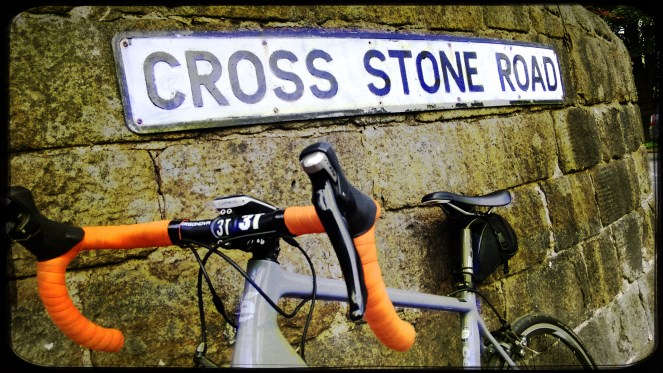
I left in the early afternoon, and chose a short route with a big challenge: Cross Stone Road leaving Todmorden for more gorgeous views over the moors. The information online said the climb included a short punch of less than 1km followed by a longer, flat stretch, and then a steep but shortish kick up to the top. I reasoned that the word “short”, repeated a couple of times, meant I’d be fine.

Yup. Nope.

After missing my turn on the way into Todmorden and having to backtrack, I found myself on a steep but manageable residential road. I made the mistake of standing and pushing hard at this point, taking the “short” thing literally. Mistake number one! I found soon the road was not levelling, and I had to sit and push hard, breathing at my threshold, for a good 500m before the flat began. I heaved through the growing heat (Yorkshire is not hot, but sun plus no wind plus exertion is what it is), and prayed the second bit would hurt less.

Then the second bit heaved into view.

To say I was slow would be an understatement. The walker I clocked about 200m ahead of me as I began the punch ultimately beat me up the hill – though in my defence I had to stop twice: once to negotiate the single lane with a grocery van, and once just because I needed to cry a bit and ask god to save me. (I also needed to catch my breath: you can’t ride at VO2 max for as long as I was taking to get to the top, and not risk puking, which I did not want to do in full view of the confused sheep around me.) But I made it on two wheels: crying and praying or none, I refuse to walk any hill I’ve started on the bike.

I’m vain like that.

The rest of the ride was hard: I was spent from the climb. I got back to Todmorden, snapped some photos of the start of the climb to remind myself of the pain I’d endured, and home I went to eat.
OriginalPhoto-520961962.374086

(Kim’s grey and orange bike against a stone wall, with a prominent white road sign that says “cross stone road”.)

The rest of my Calder rides varied between these two poles: long, picturesque climbs I’d ride again and again, and short, painful bursts of 18-22% gradients that I was convinced I had to do in order to prove I could, but that made me hate myself, my bike, and the world for the 5-10 minutes required to finish them.

Over the week, I began to think I had hold of the wrong end of the saddle, so to speak.

My first clue came from Strava. I’m a Strava junkie, and I uploaded my rides immediately upon each return. The long climbs were full of riders, many of them pro or semi pro. (My proudest moment: learning I was 32 on the leader board for the climb up to Oxenhope, with the British cycling star Emma Pooley at number 6. Squee!)

But hardly anyone did the crazy steep climbs: I’d be among 300-400 riders on the winds, but maybe one of 20 on the punches. I scored 8th overall on the climb where I stopped twice, for heaven’s sake! I think there were 11 or 12 of us in all.

Then there was the part where I felt joyous and free on the winding climbs, but sick and demoralised on the punches. Where I wanted to climb more on the winds, but I wanted to stop, cry, and turn around on the punches.

I wouldn’t let myself stop, though, because I thought stopping meant failing. It hadn’t occurred to me that, since punching is not my strong suit, maybe I shouldn’t have attempted those routes. Maybe they were not fun – not even a fun challenge, just a terrible, unhappy slog.

I’m a big proponent of challenging myself in sport, but the challenge needs to be both challenging and, ultimately, rewarding. I did not feel rewarded on any of those little punches; I was just grumpy and out of breath. What good is that?

On the train back to London I thought about this. Why did I really want to conquer the brutal little hills, when I train best, get stronger faster, and feel more satisfied on longer climbs? Why did I care about 500m at 20%, when as a cyclist I’m best suited to 5km at 5-7%?

Sure, you could say all climbing is learning, and all learning good training.

Except: the more I pondered it, the more I realised it actually, for me, had to do with body image.

I am not small: I am 174cm tall and I weigh 77kg. It doesn’t matter much that my fat to muscle ratio is such that I’m technically athletic; that’s still a huge amount of weight to haul up the side of a cliff, on the vertical.

My strength profile means I can kill a shallow climb, but my body weight puts me at a significant disadvantage the steeper you get. And that’s fine: there are climbers and sprinters and all-rounders in the world of cycling as a norm.

But for a girl alive and well under patriarchy, being too heavy to climb a steep hill easily has other reverberations; it smacks of the whole body-mass-index culture that tells us to be teeny, already, or hate ourselves forever.

And readers of this blog all know where that kind of thinking leads.

(My body mass index makes me technically overweight, just as my muscle ratio makes me technically athletic. Thanks, stupid and ineffective measures!)

Through one lens, you could say I learned in Yorkshire that I’m too heavy to punch, and should admit defeat and move on.

Through another, you could say I learned that I’m fit and strong enough to rate in the top 10% or better on iconic climbs that the pros even find challenging.

That punching is not what I’m good at, and so I need not worry about punching just for the heck of it when I could be winding up a mountainside, happily, instead.

And that, hey: if the walker beats you to the top, maybe you should just walk, already, and save the bike for another stretch of road.


disability · Sat with Nat · traveling

WisCon41 all the feels about disability 

I had a great time at WisCon last year and was delighted when David had offered to go together.  It’s a long drive from London, Ontario to Madison, Wisconsin but totally worth it!

This year I brought my swimsuit, running shoes and yoga mat. I did swim Thursday night to stretch after the drive down.

The rest of the weekend I managed to get 8-10 thousand steps a day. I’m not sure how but it may have been going further afield for food.

a thick brown pottery plate from the 70s is heaped with thick slices of golden french toast. This is topped with strawberries, blueberries, pecans, powdered sugar and creme fraiche
My new love, giant French toast

I slept much better this time around, largely due to not submitting for writing workshops which had made me a twinge nervous. I am committed to putting writing in next year though!

As last year, I loved the panels. I attended so many great sessions on everything from food and culture in sci-fi to unpacking portrayals of mental health in fiction.

Due to a mix up on my part I ended up in “Beyond the Fix or How Do I Live this F***ing Life?”

the photo is of the event schedule that indicates the topic is in the Feminis and Other Social change Movements stream of the conference. The panel short description: When you know there's no fix, your disability's never getting better, might get worse, and acceptance is the only possibility, it's time to share aka vent. On this panel we'll air our pet grievances, exchange survival strategies, and discuss the challenges - both surprising and predictable- of a life with disability. We'll also share the stories we've used to keep going. #beyond the fix
Friends, there were so many feels as folks shared their experiences of coming to understand disability and how it has impacted their lives. Many people in the audience were coming to realize that “disability” was a word that described their life too.

My favourite moment was when Jesse the K spoke about how she learned to shift her identity from an independent woman to being interdependent and connected in community.

I reflected on my privilege of living with Major Depressive Disorder and being able enough to stay fully employed. I thought about how my morning routine of stiff joints may hold greater mobility challenges in the future. I thought about my unilateral hearing loss and how my head tilts to put my good ear to a person talking. I thought about my intermittent vertigo. The stories shared by the panelists were on the continuum of ability and disability and I shift along those lines, mostly invisible.

There is a piece about fitness that I don’t talk about, the part where age & ability turn and mean I won’t get faster, better, stronger. Sometimes my goal is to simply slow the slide or manage pain.

It was humbling to really grapple with what my future will hold, especially around chronic pain, and I’m grateful for the mix up that lead me to sit in on this panel in particular.

The absolute best part was that I met even more of David’s lovely librarian friends, some of whom read this blog!

The weekend was just what I needed.

The photo is a headshot of Natalie, with her sunglasses sitting up on top of her head. She is outside waling to breakfast, smiling, wearing a necklace that is the anatomical structure of seratonin.
I feel great and, unlike last year, no mobility or pain from my travels. Just a wince at re-entering a patriarchal society.

Sat with Nat · traveling

This is how I travel now

My partner was awarded a trip to Punta Cana! Wahoo! So Saturday morning I’m airborne and heading south to a week at a resort. 

I’ve never chosen a trip to the Caribbean before. I have complicated feelings about flying for leisure, the environmental impact of all inclusive resorts and wealthy people’s entitlement about seeing/consuming the world. I didn’t let these complicated feelings keep me from joining my partner on the trip.

The last time I flew for personal reasons was before my now fifteen year old son was born. The last time I flew in the military was a year or two after that. It’s been a long time. I do love flying. It’s the sounds and smells of jet engines, the crackle of radios and the magic of escaping the earth through sheer thrust. Even if you know the math jet planes just don’t look like they should fly and yet they do. It’s marvelous. 

During my time in the military I discovered I’m delightfully prone to GI distress. I once had a crippling bout in Florida. Sad really. So this is how I travel now:

A collection of over the counter medicines detailed in the text that follows
Let’s start at the top left with a Diva cup because, thanks to middle age, any day can be a menstruating day. Next is antacids and antidiarrhea to manage my increasingly sensitive guts. 

Next row blood pressure meds, these are simply not optional. Solid sunscreen for my face and a big tube of sunscreen. Preventing sunburns is just smart. Heat stroke, blisters and pain are just not necessary for my fun in the sun week. Note that the sunscreen is followed by after sun gel for the inevitable sunburn. Ibuprofen for menstrual cramps, sore back from a strange bed and, hopefully, to relieve any strains and sprains I might sustain from vigorous activities. I’m really hoping for a sex injury on this trip. It would make a great story. 

Finally, antihistamines round out my travel pack. I’ve hay fever and am scent sensitive as well as allergic to most animals. I’m allergic to cats so much that when I hug my cat loving friends my eyes swell up. Yup. I’ve become this person who packs for every possible health concern. 

There was a time I would pack a couple changes of underwear and two shirts for a week. I didn’t appreciate the ease of traveling when young without prescriptions or unpredictable periods and I think I just didn’t have a big enough bank of bad experiences to know all the ways things go wrong for me. 

I’m so very fortunate to go on this awesome trip. I’m ready for fun in the sun with a wide brim hat and sunglasses. 


My partner wants an active trip and I love swimming, snorkeling and kayaking but I’m also looking forward to sleeping, eating and drinking without caregiving or being in charge of meals. 

It’s a once in twenty years kind of experience. Very different from my usual vacations to New Brunswick and I can’t wait to tell you how it goes.