body image · diets · eating · overeating · sports nutrition · weight loss

Intuitive Eating: What It Is and Why I Love It!

Recently I wrote about my (personal, not for everyone) decisions not to get further sports nutrition counseling and to stop weighing myself.  I committed to re-acquainting myself with two books that helped me a lot back in the early nineties when I was a compulsive dieter and exerciser with a diagnosed eating disorder (that I didn’t believe I had because I wasn’t skinny enough).

The books were Overcoming Overeating: How to Break the Diet-Binge Cycle and Live a Happier, More Satisfying Life by psychotherapists Carol H. Munter and Jane R. Hirschmann and Intuitive Eating, Third Edition:A Revolutionary Program That Works by nutritionists Evelyn Tribole and Elyse Resch.  You can find my review of and experience with Overcoming Overeating here. There I say that while I liked a lot of the principles, Intuitive Eating resonates much more strongly with me.  So today’s post is about this approach and why it’s working for me.

Intuitive Eating (IE) is based on ten principles, to each of which the authors devote a full chapter:

  1. reject the diet mentality
  2. honor your hunger
  3. make peace with food
  4. challenge the food police
  5. feel your fullness
  6. discover the satisfaction factor
  7. cope with your emotions without using food
  8. respect your body
  9. exercise: feel the difference
  10. honor your health with gentle nutrition

The authors introduce the concept of IE. They identify a number of different eating “personalities” who have an unhealthy relationship with food–the Careful Eater who is obsessed with nutrition, the Professional Dieter who is perpetually on a diet, and the Unconscious Eater who pairs eating with another activity, such as watching TV or reading, or just generally eats mindlessly because they are too busy, vulnerable to the presence of food (like the cookie jar or the donuts at meetings), or they don’t like to waste food (they’d rather clean their plate and then move on to their children’s or spouse’s plates), or they use food to cope with emotions.

The Intuitive Eater, by contrast, has what the authors consider to be a healthy relationship with food. They “march to their inner hunger signals, and eat whatever they choose without experiencing guilt or an ethical dilemma.” The authors believe children are born as intuitive eaters, but that social messaging leads many people to develop an unhealthy preoccupation with nutrition, weight loss, and food. The goal of the book is to help people who, in their words, have “hit diet bottom” become Intuitive Eaters.

The first four principles help to change the diet mentality, where food is the enemy and needs to be controlled and restricted to reach the ideal weight.  Principles 5 and 6, feel your fullness and discover the satisfaction factor, nudge us in the direction of a more intuitive relationship to the food we eat. Principle 7 addresses the issue of emotional eating and offers alternative modes of self-care that are more successful.  Principle 8 calls upon us to stop body-bashing, and, as Samantha has recently urged, respect the body we have.

Principles 9 and 10 are introduced last for a reason. The authors think that both exercise and attention to nutrition (The Careful  Eater) can be used as covert ways of implementing The Diet Mentality.  Not only that, many people with a history of dieting and food obsession have negative associations with exercise in particular. They strongly suggest that people work with the first 8 principles to become comfortable Intuitive Eaters and only then pay close attention to exercise and nutrition.

I can’t go into the principles in detail, but I want to say a bit more about my favourites.

Of course, I love the idea of rejecting the diet mentality. I’ve spoken of it here, here, and here.

Feeling your fullness (Principle 5) is the one that challenges me the most and that I have worked with most closely since I started this approach back in early January. The authors claim that “the ability to stop eating because you have had enough to eat biologically hinges critically on giving yourself unconditional permission to eat (Principle 3: Make peace with food).

In order to feel your fullness, the authors recommend conscious eating. Instead of moving into autopilot, they suggest paying attention, eating without distraction, pausing part way through a meal to register whether the food still tastes good and whether you’re still hungry. Samantha is doing the same thing with her recent attention to mindful eating. They introduce the idea of comfortable satiety, where you’ve had enough to eat but are not overstuffed.  Respecting your fullness means stopping at comfortable satiety. In order to achieve this, you need to eat engage in mindful or conscious eating.

Their approach to both exercise and nutrition focuses not on weight loss but on how good both make you feel and how they act as methods of self care.  In fact, the authors note that exercise is a great stress buffer.  A good relationship with exercise, when it is a part of your life that you actually enjoy instead of see as an obligation, can go a long way to curbing emotional eating.

The IE approach appeals to me for so many reasons.  I am convinced that diets don’t work for long term weight loss and I despise food tracking and monitoring.  So the idea of learning to identify and respond to my body’s natural hunger signals provides an exciting alternative and a reason for optimism. Since I started focusing on mindful eating and respecting my fullness I have been much more capable of eating when hungry and stopping at the point of comfortable satiety.

I am eating foods I enjoy, engaging in exercise I enjoy, and have no hard rules around the foods I choose.  My tendency is towards nutritious foods anyway. I love salads, legumes, soy, whole grains, and fruit. I have a sweet tooth which I satisfy with a whole range of things, from medjool dates and dried pineapple to my favourite vegan chocolate cake and home-baked coconut cranberry chocolate chip cookies.  I have discovered a few things too, like I prefer mangoes to french fries. I have total permission to eat either, depending what I feel like.

The recommendation to toss the scale, found both here and in Overcoming Overeating, has been the single most positive change for me.  I love not weighing myself and instead tuning in with how I am feeling.

On my recent sailing trip to the British Virgin Islands, I maintained an easy level of activity with snorkeling, kayaking, and swimming with a few push-ups and burpees thrown into the mix, ate when I felt hungry and stopped when I felt satisfied, and drank one totally indulgent virgin cocktail (I don’t drink alcohol) a day.

I am sure that I gained no weight and quite possibly lost some (of course I can’t be sure). What matters most is that I feel really good, like I took care of myself, ate well, and kept moving during my vacation. Though I experienced a bit of self-consciousness in my bikini at the beginning (I adjust more quickly to being totally nude than being in a bikini, as explained here), I respected my body and didn’t engage in body-bashing.  After a day or two I felt good.

A couple of other things about the book.

Since the original edition came out in the early nineties, there have been quite a few studies on the approach to gauge its success as a health strategy. The authors have included a chapter about the science behind the IE approach. The chapter adds scientific validity to the author’s suggestions and makes a strong case that Intuitive Eaters experience both mental and physical health. Moreover, they cite studies that show it as a viable solution for the prevention of eating disorders and obesity.

It includes chapters on raising children to be intuitive eaters, and on using the IE approach to treat eating disorders. It also has a Q and A appendix to answer common questions about Intuitive Eating, such as “If I let myself eat whatever I want, won’t I eat uncontrollably and gain lots of weight?” The authors do not believe this will be the case because “when you have made complete peace with food and know that what you like will always be available to you, you’ll be able to stop after a moderate amount. If you’re only giving yourself pseudo-permission, it won’t work, because you don’t really believe you’ll always have access to food. So check out how genuine your permission-giving is.”

Finally, the book has a really helpful appendix that outlines strategies for implementing each of the principles.

I’m a total convert to this approach to eating.  I don’t think about food all the time and don’t spend a lot of time planning my meals and snacks. I just make sure there I’ve always got lots of good food that I like on hand for when I am hungry. I do pay attention to nutrition though I am not a slave to it, and I am as active as I want to be, minimally doing at least one weight training or yoga session a day and one “cardio” activity a day.

I never track and I no longer weigh myself.

If you are ready to do something different and truly willing to commit to never dieting again, I highly recommend that you read this book.

body image · diets · eating · fat · fitness · motivation · sports nutrition

“Nutrition is the foundation of health and fitness. You simply cannot out train a poor diet.”

The quotation above is from Greg Glassman, the founder of Crossfit. I’ve been thinking a lot lately about the relationship between nutrition and fitness and thinking about where there’s room for improvement in my efforts to be the ‘fittest by fifty.’

Unlike my co-blogger Tracy who has decided that sports nutrition counseling isn’t for her and who has stepped away from the scale, I’m continuing with habit based nutrition counseling. I’m a numbers geek, I like tracking, and I’m looking forward to getting leaner in the year ahead.

It’s not about hating the body I’m got, I’m quite fond of it thanks, and it can do amazing things, but I need reminders to give it the love and attention it deserves. With three kids and a busy career, I sometimes struggle to take care of myself. I’m not quite the opposite of the food obsessed dieter but it’s true that for me, more often than not, convenience and the needs of others, take precedence over my own food choices.

Whether it’s a banana and a protein bar before Crossfit, a drive thru coffee and bagel on the way to rowing, a pizza slice post Aikido or instant oatmeal as a warm bedtime snack, some of my food choices aren’t the best. And given the demands I place on my body, I need to do better.

For some reason, for me, physical activity is easy. I love it, can’t get enough of it, but nutrition is another matter. And yet, eating well supports everything else I do. And I do a lot so I need to eat very well. So I’m setting out to work on the foundation this year, to try to pay as much attention to nutrition as I do to other aspects of sports performance. I’m trying to think of eating as part of sports training. Nutrition counseling helps serve as a reminder that this matters.

I’ve blogged here about my reasons for wanting to be leaner but I need to balance that goal with making sure I eat enough to support my physical activity.

I just did another check in at the Bod Pod this week and I’m happy with my progress so far. I’ve lost another 4 lbs overall but more importantly, as part of that overall, I’ve also gained 2 lbs of muscle since my last check in, and so my per cent body fat is down 2%. Yay Crossfit! Yippee new muscles! I’ve joined Tracy in the merely “excess fat” category, heading towards “moderately lean.”

I’m also now following the Lean Eating program at Precision Nutrition.

You’ve probably read a few wonderful rants I’ve linked to by Krista Scott Dixon. Here’s my faves:

In addition to having put together the best women’s weight lifting site on the web, and having a PhD in Women’s Studies she’s also the Coaching Program Director for Precision Nutrition.  I’m actually working with another Precision Nutrition Krista though. Krista Chaus is another woman with a pretty impressive bio.

“Since beginning her competitive career as a strength athlete 10 year ago, Krista has become one of the Canadian Powerlifting Union’s Top 20 Female Powerlifters. She is also a National champion, provincial record holder and two times Commonwealth Championship medalist.

Recently, Krista has turned her competitive attention to the physique side of the industry, capturing 7 overall finishes in bodybuilding in 2008 and placing 5th at the 2009 Arnolds Amateur Bodybuilding Championships.  She’s currently working towards a National bench press record with the Canadian Powerlifting Association.” from her PN bio

It’s not a diet, in terms of short term change. Instead, I’m trying new habits on for size and trying to make them part of my life. The first big change for me is that one will sound familiar to those who’ve been following the blog: slow mindful eating.

There’ll be no vibrating forks for me though. I’m hoping to pay more attention to my food and less attention to electronic gadgets at the dinner table.

Anyway, wish me luck.

cycling · Rowing · sports nutrition

March Challenge for Me?

Tracy has blogged before about why she likes 30 day challenges.

I’ve never actually completed one of these though I did begin, with all good intentions, Jennifer Broxterman’s 30 Day Nutrition Challenge.

I don’t recall exactly which day I fell off the wagon. I made it through vegetables at lunch, fruit at breakfast, the benefits of tea, and hydration but got lost somewhere before the fish oil.

But now there’s a new 30 day challenge on the horizon which has the benefit of team accountability. My masters’ rowing group is considering taking on Concept 2’s March Madness Challenge (the advanced version). The basic idea is simple, do 10 km a day for 25 days on the erg, during the month of March.

I may have to tweak the rules slightly though since if the weather is okay in March–that’s iffy–I hope to be getting some bike kilometers in too. I’m thinking 30 km a day on the bike or 10 km a day on the erg for March. Anyone out there both a cyclist and a rower? That rate of conversion seem fair to you?

All of our group workouts in March will be at least 10 km so that’s 3 days a week covered on the erg. I do have some travel booked in March so I might be on the look out for hotels with rowing machines!

My other option is to do the basic version of the challenge 5 km a day for 25 days…that might be less complicated. A rowing friend suggested that and it would certainly be more reasonable given cycling, cross fit, aikido, soccer etc!

The picture above in the inside of the London Rowing Club. There’s actually 2 rows of rowing machines but I wanted to get the ‘tank’ in the picture too.

Come join us if you’d like. The Masters group meets Tuesdays and Thursdays in the early evening and Sunday morning for coached sessions. It’s a fun group and there’s a great coach.

body image · diets · eating · fat · overeating · sports nutrition · weight loss

Overcoming Overeating: Overview, Review, and Update

oocoverA few weeks ago I announced that I’ve given up the scale — no more weigh-ins. This new commitment to dispensing with weight as a measure of my fitness progress came in part because I’ve been following some of the recommendations in Overcoming Overeating: How to Break the Diet/Binge Cycle and Live a Healthier, More Satisfying Life by Jane R. Hirschmann and Carol H. Munter.

The book is aimed at chronic dieters who feel ready to break free from the cycle of weight gain, weight loss, weight gain, and the food obsession and body hatred that accompanies that cycle.  I first encountered the book back in the early nineties and its methods have helped me get perspective over the years.

But the holidays, coupled with my personal trainer’s insistence on weigh-ins, had me right back in the despair of poor body image and food obsession.  And that’s why I picked the book back up, along with Intuitive Eating:A Revolutionary Program That Works, Third Edition, by Evelyn Tribole and Elyse Resch.

Today’s post is about the plan outlined in Overcoming Overeating. The authors do an excellent job of explaining the psychology of the diet-binge cycle and the horrible feelings associated with it. They are also pretty convincing on the futility of the “Change Your Shape, Change Your Life” game. The game has a few well-known rules: 1. Fat is bad, 2. Fat people eat too much, 3. Thin is beautiful, 4. Eating Requires Control, 5. Criticism Leads to Change. The rules take us in one direction:  dieting.

The game is futile because….drumroll please…DIETS DON’T WORK.  Roughly, they don’t work because the natural response to rules and control is rebellion (i.e. the binge).  They also have a  metabolic impact that undermines our efforts. If diets don’t work, then we need a new approach.

Their approach begins with two radical ideas. The first is to accept the weight and body you have now as if it will never change (for this, they have you engage in a thought experiment where you live on a planet where they inject a gas into the air that, once inhaled, makes it impossible to gain or lose weight ever again. They urge us to think about how we would approach food in this scenario). The second is the idea that you can eat your way out of your “problem.”

I was good with lots of their recommendations. They encourage people who do not own a full-length mirror to get one and to stand in front of it, naked, and observe their bodies in a purely objective, descriptive way. For example, “I am round here, smooth there, bony here, hairy there.” This is supposed to get you in touch with what your body looks like in a neutral way.

They tell you to toss the scale.

There is the old stand-by: the closet clean-out. This is where you get rid of the clothes you plan to wear when you lose a few inches and the clothes you plan to wear when you gain a few inches.  You get rid of that dress that pinches at the waist, the beautiful blouse that pulls across the back, the bra that needs constant adjusting, anything with a hole in it. You keep only the clothes you feel good in.

If that leaves you with very little, go shopping. Buy according to fit, not the size on the label.  I’ve always liked cleaning out my closet because it serves the dual purpose of helping me declutter. Occasionally, I even discover things that I forgot I had and can start wearing again.

And finally, the one suggestion that makes all chronic dieters absolutely terrified and giddy, sad and relieved: dump the diet.  If you can’t face this idea, they remind you of the facts: 1. The vast majority of dieters regain their weight plus some, 2. Diets make you fat, 3. Deprivation ensures a fight-back response—the binge.

With the diet dumped, many of us need a new way to live. I had already pretty much resolved not to diet for weight-loss anymore. But diet-like behaviors  and thinking started creeping back into my eating when I started personal training and began to concern myself with “sports nutrition.”  For me, tracking and planning and measuring and counting, even in the name of sports nutrition, created a diet mentality. This might not be the same for everyone.

The new way to live involves legalizing food — carrot sticks are not any better or worse than carrot cake. No food is forbidden (allergies and moral commitments aside, of course. If peanuts will kill you, don’t eat them. If you don’t eat animal products, you don’t have to start).

Up to this point in the plan, I’m on board. It’s the next part where I jumped ship this time. That’s where they tell you to stock up on all your favourite foods in quantities so vast you couldn’t possibly eat them in one sitting.

If you adore dark chocolate, don’t buy one chocolate bar, buy ten. If you love carrot cake, don’t buy one cake, buy three so you can keep two in the freezer.  If you like crusty bread, buy a few loaves.  If you want the whole soy milk instead of the light, buy it! Cashews and almonds—buy the family sized packages.

This part just didn’t speak to me this year. It may be that I am already over the food categories for the most part from the work I have done over the years with the very ideas recommended in the book. I do have bars and bars of dark chocolate in my pantry already and that’s not a problem for me. Sometimes I eat a few pieces of chocolate. Other times it just sits there for weeks or months untouched. I do prefer the regular soy milk over the light so that’s what I buy.  And I haven’t found a vegan carrot cake that I like, so carrot cake is off the menu these days anyway. The triple chocolate cake at Veg Out is bar none the best chocolate cake I’ve ever tasted in my life. But I am happy enough to know that I can go have a piece whenever I like. I don’t need a few cakes in my freezer.

halloween2009_candy_bowlWhen I was a graduate student, my housemate and I followed the suggestion to overstock the pantry with favourites. We had a big bowl of Halloween candy on our kitchen table and we kept it filled to the brim all the time.  The first week or two, we ate a lot of candy and had to refill the bowl frequently.  By the third week, the pace slowed. And by the fourth week, it was so commonplace that some evenings it just sat there, or we might take one Aero bar.  After a few months, having convinced ourselves that candy was truly “legal,” it had lost its mystique.

Whether you need to do this will depend how game you are to legalize food.  Overstocking is part of the process of convincing yourself it’s okay.

The is all a prelude to the central idea in the book: food on demand.

The idea is this. We chronic dieters have spent our lives eating controlled, pre-determined portions of pre-planned food at specific times of the day. How much, what, and when we ate had nothing to do with how much or what we wanted or whether we were hungry. And then there were those times we ate from “mouth hunger” instead of “stomach hunger.”

Demand feeding requires learning to feel and respond to stomach hunger. Imagine a ledger (or even keep one for a few days) that has two columns — stomach hunger and mouth hunger. If a chronic dieter recorded whether she ate from one or the other each tie she ate, she’d have more check marks in the mouth hunger column.  The goal then, is to move the checks from the mouth hunger column to the stomach hunger column.

This re-calibration of eating habits requires vigilance. In particular, it requires that we attend to emotional reasons for eating, since a lot of times we seek food for comfort (mouth hunger) even though what comfort it brings is fleeting. How do you move the checkmarks?

Let yourself get hungry as much as possible during the day and eat just enough to satisfy that hunger each time.  Carry a food bag, filled with your favourite foods, so that you are never hungry and without something to satisfy that hunger.  Stop thinking in terms of meals or of food that is appropriate to specific times of day. If you wake up hungry and feel like eating a bowl of chili, eat it. If it’s “lunch time” and all you want is a piece of chocolate cake, have the cake.

Stop eating when you are satisfied — not stuffed.  This makes total sense.  Of course it does. For me, this is the one area of eating with which I have always struggled.  If I am not paying very close attention, I will eat more than I need to eat, and I will feel over full.  The authors recommend sticking with this, learning to forgive yourself, keeping at it long enough to convince yourself that you can stop now because, in an hour when you are hungry again, it will be okay to eat.  The idea is that if you know you will have permission to eat later (unlike when you’re dieting), it’ll be easier to stop at a comfortable place.

I tossed the scale and dumped the diet. I didn’t overstock the pantry and I do not carry a food bag. I have not stopped thinking in terms of meals — I like meals.  But I do pay closer attention and find myself eating smaller portions. I eat what I want. What I want turns out to be fairly nutritious for the most part.  I actually do like salad as much as I like fries, and which I have depends on what I feel like eating at the time.

The authors suggest that over time, the nutrition issue will take care of itself.  In my case, this has happened, but my issue has always been more about the “how much” of eating than the “what” or even “when” of it.  In order to keep with the program, you need to have a lot of faith in the process and just forge ahead, trusting that the authors are not leading you astray.

The plan is not designed for weight loss, but they maintain that if you have been overweight from the diet/binge cycle, you may indeed lose weight in the long run.  At the beginning, it’s pretty normal to gain a bit when all the favourite foods become legal.  What they do promise is that over time, people who follow this plan will find that their weight settles. Instead of the crazy range that many of us have become accustomed to, we’ll reach a comfortable weight and moreorless stay there.

I’m not sure about that because I’ve not followed the plan 100% and what little I have followed I’ve only been doing for about a month. Before I started, my weight had been in a four-pound range for quite some time (about a year).  Since I’ve tossed the scale, I can’t say where it is now, but I can say my clothes all fit me still.

If you are a serious emotional eater, there may not be enough in the book to help with your “core issues.”

I know I haven’t really come down strongly in favor or against the plan outlined in the book. I like some of the suggestions and think that, as an alternative to dieting, it has potential. But the suggestions about stocking up, carrying a food bag, and feeding on demand were a bit too much for me.  Still, I am more in touch with the feelings of hunger and satiety since I started reading this and Intuitive Eating (which I am more partial to and will explain why in a later post).

If you’re tired of dieting and ready to try something else, it’s worth a read and a try.  The advice that resonates most strongly with me is: toss the scale, legalize food, dump the diet, and pay attention to how you feel (both emotionally and physically) when you eat.  I like the visual of moving the checkmarks in the ledger over to the “stomach hunger” side.  Mindful or conscious eating is a good goal.

How has what I’ve tried worked for me this month? I feel freer. I’m drastically less preoccupied with food than I was just a month ago and not at all preoccupied with weight. I’m eating less at a sitting and enjoying what I eat more. All good outcomes.

For more information about the plan, check out the authors’ website.

diets · sports nutrition

Chewdaism and vibrating forks

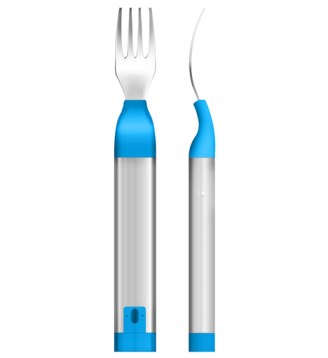
HAPIfork by HAPILabsChewdaism is the theory that chewing food slowly and thoroughly delivers health benefits.
I first encountered this idea while reading AJ Jacobs’ Drop Dead Healthy: One Man’s Humble Quest for Bodily Perfection. It’s one of the healthy ideas he tries out during his year long experiment with improved exercise and nutrition habits.

Chewdaism is obviously a portmanteau (a combination of two words and their meanings) of the words “chew” and “Judaism” though there isn’t any connection that I can see between the idea and Jewish dietary laws.

According to Jacobs, Chewdaism is a kind of food mindfulness. The central tenet of Chewdaism, is that chewing your food 100 times  before swallowing it makes you healthier. Jacobs aimed for just 50 chews and found even that a challenge. He describes a night where his family abandoned him at the table, and left him chewing away into the wee hours.

“They say chewing will cure stomachaches, improve energy, clear the mind, cut down on gas, and strengthen the bones,” Jacobs writes. “Those claims are overblown. But chewing does offer two advantages: You can wring more nutrition out of your food. And more important, chewing makes you thinner, as it forces you to eat more slowly.”

Eating slowly and paying attention to your food, mindful eating as they say, seems obviously to be a good idea. But how to tell if you’re eating slowly enough? Don’t worry. There’s now a fork that monitors your eating speed.

Food tracking which Tracy and I have both blogged about here may turn out to be small potatoes as far the Panopticon goes, given the new food health and nutrition apps and gadgets that are on the way. You can log your steps with a pedometer, of course but new versions of Google on your android phone estimate how far you’ve walked and biked based on the movement of your phone.

“Google Now continues to try and improve our daily lives one little step at a time, and the latest addition seems to be doing just that. Some users are reporting this card now appearing when they open up Google Now, which reports on the distances you walked and cycled in the last couple of months, with a comparison of the two. Pretty nifty, and while not quite at the same level as an actual pedometer, those of you who like to keep active will no doubt find it useful.  How accurate it actually is — especially for the cycling — remains to be seen. Presumably this relies on having your location data, so turning this off should disable it if you’re not too keen.” Read more here, Google slips a walking and cycling tracking card into Google Now.

But back to the smart fork, pictured below. The vibrating fork doesn’t count your chews exactly but it does vibrate if you eat too quickly. Luckily, I don’t eat M and Ms or ice cream with a fork. From the article HapiFork Vibrates if You Eat Too Fast:

“The fork is, well, a fork. But inside it has a capacitive sensor that knows how long it has been since you have taken your last bite. Say you take a bite of that piece of fish, chew it and then go for another bite within 10 seconds. The fork will know that and gently vibrate to tell you have been eating too fast.

The fork also pairs with HapiLab’s iPhone app so you can see how long your meals are, how long you are pausing between bites and even track the number of times you bring the fork to your mouth. The app will also let you track your food intake”

I find myself thinking they could just have it give you mild electric shocks too while they’re at it. Slow mindful eating is good but this seems a bit much monitoring even by my standards. And I like good tracking!

Read more about Chewdaism and about vibrating forks:
Chewdaism: Chew Your Food! on the blog The Jew and the Carrot
diets · sports nutrition · traveling · weight loss

Hunger and Nutrition

There’s a lot of talk about hunger in the literature about making food choices. It doesn’t matter whether your focus is sports nutrition, weight loss, or ‘making peace with food’ and ending dieting, most books in these areas talk about hunger. It’s clear that hunger is something we need to recognize and to which we need to respond. We need to listen to our bodies and to eat when we’re hungry.

I struggle a bit with this because I’m often not hungry when I know I need to eat–during long, intense bike rides is the most common example–and at other times I’m famished even when I know there’s no need for extra calories (after long bike rides when I’m often hungry for the rest of the day and into the next one even after I’ve refueled.)

I was interested to read recently that part of my confusion may be connected to our misunderstanding of hunger.

In Hunger. What it is and what you can do about it Richard Feinman writes:

“We grow up thinking that hunger is somehow our body’s way of telling us that we need food but, for most of us that is not usually the case.  Few of us are so fit, or have so little body fat, or are so active that our bodies start calling for energy if we miss lunch.  Conversely, those of us who really like food generally hold to the philosophy that “any fool can eat when they’re hungry;” passing up a really good chocolate mousse just because you are not hungry is like … well, I don’t know what it’s like. “

When I was focusing on sports nutrition last year, I played a bit with the feelings of hunger in an effort to make peace with them. In situations where I know I’ve had enough to eat, and it’s just a feeling that I can choose to act on or not, I tried to live awhile with hunger and see if I could just let the sensation be. It was interesting experiment and it served me well to realize that the world doesn’t end. I needn’t binge at the next meal. Sometimes it’s okay to live with hunger and wait.

These days I use that to my advantage on traveling days. Yes, I pack food but if I run out it’s not the end of the world.

I hope I don’t have to use that trick as I travel home from Atlanta, site of the 2012 Eastern Division Meeting of the American Philosophical Association, today.

the hunger

That’s the 1983 film The Hunger, of course. My first vampire movie starring Catherine Deneuve, David Bowie, and Susan Sarandon.

sports nutrition · weight loss

Great reading for the fitness geek on your gift list

Timothy Caulfield’s new book The Cure for Everything: Untangling the Twisted Messages about Health, Fitness and Happiness aims to set the record straight on what the latest research in food and fitness does and doesn’t show. Caufield is sick of all of the myths and hype surrounding food and fitness trends.

For the most part The Cure for Everything is a fun, fact filled exercise in debunking. I like a good debunking as much as the next philosopher. What science minded academic doesn’t?

Here are some highlights from the self described science nerd and health nut:

  • When it comes to weight loss, exercise is just a tiny part of the story. 90% or more of it is diet. Caulfield thinks there is a reason so much funding for sports and exercise programs comes from food manufacturers. They’re anxious to redirect attention.
  • That said, we should all exercise more than we do. It’s incredibly good for us, even if we don’t lose weight. What sort of exercise? Heavy weights and intensity. Forget “moderate” exercise, intensity is where it’s at and what makes a difference. Governments encourage “moderate” exercise because that’s where there’s the biggest bang for health improvement buck but really, it’s intense exercise that offers the most individual benefits. Governments rightly worry that if they shared this message we’d all give up, go home, and watch yet more television.
  • There’s no such thing as toning and the best way to visible abs is low body fat. (That’s why heroin addicts look ripped.)
  • Stretch if you want to but there’s no evidence to say it’s good for you and some evidence to show it hurts performance. (Yes! Thank you.)
  • The food industry touts the ‘everything in moderation’ ideal but the truth is that some foods have no place in a healthy diet. Rather by the time you eat all the foods you need to eat, there’s no room for them in the daily calorie count.
  • Don’t bother with vitamins and supplements. Eat real food.
  • And there’s nothing particularly good to say about detox and cleansing diets.
  • Most surprisingly (for me) was his critique of yoga. I wasn’t shocked that homeopathy isn’t medicine but I was taken aback by his claim that yoga is not very good as exercise though it is probably good for stress relief. I’ll worry less now that I’m not very good at yoga but I still enjoy it anyway. Hot yoga on a cold winter day feels wonderful. And I’ll be curious to hear what yoga buffs make of Caulfield’s claims. (Hi Tracy!)

You can read the short version here on Huffington Post, 9 Health Myths Debunked by Timothy Caulfield.

Caulfield leads the Faculty of Law’s Health Law and Science Policy Group at the University of Alberta and is a Canada Research Chair  in Health Law and Policy. He is also a pretty serious track cyclist (a former Canadian master’s champion in sprint cycling) and the same age as me, 48. Oh, and he’s got cool glasses.

What counts as fitness, according to Caulfied? In an interview with Healthzone he says:

In our society, fitness is about looking good, about esthetics. My definition is not tied to sexy abs. It’s tied to feeling strong and vigorous. It’s about biological markers, such as blood pressure and cholesterol. You get all that from working out. If your goal is to look in the mirror for drastic changes, you’re going to be disappointed.

Some of this will be familiar to readers of Gretchen Reynolds’ The First 20 Minutes: Surprising Science Reveals How We Can: Exercise Better, Train Smarter, Live Longer which I talked about here.

Both books cover lots of the same ground although I found Caulfield’s conclusions a little gloomier. Reynolds tends to sprinkle the bad news with the good. She’s also a health reporter and he’s an academic and the difference in background shows. Though both aim to be popular books sharing research in a field many of us care deeply about, if you actually want the science and some details about the studies Caulfield will be a better read.

Both books also make clear that the truth doesn’t provide much fodder for catchy motivational slogans: Exercise intensely for long periods of time and you might just stay the same! Both cite the same study showing women who exercise a lot, and regularly, still gain weight as they age. They just gain less. That’s good health news but won’t exactly make for a very good poster at the gym.

The bit that I found hard to take, though I don’t doubt he’s right, was Caulfield’s assessment of what’s required for long term weight loss and maintenance. People who lose weight and keep weight off in the long run have some traits in common. And this group, because they’re rare, have been studied closely.  First, constant vigilance. They remain as focused and determined as they were when losing weight and they log and track just as carefully as when they started. Second, they exercise a lot. Third, they also don’t eat very much. Yikes.

During the course of writing the book, Caulfied himself dropped 25 lbs and went into the very lean category in terms of body fat. He did with some simple rules: no junk food, very limited quantities (he only ordered starters not entrees) and half of everything he ate had to be fruits and vegetables. He speaks in frank terms about hard this was, about hunger and resisting temptation. He’s kept the weight off but still finds it a struggle.

In the end I like ‘s assessment of the book. On his blog Weighty Matters he calls it an “evidence based romp.” Three words he says he’d never thought he’d string together.

You can hear Caulfield interviewed on the ABC here and his book is also reviewed  in the National Post

body image · diets · sports nutrition

Why Sports Nutrition Counselling Is Not for Me (in the Long Run)

I posted recently about vegan sports nutrition. I know I can fuel my body sufficiently on a vegan diet. A sports nutritionist confirmed that for me. And she was impressed with the choices I make, even before she “counselled” me. In fact, she had very little to say about how I should change my eating, given my level of activity.

Samantha posted about why she hates Weight Watchers. I have also had my ups and downs (literally) with WW and other programs. There are lots of reasons to be wary of any program that focuses on weight loss as the sole goal. And there are lots of programs like that out there.

When I was in my twenties I (twice) lost a considerable amount of weight through a centre called “Physician’s Weight Loss Clinic.” I am 5 feet, 4 inches tall and when I joined I weighed about 120 pounds. On their 700 calorie a day diet (!!) and with *daily* weigh-ins, I went down to 105 pounds (that’s 11 pounds lower than the low end for my height at WW; WW would refuse me or demand a doctor’s note).

Forget any form of activity on the Physician’s Weight Loss Clinic plan. I could barely make it through a work day at my summer job in an air conditioned office answering phones at a desk all day. I’m sure the nurse who did the weigh-ins had an eating disorder. By the time I reached goal, I had one too.

As Samantha said, apart from the fact that these programs don’t usually “work” for long term weight maintenance, they do not have a good handle on what active people require. They do not support, encourage, or even understand eating for performance.

Sports nutrition is a far cry from the calorie-restricted plans weight loss centres and programs offer. And sports nutrition counselling provides solid information for the athlete who regards food as fuel for enhancing her performance. In general, I had a positive experience with it in that respect.

So why have I decided that it’s not for me? I have a history of food obsession, chronic dieting, and disordered eating. The diet industry fostered the attitudes and behaviors that resulted in an almost complete disconnect between my physical hunger signals and my actual desire for food. I had no sense of proper portions and still today struggle most not with what to eat but how much.

At various times of my life, I have attempted to “recover” what I lost: a natural, intuitive relationship with food as a response to hunger and physical need. The most hope for a new approach came to me through the work of Geneen Roth (especially Breaking Free From Compulsive Eating) Jane Hirschmann and Carol Munter (Overcoming Overeating), and Evelyn Tribole and Elyse Resch (Intuitive Eating).

The approach, popularized in the early nineties, teaches people to re-connect with their hunger signals and to stop demonizing some foods as “bad” while others are praised as “good.” All of them said to throw away the scale and commit to never dieting again.

When I first encountered these works, I was a PhD student in a demanding doctoral program. I spent most of my day thinking about food and judging my body harshly. I starved myself for weeks on end and worked out for hours every day. These authors promised relief from the obsession with food and, more importantly, from the body hatred that fuelled my workouts.

This month, after some reflection, I made a decision to return to the authors and books that gave me so much hope twenty years ago. I will be blogging more about that at some point soon.

So what does all of this have to do with sports nutrition and sports nutrition counselling? Given my history, it is beyond easy for me to convince myself that a solid “plan” is not a diet. Even the diet industry avoids the word “diet” these days.

But for me, no matter how sound the information I receive from a nutrition counsellor is, it starts me down the path of what I call “mediated eating.” The eating is mediated by information about what and how much I should be eating. And that disassociates me from my body, my physical hunger signals, my intuitive relationship with food.

For me, that is dangerous. It fosters old patterns of behavior and soon I am back to an obsessive relationship with food. Eating is then mediated by the desire to change my body. My body is no longer acceptable as it is.

And the cycle starts all over again. I can feel that creeping back into my life right now. It started with the nutrition counselling. I want to nip it in the bud.

Now, maybe someone who is blogging about being “fittest at fifty” is just fooling herself if she thinks she can have that as a goal and yet not have an at least somewhat mediated relationship with food.

We will have to see. If I want freedom from the obsession with food, weight, and body image, I need to accept that for me (not necessarily for you), sports nutrition has all the psychological trappings of any other plan.

And that’s why I am no longer interested in sports nutrition or sports nutrition counselling.

sports nutrition

Vegan Sports Nutrition

My trainer has said on a number of occasions that I have two main things working against me as I attempt to increase my lean mass and decrease my body fat percentage: my age and my vegan diet. I’m only going to get older. This I know.  And I am strongly committed to a vegan diet for ethical reasons. So I found his opinion quite discouraging at first.

But I have now come to the conclusion that he is just wrong. My first piece of evidence comes from this amazing gym in Melbourne, Vegan Strength.  These guys are all vegan and I defy anyone to say that they don’t have enviable lean mass to fat body composition.

And then there’s Amber from Go Kaleo. She has a great video response to the claim that eating a vegan diet makes you “skinny fat.”

Exhibit 3, Samantha’s post the other day about vegan athletes.  Clearly, these people are not under-performing and do not have compromised fitness. And yet they are vegan.

Here’s a good article from The Yoga Journal (author Rachel Seligman) about the merits of a vegan diet for sports nutrition.

According to the article, “these athletes say they stick with it because they feel—and perform—better. After six months without meat, eggs, or dairy, Jurek found he bounced back quicker even as his workouts grew harder and longer; he didn’t feel as sore or tired after one of his ultramarathons, he says. Vardaros says she rarely gets sick and outlasts her nonvegan friends in training. Heidrich says she has more energy, which has allowed her to dramatically increase her training. Not long after she committed to veganism, she completed her first Ironman Triathlon (a 2.4-mile swim and a 112-mile bike ride followed by a 26.2-mile marathon).”

Finally, my own visit to a sport nutritionist a few months ago yielded very little advice. She did a detailed analysis of the nutritional composition of my diet over a three-day period. The only thing I wasn’t doing to fuel my body for optimum performance was eating frequently enough throughout the day.

The myth that vegans (or even vegetarians) cannot be athletes flows directly from two assumptions. First, athletes requires lots of protein to gain and maintain muscle mass.  And second, the only sources of quality protein are animal sources. The second assumption is off the mark.

According to The Yoga Journal article, getting enough “protein is no problem on a vegan diet. Half a cup of lentils or tofu gives you 9 or 10 grams of protein; two tablespoons of peanut butter gives you 8 grams. Beans, nuts, and grains are all good sources of protein; even veggies contain small amounts. And though meat is sometimes praised for having a complete spectrum of the amino acids our bodies need, vegans can get all the necessary amino acids if they eat a variety of foods every day.”

While I don’t think I’ve hit on a totally winning balance of fuel and activity yet, I do feel encouraged that I can continue to eat vegan. “Skinny-fat” is not the best I can hope for. I can continue to alter my body composition and stay true to my ethical commitments at the same time.

For more resources on vegan sports nutrition, see VeganHealth.org, which has a list of further readings on the topic.

fat · fitness · health · sports nutrition · weight loss

Fat, fit, and why I want to be leaner anyway

As you’ll know from reading my posts on our blog, I’m fat and fit, aiming to be fitter and to be the fittest I’ve ever been, at 50. (In some moods I prefer big and fit, read why here.)

Weight loss isn’t a direct goal for me in this project. That’s partly because I’m a supporter of the Healthy At Every Size movement, partly because I don’t think there’s a fatness-fitness connection, and partly because for me, personally, there aren’t health related reasons to lose weight. So I take it as a starting point that it’s possible to be the fittest I’ve ever been and not weigh the least I’ve ever weighed. Indeed, although I wouldn’t like it, I might be the fittest I’ve ever been and weigh more than I do now, though I’d much rather that not be the outcome I get.

As I detailed in Fat, Fat, and What’s Wrong with BMI I’m a bit of a healthy living rock star. Yes, I’m significantly overweight but I have excellent blood pressure and heart rate, excellent good-bad cholesterol ratios, and excellent blood sugar levels. I’m also an over-achiever in the bone density department but that’s from years of living large and lifting heavy weights.

(An aside: Bone density is a great reason to lift weights, especially for you small, thin women whose frames aren’t much challenged by the mass you carry around. Weight lifting works to build bones unlike endurance sports such as swimming, cycling, and running which in volume can actually hurt bone density. Read “Training to Improve Bone Density in Adults: A Review and Recommendation here.)

I’m also not sure about the wisdom of picking a goal–long term weight loss–that defeats almost all the people who aim for it. (Read Gina Kolata’s Rethinking Thin: The New Science of Weight Loss—and the Myths and Realities of Dieting for some of my reasons.)

Oh, and I already eat very well. I’m a vegetarian, aspiring vegan, non-drinker, who stays well away from fast food. I have a bit of a sweet tooth and sometimes I eat too much of  good thing but there’s not a lot of room for nutrition improvement.

But I really would like to improve my ratio of lean to fat, by building more muscle and losing some fat, even if I think that’s got zero to do with fitness or being fittest by fifty.

Why?

That’s a question that in our culture hardly seems worth asking. Everyone I know, pretty much, wants to shrink. The size 4s want to get back to size 0, the 10s back to 4, and so on. It’s a cultural obsession and mega money making industry. I try to stay clear.

Most people assume weight loss is why I exercise. But really, if that were my goal I would have quit long ago. Indeed I worry that lots of fat people quit working out because they aren’t getting thinner and why else would they go to gym? The fat but fit person looks like she’s doing all the work and not getting the rewards. Nevermind that the real rewards are health related and have nothing to do with weight.

So again, why do I want to be leaner?

My main reason I want to get leaner is sports performance. An awful lot of what I do depends on a power to weight ratio. For an explanation of power to weight ratio and its importance when it comes to cycling, read The Pursuit of Leanness over at Australia’s Cycling Tips blog.

I’ll never be a hill climber. I’m a reasonably powerful sprinter and time trialer (for a recreational cyclist in her midlife years!). I know my place in the cycling world. But I’m sick of getting dropped on hills.

My second motivation for the pursuit of lean is wear and tear on joints. I love sports and physical activity. Hard to imagine life without it. But you don’t see many overweight runners in their 70s. Cyclists either. I worry about stress on my knees and hips and think there’s got to be an advantage to weighing less. Or at least if I want to play with people lots younger than me, as seems to be the case with every sport that I do, I want to even the playing field.

Evening the playing field is one of the reasons I feel great being a non-drinker on multi-day cycling events. Stay up, you 19 year olds and 25 year olds. Have another beer. I’ll be asleep, sober, and well hydrated by 10 pm. Not fun now but fun when I see you suffering tomorrow.

Finally, there’s  bad motivation, one of which I try to be wary. And no, it’s not looking good naked. Like Tracy, I’m pretty comfortable in that department. I don’t have a lot of body image issues. I’ve often wondered about why that’s so. I’ve got some thoughts about my resilience in that department, fodder for a later post, I think. (Short answer: Thanks spouse, thanks feminism, thanks queer community.)

Sometimes I want to look like the very fit person I am. There are days when I’m weary of fighting the good fight, challenging our notions of the size and shape fitness takes. Sometimes I want people to look at me and see who I am and what I do.

For example, I’ve got incredible abs. You can’t see them as they are under a layer of fat but they do amazing things. I’m very strong in my core but it’s like they’re a secret super power, my invisible abs.

Not being seen for who I am is a bit of a struggle on my life on a few fronts. (You can read some of my work on bisexual invisibility here and here.)

So sometimes I’m sick of it all and want to be seen as the athlete I am.

But I’m hoping to keep those motivations at bay and focus on the hills and the climbing.