“National Hammock Day is a day to celebrate hammocks and all they can do for the summertime experience. This special day is celebrated each year on July 22nd. Hammocks are one of the most versatile pieces of camping gear there are. They can be used for sleeping, hanging out in the sun, or just relaxing.” See here.
From our hammocks to yours, we wish you a happy hammock day!
Two in a hamockReading a thesis in a hammockPost swim hammock-ingSarah in her hammockMallory in her hammockCamping with our hammockAlgonquin hammockAlgonquin hammock
I went summer camping with 5 friends recently. We went biking, swimming, kayaking, and hiking—regular outdoor physical activities one might do while in The Nature.
During this time, I noticed how often we were up and moving around to do simple tasks and chores throughout the day, even when we weren’t out out doing the recreational exercise activities.
When we wanted to go to sleep, we had to put up a tent. When we wanted to make a fire but ran out of wood, we had to scavenge or head to the conservation office to buy more. When we wanted to brush our teeth, it was a walk or a bike down the path to the loo. Whenever I misplaced bug spray or sunscreen, I was up rummaging around to find what I needed.
There’s exercise to be had in scavenging for firewood!
Not everything was within easy reach when you are camping: there’s often a little added effort to find, get, or make whatever you need. Without all the conveniences of home, we were moving, walking, bending, and stretching in short bouts all day long.
Like most people, I often establish habits and use tools that maximize convenience and comfort when I am at home. How much more physical activity might add up in my days if I intentionally made things slightly less easy for myself? What if I chose to knead bread without the mixer, walk to my mailbox rather than stop after my commute home, use one tissue box at a time rather than plant them in many rooms of the house?
The animated Disney movie Wall-E tells a story of how, in the future, people have every luxury thanks in part to the machines they invent; consequently, they become totally inert and lazy. The moral of this cautionary tale is that excessive convenience and comfort will diminish our ability to think and act and move for ourselves.
Of course, my tent-trailer and Coleman stove camping experience was still relatively easy and convenient, but I realized that adding some purposeful inconveniences in my daily life could lead to a little more physical activity that I might not even notice.
What are some small inconveniences you maintain for a little more physical activity each day?
I’ve been nervous about having signed up for it this year. The training is hard, the fundraising is hard, I’m getting old, I’m waiting for knee replacement surgery, I’ve got a big job, and the rally takes a lot of time. Maybe those days are over? Nothing last forever, right?
I know some of that anxiety is unreasonable. I’m actually not that old. My knee is a disaster but otherwise I’m in pretty good shape. I know some of the anxiety is related to having lived through the pandemic. But it’s also hard figuring out what’s reasonable and what’s not. And whether or not it’s reasonable the anxiety is certainly real.
I tell people that doing one day of the rally isn’t that hard. Lots of you could do it right now. The hard thing is getting up the next day and doing it again. I blogged about the ‘toughness’ of the rally here: How was it? Could I do it? Reflections on the bike rally.
It’s true you don’t need to ride that fast but in a way it’s harder to ride slowly. It’s more time on the bike.
I like the rally experience best when I’m in good shape. I get into the campground with energy to put up my tent and go for a swim. I get a massage, I stretch, and enjoy a delicious vegetarian dinner.
Here’s one my favourite stretches of road on the rally:
Long Sault Parkway
So this weekend, I put some of my jitters to rest. Sarah and I rode 70 km on Saturday with Jeff who is town having helped with a boat delivery, and on Sunday we rode 97 km on a bike rally training ride. We did the thing I was nervous about, ride one day and get up the next and do it again. And it was fine. Better than fine. Both days felt great. My knee was fine.
Yes, it was a bit of slog out to Musselman Lake on Sunday with some hills and a headwind but we made it just fine and the ride back, with a tailwind, was glorious. It was also great to see bike rally friends again.
It helps that lots of them are my age. I’m not alone in being nervous about doing this thing again after a break. Thanks to the pandemic we’ve all had a break.
The past twelve months of my life have been overflowing with adventures and exciting changes. In May 2021, I began to realize that my beloved London, Ontario community would not be my home forever. But I wasn’t sure what my next steps would look like.
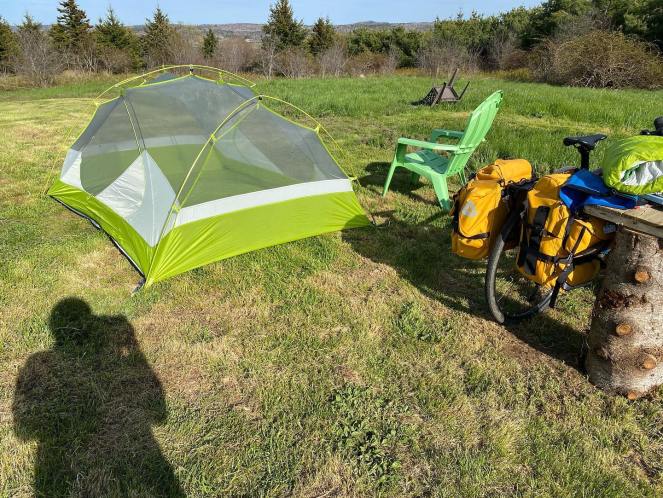
In late August, I hopped on my trusty pedelec (pedal electric assist cycle) loaded with camping supplies and headed north along Lake Huron. At that time I assumed I’d be back in London by November or December, but had no plans set in stone.
In mid-October, I was biking from Wikwemikong to Manitowaning when I snapped a milestone photo showing 1200km on my trip odometer. Although I continued on to Kagawong & Ice Lakes afterwards via a bus-bike combo, in many ways it marked the end (or at least nearly the end) of my first bike camping adventure.
A week later I was supposed to catch the last ferry of the season back to Tobermory… but I didn’t want to leave. In the short time I’d been on Manitoulin, I had already begun to feel a sense of belonging. Community care, breathtaking beauty, and changing scenery around every corner make Manitoulin a place unlike any other that I came across in my travels.
Several weeks of stealth bike camping increased my comfort with making decisions based on rapidly changing contexts, rather than trying to plan everything in advance. Manitoulin feels like where I need to be during this season of my life. So I took a leap and unexpectedly moved to Northern Ontario via bike camping!
This December sunset bay photo feels like a warm winter hug! To the left, a few trees are silhouetted against a pastel pink sky. A couple islands can be seen on the horizon line. A thin row of rocks poke through ice which reflects the sky near the horizon, but is covered with snow closer to the shore line. The shore has patches of snow interspersed with sand and tufts of grass. On the left side of the foreground is the corner of a weather worn wooden fence, with tall dried grass spilling out to the right and gradually thinning out. Despite the busyness of this photo, it somehow feels inviting.
Yes, you read that right. After two plus years of pandemic and nearly two years of life with a little one, we are going on holiday. As in, travelling somewhere that’s not to see our family, or visit friends (we are, in fact, going to visit friends on the way, but we’re also going to be on our own for a bit).
We’ve rented a camper van and will be cruising around Dutch campsites. We’re taking our bikes (the adults) and trailer (the toddler), in the hopes that it will stop raining for long enough that we can do some cycling tours through very flat landscapes. This may not sound very adventurous, but right now I think it’s going to hit the sweet spot of being active but not overexerting ourselves, and fun for everyone in the family. We also have a kite, beach toys, and swimwear – not that we’re planning the brave the North Sea (though who knows?!), but the weather forecast really isn’t great, so if it won’t stop raining, at least we can go to the indoor pool.
When you read this, we will actually already be on our way back, but I’m writing this post before we even leave, since I don’t know how much Internet we’ll have along the way (the campsites all promise wifi but I also honestly don’t know how much I’ll feel like posting when the alternative is frolicking around a campsite or the beach!
I wrote in my first post that every material aspect of touring by bike seems to have a metaphorical one as well. How you pack your bags might be the most obvious.
Baggage. It’s a loaded word that translates directly to a loaded bike.
The multiple decisions of what to take and leave tell you so much about your need for comfort, the things you think you can’t live without, the fear that you might need something and not have it, or suffer for not having it, or feel foolish for not having it, or feel equally foolish for having pushed it and hauled it and never used it.
The novice bike adventurer, that is me, has to rely on other peoples’ lists, what experience has taught them is necessary—or extraneous. The first decision, and one with the biggest consequences for your route and weight is whether or not to camp.
Cruising from bed to bed is delightful—and much lighter—but a tent and sleeping bag and a little mattress and a tiny stove and pot and an areopress gives you ultimate freedom and coffee in bed in the most delicious places. It’s a paradoxical combination of baggage and freedom. Camping will easily add ten lbs to the bike but will allow you to pull off the road wherever you can. Everything else is a question of comfort and fear.
Like most riders, I performed the ritual of unloading, sending home a package of heavy and accumulated light things—each light thing feels like nothing on its own—after riding for just a few days. Some of my protection and comfort and cleanliness went with those things, but hauling them around just wasn’t worth the weight. You see the obvious psychic metaphor here.
And, a week later, as I contemplate the mountains of Cape Breton, I’ve deemed another bag of stuff not worth the drag. The bike is still very heavy. I haven’t weighed it; I don’t want to know. I’ve climbed a few steep hills now and know that I can crawl up just about anything, but no question, I feel every ounce.
Have I missed anything I’ve let go? Can’t even remember what I packed off, except that most of it I bought last minute and because I was checking off other peoples’ lists. What’s the heaviest thing you cannot do without? Water. Unlike everything else, you need more of it than you think you do.
I think about weight and baggage with almost every pedal stroke. If even the minimum I have now feels too much, what about all the things I have left behind? The one object I keep excising and adding back in—and here my attachments as a recovering English Prof are most obvious—is a book.
Julia Creet is a recovering academic who just wants to ride her bike.
I blame Cate Creede. She made it look so good, so easy. Just hop on your bike and go… wherever your legs will take you. No waiting for others, or trying to catch up. No discussions about decisions, where to go, when to stop, what to eat. Complete unstructured freedom.
That was the appeal. It seemed like a strange appeal after two years of more isolation than I could barely tolerate. Why chose then a trip on which I would mostly cycle alone?
I had an inkling that it would serve so many deep purposes for me. A chance for the wind to unravel the wired knots of my brain, cinched by two years of technology and teaching. Time to think through the decision to retire after twenty-five years of a full-on academic career.
And I needed new conversations. Riding alone would open my bubble to anyone who crossed my path. That felt exciting and random and the very opposite of my shrinking social circle and the rigid structures that were my scaffolding for surviving these strange last two years.
So here I am wandering around Nova Scotia, my home in my panniers, learning to crawl hills and stealth camp. I have some thoughts I’ll share along the way. Every material aspect of riding seems to have a metaphorical one as well. So thanks Cate. You said this to me early on in one of our chats about riding solo. “And for me there is something I really love about ending up in some random place with terrible food and knowing that I got there on my own.” You were right.
Julia Creet is a recovering academic who just wants to ride her bike.
Sorry to leave you all hanging for so long! When I wasn’t hanging in my hammock, I was catching up on school and much needed rest! As fun as adventuring is, it’s also tiring. I’ll be taking a break from blogging for a while to dig into exciting research projects, focus on my course work, and start drafting ideas for a book. My posts will be sporadic until I have a lighter course load in the spring. In the meantime, you can follow me on Twitter @JoyBringingHope.
Image Description: In the top right corner of the photo is a background with grey and white clouds with a tiny bit of blue peaking through, below it but still in the background are brightly coloured trees in red, orange, and yellow. In the foreground, surrounded by first tall grass and then a neatly manicured clearing of grass, is another group of trees that are yellow-green and in the centre of those is a forest green hammock covered by a rain fly.
Give yourself time to adjust to a hammock and ask for comfort tips. Initially I found my comfort was inconsistent, so Hennessy suggested positioning my head at the (slightly) lower end of the hammock. It worked! Now beds annoy me. 😂 A quick pre-purchase web search revealed that many North Americans are surprised that they prefer the comfort of a hammock over the comfort of a mattress. (Don’t tell Sleep Country or hammocks will start costing thousands of dollars!)
Pillows are unnecessary (and uncomfortable) while on your back, but useful when sleeping on your side – a sweatshirt works too.
Practice setting up before you actually need it — or at least leave plenty of time to set up before dark.
Falling asleep staring up at the stars is epic… I will never tire of that.
Be prepared for sudden rain even if it isn’t in the forecast.
As the nights start cooling down dew makes the rain fly necessary even when rain isn’t forecast.
Waking up to chirping birds or chittering squirrels can be fun… and rain flies provide poop protection!
Image Description: the background fills the left half of the photo with green grass, it is lush towards the top of the photo, but sparse and interspersed with dirt towards the bottom. The right half of the photo shows a close up of part of a tree trunk in the foreground. In the centre of the photo peaking around the tree and looking directly at the camera is a brown squirrel with a cluster of seeds from a cedar tree in it’s mouth.
Apple trees smell nice, but you’d better have a strong rain fly! 😆Hennessy’s held up well. 🙃
Position your hammock so that the zippered side of the bug net opens towards the easiest exit… which conveniently also allows easy sunrise photos from your cozy sleeping bag.
If you’re hammocking between posts be aware of joints where your rope can get jammed. Always use tree straps since they are easier to get out of a jam or replace if necessary.
Transcript: “I definitely just used my bicycle as a stool so I could get up here [onto the top of a pavilion beam] because my hammock rope was wedged into there [between the joints] and it required hacking with a tent peg in order to get it free. So this was an adventure for the morning. Problem solving while hammock camping.” Image description: A caucasian woman with rosy cheeks wearing glasses, a red rain coat, black gloves, and a blue helmet over a thin grey hat. I am perched atop a wooden beam at the edge of a pavilion, holding my hammock rope and a tent peg in one hand while videotaping myself with the other.
Water bottles in plastic bags are great for keeping the fly taught by weighing it down.
Watch the forecast and find covered shelter if it’s likely to be rainy *and* windy. Pavilions, bridges, and Kingdom Hall overhangs are prime possibilities. School entrances could work in a pinch, but would definitely be a privileged mea culpa option which likely has a relatively high risk of police being called. Huge thanks to my friend Eric Todd for brainstorming with me when buckets of rain were expected and the only pavilion in Espanola was unavailable!
Image Description: In the background is a grey sky, with a forest of trees. In the mid-ground is highway 6 leading out of Espanola. In the foreground is the distinct architectural design of a Kingdom Hall: a red brick building with a wide and long overhang that is big enough to fit a large SUV underneath, the ground beneath is red cobblestone. Underneath the overhang is a blue winter shovel, beside a yellow bin (presumably holding sand), beside my bicycle which is covered in a camoflage bike parka. Beside all that, just in front of the main doors to the building the edge of a blue tarp can be seen on the ground blowing slightly in the wind. On top of this is my hammock with bug net (to protect against the few remaining mosquitoes), then inside that is my sleeping pad, sleeping bag, and an emergency blanket.
Better yet, buy a big rain fly. The one mine came with was perfect most nights… but nowhere near sufficient during windy storms.
If lightning is expected look for a shelter with electricity (eg. fancy picnic pavilions and Kingdom Halls). At the very least avoid tying to the tallest trees… maybe also avoid close proximity to large bodies of water. Stay off the ground though… it’s a conduit. Shoes don’t have enough rubber for lightning protection. (Don’t ask me why. I read this somewhere online while freaking out at my nightmare stealth site.)
Bring a sleeping mat for insulation; it’s also useful if you need to wait out a storm on the ground of a pavilion or simply can’t find suitable trees.
Bring a balaclava to keep your nose and ears warm.
Bring a spare dry bag to store your dirty shoes beside your hammock.
In the space of a few days, I had both the worst and the best campsites.
I was in Thessalon on September 14th, when I had an utterly nightmarish campsite. Hopefully this gives you a laugh without giving my mom nightmares! It began with an electric storm that kept me up terrified I’d be struck and with no idea what to do to protect myself… something I didn’t research before leaving home! I tried googling this info, but my internet connection was the speed of dial up… so while I waited, I continued freaking out about the possibility of being struck by lightning. Eventually I managed to read a few articles that were only marginally helpful and then climbed out of my hammock to begin looking for a safer space to wait out the storm. Since I found nothing within close proximity, I figured curling up in my hammock on a thermarest was probably safer than being a tall thing seeking shelter in a fairly open area.
As I returned to my hammock, I noticed a small plant in the middle of my “campsite.” Not knowing how to identify poison ivy, I freaked out… another thing I didn’t research before leaving home! After yet another extensive and painstakingly slow Google search, I concluded that it was in fact poison ivy. If I’d stepped in it while setting up camp, I’d long since spread it all over my clothes. In the morning I would need to figure out a place to wash my clothes and shower carefully just in case I’d stepped in it… something fraught with other risks since I don’t do well with many types of laundry detergents and artificial fragrances… both of which laundromats are full of.
Finally the lightning ceased and I fell into an exhausted but fitful sleep. I woke up to my 7am alarm, but I desperately needed more sleep so decided it was worth the risk of someone finding me there. By this time I’d been discovered stealth camping a few times and it had always ended in a great convo and laughter, so I wasn’t concerned. I figured the worst that would happen is they would tell me to leave… and I would leave… no big deal.
Around 8am, I awoke to trucks sawing down trees on the next lot and approaching my “campsite” …which was also a construction site.* I have never scrambled out of my hammock and packed up camp as quickly as I did that day! Don’t worry though, I paused to snap a photo before tearing down and did a quick vlog before racing out of there. I did not look back. Really wish I’d left behind a note for the unsuspecting construction workers: “Thanks for the campsite… and not felling a tree on me! My day would have been soooo much worse if you weren’t skillful at guiding the trees as they fell!” (Note to those absolutely horrified by this story: I would not have stopped to video or even packed up if I didn’t think it was safe to do so.)
Idyllic spot on the beach? Maybe not…
Even with anxiety a trip like this can be fun… and vlogging my mishaps has been a great way to gain perspective and find humour in the challenging aspects of my adventure. Don’t worry… most sites are nowhere near as dramatic as this one!
Down the street, I paused to pick up my bear bag from the portapotty at the nearby park and to rearrange my load which was very higgilty piggilty. For some time I stood in the wind beside the playground alternating between feeling amused at the absurdity of the story and anxious about poison ivy. I was grateful that the rain held off until I could assemble myself and plan my next steps.
It took a few hours, but eventually my day began to turn around, thanks in large part to another visitor to Thessalon who asked if I was biking across Canada, was empathetic when I immediately burst into tears, looked at the “poison ivy” photos I had taken and confidently told me it was not poison ivy. Thank you environmental guide turned musician visiting from the states for the first time in two years! We ran into each other a few times during the next few days and both appreciated the company of a new friend in the midst of our solo travels.
What I thought was poison ivy… My second night in Thessalon I slept peacefully at the city run campground across from this beach.
Delightfully, a few days later I was gifted with the best campsite imaginable… a much needed reprieve! More on that another time!
*Yes, it was a bold stealth spot that likely only felt like a reasonable risk because of my social location as a white thin female. I can get away with things many others could not.
Over the course of about ten days, I spent several hours on the phone with Elections Canada being transferred to one person after another as I tried to get correct information about my voting options, figured out how to vote by mail, and how to resolve complications with the process. I could have voted at any Returning Office before the 14th, but by the time I learned that I was in Espanola and was under the impression that I still had plenty of time to vote by mail since September 14th was listed as the deadline to apply.
Unfortunately, this is misleading since in reality it wouldn’t allow for enough time to receive the special ballot via Canada Post and then get it back to Ottawa by 6pm on September 20th. That’s right, post mark dates aren’t what count here; it has to physically arrive in Ottawa by the 20th. That sort of turn around *might* be possible, but only for those who can afford $85+ to courier it there.
Why is the government not footing this expense for all mail in ballots given the impossibility of the deadline they have listed? Disabled folx and those in remote communities (like Northern Ontario) will be disproportionately excluded by this process. How many ballots will arrive late and thereby be excluded? During the last election “11.1 percent of national ballots and 11.8 percent of international ballots were returned late” (Elections Canada Vote by Mail FAQ). Clearly this is a significant issue even outside of a pandemic.
I applied on September 9th, but even this wasn’t enough time by regular post and maybe not even by express post. My ballot finally arrived to Iron Bridge on September 15th. At that point I was in Thessalon and had been told by Canada Post that the mail left at 5pm. Express post should get it there in three days – just enough time. I packed up as quickly as possible and rode hard and fast to get there in time.
On the way I made a quick stop at Little Rapids General Store for food. I’d heard they had lots of delicious smoked meat and cheese and I needed food anyway to get through the next stretch without grocery stores. Little Rapids did not disappoint. The smoked rainbow trout and taco flavoured cheese curds were delicious. Beyond that though, the town is a beautiful hole in the wall spot that most drivers would likely miss. I was disappointed that there wasn’t time to hike out to see the salmon spawning or take in the heritage museum. It also had lots of spots that looked great for stealth camping.
Standing outside Little Rapids General Store with dinner and on the go protein (taco flavoured cheese curds, smoked rainbow trout, dried turkey, and dried elk!)
About half way to Iron Bridge I realized that without taking the highway I’d never make it. Pro tip: avoid this stretch of highway 17 at all costs. There’s no paved shoulder and drivers will risk your life here. If I hadn’t been so emotional about the messed up system I likely would have bailed and hoped it would get there anyway. As it was, I plowed on.
My cousin didn’t have time to drop my ballot off and I knew there was no way I’d get to the their place and then the post office in time. A random kind gentleman in his driveway picked up the ballot from my cousin’s (only a few blocks away) and dropped it off at the post office across the road. I made it to the Iron Bridge post office just before 5pm!
But I got misinformation for the bajillionth time: mail left at 3pm, not 5pm. Couldn’t have gotten there earlier anyway. I cried… not for the first time about the likelihood of my ballot not being counted. I jumped through so many hoops trying to get this ballot in – including changing my route multiple times. Right now it’s not looking hopeful – as of now it’s showing a Tuesday arrival and has no updates since it left Iron Bridge on Thursday.
Giselle (Canada Post staff) and I crossing our fingers in hopes that the ballot arrives in time to count.
As someone who has lived in poverty since my teens, the right to vote is a huge deal. It’s how we raise our voice, call for change, and hold our government accountable. If you weren’t planning to vote today, please get moving and go vote. My vote probably won’t be counted, but yours still can (if you have the privilege of accessibility). If transportation is a barrier phone the office of anyone who is running and a volunteer will help you get there!