fitness

Be a Fitness Muppet!

Here’s Brett Goldstein (of Ted Lasso fame) speaking as a guest on Brené Brown‘s podcast, Unlocking Us about the Muppets.

“Well, it’s like… The secret of the Muppets is they’re not very good at what they do. Like Kermit’s not a great host, Fozzie is not a good comedian, Miss Piggy is not a great… None of them are actually good at it, but they fucking love it…

And they’re like a family and they like putting on a show and they have joy and because of the joy, it doesn’t matter that they’re not good at it.

And that’s like what we should all be. Muppets.”

I agree. What I love about the Muppets is how much fun and joy they have even though–as noted above–they’re not the most talented at what they do.

I blogged recently about being willing to be bad at a thing and the role that willingness plays in motivation.

For me, it feels like it’s sport dependent. There are sports I’m good at and they’re easy to like. Bike riding! Weight lifting! I’m a strong, powerful person with a fair bit of endurance. And I take joy in those activities in part because of my achievements.

But that doesn’t work when I’m bad at a thing. Now it’s one thing to be bad at thing and not like it. Then you can just move on and find something else to do. But what about things you’re bad at and like anyway?

I never was a very good soccer player but I loved it. I liked the team aspect, the social aspects of playing, being outside. There was lots to take pleasure in besides getting good at soccer. I was a soccer Muppet.

I’m also not very talented at Aikido. Sometimes that was fun and sometimes it wasn’t. Most of the not fun bits revolved around testing. I worked hard but the individual testing made me want to get better and when I couldn’t, at least not at the speed of those around me, I really struggled to enjoy it when I knew I wouldn’t be ready for the test everyone was training for. It felt hard to be part of the community and opt out of the testing culture.

Swimming? Not ever getting faster bums me out.

But why do I care about getting faster? Why do I care about advancing to the next belt level?

Swimming and Aikido are both good for me even though I’m not good at them. I should bring some of that Muppet energy to the pool and the mat. Weirdly as I get older, it gets easier. People drop their expectations. People are just impressed you’re doing a thing at all. That’s ageist and frustrating in a different way but it takes the pressure off.

Do you struggle with not being good at things, even if they bring you pleasure? Or are you a happy, cheerful amateur, a fitness Muppet, as it were?

There’s a quote attributed to Kurt Vonnegut though no one can agree whether or not he actually said it, where it came from, or who else might have said it, if it wasn’t Vonnegut.

It’s in a spirit aligned with my calling for more Muppets in the fitness world. It’s a great quote. Bonus points if you know who it’s actually from.

“When I was 15, I spent a month working on an archeological dig. I was talking to one of the archeologists one day during our lunch break and he asked those kinds of “getting to know you” questions you ask young people: Do you play sports? What’s your favorite subject? And I told him, no I don’t play any sports. I do theater, I’m in choir, I play the violin and piano, I used to take art classes.

And he went WOW. That’s amazing! And I said, “Oh no, but I’m not any good at ANY of them.”

And he said something then that I will never forget and which absolutely blew my mind because no one had ever said anything like it to me before: “I don’t think being good at things is the point of doing them. I think you’ve got all these wonderful experiences with different skills, and that all teaches you things and makes you an interesting person, no matter how well you do them.”

And that honestly changed my life. Because I went from a failure, someone who hadn’t been talented enough at anything to excel, to someone who did things because I enjoyed them. I had been raised in such an achievement-oriented environment, so inundated with the myth of Talent, that I thought it was only worth doing things if you could “Win” at them.”

fitness

WHO drops ball on diabetes and weight stigma

Earlier this week, WHO posted a tweet on World Diabetes Day. It received a significant response, so much so, it deleted the tweet and then posted an apology which included a screenshot of the now-deleted Tweet (see image below).

The image is a screenshot of a tweet. WHO says: We have removed this post following comments we’ve received. We apologize for an image that was stigmatizing and for content that was inaccurate in explaining the types of diabetes. Attached to the Tweet is an image identifying the causes of diabetes Type I (unknown) and Type II (excess weight and lack of physical activity). Accompanying the commentary is a picture of a large man sitting in an easy chair and eating a large bag of snack food.

Dr. Yoni Freedhoff, an Ottawa-based specialist in obesity writes a blog and here he writes: Never mind genetics, social determinants of health (including poverty, education, caregiving requirements, etc), co-morbid medical conditions, and more, the actual World Health Organization on World Diabetes Day, is stating if you have type 2 diabetes, it’s your fault.

Weight stigma surrounds us everyday. The pressure to lose weight to meet a social ideal is constant. It used to be the ads would start late in the spring on getting beach body ready. Now we have, beach-body season followed by little black dress season in the holidays, then by New Year’s resolution season, winter beach vacation season, prom season and wedding season.

Really, when is there not a season where we are told to lose weight?

That said, the WHO, with their use of stigmatizing language and victim-blaming, lent an aura of credibility to long-held assumptions on the causes of diabetes, and also possible solutions (eat less, exercise more). The WHO ignored issues of social determinants — whether one can afford nutrient-dense food, whether one can afford to go to a gym, or even if you afford the time to workout and the issues of genetics such as family history, conditions which lead to insulin resistance/diabetes/obesity (hello polycystic ovarian disease).

Yes, we can all make choices that lead to improvements in our health, well being, and quality of life overall. However, we need to make choices and be able to afford those choices based on best evidence, and in this case, the WHO got it all wrong.

covid19 · fitness

Learning About Curling

By Elan Paulson

For my whole life I knew nothing about the sport beyond that it resembled the shuffleboard table in my grandparents’ basement and it was a Winter Olympics sport (again). I hadn’t even seen the Canadian romantic comedy, Men with Brooms (2002), with Leslie Nielson.

Then, in 2020—pandemic year 1–I joined a curling club. I am not amazing at curling, but thanks to many supportive players I picked it up faster than I picked up soccer as an adult.

Now in my second season of curling, I’ve discovered that this sport is growing its inclusivity and fitness focus, yet remains rooted in etiquette and community. Let me tell you a little about what I’ve learned about curling!

Curling is for Many People

Curling is an olympic and paralympic sport, with medals for four-person women and men’s teams. Men and women can play and compete together in mixed leagues and on mixed doubles teams (two people instead of four), since finesse matters as much as strength.

Curling is also a recreational sport for youths, seniors, and everyone in between. Learn to curl clinics are put on annually by curling clubs, and online information for new curlers is widely available.

There are various support tools for all types of curlers. These “sticks” and “crutches” aid the release of the curling rock that travels down the 146 to 150 feet of ice, providing stability and balance for players. The supports also alleviate pressure on the knees and body, giving all kinds of bodies a chance to curl.

Screenshot of Google search for “curling sticks and crutches”

Curling associations, such as Curling Canada, encourage the sport’s accessibility. The Ontario Curling Council explains that wheelchair curling leagues and curling competitions are available for those who are non-ambulant or can only walk short distances. Canada boasts talented, award-winning visually impaired and wheelchair teams.

In terms of gender inclusivity, my teammate tells me that some larger clubs have open and LGBTQ+ leagues. More clubs are also drafting inclusion policies, showing that this once traditional and gender-siloed sport is striving to grow and change with the times.

Curling is in Many Places

Curling clubs have existed in Canada since 1807, with the first curling club located in Montreal. Today, you can find curling clubs throughout Canada, but more than half of these clubs are still located in small towns.

Sports and recreation foster not only healthy activity but also local community. Studies have shown that curling supports the health and wellness of rural women and older adults. I hear that many people grew up with curling in the family (so kids learn to play whether they want to or not).

In the country and the city, curling has a reputation for courtesy. League games are non-refereed. Curlers are supportive and unpretentious. (When you throw a rock really well, you celebrate by complimenting your sweepers.) It is customary for the winning team to buy the first round of drinks for the losing team after the game. (This tradition of sitting together post-game was temporarily suspended during the COVID-19 pandemic.)

The Fitness of Curling

Curling has a reputation as a sport for being more recreational than rigorous. However, the author of this article from The Cut describes how throwing and sweeping rocks over two hours led her to conclude curling is a good interval workout. One study that measured participant heart rates after sweeping suggests that fitness training can help avoid fatigue during curling. At the competitive level, where athletes curl 10 ends a game and play multiple games in a tournament, mental and physical training is now standard.

The media is increasingly hyping the athleticism of the curling, and paying more attention to the bodies of players. An NPR article from 2014 describes the need for curlers to be extremely fit, not just for the sport but for the tight uniforms. The fitness element of curling also got press when “Superwoman” curler Rachael Homan won curling titles while 8-months pregnant and then again just 3 weeks after delivery.

My Oura fitness tracker ring tells me I don’t yet get a high intensity workout from curling, but I only play one 8-end game once a week. Watching others, I’m pretty sure that I would be a stronger sweeper and have more controlled throws if I were in better shape. So I might pick up one of the books available on curling training and strategy, such as Fit to Curl (2016) or Curl to Win (2010).

Still Learning about Curling

Curling was going to be my “retirement sport”—in another 15 or 20 years. But without other regular indoor winter sports to keep me active during the COVID-19 pandemic, I advanced my timeline (not the retirement part, sadly). I’m glad I did. It’s been a physical and social activity that has had many benefits for me.

Thanks to my teammates and my league, I am eager to continue to learn more about this sport, which is in fact way more complex than grandparents’ basement shuffleboard. I am grateful to the St. Thomas Curling Club, which has gone to great lengths to adjust the rules and maintain the safety of its members during the pandemic.

If you curl, what brought you to the sport? If you don’t, would you like to try?

fitness · racing

Applying the terms DFL-DNF-DNS to life these days

Is it me, or is life right now kind of hard, very unpredictable and undeniably weird? This fall marked my return to the philosophy classroom, everyone masked, most of us vaccinated, and no one feeling like their before-times selves. University administration is trying very hard to usher/cajole/push faculty, staff and students back into a new-normal routine. And I get it. But man of man, we are so not back into a routine of any sort.

I’ve been trying to come up with a way to understand how I’m doing these days. Yes, I’m back to commuting to work (aided by my new, beautiful Aegean Blue Honda Civic Hatchback and copious podcasts). And it’s a great pleasure to see my students in person. But living my grown-up, working life with its pre-COVID responsibilities is still too much for me. I’m not crossing the finish line of the day, feeling triumphant and looking to high-five anyone. No, that is definitely not my end-of-the-day feeling.

Enter some race designation acronyms that might help describe what’s going on some days. You may or may not be familiar with them. Here’s the list:

  • DFL: Dead F*cking Last
  • DNF: Did Not Finish
  • DNS: Did Not Start

Conventional wisdom/advice for anyone who’s dabbling in amateur racing (I did some bike racing and also two triathlons in the distant past) is this:

Shorthand for: Dead Freaking Last is better than not finishing, which is better than not starting.

Let me state for the record that I’ve been DFL in at least one race (cyclocross), DNF in a few (got lost in two mountain bike races, got pulled in various crits, and lost steam/motivation in another), and several times DNS’ed (I signed up for races but never made it to the race or the start line). Hey, it happens.

And I am reminding myself that these DFLs, DNFs, and DNSes happened when I was 13–16 years younger. Here’s me in 2005, coming into the transition area during a triathlon.

Me in 2005, pedaling for all I’m worth as the triathlon folks yell at me to slow down going around a corner.

Fast forward to 2016, when I last did anything like a race. This one was a costume cyclocross race, and I’m dressed as a banana.

Me on bike in banana outfit in 2016, pedaling hard, but with no one around me. Hey, it's a big course... :-)
Me on bike in banana outfit in 2016, pedaling hard, but with no one around me. Hey, it’s a big course… 🙂

Full disclosure: I ran out of steam after 2 laps, so I pulled over and pretended to check my bike chain. However, I was really trying to get my breathing under control. There you go…

Honestly, this is how life is feeling these days. I am mostly making it to the start line of my day. I am not rocketing out of bed, getting the hole shot and shooting ahead of well, anyone. Nonetheless, I’m mostly not DNS’ing on workdays Yay!

But I have been DNS’ing with physical activity more than I’d like. Getting out the door, making it to the yoga studio, throwing a leg over the saddle of the bike– all of these feel a lot harder to manage. Okay, duly noted. I can pay attention to what’s going on around my DNSes and see what I want to do.

What about DNFs? Well, yes, I would say there are a bunch of projects and plans that I’ve started but not finished. And yes, a couple of them I’ve just had to cut my losses with, realizing that it’s just not going to happen. I took on too much, or overestimated my energy and underestimated the time commitment.

Of course DNF’ing happened with me before March 2020, but I’m much more aware of it these days– not just in me, but also in my students, friends and colleagues. We all run out of oomph on some projects and in some areas. It happens all the time. If it didn’t, there wouldn’t be this DNF acronym. That suggests it’s kind of a regular thing. And if it’s a regular thing, then maybe it’s worth noting but not flogging ourselves about it.

And then there’s DFL: Dead Freaking Last. Honestly, at this point, in 2021, I got no worries about this one. First of all, I’m often DFL on administrative things in my job. I try not to be, but it happens often. Hey– someone’s going to be DFL every time. My view is, as long as I get it done and cross that finish line, I’m good. In terms of speed and distance and duration, DFL is also not bothering me too much. In my 221 workouts in 2021, I may be DFL on reaching 221. We shall see. But who cares? It’s a FINISH. YAY!

So, to sum up: if you’re worried about how well you are adulting these days, ask yourself:

  • Am I DNS’ing? When and how? What do I want to do instead?
  • Am I DNF”ing? When and how? What do I want to do in future about this?
  • Am I DFL’ing sometimes? Does it matter at all? No? Excellent.

fitness · motivation · planning · schedule · self care

Christine Is Trying To Take Her Retreat Home With Her

Ever since I wrote about doing yoga on my writing retreat last week, I’ve been considering my retreat state of mind.

A light haired dog is asleep, curled up on a grey and green bedspread.
Here’s Khalee doing a remarkable imitation of my relaxed retreat-brain. Image description: My light haired dog, Khalee, is sleeping peacefully, curled up on my grey and green bedspread.

It’s easier to write when I am on retreat, of course, that was pretty much a given. What always surprises me, however, is how much easier it is to do yoga, practice my TKD patterns, and to get out for a walk when I am on retreat.

I mean, obviously, it’s easier to do anything that I want to do when my schedule is fully under my control and I am the only person I need to take into account when deciding when or how to do something.

(In theory, it should be similar when I am home. Given that I work for myself, I have a fair amount of control over my schedule. My kids are practically adults so they don’t exactly need my supervision anymore. But I am part of a family, a household, so our choices do affect each other, at least to some degree. And given my personality/my ADHD, I will overthink (at least subconsciously) all the possibilities of how I might be disturbing someone else.)

And, aside from the schedule thing, when I’m on retreat, I only have so many activity options available to me. I can write, I can read, I can chat with my friends, or I can exercise. Having fewer choices makes it easier to rotate through them throughout the day.

When I’m home, I have so many things that I *could* be doing at any given time that I often have trouble figuring out what to do when. (Another personality tendency that is exacerbated by ADHD.)

If the above picture of Khalee is my retreat brain, my at-home brain could often be depicted like this:

A small dog walks on its hind legs through a convenience store. It looks like it is shopping. Text above the photo reads ‘decisions, decisions.’
Image description: a small light-haired dog is waking on its hind legs through a convenience store, looking from side to side as it hurries along. Text above the photo reads ‘decisions decisions…’

It would be pretty hard to make my home like our retreat space. I’m always going to have to factor in other people’s schedules and I’m always going to have different priorities competing for my time.

BUT…

I wonder how I could move my at-home mindset closer to my retreat mindset and help make it easier to get into exercise mode?

I guess I could deliberate reduce the number of choices available to me at any given time of the day.

And I could probably set firmer schedule boundaries for myself so I don’t spend so much time factoring in the possible effects I might have on other people’s schedules.

And I could definitely put fewer things on my to do list each day, to help me have more of that retreat-style focus.

I’m going to give it a whirl and see if these things help make it easier to break out of decision mode and into exercise mode.

How would YOU go about bringing a retreat mindset home with you?

fitness

Why wear the same dress for 100 days? (Guest post)

by Nicole Wyatt

On October 25th I put on the same wool& dress I had worn for the previous 100 days. The difference was I no longer had a reason to — after 100 days of wearing the dress for at least 8 hours, and documenting with a photo, I had earned a $100 gift certificate.

That gift certificate surely wasn’t the reason I had put on the dress for any of those 100 days though, not really. After all, I’m an upper middle class woman with a steady pay cheque from a secure job. If I want to spend $100 at their store I can. Indeed, when Sam posted about the 100 day challenge on her Facebook page, Tracy said: “I don’t even see why someone would be motivated to do this.”

Some of the over 1500 women who have now completed the challenge do so because they see it as a creative challenge to style the same dress in different ways each day. This was, as a quick view of the instagram account I used to post the daily photos will attest, not me. I ordered a few pairs of brightly coloured tights, paired the sleeveless Sierra dress I chose with various scarves in the summer and sweaters as it got colder, and called it done.

Nicole in her grey wool dress with a black and white scarf
Nicole in her grey wool dress, jacket, and necklace

Others emphasize the desire for minimalism—less physical stuff, less disposable fashion. But also, fewer decisions, less time agonizing over what to wear. They are, as the husband of this journalist remarked, “dressing like a man”. Steve Jobs notoriously wore the same thing every day, but even men who don’t take it this far often have a uniform of sorts. This latter is closer to home for me, and definitely goes some way to explaining why, 15 days after the end of the challenge, I still wear the dress more often than I don’t.

wool& themselves include minimalism, but also environmental and social responsibility, fiscal prudence, and body image in their list of reasons.

  • Spend less time and money doing laundry and dry cleaning (duh!).
  • Learn how to get more wears out of a garment (e.g. when you spill on your dress, you’ll immediately take action to clean it since you’re wearing it again tomorrow!).
  • Recognize what you need and don’t need in your wardrobe.
  • Realize that your clothing isn’t what defines you (have you heard of the spotlight effect? It’s a phenomenon in which people tend to believe they are being noticed more than they really are.)
  • Have more money to spend on experiences with the people that make you the happiest.
  • Reduce your impact on the planet when you realize you don’t need a closet packed full of clothing.

They aren’t wrong about the practicality of their garments. I gained a whole new appreciation for how people in earlier eras could manage with a small number of outfits. Their dresses wash easily and dry overnight but do not need washing all that frequently — I confess I washed Sierra at least once a week more out of sense that I should than for any other reason. It’s comfortable in both hot and cold weather. Due to a hip injury I haven’t been biking to the office, but I did do some less hilly trips during the challenge, as well as lots and lots and lots of walking. Also, Sierra has pockets. Big enough pockets to hold a phone, keys, a mask, earbuds, and a pair of reading glasses.

The grey wool dress accessorized with hat and very cute dog
Biking in the grey wool dress

I told no one except my daughter about the challenge, and while I don’t know if anyone noticed, certainly no one said a word. But then again, I wasn’t inclined to worry too much about what people thought about my clothing choices prior to the challenge.

So, why wear the same dress every day? 

After 18 months of pandemic, the onset of menopause, and restrictions on physical activity due to an injury my body is not the same shape as it once was. My closet is full of clothing that isn’t comfortable or doesn’t fit. Buying one dress that fit comfortably and wearing it a lot means I don’t have to deal with all of that: I don’t need to get rid of clothes, I don’t need to buy a lot of new clothes, and I don’t have to wrestle with any internalized fatphobia or body shaming around the ways in which I have changed shape and gained weight. I can just put the dress on and go out.

After 18 months of the pandemic during which crisis management has been a big part of my job, as well as looking out for the mental health of others, I am suffering from serious decision fatigue. When my partner asks me what I would like for dinner I stare at him in a panic. When my daughter asks me which second season Star Trek: DS9 episode is my favourite I forget the plot of every episode we have watched over the last month. Including the one the credits just rolled on. But I can just put the dress on and go out.

Yesterday I wore a different dress that I remember being one of my favourites pre-challenge. It still fits just fine. But it just didn’t feel right. I kept pulling at it. It stuck to my tights weirdly. I was either too cold or too hot.

This morning I put Sierra back on and breathed a sigh of relief.

Did I mention the pockets?

Nicole, smiling, with glasses and the grey wool dress belted

Nicole Wyatt is a philosopher working at the University of Calgary. She has a husband. a daughter and a dog, at least she did last time she checked. Her next most significant relationship is with her bicycle.

cycling · fitness

Helpful responses to snarky comments about e-bikes

I’ve been thinking and talking about getting an e-bike for a while now. A few factors have held me back:

  • cost: e-bikes with nicer components have been running $5K USD or more
  • weight: most e-bike weigh 40+ lbs/18+ kg, making them hard to move up and down stairs (in my case)
  • felt stigma: I felt like buying an e-bike was an announcement that I was giving up on fitness, that I would be losing out on the joy (and pain) of riding on or off-road with friends.

I’m happy to report something good about 2021: e-bike prices are dropping, with more options and price points for different types of e-biking. Also, it’s possible to get a lighter e-bike. You’ll pay for it, but you no longer have to pay $8K or more to get a lighter-weight e-bike.

And the felt stigma? Well, with all that we’ve gone through in 2020 and 2021, I’m done with that. I want to be out there, turning the cranks, riding by myself or with friends, and if an e-bike will get me there, I’m ready to pull out the credit card. Plus, I’m turning 60 next year, and an e-bike sounds like an awesome present to give myself. Apparently they can even be gift-wrapped.

Lovingly gift-wrapped bike, with reindeer paper. You can learn how to do it yourself on this site.

Okay, I’ve done the internal work to prepare myself for buying an e-bike. And, I’m saving up. But there’s still some potential external stigmatizing of e-bikes out there. Well, forewarned is forearmed. I’ve come up with a short list of common snarky comments about e-bikes, along with snappy responses. Read now, and thank me later.

Snarky comment: Well, I guess you’re giving up on fitness riding. But hey, I guess that’s okay… for you.

Response: What a sad, non-data-driven life you must lead. Let me science-splain you about e-bikes.

In this study on experienced (yes, they were all male; sigh…) mountain bikers, researchers compared average heart rate on both conventional mountain bikes and e-mountain bikes. On the e-bikes, the average heart rate was 94% of the heart rate on the conventional bikes. This suggests they got about the same workout on both bikes.

Snarky comment: Okay, but that’s a bunch of off-road experienced cyclists. How are YOU going to get a a decent workout just toodling around town?

Response one: Let me address your snideness in two parts. First, a variety of studies have shown that e-bikes increase frequency of cycling by reducing barriers like weather, terrain, distance and difficulty of ride. This has been shown to translate into more miles/kilometers cycled. In short, if an e-bike gets you out there, it’s a good thing.

Response two: It is true that studies have shown that cyclists burn fewer calories on e-bikes than they do on conventional bikes. However, the difference is low. In this study, summarized in this Washington Post story, we see a 100-150 fewer calories burned per hour on average. But, the level of exertion was still in the moderate-intensity range. Furthermore, in the above-mentioned mountain biking study, researchers noted that the main difference in exertion was in top-end power output. But that’s a just one factor in cycling fitness.

Besides, I’ve got a bunch of conventional bikes. When I feel like doing sprints, I’ll do some damn sprints.

Snarky comment: I respect your acknowledgement of your limitations. I’m sure riding in the slow lane will be, uh, pleasant.

Response: Whatevs. I’m off to ride e-bikes now with GREG LEMOND. Later, loser…

Greg Lemond, cycling titan and three-time Tour de France winner, is on a mission to create a revolutionary new carbon-fiber e-bike. Yes, you read that right: e-bike. (full disclosure: I have a 2005 Lemond Alpe d’Huez road bike that I love like a close relative).

And he’s done it. Not for cheap, but we cyclists know that our love and devotion to the sport and pastime requires a big chunk of our disposable income. Take a look at this beauty, which comes in black, white, or pink (not in the pink-and-shrink way, but the winning jersey of the Giro D’Italia way):

Herewith the Lemond Prolog, in Giro D'Italia pink. It can be yours for $4500 (base price).
Herewith the Lemond Prolog, in Giro D’Italia pink. It can be yours for $4500 (base price).

Snarky comment: But isn’t it kind of cheating? You know what they say: no pain, no gain.

Response: Who do you think you are, Martin Luther? What kind of penitential, self-flagellating approach to bike riding are you advocating here? My e-cycling BFF Greg Lemond, has already covered this:

“Until you get fit, riding fast hurts a little bit,” LeMond says. “It’s just really hard to get to the point where it feels good. Being able to go that fast—it’s a whole different sensation. It’s magical. I can’t even ride that fast anymore, but an ebike can take the pain away. An ebike can get you there.”

Last (post-snarky) comment: Uh, can I try it?

Last response: Try being a little nicer, and we’ll see.

Readers, are you e-biking already? How do you like it? How do you shut down the naysayers? I’d love to hear from you.

health · self care

World Kindness Day: Make Kindness the Norm

It’s World Kindness Day and I thought it would be a good idea to post some resources to help you explore this year’s theme ‘Make Kindness the Norm.’

a promotional image for World Kindness Day that reads 'Kind People Are My Kind Of People' in the center and 'World Kindness Day 2021' in the bottom right.
Image description: Multi-coloured text in the center of the image (against a white background) reads ‘Kind People Are My Kind Of People.’ In the bottom right corner is black text that reads ‘World Kindness Day’ and orange text that reads ‘2021’ with the url inspirekindness.com in black and orange beneath. The black letters in ‘World Kindness Day’ look as if they were cut from an image of the sun rising behind planet Earth. Image source

Encouraging people to be kind to themselves is one of my favourite things to do. I have a whole series of Go Team! posts here on the blog and I wrote a post about self-kindness this time last year.

I also love encouraging people to be kind to others but I tend to do that more in person (and I hope by leading by example) than I do in writing. However, given this year’s theme, I thought I would try to write a bit more about being kind to others.

With the way things are structured these days, it often feels like we are rewarded for snarkiness or snap judgements. There is a sense that we are in constant competition and that it is everyone for themselves.

It takes some effort to look beneath that dominant narrative and see the everyday kindness and the big-picture-positive projects that are happening all around us. It’s worth the work to find them though and once you start noticing them, you will begin to see them more and more often.

Obviously there are a lot of bad things going on in the world and a lot of things that need to change. I would never suggest that you ignore those issues but while we are working on them, we can also work on creating more kindness in the world.

Please don’t get caught up in the idea that kindnesses that you can perform and participate have to be grand gestures and huge tasks. Small acts of kindness can make a huge difference in one person’s life and making a small contribution to a bigger project can have a wide-ranging effect.

Kindness at any scale is incredibly powerful.

Image description: a sepia photo of a country road extending into the distance with trees and bushes on both sides. White text in the center reads ‘Do small things, with great love.’ and a small read triangle beneath the text attributes the quote to Mother Teresa. image source.
An image of a tweet from the UN (@UN) that reads: During times of difficulty, love and solidarity can help us stay strong. Saturday’s #WorldKindnessDay is an opportunity to demonstrate how small acts of kindness can create a better world for us all. The tweet includes an image from artist Margaret To which shows multicoloured dots arranged in rows with a yellow heart as the centre dot. The text in the image reads ‘Your kindness is contagious’

I’m not at all suggesting that you flip a switch and turn into a selfless person who operates only from kindness. Instead, I’m inviting you to make a difference for everyone involved by choosing the kindest option whenever it presents itself.

I think it would be good for the health, wellness, and brain space of everyone involved.

Note: a quick google search will produce tons of articles showing how being kind to others benefits us, I like the idea of letting go of that expectation and being kind for its own sake. I’m not suggesting that you dismiss the good feelings that may arise from kindness, those are terrific, but I think that having those feelings as our goal can lead to disappointment.

If you want some specific suggestions for kind actions, here’s a great list from the Random Acts of Kindness website:

An image from Random Acts of Kindness that has a list of kindness ideas featured on a white rectangle against a background of a flower with multicoloured petals. The text on the image reads '7 ways to start making kindness the norm in your daily life 1. send an uplifting text to a friend or family member. 2. Let that guy merge into traffic with a wave and a smile. 3. Include intentional moments of kindness, laughter and delight in your daily routine. 4. Go slightly outside of your comfort zone at least once a day to make someone smile. 5. Share a complement with a coworker or friend. 6. Reach out to a family member you haven’t spoken to in a while. 7. Treat someone to a cup of coffee a friend, a stranger, or even yourself.  Larger text under the white rectangle reads: Make kindness the norm. #WorldKindnessDay #BigKindnessTheNorm www.RandomActsofkindness.org
An image from Random Acts of Kindness that has a list of kindness ideas featured on a white rectangle against a background of a flower with multicoloured petals. The text on the image reads ‘7 ways to start making kindness the norm in your daily life 1. send an uplifting text to a friend or family member. 2. Let that guy merge into traffic with a wave and a smile. 3. Include intentional moments of kindness, laughter and delight in your daily routine. 4. Go slightly outside of your comfort zone at least once a day to make someone smile. 5. Share a complement with a coworker or friend. 6. Reach out to a family member you haven’t spoken to in a while. 7. Treat someone to a cup of coffee a friend, a stranger, or even yourself.  Larger text under the white rectangle reads: Make kindness the norm. #WorldKindnessDay #MakeKindnessTheNorm www.RandomActsofkindness.org
 

I also found these great resources for you to explore:

Unconditional positive regard is an ongoing kindness that can strengthen our relationships.

Download a Kindness Calendar

Some Ways to be Kind to Yourself

How to be More Kind

More Kindness Resources at Random Acts of Kindness and at Inspire Kindness

A small kindness challenge from Greater Good Science Center.

This embedded video from the MyLife YouTube channel is entitled ‘Kindness Meditation (Strengthen Happiness)’
This embedded YouTube video is from the Greater Good Science Center and is entitled ‘Being Kinder to Yourself’
fitness · trackers

Apple Watch Honeymoon Is Over (but our relationship continues)

Image description: Activity face of an Apple Watch on Tracy’s arm, showing three embedded rings of different colours and the time of 3:47.

I bought an Apple Watch right before the last major lockdown started back in February (or was it March? The entire pandemic has become a big blur). I loved it so much and wrote about the way it motivated me again here. Closing the rings was an actual motivator that didn’t feel oppressive to me. There was something about it that felt more like a carrot than a stick. I never felt shamed by the watch for not closing the rings and always felt sort of encouraged.

We have all had our struggles with gadgets and trackers. Elan wrote about her tracker ring just the other day. Overall, I think I have done better with the watch than I would have without it. That is, I have gotten in a bit more activity than I otherwise would. But whereas I used to feel almost fully positive about it, the honeymoon is definitely over. What happened to that beautiful time when the watch seemed like my new best friend, all supportive and helpful?

Well, a few things, mostly having to do with not giving credit where credit is due. Back at the beginning, my Apple Watch used to sense when we were outside walking and ask me if I wanted it to start tracking our walk as an activity. Somewhere along the way it stopped doing that.

A friend with an Apple Watch was visiting me a couple of weeks ago and her watch always asked her if she was going for an outside walk. So at the end of a day of being out and about together, she’d tracked many minutes of activity just “by the by,” whereas I only tracked the minutes that I consciously and explicitly asked my watch to track.

But lest you think that my Apple Watch gives me credit for every walking minute I ask it to, I can assure you that it does not. I will routinely walk to work, which takes anywhere from 45-50 minutes. Despite tracking a 50-minute outdoor walk, the Apple Watch will “log” only 28 minutes of “activity.” My daily activity goal is 45 minutes. Granted, I will hit that 45 on my way home, since having walked to work I need to walk home again. But still. Back to this same friend — we would track the same walk and her watch would give her full credit, whereas mine would discount my walking minutes.

My watch is similarly stingy with the “move” tracking. Again with my friend, we were moving exactly the same amount at the same pace. And yet her watch would credit her a way larger percentage of move points (it’s actually measured in calories burned) for the exact same activity than mine would credit me.

And finally, there are the mysterious Stand points. That is, the watch tracks the number of hours in a day you stand for at least one minute. This is a good one for those of us with sedentary jobs. I do not resent the little reminder at ten minutes to the hour if I haven’t stood. What I do resent are the times I get that reminder when I am already standing or when I have stood quite a bit during the previous 50 minutes. Really, the watch doesn’t track “standing.” It tracks standing and moving.

I don’t doubt that standing and moving is superior to standing in some overall health sense. But it can be frustrating to be reminded to stand when it seems as if you have been standing a good portion of the preceding hour already. And then to have to stand up and march in place or do the floss or something (I actually do that a lot!) can sometimes be awkward (I did the floss outside during a break from my graduate seminar the other day to get my “stand” credit and my students were amused).

Image description: still shot of the Apple Watch’s “closing of the rings fireworks of three rings of different colours embedded in one another with an animation effect of each of them bursting into flames like fireworks.

And then there was the time when my watch stopped giving me the fireworks animation when I closed all three rings. That was a dark period that I don’t want to revisit. I mean, the added carrot of the fireworks animation actually gets me going sometimes.

What’s the upshot? I’m still liking the watch. I still wear it every day and check it from time to time. My Intervals Pro running app is still incredibly user-friendly that I cannot believe that I was loathe to switch from my very old Garmin Forerunner for fear that whatever I replaced it with wouldn’t do run intervals as well. There is no comparison. The Apple Watch plus the Intervals Pro app is a fabulous combo.

I have not activated the call to compete with either of my two fitness friends and I never will. I like that we cheer each other on instead of feel like rivals. And one of the fitness friends and I like to send each other the cheesy messages the watch gives as options for when one of us finishes a workout or closes their rings. Things like: “Incredible” or “Rockstar” or “You really know how to hit those pedals” or the more chiding “is that all you’ve got?”

I still find closing the rings motivating, but I am also really comfortable saying out loud to the Watch “I don’t care!” and then going to bed. More likely is that I will throw on a short dance workout to close the deal for the day. I don’t feel that that watch shames me into action. I have to say, I do like the positive messaging. Instead of reminding me of what I failed to accomplish, the watch rewards me for what I have accomplished. There are little monthly challenges, for example, and if you hit them great! If not, there is no rubbing your face in it or anything like that. So it’s a kind of tracking that I don’t experience as oppressive. Does that mean my views about tracking have changed since I compared it to the panopticon? Maybe a little bit but it really depends on the manner in which it motivates. Tracking can still be oppressive if it motivates as a stick not a carrot.

Upshot: the honeymoon is over but I’m still satisfied with my relationship with the Apple Watch even though it occasionally lets me down.

How do you feel about your fitness tracker?

aging · birthday · fitness · fun

Christine and the Birthday Decisions

That kind of makes me sound like I’m starting a band, doesn’t it?

If that was my band name, what would our first album be called?

Ahem.

Back on topic:

Wednesday was my birthday and I had a great day.

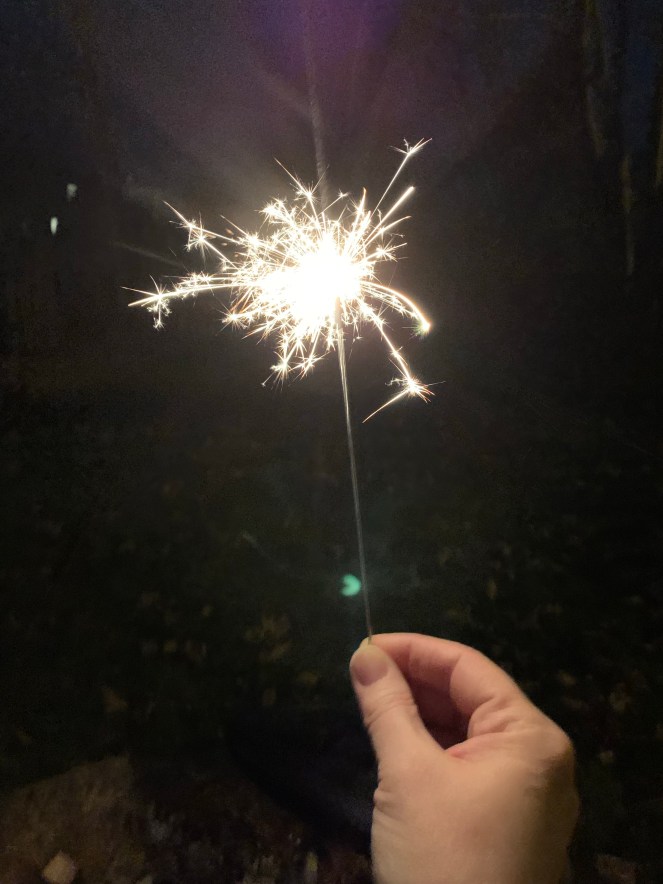
A hand holding a sparkler at night.
My friend Elaine brought me sparklers and other treats for my birthday. She knows how to make everything more fun. Image description: Christine’s right hand is holding the handle of a burning sparkler – a piece of metal that has been coated at one end so it gives off a sparkly flame as it burns. It is night time.

Usually, on my birthday, I’m trying to cram in so many fun things that I actually end up amplifying my usual feeling that I *should* be doing something else.

I always have fun but I tend to feel a bit tightly scheduled and a bit frustrated.

This year, I noticed that feeling creeping up the day before my birthday and I made a conscious decision to get over myself and be clear about the facts:

I don’t have to limit my fun to one day a year. *

In fact, I can add more fun to every week.

I can even add a bit more fun to every day.

I can take my birthday attitude into the rest of the year.

In a surprise to no one, making that decision took all of the pressure out of my birthday.

And instead of keeping a tally of accumulated fun, I just did what I felt like doing in any given moment.

And that’s how I found myself dropping everything to take Khalee for a walk while the sun was out (instead of at a more ‘logical’ time.)

And, it’s how I found myself sitting peacefully, all by myself in the 5pm darkness, watching the small fire I had set in our fire pit.

Normally, I would have talked myself out of lighting a fire just for me. It’s a little bit of hassle and I didn’t have a lot of time before supper, but I had that bit of birthday ‘permission’ going for me so I crumpled some paper and got the kindling from the shed and settled in next to the fire.

I felt calm and restful and so very grateful for all of the good things in my life.

I even felt a bit more patient about the challenges I tend to encounter

It was a wonderful way to round out a day of giving in to my whims.

And, my birthday gift to myself is the decision to prioritize things like an early evening fire far more often.

I challenge you to do the same. 💚

A nighttime selfie of a woman with a round face wearing a dark hat and dark clothes, she is lit by firelight.
Enjoying the glow of the fire AND the fun of doing just what I wanted to be doing at that moment. Image description: a selfie in which I am outside at night, lit by firelight. I am wearing a dark hat and a dark coat. Only my face is visible and I am smiling contentedly.

*To be clear, I do take time to relax and do fun things on a regular basis. But, on my birthday, I give myself permission to maximize my fun.