Sunday afternoon Sarah, my son Gavin, and I stopped by the Fergus Highland Games Festival.
Lots of the competitions are new to me. Tug of war is familiar, of course. But I was glad to realize, after my second or third time hearing it, that this competition was “sheaf tossing” not “sheep tossing.”
We really just wandered in to see what it was all about, hoping to catch some of the women’s competitions.
And we lucked out. We got to see Sultana Frizell, set the new women’s Canadian record in light weight for distance. The record is now 85 feet, 2.5 inches.
Later this amazing athlete set another record in the hammer throw.
I loved watching the different shapes and sizes of the competitors and seeing all of their different techniques too.
I don’t have a photo from the events yesterday but here is Sultana at the Commonwealth Games.
Just as rugby and roller derby and power lifting are on my list of sports I wish I’d tried, so too are the lifting and throwing competitions associated with the Highland Games. This blog’s Sandi does it and I love hearing her talk about it.
It’s also a lot of fun to watch. I recommend it!
Here’s Sultana talking about the stigma of being a woman who throws heavy things. She laments not being seen as an athlete but rather looked at through the lens of normative femininity. People are often commenting not on her throws but on, given her size and strength, how remarkable it is that she looks like a girl/woman.
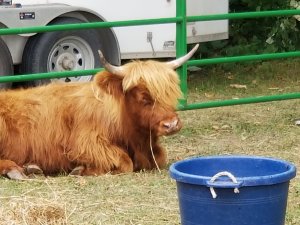
After we watched the women’s competitions on Sunday we also wandered over to see the animals on display.
The snipe is a small, two person boat and there’s a healthy racing fleet of them up at Guelph Lake. Jeff’s been teaching Sarah and me how to sail and race the Snipe over the past month or so and Tuesday night we got to make our debut. There was no Jeff. He’s off on his big boat and you can read about his adventures here on his own blog.
How’d we make out?
We didn’t die, capsize, crash into any other boats, or drown.
We (mostly) successfully rigged the boat.
We got the boat into the water, and ourselves into the boat, and vice versa at the end. As with rowing there are times when this feels like the trickiest part of the whole thing.
We made all of the mark roundings.
The winds were tricky. It was great that it was neither dead calm nor blowing all the boats over but the winds were really shifty. Because the weather was unsettled we were happy to see that there were only a dozen or so boats out. Sometimes there can be twice that number and it gets a bit hairy at the start. In the end, it rained but only for about ten minutes. We got damp but not soaking wet.
From my point of view, we safely followed the fleet around the course at a respectful distance. In our last race we nearly came second last but the other boat got by us on the final run up to the finish. It was a confidence building experience. It was fun and we’ll definitely do it again.
Sarah had the much harder job of skippering. I was just crew. But we’re learning to work together, to communicate better, and next time we’re hoping to mess it up with the boats at the back of the pack. It’s good to have something that’s new, with a lot to learn, to distract me from all the things I’m not doing this summer because I can’t.
Last week I saw this video by the BBC about London’s youngest yogis. A yoga program for small children is being piloted in some London nursery day care centers, with the goal of providing the tots with inner strength for battling the stresses of modern city life in the 21st century. Here’s what it looks like:
Toddlers on yoga mats, crouching and standing, one with head between knees.
Honestly, to me it looks like any day at any nursery with any group of kids. When they have a space which allows it, children regularly move around every which way.
But this is movement with a purpose.
The purpose, according to the CEO of a nursery company in the UK, is to address the lack of feelings of stability, of calm, of safety in a sometimes-dangerous and mostly-urban world. She says in the video,
Where do children get quiet? Where do children just get a time to be? Where do children get space, just to feel safe and able to just do a deep breath?
The idea, it seems, is to institute a playplace wellness program at nurseries to help kiddos identify when they’re feeling sad or mad or upset or stressed, and to teach them movements (kiddy yoga and other things) to address those feelings.
We’ve written about workplace wellness programs on this blog before. Here are some of them:
What’s the tl:dr version of all these posts? For individuals in particular workplace challenge programs, mileage varies. Some find that them fun, and others find them stressful or interfering with their regular physical activity routine.
Looking at them in general, though, there are a number of problems. First, they don’t actually seem to work— that is, they don’t tend to result in increased health among workers enrolled in the programs. Second, and more worrisome, is that many of the causes of stress and ill health are found in the workplace itself– long hours, uncompensated duties, no accommodation for life issues, short vacation time, lack of control over work time, etc. Fixing those features of work life will make a world of difference (as opposed to offering a 7am meditation class in the conference room before work).
But back to the London tots and the word of that CEO. Where do children get space to move, breath, play, rest, and enjoy life? How about in their homes, in their schools, in parks in their neighborhoods, in museums and playgrounds and pools and lakes and beaches and woods? That is what we need to be working on and identifying and speaking out about. Creating little zones of mini-serenity for children isn’t going to fool them into thinking the world is a happy-go-lucky place. Let’s get working on making neighborhoods safer, housing better, jobs more plentiful and better-paying, and healthcare more accessible for all.
I know, I know– these are all idealistic and massively difficult goals. But so is doing this:
A woman in a balancing pose with one leg behind her head and the other against her right arm, in the air. Yeah.
Some goals are very very very hard, but worth working toward. Even small progress in this respect makes a difference.
Sam recently contacted me and asked if I wanted to write another post for the Fit is a Feminist Issue blog. I felt a bit paralyzed, because I had stopped exercising again. If any of you remember, I had written in May about exercising during Ramadhan, and one of the things I commented on then was how Ramadhan often resulted in me taking an irreparable break from exercise, and how this Ramadhan was different . Well, after Ramadhan, we left for Najaf and Karbala (Iraq) for a religious pilgrimage,
Me at Masjid-e-Kufa in Iraq at 3 am at the morning, right before morning prayers.
and onto NYC for a wedding.
At one of the wedding ceremonies in NYC
While I walked a lot in Iraq, I also started consuming high amounts of soda (it was readily available and it was super-hot).
the air was super dry and the sun was relentless.
Once we returned, I just couldn’t start again. I don’t have any excuse, I just didn’t want to, didn’t feel like I was in a routine, or something like that. In fact, I have gone back to consuming a soda bottle a day and eating quite unhealthily.
So I thought, what the heck would I write on? Too embarrassed to even respond, I felt paralyzed. Then fellow philosopher and a prominent scholar on disability, Shelley Lynn Tremain, posted this link to an article on her Facebook page Discrimination and Disadvantage, The danger of fetishizing failure in the academy. Something in that article really stuck out to me. “What I was inadvertently telling students with my cheeky art installation was that their failures don’t matter as long as they eventually succeed – and that success is narrowly defined as excellent grades.” Well, that’s how I felt about exercising. Writing a blog about how I didn’t exercise during such and such time would be wonderful, but only if it ends with some triumphant story about being fit and eating healthy, and how I was able to overcome it all.
Well, it’s a constant struggle for me and it doesn’t always have a triumphant ending.
Bio: I am an Associate Professor of Philosophy and the Religious Studies program coordinator at Southern Illinois University Edwardsville. I am always in the process of getting/remaining physically active. I am also the mother of a 10 and 8 year old. I am concerned about social and political issues that Muslim Americans and other marginalized communities face and believe that our struggles have many commonalities. I am currently working on a book on an introduction to Shia Islam. You can find more about me at http://www.siue.edu/~sfatima/
Two weeks ago, I attended the Women’s Summer Festival in Ischgl, Austria. It’s basically a three-day summer camp for female adults. You can sign up for lots of different sports workshops, including yoga, mountain biking, climbing, hiking, the full works. All of it women-only, set very scenically in the Austrian Alps. I’d read about last year’s edition and it sounded like a ton of fun: a chance to try out new things, meet people and spend a few days frolicking in the mountains? Sign me up.
View over a lush green alpine valley, from the beginning of our via ferrata.
I agonised for a while about my choice of workshops – there’s no way you can do them all – and finally put myself down for a via ferrata (complete novices), trail running (beginners), morning yoga (all levels), and an all-day hike (experts). Aside from yoga and hiking, I decided to do things I hadn’t done before, so for instance bouldering fell by the wayside in favour of the via ferrata. And I was too much of a chicken for mountain biking. Somehow, the thought of hurtling down a mountain on two wheels terrifies me a lot more than the thought of being suspended above a precipice secured by nothing but a fixed steel cable and two carabiners attached to my harness through a via ferrata set.
Bettina in full gear, taking a well-deserved sip of water after completing her first ever via ferrata.
The classification of levels, I later learned from fellow participants, stumped not only me. How do you know you’re an “expert” hiker, rather than an “advanced” one? As I’ve mentioned before, I have my share of athletic impostor syndrome, so I was mildly terrified of both the trail running (should I have signed up for the “complete novices” one?) and the hiking tour (what on earth had made me think I was an expert? The hubris!). If anyone still needed proof that women tend to underestimate themselves, they only had to attend this festival. Nearly everyone rocked up with the same self-doubts.
But these shared concerns actually ended up making for an incredibly supportive environment. Everyone cheered each other on and kept encouraging others. It had been a long time since I’d seen two people as happy as two women with vertigo after crossing an incredibly scary suspension bridge on our trail run, fuelled by gentle coaxing from our guide and the supportive cheers of the other participants. It was wonderful to watch.
The really quite scary suspension bridge we had to cross during our trail run, complete with some runners from our group approaching in the distance.
The other thing I’d been a bit wary of is going by myself. I wasn’t organised enough to enlist anyone else to come with me, and I’m not exactly a social butterfly – my small talk is limited and I tend to get incredibly intimidated by people I think are cooler than me, which is pretty much everyone. I ended up really, really enjoying myself, both in terms of the activities and the company. I met some very nice people, and the activities were great. In fact, both the via ferrata and trail running (who would have thought, considering how badly I do running uphill!) left me hungry for more.
The morning yoga was beautiful, and the hike was out of this world stunning – three three thousand-metre summits in one day! With bright sunshine! And incredible views! If I were to do this again, and I’m definitely keeping this option open, there are plenty of things I didn’t get around to doing: a more challenging via ferrata, bouldering, more hiking, and maybe, just maybe, even some mountain biking?
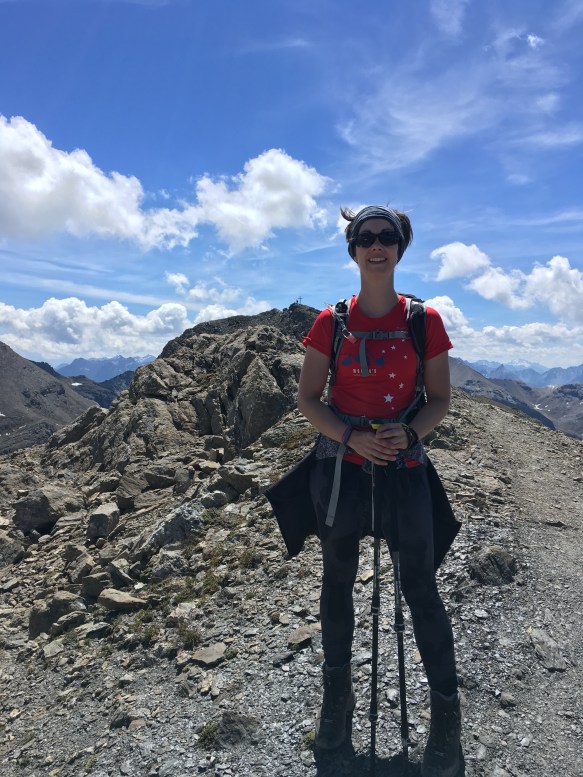
Bettina in a red t-shirt and hiking gear, beaming widely with one of the summits she climbed during her all-day hike in the background.
There was a framework programme too, to keep yourself occupied while not attending a workshop, with ad-hoc activities such as TRX training, massages, pilates, etc., and you could even get your nails and your hair done if you wanted (I opted for the nails, which I usually never do or get done, and also because there’s not much you can do with my hair). In the evenings, one night there was dinner at a local hut, which ordinarily is a hip après-ski joint, and another night there was a concert with a local band in the festival tent. And as these things are wont to go, there were exhibitors peddling the latest trail running shoes, hiking poles, outdoor and yoga clothing, etc. You could also try all these things in action, which was fun, though it didn’t motivate any purchases for me.
The whole thing was a very enjoyable affair, but I wouldn’t be a good feminist killjoy if I didn’t have some issues with it. This was obviously not a free event. The all-in festival pass set me back just under 280 Euros, and I treated myself to a nice hotel in addition. There was the option of booking just individual workshops, but they also weren’t super cheap. There was a goodie bag for those who’d booked the festival package that contained some ecologically very dubious plasticky giveaways (although in fairness, there were some great quality ones too that I’ll definitely be using). And diversity at the event was limited to cis-gendered almost exclusively white, almost exclusively able-bodied, relatively fit women who could afford to be there, and a bunch of invited press, bloggers and social media influencers who were there for free (disclaimer: I wasn’t one of them).
In other words, we spent three days oozing privilege from all pores. Is this inherently a bad thing? Probably not. We had a lot of fun and it was great to completely disconnect from the news and the heat wave gripping the rest of Europe for a few days, being active among a bunch of very nice, like-minded women and pushing our comfort zones in a highly supportive environment. The event is absolutely fantastic in that it lets you test the waters with new activities that might otherwise be quite intimidating, which I think is very important in getting women to be more active. But it’s important to be aware of that privilege – and of the fact that if you were insecure about doing any sort of exercise, you probably wouldn’t sign up for a three-day mountain sports festival in the first place, so a substantial threshold is still there.
Enjoying these views was part of our privilege: panorama of the Alps with some flecks of snow in the sunshine.
And things could be done to make the event more inclusive. One could think of travel stipends, marketing the event a bit differently to attract a more diverse crowd, and so on. Again, the organisers are a for-profit company that makes money with this, so it’s not surprising that it’s all a bit commercial, and all things considered, the commercialness is very low key – you’re not forced to buy anything or partake in any activities that aren’t your jam. And yet. A bit more of an effort in making the event more diverse and accessible would be very welcome.
Will I go back? Maybe. I had too much fun not to contemplate a return next year. I’ll keep you posted – and if I do, perhaps it will be in some fit feminist company? Would be fun.
We’re more than six years old! That’s very old in blog years. We’ve come a long way since the early days. Back then it was just Tracy and me and few hundred followers. We were amazed when we made it to 500. Now 20,000 is within sight.
These days it’s a different place, a more communal place. We started out focused on the Tracy and Sam’s ‘fittest by fifty’ challenge but now that’s in our past and the blog has a lot of regular other voices, telling different stories. Nat, Susan, Cate, Martha, Catherine, Christine, Kim, Bettina, and Mina all blog regularly here. It’s a terrific community of bloggers. I love our conversations, those we have on the blog, and those behind the scenes too.
We also have occasional guests. More than 200 since we first started. And then there’s our regular commentators.
We’ve also got our Facebook page (that’s mostly me, Sam, with help from other FIFI bloggers,) Twitter as @FitFeminists (that’s Tracy) and an Instagram account that lots of us post to, fitisafeministissue.
I love the book that Tracy and I wrote but I worry sometimes in the shorthand version of things that journalists write (been there, done that myself) the gap between the blog and the book goes missing. What’s the gap?
First, just time. The blog is current. I’m clearly not the person I was when I wrote the book. Hello injured knee and changed perspectives! Tracy isn’t doing triathlons these days. Of the three multisport activities she’s fixed her sights on running. We’re not 50 these days. Both Tracy and I are 54.
Second, community. The book is the story of Tracy and me and our challenge. But the blog is so much more. The blog contains our story but also the stories of Nat, Susan, Cate, Martha, Catherine, Christine, Kim, and now Bettina, and Mina. Catherine blogs every week. Cate nearly as much.
Thank you everyone for being part of our blog community!
Anyway, here’s the latest version of our blog schedule
Mon morning: Sam
Tues morning: Tracy
Wednesday morning: Sam
Thursday morning: Tracy or #tbt
Fridays:
1st Friday morning of the month Martha
2nd Friday morning of the month Cate
3rd Friday morning of the month Martha
4th Friday morning of the month Susan
Saturdays
1st Saturday morning of the month Nat, #SatWithNat, and first Saturday afternoon of the month Mina
2nd Saturday morning of the month Bettina
3rd Saturday morning of the month Cate
4th Saturday morning of the month Christine
Sundays: Catherine (Weekends with Womack!)
If you’re ever interested in guest posting here at Fit is a Feminist Issue, drop me a line at samanthajbrennan@gmail.com.
In addition to the regular blogging community, there is room for guests.
Here is the note I send guests.
Thanks for your willingness to join our community of guest posters at Fit is a Feminist Issue.
Posts usually range between 500 and 1000 words. If your post is really long it might make sense to do it in several parts.
First and foremost we’re a feminist blog and we expect guests to share that perspective. We also usually incorporate a personal perspective in our writing, even if that’s the history of what made us think about the thing we’re writing about.
We also are a body positive blog and we try to keep the diet talk down to a minimum. Lots of us are critical of diets, the long term odds of success, and the beauty standards beneath lots of fitness ideals. We’re more about doing things we love and sharing athletic, rather than aesthetic goals. That said, we don’t all agree about all of these things and “big tent feminism” is part of the charm of the blog.
We try to use accessible language and write with a sense of humour, where appropriate. We especially try to avoid ableist language. For example, we don’t say “crazy” or “lame.” Here’s a link to alternatives
Where it makes sense include links to further resources.
You must include a short bio at the end.
The way it works is that you submit the post for review and I edit it lightly (mostly for grammar and spelling and adequate paragraph breaks). I schedule it. I also add photos. You can email pictures to me, samanthajbrennan@gmail.com.
Contributor status means that you can’t add photos. After a few posts, we switch you to author status and authors can add their own photos and schedule their own posts.
Note: If you are adding your own photos and video, pls be sure to provide image and video descriptions for the visually impaired. All non-text content should have a text alternative that provides an equivalent meaning as the image. Read past posts for some descriptions of the images in the posts. Best practise is for the image description to go in the alt-text field which you can see when you edit the photo. You can put the image description in the caption as well if you have space. Captions are also useful for photo credits Finally, giving your photo a descriptive title makes it easier for search engines to find.
Please share your guest post widely to let your friends and social media followers know about the blog. We’ve got some excellent regular commentators and if you could check in on your post and reply to them that would be great.
On Tuesday night last week, I found myself skipping rope and doing side planks in a random pop-up “boot camp” type class taught by my spinning teacher. That was my final entry in my “work out every day in July” streak.
I don’t know exactly *why* I decided I wanted to work out every day in July — I think it actually happened because I roused myself from a stupor at 8 pm after a travel day on July 1 and went for a short run, and felt energized and happy. And thought, what would happen if I tried to get out and do some kind of intentional movement every day in July, even when I didn’t feel like it?
I wrote a little bit about what I was discovering about the emotional benefits of moving every day about a month ago. I definitely felt more clarity and much greater awareness of the relationship between exercise and mood. (Spoiler: it’s important). But I also learned a bunch of things about my own habits and that elusive thing called motivation. In no particular order…
Everything that looks like intentional movement beyond your day to day “counts.” I’ve made this assertion before in our posts about “218 in 2018” — but my 32 workouts in July (I did two in one day, once) ranged from overt “workouts” (the boot camp class or runs) to long bike rides (alone and with friends) to yoga classes and videos to paddling a canoe and camping to deliberately riding my bike all over the city for errands to deliberately walking to errands/dinner. And every one of these activities made me feel calmer, happier and accomplished.
One of the things about just needing “to move” every day is I got less rigid about what I did to move — and discovered a kind of playfulness I don’t bring to my movement very often. I played with a kind of underwater skateboard in someone’s pool, went for a long paddle on our non-travel day on a canoe trip (and ran into a lady moose bathing!), and, in the last week of the streak, did a handstand for the first time in yoga practice.
I was ridiculously proud of myself.
So by the time I got to skipping rope in the pop-up class on July 31, I was just 8 years old again. Hopscotch, anyone?
3. The voices in my head that say “just skip today’s workout” are persuasive and diverse, but are worth overcoming. I have been running for 23 years, and I cannot count the number of times I have actually gone so far as to put on running clothes and then flopped back onto the couch or into an online rabbit hole and never made it out. This happens a lot to me. But with this streak, that wasn’t an option — I was going to work out, I just had to figure out how.
There are a LOT of factors that make it easy to skip days, and I saw them all in this month. Work stuff that piled up against a need to get to a friend’s for dinner (with the burgers!), with a thunderstorm in the mix (I squished in a 4km run that ended in the rain, and was 15 minutes late for dinner). Very hot busy day and no time for a run plus a shower (I walked 5 km to meet a friend for dinner and a movie instead, and accepted that I was going to arrive damp. They ordered me a drink while they were waiting). Spinning studio closed because of issues with construction upstairs — hence the pop up bootcamp class. A Sunday that was overloaded and included an early meeting an hour away, brunch with a friend even further away, sausages in the brunch that did NOT lend themselves to running, a flat tire on my bike, and severe ennui with running in my neighbourhood — I ended up willing myself into my running clothes at 7 pm, texting a pic to my cousin for accountability, taking a bike share bike down to the beach, and having my fastest, strongest and happiest run of the year).
4. Plans should be loose. In this framework, weirdly, I found it better to NOT have a plan for what I was going to do on any given day. Because it is July, I have a less rigid work schedule — so I tried to listen to what I needed, and look at what was actually happening in the world. A couple of times I planned long bike rides but woke up and took stock and realized my body needed yoga instead. Another time I spontaneously drove out of the city for a 60km ride at 3 pm on a Sunday. Honouring what I felt like doing felt like a huge gift to myself, and gave me that same kind of airy, restorative rhythm that traveling alone does. I know this is a huge privilege — and it’s summer, light, and less busy. But listening to what I actually needed let me work my body hard over a month without hurting it.
Which leads me to ….
5. Rest matters. Even though I was working my body every day, I did it in a way that gave different parts of me opportunities to rest. A lot of the workouts were yoga, which, while strength-building, also kept me aligned and supple and grounded for the runs and rides. When I walked, I listened to non-political podcasts. I tried to get as much sleep as possible. And whenever I could, I took to a hammock. I’m lucky enough to have one on my deck, and Susan is brilliant enough to bring one camping. Hammocks are the best.
6. Every time you move, you are building overall health, for now and as you age.
One of the things I was working on throughout the spring was a giant project about the role of mitochondrial health in our health overall. There is huge emerging evidence that exercise prevents cellular aging by boosting mitochondria. This speaks directly to all of the reasons I want to stay fit — to age well, with good mobility, with strength, and with emotional balance. I have written about this endlessly, but I felt it this month. Even though I wasn’t doing anything deliberate to “get stronger” or “faster,” that run on July 29 was my most comfortable and fastest in at least two years, and I got into a handstand for the first time since I was 10. I felt the tightness in my thighs and hamstrings loosen up. And I slept better.
I DID take a day off active exercise on August 1, mopping up a bunch of undone work and housework before taking off on a short holiday. But I still did a few sun salutations and stretches. My body asked for it. And my streak taught me to listen.
Fieldpoppy is Cate Creede, who lives and works in Toronto and blogs here twice a month.
Just to give a sense of size of the lake and its surroundings, here I am with my guard poodles at a Lake Tahoe overlook in August 2014.
The Trans Tahoe Relay is a race that crosses the northern end of Lake Tahoe from east to west at a part of the lake where it is 10 miles wide. (The lake overall is approximately 22 miles long and 12 miles wide – it’s a very large and deep lake!). Teams are composed of six swimmers each, with a support boat. (We owe big thanks to TERC for providing us with a boat and to TERC’s director, Geoff Schladow, for piloting the boat). The rules are that each swimmer swims for 30 minutes, and then takes turn swimming 10 minutes each, until the 10 miles is completed. On our team, after our first leg each of us did two 10-minute legs, with two members of the team doing a third 10-minute leg. So, we didn’t break any speed records, but we were happy with our result anyway!
Our boat for the day arriveth! We were very grateful to have the use of the TERC boat.
We didn’t all know each other before the race, but we were brought together by our love of swimming and our passion for the environment, with each of us doing research in an environmentally-related field. (My own areas of research encompass philosophy of evolution and ecology as well as environmental ethics).
Here we are, the swim team, plus vital support folks, on our boat, all smiling.
I’ve done a number of open water swims, including one at nearby Donner Lake (2.7 miles), but this was my first relay, so I didn’t know what to expect. In some ways it was very much the same. You’re in the water, it’s often a little cold (we were told to expect 55-60 degrees Fahrenheit, but thankfully it was more like high 60s), and you’re just trying to stay focused, keep your pace up, keep going. In other ways, though, it was very different. In most open water swims, you feel very much alone, and that can be part of the challenge, to be “in your head” for such a long period of time. But here all you had to do was pick up your head to see the boat and your teammates, so you never felt alone.
Getting ready for the tag and switching of swimmers.
And whereas my best time for the Donner Lake swim had me in the water for an hour and 23 minutes (and that was drafting like mad), here the swim was broken up into segments. In some ways that made it harder, as muscles tightened between swims and then were forced to be used again, but it also made it less mentally challenging because you knew that your time in the water was a limited, manageable chunk.
Still smiling, even after my 30-minute leg of the swim. Warm swim coat courtesy of my sister and nephew.
But I’ve left out one really big difference between a relay and a solitary open water swim: the time in between swims. Here whichever five swimmers who were not in the water got to hang out on the boat. We talked about swimming – how much swimming we’d done in the past, how much we were able to fit into our busy schedules now. We talked about our research, and learned about the interesting projects that each of us was engaged in. We ate snacks and recovered between each swim. And we encouraged each other and cheered each other on. No one worried about our time or how fast each person was going (something that is in any case impossible to tell without a GPS). Instead, we enjoyed the day, enjoyed each other’s company, and swam for a good cause. We were a true team. I am grateful to have had the opportunity to be a part of it. 2019, perhaps?
Almost at the end, now!
Roberta M is a professor in the Philosophy Department at UC Davis, specializing in philosophy of biology and environmental ethics. She enjoys walking with her poodles, swimming with Davis Aquatic Masters, and her 10-minute bicycle commute to campus.
From the archives. In 2013 the blog wasn’t even a year old and we were pretty focused at that time on getting our core themes out there. One of them that we have sustained throughout is the the theme of encouraging everyone not to preoccupy themselves with weight loss (their own or others).
This was not just for friviolous reasons. Fixating on weight loss as a thing that is assumed to be positive, policing others’ bodies in a way that makes it normal and natural to “compliment” someone when they’ve lost weight (even if you don’t know whether they wanted to–see our cautionary tale), and externalizing your fitness efforts so that your “success” is measured by the number on the scale, are just some of the ways we miss the mark when it comes to fitness.
Our aspirations for ourselves and hopes for others can come from a more loving place. One way to start on that new road is to refrain from offering “you look great, you’ve lost weight!” as a compliment.
Dear readers, I’m delighted to share with you one of my favorite posts by one of my favorite bloggers, Coach Aruni. I took her mindfulness in eating course at Kripalu in western Massachusetts, and she gave me some tools for thinking differently about body image, self-acceptance, self-love and eating in more satisfying ways (to me).
Aruni and friend, small kids with big bikes and big adventures in mind.
Biking was freedom. As I kid, I couldn’t get home from my school, John James Audubon #42, fast enough to shed my school clothes and wiggle into my play clothes. Dragging my bike out of the cellar, up into the back yard, awkwardly sprinting with it through the narrow walkway separating our house from Mrs. Eisner’s next door, with the two sitting lions guarding her entry, onto the street, Arthur Avenue, and whoosh, into Nay Aug Park, across from our house. I would lose myself in the spiraling bumpy paved paths there, biking and weaving and pretending I was a Royal Canadian Mountie, out to save the beautiful damsel in distress. (It was my era of Sargent King of the Yukon—I was infatuated with the uniform.) School, it’s stressors, my aloneness, my stuttering, all faded as I biked onward, peddling toward glory and that well-earned kiss.
As childhood passed, my biking receded, as did my obsession with the uniform of the Royal Canadian Mounties. Time and life went by. It all changed.
However, once in the ashram, biking had its resurgence. We were an active lot back then and my then- fantasy-crush, my now-wife-of-decades, was one of the most active of all us “sisters”. Biking, hiking, swimming, we were committed to the unity of body, mind, and spirt. The Berkshire Hills were not daunting for me; fueled by sisterhood, spiritual longing, carnal lust, and a plain, ordinary desire to fit in, I biked and biked on.
While courting and married, biking continued its role as primary activity in our burgeoning family life, the hub of vacations, amazing day trips, great adventures big and small. This continued for a long while, years upon years, until it didn’t.
It all changed. Why does it shock me when things change? Everything always does.
My wife hurt her knee. I tried biking that first summer without her. It didn’t stick; I missed walking the dogs and being in the family unit. Solo-pleasure seemed unwarranted, undeserved. A few more bike-less summers passed. I got older and slower, with less energy. I hurt my shoulder. We got a new president. I gained weight. Blah-blah. And blah. Not only was there no biking, there didn’t live in me the willingness to take the risk and get out of there and try. I knew I was no longer able to—to what? To get up the hills? To feel that free in my body? To relax into that level of bliss?
The Berkshires Hills were now, for me at sixty-eight, truly daunting.
Until Boomer. Who is Boomer, you might wonder? Boomer is my one-month-old bike-friend, my new e-bike. E stands for electric; she, unlike me, is fueled by a battery. When I need the assist in moving forward, in getting up the hill, both literal and metaphoric, I put slight pressure on the throttle, and WOOSH, I am carried forward.
I now have a throttle. I didn’t even know that I needed one. A friend initiated me into the world of the e-bike. I had no clue about my need or any potential response or solution.
Realizing I now have an externally provided throttle is my fighting back against aging, giving my middle finger to mortality; nothing can stop me now. I’ve had a profound month, biking around, getting use to Boomer’s larger, stockier frame and relaxing into my relationship to that amazing apparatus, the throttle. Initially I had some shame; some still lingers. She’s so Cute, that bike, so fancy and upscale. Shouldn’t I be able to do It all myself? Obviously, the answer is simple. No. I need help.
I can ask for help. Clearly, I need it. I didn’t realize how vulnerable and tentative I have felt, so distant from accessing the energy of moving up the hills of my life. But now, there is a throttle. As I engage it, support is right there, at my fingertips.
Why is it so hard to acknowledge change? How come asking for help often doesn’t even exist on our radar? What strategies can we use to imagine creating support, manifesting an “external throttle” to get up the steep slopes of our lives? Please come on over to this week’s blog as we explore this arena of life. At the blog, too, you’ll find a of picture of Boomer and me in our new partnership, sixty years after the above picture of me in the land of Biking Bliss, 1956. I also will post a snap from this morning’s glorious Berkshire ride. (here it is!)
Aruni and Boomer, a big red bike and her new two-wheeled partner in the Berkshires of western Massachusetts.
Aruni is a writer, teacher/facilitator, and life coach. You can read more about her and from her on her blog here.






 On Tuesday night last week, I found myself skipping rope and doing side planks in a random pop-up “boot camp” type class taught by my spinning teacher. That was my final entry in my “work out every day in July” streak.


 5. Rest matters. Even though I was working my body every day, I did it in a way that gave different parts of me opportunities to rest. A lot of the workouts were yoga, which, while strength-building, also kept me aligned and supple and grounded for the runs and rides. When I walked, I listened to non-political podcasts. I tried to get as much sleep as possible. And whenever I could, I took to a hammock. I’m lucky enough to have one on my deck, and Susan is brilliant enough to bring one camping. Hammocks are the best.


