fitness · hiking

The sort of person who…? (Guest post)

During a recent sabbatical, I spent a few months in Birmingham, walking (as the British call hiking) on weekends in the hills of Shropshire.

I had a reaction one day I wanted to describe as “falling in love with a hill.” The hill was Caer Caradoc, and the experience was great fodder for rumination the rest of the day. What could it possibly mean to fall in love with a hill?

A fine view of Caer Caradoc


Walking is like that—lots of time for rumination.

My sabbatical host, Angus Dawson, later told me that the Long Mynd area has a surprisingly alpine quality for hills of 300m—“Little Italy,” they call it.

More rumination: 15 years ago, I walked on top a dead volcano, face to face with a live one, and wondered that day why I didn’t spend every weekend of my life on top of mountains. At every hilltop in Shropshire, I started looking eagerly for the mountains of Wales on the horizon and learning their names.

But every time I got excited about mountains, I reminded myself that I’m not the sort of person who climbs mountains. I’m the person who was laughed at by my fellow 7-year-olds for coming in last on track and field day. I put my nose in a book and ended up with chronic arm pain from the final dissertation run 21 years ago. Most definitely not a mountain climber.

I went back to hiking the coastal barrens around Halifax just like before sabbatical, wondering how I could make my hiking more intense—without carrying a tent on my back and sleeping in it, which is how Canadians ramp up the hiking. Orienteering? Snow-shoeing? Trail running? Bush-whacking? It dawned on me that I might try editing out the thought that I’m not the sort of person who climbs mountains. But where to start?

A bouldering gym and coffee shop opened in Halifax. After a few months of watching people climb while I was drinking coffee, I asked the staff, do you have to be under 30 to boulder? (I wasn’t seeing many people my age.) They were friendly and encouraging. I did an intro morning and found to my surprise that it didn’t bother my old arm pain too much.

You can’t keep me away now. I find the bouldering gyms when travelling for work and I’m getting muscles for the first time in my life. It feels great. And it’s from a non-repetitive, highly entertaining, intellectually challenging, indoor-outdoor activity—even better. I don’t have to make myself go to the gym. I’m counting the hours until the next time I get to go.

I went back to the UK in the summer and went for those Welsh mountains. The peaks are only 1000m, but again very alpine in form. That, plus colonialism, means North Wales is important in mountaineering history. The pattern of claiming “first ascents” for people from London who speak English and write about it goes back to 1639 on Snowdon (Yr Wyddfa in Welsh). At that stage, mountaineering was about collecting alpine plant species, connecting the activity to another obsession of mine—plants of the coastal barrens. (The same plants like harsh environments at many altitudes.)

On that trip, I scrambled Crib Goch and the North Ridge of Tryfan. Easier than the easiest bouldering problem, but with 450m to fall if you let go. I didn’t find myself ruminating while scrambling Crib Goch. I knew where my hands were and where my feet were, and if calm enough, just for a moment, I took in the astonishing view. (The British skip along Crib Goch in sneakers, no hands, in their 70s.)

The Crib Goch ridge safely behind me, from the summit of Snowdon.

Back home I had some awesome climbing lessons with Heather Reynolds, a local treasure. “She’s climbed with Lynn Hill,” I say to people when I want to demonstrate that I know that name, and impress on them how lucky we are to have Heather here. (Lynn Hill was the first person of whatever gender identity to free climb the Nose on the iconic El Capitan.)

In November, I took part in a bouldering competition—competing for last, just like when I was 7. I succeeded in this ambition, with half the points of my nearest rival. Instead of laughing at me, as 7-year-olds do, some spectators formed a cheering section. A young woman told me I was an inspiration for not caring whether I made a fool of myself. She put it much more kindly than that, I’m sure—boulderers are the nicest people. All they ever do is ignore you when you want to be ignored, and then magically appear behind you and cheer you on when you need it. You’re precariously standing on a tiny chip of plastic on the wall 3m from the floor, about to give up on reaching that one last hold, and suddenly a voice behind you says, “nice,” or “you got this.” So you decide not to give up after all. But if you do give up, they say, “good call,” and “you’ll get it next time.”

I’ve set my mind on a new goal: to drop the act that I’m climbing to set up the punchline in a joke about a 52-year-old woman who takes up climbing.

A few weeks after the competition, I was back in North Wales, on my first multi-pitch trad climb at Tremadog, with an expert, enthusiastic, and thoughtful guide—Sabrina Paniccia. Freezing temperatures, snow squalls blowing through, numb fingers, aching toes—these peeled off a few layers of habitual self-doubt. When footholds in the rock of less than a centimetre were the only path to my warm wool socks at the top of the crag, I edited out the thought that it was unlikely I could ascend them.

Photo credits: Sabrina Paniccia


What kinds of activities would you do if you edited out the thought that you are not the sort of person who does them? Check out #unlikelyhikers and #indigenouswomxnclimb on instagram (thanks @shortworksproduction for the tips)—a whole world of people challenging the idea that people like them don’t explore the outdoors.

fitness

Have you forgiven Participaction? Sam hasn’t yet…

In theory I ought to like Participaction. I’ve been going to write and say nice things about their movement based activity encouragement programs.

Their list of 18 resolutions to make in 2018 is pretty good.

Here’s some text from them about 2018:

“This is the year to take charge and make change. We love the start of a fresh new year. It’s a time when many resolve to make positive changes, like exercising more. Yes! But, despite our best intentions, we often fall short. We lose momentum, motivation dries up, and too often, we end up right back where we started. This is where ParticipACTION comes in.”

If you’re not Canadian you might not know what they are all about: “ParticipACTION is a national non-profit organization whose mission is to help Canadians sit less and move more. Originally established in 1971, ParticipACTION works with its partners, which include sport, physical activity, recreation organizations, government and corporate sponsors, to make physical activity a vital part of everyday life.”

What’s to dislike?

And yet, I feel guilty and judged each time I look at their website. That’s weird. I’m a super active Canadian. I might even be one of the 1 in 5 Canadians who meets the weekly recommended amount of physical activity. I love their focus on outdoor activity, inclusive fitness, joyful movement across generations. There’s little (maybe no?) talk about weight loss on their website. They ought to be my people. And yet…

What’s going on then?

In truth, I haven’t forgiven them yet for the Canada Fitness Test which I failed each year through elementary school and I took that failure to heart.

The Canada Fitness Award Program was a national fitness test and evaluation program operated by the Government of Canada department Health and Welfare Canada from 1970 to 1992. It ended ten years after I graduated high school and it was replaced by something much more my speed, the active living challenge.

I don’t think Aimée has forgiven them either. You can abut her experiences in her post about finally coming to think of herself as athletic.

I was the kind of kid who loved school. I thought tests were a great idea. Give me a test and I do well on it. I had test taking down pat. I loved teachers too. I even tried at one point to run away and join the nuns who taught me.

But the fitness test? I cried every year, I think. It taught me that some people were athletic and others were not. I was not.

Here’s the test:

Pushups. No time limit. Maximum continuous reps.

10m Shuttle Run

Situps No time limit. Maximum continuous reps.

Standing Long Jump

50m Run

1-mile run

Flexed-arm hang for time

It was the flexed arm hang that did me in every year!

Here’s Jess and Chantal, two people like me, who failed the test as kids recreating it.

Here’s a defence of the test including a score sheet so you can take the test and rank yourself

From 1985

Do you remember the Canada Fitness Test? How’d you do? Scarred for life or not?

Uncategorized

These Four Healthy Habits Matter More Than Your BMI

I love a good, simple message.

Here’s my favourite in recent months. See Can you disease proof yourself? Why appearances can be misleading

Short version: Regardless of weight the people with these four healthy habits had the lowest risk of early death.

Take away: If it’s health that’s your goal work on these habits not your weight.

The four? Eat your vegetables. Don’t smoke. Drink in moderation only.  And exercise.

It’s not rocket science.  And pretty much everyone lots of people can manage these habits. (Corrected: See RK’s comment below. I tend to think that since I quit smoking and can’t lose weight, it’s true that one is easier than the other. Not necessarily true. Context and social circumstances matter.)

So while your friends and my friends are busy debating (for health reasons) high fat low carb diets versus vegan diets or high intensity interval training versus strength training, just relax. Breath and smile and eat your veggies. That’s the thing that matters. Don’t stress the details.

Vegetables chopped and displayed in white bowls
Photo by Dan Gold on Unsplash

“It’s January, which means health-improvement thoughts often turn to weight-loss diets. That’s unfortunate, not just because 95 percent of diets fail, but because research shows that what we do is more important than what we weigh for improving our odds of living longer and better. The good news is that what you need to improve your health odds is less than what you might think.

The four crucial habits are eating at least five servings of fruits and vegetables per day, exercising at least three times per week, drinking alcohol in moderation and not smoking. People who have all four habits have the lowest risk of dying before their time, and that risk is the same regardless of body weight. Similar research in the United Kingdom has found that having all four healthy habits may equal an extra 14 years of life.”

monthly check in

Sam’s monthly check-in: What’s up, what’s down, the January version

Blue and pink sky, outline of mountains
Photo by Paul Gilmore on Unsplash

I like Catherine’s idea of a monthly “where I’m at” post. This is mine for January.

The image above is one of the lovely pictures you get when you search for “highs and lows” on Unsplash.

First the bad news, the lows, my knee is still injured. Progress is slow. I’m in pain a lot. It’s not fun. I’m meeting a surgeon on the 29th of January. This limits my physical activity and my time outside, since I only enjoy winter outdoors if I’m warm and moving. Brrr. I’m sad because I’m not cross country skiing. I’m not riding my fat bike. I’m not snow shoeing. And I’m not learning to downhill ski.

On the bright side, I’ve got a new job that’s keeping me really busy so there’s less tension between play and work than there might be otherwise. I’m also doing other things like cooking (I’m using the same delivery plan that Susan wrote about here) and reading books. (Including Wellmania, by Brigid Delaney, which I’m also going to review for the blog later.) Also, I’m spending time with Zippy, my cat, indoors rather than outdoors with Cheddar, the dog.

I’m also riding my bike on the trainer, doing lots of physio exercises, and icing my poor knee three or four times a day.

There’s more bad news that’s complicated. And to be clear here I don’t want medical advice. I have lots of doctors. I feel well cared for. And it’s about a subject that Tracy has pledged not to write or talk about, weight.

Mostly I agree with Tracy but I also think that’s easy to say when you’re in the normal weight range for your height, when your weight is unremarkable. That’s not me.

So I’m going to talk about weight. If that’s not your thing, if it bothers you, please look away. Read no further.

Saying that makes me feel like Lemony Snicket:

Thanks to the combination of menopause and thyroid surgery, oh and the knee injury, I’m at the highest weight I’ve ever been in my adult life. I’m working hard not to freak out about that. The issue is getting thyroid levels right in the midst of the hormonal storm that is menopause. I’ve been having frequent blood tests and meetings with doctors. A few of my friends have also been through this and have shared their stories. It isn’t fun.

Let’s just say it’s a challenge. There are two aspects to the the challenge, one is hunger and the other is metabolism.

Of course it also didn’t help not being able to walk much during the Christmas season. I was aiming to walk fewer than 2000 steps a day while surrounded by cookies and holiday chocolate.

But back to the thyroid issue….

From the Livestrong website here’s a short explanation of the ways things can go wrong.

Your thyroid gland is located at the base of your neck, below your voice box. It plays a major role in taking iodine and converting into the two major thyroid hormones —triiodothyronine T3 and thyroxine T4. Oftentimes, these hormones are referred to as TSH or total stimulated hormone. These hormones absorb iodine and combine with tyrosine to make T3 and T4 hormones, explains Endocrineweb. Your entire body relies on T3 and T4 hormones for regulation of metabolism. When your body reduces the amount of hormones that it makes, your metabolism throughout your body is affected, resulting in increased cholesterol levels, increased liver enzymes and low sodium levels. This can cause any type of food you intake for fuel to be stored as fat, leading to weight gain. You may also have an increase in appetite, even after a large meal.

It’s a challenge not eating when you feel hunger pangs. Your mind can know that they’re just caused by out of control thyroid levels but that doesn’t make it any easier on the rest of your body.

I’ve had the version of this without any hunger signals. That made riding my bike hard. I wasn’t hungry, at all. But I couldn’t ride without food. Now I’ve got the all hunger, all the time kind. Rawr! I’m like a hungry lion stalking the kitchen.

There is also this piece that’s been making the rounds on thyroid problems as a feminist Issue.

I’m not so worried about looks. I’d be okay being this size. I’d be okay being larger. I’ve got larger friends who I think look great. Our bodies are what they are. We should care for them and love them at all sizes. I’m even okay about the practical things like replacing clothes. I could use some more Dean-ly outfits. But I’m worried about extra weight on the injured knee. I’m worried about trends. I’m worried about the race wheels on my bike and their recommended weight maximums that I am now way over. Less, but still very real, I’m also concerned with making it up hills quickly.

I’d like hunger to be a reliable cue of something but in my case, it is not.

So once again, I’m tracking and counting and watching what I eat. But I don’t want to feel part of the great January diet culture either.

I’m trying not to panic. I’m trying to believe that doctors will sort this out. Deep breaths!

Finally, on the Guelph exercise front, I’ve joined the university gym. It’s super close to my office. And I’ve got a locker and towel service which I figure will be good in the summer for showering after long rides. I’ve got a Guelph physio person and I’m feeling positive that they might have some tweek, some new trick, that will help my knee.

fitness · health

Waiting it out on the sidelines of fitness

This week I write to you from my arm chair and ottoman, sitting grumpily on the sidelines of fitness activity.  I’m bummed to report that I have pneumonia.  I got sick with a cold December 22, traveled to see family for the holidays, and came back to Boston sicker.  I went to my health care provider (a wonderful physician’s assistant named Lauren, who works for Family Practice Group in Arlington, MA.  I love them.)  Lauren checked me out, gave me an inhaler for wheezing and cough syrup for the cough, and said I should come back if I’m not starting to feel better in a few days.

I went back a few days later, feeling much worse.  Turns out, I have pneumonia.  That word is scary– it conjures up images for me of Dickensian figures in inexorable decline, headed for the hereafter.  The reality is, for people who are lucky enough to have general good health and good insurance (like me), pneumonia means antibiotics (along with probiotics to help restore gut flora) and time– time to rest.  And rest some more.  And keep resting.

It’s shocking to me how much rest I need right now.  I am sleeping 10–11 hours a night.  I get up, make coffee and toast.  I look over email and do some (very late) morning online reading.  Maybe I do one light chore, like 3 minutes of dishes, or folding 5 items of clothing and putting them away.  Then I’m tired again and have to go rest again. Seriously.

It’s getting better each day, and at my followup appointment Friday, my vital signs were much improved, my fevers were over, and I was on the mend.  I asked Lauren when she thought I could cross country ski.  She paused, took a breath, and then said, “well, we recommend you restart light activity in about a week after your vitals/fever have improved.  Cross country skiing is not light activity.  Start with walking around the block.  I think that is going to tire you out next weekend.”

Okay.  Got it.  I need to rest.  So I’m resting. A lot.  This will pass, and I’ll recover completely– this is a great boon and I feel quite lucky.  But it’s also hard, as we are constantly told that the sidelines are not the cool place to be.

caption reads "You don't make progress standing on the sidelines, whimpering and complaining", Shirley Chisholm.
caption reads “You don’t make progress standing on the sidelines, whimpering and complaining”, Shirley Chisholm.
Caption reads "Don't sit on the sidelines. Life is either a great adventure or nothing." Helen Keller
Caption reads “Don’t sit on the sidelines. Life is either a great adventure or nothing.” Helen Keller


The sidelines are never portrayed as a happy place.  I mean, look at this guy:


Professional American football player, sitting on the sidelines, head in hands. Not looking happy.
Professional American football player (Walter Payton), sitting on the sidelines, head in hands, not looking happy.


This little girl is by herself on the sidelines of a kids' soccer game. She's featured in an article about how we shouldn't feel sorry for ourselves. Sigh...
This little girl is by herself on the sidelines of a kids’ soccer game. She’s featured in an article about how we shouldn’t feel sorry for ourselves, but instead get out there and experience life. Sigh…


So the big message is that sitting out a round or two and hanging out on the sidelines while the action is taking place is not a good thing.

But of course this is absurd.  In this blog we write a lot about injury, sickness, ability and disability, aging, and other changes that happen in all of our lives.  Taking time out, taking the space and resources and support and company we need in order to make the sidelines a healing place– this is also a feminist issue.

To me, that little girl above doesn’t look unhappy at all.  She’s interested, taking in all the action, and biding her time.  She’ll be getting out there sooner or later.  And so will I.

See y’all back in the game soon.

Two female pro basketball players, about to high-five, when one is coming into the game.
Two female pro basketball players, about to high-five, when one is coming back into the game.


Sat with Nat · yoga

Revisiting Hot Yoga

It’s been a long time since I first tried hot yoga. My friend and neighbour Kim had scored a free pass to try hot yoga and asked me if I would like to join her. I agreed to go but wasn’t sure which studio we were heading for.

I’m very lucky that I live within walking distance of many yoga studios. As we walked down in the squeaky snow I realized it was a studio my oldest son goes to as well as a few other friends.

I knew to bring a towel and water. We did an evening community class. It was not too crowded and the instructor was lovely.

I enjoyed chatting and walking to and from with Kim. We both decided to get 5 class passes and have been going to a noon flow class for 3 weeks.

Since I now manage cold hands and feet from Raynaud’s the heat feels especially good.

I’ve had the chance to have a different instructor each class which keeps it interesting. The timing worked out that we were in class both on Christmas Eve and New Year’s Eve.

It felt great to move with intention and take time to support my wellbeing during potentially hectic days.

One surprise has been the muscle fatigue, especially in my gluteus medius. It’s the crescent shape spot on my upper glute that joins to the bone and fans outward towards my hip.

I’m taking that as a sign that the other muscles are doing enough work that new muscles are engaging. I’m delighted that my piriformis is not aching.

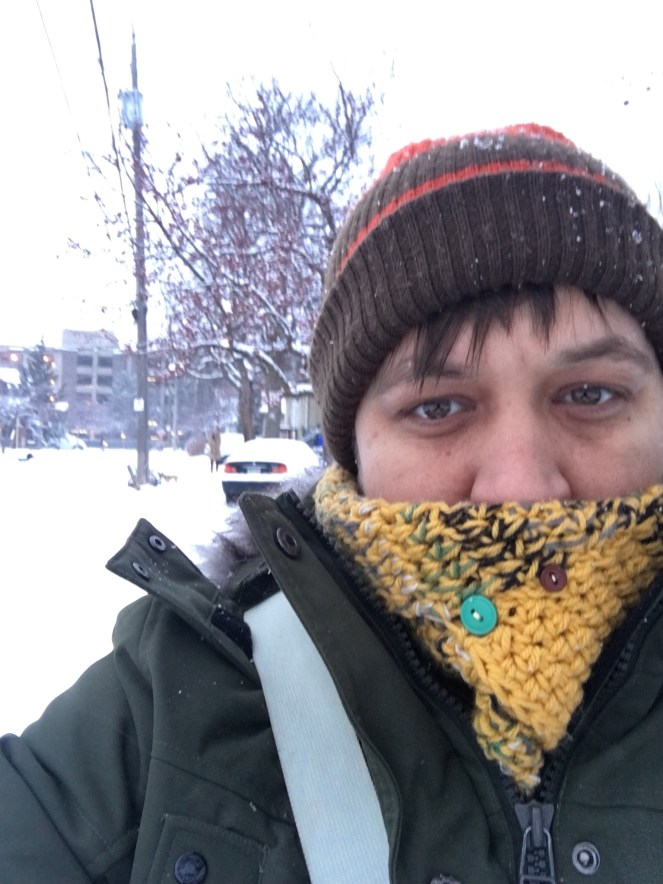
Natalie stares at the camera wearing a brown and orange toque, a mustard yellow cowl and an army green parka. The background is a narrow lane with apple trees covered in snow

I keep forgetting to snap a photo after yoga but here’s one of my outside, walking to meet Kim.

Uncategorized

Compassion for aging, ailing bodies

Recently someone close to me (hi Sarah!) asked me a really hard question. Do you think that if your knee can’t be fixed you could make peace with your current level of ability? How would you feel about a new normal where your level of activity is set by the limitations of your knee?

It’s pretty clear I’d get back to riding so long distance cycling stays on the agenda. Everything else is short. With pain.

I didn’t know how to answer that question. I’d find other things to do. I’m a relentless optimist. Life would still be rich and rewarding.

I’d read more books.

Maybe I could learn to swim? I don’t know. I’m still thinking about this.

Today I met a new physio person at the University of Guelph clinic. She was lovely. She protested though when I called my left knee “the bad knee.”

We don’t say that here. We talk about the affected knee and the unaffected knee. They’re both good knees. It’s your body, she said. You should appreciate and take care of your knee. No name calling.

Our job here is to help you support the left knee.

Here’s the sign outside the physio clinic. Recovery, success, those are words I like.

Acceptance and compassion are not exactly my strong suit when it comes to me. But I’m thinking about it.

cycling · eating disorders · feminism · fitness · motivation

A return to fitness in 2018 (Guest post)

Biking with a friend

I love to make New Year’s resolutions, although I sometimes have uneven results. My main and most exciting New Year’s resolution for 2018 is to do 218 workouts – they don’t have to be particularly strenuous or any set length but they have to be fun and pleasurable.

I hope that 2018 – the year I turn 40 – will be at my fittest year ever. This isn’t an extreme goal because my fittest year was probably 2011, when I was running regularly, had not yet gotten my driver’s license so cycled everywhere out of necessity, and impulsively bought an expensive personal training program. I was 33, so it is not as if I am trying to re-live athletic teen years, which would be considerably harder. I was actually the type of kid for whom gym class was a nightmare. I walked the field when I was supposed to run, regularly ‘forgot’ my gym clothes, and dreaded group sports when my lack of any skill would be humiliatingly apparent to all my classmates.

I was not fit in any sense of the word until my late twenties when I started to cycle everywhere often, in those years, pulling two children and/or groceries (!!) in a bike trailer. When I was 30 and newly single I decided to try some new activities: running, roller derby, hot yoga, and weight-training. I felt fantastic, met some great people, and began to think of myself as a fit, even athletic, person. I felt strong and powerful and had a lot of fun. I still remember the exhilarating day I ran 13 km for the first time. As someone who a couple years earlier could not run one block, I was extremely proud of myself.

Unfortunately, the fitness activities got confused with and integrated into disordered eating habits, which dulled my enjoyment. Healing from disordered eating, which for me meant restricted eating, and unattainable weight loss goals, meant also giving up some of my fitness goals. But now I am about turn 40, a busy PhD student, community activist, and mom. Giving up a strong focus on fitness may have been necessary for me to heal from disordered eating but it also meant that I lost the physical and emotional benefits of fitness especially the almost magical effect it has on my ability to deal constructively with stress.

I miss the camaraderie that accompanied roller derby practices and group runs. I miss experiencing my body as strong and powerful. When I think about my life in ten and twenty years, I want fitness to be an everyday part of it. So, I have made a plan to get to my fittest this year and to re-discover the joy of fitness.

The plan is simple: do 218 workouts in 2018 which will include some weight-training, a gentle triathlon, and a few no-pressure and fun 5 or 10 km runs.

Maybe I’ll even, finally, attempt a fall half marathon – but only if it brings me joy. I also hope to cycle year-round instead of taking a long winter break after which I always feel hesitant and creaky. The focus, other than doing the 218 workouts, will be on feeling pleasure in moving my body and having fun participating in physical activities with other people.

There will be absolutely no weight loss goals or restricted eating plans and I will steer clear of others who have integrated those elements into their fitness plans and motivations. I’m excited, motivated, and ready to have fun and feel strong!

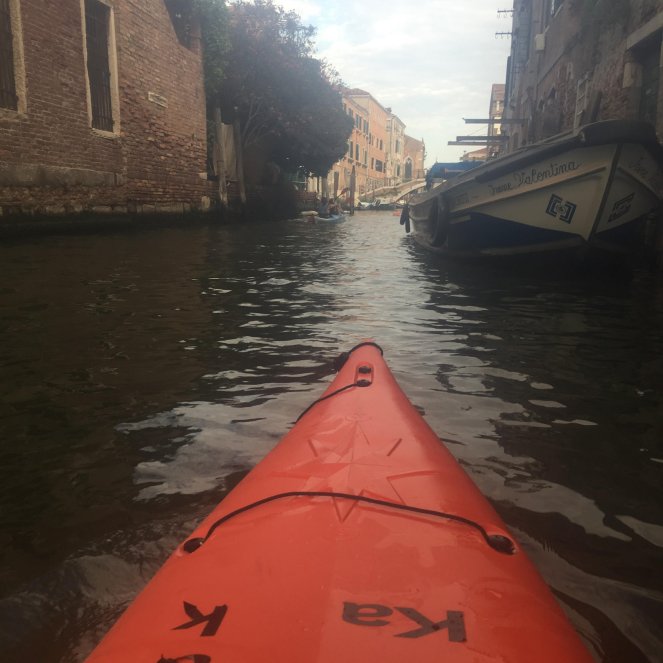
Kayaking in Venice in 2017

Becky Ellis is a PhD student at Western University who studies the bee-human relationship in cities. She is a mom to four kids and a community activist. Becky loves gardening, cycling at a leisurely pace, and taking millions of pictures of bees. She also maintains the blog Permaculture for the People about social justice and urban permaculture.

dogs · fitness

Lost Without My Doggo (Tails From the Woods)

Hi. This is me, still not doing very much by way of movement. . .EXCEPT. . .dog walking.

In this post I will contemplate the different types of dog walks as I see them. You can argue with me, but I just made this all up so you can be right if you want.

Basic walk: This is the 7:45am walk around the small park. It is necessary for the dog’s health and short because I (or you, or someone) has to go to work or school. The dog loves it and the human just needs it to be over (1km).

Panic walk: This walk happens right before you have to do something important but the dog needs it and you love the dog. So you walk very fast and yell at the dog to stop checking every bit of pee-mail she has and lets go because you need to move. (1km)

Information gathering from teenager walk: This is the one you ask your teen kid to come on with you so that the dog gets a walk and you maybe get some info (intel) on their life or the life of a sibling. Children who are looking in the same direction as the adult talk more than children being directly interrogated. Don’t believe me? Try it. Car ride, swings in the park, park bench, ski lift or. . .dog walk. (1.8km)

Hang out with a spouse walk: The spouse you never see. Ya, that one. Go for a dog walk, get a coffee, don’t forget the Timbit for the dog. (1.8km)A happy yellow lab standing in snow looking up. There are snowshoes with boots in them all around the frame

It’s so cold I hate you dog walk: This is the walk that you wish you never owned a dog for. Except she is so happy and loves you for taking her, so I guess it’s okay and she can stay, but I can’t feel my face. (1km)

Cottage road dog walk: Casual, delightful, you remembered to put your snow pants on so you are not too freezing. Love the cottage road dog walk. (1.5km)

Forest tromp with dog: Snow! Forest! Happiest dog ever in the world. These are the best walks. They can be casual and slow or fast and sweaty. Everyone is having a good time, especially the dog. Let’s face it, the dog always has a good time. (4km)

It doesn’t matter what state you are in or I am in or how long it’s been since I wore running shoes. It doesn’t matter if I’m depressed and peri-menopausal and hate everyone. The dog is always up for a walk and the dog is always happy. Therefore, I walk the dog and the fog of life lifts just a little bit. May your year be full of happy dog walks or some equivalent even if you don’t feel very fit and even if you are exhausted trying to be a feminist in these weird times. Dogs see your potential. Dogs know you’ve got this. Dogs think you are a-okay.

Uncategorized

Walking again!

I’ve taken walking for granted over the years, assumed that whenever I want to I can walk as far and as long as I need to. No fuss, no muss.

Not anymore.

Today I went on my first walk that was long enough to register as a walk on my Garmin since my knee injury. But I’m not sure if it’s getting better or if my pain tolerance is going up. Still, the sun was shining and I need to get outside. There are emotional well-being issues here too.

The whole walk was actually closer to 4 km but I stopped and started a few times running errands on campus.

Tonight though I’m back to my ice and riding on the trainer routine. Tomorrow I meet a new Guelph physio person.

Slow, steady, walking not running….