hiking · menopause · running · training

Now That Getting Stoned Is A Legal Training Option

Before I dive into this post, I want to put a caution up front. This represents my personal views. I’m coming from a cannabis-positive direction and will not look at the risks and downsides. Others will represent that perspective, to be sure!

Yesterday the recreational use of cannabis became legal in Canada. As if I needed another reason to miss my homeland! By way of celebration, I considered getting stoned this morning before my run, but I’m only a baby stoner and consuming cannabis straight out of bed (and by myself, since my partner is away) felt more than a wee bit outside my comfort zone.

photo-1498671546682-94a232c26d17
lush green cannabis plant

This article in Canadian Running about the potential benefits of cannabis on training might change my mind about running stoned.

By way of background, I consumed virtually no pot until I was into my thirties. Then a few years ago I became intolerant of alcohol, likely related to the onset of menopause. I was never a big drinker, but I enjoyed the social aspect. I miss the festive feel of a cocktail or the last glass of wine around a dinner table littered with the debris of a long meal. I’m glad that I have access to edibles (products like candies or brownies containing cannabis) and enjoy them as an alternative that never gives me a hangover.

Cannabis products didn’t really figure in my athletic life. Sure, there was the marathon I finished where a friend with a joint was at the finish line, touting the anti-inflammatory benefits. I can’t remember if I recovered more quickly from that marathon. Until recently, I had not used cannabis specifically as a recovery tool. Yes, I am likely to consume in the evening after a long effort, but that’s a reward, a celebration. The pain relief is a bonus and I haven’t tracked the efficacy.

Then, about a year ago, I had a period where my hip flexor started bothering me out of the blue. Putting on a pair of pants was uncomfortable. Running got hard and slow, because lifting my leg invoked the pain. My partner counseled me to use the CBD oil he’d bought a while back. I was skeptical. Then I was a grateful convert. Since then we’ve bought a couple of other CBD products for muscle pain, and my acupuncturist uses it. Wow. Nothing topical has worked so well for me. This summer when I was training for a 30k mountain run, I would mix CBD cream with foot salve, to my feet’s delight. I used it on my sketchy hamstring and my cranky shoulder blade muscle. All were happy.

IMG_2122
White plastic bottle labeled Muscle Melt Active Cannabis Heating Rub, beloved by Mina’s muscles

While training for that long run, I did a couple of runs with some younger folk. They were mountain goats with incredible endurance, agility, quite a bit of speed and a lot of good cheer. I also realized that two of the three of them were stoned. That gave me pause. I had never thought about the potential training benefits of cannabis. If anything, I assumed that being stoned would diminish my ability to work out.

The day after one of our four-hour training runs, my partner and I decided to do a 10-mile, steep hike, as a way of being on our feet, without using the exact same muscles. I suggested we follow our mountain-goat friends’ example. We had a cannabis candy as we started up the trail.

I was curious to see how it would feel. Would we be slower? Would we lose the thread of the hike? Would we just sit down and admire the forest? Nope. We charged up the mountain and got to the top as fast, if not faster, than we usually do. We were so jazzed by our ascent that we run-hiked back down. We were so focused on whether we were having a “better” time on our hike, that we didn’t even notice our performance. We concluded that the forest had seemed just as spectacular as always, the view from the peak as breathtaking, and the high meadows of wildflowers as eye popping. With or without cannabis enhancement, we got the same joy out of the experience. It was only afterward that the performance side sank in. Hiking stoned was hiking strong.

That one anecdotal event was not enough to change my training habits. I didn’t overcome years of a strict church and state separation of the workout part of my day and the relaxation part; that prude in me who clucks her tongue at having too much fun when I should be working. I thought of that hike as a one-off. But when I add in the new information from the Canadian Running article about the potential benefits of cannabis during training runs, well, I can feel my no-no stance crumbling.

I’m always curious about new training modes, so why not running stoned? Have you tried it? What are your experiences with cannabis and training?

Guest Post · hiking · nature

Joh et Sabrina en randonnée à la Péninsule Bruce/Joh and Sabrina hiking on the Bruce Peninsula (Guest Post)

Joh. et Sabrina en randonnée à la Péninsule Bruce (see English below)

En juillet 2018, j’ai eu le plaisir d’aller en randonnée pédestre pendant 3 jours à la péninsule Bruce avec mon amie Sabrina Olender . Quel bonheur que de voyager avec une personne aussi organisée que Sabrina! On a préparé la liste des repas et du matériel commun ensemble, mais quelques jours avant le départ, Sabrina avait contacté le parc national pour s’assurer que nous avions tous les permis en main avant de partir, nous épargnant ainsi une heure de transport supplémentaire vers le poste d’accueil, en sus de la route de Toronto.

Après quelque quatre heures de route, nous voici donc arrivées au stationnement du lac Crane, notre point de départ vers le camping High Dump (après avoir pris une mauvaise route privée et rencontré une résidente assez abrupte de notre erreur). Nous mettons la dernière touche à nos sacs à dos, enfilons nos bottes et étudions la carte. Je marche 10 pas et réalise, catastrophe, que la semelle de ma botte droite s’est complètement détachée, affichant un large sourire. Comment vais-je marcher 8 km avec un sac à dos de 18 kg sur le dos sans bottes de randonnée?

Heureusement, Sabrina la prévoyante avait du ruban adhésif (le bon vieux duct tape) avec lequel j’ai réussi à attacher ma botte tant bien que mal. À ce moment est sorti du sentier un couple de randonneurs (de 75 et 78 ans!) qui m’a aussi donné du ruban pour tenter de réparer ce dégât; un autre randonneur rencontré en route m’a également donné du ruban. Beaux exemples de solidarité en camping!

Après une randonnée sans autre anicroche, nous avons entamé la descente abrupte vers le site de camping, à l’aide d’une corde pour faciliter le tout. Notre campement était le plus éloigné de tous, situé près de l’eau et très bien aménagé avec une plateforme de bois entourée d’arbres pour bien attacher notre bâche. Aussitôt arrivé, il a commencé à pleuvoir, interrompant notre observation de la magnifique baie Georgienne pour terminer notre installation. Grâce à la plateforme, la tâche nous a été simplifiée, et la cuisine aussi, que nous pouvions faire debout

Le lendemain, nous sommes parties pour une randonnée d’un jour avec un plus petit sac, mes bottes toujours maintenues par le ruban et munies de notre enthousiasme à explorer le secteur et les différents points de vue sur la baie Georgienne. Le sentier était vraiment plus difficile, parsemé de grosses roches et très accidenté. Nous nous sommes rendues au point de vue situé à 2 km, avons dévoré notre lunch et sommes revenues profiter de notre campement et de la plage.

Pour conserver notre nourriture au frais au campement pendant notre randonnée d’un jour, nous avons eu l’idée géniale de la mettre dans un sac étanche dans l’eau glaciale de la baie, bien sécurisé sous des roches et arrimé à la terre ferme (photo 5)… sauf que, deuxième difficulté technique, nous avons dû constater au retour que le sac étanche ne l’était plus et qu’il était plein d’eau; celle-ci avait pénétré par une ouverture béante à son côté! Heureusement que tout était emballé à l’intérieur du sac, sauvegardant la nourriture qui s’y trouvait.

En ce qui concerne les animaux, nous avons vu de multiples grenouilles et crapauds dans le sentier qui sautaient littéralement juste devant nos pieds, un serpent d’eau près du campement, des tamias rayés assez agressifs (un d’eux a même suivi Sabrina dans les bois) et des oiseaux. Pas de trace d’ours, malgré les avertissements. Et vraiment trop de traces de l’animal le plus terrifiant des bois à cette période de l’année : le moustique! Omniprésents et fatigants, ils ne nous ont pas laissées tranquilles, comme en fait foi l’épaule de la pauvre Sabrina!

Le dernier matin, avant de tout remballer et de reprendre le sentier, il y a des crêpes au menu… mais plus de beurre ni d’huile pour les faire cuire, et la poêle n’est vraiment pas antiadhésive. Ce sera notre dernière mésaventure technique… et une chance que nous avions beaucoup d’autre nourriture pour bien commencer la journée!
Puis, ce fut le démontage du campement et le départ! Il s’agissait d’un trop court séjour pour cet endroit magique et magnifique, que je revisiterai assurément.

Et vous, quelle est votre destination préférée de randonnée pédestre avec camping?

Joh. est traductrice, originaire de Montréal et vit maintenant à Toronto. Elle aime être en plein air autant que possible et fait du vélo, du ski, du canot, du kayak, de la randonnée pédestre et, plus généralement, aime trouver du temps pour être active, malgré une vie divisée entre un travail à temps plein, des contrats et un enfant.


Joh. and Sabrina on the Bruce Peninsula

In July 2018, I had the pleasure of hiking on the Bruce Peninsula with my friend Sabrina Olender.

Sbarina (left) and Joh (right), all smiles and backpacks

What a joy to travel with someone as organized as Sabrina! We have prepared the list of meals and common equipment together, Sabrina had contacted the national park to make sure we had the right to leave the room. pick up our permit before getting to the trailhead.

After a couple of hours on the road, we arrived at the Crane Lake parking lot (after taking a wrong turn on a private road and meeting a resident who was quite angry at our mistake). This was our starting point towards the High Dump campground. We put the finishing touches on our backpacks, put on our boots, and checked the map. After 10 steps in, I realized that the sole on my right had been completely detached, showing a wide smile. How am I going to walk 8 km with 18 kg backpack on my back?

Hiking boot with duct tape

Fortunately, Sabrina the farsighted had the good old duct tape with which I managed to wrap up my boot as best I could. We also have a couple of hikers (75 and 78 years old!) Who were getting off the trail. And as luck would have it, we put another one in the way who also gave me some more. Beautiful examples of solidarity in camping!

Boot with tape

After all, we started our strenuous descent into the camping site, using a rope to facilitate everything. Our site was the most remote of all, with a wooden platform. As soon as we arrived, it started to rain, interrupting our break to observe the beautiful Georgian Bay. Thanks to the platform, we were able to set up camp and it was nice to cook on a level surface, which we could do up.

Wooden tenting platform

The next day, we still have a little bag, my boots are still wrapped up in its tape, and we’re all looking at Georgian Bay. The path was more difficult, strewn with big rocks and very unven. We went to the viewpoint 2 km away, ate our lunch and cam back to enjoy our camp and the beach.

To keep our food cool during the day, we had the brilliant idea of ​​putting it in a dry bag in the cold water of the bay , right?)  This is when we encountered our second technical difficulty – we realized that it was a long time ago because of a gaping opening at its side! Fortunately, everything was well inside the bag, saving the food.

As for the animals, we have a lot of frogs and toads on the trail, we are going crazy, and we’re going crazy. No trace of bears, despite all the warnings. And too many traces of the most terrifying animal in the woods at this time of the year: the mosquito! Omnipresent and tiring, they did not leave us alone, as shown on this picture of Sabrina’s shoulder!

Sabrina’s tattooed shoulder with lots of bug bites

The last morning, before packing everything and heading out, we had pancakes on the menu … no more butter or oil to cook them, and the pan was not really non-stick. It was our last technical mishap … and good thing we had plenty of food to start the day!

Then, it was time to dismantle the camp and off we go! It was too short a stay for this magical and beautiful place, which I will certainly revisit.

And you, what is your favorite destination for hiking and camping?

Joh. is a translator from Montreal who now lives in Toronto. She likes to be as active as possible, and is into biking, skiing, canoeing, kayaking, hiking, and enjoying an active life, between a full time job, some contracts and having a kid.

accessibility · climbing · fitness · hiking · holidays · inclusiveness · nature · running · traveling · yoga

Women, mountain sports, and privilege – thoughts on an all-female sports festival in Austria

Two weeks ago, I attended the Women’s Summer Festival in Ischgl, Austria. It’s basically a three-day summer camp for female adults. You can sign up for lots of different sports workshops, including yoga, mountain biking, climbing, hiking, the full works. All of it women-only, set very scenically in the Austrian Alps. I’d read about last year’s edition and it sounded like a ton of fun: a chance to try out new things, meet people and spend a few days frolicking in the mountains? Sign me up.

IMG_3594.JPG
View over a lush green alpine valley, from the beginning of our via ferrata.

I agonised for a while about my choice of workshops – there’s no way you can do them all – and finally put myself down for a via ferrata (complete novices), trail running (beginners), morning yoga (all levels), and an all-day hike (experts). Aside from yoga and hiking, I decided to do things I hadn’t done before, so for instance bouldering fell by the wayside in favour of the via ferrata. And I was too much of a chicken for mountain biking. Somehow, the thought of hurtling down a mountain on two wheels terrifies me a lot more than the thought of being suspended above a precipice secured by nothing but a fixed steel cable and two carabiners attached to my harness through a via ferrata set.

f16d49f8-f3e3-4a9c-b9eb-182e60926933.JPG
Bettina in full gear, taking a well-deserved sip of water after completing her first ever via ferrata.

The classification of levels, I later learned from fellow participants, stumped not only me. How do you know you’re an “expert” hiker, rather than an “advanced” one? As I’ve mentioned before, I have my share of athletic impostor syndrome, so I was mildly terrified of both the trail running (should I have signed up for the “complete novices” one?) and the hiking tour (what on earth had made me think I was an expert? The hubris!). If anyone still needed proof that women tend to underestimate themselves, they only had to attend this festival. Nearly everyone rocked up with the same self-doubts.

But these shared concerns actually ended up making for an incredibly supportive environment. Everyone cheered each other on and kept encouraging others. It had been a long time since I’d seen two people as happy as two women with vertigo after crossing an incredibly scary suspension bridge on our trail run, fuelled by gentle coaxing from our guide and the supportive cheers of the other participants. It was wonderful to watch.

IMG_3706.JPG
The really quite scary suspension bridge we had to cross during our trail run, complete with some runners from our group approaching in the distance.

The other thing I’d been a bit wary of is going by myself. I wasn’t organised enough to enlist anyone else to come with me, and I’m not exactly a social butterfly – my small talk is limited and I tend to get incredibly intimidated by people I think are cooler than me, which is pretty much everyone. I ended up really, really enjoying myself, both in terms of the activities and the company. I met some very nice people, and the activities were great. In fact, both the via ferrata and trail running (who would have thought, considering how badly I do running uphill!) left me hungry for more.

The morning yoga was beautiful, and the hike was out of this world stunning – three three thousand-metre summits in one day! With bright sunshine! And incredible views! If I were to do this again, and I’m definitely keeping this option open, there are plenty of things I didn’t get around to doing: a more challenging via ferrata, bouldering, more hiking, and maybe, just maybe, even some mountain biking?

IMG_3751.JPG
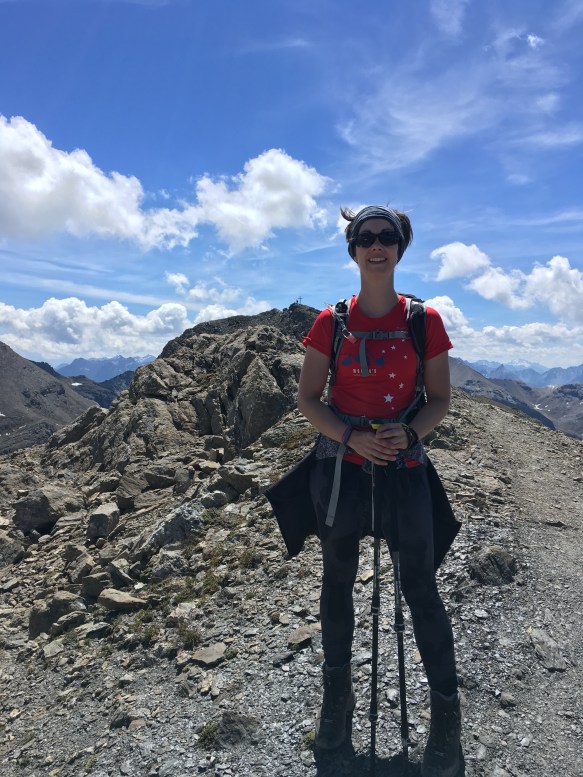
Bettina in a red t-shirt and hiking gear, beaming widely with one of the summits she climbed during her all-day hike in the background.

There was a framework programme too, to keep yourself occupied while not attending a workshop, with ad-hoc activities such as TRX training, massages, pilates, etc., and you could even get your nails and your hair done if you wanted (I opted for the nails, which I usually never do or get done, and also because there’s not much you can do with my hair). In the evenings, one night there was dinner at a local hut, which ordinarily is a hip après-ski joint, and another night there was a concert with a local band in the festival tent. And as these things are wont to go, there were exhibitors peddling the latest trail running shoes, hiking poles, outdoor and yoga clothing, etc. You could also try all these things in action, which was fun, though it didn’t motivate any purchases for me.

The whole thing was a very enjoyable affair, but I wouldn’t be a good feminist killjoy if I didn’t have some issues with it. This was obviously not a free event. The all-in festival pass set me back just under 280 Euros, and I treated myself to a nice hotel in addition. There was the option of booking just individual workshops, but they also weren’t super cheap. There was a goodie bag for those who’d booked the festival package that contained some ecologically very dubious plasticky giveaways (although in fairness, there were some great quality ones too that I’ll definitely be using). And diversity at the event was limited to cis-gendered almost exclusively white, almost exclusively able-bodied, relatively fit women who could afford to be there, and a bunch of invited press, bloggers and social media influencers who were there for free (disclaimer: I wasn’t one of them).

In other words, we spent three days oozing privilege from all pores. Is this inherently a bad thing? Probably not. We had a lot of fun and it was great to completely disconnect from the news and the heat wave gripping the rest of Europe for a few days, being active among a bunch of very nice, like-minded women and pushing our comfort zones in a highly supportive environment. The event is absolutely fantastic in that it lets you test the waters with new activities that might otherwise be quite intimidating, which I think is very important in getting women to be more active. But it’s important to be aware of that privilege – and of the fact that if you were insecure about doing any sort of exercise, you probably wouldn’t sign up for a three-day mountain sports festival in the first place, so a substantial threshold is still there.

IMG_3762.JPG
Enjoying these views was part of our privilege: panorama of the Alps with some flecks of snow in the sunshine.

And things could be done to make the event more inclusive. One could think of travel stipends, marketing the event a bit differently to attract a more diverse crowd, and so on. Again, the organisers are a for-profit company that makes money with this, so it’s not surprising that it’s all a bit commercial, and all things considered, the commercialness is very low key – you’re not forced to buy anything or partake in any activities that aren’t your jam. And yet. A bit more of an effort in making the event more diverse and accessible would be very welcome.

Will I go back? Maybe. I had too much fun not to contemplate a return next year. I’ll keep you posted – and if I do, perhaps it will be in some fit feminist company? Would be fun.

hiking · sleep

Early to sleep, early to rise

Talking with Tracy this week about sleep made me realize a difference between us. She was asking how I managed to get to sleep before 10. I said I just get into bed. The trick for me then is staying up.

When I’m tired I just fall asleep. I start to fall asleep downstairs sometimes, after supper, after dishes, using my phone playing word games on the sofa. By the time I’m upstairs, teeth brushed, in PJs, I’m definitely ready for sleep. 

If I’m up and out past my usual bedtime, I’ll fall asleep on the subway, in the car, sometimes I’ll even doze off over dinner. There’s no question about staying up late.

It’s why sleep is my super power. I sleep on short flights. I can sleep anywhere and everywhere at any time of day. But the downside is that at night I don’t have much choice about it. If I’m tired I fall asleep. I fall asleep during tv shows, listening to books, in the middle of conversations. I try to use my phone in bed but sometimes I fall asleep emailing and it hits me on the head.

Going to sleep isn’t a virtue or even a habit. It happens whether I want it to or not. It’s like an off switch. Mornings are the same with on. I usually wake up pretty quickly and have lots of energy.  I think this is just how I’m wired.

How about you? Are there any other falling asleep over dinner people out there?

dogs · hiking · walking · winter

Winter Camping with a Beast (Guest Post)

by Mallory Brennan

A few weeks ago, during March Break, I went winter camping! It was a short 24-hour trip due to an extremely busy life and getting our house ready to sell.

It was me, my younger brother, and our dog Cheddar. It was Cheddar’s first time camping and he was the best-behaved camping beast you could expect! We were the only people I saw in tents, everyone else was in a yurt or a trailer. When we first arrived we set up our tent and put Cheddar on a long leash to explore our campsite. We put a tarp on the ground for him to lay down on during the afternoon (he slept in the tent with us at night).

Then we went hiking. It’s always interesting to see what the parks look like in winter- frozen ponds and lakes, snow, ski tracks.

After hiking, we had a campfire and cooked our dinner. All our normal camping dishes were in storage so we cooked using no dishes- we roasted veggie skewers with vegetables, smoked tofu, halloumi cheese (which has a higher melting point so it doesn’t melt when you toast it). Then, of course, s’mores for dessert! As soon as it got dark (~8:30pm), Cheddar decided it was bedtime. He started circling us, going into the tent and looking at us (“Are you coming?”), coming back out to get us. We gave in after about ten minutes of this and curled up in the tent with him. It is very helpful to have a warm, furry beast in your tent. Especially a Cheddar-beast who loves to be as close to his people as possible and loves sleeping under the covers with you.

When we woke up in the morning and got up (12 hours later), he was still sound asleep in the tent and even looked at us as if to say “Do we have to get up yet?”. But he cheerfully got up once we got his leash out for a W-A-L-K (if you have a dog you know why we need to spell that word!). A couple hours more of hiking and we headed home. A successful 24-hour camping trip with a beast.

Mallory Brennan is many things. She’s the daughter of Samantha (and Jeff!), part-owner of Cheddar the dog, lover of the outdoors, hater of shoes, singer, conductor, and traveler.

fitness · hiking

Change of scene: moving through the desert in Tucson, AZ

This week is spring break at my university, which means I am either 1) somewhere warm; or 2) complaining about not being somewhere warm.  Happily for me (and the people around me), this year my friends Kathy and Janet and Steph and I made plans for biking and hiking/walking around in Tucson, Arizona.  Our plan also includes eating as much Mexican food as possible during the trip (this was my additional requirement).

I was supposed to arrive in Tucson last Friday, but a nor’easter changed my plans; I got here Monday instead.  No matter– I’m here now!

Tuesday was desert walking day.  Every time I come to a desert landscape I am completely taken by its beauty and otherness.  As a person raised in woodsy, swampy flat southeastern landscapes and who lives in woodsy rocky coastal New England, the southwestern desert is otherworldly.  And I’m also surprised by how varied it is.  You will see this for yourselves below.

Tuesday morning we went to the Arizona-Sonoran Desert Museum.  It includes lots of indoor exhibits about the history, geology, flora and fauna of the area over time.  However, most of its loveliness is outdoors– there’s a circuit of walks with info posted about plants and animals.  At the start, we were greeted with this:

yellow sign saying "warning!" and "welcome" (with a red line through it)
yellow sign saying “warning!” and “welcome” (with a red line through it)

I’d call that a mixed message– which is it, people?  The point of the sign is to remind us that the desert is hot, dry, and contains plenty of prickly and potentially hazardous things.  We should be careful.  Okay, got it.  And yes, I’m wearing sunscreen, sensible shoes and a hat.  Ready to proceed.

It’s not yet peak desert flower season, but there were some blooms to enjoy.

We saw a huge variety of agave, cactus, aloe and other plants. I mean huge.  There was hedgehog agave (Steph’s favorite), bonker hedgehog agave (nothing to add here), and my favorite, octopus agave.

An octopus agave, with multiple (actually, more than 8) green large curving tendrils.


We saw this intriguing sign:

Sign saying "raptor free flight"
Sign saying “raptor free flight”

There was some discussion about what that sign could mean.  Steph thought it was advertising free flights, courtesy of raptors; maybe we could just grab some talons and hang on.  I was wondering if it was a chance to fly with no raptors around.

We strolled, pointed at things, shared and compared our preferences, and took loads of pictures for a few sunny hours.  Being outside in short-sleeves at this time of year is such a privilege and a pleasure.

After leaving the museum to have a late picnic lunch, we drove over Gates Pass, a very scenic spot and well-known cycling climbing route in the area.  Here’s a view from one of the overlooks:

The side of a mountain, dotted with Saguaro cacti, at Gates Pass near Tucson.

Then we headed over to Catalina State Park.  It has a very different desert profile.  We took a couple of easy loops (the trails vary from short easy stroll to long arduous climb).  Here’s a view along one of them:

A stand of majestic saguaro cactus against blue sky, on a hillside in Catalina State Park.

I kept exclaiming, “this is so beautiful!”, at regular intervals, stopping to take pictures throughout our walks.  My friends were patient, but I believe wanted to get a move on at some point.

Steph, Janet, and Kathy, hands on hips, waiting on the trail for me.

On the other side of the main road, we took the birding loop, and we were greeted with lots of unexpected greenery.  It had rained the week before, and the desert eagerly put on a show of color.

Walking through a woodsy, green area, headed up to more desert views.

And we were not disappointed when we got there:

View of the Catalina mountains, with cactus and scrub bush in the foreground.

Today I turn to the bike– there is a 60+ mile system of bike paths around Tucson, and I’m off to explore.  We have cycling fun planned for the rest of the trip.  But it was nice to ease into movement on foot.

Readers, do you like multiple modes of activity and exploration when you go to a new or different place?  Or do you stick to one favorite form of transport?  I’d love to hear from you.


fitness · Guest Post · hiking · winter

Pack up your snowshoes and trek it all away (Guest Post)

Image description: Long-haired blond woman (Wendy) with sunglasses, ski style hat, pink and black plaid ski jacket, smiling. In the background a medium sized black and brown dog standing in the snow, looking toward a footbridge, trees, blue sky with clouds.

By Wendy Boucher

I’m 48, I have a phenomenal seven-year-old girl, I’m a Western science student, and my boyfriend of 2 years dumped me via email in October. The day after Christmas he tagged me in a Facebook post stating that he hoped I got coal for Christmas, quickly followed by a post announcing his new relationship (complete with loved up pics).

What did I do, you ask!?

Did I send a poisonous rebuttal? Cry in my ice-cream bucket? Call my girlfriends and formulate a plan to photo shop hearts around a pic of me and my super cute 38-year-old guy friend – who has a crush on me – and post it on my Facebook page? Nope. None of the above.

I threw on some lipstick, packed a light lunch, a big bottle of water, my iPhone, and… my snowshoes. My German Shepherd cross, Kyah, was down for the adventure so we dropped my girl off at her dad’s house, and drove to FanshaweConservation Area. It is there in the wilderness, trekking the 21k loop around the lake that I always find me. My independence. My strength. My love for myself. And I lose the marionette strings that those who hurt me have attempted to control me with – including social media passive aggressive shots.

The first 5 km found Kyah and I taking selfies amongst the many snowy footprints of other hikers. The scenery was a massive contrast to urban London, and the sun painted the snow silver. I was still frustrated but felt the anger begin to drift into apathy.

The second 5 km saw my spirits lift considerably. I saw far less signs of human life along our path which made me realize that not many people can walk this far. I am one of the elite winter hikers. I shout out, “I am woman”. My best friends are my strength and my loyal canine. Hear us roar.

Image description: Black and brown dog on a long leash on a snowy trail with low brush on either side. In the centre foreground a blue metal snowshoe, left foot, extending forward to take a step.

When I reached the 10 km mark (which means I continue the 11 km to my car, or turn around and trek 10 km back to my car) I had been hiking for 2.5 hours. I was committed either way. I thanked my fitness level, the mental endurance I learned from 10 years of adventure racing, and the fact that emotional pain drove me to this awesome place of a natural endorphin high. I found myself singing “Let It Go” as I trekked amongst a long corridor of evergreens. I was the Snow Queen of the Fanshawe forest.

The third 5 km discovered the power within me. I found no prints in the snow, was forced to load myself onto my snowshoes, and my dog lead the way with her keen sense of smell. She guided me through the woods sniffing out the trail with her 300 million olfactory receptors. She became my compass as well as my social support. My strength was waning but my spirits were jubilant. “You’ll never see me cry… the cold never bothered me anyway.”

Sadly, everything but my strength fell apart after that. My water bottle was plugged with ice, my phone died, my dog began to limp from the ice between her toes, my snack was a cold solid rock (I totally forgot that everything outside freezes at -15 – and I am outside), and I was still 5 km from my car. I began to think.

Remember what happens when you work out? You tear your muscles, just a tiny bit, all over and this is what makes them stronger. Your tiny muscle fiber tears heal, and you get larger muscles. So, when you heal – you are stronger. So maybe in order for us to become emotionally stronger, we have to hurt a tiny bit all over. So maybe we need to think of emotional pain as the post-workout-aches, take an ibuprofen, and in a few days we will actually will be stronger, look fitter, be healthier, and be a better version of ourselves.

As I was thinking, I cut off the trail opting to take a country highway back to my car. I didn’t want to die in the woods as darkness was quickly approaching and my time in the cold was nearly up. A silver Audi pulled up alongside my popsicle self and that of my icicle dog. The man and his fiancé that I had spoken with an hour earlier in the woods recognized Kyah and I and recalled that I had told them where our car was. He jumped out and told me that I was a million miles away from my car. He helped me with my backpack, threw it in the trunk, and like a big brother, escorted me to the front seat of their toasty vehicle. We are all Facebook friends now. He has since told me that his motto is “leave no hiker behind”. Wow. There are amazingly helpful and unselfish men out there. My faith has been greatly restored by this one.

Kyah and I gratefully welcomed the warm drive back to our car. She was curled up on my lap licking her paws as the angel-couple and I chatted about our hikes.

Image Description: Left wrist with an electronic activity tracker watch showing 10:55; Total Steps 24,935; total distance 17.87 KM; Outdoor Walk: 15.03 KM.

Sure, I didn’t do the whole 21k trek, and I didn’t do it all alone. And yes, the powers-that-be had to send me help when I needed it. But guess what? I’m smiling. I made new friends. I’m healthier. I’m leaner. And I have a great story to tell. All because I channeled a bit of emotional pain and used it to fuel adventure, kick-start fitness, and promote a healed mind.

Get out there and tear some muscles.

Wendy is currently a student at Western University and studies Biology and Psychology. Her passion is ecology, animals, and outdoor fitness. Summers are spent mountain biking, paddling, backcountry camping, and hiking. Winters are spent snowshoeing and bird watching. Wendy has a seven-year-old daughter who helps keep her young and fit at 48. 

fitness · hiking

The sort of person who…? (Guest post)

During a recent sabbatical, I spent a few months in Birmingham, walking (as the British call hiking) on weekends in the hills of Shropshire.

I had a reaction one day I wanted to describe as “falling in love with a hill.” The hill was Caer Caradoc, and the experience was great fodder for rumination the rest of the day. What could it possibly mean to fall in love with a hill?

A fine view of Caer Caradoc


Walking is like that—lots of time for rumination.

My sabbatical host, Angus Dawson, later told me that the Long Mynd area has a surprisingly alpine quality for hills of 300m—“Little Italy,” they call it.

More rumination: 15 years ago, I walked on top a dead volcano, face to face with a live one, and wondered that day why I didn’t spend every weekend of my life on top of mountains. At every hilltop in Shropshire, I started looking eagerly for the mountains of Wales on the horizon and learning their names.

But every time I got excited about mountains, I reminded myself that I’m not the sort of person who climbs mountains. I’m the person who was laughed at by my fellow 7-year-olds for coming in last on track and field day. I put my nose in a book and ended up with chronic arm pain from the final dissertation run 21 years ago. Most definitely not a mountain climber.

I went back to hiking the coastal barrens around Halifax just like before sabbatical, wondering how I could make my hiking more intense—without carrying a tent on my back and sleeping in it, which is how Canadians ramp up the hiking. Orienteering? Snow-shoeing? Trail running? Bush-whacking? It dawned on me that I might try editing out the thought that I’m not the sort of person who climbs mountains. But where to start?

bouldering gym and coffee shop opened in Halifax. After a few months of watching people climb while I was drinking coffee, I asked the staff, do you have to be under 30 to boulder? (I wasn’t seeing many people my age.) They were friendly and encouraging. I did an intro morning and found to my surprise that it didn’t bother my old arm pain too much.

You can’t keep me away now. I find the bouldering gyms when travelling for work and I’m getting muscles for the first time in my life. It feels great. And it’s from a non-repetitive, highly entertaining, intellectually challenging, indoor-outdoor activity—even better. I don’t have to make myself go to the gym. I’m counting the hours until the next time I get to go.

I went back to the UK in the summer and went for those Welsh mountains. The peaks are only 1000m, but again very alpine in form. That, plus colonialism, means North Wales is important in mountaineering history. The pattern of claiming “first ascents” for people from London who speak English and write about it goes back to 1639 on Snowdon (Yr Wyddfa in Welsh). At that stage, mountaineering was about collecting alpine plant species, connecting the activity to another obsession of mine—plants of the coastal barrens. (The same plants like harsh environments at many altitudes.)

On that trip, I scrambled Crib Goch and the North Ridge of Tryfan. Easier than the easiest bouldering problem, but with 450m to fall if you let go. I didn’t find myself ruminating while scrambling Crib Goch. I knew where my hands were and where my feet were, and if calm enough, just for a moment, I took in the astonishing view. (The British skip along Crib Goch in sneakers, no hands, in their 70s.)

The Crib Goch ridge safely behind me, from the summit of Snowdon.

Back home I had some awesome climbing lessons with Heather Reynolds, a local treasure. “She’s climbed with Lynn Hill,” I say to people when I want to demonstrate that I know that name, and impress on them how lucky we are to have Heather here. (Lynn Hill was the first person of whatever gender identity to free climb the Nose on the iconic El Capitan.)

In November, I took part in a bouldering competition—competing for last, just like when I was 7. I succeeded in this ambition, with half the points of my nearest rival. Instead of laughing at me, as 7-year-olds do, some spectators formed a cheering section. A young woman told me I was an inspiration for not caring whether I made a fool of myself. She put it much more kindly than that, I’m sure—boulderers are the nicest people. All they ever do is ignore you when you want to be ignored, and then magically appear behind you and cheer you on when you need it. You’re precariously standing on a tiny chip of plastic on the wall 3m from the floor, about to give up on reaching that one last hold, and suddenly a voice behind you says, “nice,” or “you got this.” So you decide not to give up after all. But if you do give up, they say, “good call,” and “you’ll get it next time.”

I’ve set my mind on a new goal: to drop the act that I’m climbing to set up the punchline in a joke about a 52-year-old woman who takes up climbing.

A few weeks after the competition, I was back in North Wales, on my first multi-pitch trad climb at Tremadog, with an expert, enthusiastic, and thoughtful guide—Sabrina Paniccia. Freezing temperatures, snow squalls blowing through, numb fingers, aching toes—these peeled off a few layers of habitual self-doubt. When footholds in the rock of less than a centimetre were the only path to my warm wool socks at the top of the crag, I edited out the thought that it was unlikely I could ascend them.

Photo credits: Sabrina Paniccia


What kinds of activities would you do if you edited out the thought that you are not the sort of person who does them? Check out #unlikelyhikers and #indigenouswomxnclimb on instagram (thanks @shortworksproduction for the tips)—a whole world of people challenging the idea that people like them don’t explore the outdoors.

hiking

Active adventures in Iceland: Sam hikes to a hot river and gets her heart rate up in the process

I confess that although I list substantial dog hikes (not the everyday ‘around the block a few times’ kind but the kind where we go to the park for an hour or two) in the Facebook group 217 in 2017, somehow in my mind I don’t really think they count as exercise.

They’re not strength training. And I thought, they’re not really cardio either. (Unless, I dog-jog, and then they’re cardio.)

I now admit I might be wrong. At least if hills are involved.

This week, I’m in Iceland during our school’s fall break. Autumn temperatures hadn’t really hit Ontario yet so I took a drastic measure of finding cooler weather by flying North. Also cheap flights thanks to Iceland’s discount airline, WOW.

I went from 23 degrees for a high outdoor temperature last Monday to 8 for a high last Tuesday.

Our first day in Iceland was a bit sleepy. Our “overnight” flight got in at 5 am (1 am, Ontario time) and some exercise seemed in order to keep us moving. I also liked the idea of the hike to the hot river, because “hot” also sounded good.

It’s a 1 hour very hilly hike to the river in the Reykjadalur Valley. And looking at my Garmin watch data I may need to rethink my view that hikes aren’t really exercise. It seems hilly ones are hard as riding my bike at a good clip.

Here’s what the hilly part of my walk looked like on my Garmin.

Here’s me, all bundled up, near the start of the trail:

Here is the hot part of the river you can bathe in. It’s about 40 degrees. Much better than the hot water above with the warning sign. That can reach up to 100! Not for bathing…

Here is the whole area with lovely wooden board walks and privacy screens for changing.

You need to hike through some steam on your way to the river!

Geothermal activity is awfully pretty to look at!

There’s no selfies from the hot river because I was too nervous about losing my phone. It would be a great story to tell losing the phone in a hot river in Iceland but traveling is never a good time to lose your phone.

fitness · hiking · injury

Regaining confidence after an injury: one climber’s story (Guest post)

I’ve had some degree of pain almost every day for the past 9 months.

For the first few weeks after I injured my back, I could barely stand, sit or walk. I couldn’t go to work. I couldn’t take care of anything at home.

Before this, I had only experienced minor athletic injuries. A sore knee from hiking too far. An aching finger tendon from pulling too hard on small climbing holds. These all resolved quickly with a little rest.

This time was different. I was warming up doing an unweighted squat in the gym. Then out of nowhere, I felt the spasms of pain shoot through my back. This exercise was usually easy for me. I had learned how to do it safely with a trainer.

I used to hesitate to tell people how my back injury happened. I was embarrassed that I did this to myself in a part of the gym where I often felt like I didn’t belong. I had worked so hard to convince myself that I could take up space among the muscular men, bench pressing and deadlifting what seemed like so much more weight than me.

And it made no sense how such an easy movement could have caused so much destruction.

I now know that I was overtraining. That one squat probably wasn’t to blame. I was exercising too hard, too often and my body had broken down.

My goal had been to get stronger to keep up with others on climbing and mountaineering trips.

screen-shot-2016-09-27-at-12-43-35-pm
Me climbing in the North Cascades before my injury. Photo: Tony Lu

My favourite sports involve carrying a lot of stuff uphill for long distances. This poses some unique challenges for petite people, such as myself.

All the gear all adds up quickly: a warm sleeping bag, a down jacket and rain coat, food, water, climbing harness, crampons, ice axe.

On one long trip, my backpack weighed just over 40 pounds. At 35% of my body weight, I was carrying what many consider the upper limit for a well-conditioned hiker. This meant I relied on other people to carry all the gear shared by our group, like a tent and climbing rope.

Distributing gear proportionally according to a person’s size is fair and a widely accepted practice.

However, it always bothered me to be the smallest person who carried the least. I also often worried that I’d be the slowest person who held everyone back. Being one of the only women on some trips meant I felt even more sensitive to any physical differences.

After several months of treatment and physical therapy, my back pain began to decrease.

I slowly began to take up the things I loved again in new and different ways.

Instead of an all-day hike, I went on a short walk to the beach with a friend. Instead of trying to climb the hardest routes, I meandered up some of the easiest walls I could find.

Returning to the backcountry was harder.

Despite training and testing my limits close to home,  I was still so afraid of re-injuring myself in the middle of nowhere.

My first trip into the wilderness was on a multi-day canoe trip with my sister. An hour into paddling, I broke down into tears. I was so afraid. We stopped and set up camp at the first spot we found. We carried on that way all week: paddling short distances with long rests. It was not the trip we had planned, but I was grateful just to be out there and for my sister’s patience.

A canoe on a calm river surrounded by trees.
My view from our canoe in the Boundary Waters Canoe Area Wilderness, Minnesota.

The following month, I spent time in the wilderness again on a week-long trip in the mountains. While my friends hiked and climbed, I earned the nickname “Base Camp Babe.” I spent a lot of time reading books, swimming, napping and enjoying the beautiful alpine views. As the week went on, I ventured out on increasingly more adventerous hikes and climbs too.

med-154720
One hour of scrambling equals one hour of resting. Vancouver Island, British Columbia.

This injury has forced me to deal with my fear of being the slowest and smallest person in the group.

This year, I’ve had to turn around before reaching the summit far more times than I’ve made it to any desired destination. My friends carry even more of the gear than before. I often have had to lay down for long rests in inconvenient (but beautiful) spaces.

med-06
The view from a rest spot on one of the many mountains I did not get to the top of this year. Vancouver Island, British Columbia.

What’s surprised me the most is that despite being up front about my limitations, people still want to climb and hike with me. People whose company I enjoy and judgement I trust. My climbing network has continued to expand and become more diverse, especially in terms of gender and age.

While I am never going to carry a 70-pound pack up a mountain, I have other things going for me. Things like an eagerness to explore new areas, technical climbing skills and knowledge of local areas. I need to work on my limitations while focusing on my strengths.

For the most part, we are roughly stuck with the bodies we are born with. I’ve learned that trying to overcome my fears and challenges by trying to change my body is not going to work.

 Jes loves rock climbing, hiking and outdoor photography. Ten years ago, she moved from a big east coast city to Vancouver Island, Canada. She writes about her outdoor adventures at jescott.ca.