fitness

To listen, read, watch on a weekend #ListenReadWatch

Listen

Choose from this list of 35 best women’s sports podcasts.

John Torcasio, Unsplash

Read

From the New York Times, “You’re slow, buddy,” a man shouted at Martinus Evans during the New York City Marathon, adding an expletive to indicate just how slow. “Go home.” Evans tried to ignore him, but as the bystander repeated his taunt, Evans got angrier — then inspired. He created the Slow AF Run Club, a community for back-of-the-packers. And this month, he’s releasing his first book, “Slow AF Run Club: The Ultimate Guide for Anyone Who Wants to Run.”

You can order the book here.

Slow AF Run Club

Watch

Read about Biking While Black, directed by Yolanda Davis-Overstreet here, https://mass.streetsblog.org/2023/04/24/worcester-film-screening-to-discuss-the-realities-of-biking-while-black

Book Club · weight stigma

FIFI book club: “You just need to lose weight” and 19 other myths about fat people (section three)

CW: in-depth discussion of anti-fatness myths and people’s experiences around body shaming.

Welcome back to installment three of the FIFI book club’s review of You just need to lose weight and 19 other myths about fat people, by Aubrey Gordon. If you missed any previous bookclub posts, you can access them below.

FIFI book club: You just need to lose weight, and 19 other myths about fat people

FIFI book club: You just need to lose weight, and 19 other myths about fat people (section two)

This week, we are commenting on section three, “Fat acceptance glorifies obesity”. The myths of this section are:

  • myth 10: “Accepting fat people glorifies obesity.”
  • myth 11: “Body positivity is feeling better about yourself, as long as you’re happy and healthy.”
  • myth 12: “We’re in the middle of an obesity epidemic.”
  • myth 13: “Fat people don’t experience discrimination.”
  • myth 14: “I don’t like gaining weight, but I don’t treat fat people differently.”

Here are Amy’s comments:

There was so much to unpack in this section, and it really addressed the “myths” that I encounter most in my every day experience. These five also work together in the most insidious ways to make it easy/ier to justify being biased against fat people. If body positivity is about the individual then it doesn’t matter how someone/society views that individual so long as the individual has the ability to tune out all that noise and love themselves even while (gasp) being fat. If accepting fat people promotes and glorifies obesity, especially in the middle of an obesity epidemic(!) we must avoid that acceptance at all costs. Instead we should try to “fix” fat people so they can be “healthy and happy.”

Myth 13 is truly laughable to me. I just spent 3 days running around to malls and stores in 3 different towns trying to buy one outfit for an upcoming trip. Because stores don’t carry or stock a full spectrum of sizes, and each mall only has one “plus size” store. So in addition to paying the “fat tax” of those specialty stores being more expensive I also paid more in gas and time lost driving from place to place. Citing concerns about a fat person’s health is a common tactic used against fat people, but no one ever asks how my mental health is impacted by having to go drive all over the county to find 2 suitable pieces of clothing (or be relegated to online shopping and the often laborious return process that entails).

Myth 14 also made me roll my eyes a little bit. I frequently have colleagues and friends say this to me. The refusal to accept that their feelings about weight gain is not happening in a vacuum but rather in a world where they are constantly told they must not feel good if they have gained weight is noticeable. And when they get into the nitty gritty about whatever diet they are following to lose the weight… the sacrifices and hardships they are making by depriving themselves, I know I am supposed to feel shame for not forcing that on myself and instead “choosing” to be/stay fat. How are fat people supposed to maintain close relationships with people who constantly say/imply/indicate that their biggest worry is having a body like ours?

On to Samantha’s comments:

I don’t have a lot to say about this section. It’s pretty familiar material but once again I have a favorite myth. This time it’s number 14: I don’t like gaining weight but I don’t treat fat people differently.

We all have that friend, the normal sized friend who is trying to lose weight all the while insisting it’s just about them. They don’t mind other people being fat.

Yeah, right.

Gordon has a couple of things to say about this myth and the ways in which anti fat bias hurts everyone. Whatever we say most of us do engage in anti fat bias and we do treat fat people worse than thin people.

Also, I like the opportunities for action at the end. My favorite is asking for consent before engaging in diet talk. I also agree with Gordon that we should ditch all talk of “feeling fat.”

Here are Diane’s comments:

The history nerd in me loved the first part of Myth 11, which explained the roots of the body positivity movement in the US civil and welfare rights movements. The commercialization since? Not so much. Myth 10 immediately had me thinking about the painter Rubens, an all the other Renaissance and Baroque artists who painted glorious portraits of fat women and men. And more recently, Colombian artist and sculptor Fernando Botero.

Though I have heard Myth 12 ripped to shreds on Maintenance Phase, I loved reading this chapter. The “science” behind this one is “garbage” to use one of Aubrey’s favourite words on the podcast. It’s also the myth that has me dreading every visit to the doctor’s office, and feeling relief when no-one asks about my weight.

The last two myths in this section are best addressed in the questions for reflection and action at the end, about learning to identify and address our implicit biases. Anti-fatness is so ingrained in the world view of many that we don’t even notice it. But at least we can try to be aware, and address the more conscious manifestations of it.

On to Tracy’s comments:

On Myth 14: The subtle and not as subtle forms anti-fat bias takes are many and varied. The upshot of this myth is: anyone who doesn’t like gaining weight has anti-fat bias, and people with anti-fat bias treat fat people at best differently and likely worse than they treat thin people. The chapter gives lots of examples of anti-fat bias: using thin actors in fat suits to play fat characters in movies; frequent talk about “feeling fat” or body dissatisfaction, even from thinner people; trying to “reassure” people who self-describe as fat that they’re not; complimenting people on weight loss, assuming it to be a desired and planned weight loss; expressions of “concern” about health; studies showing the majority of women-identifying people feeling unhappy with their bodies regardless of their body size. Thinner women expressing negative body image is identified as causing harm to fat women and reinforcing anti-fat bias.

Her distinction between implicit and explicit anti-fat bias is useful, and the study at the end that showed that participants who were told their anti-fat attitudes were in conflict with their values engaged in less explicit anti-fat bias (at least in the moment soon after being so told). I think this is true for many of (that anti-fat bias is in conflict with our values), so it’s promising that finding ways to remind ourselves of that can potentially help to address explicit bias.

Implicit bias is of course harder to change, and requires collective effort to change widespread attitudes and assumptions. That change does happen through the cumulative actions of individuals though, so she suggests as opportunities for action: taking the Harvard Project Implicit implicit bias test on anti-fat bias, asking friends or family members who are fatter than you for feedback; always checking first before launching into a discussion of diet or weight; not talking about “feeling fat” as a substitute for what you’re really feeling, since that is a clear expression of anti-fat bias.

Now to my (Catherine’s) comments:

I never really took seriously myth 10, that “accepting fat people glorifies obesity”. It always seemed nonsensical on its face. But it’s been around in multiple forms, including academic ones. Ten years ago, prominent bioethicist Daniel Callahan wrote a peer-reviewed article proposing that, in order to “reduce obesity rates [the government should] use strong social pressure—even if it crosses the line into outright discrimination—to teach people that being overweight and obese is ‘not socially acceptable any longer,’ and ‘to make just about everyone strongly want to avoid being overweight and obese.’ (cited from this paper, by Janet Tomiyama and Traci Mann, objecting and responding to Callahan’s claims).

Tomiyama and Mann go on to point out that such stigma is ever-present in every aspect of the lives of fat people; if stigmatizing fatness would have turned fat people into thin people, it most certainly would’ve worked by now. What it does do is make fat people the targets of discrimination in all sectors of society. If what governments care about is a healthier populace (however that gets interpreted), anti-fat bias provably undermines that goal.

I’ll be blogging soon about what “glorifying obesity” could even mean, and what “accepting fat people” really does mean. In the meantime, we’d love to hear from you– what do you think of these myths?

fitness · habits · health · self care

Great news! It’s too late to do Joyful June perfectly!

It’s June 9th so we’ve already missed the first part of the Action for Happiness Joyful June calendar.

Isn’t that terrific?

No, I’m not excited that we missed it.

I’m actually thrilled that we can’t do it perfectly.

Since perfect is no longer possible, we’re all free do what we can – small or large – to find a bit more joy in June.

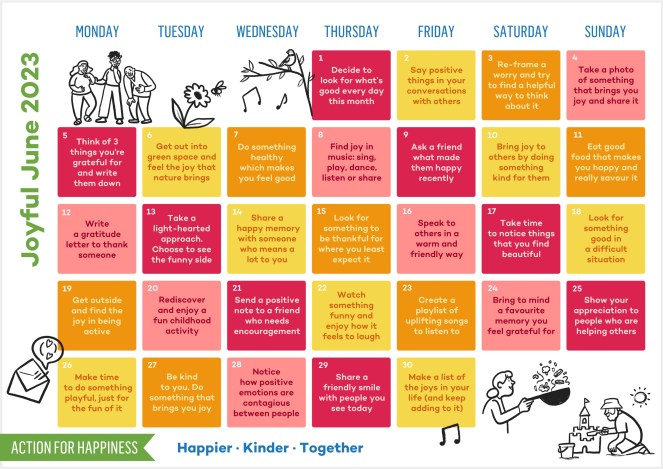
Here is the Action for Happiness calendar of daily tips for this month.

A multicoloured calendar of daily tips for finding joy in June. The calendar is decorated with cartoon drawings of joyful things, flowers, singing birds, a person building a sand castle, etc.​
A multicoloured calendar of daily tips for finding joy in June. The calendar is decorated with cartoon drawings of joyful things, flowers, singing birds, a person building a sand castle, etc.

(By the way, if you download their app, you can receive the daily tip as a notification.)

Here’s this month’s introductory video:

A YouTube video from Action for Happiness entitled Joyful June with Vanessa King. The still image shows a woman with shoulder length blonde hair and bangs wearing a brightly coloured shirt. Behind her are vases of flowers and some shelves of books.

And here’s a quote that was shared on the Action for Happiness website.

Image description: A quote reading ‘
 every day may not be good, but there is something good in every day, a green rectangular background with a small banner on the bottom that says ‘Action for Happiness’ on the right is a cartoon line drawing  of a person looking at a bird in a tree.
Image description: A quote reading ‘
every day may not be good, but there is something good in every day, a green rectangular background with a small banner on the bottom that says ‘Action for Happiness’ on the right is a cartoon line drawing of a person looking at a bird in a tree.

For me, this quote is helpful and hopeful without ‘bright siding’* me.

It’s not asking me to forget my struggles or to pretend everything is great, it’s just reminding me to look for something good to help make my day a little easier.

I can get behind that.

And I hope you can, too.

Good luck with Joyful June!

*I don’t remember if Barbara Ehrenreich actually uses the term bright siding the way I have here but I am referring to the kind of ‘reckless optimism’ and toxic positivity she writes about in her 2009 book Bright Sided: How the relentless promotion of positive thinking has undermined America Meanwhile, I read the book a long time ago so I may have stitched her ideas into a quilt with other ideas about the irritating nature of many ‘just be positive!’ messages by this point.

fitness

How’s your vulva doing?

All vulvas are beautiful!

(That link is a bit NSFW, but it’s line drawings, not photos. I just wanted to get your attention).

I’m famed around this here blog for yapping on endless about vaginally related things — periods (my evergreen post about geriatric menstruating, periods and covid vaccines (remember that??)), period coloured paint colours, middle aged menstruating, catching lotuses with my vagina, menopause (twice), menopause , vaginal atrophy. Etc. So when I said to the blog group last week, “hey, I went to see a gynaecological dermatologist,” Sam naturally said “blog about it.”

Yes, vulvar dermatology. A very niche sub-specialty. I often work with OBGYNs and I had never encountered it before. But I am a fair-skinned human with a constellation of skin conditions, and I have a vulva, and it is inevitable that my aging vulva and inflammatory skin conditions would eventually encounter each other.

Like a lot of pale people of northern european descent who spend time in the sun, my body dis-ease often manifests in my skin. I’ve had a basal cell carcinoma removed from my nose, routinely have to have pre-cancerous cells blasted off my face and shoulders, get eczema-rashy at the slightest provocation, and I have a much more severe condition called hidradenitis suppurativa, which manifests quite terrible lesions in my groin and armpits (I do not recommend clicking that link unless you really want to level up your titillation about gross skin things beyond Dr Pimple Popper).

So I wasn’t surprised a few months ago when my dentist peered into my mouth and said, hm, have you ever heard of lichen planus? (Swelling, irritation, bumps, lesions, all the good stuff). Like most skin-related ick, no one really knows what causes it. Most explanations are a kind of shrug about auto-immune responses (I have a belief that three decades from now we will view our current understanding of the immune system as akin to the four humours. Leeches, anyone?)

Anyway, once I read about the lichen planus in my mouth, I made an aha connection to the condition of my labia. Another mucosal tissue. Red, burning, sore, tight. I’d assumed it was just ye olde menopausal vaginal atrophy, and was slathering on the hormone creams and aging-friendly lubricants. But the visual inspection (ahem) plus the description of vulvar lichen planus (no link because lots of icky photos) made me realize that was probably what was going on. So I presented myself in all my glory to my fancy dermatologist at my usual biannual check in.

Oh, the images that show up when you google “images, vulva”. All images from unsplash.

Turns out it was indeed vulvar lichen planus. This condition can cause scarring, skin fusing (fused hood of the clitoris! fused labia!), infections and squamous cell carcinoma of the vulva. Skin cancer. In the labia. This condition most often shows up in among people in their 50s, so it’s likely somehow menopause related, but who knows.

As a person who enjoys cycling, sex and peeing without pain (and just, you know, having labia and a clitoris), I was glad that the second line of topical steroid treatment seemed to work, according to the fancy vulva dermatologist (I’m also chronically on doxycycline to keep the other skin condition under control). I’m much more “comfortable,” as the euphemism goes.

So why am I telling you all this? Because one of our goals here at the blog is to keep people active and moving as long as possible. If you’re still experiencing any kind of pain, burning or dis-ease in your vagina or vulva, tell your doc. It’s common to have these experiences as we age, but we don’t have to live with it. Protect it from cancer and ripping and use it fully. Run free — enjoy your vulva.

Fieldpoppy is Cate Creede-Desmarais, who rides their bike without pain in Treaty 13 Territory in Ontario.

fitness

My Long-Term Running Relationship with Central Park is Evolving

I have run in Central Park since 1993. I’ll let you do the math. When I first got here, I lived on 113th Street and came into the park at its northwest corner on 110th. Then, six months later, I moved to 85th street and then to Riverside and 79th. So, for 28 years, I have run into and out of Central Park at the entrances on 81st and 77th. One result of the demise of my marriage is that I have gone full circle. I run into the park at its northwest 110th Street entrance again. Welcome home. The cycle of life.  

Except two things—it doesn’t feel at all like home. Not yet. While I still carry inside me that 27-year-old, who learned how to be a runner in Central Park, I am not her. The clock has ticked. I turned 57 a few weeks ago. I am trying to find my new running groove. And it’s super awkward. Sometimes, as I pass my old entrance/exit, my feet are confused when I keep going. Sometimes when I run out of the park, my feet think I’m abandoning my run too soon. Too long. Too short.

Well, it is actually too short. There’s the mile that’s been stripped from every run, because now I’m only one block out of the park and not five long New York City crosstown blocks each way. I’m so tired so much of the time now as a result of the stress that it’s sort of okay that my runs are shorter. And the reduced distance makes me feel old and feeble. Sure, self-care suggests I should be easy on myself during this time. And self-care, for me, is not always doing less. Sometimes, it’s doing more, to remind myself that I’m alive and strong. 

I am surprised by how disconcerting it is to enter and exit in a different spot. I almost didn’t want to write about it, because it felt like such a slight topic. Then I was inspired by the poet Maggie Smith’s piece about google-mapping the demise of her marriage. If I were on Strava, all my statistics would need to be recalibrated to account for my new starting line. The pure physical sensation is strange. For one, I’m starting in the middle of the most significant hill in Central Park. So, I’m either headed up or down. I don’t get to enjoy the full challenge of the ascent, nor the full liberation of the descent. Unless I make a conscious decision to overshoot in one direction. For two, the landmarks take on different meaning. Each one now represents different mile markers in my progress. Belvedere Castle meant beginning and ending. Now it’s at 1.5 miles in or still to go.  The east side 90th street entrance was approximately halfway. Now it’s also 1.5 in or to go. The Harlem Meer was part of all the north hills. Now it means I’ve just started, or I’m almost home. For three, meeting my friend Auditi for a Saturday morning run is a whole different time and distance calculation—including the question of whether to lengthen my usual run with her by 1.5 miles each way, for a total of around 12.5 miles (not insignificant in my current running shape) or ride Citibike to and from our meeting spot.

And all those facts and figures say nothing of the weight of grief. Each place I ran or walked or sat with my partner. We fell in love running in this park. The tree roots and mycelium have converted the residue of our passage into new life. Is our intermingled breath in that small overhanging branch that brushes against my arm as I run by?

In a podcast I was listening to while running today, Katherine May (author most recently of Enchantment), being interviewed by Dr. Sharon Blackie on Hagitude, the show I’m currently addicted to (possibly more on that next month), talked about how joy is only possible when we allow ourselves to live fully into our grief. There is joy in my new relationship to Central Park. Because I arrive into the park beside the North Woods, and because I’ve been tired lately and running shorter, more playful routes, I am spending much more time in the forested bits. On my birthday a few weeks ago, I was up in the woods as my podcast ended. I noticed the birdsong, which seemed unusually vivid. I had noticed the same thing waking up. I stopped running, closed my eyes and soaked up the song, tilting my face to the sky, as if I might catch the scent of the notes. Shortly after I started running again, I came upon a birdwatcher. I stopped to ask him what he was looking at through his gargantuan telescope. There are often clusters of birdwatchers focused on an owl or an eagle or some other extraordinary bird in the park. He said, all of the birds. Then he told me there had been an unusually large migration overnight and that there hadn’t been so many birds in Central Park for years. I took the migration personally. The birds were there to sing me Happy Birthday. My heart swelled to embrace the joy that bloomed alongside the grief. If I hadn’t been living in my new place, I might not have passed that way this day.

Meanwhile, with each run, I write new memories, which will begin to encode their patterns in my feet. Step by step.  

fitness

June is for Gardening

If you’re like me your annual interest in gardening just kicked back in. I’m not a gardener… I don’t pour over seed catalogs in the winter, I don’t draw out maps of what my garden should look like or put too much thought into what varietals I want to plant each spring. But when my friends start talking about their garden, posting pictures of early blooms and cursing about the vicious bunnies who eat their new buds…. Well, I get FOMO (fear of missing out).

A couple weeks ago that FOMO feeling settled in and I started talking to my partner about what we should do with our front yard. I’ve long lobbied to pull the grass up and make it something pretty. Some friends have done a lot of research into pollinator gardens and I absorbed some of that knowledge through conversations with them. Suddenly we seemed to be in agreement on what to do, and poof – the grass was gone. Just kidding… it was hours of hard work, all of which was blissfully done by my partner.

It seems I’m not alone in getting the garden bug around this time of year. The National Garden Clubs, Inc. has designated the first full week of June as “National Garden Week” and The National Wildlife Federation has declared June to be National Pollinators Month. Noting that pollinators are crucial in supporting our food ecosystem, the National Wildlife Federation notes that pollinators are responsible for 1 of every 3 bites of fruits and vegetables we consume!

A yard filled with various green and red shrubs with black mulch in front of a tan house.
Our work-in-progress pollinator garden

Thinking beyond fresh food consumption, gardening itself can offer a lot of health benefits. National Day Calendar recognizes June 6 as National Gardening Exercise Day, and says gardening is not just therapeutic but also builds muscles. Activities such as weeding, planting, pruning, and mowing offer natural forms of exercise and strength building, along with stretching and flexibility. Exposure to sunlight and fresh air also offer health benefits by increasing our Vitamin D and boosting our immune systems.

National Calendar Day also recognizes June 13 as National Weed Your Garden Day. This day, they say, is intended to remind gardeners to take an extra 5 or 10 minutes to weed the garden(s). My informal survey of gardening spouse and friends reveals that weeding is not considered a fun activity, but it does provide a chance for lots of good movement with all of the stretching and bending involved.

While National Calendar Day isn’t able to provide the origins for either weeding day or gardening exercise day they do offer some reasonable sounding suggestions for getting started and managing this type of movement (https://nationaldaycalendar.com/national-gardening-exercise-day-june-6/):

1. Start slowly. Just like any new workout program, small steps.

2. Use the right and left hands equally.  When raking or shoveling, switch hands every 5-10 minutes to give each side a good workout.

3. Make sure to breathe. Deep, cleansing breaths bring oxygen to those working muscles.

4. Lift with your legs! When lifting, bend your knees. Don’t lift with your back.

5. Drink plenty of water.

6. Enjoy your garden. Visit it often!

Specific to weeding they add the following tips (https://nationaldaycalendar.com/national-weed-your-garden-day-june-13/):

1. Committing to regular weeding to reduce weed growth.

2. Weeding after a good rainfall while the soil is soft makes it easier to clean by the roots. 

3. Weeding your garden with a friend to makes the job go faster and feel more like a celebration!

4. Rewarding yourself with tall glass of something iced and refreshing as you admire your weed-free garden.

How about you – have you been bitten by the garden bug or are you just enjoying your neighborhood blooms?

Amy Smith is a professor of Media & Communication and a communication consultant who lives north of Boston. Her research interests include gender communication and community building. Amy spends her movement time riding the basement bicycle to nowhere, walking her two dogs, and waiting for it to get warm enough for outdoor swimming in New England.

fitness

Spring on the Path – Remember the Etiquette!

Spring is a wonderful time for outdoor runners, cyclists and other outdoor exercise enthusiasts. Even though I run and walk outside all year round, there is still a thrill, each year, when it’s warm enough for me to don my shorts and tank top, instead of my “cold weather tights and two layers and my toque”. There are other considerations in the spring and summer (sunscreen, chafing ointment on the inner thighs and upper arms if it’s a very long run in hot weather). But, that first run in the warmer weather season is freeing. The sunshine is perky. I don’t have to worry about whether the sidewalks and paths are going to be slippery from the last snow fall. Ahh, bliss.

Part of the Martin Goodman Trail that is a regular part of Nicole’s running route. There is a runner ahead in a white top and shorts, who is running on the right side. There is a cyclist going in the opposite direction, also on the right side. Both are practicing good path etiquette.

Until I hit the part of my route where I reach the “shared use recreational path” and I hit the “fairweather” recreationalists who don’t seem to know or care about the etiquette on such routes. It may not seem fair to blame it on the “fairweather” recreationalists, but it doesn’t seem to be a problem most of the year. It may just be a case of volume, similar to January at the gym. I welcome the fairweather fitness enthusiasts. There’s room for all of us. I know it’s not “my path” ….But, there are good reasons to understand and practice “shared use recreational path etiquette” while getting your natural Vitamin D.

From “natureconservancy.ca”, “If you have ever wondered how best to engage with people you encounter on a hike, you’re not alone. Trail etiquette is mostly about common courtesy and common sense, both are especially important for maintaining a positive atmosphere on the trail.”

From “Ontario Trails Council”, “Walk, ride or cycle in single file in the middle of the trail, even when wet or muddy. Stay to the right of the trail and pass on the left.”

Aside from courtesy, the practice of staying to the right and passing on the left, is about safety. If I’m running to the right, and I come to 2 or more runners, walkers or cyclists, walking across the path instead of single file, I have to go far to the left to pass, further over to the left than usual. This is a safety hazard for bikes coming up behind (I do a shoulder check, but sometimes bikes are going pretty fast) and for bikes coming in the other direction, particularly, if the bikes coming in the other direction, are also, not advancing single file.

Typically, my long run happens early enough in the morning, so that there isn’t too much path disruption. But, every so often, particularly in the spring, there are running groups (dozens running together), cycling groups (again, dozens in packs) and new pals walking their dogs on the path, on extra long leashes or no leash at all. Welcome! Now, please learn about keeping to single file. It’s so much safer! Also, keep your dog close to you. A dog running in the path of a cyclist is never a good scenario. Same goes for toddlers.

Just this morning there was a dude (imagine what you will) running in the opposite direction on the wrong side. Meaning, I was running to the right of my side of the path and he was running towards me in my line of fire, rather than being on the opposite side of the path for those going in the opposite direction. He remained oblivious to me and I yielded and went around him. What occurred to me, was that, if I were another guy or a cyclist, he would have yielded, but because I am neither of those things, and he figured I would yield, he ignored me and the etiquette of the path. This annoyed me briefly and then I let it go.

I know I sound a bit curmudgeonly. I am an ardent rule follower. I get annoyed with (increasingly) distracted people walking and driving. People could use reminders about sidewalk etiquette too, but that’s for another time. It’s not surprising that I get annoyed with people using the path in a way that makes it less blissful. There will be people who read this and who think I am being silly and will ignore the suggestion. However, if some people read this and remember that there is an etiquette on such paths and think, “Oh! I forgot and I will try to remember” or didn’t know in the first place and keep it in mind the next time they go for a (walk, run, cycle) on the path, perhaps I’ve made a small difference in the overall enjoyment of pathways around the world….

How about you readers? Do you think there are benefits to practicing path etiquette? Or, do you fall into the etiquette schmetiquette camp?

Nicole P. loves running, walking everywhere, HIIT/strength training and practicing good path etiquette.
fitness · swimming

Catherine finds joy in exotic hotel pools

Who among us is immune to the pleasures of the hotel pool? Ever since I was little, I always looked forward to checking out pools when we went on vacation. Back then we had diving boards, slides with water hoses affixed to them, and those ropes with blue and white buoys to mark the deep from shallow end.

Those old-style pools have been replaced by shallower and simpler, diving-board-free rectangles, surrounded by a few lounge chairs and devices to make swimming accessible for people with disabilities. There’s a predictable uniformity to them– you know what to expect.

Except… Sometimes you come across a pool that defies hotel-pool expectations. Like this one.

Yes, you are in fact looking at a hotel pool fashioned very roughly after some Grecian-y pool thing. At least that’s what the hotel desk person told me.

I saw a picture of this pool online and honestly thought the columns were photoshopped in. Check it out.

See what I mean?

But I can personally testify that they are real, and they are there. And in the way of any real swimming, although I enjoyed breast-stroking around them, like an aqua-obstacle course.

I imagine that the designers imagined that this pool could transport you to another time, another place, awash in history and beauty. This experience might have been more likely if two workmen hadn’t been there the whole time, trying to fix the hot tub, which was having electrical problems. But hey, as an aquatic time traveler, I should expect the unexpected. So I swam and they repaired in relative peace.

In case you’d like a better look, here are two more views of the pool:

This was not a pool for lap swimming or, indeed, for any real exercise. But it was hilarious and delicious and silly and refreshing for this and other weary travelers. I’ll take it.

Now I’m on the lookout for other, shall we say, distinctive pool experiences while I’m traveling this summer. Any tips will be most welcome. Oh, in case you’re wondering, this was the place I stayed (not to promote any commercial enterprises, of course).

Dear readers, have you encountered exotic or strange pools in your travels? Tell me– I’d love to hear about them and also visit with bathing suit and towel!

fitness

To listen, read, watch on a weekend, #ListenReadWatch

Listen

It’s Pride Month and there are lots of great Pride playlists on Spotify. Here’s one, Pride Party 2023 and here’s another Pride Parade 2023. You can listen while doing one of the Zwift Pride rides, or not. Just dance in your kitchen. That’s fun too.

Photo by Carlos de Toro @carlosdetoro on Unsplash. White sneakers on a rainbow.

Watch

I’m definitely going to watch this movie. “Les Échappées (The Breakaway) is an inspiring new film that follows Louise Roussel and Océane Le Pape on a 3,000-kilometer ride around France to meet more than 200 women who share a passion for cycling in its many forms. “

Read

I’ve added Coffee First, Then the World to my reading list.

Here’s a description,

“In 2018, amateur cyclist Jenny Graham left family and friends behind in Scotland to become the fastest woman to cycle around the world. Alone and unsupported, she crossed the finish line at the Brandenburg Gate in Berlin four months later, smashing the female record by nearly three weeks.

With infectious wit and honesty, Jenny brings readers into her remarkable Round the World adventure, as she takes on four continents, 16 countries – and countless cups of coffee. Her journey swerves from terrifying near road collisions in Russia and weather extremes in Australia to breathtaking landscapes in Mongolia and exhilarating wildlife encounters in North America. Tight on time and money, she resorts to fixing her bike on the fly, sleeping on roadsides and often riding through the night to stay on track and complete her mission.

As she battles physical and mental challenges to race against the clock, Jenny gradually opens up to the joy of the adventure and all its daily discoveries. She gives in to her impulse to connect with people, making friends with strangers across the globe and embracing new cultures.

Coffee First, Then the World is her account of a record-breaking ride, and how one woman and a humble bike conquered the world.”

See Laura Killingbeck’s review Eight Things I Learned from Round-The-World Record Holder Jenny Graham.

body image · Book Club · fat · weight stigma

FIFI book club: “You just need to lose weight” and 19 other myths about fat people (section two)

CW: in-depth discussion of anti-fatness myths and people’s experiences around body shaming.

Welcome back to installment two of the FIFI book club’s review of You just need to lose weight and 19 other myths about fat people, by Aubrey Gordon. If you missed last week’s post, you can access it below.

FIFI book club: You just need to lose weight, and 19 other myths about fat people

This week, we are talking about section two, which is about health-related myths foisted upon fat people. Here they are:

  • myth 6: obesity is the leading cause of death in the US
  • myth 7: BMI is an objective measure of size and health
  • myth 8: doctors are unbiased judges of fat people’s health. Fat people don’t like going to the doctor’s office because they don’t like hearing the truth.
  • myth 9: fat people are emotionally damaged and cope by “eating their feelings”.

Sam’s comments

The second part of Gordon’s book is about health myths related to fatness. She does a good job with the issues which will be familiar to readers of this blog. The one I’d like to chime in on is the one that drives me wild because it’s one I encounter among otherwise progressive, body accepting people. It’s Myth 9, “Fat people are emotionally damaged and cope by ‘eating their feelings.’”

Gordon takes on the concept of ‘emotional eating’ which came into vogue in the 70s and was the way Weight Watchers’ founder Jean Nidetch framed her own journey to weighing too much. On this view of overweight and obesity, fatness comes to be as a response to trauma. Fat people have endured horrible experiences and turn to food for emotional comfort. Deal with the trauma, cease the emotional eating, and a normal body size will emerge.

Of course, while this matches the experience of some fat people it’s too simple in a few different ways. First, it ignores the genetic aspects of our body size and in families, you’ll see people who have different experiences, not everyone has a traumatic childhood, but many or all of the family members share a body size. Second, lots of people engage in emotional eating and don’t get fat. Emotional eating may not always be a healthy response to the bad stuff in our lives but it doesn’t necessarily lead to weight gain.

To this I’d add the thing I’ve blogged about, not all emotional eating is unhealthy

See also Four worries Sam has about intuitive eating. Here I raise the worry that the emotional eating framework becomes yet another way to judge and blame fat people, especially fat women.

“You’re supposed to only eat because you’re hungry. Intuitive eating, done right, is supposed to land you at the right weight for your size (see above). Therefore, larger people must be eating for reasons besides hunger. You’re supposed to be vigilant about emotional eating. So often there’s judgments about mental and emotional health of fat people, as if we can read your emotional well-being off the number on the scale. It assumes that if you take care of your mental and emotional health your weight will fix itself. And that you can tell that people–and here pretty much we mean women–are emotionally unstable, because they’re fat. Just no.”

See also Catherine’s Comfort eating– it’s not gonna kill you, and may even be beneficial (says science)

To sum up, I liked this section on health but I think you almost need a whole other section on myths about emotional health and larger bodies.

Diane’s comments

This section didn’t hold a lot of surprises. I really liked the attempt to asses the causality of obesity related to various diseases. As I now deal with arthritis-related joint pain and high blood pressure, I get anxious about whether I could be doing something more to help myself. I would happily have read a lot more about this topic as I’m still not confident I understand all the nuances around where there are legitimate causal links (while fully supporting the well-argued case that fat does not necessarily cause disease and that many other factors including poverty and genetics are at play).

The one surprise was in Myth 8. I have heard from friends abut their experiences with doctors demonstrating anti-fat bias by dismissing health concerns and focusing instead on their weight, but I didn’t know that getting this short shrift was a literal thing – fat people actually have shorter appointments.

Amy’s comments

The second section was just as informative as the first, and Gordon tackles some great myths here. One of the ones that struck me was Myth 8 “Doctors are Unbiased Judges of Fat People’s Health.” As we know is true almost universally, humans are biased. We are all produced in particular systems and structures that often lead us to bias, both conscious and unconscious. Doctors are no different. Here Gordon goes on to provide data taken from medical training environments regarding people with higher weights and larger bodies. She offers studies in which some of those bias were reduced with small tweaks to the environment or educational information.

I’m often stymied by friends, many of whom are academic researchers themselves, who take information from their medical doctors at face value. Even when they are told by others that the info may be biased or out of date, they insist that the physician must be correct simply because they are a doctor.

One friend in particular was told by an “ob*s*ty specialist” that they would die if they didn’t reduce their body weight. They embarked on a lengthy “treatment” process of what was essentially a (reduced) calories in/(elevated) calories out model. When confronted with the notion that a) this doc was making a (lucrative) living off convincing higher weight folks that they need to lose weight and b) the dangers and stats on weight cycling, the friend doubled down by insisting that they “just didn’t want to die.”

The fear mongering that can happen in the medical community around weight and body size is truly astounding to me, and Gordon captures quite a lot of the foundation for these tactics in this chapter.

The chapter on emotional eating also stuck out for me, not so much because of the negative valence attached to emotional eating (though there is that too) but for the identifying of the assumption that anyone who is fat must be engaging in it. This chapter does a great job of really pulling the curtain back on the way no one questions “naturally thin” people but the default assumption about someone fat is that they must be doing something “wrong” (in this case engaging in “emotional eating” in response to trauma).

Tracy’s comments

The chapter on emotional eating also stuck out for me, not so much because of the negative valence attached to emotional eating (though there is that too) but for the identifying of the assumption that anyone who is fat must be engaging in it. This chapter does a great job of really pulling the curtain back on the way no one questions “naturally thin” people but the default assumption about someone fat is that they must be doing something “wrong” (in this case engaging in “emotional eating” in response to trauma).

In general this book has so far been a been a very uncomfortable read for me as someone who has relative thin privilege and who has been a proponent of intuitive eating.

And here are my (Catherine’s) comments

These days, I spend a good bit of my professional research and speaking time on myths 6 and 7, giving talks and writing about 6) how higher body weights are not (I repeat, not!) correlated with all-cause mortality; and, 7) how BMI is not (I repeat, not!) an indicator of health. Gordon’s chapters on these myths are superbly done and precisely documented with studies to back up her rejoinders to these entrenched myths. Her citations are but a small sample of the comprehensive literature showing that the relationships between body weight and mortality risk, and between body weight and disease are not simple and are not linear. They are complex, nuanced, and modulated by genetic, genomic, environmental, and other factors.

Yes, science is complicated. And the science of human metabolism is especially complicated. But anti-fat bias plus the desire for simplicity drives medical beliefs and practices that have been oversimplified to the point of falsehood.

Take BMI as an example. It’s easy to calculate someone’s BMI. All you need are a tape measure (for height), a scale (for weight), and a BMI table. Anyone in any primary care practice can measure and weigh people reasonably accurately and very cheaply. So BMI is a cheap and easy metric to use. The problem is, it doesn’t actually measure what medicine and public health are looking for, which is something like “risk of disease/death due to degree of fatness or thinness or body shape, relative to height”.

I am here to tell you today that IF there were some biometric(s) that predicted disease or mortality risk in virtue of one’s size or amount of fatness or type of fatness or distribution of bodily fatness, they wouldn’t be simple or easy or cheap to measure. We know this already: there are loads of studies that use metrics like fat-free mass and others to investigate their possible correlations with e.g. mortality risk. Based on initial research, those possible correlations are complicated, change during the life course, and they require very expensive equipment not found in doctors’ offices.

As of right now, medical science doesn’t have any easily accessible, clearly interpretable, agreed-upon metrics that predict disease or mortality risk due to fatness. When I’ve given talks to physicians’ groups about how bogus BMI is, they (sometimes grudgingly) accept the data, but during the Q&A a few will inevitably fall back on the assumption that increased body weight is always a negative medical indicator. I get that healthcare providers are constrained by time, insurance billing codes and regulations, and the need to address complex and urgent health problems with limited tools. But BMI is just not one of those tools. It’s a blunt object, and every single fat person (myself included) is done with being bludgeoned by it.

Readers, are you reading this book? Do you have any thoughts about this week’s myths? Let us know.