challenge · fitness

Seeking Comfort

This Girl Can recently asked what exercises have taken you out of your comfort zone and made you feel empowered. Sam posted some of the FIFI group responses in a recent post.

Screenshot of social media post from This Girl Can that reads: It can be easy to feel comfortable with an exercise or activity we know, but sometimes taking it one step further or trying something you never thought you could do can make you feel like a badass! What activities have taken them out of your comfort zone and loved them?

When I saw the question pop up from This Girl Can I immediately started thinking about comfort zones and what they mean. For me, a comfort zone is a place where I feel safe and cared for, either by myself or by others. Many factors go in to creating that zone of comfort, including comfort clothing (no more hard pants!), comfort foods, and even comfort weather – I’m a big fan of peak fall weather when it is chilly enough for sweaters but not coats, socks but not boots, and colorful leafy views.

When I think about fitness through this lens I realize that what feels empowering to me is to stay IN my comfort zone. We tend to think of comfort as something that is easy or unchallenging, but when I dive deeper I realize that if I don’t feel safe or if I don’t feel like I am caring for myself in a smart way I do not feel empowered.

I’ve taken up a lot of different fitness activities. I was not raised to enjoy or do physical movement – instead it was something to dread, and to feel shame about how my body looked attempting such feats. I started to encounter minor mobility issues in my late 30s, a twinge here, a pain there. Various treatment pathways, traditional and holistic, brought me to walking. Just simple walking. I felt safe in my neighborhood. I felt cared for, by myself and by my health practitioners. I felt empowered. I started adding short jogs into my walks – the the next telephone pole, to the yellow house, to the street corner. I was testing my limits, but I was still protecting my body and my soul, making sure it felt safe.

I do not respond well to being pushed or pushing myself beyond “limits.” Sometimes those limits are arbitrary, and sometimes they shift with the given moment. Some days are “beast mode” and some days aren’t. I’ve taken all sorts of clinics, workshops, and classes for things like yoga, swimming, cycling, running, TRX, zumba, water aerobics, pilates, and strength training. Some felt empowering while others felt defeating. Coaches who pushed often found that I was slower, more uncoordinated, and crankier when they insisted I do something a particular way or aim for a goal that felt unattainable. Coaches who asked “can you add/do more/focus on…” and allowed me the time to think about the answer got more favorable results. I was able to ask myself “does adding/doing/focusing feel safe, does it feel right for my body?” Folks who ignored me when I said “no, that doesn’t feel safe” quickly became untrustworthy and people whom I distanced myself from going forward.

Here’s the rub with that plan though – I have to really listen to myself. To give myself space to say “no, that doesn’t feel safe.” To ask myself, and listen to the answer all the time, not just sometimes. I love to try new things and can get easily excited about a new activity, hobby, or project. I do feel empowered when I try something new, but I need to stay in my “comfort zone” more often than not to feel good about something.

Amy ziplining.
Amy’s first ziplining experience

Maybe others view their comfort zones differently and are able to leave them more freely, to take bigger risks, or at least to engage in things that feel riskier for themselves. I’m okay with that! My comfort zone lets me try all sorts of new activities in ways that work for my heart, my head, and my body.

See you on our next adventure!

Amy Smith is a professor of Media & Communication and a communication consultant who lives north of Boston. Her research interests include gender communication and community building. Amy spends her movement time riding the basement bicycle to nowhere, walking her two dogs, and waiting for it to get warm enough for outdoor swimming in New England.

cycling · fitness · inclusiveness · Zwift

Celebrating diversity on Zwift

Great news for the paracycling community and for those of us who see opportunities for greater inclusion in the world of virtual cycling. The latest Zwift update includes handcycles.

A handcycle in Zwift

To be clear people at home having been using handcycles to ride in Zwift but the virtual bike options didn’t match. And that matters.

Says Zwift in its announcement of the handcycle option, “Zwift is a platform for everyone and our goal is to represent all members of our community within the worlds of Zwift. We hope that the Zwift Handcycle will allow adaptive athletes to have more fun in-game and better represent themselves on the roads of Watopia.”

We’ve written before about inclusion in cycling both in the virtual and in the real world. See In favour of April Fools’ Day Trikes and Inclusive Representation and Not all bikes are pedaled by foot, Sam finds out. I’m happy that the Zwift developers made this a priority and I’m looking forward to seeing some handcycles out there this winter.

Zwift Handcycle

beauty · clothing · fashion · racism · sexism · stereotypes

Jewelry and Exercise

Do you wear jewelry when you exercise? If do, how much, and why?

This McGill wikipedia entry describes that jewelry has been used for

  • Currency, a display of wealth, and a way to store things,
  • Making clothing functional (such as jeweled clasps, pins, and buckles)
  • Symbolism (to show membership, status, political affiliation, or relationships)
  • Protection (in the form of amulets and magical wards), and
  • Artistic display (personal style, fashion, etc.)

I normally wear at least some jewelry for most of these reasons. When I exercise, I wear my fitness tracker ring (to “store” data?) and my wedding ring when I want to reduce the likelihood of being approached (a magical “protection” amulet?).

An anklet while running? Photo by Bicanski on Pixnio Copy

I’ve noticed that my (semi-) regular exercise has had an impact on the jewelry I wear these days: thin, flat, light rings and an equally thin, light, and short necklace that I don’t have to remove. However, I do replace big earrings with small sleeper hoops when I bike or curl or whatever. I don’t normally wear bracelets or anklets, and I have no other piercings (other than a tongue ring, which stays in).

You may have a different approach–you don’t wear jewelry of any kind, or you take take off some or all jewelry then put it back on after exercising. And, of course, it depends on the sport! But there aren’t any sporty people I know who leave on all their regular day-to-day jewelry on while exercising.

I wear some jewelry when I exercise because I like the jewelry I have and I lose what take it off. Also, the jewelry I wear allows me to exercise unimpeded. If I’m honest, I might also keep jewelry because I think it communicates that I am a recreational athlete.

My assumptions about exercise and jewelry

“A quick shot after getting wrapped for the boxing gloves, before the ring comes off and the gloves go on.” Photo by Sarah Cervantes on Unsplash

Somewhere along the way I picked up the idea that exercise and jewelry do not go together, that the more competitive the athlete the less jewelry they wear. Where did this idea come from? Practically speaking, jewelry can hinder performance and even increase injury risk. But I have also assumed that “serious” athletes care more about performance than appearance.

I admit to holding the converse assumption as well: the more jewelry, the more the exerciser cares about appearances. For sale these days is a bevy of “exercise jewelry” that is advertised as waterproof, sweatproof, and non-tarnishing. But do serious exercisers really go for these? The workout jewelry and charms on Etsy are cute but not all practical for the exercise they represent.

While I do not want to police what people wear, my immediate thought about the “strong AND pretty” message of workout jewelry is that it reflects what Andi Zeisler (2016) describes as “marketplace feminism”–reducing social movements and personal empowerment to beauty and fashion items for purchase.

Challenging my assumptions

Then, recently I saw a web news article whose accompanying image made me question these above preconceptions.

I was struck by the size and amount of jewelry worn by track and field athlete Sha’Carri Richardson in recent photos on the Yahoo news site. Richardson is photographed while competing at the 2022 USATF outdoor Championships at Hayward Field wearing multiple hoop earrings, nose rings, a necklace, a bracelet, and a belly piercing with a full chain (not to mention flowing hair, false eyelashes, and long fake nails). She did not qualify at that event, but later at a different international event, wearing similar jewelry she did qualify.

Photos are of Sha’Carri Richardson racing in June 2021 by jenaragon94, CC BY 2.0, via Wikimedia Commons
Cropped photo of Richardson.

Recently, jewelry wearing, jewelry design, and jewelry store ownership have all gained attention for their historical and cultural meaning and significance for African North Americans. I do not claim to know why Richardson wears what she wears, but I imagine her exercise “look” might go beyond personal beauty and fashion choices to deeper personal and cultural symbolism. A recent article on Serena Williams mentions her wearing Love earrings in her very last tennis match as a tribute to the game, and braids with beads she wore early in her career to honour African cultural traditions.

One of the only fitness activities that stereotypically show athletes with jewelry-like “accessories” in North America: yoga practice. But appropriating prayer beads is for another post. Photo by Mor Shani on Unsplash

Perhaps Richardson, Williams, and other non-white athletes wear their jewelry styles precisely to challenge dominant white-centric stereotypes of competitive athletes as de-jewelled and unadorned. Their accessories lead me, us to realize there is in fact a whole world full of athletes engaging in various types of sports and exercise while wearing jewelry and other body adornments.

Old habits, but some new thinking

I probably won’t change my own minimal jewelry-wearing habits while I exercise. But, this reflection has given more insight into what drives my current jewelry-wearing choices. Some of it is fashion, but mostly it is simplicity and convenience.

It has also invited me to confront the narrow range of imagery that reinforce what is “normal” for athletes to wear (or not wear) when it comes to jewelry. I’ll think twice about my ideas about the relationship between jewelry and exercise. Some competitive athletes wear jewelry for its social and political meaning, not (or not only) to make a fashion statement.

fitness

I went for a group ride

#ottawabikesocial is a group that gets together for weekly rides in different parts of Ottawa. I was intimidated by the idea of joining in, but then they posted about going for ice cream afterwards. That sounded like my kind of group!

My friend Florence rides with them regularly, so I followed her to the meet up spot, where we were joined by 25-30 people, men and women of all ages and sizes. There were people in Lycra, in casual shorts, and even one in an elegant dress and tights.

The bikes were even more varied. There were road bikes and mountain bikes, cargo bikes, electric bikes, bikes with baby seats, and even a recumbent bike and a Brompton folding bike. Plus there was Winston, a little dog who loves to ride in own basket.

A large group of cyclists at a stop sign, waiting to cross the road.

We headed at a comfortably sedate pace to the nearby bus station, where we had a chance to try using the the rack and roll system that allows cyclists to use public transit.

A group of cyclists looks on as one person demonstrates how to put his bike on the rack. Winston is in his basket on the right.

The rest of the ride took us along paths and urban streets, over the highway on a pedestrian/cyclist bridge, through parking lots and then through a park along the Rideau River to our start point..

All told, with the ride there and home, plus my commute to work today, I did about 22 km, my longest ride this summer.

As I rode with a group that pushed me out of my distance comfort zone, I was reminded of a 2007 report for Natural England about the shrinking space of childhood.

A map showing the space where four generations of children in one family were allowed to go without an adult, all at age eight. It shrank from 10 km for the great-grandfather, to less than half a kilometre for the great-grandson.

On my bicycle, I can be like the great-grandfather. I have the freedom to go a fair distance. Things are closer than they appear, and often it is almost as fast to get there by bike as it is by car.

Happy me in a pink cycling jersey and my blue helmet after the ride, with more cyclists in the background.

How about you dear readers? What have you tried that turned out to be less scary than you thought? What did you learn from the experience?

Diane Harper lives in Ottawa, where she mostly uses her bike to commute to work.

ADHD · fitness · meditation · mindfulness

A short reflection on 22 days of meditation

A few weeks ago, I posted about finding ease by doing the easy thing and, at that point, I was on my 9th day of yoga and meditation.

As I write this (on Monday night) I am at Day 22 and I feel really good, really at ease.

A screen cap from a meditation app that shows a small round photo, text reading ‘22 Consecutive Days’, and a row of stars.
I chose this profile photo in Insight Timer ages ago, I didn’t realize until now that the teeny version looks either smug or disconcerted – I’m actually smirking of course. Meanwhile, I love that the app has given me gold stars. Image A screen capture from the ‘Insight Timer’ app that shows a small photo of me, text that reads ‘22 consecutive days’ and a row of 5 stars – 2 bronze and 3 gold.

Not every minute of every day but, at any given point, it’s a little easier to find that space, that breathing room, when I need it.

And, to be clear, I’m not saying that I am meditating here and there in search of that ease. I mean that, because of my short daily meditation sessions, there’s a little bit of extra room in between my thoughts – I just have to choose to look for it.

Given my galloping ADHD brain, sometimes it is a bit tricky to remember to make that choice but I am definitely making it more often than I ever have before.

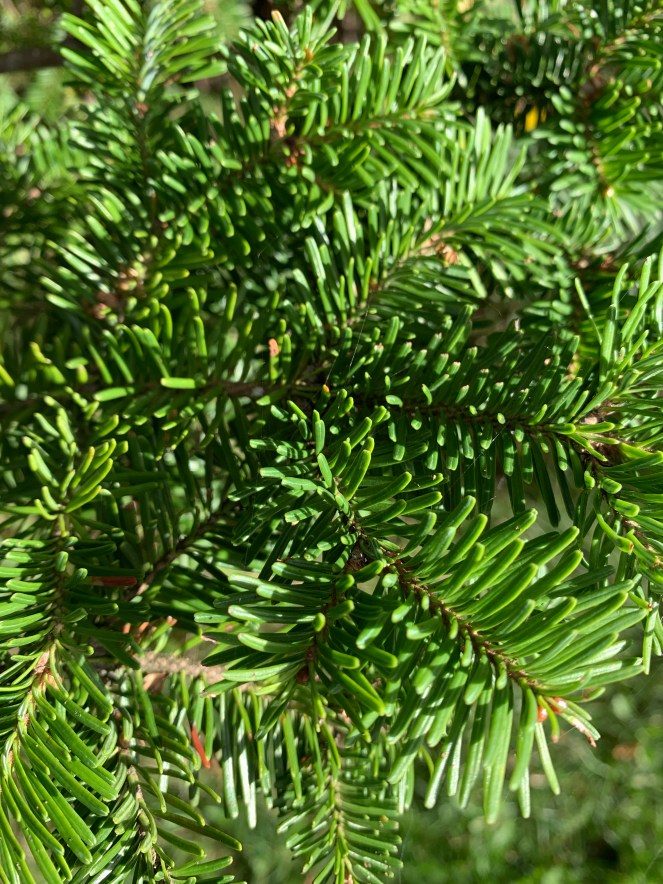
An up-close view of evergreen needles.
Looking closely at these evergreen needles also makes me feel peaceful so I thought I’d share. 💚 image description: an up-close view of evergreen needles on a tree.

I know that I have tried to develop a meditation practice several times before and my results were mixed, to say the least.

This time, though, doing the easy thing, not making a plan, just taking it a day at a time has worked out marvellously for me.

It has become easy and straightforward to include meditation at the end of my day – sometimes for 10 minutes, sometimes for 2 minutes – and I feel great about it.

In case you were wondering, Khalee is also a fan of my quiet practice…

A light haired dog rests in a burgundy armchair.
When I finished my practice a couple of nights ago, I looked up from my mat to see Khalee looking off in the distance like this. I can only assume she was mindfully paying attention to her breath like I was. Image description: Khalee, my light-haired, medium-sized dog, is resting in a burgundy armchair. Her head is resting on the seat cushion and she is deeply relaxed while she looks forward but off somewhere to left of the camera.

cycling · traveling

Sam has that look in her eyes, she’s thinking about bikes

Because of course she is.

You need something positive to think about while doing lots and lots of painful physio.

Even Duolingo knows something is up.

Ella tiene dos bicicletas

In the interests of honesty and putting all my cards on the table, let’s recap the bike situation as it stands. My current fleet contains:

1. A folding bike, a bright pink Brompton

Its origin story is that I bought it new three years ago so that I could have a bike to travel with when I went to conferences. This was the summer I was referred for knee replacement surgery and I needed ways of getting around that weren’t walks even for short distances. It’s great for folding up for travel and I use it a lot in Guelph too. Love wearing regular clothes and riding around campus with it.

Pink Brompton at an Airbnb in Halifax

2. A fat bike

This bike was one I got in a swap for my cyclocross bike. The cyclo-cross bike was my bonus thyroid cancer bicycle. I used it some but not enough to justify keeping it. At the same time I was renting fat bikes and loving it. So I decided to sell the cyclo-cross bike and buy a fat bike but instead found someone who wanted to trade. Perfect! Sarah now has a fat bike too and I love bombing around in them on local trails and taking them on weekend adventures.

Sam’s fat bike

3. A very nice road bike

I think this is bike 5 in the series of very nice Cannondale road bikes that I’ve owned. I broke the frame of the last one in Newfoundland. This is its replacement. It has fancy electronic shifting. It feels fast. I like sprinting on it. And it climbs pretty well too. It’s also comfortable for long rides. Jeff found the seller in Montreal and Sarah and I went to purchase and bring it home. It’s the bike I do almost all of my big outdoor rides on, the bike rally, pedal for Parkinson’s etc.

Sam’s Cannondale

4. An older road bike that I lend to friends and let hang out on the trainer

I bought this bike used because I was wanting something more aero, good for solo riding. It’s a fun bike. It’s not particularly comfortable but it’s great for distances under 50 km. These days though it’s pretty much a dedicated Zwift machine.

That’s the Cervello on a wahoo trainer, wheel on, but I have since I acquired a wheel off, direct drive trainer, a tacx neo 2..

5. Adventure road bike

This was a birthday bike from 7 years ago. Bike thieves cleared out our porch bicycle cage in London, Ontario stealing my commuting bike and Sarah’s good road bike. Jeff bought me this bike from Two Wheels in London, Ontario for my birthday as a replacement. It’s a great bike. I love trail riding on it and commuting with loaded panniers. It’s a very sensible bike.

Adventure road bike for trail riding and commuting

All of these bikes are loved, well maintained, and used often. They play important roles in my life. I also have an old track bike but I’m not counting that. It hasn’t been ridden in years and I would sell it except Sarah thinks occasionally that she might like to give track cycling a try.

So what’s missing?

Well actually, if I were racing time trials a time trial bike is missing. Ditto cyclocross. But I’m not doing those things. I’m also not mountain biking. I’m not aiming to create a bicycle zoo or a Noah’s ark of bikes around here. We don’t need one of each kind. That’s not the point.

What’s missing that I actually do is gravel riding. My adventure road bike is fine on gravel but it’s not a gravel bike. It’s stable but it’s not particularly fast. On its own that might not be enough to push me into new bike think. Fast is overrated. I’m slower than Sarah anyway these days. Also, I’m not that brave on gravel.

But I’ve also been thinking lately about travel and about a bike to travel with. Yes, my road bike, that’s my usual choice. But lately I’ve been wanting to do gravel rides too when I travel. When I next go to Australia or New Zealand on sabbatical, I know I won’t be happy with just a road bike.

That’s the line of thinking that gets me into new bike land. So what I’d like is a bike that can do double duty, both road and gravel. I’d travel with one bike and either two sets of wheels or more minimally two sets of tires. Essentially I’m in the market for a road bike that can take 35 mm gravel tires.

Here are some examples:

Trek Domane

Specialized Crux

BMC Road Machine One Three

Norco Section

Giant Contend AR

Cervelo Caledonia

Surly Midnight Special

Allied All-Road

There’s lots more. This would allow me to upgrade my gravel bike and have a bike I can travel with that will do both road and gravel. I think I’d keep the adventure road bike for bike packing and for commuting.

Depending on how/when my knee heals and the timing of the next surgery, I’d also like to go riding in Cuba and I know I’d want wider tires there.

I know that it won’t be a perfect gravel bike. There are other differences and it will still be a compromise bike. But I’m thinking I don’t need to be a gravel bike purist. I’ll always be primarily a road cyclist. So this compromise for the sake of travel seems okay.

If that’s Plan A, Plan B is just to buy a gravel bike and deal later with the travel issue since Australia and NZ travel are still a few years off.

Apologies for all the bike geek talk and the privilege that comes with travel and owning multiple bikes. But I’ve needed something fun to focus on while I recover from knee replacement surgery.

Any recommendations?

fitness

Sam is checking in two weeks after knee replacement surgery

After a rocky start and an additional night in the hospital, things have been progressing pretty well with the total replacement of my left knee.

Here’s a few milestones on my road to recovery:

I’m sleeping in my own bed and the stairs, with crutches, seem pretty manageable. I’m still only doing them once a day though.

I’m also going on tiny walks down the street each day.

For better or worse, lol, I can now manage basic household tasks such as unloading the dishwasher, sorting laundry, and making lunch.

Physio tells me I’m going well at both ends of the range of motion, getting the knee to lay flat and bend. Physio is so hard!

I got back on the bike on the trainer just to work on range of motion. That felt both inspirational and humbling. I know it will take time.

Friends warned me about out of character things they’ve said and done, wild emails sent, while on pain medication for knee replacement.. So far so good for me. Except I might have gone on a middle of the night pillow shopping spree after googling “best pillows for sleeping after knee replacement.” They keep arriving.

Yay for tonight body pillow

And speaking of pain medication, I’m just taking the heavy duty stuff now for night time and after physio.

We also went to the wedding of dear friends on the weekend. So much joy! I wasn’t sure if I’d be able to do it and I wasn’t sure how I’d feel just being there for the ceremony, but thanks to pain medication, ice, and Sarah’s help it went perfectly. It was lovely to see friends and to be there to celebrate with Jenn and Annada and their friends and families. I promised them we’ll dance next year for their anniversary.

What’s not going as well as I’d hoped? I’m still struggling with attention span and reading. I was hoping to enjoy having time to read but it turns out physio and recovery is pretty much a full-time job. So far I’m sticking mostly to tv and audiobooks.

Enjoying She-Hulk, for example, but the Booker prize winning novels will have to wait.

She Hulk

What’s up this week? Staples removal and follow up appointment with the surgeon. Stay tuned.

cycling · fitness

First time back on the bike

It’s baby steps but I’ve been given the okay to get back on my bike on the trainer.

The goal isn’t some number of kilometres, a given amount of time, or to reach a certain power level

Instead, it’s something much more basic and fundamental. It’s all about regaining enough mobility so that I can make a full rotation of the pedals. It’s range of motion time, baby!

Various guides to knee replacement say to expect a 5 degree improvement in the angle possible for your new knee each week. You need 90 degrees to ride a bike. A goal is 120 if your leg size permits that. Not sure mine does. I was at 52 degrees last week, a few days after surgery, and 67 today eight days after replacement.

But all of these guides to knee replacement say don’t compare your progress to the progress of others. Different people take a different amount of time to get there.

It’s unlikely I’ll be able to that the first few times I try I’ve been told. So no expectations.

Also, even once I can I’m to use the trainer in a very spinny gear, no pressure at all on the pedals.

Whether or not you’re a cyclist the bike trainer is a basic rehab tool after knee replacement surgery. Surgeons and physiotherapists have to talk people who aren’t cyclists to give it a go. It’s easy when the patient’s first question is how soon can I get back on the bike (on the trainer to start.)

It’s all about passive range of motion. Here we go!

Sam on her trainer
boats · fitness · kayak

Paddling–following the signs

Yesterday my friends Janet and Kathy and I took advantage of the lovely September weather and did some kayaking north of Boston, at the Parker River National Wildlife Refuge, north of Boston. It is largely salt marsh, which means two things: 1) you need a canoe or kayak to see it; and 2) because of tidal ebb and flow, you need to time your trip for between two hours before and two hours after high tide. Otherwise, you’ll be dragging your boat through mud.

The very kind folks at the refuge created special routes for us (and other people) to follow, marked with signs.

Two marked paddling routes through the salt marshes at the Parker River National Wildlife Refuge.

We dropped off our boats and gear at the landing– the green teardrop at the upper right. The area had potholes with water in them and was generally kind of wet, even though it hadn’t rained overnight. Unbeknownst to Kathy and me, Janet had spotted fish in the puddles. What could this mean? We’d find out a few hours later.

After moving the cars to the parking lot (there was no parking allowed at the landing), we launched our boats and set off. We crossed an area with boat traffic, then (as Siri advises us), proceeded to the route.

It was a beautiful day, in a beautiful place.

Janet, a very experienced sea kayaker and navigator, had maps and navigation app and gps and everything to keep us on track. However, the signs in the marsh were very visible and easy to follow, which is great for more recreational paddlers. In fact, this route is meant for them– to make it possible to explore the marsh safely.

View of Kathy and me paddling from the bow of Janet's boat, equipped with extra paddle and compass.
View of Kathy and me paddling from the bow of Janet’s boat, equipped with extra paddle and compass.

In addition to navigating, Janet was our trip photographer. Here’s our obligatory on-water selfie:

Janet, me and Kathy, in our trio of kayaks.

We took the slightly longer yellow route and then, because Janet had maps and a navigation app, went a bit further before making a left turn to go back to the marked route. The marsh was very full because 1) it was high tide, and 2) it was a spring tide, which happens after a full or new moon. At those times, the difference between high and low tide are largest. This is one reason why it’s important to read tidal charts before settling off in one’s boat in coastal waters.

Eventually, we got hungry for our lunches, which were waiting for us in coolers at our two cars. So we reluctantly left the beauty of the marsh, and headed for the boat landing. Entering the landing, we noted what a difference a few hours makes.

The three of us in our boats at the landing. The whole area had flooded with the tide!

When we launched our boats, we did so at the two poles in the background. A couple of hours later, we could float in right past the poles, pretty far into the landing area!

When they say No parking at any time, they’re serious. And there’s a reason– you can see it in these pictures.

Honestly, the extra water made it much easier to move our kayaks from the landing area to the parking lot. We could float part of the way, pull the boats in water a bit longer, and carry them across the road to our cars in the designated parking lot.

After loading the boats on the cars and changing clothes, we grabbed our lunches and headed to the beach, which was on the other side of the parking lot. Loads of people were there, enjoying the warm sunny September Saturday. Not many were swimming, though. Hurricane Earl, far off the Atlantic coast, was bringing pounding surf and rip currents up and down the East Coast.

Janet had originally planned a coastal sea paddle for us to a lighthouse on Cape Ann. But reading the warning signs posted on weather and navigation apps, she changed course and picked a safe route for us instead.

The waves on the beach confirmed the predictions. They were bigger than usual and very powerful. Swimming was strongly discouraged. We enjoyed watching them, though.

Kathy, standing near (but not too near) the pounding surf.

I learned more about kayaking this trip. The most important thing is to read the signs and follow them; that will make life easier (and also probably longer). The other thing is to bring a bin or plastic bag for soggy, salty, sandy stuff, so as not to mess up the inside of your car. Live and learn…

East coast readers, did any of you see the pounding waves this weekend? They were really something.

cycling · fat · Sat with Nat

Working out with Lizzo

Recommended Soundtrack: it’s about damn time by Lizzo

Recommended viewing: Watch Out for the Big Grrrls

It all started with Sam sharing this video with our bloggers Lizzo Announces Her Peloton Artist Series and asking who would like to write about it?

I haven’t been on my Peloton since the spring. I agreed to give it a go after my vacation. So, yes, I am late to the game, not only for the Artist Series workout but Lizzo in general.

One of my roller derby friends recommended I watch Lizzo’s reality TV show on Prime, Watch Out for the Big Grrrls. She loved it. I was leery as I don’t enjoy the mean things that are the backbone of unscripted shows.

I watched it and totally fell in love with Lizzo. How did I not know her music before? I listen to mostly metal, rock and Canadian indie music. Well, I’m a fan now.

The show is an extended audition for dancers to join Lizzo’s touring troupe. It was great to see all of the athleticism, fashion and choreography. There was the sprinkling of unnecessary drama but it was 5% of the airtime.

The show also functions as a promotion of Lizzo’s newest album and her tour. It does a great job showcasing her songs and artistic persona.

Most importantly, and fitness related (I’m getting there!), is Lizzo’s message about body positivity. She explicitly states in each episode that working out is not to loose weight but to be strong to perform and live life. She encourages us all to enjoy our embodiment, revel in our grace, sexiness and “having the juice!”

Now on to the Peloton class. Peloton is working hard at shifting its brand to be more inclusive, reach new audiences and stay financially viable. The business model is built on a foundation of selling stationary bikes, treadmills, athletic wear, and monthly subscriptions.

One way to select workouts is by music genre and there are several class releases in their Artist Series where all songs are from a single artist. There’s been Queen, Def Leppard and David Bowie to name a few. Yes, the ones I noticed totally tell you all the demographic info you need to know about me. The Artist Series is a business partnership where Peloton and the Artist/their label get to draw on each other’s clout for mutual benefit. You can “like” the songs in class and tie that to your music streaming service.

So with many, many, many Artist Series classes already recorded, Lizzo’s stands out because she joined the cycling class and brought a subset of The Big Grrrls with her. The energy and enthusiasm she brought to the workout was awesome.

In the background four women of size are dancing in bright pink workout wear. Lizzo is in the foreground dancing and singing on her bike.

I took the class in September to realize the livestream had technical issues back in July. Lizzo broke the internet and I totally recognized the dancers!

Lizzo’s body is not the build Peloton usually features in ads and classes. All of their instructors are either lean or very muscular with very low body fat. While they do recruit a diverse cast for ethnicity, the age range is tightly dialed in, no seniors as instructors.

It was great to see Lizzo moving on the bike the way I do, breasts bouncing around, belly swaying and thighs undulating. Watching her reality tv show, listening to her music and watching her perform, whether in a workout or on stage, has seriously improved my self confidence. I’m wearing crop tops in public and feeling awesome!

Nat is taking a selfie in her bathroom wearing a super cut space cats print crop top from Point Seven Five.