fitness · habits · motivation

How much can you do on a daily basis? #tinyhabits

On a road trip back from Montreal, Sarah’s sister Victoria sang the praises of ToDoist. Well, she repeated praises from a friend who is getting so much more done on a regular basis now she has the app.

Needless to say, we three downloaded it and began adding our daily habits, real and aspirational.

I’ve been looking for a new list maker/habit tracker since I’ve started to overwhelm Google Keep with too many lists. It’s good for notes but not so good for ticking off boxes.

Here’s my current crop of aspirational daily habits:

And it’s not a must-do, but I pretty much always Wordle.

But how to fit it all in? I Wordle very fast in the morning so Wordle plus read, write, floss, and Duolingo would be under an hour if I stuck to my ten minutes of reading and writing. I often don’t though since that’s part of the power of the tiny habit. It’s 10 minutes minimum so I tell myself, “Who doesn’t have time to write for 10 minutes?” and then often stick it out for 30.

Reading/Duolingo/Meditation are all nighttime/in bed things.

The others are all evening things and that’s where things can sort of fall apart. Last night for example, I watched Our Flag Means Death (I was drawn to finish it after reading 10 Queer Reasons You Should Be Watching Our Flag Means Death.) and didn’t make it to mobility training, flossing, or planks!

Maybe I need to pick fewer things? But which to get rid of? I could put all the daily habits in a hat and select one lottery style. Or I could count as a pass getting 6 of the 8 done?

An aside: In grad school my roommate had an unusual night time routine. She would either do sit ups or floss. It was never both. It was always a choice, “Is this a floss night or a sit ups night?”

So in search of solutions to my daily habits problem, I turned to the habit expert BJ Fogg. Fogg says to make a new habit we need three things:

  • Some level of motivation
  • The ability to do the thing
  • The trigger to do the thing

What’s missing, for me, and for most of us is the trigger. It’s a thing we can do, and we want to do it, but how to make the magic happen? That’s where the idea of “habit stacking” comes in. You have things you always do and you attach the new habit to that. Fogg gives the example of doing push ups after he pees. I used to do burpees (when I was mid burpee challenge) waiting for the microwave to finish its work. Likewise, I had great success doing shoulder physio by doing it each time I walked through my office door, en route to my desk. I had the red physio band tied to the doorknob to remind me.

He recommends setting habit intentions like this, “After I ………….., I will…………….”

Key Point: “Set the habit you want to make right after something you already do.” i.e. Do 2 pushups right after going to the bathroom or flossing just 1 tooth after brushing your teeth. What’s important is to make the habit TINY so that you will do it no matter how tired or unmotivated you are, yet you will be creating the seed for a good habit nonetheless. (Also that you should praise yourself after doing the habit. Tell yourself “I’m awesome!” or pump your fists in the air).”

Here’s the tiny habit guy himself:

Forget big change, start with a tiny habit: BJ Fogg at TEDxFremont

Martha blogged about this book too. See here.

I’m reading his book Tiny Habits right now. I think I need to work on my post habit completion celebration. “You’re awesome” isn’t really my style. But a Muppet style happy dance just might be.

Tiny Habits: The Small Changes that Change Everything

As usual you, dear blog reader, are under no obligation to establish new habits, however tiny. You do you. This is all offered for those of us, who want to do a thing, and struggle to get it done.

It’s okay not to want to do any of these things. Life needed be about constant improvement.

And in that spirit, here’s Dorothy Parker.

And now, having written for 10 minutes, I’m going to do a dynamic mobility routine. Having done that, I might even floss and then meditate. I’ll follow it with a happy dance.

Disco Muppets

Buenas noches!

fitness · kayak

Return to kayaking: paddling and learning things

As many of you readers know, I bought myself a new-to-me kayak in honor of my 60th birthday in April. It’s a used (but in beautiful condition) Epic GPS Ultra– 12 ‘ 11″ (3.3 meters), weighing 27 lbs (12 1/4 kg)!

In case you missed it: me, sitting on top of my kayak (on dry land).

This weekend marked my debut outing with my very first boat. Seasoned kayaker and good friend Janet met me at the boat ramp on the Concord River. But first I had to load the boat on top of the car by myself. ACK!

I had taken pictures of all the places the boat was tied down when Janet and I had previously loaded it on my car. We used foam blocks and straps tying the blocks to the car and the boat to the blocks. Also there was a bow line, connected under the hood of my car. This was the setup I was to reproduce.

tl:dr version: it wasn’t pretty, but it happened. I managed (with three phone calls to Janet) to load the boat and get it to the launch intact. I had loaded it backwards (stern to the front), which made Janet smile. Thing #1 learned- always load the kayak with the bow facing front. It’s apparently a kayaker superstition, which I’m happy to respect.

Unloading the boat was easy, as was getting it to the launch– did I mention it only weighs 27 lbs? Then comes a hard-for-me part: getting in (and then out of) the boat. I have always had a hard time getting in and out of kayaks without a lot of help (even with help, honestly). It totally stresses me out. I’ve tipped over so many times, it’s no longer surprises anyone who paddles with me. For you kayakers out there, I’m the queen of the shallow-water wet exit and solo rescue…

Yes, there are loads of techniques for getting in and out of kayaks, and I’ve had 1) a lot of instruction; 2) a lot of experience kayaking off and on over more than a decade; and 3) a lot of help and tips from friends. And still it feels scary and embarrassing.

Which leads me to thing #2 learned: getting in and out of my boat is something I can practice, both on grass and in the water. After all, I have my own boat now– why not play around with ways to deal with this so that I can avoid throwing a conniption fit every time I go paddling?

I did some googling (as one does), and discovered I’m not the only person who has trouble getting in and out of a kayak. One site suggests that, if the water is warm enough, just tip over and roll out of the boat (which in fact I did– twice– during our paddling outing). It worked fine, other than getting me wet. But, as Janet reminded me, kayaking is a water sport… Still, it would be nice to have drier options.

Once we got on the water though, the fun began.

We paddled easily down the river, chatting and looking at the many birds. We even saw a happy yellow lab fetching sticks in the water. I was getting used to steering this boat, which has no rudder or skeg, and also is flat on the bottom (as opposed to angled in a v-shape). Also I was getting used to paddling again after a hiatus of at least 3 years (wow). Which gets me to thing #3 re-learned: I love being on the water in a kayak! I hadn’t actually forgotten, but I had been away from it for a long time. It’s so great to be back! I’ve already made plans to kayak with some friends next weekend, and will keep it up this summer.

But of course there’s still the issue of loading the boat on my car and unloading it. Twice. All by myself. Enter thing #4 learned: there are some super-cool gadgety kayak carriers out there for every price point and preference. Janet recommended, and I ordered an inflatable roof rack that will carry my boat easily, and has built-in D rings for tying my boat to the rack and tying the rack to my car. It was delivered just as I had loaded the boat onto my car using foam blocks (a fine low-cost way, but this is much better). I took the package with me, and Janet and I tried it out for my boat’s trip back home.

Inflatable roof rack secured to inside of car, with boat tied to rack. Handy and dandy.

It is easy-peasy to use, inexpensive and simple to store. Perfect.

As we were able to depart, Janet told me that she keeps a notebook to log her paddling trips, noting location, distance, conditions, etc. But she also writes about things she’s learned or needs to learn based on that trip. She suggested I do the same. I like this idea. So, for the last thing, #5, I close with: note my experiences and what I learned from them, and what I can change or add or subtract for next time. This will prepare me for future trips and help me enjoy paddling even more. I’m down with that.

Readers, what have you had to remind yourselves about or relearn when coming back to a sport you were away from? Has it been fun? How have you dealt with the stresses and changes? I’d love to hear from you.

charity · cycling · fitness · training

Sam’s stormy scary bike ride

As we’re gearing up for friends for life bike rally training this summer, weekends will involve longer back to back bike rides. It’s all in preparation for 6 days of riding, 660 km, Toronto to Montreal.

A reminder, we’re raising money for an excellent charity. You can sponsor us here and here.

This was Saturday’s ride. It started like this. All cherry blossoms, sunshine and smiles.

Happy faces!

We were doing one of our favorite 50 km Guelph rides with coffee after, making it about 60 km total.

As we approached our favorite apple fritters and coffee shop, Sarah broke the bad news.

“Here have a cliff bar. We’ve got just enough time to make it home before this thunderstorm rolls through.” She pointed to her phone displaying the radar.

Reader: we did not have just enough time. The storm was moving very very fast. This was us about ten minutes later, not yet home.

Yes, that’s hail. Videos of the storm rolling through Guelph.

This is what it looked like on the radar.

“Daniel Liota, a meteorologist at Environment Canada’s storm prediction centre, told the Star that Saturday’s storm had wind speeds equivalent to a low-grade tornado. As a result, the agency sent out text message warnings urging Ontarians to seek immediate shelter. It was the first time this had ever been done for a storm in the province, he said.” That’s from the this story Intense storm rolls in from the Toronto Star, we read after it all happened. We also heard the very sad news that at least two people died.

Luckily we did not die.

What we did: When the wind picked up and the hail started we stopped by the side of the road, and then took cover in nearby subdivision. Continuing to ride wasn’t an option. I couldn’t see or stay upright. When things let up we biked to Hasty Mart and took cover under the awning there. When we could see the worst had passed we biked slowly home in bike lanes full of fallen trees, with no traffic lights working.

There were trees down everywhere. Power out everywhere. And sirens wailing as police and ambulances tried to get to those in immediate danger.

We got to hang out in the backyard and clean our bikes. They were covered in mud and grit.

Two bikes upside down in the grass, one orange and one black. A cat approaches and curiously sniffs the orange bike.

I’ve done a lot of bad weather cycling in my day. I’m tough and I can cope with cold and rain. But that thunder and hail and wind was really frightening.

I’m thinking of the cyclists we saw heading out of the city. We’d already ridden 50 km.

I’m also thinking of the biking rally training ride riders in Toronto. They got 10 km into their ride before being called off the road by those in charge of the ride.

Oh and then there’s Elan! She’s been asking Cate questions about touring since this was the weekend of her big ride. Yikes.

Hope everyone is well. If it’s like this again tomorrow, I might see you on Zwift!

camping · cycling · fitness · Guest Post · traveling

Riding Solo, Part 2: Baggage (Guest Post)

by Julia Creet

I wrote in my first post that every material aspect of touring by bike seems to have a metaphorical one as well. How you pack your bags might be the most obvious.

Baggage. It’s a loaded word that translates directly to a loaded bike.

The multiple decisions of what to take and leave tell you so much about your need for comfort, the things you think you can’t live without, the fear that you might need something and not have it, or suffer for not having it, or feel foolish for not having it, or feel equally foolish for having pushed it and hauled it and never used it.

The novice bike adventurer, that is me, has to rely on other peoples’ lists, what experience has taught them is necessary—or extraneous. The first decision, and one with the biggest consequences for your route and weight is whether or not to camp.

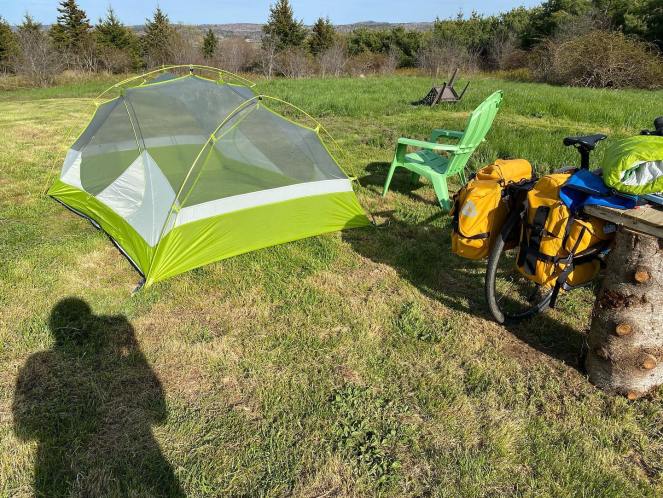
Cruising from bed to bed is delightful—and much lighter—but a tent and sleeping bag and a little mattress and a tiny stove and pot and an areopress gives you ultimate freedom and coffee in bed in the most delicious places. It’s a paradoxical combination of baggage and freedom. Camping will easily add ten lbs to the bike but will allow you to pull off the road wherever you can. Everything else is a question of comfort and fear.

Like most riders, I performed the ritual of unloading, sending home a package of heavy and accumulated light things—each light thing feels like nothing on its own—after riding for just a few days. Some of my protection and comfort and cleanliness went with those things, but hauling them around just wasn’t worth the weight. You see the obvious psychic metaphor here.

And, a week later, as I contemplate the mountains of Cape Breton, I’ve deemed another bag of stuff not worth the drag. The bike is still very heavy. I haven’t weighed it; I don’t want to know. I’ve climbed a few steep hills now and know that I can crawl up just about anything, but no question, I feel every ounce.

Have I missed anything I’ve let go? Can’t even remember what I packed off, except that most of it I bought last minute and because I was checking off other peoples’ lists. What’s the heaviest thing you cannot do without? Water. Unlike everything else, you need more of it than you think you do.

I think about weight and baggage with almost every pedal stroke. If even the minimum I have now feels too much, what about all the things I have left behind? The one object I keep excising and adding back in—and here my attachments as a recovering English Prof are most obvious—is a book.

Julia Creet is a recovering academic who just wants to ride her bike.

clothing · fitness · gender policing · Guest Post

Sweater Vest (Guest Post)

by Brett

Gender dysphoria has plagued many moments of my life. In fact, some of my earliest memories remain stark in my mind as moments of feeling lost in my body. Being at the golf store with my dad, and having a ravenous obsession with the sweater vests. There was something about the sharp argyle patterns, and crisp cuff lines. I couldn’t tell you how my parents responded to my want for the purple and grey one I got my grubby little hands on…but I do know it never made it home with me. I couldn’t have been much older than 6 or 7, but if I close my eyes and imagine the smell of fresh leather and the sound of people testing out clubs in the range area, I am brought back to that store. I can feel the 80% cotton and 20% cashmere in my fists, imagining how it would show off my arms without hugging my petite frame.

However disappointing my sweater vest memory is, it was one of the first moments of clarity I had about my identity. Maybe that vest didn’t hang in my closet, but it hung in my mind as a siren for what was yet to come.

I have been an athlete my entire life. Growing up I was a multi-sport athlete through every season. Winter was hockey and volleyball, Spring included track and field and rowing. Summer featured more track and field, occasionally soccer, and ball hockey. Finally, Fall brought about cross country, and basketball. On top of it all, fitness is a passion that has always ignited my deepest sense of self.

I began my own training around age 9. While the drive has remained the same, the goal has weathered many gender-fluid storms. As a child, I loved the attention of having ‘unbelievable’ strength…especially when it showed the ‘boys’ who was boss! What was so wonderful about this time was that societal pressures, and peer-level interrogations, hadn’t forced me to evaluate my beauty, yet. Instead, all that mattered was doing the most pushups, planking longer, and running the fastest. It was a simple time.

However, puberty wreaked havoc on my gender-fluid being. Suddenly, I was painfully aware that my breasts had been replaced by strong pectoral muscles. I remember foolishly thinking that my back side would have to make up for that, to maintain any kind of desirability. During these years, I tortured my mind into conforming to female beauty standards. I was worried about being too ‘bulky’, not having breasts, and not having curves. I would stand in the mirror, flaunting skin-tight dresses, skinny jeans, and leggings knowing that the aesthetic appearance of my body was ‘to standard’. However, witnessing my body in feminine clothing made me want to crawl out of my skin. Suddenly, the goal was no longer obvious. This was the fantastic beginning of a complex, heartbreaking, and liberating fitness journey.

The transition to ‘men’s’ clothing came gradually. It started with looser fitting jackets; then shirts. Finally, the button-downs began to appear, as well as straight-cut pants. My muscular arms and broad chest started to look ‘at home’. The goal changed, quickly. I began to observe my male-identifying, athletic peers. The way their shoulders filled out the hem of a fitted t-shirt. The infamous ‘triangle’ shape in which your shoulders taper to a narrow waist. What I used to think was attractive for men became the desire for my own form. It wasn’t attraction…it was envy.

My workouts have become fixated on acquiring strength, and I’ve learned to appreciate the painful calluses that stubbornly rest on my inner palms and fingers. While the skin-tight dresses rarely surface anymore, I can tell you that they don’t fit the way they used to. But I’ll be damned if I don’t admit to feeling like a warrior in them. Miraculously, my gender-fluid soul has found appreciation in this strength as it embodies each of my identities in a different way (but more on this, later!).

I am on my way. My ‘men’s’ cut t-shirts are becoming less baggy. My ‘men’s’ cut jeans are pinching too much when I sit down. And I’m proud to tell you all that there is a navy-blue sweater vest hanging in my closet.

Bio: Hi! I’m Bret and I hail from Guelph, ON, where I completed my undergraduate degree in Philosophy. I am currently working towards an MA in Philosophy at Western University, and enjoy engaging in feminist theory, ethics, as well as gender and sexuality studies. I’ve had the amazing opportunity to be taught by both Sam and Tracy, and I am excited to joint the Fit is a Feminist Issue community! When my nose isn’t in a book, I can be found in coffee shops, at the gym, or taking on car repairs that are far beyond my capabilities.

family · fitness · habits · motivation

I had a plan – where did it go?

Well this is not the post I expected to write this month! A few months back I wrote Sam that I had been exploring and really enjoying exercise and would like to regularly blog about aquafit. At that time, I’d been going to the pool two to three times per week for a few months. It was a habit and it felt good. I also had started really enjoying the feeling of getting a good cardio workout. That itself felt like a minor miracle.  

I wrote my introductory post and looked forward to seeing what was coming on my journey of digging into exercise. It turns out what was awaiting me the last month was a lot of frustration and not getting to exercise! This is not new – many people struggle to get to their gym or their exercise. Women especially are conditioned to put our needs after others. In my case, historically it’s been really easy to distract me from exercise because honestly, I didn’t like it and I didn’t want to do it.

This is different though. I want to get there. Apparently though, wanting isn’t always enough. I’ve only been to the pool a couple of times since mid-April. And it shows. It shows in my mindset, which is more easily frustrated. It shows in my aching hips that don’t want to sit for hours while I teach and grade. It shows in my own disappointment too.

Now I have good reasons for not getting to the gym. I’m on a job search that is going s.l.o.w.l.y. (I teach college on contract and I want a permanent, student-facing job!). My husband is on sabbatical in Italy for the month of May. He’s working hard too and I’m happy to support him, but oh boy, I didn’t anticipate how many things would go sideways at home with our kids while he was away, or how much of our lives relate to getting our kids to places. I am struggling between my kids’ needs and my own, and my own have been losing out.

Selfie of a woman with greying hair and brown sunglasses in front of a blooming pink magnolia tree. She has bright sunlight on her face and is wearing a navy coloured tshirt reading "halfway between"
On my dog walk, I had to stop in front of this beautifully blooming magnolia tree

In truth, all reasons for not exercising are “good” reasons. Our reasons can be legitimate even when they are frustrating or disappointing. Canadian society seems to have a fixation with connecting fitness with guilt and judgement (as anyone who knows this blog knows). The last thing I want to do in writing today is to contribute a sense of judgment of people’s choices. What I do want to acknowledge (mainly mainly to myself) is that for the first time I really miss exercising. That makes this post another in my posts celebrating my journey toward enjoying and, I would say, reclaiming my body as my own for my own use. THAT feels pretty good to say.

So since I’m missing activity, and my growing strength and confidence as (dare I say it?) an athlete, it seems that my next challenge is to actually get back in the pool, and doing some late spring hiking. I can see I need to re-establish my routines and make space for myself in my life. I’m working on that now. So far the best I can do is get out each day to walk my dog. It’s a start – I’ll let you know in a month how it went!

fitness

Warrior Pose (Guest Post)

My name is Tara Clark and I am an avid yogi. I have been practicing yoga for many years and I recently became a certified instructor. Yoga has brought a tremendous amount of healing into my life. I first began practicing yoga to help with my asthma. I thought the breathing techniques would help and they have. Yoga quickly turned into a deeper healing practice allowing me to use my breathe with every movement to bring a sense of calmness and peace into my body, releasing memories and trauma and letting me know where I had work to do. I’ve spent many years healing my mind, body & spirit and now in my 50th year I feel strong, unwavering and fearless and for the most part I can live without judgement of myself. I am a warrior and I am surrounded by many others who model for me what true strength and compassion and love look like. I am grateful for all the other women warriors that have gone before me and walk alongside me. I get so much strength from their wisdom. Namaste 🙏

camping · cycling

Riding Solo, Part 1 (Guest Post)

by Julia Creet

I blame Cate Creede. She made it look so good, so easy. Just hop on your bike and go… wherever your legs will take you. No waiting for others, or trying to catch up. No discussions about decisions, where to go, when to stop, what to eat. Complete unstructured freedom.

That was the appeal. It seemed like a strange appeal after two years of more isolation than I could barely tolerate. Why chose then a trip on which I would mostly cycle alone?

I had an inkling that it would serve so many deep purposes for me. A chance for the wind to unravel the wired knots of my brain, cinched by two years of technology and teaching. Time to think through the decision to retire after twenty-five years of a full-on academic career.

And I needed new conversations. Riding alone would open my bubble to anyone who crossed my path. That felt exciting and random and the very opposite of my shrinking social circle and the rigid structures that were my scaffolding for surviving these strange last two years.

So here I am wandering around Nova Scotia, my home in my panniers, learning to crawl hills and stealth camp. I have some thoughts I’ll share along the way. Every material aspect of riding seems to have a metaphorical one as well. So thanks Cate. You said this to me early on in one of our chats about riding solo. “And for me there is something I really love about ending up in some random place with terrible food and knowing that I got there on my own.” You were right.

Julia Creet is a recovering academic who just wants to ride her bike.

fitness · yoga

Laughing while doing yoga: gimmick or tool?

CW: mention of BMI and body weight in a medical study on laughter yoga.

Since yoga took off in North America, teachers and studio owners and social media hopefuls have trotted out every possible variation to make it more attractive to more people. I’m not talking about Kundalini yoga, Iyengar yoga, etc.

No, in this case, I’m talking about yoga with music, yoga with wine or beer or cocktails, goat yoga, bro yoga, naked yoga, yoga dance, etc.

Glow in the dark yoga!

One type of yoga I hadn’t heard of until last week was laughter yoga. Yes, this is a thing. Dr. Madan Kitaria is credited with inventing it, and this site goes into loads of detail about him and about what laughter is alleged to do to us and for us. In short, laughter yoga is supposed to lower stress and anxiety, provide ease from depression, release endorphins, and generally relax us.

If you’re interested in a demonstration of laughter yoga, here is a TED talk (of course there’s a TED talk!) that you can watch.

5-minute TED talk on Laughter Yoga

Okay, I get it: yoga is good for you. Laughing is good for you. So, laughing while doing yoga must be extra-good for you. And yet I maintain a smidge of skepticism. Why?

Lots of scientists and sciency-folks have been speculating about the role of laughter in health and well-being for decades. In this Shape article (an authoritative source if ever there was one), we get this capsule history of laughter as medicine (forgive me, I got lazy while googling):

William Fry, a professor of psychology at Stanford University, helped to pioneer the research on the health benefits of laughter back in the 1960s. Fry found that laughter enhanced the activity of immune system cells through an experiment in which he drew blood at regular intervals while watching comedies. In author Norman Cousins’ 1979 book, Anatomy of an Illness, he described how he battled a fatal disease for years through his practice of mindful laughter. And psychotherapist Annette Goodheart published a book titled Laughter Therapy in 2006 that included 25 ways to help yourself laugh about everyday things. 

It makes sense that people hope to leverage laughter to bring down blood pressure, cholesterol, blood sugar, cortisol levels, you name it. So far, the research suggests diffuse and bidirectional effects– laughter may affect well-being, and feeling better influences frequency of laughter. For instance, in a 2021 study of the relationship between oral health and laughter, the researchers found

The participants with 10 or more teeth were significantly more likely to laugh compared with the edentulous participants, after adjusting for all covariates… There was a significant bidirectional association between frequency of laughter and oral health that was independent of socioeconomic and lifestyle factors among older adults.

Which is to say: people with more teeth laugh more, and people who laugh more have more teeth.

I bring up actual laughter research because last week, while perusing the weekly newsletter on body weight and metabolism research, I found this study:

Effects of a laughter program on body weight and mental health among Japanese people with metabolic syndrome risk factors: a randomized controlled trial. In BMC Geriatrics.

Curious, I read the article. Twice. Here’s what I found:

The researchers tried out a 12-week program of 60-minute laughter yoga classes and 30-minute rakugo performances (a traditional form of Japanese comic storytelling). The participants were mostly women over 60, and they had some standard risk factors like high blood pressure or cholesterol, diabetes, or slightly higher body weights (overweight according to researchers and adjusted BMI scale). The control group just went about their business, with no intervention.

So what did the researchers find?

The intervention group laughed a lot more. Their responses to all sorts of quality-of-life health surveys after the 12 weeks were a bit higher than the control group’s. The laughter yoga and comic performances seemed to do them good.

But laughing a lot didn’t really affect their body weight. The researchers document some teeny-tiny shifts in BMI– shifts which they acknowledge aren’t clinically significant. The men in the intervention group– which were 2% of the group (yes, I wrote that correctly) experienced stronger effects overall, but even their effects were very small. So much for laughter yoga as weight-loss method. This is entirely unsurprising.

However, that doesn’t mean that laughter yoga should be dismissed; far from it. It seems to be a way to introduce some people to both gentle movement and breathing techniques that reduce stress and improve mood and feelings of well-being.

Here are a couple of laughter yoga exercises you can try in the privacy of your own bathroom. I took them from the knowledgeable folks at Shape (obvs):

Smile-Ups: Stand in front of a mirror, or even better, face to face with a friend or family member. Practice breaking into a big smile 10 times. You can also do this when confronted with a stressful situation, such as being stuck in traffic.

Hand Puppet: Struggling with negative self-talk? Get rid of it by acting it out. This exercise, which you can also call the “I love myself” laugh, helps you to recognize the silliness of those thoughts. Lift up one hand and imagine it’s a hand puppet, and start putting those negative thoughts into words using a funny voice and moving your hand puppet accordingly. Then, take your other hand and “squash” the hand puppet with laughter.

Person using hand puppet technique. Googly eye additions optional.

Readers, have any of you tried laughing yoga? Did you try the smile-ups or the hand puppet negative self-talk? Let me know.

ADHD · fitness · health · meditation

The effect of music on Christine’s brain: A (very) small sample experiment

As someone with ADHD, I am always looking for ways to improve my ability to focus. My medication, my planning, and environmental cues all help but it can still take a lot of energy to keep myself on task, so when I came across some music that made it easier to stick to my work plan, I was delighted.

I’m not sure how I happened upon Greenred Productions ADHD Relief Deep Focus Music (embedded below) but I can only assume that it was something the algorithm churned up after I watched a How to ADHD video at some point.

Embedded YouTube video from Greenred Productions called ‘ADHD Relief Deep Focus Music with Pulsation, ADD Music for Concentration, ADHD Music’ The video includes 12 hours of music but there is a single still image on the screen for the whole video. The image is of a mystical looking stag with antlers that look like gnarled tree branches. The stag is standing in light that seems to be shining through the trees that surround it. There are broken tree stumps, plants, and a large rock near the stag.

Maybe there is a scientific reason why this music works for me or maybe it is a coincidence but, either way, playing this video helps me to focus. And the fact that it is almost 12 hours of music means that I won’t lose track of time while selecting music or creating a playlist.

I don’t always have music on when I am working but it has been great to have this on hand when I need a little extra help to focus.

A couple of weeks ago, I was returning to the video over and over throughout the week but, for some reason, I wasn’t resetting it, I was just letting it play from wherever I had paused it the session before.

So, even though it is a 12 hour video, I eventually reached the end and THAT’S when I found the best meditation/relaxation/body-calming music (embedded below) that I have ever encountered.

Embedded YouTube Video of Greenred Productions video “Deep Cello Meditation Music: Dark Meditation Music, Relaxing Music, Dark Cello Music for Relaxation” There is two hours of music but there is no actual video just a still, black and white image of a person with shoulder length hair playing the cello outside a stone house with a set of double doors and a window set in the front of it.

It turns out that I find cello music incredibly calming. In fact, when I listen to this music, I feel the same kind of sensory-soothing calm that I feel when I put on a weighted shoulder wrap or lie in my hammock. Something in the music just really grounds me and puts me at ease.

I have been playing it while I meditate, draw, colour, or read and I swear I can feel myself sinking deeper into those relaxing activities as a result.

Do you find specific types of music help you to focus or to relax?

Does music contribute to your peace of mind?

Did YOU know that cello was so relaxing? Am I the last person on earth to discover this?

Tell me all about it in the comments. Pretty please!

PS – I really wanted to call this post ‘Cello, it is you I’m looking for’ but then the first embedded video wouldn’t make any sense and besides, I wasn’t sure if the Lionel Richie reference was too much of a reach for the joke to work. 😉