fitness

Using “Carrot” to Earn Fitness Rewards (Guest Post)

[Disclaimer: This blog post is about an app called “Carrot Rewards”. This is not a sponsored post nor is it intended as a promotional post for the app. Rather, my goal is to explore the idea of turning fitness into a reward-based activity and discuss some of my thoughts about this app]

So, there’s this (relatively) new App available called “Carrot Rewards” that I’ve recently started using. It is a government-funded app which claims you can “Complete healthy offers and be rewarded for making healthy lifestyle choices. Earn points every time!”. It allows you to earn points (Petro-Points, Aeroplan, Scene) for completing surveys or through fitness tracking.

The Surveys

The surveys are not commercial surveys, they are not based on specific products or your spending habits. Rather, they are aimed at informing you about a topic you may not know much about. Surveys pop up roughly once a week, take less than two minutes to complete and are worth between 5-200 Scene Points. (A free movie costs 1000 Scene Points). The three most recent surveys have been “Live Life, Pass it On” which was about the importance of being an organ donor, “Let’s Get Moving for Mental Health” which was about the connections between physical and mental health, and “Gettin’ Outside” which was about the importance of spending time outside.

Fitness Tracking for Points

The Carrot App partners with either a FitBit Product (there are many) or your phone’s built-in fitness tracker to keep track of the number of steps you take daily. For the first two weeks, it keeps track of your daily steps to calculate a daily step goal for you. After the initial two weeks, you earn points by completing your daily step goal (I’m earning 4 Scene Points daily which is worth about $0.04 real money). You also earn a bonus of 55 Scene Points every two weeks if you meet your goal 10 or more days out of the 14. Every two weeks, it updates your daily goal based on how often you meet you goal.

There are two major cons to the fitness tracking aspect of this app. One, it only tracks your steps. This means any other physical activity you do won’t earn you any points. Two, it currently only partners with FitBit or your phone’s built-in tracker. This means you have to either be always carrying your phone (which I am anyway) or own a FitBit product.

My (Somewhat Random) Thoughts

As a student (student=poor), I love this app. Usually, I don’t pay to see a movie in theatres unless it’s a something I REALLY want to see. Usually, it’s not. So, I like being able to see movies for free. With this app, I earn enough points to see roughly one free movie per month. I like that the points I earn can be used for something tangible, an actual real-life thing. There are many apps that turn fitness into a game but most of them turn it into a virtual competition (see Samantha’s post about losing Strata segments!), reward you by posting to Facebook about your activity or reward you with a virtual medal or trophy.

Has it increased my fitness levels? Not really. Generally speaking, I walk most places unless it’s really far then I take the bus. But what I have noticed is that I’m more aware of my daily steps. Often near the end of the day I find myself checking how close I am to my daily goal and if I’m close, I’ll make an excuse to go for a short walk (for example to return library books or pick up groceries).

I dislike that it only tracks steps. There are days where I spend all day standing and moving around and I feel like it hasn’t been a particularly inactive day. Then I look at my daily step counter and realize how few steps I’ve actually taken. Or if I take the time to do other activities such as swimming and don’t walk very far, I feel like those days should count for something.

Has anyone else used this app? What are your thoughts? I have many more including the implications of it being government-funded, issues around accessibility for people who may not be able to walk as easily as I can, etc, etc, etc but I won’t get into them here. Instead, I’ll simply end by saying that this app isn’t for everyone, but for me, I like earning free stuff so I’ll keep using it even if it isn’t perfect.

Mallory Brennan is many things. Currently finishing a Certificate in Conducting at Capilano University. Daughter of Samantha (and Jeff!), part-owner of Cheddar the dog, lover of the outdoors, hater of shoes, singer, conductor, and traveler. 
 

fitness

Keeping your bike healthy

I learned how to ride a bike when I was 7, when my dad and Howie Stolz, beers and Rothmans in hand, took me and the Stolz kids to the top of a hill in a German campground, balanced us on our bikes and let us fly downhill.  By the end of the weekend, knees embedded with gravel, we knew how to ride bikes.

My bike has been freedom, openness and adventure ever since. But despite riding for 45 years — 3500 km last year —  I’ve never been able to keep it healthy and running myself. But I’m planning a solo, unsupported trip this summer in the Baltics, and I finally had to come face to face with learning basic bike repair.  My 4.5 decade strategy of having reliable bikes, befriending people with skills, hoping for the best and knowing that I can always call someone to come and get me if things fall apart won’t work when I’m alone in Latvia and Estonia.  So.  I spent last Sunday in a one-on-one bike clinic with an amazing mechanic I met on the Bike Rally last year.


Alex is an excellent mechanic, a born teacher and just an all round lovely human.  We spent 6.5 intense hours together, and I felt like my bike was slowly peeled apart and revealed for me.  I was literally and emotionally given the tools to move into an empowered, more intimate relationship with it.

I’m not remotely mechanically inclined. I’m also a total klutz. I once punched myself in the mouth and made it bleed trying to put a tire back on after changing a flat. (I also recently dropped a cup of coffee in my work bag and destroyed all of my electronics, but that’s another story).  So I’ve always engaged in bike maintenance with some indifference, a little fear, and a high sense of incompetence.  I oil my chain and keep the tires pumped, can put a chain back on on a ride, and once adjusted my gear cables. But as much as possible, I outsource my bike care.

Until now. Last weekend, I learned and did a 7 point A-B-C-D safety check (an intense 2 hours), adjusted my brakes, learned how to adjust my gears using three different points on the bike, created and fixed a flat, fixed a broken chain, replaced a spoke and trued a wheel by carefully adjusting spokes.  I completely changed a brake cable, adjusted the headset, and learned how to tape my handlebars.

IMG_3771Several times, I felt like the bike was inside out. We pulled the handlebars and stem RIGHT OFF the fork, and I felt actual anxiety when the handlebars and cables dangled down over the front.  But I also *felt* my bike in completely new ways.  By running my fingers down every cable and housing and threading them back into their slots, I felt like I was finding my bike’s veins. By pulling on the cables and derailleur gently and watching the gears shift, feeling the exact moment where the tension wasn’t perfect, I felt a new flow, the real connection between clicking the gear shifts and the bike’s response.  Gently tightening and loosening to find one spoke after another until the wheel spun evenly was meditative, truth in my fingertips.

A bike is physics, and craft, and engineering, and magic. The spokes act in tension and compression to distribute the weight of the bike and the person as it moves forward without allowing the wheel to squish — but there is, apparently, still a debate about exactly how this works.  Looking at the bearings on the inside of the wheel axle, I understood in my hips how balance happens when you’re pedaling. By feeling the layers of how the chain links slip effortlessly together, how to tighten them, I had a little physical sensation of movement.

IMG_3761There was a lot of laughing, and I had a lot of “ahas.” What felt scary and foreign became intimate.  Alex taught me mountain biker tricks about how to get “back to camp” even when your bike has been, basically, run over by a car, by twisting spokes together and whacking the wheel back into something approximating round. She broke me of my lifelong habit of trying to adjust both sides of the quick release wheel at once when putting it back on, explaining that the little acorn nut is the only one that really moves, and you don’t have to worry about the balance. (This will change my life — I take my wheel off a LOT). She also explained that it’s my habit of changing trying to shift the gears too hard on hills that makes my chain fall off so often — that I should just look ahead and start out in a gear closer to something I can sustain.  Changed. My. Life.

By the end of the day, I felt a tiny bit of shame that I had waited so long to try to understand my bike like this.  It feels like I’ve taken my bikes for granted my whole life, deriving huge pleasure and trust in them without bothering to really get to know them. Feeling a bike from the inside out, gaining intimacy and familiarity with parts I’ve literally never looked at — it makes me feel like I’m honouring what my bikes have given me. Bikes are miracles and deserve care.  And knowing how to listen differently, know what that noise means, how to respond to things that could go wrong out in the world, how to care for the parts —  makes me feel more intrepid, like anything is possible.


DSCF0120
Fieldpoppy is Cate Creede, who lives in Toronto where she works as an educator and strategic change consultant in academic healthcare and other socially accountable spaces. She blogs here on the second Friday of every month.  If you’re interested in deepening your own relationship with your bike, leave a comment and she will hook you up with Alex, who does freelance coaching and repair instruction and riding skills workshops — and is awesome.  (Alex is also reachable on twitter at @legslegum).


fitness · tbt

Bleeding while running and ending menstrual stigma, #tbt

#tbt to the time when I blogged about bleeding while running and ending menstruation taboos. What do you think?

fitness

My aspirational cook book problem

There many ways that Tracy and I are alike. We’re friends, co-bloggers, and longtime colleagues with a slew of shared commitments but we are also very different people. Mostly we both accept that “you do you” idea and let the other go her different ways. I road bike. She runs. That’s just one example but there are many. Also, we don’t generally pine after what the other one has.

But there is one thing that Tracy has that I envy. That’s her love of cooking and her cooking skills. I listen to her stories of cooking as a relaxation thing and I’m jealous.

Me, I appreciate good cooking. I love food. But I have very little patience for making it. Partly that’s a matter of personal history. You try feeding three kids with different tastes for many years and food planning and preparation loses lots of its charm. You try to make something fun, and yummy, and new but really they’d rather have tomato soup and grilled cheese or scrambled eggs or veggie burgers and fries.

For years I’ve had the luxury of complaining about buying groceries. Three teenagers and their friends adds up to a lot of food. There’s all the putting in the cart, bagging it, getting groceries to the car, unloading the car, putting the food away, and then blink, it’s gone. I joke that I may as well ring a bell in the driveway and they could all run out and eat and we could just cut out the putting away part.

Things are a bit better now. Some of the kids are away. Their tastes have broadened and they cook. That’s lovely. Last year when I was teaching late and my daughter would text with me with dinner options I felt I’d truly arrived.

But I still haven’t found a love of cooking in me. I mean, yes, I prepare food. I make salads. I boil pasta. I scramble eggs. But I don’t cook in any serious way. When you’re an academic and you want to know something about a thing, what you do is acquire books about it. That’s been my unsuccessful approach to cooking.

I look at cookbooks and I dream of a better, healthier, more ethical life. I aspire to veganism and if only I cooked, I think, I could do that. (I do pretty well as it is 50-75% of the time and that’s not so bad.) So I buy cookbooks. I read cookbooks. I imagine eating the meals therein. But so far, it’s mostly aspirational. I’ve probably made one recipe out of each book.

This isn’t even the entire shelf of aspirational cookbooks. There are more.

I think cooking from cookbooks is just too big a step for me. Last semester my son tried the GoodFood program where they deliver the ingredients for meals pretty much prepared and the recipes in a giant box. It’s kind of “meet you halfway” home cooking. When he’d had a few weeks I got some free samples and Sarah and I made them. The vegan/vegetarian options were pretty good. But it felt like a luxury, the sort of thing I might spring for on a particularly busy work week when the alternative would be take out.

I’ve also been spending a lot more time in Toronto where the take away choices are pretty amazing.

I might try Tracy’s start small thing and pick one night a week to choose a recipe and make it.

Oh, and no more cook book buying!

How about you? Do you struggle with cooking at home? Love it? Hate it? Why?

cycling

My mental health bike ride

I announced here recently that I am sick of being sick. It’s a good thing that I don’t get sick that often. The last time I had something like this was March 2013 and I had to take nearly a month off working out.

What’s wrong? Just a persistent nasty cough that seems to settle in and hang around after I’ve a cold. It happens once in awhile. It’s not pneumonia so that’s good but I’ve been coughing so much my abs are sore and I’m nervous about breaking a rib.

Persistent cough is one of those annoying things. I went to a medical ethics conference in Austria a couple of years ago and was fascinated to learn that coughs are responsible for approximately 30 million clinician visits annually in the United States. Cough is one of the most common symptoms for which people see the doctor and in some practices half of all visits by adults are for cough.

Worse yet, there’s not much they can do. Cough medicines don’t do much.

So there is a question of whether we should discourage adults from heading to their doctor when they have a bad cough given the cost to their health care system and the worry that they can’t do much besides rule out serious causes.

Oh, and women get bad coughs more often than men. We have more sensitive  cough reflexes apparently. Thanks.

So I’ve been couch bound for awhile now. I’m drinking lots of tea. I’ve nearly finished a very long novel.

Yes, I went to a conference in Iceland and did some driving around the countryside. But I was lucky to have my friend and fellow Feminist Philosophy Quarterly co-editor Carla Fehr to do all the driving. She even had to bring me food to the room at the end of the day a couple of times as this cough gets worse at night. Thanks Carla for taking care of sick me!

Post Iceland my feet have been pretty itchy, wanting to move. When the sun came out on Sunday and the day just got warmer and warmer, I really wanted to ride my bike. I knew I couldn’t go far and I certainly couldn’t go fast but I thought it would be good for my mental health, for my mood, to get out for a ride.

I know some people would counsel against this. But I pledged to go slow. Sarah and I noodled along the multi-use pathway riding around geese, lots of people walking, children learning to roller skate and ride bikes. We waved at people, made bell noises (ring ring!) because we don’t have bells on our road bikes, and we slowed right down and smiled lots. We did our part to improve the reputation of road cyclists on the multi-use pathway.

We even stopped to look at the baby owls nesting in a local park.

After of course we stopped for cruffins and coffee at the Black Walnut and sat outside in the sun.

The bike ride was definitely the right choice. The slow 23 km didn’t do much to improve my fitness, I’m sure, but it did improve my mood considerably. I love you spring!

aging

Midlife is a funny time of life, musings on aging from Iceland

Image description: View from inside the car (brrr!). Blue sky, white clouds, snow covered mountains, and yellow beach in Iceland. On the Snæfellsnes Peninsula.

Cate and I were chatting the other day about the weirdness of 52. It’s a strange time of life. Consider that person who’s looking at you and talking to you and being really nice. Do they think you’re hot or are they smiling at you because you remind them of their mom? It’s often not clear.

You’re not old enough to be out of the flirting game altogether. (When does that occur anyway? Never, I hope.) But you’re really not sure when you’re included.

Mother and potential object of interest. Those aren’t the only roles for women of course but still those possibilities do seem to colour our interactions with people.

I thought about it the other day when a man offered me a seat on the subway. Really? Should I be charmed? Offended? Amused? I wasn’t sure.

My mind went through all the possibilities. Chivalry? Flirtation? Or plain old deference for the elderly? I don’t think I look wobbly on the subway. But I took the seat, smiled, and thanked him. I’m super nice and polite that way. I joked the other day that I always say “please” when asking Google to find me things. I have to work to stop myself saying thank you.

Back to aging: I’ve been thinking lately about all the lies we tell about aging. According to this chart here, female attractiveness to men peaks at 23.

Women are most attractive to men at about 23. And men’s attractiveness to women seems to get better with age.

We sometimes act as if that’s a number that really matters. But why? Lots of us aren’t that interested in what men think about the way we look. I’m not interested in what strangers have to say about me generally. It’s not a thing that ranks high on my list of things to care about. And I suspect women, even women interested in men, care less about what men in general think, as we get older.

After all, that same chart tells us that life satisfaction peaks at 69, liking one’s body which peaks at 74, and well-being peaks at 82. Things get better, not worse, after 50. See Greetings from the happiness trough.

Why do we make getting older out to be such a bad thing if, from the point of view of subjective well-being, things just get better? Rebecca’s rant which I included in my post about menopause picked up on this same theme. There’s this narrative of misery about women’s lives that we all kind of learn along the way.

Aging is supposed to be horrible. Fading beauty, etc. Even those of us who don’t feel the sting of losing attractiveness in the eyes of random male strangers aren’t off the hook because we’re expected to feel bad. But some of us don’t feel bad at all.

Why might you not care?

A. You never had it in the first place. You’re sufficiently outside mainstream beauty norms that being attractive to generic men isn’t a thing for you. In that case, aging can feel liberating. Now no one your age has it. Finally.

B. You don’t much care what men think. They’re not your thing.

C. You care what some specific male persons think but not generic men on the street.

D. The attention of men has been painful rather than pleasurable on balance (think cat calling and street harassment) and you’re happy to have less of it.

There are many reasons not to care.

All of our lives we’ve been told that aging sucks. But most women I know who are older than me say things are pretty terrific. I keep telling friends in their 30 and 40s that the 50s are so far just fine.

I spent this past week at a conference on Feminist Utopias, in Iceland. While there I got to spend time with a couple of my favourite feminist philosophers, both in their 70s. They’re travelling, doing terrific work in feminist philosophy, and leading lives that seem pretty happy.

Friday night I saw a concert in the series “Music for Lesbians.” It was organized and  headlined by Carol Pope. She’s 70 and has a terrific energetic stage presence.

Maybe it’s time we stop telling the sad story about aging and started listening and learning.

Image description: Here’s me opining about feminist epistemology and open access publishing. My arms are widespread, I’m wearing a long grey “introvert” hoodie, I’m wearing sunglasses and standing on a wooden platform in Iceland. Location: Gullfloss Waterfall.
Image description: Sunset at Skálholt. This is the view from our conference bedroom window. The grounds are yellow. The sky is blue. And the clouds are majestic. There are two buildings, on the left a white historic church and on the right a newer conference structure.
Image description: Sunset at Skálholt. This is the view from our conference bedroom window. The grounds are yellow. The sky is blue. And the clouds are majestic. There are two buildings, on the left a white historic church and on the right a newer conference structure. You can read about Skaholt, the site of our conference, here: http://skalholt.is/3905-2/?lang=en

fitness · weight loss

Lightening the load of heavy weight research

There’s a new study out on weight and mortality risk this week.  What is it saying?

It depends on who you ask.

If you ask the press, they’ll say this:

Carrying some extra pounds may not be good after all

Or this:

If you're overweight at any point, you're raising your risk for an early death

Yuck!  That sounds just dreadful.  Why are they saying this, what does this mean, and is it true?

First, let me fill in some back story.  In 2013, prominent epidemiologist Katherine Flegal and co-authors published a paper examining relationships between body weight and all-cause mortality (risks of death from all causes).  What they found was a lower mortality risk in the so-called overweight BMI category of 25-30, and not-increased risk in the so-called obesity I BMI category of 30-35.  Their results ran contrary to conventional wisdom (so much for conventional wisdom…).  They also unleashed a furious and very rude backlash among prominent and heretofore relatively well-behaved public health  and obesity researchers.  Here are a few reactions:

“It’s a horrific message to put out at this particular time. We shouldn’t take it for granted that we can cancel the gym, that we can eat ourselves to death with black forest gateaux.”
UK National Obesity Forum

“You’d hate to have the message get out there that it’s good to be overweight. The reality is that people who are overweight very often become obese and that’s clearly not good.”
Mercedes Carnethon, Northwestern Univ. School of Medicine

Since the Flegal et. al. 2013 article, some researchers who disagree with those findings have been trying to explain how being “overweight” (I use the quotes because I’m referring to the BMI category of 25–30 here, not any description of a person’s body) can lower your mortality risk.  Andrew Stokes, a population health researcher at Boston University, has been working on trying to tease out what’s going on with weight changes over time and mortality (death by any cause).  In a bunch of recent papers he and his coauthors have looked not just at BMIs and death rates, but at maximum BMI of individuals and possible relationships between that max, trends in their BMIs over time, and death rates.  (side note: my friend Dan and I are working on an article addressing Stokes’ work, which is in progress.  I’ll certainly blog about our work when we have results).

This newest paper looks at population data from three very big longitudinal studies and concludes that we can explain the so-called “obesity paradox” (that BMI 25–30 confers lower mortality risk rather than increased mortality risk) by looking at maximum BMI.  Those with maximum BMI of 25 or greater had increased mortality risk compared to those with maximum BMI of <25.

Ah– so being fatter really is bad for you.  Whew; public health and medicine don’t need to change all that signage after all.

a mind map of phrases connected with risks of more rather than lessbody weight

Well, maybe they do.  Looking at this article, I found some complicated and interesting results (which I’ve seen in other such articles, but aren’t splashed across the headlines.)

Interesting result one:  being “underweight” (BMI <18.5) carries a much greater mortality risk than being “overweight” (BMI 25–30).  For a lot of age/sex categories, it carries a much great mortality risk than being “type I obese” (BMI 30–35).  For instance, for non-smoking men< 70 years old, the mortality risk was almost the same for <18.5 BMI as for >35 BMI (2.89 and 3.19 respectively).  That is, people at the far ends of the weight spectrum measured both had much increased mortality risk.  Again, we are talking about maximum BMI here (just to be precise).

Interesting result two:  the mortality risks from a particular max BMI shift as the population ages.  The details are pretty complicated, but here’s an example:  if my max BMI is say, 31, then these results show how my mortality risks may go up and down as I age.  This is interesting and important for patients and health care providers.  Given some max BMI, the medical advice might be different depending on the age of the patient (and other features of her medical history).  Of course, many medical practitioners act on this already by paying special attention to many features other than BMI in caring for their patients.

Interesting result three:  the results are based on three very large samples (about 225,000 people) of white people– they made up more than 91% of the sample.  We already know that BMI distributions vary across racial categories, so these results (if they turn out to be correct), would not apply in a simple way to other groups.

Interesting result four: In the article, the authors point out that their targeted group (BMI 25–30) is pretty diverse with respect to body fat percentage and waist circumference.  They’re also going to be pretty diverse with respect to their eating and physical activity practices (like every other BMI group).  The authors think that they can use max BMI to identify who in the BMI 25–30 group is at increased risk.  But to what end?  It’s not like medical practice has any currently effective procedures for bringing about and sustaining weight loss over time (except maybe some forms of gastric bypass, which aren’t indicated for the population targeted in the article).  So, what is an appropriate response to this information from patients and providers, other than more moral panic?

For me, my response to this article is to dig into the details, talk to my colleague Dan about our article, and attend to my health-as-I-define-it in the best ways I know how.  I’m not convinced these folks are right.  And I’m not convinced that we even agree on how their being right might reasonably translate into anything medically useful or practical.  However, we all know that science, medicine and health care are super-complicated, so while we’re waiting for the fog to clear, let’s just do nice things for ourselves.  So I’m headed out for a bike ride now!


fitness

Me & My Fitbit Are On A Break

fitbit pictyre.jpg
Image Description: This is a photo of a woman’s hand holding a Fitbit Charge 2 with a purple wristband. The Fitbit screen reads, “Workout” with an animation of a person above the word. Even the instructions that come with the Fitbit suggest that the wearer should take breaks from wearing the Fitbit.

I was surprised that I even wanted one.

Me, the person who has always been (and continues to be) somewhat suspicious of technology. Or at least too much technology. Or too much dependence on technology. Don’t get me wrong—I love my laptop. And I would DEFINITELY, in a heartbeat, run into a burning building to save it. I also love my iPhone. Maybe a little too much—I bring it everywhere with me (to bed, to the bathroom, you get the picture).

Anyway, my wanting a Fitbit was a bit of a surprise to me and my loved ones—up until recently I didn’t even know what it was for. But in my renewed commitment to my fitness, it seemed like a great tool to help me along and encourage me to move every hour, track my heart rate (which I have always felt is too irregular, I don’t know why), log workouts, track sleep patterns, and so on and so forth.

And for the first while, it was great! We went everywhere together, I wore it to bed every night, and I kept earning all sorts of badges…

Sneaker Badge Web.jpg
Image Description: This is an animation of a Fitbit badge called “the sneakers badge” earned for 10,000 steps taken in one day. There are a variety of badges one can earn for meeting certain milestones when wearing a Fitbit. 

My Fitbit would be like, “Great job, Tracy, you’re crushing it!” “You’re getting all your steps!” “Great job!”

And I’d be all, “Oh you…” So flattering!

The next day, my Fitbit would say something like, “Wow, you’re meeting all your goals…you’re walking everywhere, and you’re doing like, 25 flights of stairs a day! Awesome!” (Even though this wasn’t always the case—since Fitbits can’t tell if you’re physically walking up stairs or taking elevators/escalators. But I didn’t have the heart to tell it that.)

For the first little while everything was great. Every time I’d meet my goals I’d enjoy watching the corresponding graphic on the Fitbit (digital fireworks or a little rocket ship taking off or whatever). It was like any other new romance! My Fitbit was telling me how great I was, and I felt super pumped about it. We were literally in sync.

Then, after a couple of months, I had a couple sluggish days, maybe a sluggish week or two. I’d get the weekly updates in my inbox saying how I walked 20km or 30km less from the previous week. Or, down 100 active minutes last week from the killer week I’d had before.

And it was rough because I felt like I could never explain myself and say, “I know, I know, I’ve just been really busy with work and with deadlines…” Or, “I had a rough week and just needed to chill out! I’m sorry!” Nope. I would open the Fitbit app and see all the areas I was falling short: Steps, short. Calories burned, short. Floors climbed, short. Active minutes, short. Kilometres walked—something my Fitbit had praised me for on multiple occasions—short. It became a real bummer.

Then I’d have moments where, if I left the house without my Fitbit on, I’d panic for a second thinking, Shit now all these steps won’t count! (In searching for pictures to go along with this post, I found MANY others experience this same panic and express their feelings in meme form.)

fitbit meme2.jpg

Fitbit meme.jpg

You get the picture—my motivation was starting to be fueled by what my Fitbit had to say and not about how I felt. Just because I’m not wearing the Fitbit, doesn’t mean those steps lose value. Yet I started to feel like maybe this was the case.

Other times I’d have days of way surpassing my goals: getting over 17,000 steps in a day (the average person gets around 6,000/day I’m told and the recommended is 10,000), or having over 100 active minutes in a day, or whatever the case was. But often those days I’d be completely wiped or burnt out. I didn’t feel healthy–I felt exhausted and had only surpassed these goals because I was running around doing 50 things that day and didn’t even have a quiet moment to myself.

Of course, this wasn’t always the case–sometimes I’d feel great for surpassing my goals for the day. But the point is, the raw numbers don’t tell you everything.

I’ve really had to stop and think about extrinsic vs. intrinsic motivation. (Extrinsic being pressure from something other than myself; including striving for praise from a tiny computer.) I want to be the person behind my motivation to be fit and healthy. I want to do it for me because it’s what I enjoy, or what I find interesting or exciting or worthwhile.

And I get that the purpose of a tool like this is to encourage you to make positive changes. Certainly having a Fitbit for the purposes of daily activity tracking has been great in some regards. I was sleeping better, going to bed on time, waking up earlier, walking more often instead of taking transit, and getting up regularly to take breaks from desk work.

I’m sure that I’ll be happy to have my Fitbit back in regular rotation at some point in the near future. But things were starting to feel a little off.

I’ve learned that I don’t ever want to feel enslaved or beholden to a certain number or weight or outfit or angle or image or object when it comes to how I feel about my own body. So until then, my Fitbit and I are on a break!

We were on a breal
Image Description: This is a screen capture of a scene from the sitcom, Friends. Ross shouts to Rachel, “We were on a break!” The issue of whether or not the two were “on a break” at a point in their relationship was an ongoing dispute between the two.
fitness

Middle Age Horsing Around

snowbound
This picture features a white woman in a pink sweatshirt that says, A ride a day keeps the therapist away. She is holding onto the bridle of a large white horse with a pink and grey nose. is name is Snowbound. He is not the horse that she is referring to in the rest of this piece. He is a bit of a Jerk.

I ride horses once a week for the sheer pleasure of it. It is a lesson but that’s because it is the easiest way to get on a horse and I might as well learn something while I am doing it. What is odd about my lessons and my horsing as compared to most of the other people I encounter at the barn (the tween and teen crowd) is I don’t take these lessons for any purpose. I don’t show and I’m not in any hurry to do that. I am utterly not feeling competitive about this sport. I love the animal and the activity.

However, it’s still a lesson and my new-this-year coach is excellent. She occasionally switches me to a horse that is more “challenging”. In the last few months, I’ve asked her to stop doing that. There is a horse I ride who I am really in tune with. She goes well for me and I can get her to behave in ways most other riders can’t. She doesn’t jump high because of her construction. But she likes to have fun and she is game for any number of skills improving exercises in the lesson. The more interesting the lesson is, the better she goes. It’s really great.

The shift that happened for me was my acceptance that I don’t need to “progress” for progression sake. I don’t need to jump higher. I don’t need a more forward (fast) horse. I don’t even need to learn to do flying lead changes (a hop and a skip in the middle of a canter/lope) if it’s going to freak her out. We just need to have fun and stay moving.

I’m a pretty confident rider with a solid skill set at this level. I am game for occasionally schooling (teaching) a horse to pay attention to a rider and stop shenanigans so that younger riders can benefit from that. But I have no desire any more to be the rider that conquers the wild horse or risks all sorts of injury while riding an animal that is too much for me.

I’m so chill with my new-ish settled attitude and honestly, it just makes riding more fun.

Go go ahead, do the fun thing and don’t worry about improving. It’s okay!

fitness

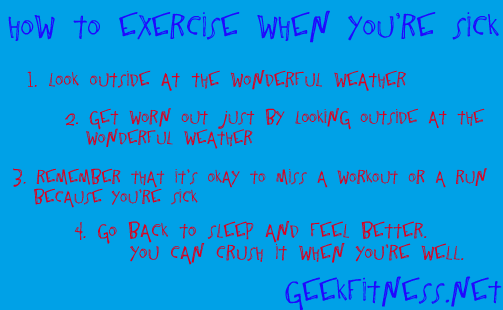
Sick, sick, sick, and sick of it. Hack. Cough. Wheeze. Blerg.

Image result for coughing cold memes workout

Image result for cough medicine memes

I took my FitBit off this week in disgust. There is nothing good to report. I’m not moving much because when I move I start coughing. I’m also not sleeping particularly well, because coughing.

ARGH.

I’m trying to keep my spirits up. I’m vaguely happy that it’s snowing because I can’t do anything anyway.

This morning’s Facebook status update: “Okay, yes it’s snowing. But I’m still sick and can’t do much anyway. Highs in the teens over the weekend. High of 20 in the forecast for next week. The snow will melt. I will stop coughing. And I will ride my bike again.”

And yes, I’m doing all the things. Drinking hot tea with honey, eating soup, resting, I promise.

When you have a cold and lingering cough, what’s your preferred ‘feel better’ thing to do? Last time I was this sick I see it lasted a month. Yikes.

(Apparently I like to Google image search for “too sick to work out” and “missing my bike.”)

Image result for cough sick memes


Related image


Image result for too sick to workout memes

Image result for my bike misses me too