I’m finally returning to running after a winter injury. Short story: Running on slush and ice can be hard on your knees.
It’s tough going. You can read about my complicated relationship with running here.
After a summer of physio, I’m back to a gradual program of running and walking. Weirdly, all this time on my bike seems to have made me a faster runner. What’s tough? Well, when you first start running walk breaks are your very best friend. You live for the breaks. But these days I’m breaking when I don’t need to from a cardio point of view. That takes discipline.
Also, my trusty neighborhood jogging companion, my dog Olivia, has gotten a bit rusty. I need a couch to 5 km app for the dog.
I’m also working on cadence. The physio folks think given my size I’m actually pretty light on my feet. I don’t have a heavy foot fall. They do think I could increase my cadence, the rate at which my feet turn over. I’m using a metronome app to help me with that.
See some of these apps reviewed here. Running Cadence is the simplest.
Running Cadence is a simple app for Android that allows runners to train and achieve a fast and steady running cadence. The app can automatically detect how many steps per minute you are running at and also gives real time voice feedback during your runs. This is useful for guiding you to keep running on your target cadence.
Apart from the auto-cadence detection and voice feedback, the app does not contain any other advanced features. The app is simple and easy to use, which most runners will probably appreciate and best of all, it’s completely free to download from the Google Play store.
But I like the ones that actually play a tempo beat to which you can match your run.
Why do I care about running?
Here’s a good list of 19 reasons to start running. My favourite reasons are that it’s the most portable fitness thing I do. My bike doesn’t easily travel with me for work. But running? Pack your running shoes and run anywhere. I also love running in the winter, even with the ice and slush. It’s also incredibly efficient, lots of bang for fitness buck. A good bike ride is at least 2 hours but 40 minutes of running feels pretty good to me.
Next up, I have some thoughts, all going well, of doing some duathlons next summer.
And then there’s soccer. That’s just for fun. I play rec league soccer with friends. But it’s probably the hardest thing I do on my knees. Winter/indoor is a bit worse for stopping, turning, and changing directions because the field is so small. So it might be awhile before I’m playing again.
Scene from the 2013 Burning Man 50K. Photography credit: Jeff Clark. Photo from the website: http://www.burningman50k.com/
They say anything goes at Burning Man. You can do pretty much anything at any time and for however long you like. But for lots of us, fitness is about routine. And it’s easy to lose that routine when you’re off schedule.
And it’s hard to imagine being more off schedule than at Burning Man, where a good deal of people take long siestas to escape the blazing afternoon sun and stay up until the wee hours, maybe even catching a few sunrises.
If you’re not sure what Burning Man is, check out the website here. I’m headed there with Renald next week. We’re meeting up with some friends who have been before. It’s our first time and we are super excited.
It’s a week off the grid, in the desert, with 60,000 other people, in the dusty environment of Black Rock City, Nevada, more fondly known as “The Playa.” It’s a temporary community that springs up once a year. They have a “leave no trace” policy, meaning that once the event is over, people are expected to pack up and take everything with them, leaving no trace whatsoever that there was ever anything going on.
So what are some of the fitness options for me at Burning Man?
1. One thing that intrigued me but I decided, ultimately, I’m just not ready to do, is the Burning Man Ultramarathon called the Black Rock City 50K. For a few years now they’ve been running this 50K race, and this year it starts at 5 a.m. on Wednesday, August 27th. Race headquarters will be Pink Lightning. Competitors will run a few laps around the perimeter of Black Rock City until they reach 50K.
I was intrigued because the idea of running with a bunch of people on the cracked desert surface from the early hours of the morning sounds like fun. I decided against because the furthest I’ve ever run is 14.5 km, and I figure it’s not wise to jump from that to 50 km, especially in the inhospitable setting of Burning Man.
Still, I might just go out and do 15K with them, then bail. It sounds like a fun time. They describe it as “the healthiest party on the Playa.”
2. Yoga. There are a few different yoga options at Burning Man this year, including an “Iyengar Style Yoga Practice” at Camp Armageddon on Monday, Wednesday, and Friday at 7:30-8:30 a.m. Lots of other yoga classes too.
3. Dancing. The night we arrive, one of the camps (Planet Earth) is hosting a 70s and 80s dance party from midnight to 4 a.m. No yoga the next morning, so that’s a possibility. And there are other dance parties throughout the week. And really, you can just dance anywhere, anyway, and any time you like.
4. Other Running. There is a group run on three different mornings around the perimeter of Burning Man from 7 a.m.-9 a.m. That sounds more do-able to me than the 50K and might be a nice way to meet up with other runners. We’ll see. It competes with yoga a couple of times.
5. Tennis. Not for us, because it’s the day we arrive, but on Monday, August 25th there’s tennis on a regulation clay court from 9 a.m. to 6 p.m. at Camp Ganesh Oasis. Renald would have loved that.
6. Bicycles! Other than some approved art cars and “mutant vehicles,” there are no motorized vehicles at Burning Man. Bicycles are the main mode of transportation. And they encourage you to have fun lighting up your bike to make it visible at night and decorating any way you like.
Renald and I ordered two very cheap cruising style bicycles from Wal Mart and picked them up in Las Vegas on Monday just after we got our rented RV. They’re single gear with coaster brakes and yes, they’re not the highest end bikes out there. We paid $100 each for them.
But you know what? This morning we rode up the Vegas strip and back on our cheap cruisers, and it was one of the funnest bike rides I have ever had in my life!
Renald and I in front of Caesar’s Palace with our cheap cruisers on our pre-Burning Man vacation. Fun times!
So we’re pretty excited about riding our bikes at Burning Man (and tomorrow at the South Rim of the Grand Canyon).
That’s just a sampling of what’s on offer fitness-wise at Burning Man this year. It’s not an exhaustive list. Want to learn to hulu hoop? Sure thing. What about competing in the Hippie Hunger Games? Show up at Camp Orphan/Endorphin Monday to Saturday at 3 p.m. Or you can learn some pole dancing.
So if you’re going to Burning Man and don’t want to let your fitness routine slide, or if you want to try something new, there’s lots to do! I’ll report back about my Burning Man experience (at least the fitness part) when I get back.
I love the photo of Lauren Bacall that was circulating among friends on various social media last week. It’s the on the right below. True, the mainstream media seemed to stick with the classic movie star Bacall of more than 50 years ago, like the one the left, but I liked this older image too. She looks to have character.
Bacall: ‘Your whole life shows in your face, and you should be proud of that.’
It’s tough for women, aging in a society that equates youth and beauty and that values beauty in women so highly.
From Psychology Today: Aging presents a particular challenge for women’s appearance self-esteem because with each passing year, the media define their beauty as fading away. Cleopatra may have been able to avoid this fate, according to Shakespeare’s play, in which it was said, “Age cannot wither her, nor custom stale her infinite variety.” For the rest of us, though, our seeming fate is to wither away steadily—at least according to our current representations of aging women. And women high on appearance-contingent self-worth will be particularly vulnerable to the effects of aging in a society that equates youth with attractiveness.
According to the Psychology Today piece it’s women who care the most about looks who have the hardest time coping with aging. That’s not a surprise.
Being thin doesn’t seem to help with body shame either. Often it’s my thin friends who are the worst, especially as we age. It’s like they’ve never had to think about these things, to worry about how they look, until now. And I’ve been thinner too and I haven’t felt less anxious or less self conscious at a smaller size. In a weird way it’s worse. In the game of looks, I’m then ‘in.’ and it matters more. Better to be outside of those beauty norms all the way maybe.
That’s true for anxiety about weight. Most of the angsty hand wringing posts about body image are written by women who are actually within the normal weight range, it seems to me. My fat friends don’t agnst so much. The downside of being inside the borders of normative beauty/body size, is I think continual anxiety about status.
“Throw away your conventional, media-defined ideals of beauty. You’re not going to change society’s definition of beauty, but you can change your own. Don’t focus on the beauty you see in ads but, instead, to the beauty you see in the real-life people you admire.”
I also like to remind myself that many of the people I find beautiful don’t match society’s standards of what counts. Find older people you find attractive and think of them when you need to push past the idea that beauty ends at 30, 40, 50 or whatever silly age you have in mind.
Second, we should care less than we do about beauty anyway. I know lots of women who seem more obsessed with clothes, hair, make up, etc as they age. They’re worried about “letting themselves go”–heaven forbid. But I think caring more sets you up on an anxious, downward spiral. It’s time to care about things that matter much more than looks, such as character and having happy, healthy relationships.
“Define yourself in ways other than how you look. Make your self-esteem contingent on your inner, not outer qualities. Focus on what you like about your abilities, personality, relationships, and perspective on the world. These almost invariably show improvement over time and are often more changeable than facial or bodily features.”
Nobody says, “Everybody has a pleasant laugh.” Nobody says, “Everyone is athletic to somebody.” Nobody says, “You are an amazing writer, whether you know it or not.” I keep waiting, but they never say it.
Beauty is the only trait that everyone gets free access to. Why?
Because we have created a culture that values beauty above all other innate traits…for women, at least. Men are generally valued by their success, which is seen as a result of talent and hard work, despite how much it depends on luck and knowing the right people.
But women are pretty much a one-note instrument. Society says, you’re hot, or you’re not. Your looks affect your choice of mate, the friends you have, and even your job. And this factor that will affect every part of your life is something you have next to no control over.
Third, caring less about beauty doesn’t mean caring less about looks. Really, what most of us care about is having people, particular people, find us attractive. But that’s not beauty.
Again in the post on body image, I wrote:
Think about it this way, it doesn’t make any sense to think about being attractive simpliciter. What exactly would that mean? There’s only attractive to particular people.
Whatever you look like I can assure you there’s someone out there who thinks that thing that you have is THE thing to which they’re attracted. In the world of the internet there’s probably even a group for women with big breasts who like to wear neon green bras and the men and women who love them.
So when friends say. I don’t look attractive when I’m this size, my first response is to wonder to whose standards they’re appealing. Who is the person who would like them but doesn’t because they’re too fat?
Mostly when straight women say they just want to look attractive they mean to look attractive to men. But still I wonder, which men?
The desires of men who like women are far more diverse than the world of men’s magazines would ever have you believe. Men whose desires don’t fit-maybe they like hairy legs, or women with crooked teeth, or they’ve got a thing for women with glasses or women in their fifties on motorbikes –are hurt by gender role stereotyping and hetero conformity too. Don’t believe me about the diversity of heterosexual male desire, read John DeVore‘s The Types Of Women That Really Turn Us On over at The Frisky.
There are men who like fat women, men who like muscles, women who like bald men, men who like men who are really hairy, women who think men wearing socks with sandals are the hottest (okay, maybe not that one) etc. My point is that it’s a wild weird world out there in terms of attraction.
Once you start thinking this way you realize that men who like skinny 18 year old blondes just have a particularly boring, mainstream fetish. You can kind of accept it, yawn, and move on. Oh, right, youth. Hmm. He likes thin women. That. That’s his thing. Ho hum. Too bad for him.
You can even work up to thinking, in an amended version of a common phrase, your thing is not my thing but your thing is okay, and move on.
And if that’s all he likes, you might even feel sorry for him for leading such a narrow, limited life in a world rich with possibility.
And yes, I know this is isn’t the whole story about body image and insecurity. Often it’s our own standards we don’t live up to. And queer people can struggle with body image as well. But to the extent that it’s about worrying that someone will find you attractive, I urge you to put that worry on the shelf, close the door, and say goodbye.
I hesitated when writing the above passage about using the word “fetish” but I did so because mainstream beauty standards are hard on men too. I’ve been writing a fair bit on this blog about men and the ways in which sexism limits their lives too. See here and here and here and here. There’s pretty strong indoctrination into what you’re supposed to like if you’re a guy. First, women. And then particular sorts of women. Not enough to be straight, to really meet the demands of normative masculinity you have to like the right sort of women. There’s lots of first person accounts of guys faking liking skinny young things around their friends, but having their fantasy lives run in another direction altogether.
So it’s normal to like young women and thin women and so on. Everything else gets labelled a fetish.
For all of our sakes, it’s time to move past it and revel in the rich diversity of human desire for all of our sakes.
A few years ago Dana White, a man who apparently believes in absolutes, said that he would “never allow women in his octagon.” To his own financial delight, White gobbled down his own words when he not only started putting women headliners on his programs, but decided to have season 20 of “The Ultimate Fighter” be exclusively all-female.
While it would be exhilarating to say that the rise of women in the UFC has been heavily publicized, the truth is that it’s the rise of a particular woman that seems to have garnered the majority of the attention. Ronda Rousey’s name is synonymous, if not currently the autonomous representation of women fighters in the UFC.
It’s not difficult to see why Rousey would be the headliner for women in the MMA word; she is an Olympic medalist (Judo), remains undefeated in the octagon, and she’s an undeniably, easy on the eyes California girl. While her ascent of the UFC ladder is both respectable and inspiring, her monopoly on the sport creates an interesting dilemma. Ronda Rousey simply can’t be the peak of women’s presence in the ring.
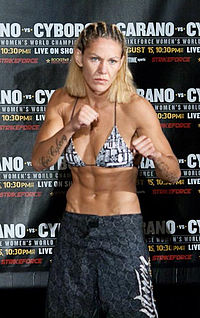
Take Cristiane Justino (also based in California), for example. She is a lethally trained trained muay thai aficionado. She was 2013’s Featherweight of the Year, and is currently ranked as the #2 pound-for-pound female MMA fighter (right behind Rousey, of course). A quick Google search for “women in the UFC,” however, will return a plethora of articles about Rousey, with only a few mentioning other women (like Justino).
Much of what arises details a feud between Rhonda Rousey (and subsequently Dana White) and Justino. White and Rousey both took shots at Cristiane Justino over Justino’s suspension as the result of a positive steroid test a few years ago. Interestingly enough, both White and Rousey took stabs at Justino’s physical appearance. White made the observation that Justino “…looked like Wanderlei Silva in a dress and heels.” However, numerous men in the UFC continue to also test positive for PED’s, without any sexist heckling from Mr. White. Justino made a mistake years ago–and paid the price. Shouldn’t she be allowed to move on with out being chastised for her physical appearance?
Granted, there can only be one reigning champion; that’s the nature of the game. And since Rousey has had a clean, white-hot career, she deserves it. However, in order to foster the growth and development of women in the sport, there needs to be competition. If a woman looks less feminine than Rousey, but is a formidable competitor, she deserves to get the coverage and celebrity that Rousey does. If one lady is the sole face of the sport, what happens when she is gone? In order to promote women fighters in the UFC, there needs to be a continual output of up-and-coming contenders (looks NOT accounted for) that will carry the torch and perpetuate the tradition. Ronda Rousey can set the bar, but women fighters across the world can’t let her be all that there is for the sport.
Julia Randall is obsessed with fantasy football, any good Merlot, and the most recent season of American Horror Story. When she’s not singing (really well) you can find her writing for DraftStreet.
It’s almost September. For an academic, it’s the new year. Forget January resolutions. For me, I’m all about September. It’s back to regular life and routine. Structure and order return to my life. Teenagers go back to high school and others back to university.
For me it’s also,
Back to CrossFit
Back to running
There’s also,
New students
New schedules
New habits (I will pack my lunch and healthy snacks!)
I always remember the saying, another grandmother pearl of wisdom, “start as you mean to continue.” No putting off adding exercise until week two of term. If you want to do it, start right away. Start as you mean to continue.
Here’s a rough outline of my fall physical activity schedule:
Monday: CrossFit + Run
Tuesday: Bike + Aikido
Wednesday: CrossFit + Run + Aikido
Thursday: Bike
Friday: CrossFit + Run
Saturday: Aikido + Bike
Sunday: Bike + Hot Yoga
That’s Aikido times 3, running times 3, CrossFit times 3 and biking times 4. Phew. No scheduled rest day but disaster strikes often enough in terms of my schedule, that I’m sure I’ll get some rest.
I’ve written before about switching gears at the start of the school year. There’ll be no more day time bike rides, for example. On the bright side, there’ll also be less travel away from home without my bike.
It’s September very soon and back to school. As a university professor this means I move from a summer time focus on research, writing, conferences, and PhD student supervision to a term time focus on teaching, university committees, department talks, and in October especially, more conferences.
And no, we don’t get summers off. Please don’t ever ask professors what we do with our summers. We get four weeks paid vacation and this summer I only managed to take a few days of that. Sigh.
Why do tenured academics work so hard in the summer when, from a certain perspective, we don’t have to? It’s our entrepreneurial work culture, I think, and I’ve blogged about that over at Pea Soup.
But back to September when the university term busyness begins. It’s not that I work more during term time, though I do because the demands of graduate supervision and research and writing continue as well, but the striking difference is who controls my time.
On my summer schedule I write into the night if I feel like it and take the next morning off to go run on the trails with dogs, or ride my bike with friends. I schedule meetings with my doctoral students off campus in nearby coffee shops. It’s still work, and there’s lots of it, but it’s more or less on my terms. It’s a very privileged life and I’m thankful.
But classroom teaching occurs when it best fits the needs of students and my department. Committee meetings are scheduled around my teaching hours. And at the start of the year it feels like there’s barely time to breath, let alone prepare classes and finish writing commitments.
I’m not complaining. I love my job and think that being a professor is one of the best jobs in the world.
September is one of my favorite months. It’s fall but not yet cold. School routine but not yet so busy I’m run ragged with meetings and grading. It’s also the perfect temperature to run and to ride bikes. Bring it on!
A study just published in the journal PLOS One is the first to prove a link between helicopter parenting and obesity: Between ages 10 to 11, the researchers found, maternal overprotectiveness “was associated with a 13 percent increase in the odds of children being overweight or obese.”
Warning: Story contains awful photo of fat kids enjoying food, watching tv, sitting on the sofa. Because we all know thin children never do that!
It’s no secret that raising kids today is nothing like it was a decade or two ago.
In fact, many moms say there’s no way they would let their children do what their own parents gave them free reign to do as kids.
“I remember taking the city bus with friends and riding to downtown Atlanta when I was 11 or 12, maybe younger,” said Samantha Gregory, a single mom of two children. “I would never let my kids do that today.”
Here’s what kids at play have always liked to do: Race, climb, wrestle, hang, throw, balance, fence with sticks, jump from heights and gravitate toward sharp objects. Ideally, while escaping the watchful eye of grown-ups.
Here’s what today’s kids hear when they’re even flirting with such pursuits: Slow down, get down, put that down. No throwing, no sticks allowed, don’t jump from there. Don’t touch, that’s too dangerous, be careful. And for goodness sake, don’t go anywhere without an adult.
In the last generation, adults have been consumed with protecting kids against all odds. But now, some child injury prevention experts are warning too much bubble wrap may be thwarting healthy development.
Most of the news articles that talk about children, risk, and inactivity look at the costs of parental over protectiveness in terms of the adult the child becomes. They tend to focus on a single outcome: Will the child turn out to be fat? I think that misunderstands the risks of inactivity. Thinking more broadly we might wonder about the future adult and risk aversion, health outcomes beyond weight, comfort in the outdoors, or losing out on the pleasures of sport and play.
We also need to think beyond the goods that occur in adult life and ask more broadly about the childhood goods on which our kids are missing out. It’s not just that they’ll suffer as adults if they aren’t allowed to play outdoors and walk to school. It’s also the case they’ll have worse childhoods and that matters too. See my paper, “The Goods of Childhood, Children’s Rights, and the Role of Parents as Advocates and Interpreters” for more on this. It’s a chapter in Family-Making: Contemporary Ethical Challenges , Françoise Baylis and Carolyn McLeod (editors), Oxford University Press
Why the focus on moms and mothering? So much of this research looks at “overprotective mothers” and it’s as if fathers play no role at all in parenting. Blame the mothers. Of course.
Image: Two children in silhouette playing with a stick on a hill
What’s the biggest single factor that puts you at risk for ignoring your health? Being a man.
Sociologist Lisa Wade, interviewed in New York Magazine, says that “some scholars argue that being male is the single strongest predictor of whether a person will take health risks.”
Men like risk it turns out. Most of them also hate putting lotion on their skin (too girly) and being afraid of things (not manly). They are also more likely to have outdoor jobs and do household tasks that involve being outside the house. Think lawn mowing and BBQ-ing. They also pay less attention to their skin and so don’t catch early warning signs.
Women, generally speaking, don’t mind lotions, do pay attention to changes in our skin, wear sunscreen to avoid premature aging and wrinkles, and often also wear make up year round that contains ingredients that protect skin from the sun.
Male socialization in this case leads to bad results for men. Women, thanks to a different set of gender norms, fare better.
This combination of factors is part of the explanation as to why men between the ages of 15 to 39 are more than twice as likely to die of melanoma than women of that age. According to the American Academy of Dermatology melanoma will kill 6,470 men this year — and half as many women.
“Advocates and researchers are currently trying to figure out how to better get the message across to dudes that they really need to slather on the SPF, and last week Wade came across an unlikely solution: the marketing teams that create what Wade calls “pointlessly gendered products.”Usually, Wade writes about such products — like gendered packages of mixed nuts, glue sticks, and even vegetables — with a mixture of snark and incredulousness. But when she came across Banana Boat sunscreen for men last week, she couldn’t help but write a “reluctant defense” of the product.
“Sunscreen is a category of lotion and so putting on sunscreen is equivalent to admitting you’re the sun’s bitch,” she writes. “In fact, thanks in part to the stupid idea that lotion carries girl cooties, men are two to three times more likely to be diagnosed with skin cancer. So, fine, dudes, here’s some sunscreen for men. For christ’s sake.”
Maybe for my teen boys they need an Axe of the sunscreen world? I was amused to see they know have sunscreen especially for tattoos. See http://www.coppertone.com/products/speciality/tattoguard/spray.aspx even though the Canadian Cancer Society says any full spectrum, high SPF sunscreen will do the trick. The “just for tattoos” stuff looks cooler and I’m sure ounce for ounce, it’s pricier. But whatever.
The sunscreen avoidance and skin cancer risk isn’t the only health problem men face.
“On average, men aren’t as healthy as women. Men don’t live as long, and they’re more likely to engage in risky behaviors, like smoking and drinking. But in the past decade, global health funding has focused heavily on women. Programs and policies for men have been “notably absent,” says Sarah Hawkes from the University of London’s Institute of Global Health.”
“It’s cool to be a man that smokes and drinks — who drives a fast motorbike, or fast cars,” she says. “If you were really serious about saving lives, you would spend money tackling unhealthy gender norms” that promote these risky behaviors.”
See also 10 bad health habits of men. The list includes the usual: smoking, drinking, fast food, not seeing a doctor regularly, stress, keeping everything bottled in.
Men lead shorter lives than women and some moral philosophers think we ought to be more concerned than we are about this inequality. There are a number of ways in which men’s lives lead to early deaths, stress, yes, but also death in war time, and dangerous jobs such as mining and construction. Men are disproportionately represented in the prison population as well.
(I’ve written a bit before about men’s health. See The unsafe sex where I address some of these arguments.)
When thinking about inequality moral philosophers like to divide up inequalities that are the result of circumstance and luck, from ones that follow from choice. We think individuals are responsible for inequalities that are their own choosing. Sure smokers die young, for example, but that’s a trade off they’ve made.
It’s tempting to put men’s deaths from sun related skin cancer that category.
“Don’t be an idiot! Just wear the damn sunscreen!”
That I can hear cry in my own voice is part of the reason that married men, or men with female partners anyway, live longer. They’re nagged into healthy habits and visit the doctor more often. Now I should say that the person I’m in the best position to nag on this front doesn’t need it, not where sunscreen is concerned. As the result of a scare in his twenties, after growing up a fair skinned, freckled redhead, racing sailboats on the ocean, he was an early adopter of hats, gloves, long sleeves, and serious sunscreen.
Maybe it’s that I’m now parenting teenage boys but I can see how strong gender role socialization is for boys. It’s okay to wear a helmet because “my parents are crazy when it comes helmets. They’ll ground me forever if I ride without one” but not okay to do it because you’re worried about hitting your head.
Note that when young women acquire unhealthy habits, dieting, for example, as a result of female socialization feminists aren’t so quick to dismiss it as a matter of individual choice. Feminists can, and should, take male gender role socialization just as seriously. Indeed, I think feminism offers the best explanation of some of the inequalities that hurt men.
When you’re suffering on a long ride, slowing down and struggling to stay with the bunch, one of the first things people ask is whether you’ve had enough to eat.
The people riding with you start rifling through their jersey pocket and handing you snacks. Why?
Why is eating while riding so important? And why does not eating enough affect performance so dramatically?
“Your body will use a combination of fat and carbohydrate to fuel your ride. The harder you work, the more carbohydrate you will use. The body’s carbohydrate stores are limited and can be rapidly depleted so it is very important to keep your carbohydrate stores topped up for the duration of the event. Without available carbohydrate your body will depend more on fat as a fuel. You may think that burning fat sounds great but to do this your body needs a lot more oxygen and in response to this your pace will slow. That’s not ideal if you want to achieve a fast time or a new PB.”
(You might be wondering what a “sportive” is. The Gran Fondo is one example. It’s a long, mass participation, endurance cycling event.)
Riding my bike is one time I struggle with intuitive eating. I don’t feel hungry but I know I need to eat. Sometimes food can even make me feel sick. I go for easy to eat, calorie dense food in those cases.
I struggle a bit with this because I’m often not hungry when I know I need to eat–during long, intense bike rides is the most common example–and at other times I’m famished even when I know there’s no need for extra calories (after long bike rides when I’m often hungry for the rest of the day and into the next one even after I’ve refueled.)
I know from experience that if I don’t eat while riding my performance suffers. It’s not just that I struggle while riding, I’m also hungry for days afterwards. By the time I get off the bike I’m eating anything and everything in sight. Often I’m still hungry the next day.
But if I eat regularly, before I’m hungry, and keep eating throughout the ride, I’m fine.
If I get the balance right not only can I ride faster, for longer, there’s no big swing in hunger associated with a long hard ride. I can have dinner that night as usual.
So I do it because I know it works even if it means setting aside my usual “eat when hungry” mantra.
If I find it tough, I think, again based on experience, my smaller cycling friends have it tougher. Food management can hugely affect cycling performance. It’s worth experimenting to find what works.
Oh, and here’s some geeky cycling humour related to our theme.
Sunday was the big day! The day of my first Olympic Distance triathlon. Ever since last summer, this has been my “fittest by 50 goal.”
I trained. I gathered up some support–both of my parents and Renald dragged themselves out of bed in the dark so they could come cheer me on. I checked out the course ahead of time. I signed up way in advance, specifically choosing the Bracebridge Triathlon because it’s reasonably close to my parents and the timing was right.
I definitely wanted this behind me before we left for our summer vacation to the Grand Canyon and then on to Burning Man.
It was a clear, hot, and sunny day, not the least bit humid. We made it to Annie Williams Park, a grass-covered picnic area on the river, before 7 a.m. My nerves settled into my stomach half way there, and I had to run from the car to the bathroom before I could even think of getting my stuff ready or checking in.
By the time I got back to the car, Renald had my bike unpacked and my bag ready to go. I pumped up my tires–a well-formed habit I’ve gotten into doing before every single time I take the road bike out. I grabbed my bag and wheeled the bike down to the registration area where I picked up my bib–#335–and my t-shirt (I should have signed up for the cap).
As I entered the transition area, I heard someone calling my name. I turned around and it was one of the guys who trains with Balance Point Triathlon, the club I swam with through the winter and joined for the summer. I wear a club suit when I race so it was easy for Kevin to pick me out of the crowd. He is a fast swimmer and, as I found out later, a fast cyclist and runner as well. He acknowledged my understandable nerves and assured me that I’d be fine.
I’d driven the bike course the day before. I would have liked to have ridden it, but it didn’t seem like a wise thing to do within less than 24 hours of the race. It’s a hilly course with lots of different kinds of ascents and descents–from short and steep to slow and steady. I’ve gotten over my terror of hills, no longer regarding them with complete dread. But the course did kind of scare me. I knew I’d be taking it slow.
I set up my transition area in the way I’ve become accustomed to, laying everything out on a navy blue towel, folded in half beside my bike. Like this:
I folded my wetsuit over my racked bike and went out to chat with Renald. The announcer kept reminding us there would be a pre-race meeting near the water at 8 a.m. to explain the “time-trial start” for the swim. Because it was a narrow course on a river, we were going to go in five-second intervals in order or our bib numbers (which were assigned by age).
With about 5 minutes to go until the meeting, I slicked myself up at key points with Body Glide and wriggled into my wetsuit, up to my waist.
Athletes were already in the water doing swim warm-ups. My parents arrived, lawn chairs in hand, just when the meeting was about to begin. Renald set them up in a prime location at the swim finish.
The time-trial start meant lining up on the dock and then in the water, 50 at a time, when the announcer called your group. It’s a bit more nerve wracking than the typical start in three waves because it involves a lot more waiting around after the race has begun. The fastest athletes were at the very front, the elites competing in the Ontario Championships and seeking a spot on the Canadian national team.
Since my group wouldn’t be called for about 15 more minutes after the start, I waded into the river for a practice swim. The bottom was oozy and soft, the water briny and dark. Not my favourite conditions, but at least it felt warm. No alarming jolt when it filled the wetsuit and no problem for the face, hands, and feet.
I hung with Renald and my parents for a few minutes but then felt like I really needed to get my head in the game. Moving closer to the dock, I heard my name again. This time, it was a colleague from the medical school. I had no idea he did triathlons. He’d done the course a few times, and started talking about the bike course. As soon as he began to describe the steep hill just a few kms from the start, at Santa’s Village, I felt my stomach drop a bit.
“Have a good race!” I said.
Then my group was called.
Lining up on the dock for the swim at Bracebridge. That’s me with the yellow cap. 🙂
The Swim: 1.5 kilometres
By the time I got to the front of the line I didn’t have a lot a time to think. A 5 second countdown isn’t very long. Just let’s say I’m glad I had my goggles in place because the next thing I knew I was swimming. I settled into pace after about 50 metres. This is the first time I haven’t had any difficulty establishing my rhythm and my breathing at the beginning of a race. I passed a few people right away.
Then I felt my timing chip coming loose. The strap was dragging and I knew at least part of it had come away from the velcro. Trust me, this water was dark enough that a lost timing chip would be just that: lost. I ignored it for a few minutes but then I had to stop and check it, for fear of it coming off. I couldn’t figure out exactly what the problem was, but at least some of it was still stuck together so I was pretty sure it wouldn’t fall off. That little stop probably added 30 seconds because it broke my rhythm.
The swim took us along the shoreline on one side of the river for 720 metres, then we crossed to the other side (about 10 metres) and swam back, down along the other shore to the finish. I sighted regularly, keeping the enormous orange markers in view and on my left. Green cones marked the turns, and there would only be three of them. The first one seemed to take forever to come into view. I picked up the pace when I rounded it. I knew I had plenty in the tank for a negative split on the swim. I got caught behind someone on that stretch, having to hold up so as not to get kicked in the face, but I altered my course slightly to find a clear path. I caught site of some gnarly tree branches under the water, which freaked me out (read: irrational fear of things in the water).
I caught sight of the final green marker at the end of the swim, indicating the last turn which would be followed by a short stretch to the shore and the run up to the transition. I gunned it.
On shore, Mum, Dad and Renald were yelling “Go, Tracy!” I smiled and ran a bit faster.
Swim time: 33:45 minutes.
Transition 1
I got all flustered in the transition area, despite having mapped out my course visually from the entrance prior to the race. I had to double back out of the duathlon bike area and when I found my bike I looked at everything on my towel and for a brief moment I had no idea what to do next. Okay. Regroup. I pulled off the wetsuit and dabbed myself off with a towel. It was hot enough that it didn’t really matter if I was still wet.
I just wanted dry feet. So I threw the towel down and stepped on it while I grabbed my socks and pulled them on. Then the glasses and the helmet, bike shoes, gloves. Things were moving in slow motion (not the best thing for a race). I unracked the bike and ran out the “bike out” arch to the mount line.
“Come on, Trace!” Mum shouted.
T1 time: the transition times seem to have disappeared from the race results postings, but my T1 was my slowest ever, somewhere in the 3 minute range.
Running out of T1 for the bike ride.
The Bike: 40 kilometres
Here’s the part where everyone passes me.
But I knew that would happen, so I had my own goals for the bike. They were modest. I was going to use it to build confidence on my ability to make it up hills, fearlessness in letting it fly on the descents, and awareness of cadence and the sensation of “spinning” the pedals, especially the part where you’re supposed to feel like you’re scraping mud off your shoes.
By now the sun had risen high in the sky and it was getting hot. I could give a play by play, but instead, I think I’ll just give you some random highlights.
1. I DID make it up all the hills. They were challenging. That Santa’s Village Hill my colleague told me about, for example, defeated at least one person in front of me because he was picking himself up after having fallen over trying to make it. Me? I had to slowly grind my way up, huffing and puffing all the way. The other challenging hill was a long, steady climb just before the turnaround point. It went on and on and on. But I had my positive self-talk ready for that one. I only considered bailing a couple of times. And then I reminded myself that everyone always tells me I’m built to be a climber. So I repeated, aloud, “I’m a climber, I’m a climber, I’m a climber, I can do this, I can do this.” And I used all the tips I’d been given at the hill climbing workshop, letting up a bit as I came into a hill, then spinning at a high cadence into the climb, doing that mud scraping thing.
2. Drinking and eating on the bike is not my strong point, but I needed to do both if I didn’t want to run into trouble on the run. I had some food handy in my new and wonderful bike bento box–my homemade endurance gel block shots. I ate them at regular intervals and drank my water, laced with Emergen-C on the flats. I practiced drinking while pedaling. But each time I took a drink, I lost time.
3. That demoralizing feeling of being left in the dust. Other than that guy who fell over and another poor soul who had a flat, I didn’t pass anyone on the bike ride. But oh, did people pass me! Each time, I had to buck myself up with some positive self-talk and remind myself that my only goal was to complete the race. There were a handful of people behind me — I saw that when I turned around. But yeah, it’s frustrating not to know what to do to go faster. I spoke to a woman at the end of the race who is the first person I’ve ever talked to who “gets it.” She too said that she just doesn’t understand how people go faster on the bike. It seems impossible to her that her time will ever improve. Well, that’s how it seems to me.
4. The last leg of the bike, when I was all alone and could see no one else, and I still had a 10K run ahead of me, and I was well aware that it was approaching noon already and it would be hot, and I knew I’d been out there on the bike longer than I’d planned to be–that’s when I thought briefly about bailing, and about downgrading my next triathlon in September to a sprint distance. But there is something about having to be accountable on the blog that can really motivate a person. So despite that little melodrama in my head, I kept at it (“I’m a climber, I can do this”) and I will be doing the Olympic in September.
When I got off my bike at the dismount line, mum said, “Wow, you look fresh!”
Bike time: 1:55:17 (I had hoped for between 1:30 and 1:45)
Transition 2
Uneventful except for the fact that the last thing I wanted to do at that point was a run a 10K.
T2 time: under 1:30 (but again, times seem to have disappeared from the website)
The Run: 10K
It was HOT. And despite looking fresh, I felt like I wanted to lie down on the grass in the shade of an old maple tree beside the river. My run strategy was simple: I would try to keep my pace between 6:30 and 7:00 per kilometre, and that would bring me into the finish line within 1 hour and 10 minutes. I knew I could complete the 10K, it was just a matter of maintaining a decent pace.
I couldn’t keep it quite there. The course was flat and had some shady bits, but the heat of the day was getting to me. At the water stations, I started to take extra and dump it over my head. That refreshed me for a few seconds each time.
Conscious that I was ignoring the received wisdom of never trying anything on race day you’ve not tried before, I drank some Hammer Heed because at that point I had over 5K to go and was worried about electrolytes. Mistake. Within minutes of drinking the Heed I felt bloated and heavy. This feeling stayed with me, in addition to overheated and just plain tired, to the end of the run.
It was an out and back course, so the people heading back were great for shouting out words of encouragement. I love the fact that this race series has our first names in large letters on the bibs, so you can support one another by name. It makes a difference.
Again, I passed no one. And by then, there weren’t many people left to pass me either. So I ran alone.
After the turnaround, about 10 cups of water over the head later, I noticed for the first time that my shoes were saturated with water. Each time I dumped it over the front of my head, it made its way down to my shoes. Slosh, slosh, slosh. That was for the last 4K.
Running isn’t scary because it’s so easy to walk. Nothing dangerous about it, you just slow down. But I didn’t want to slow down. I knew my pace was faltering. I started to play little games with myself about making it to that tree or that house or that water station or that distance mark.
John, the guy behind me, passed me at the 8K mark, with the words, “I
wish that said 9K.” I kept him in sight the rest of the way, but I couldn’t keep up.
And then I was turning into the park again, running down the grassy slope to the finish line. Mum and Dad and Renald were yelling “Go, Tracy!” and others were saying, “You’re there!”
Run time: 1:18:48
Race time: 3:52:36
Crossing the finish line.
Of the 348 who finished, I was 343rd. About six others succumbed to the heat and didn’t make it to the end. My family greeted me at the finish line, Mum moved to tears by my accomplishment, Renald close behind her.
I did it! It took a bit for it to sink in. This was the moment I’ve been training for all year. My fittest by 50 goal, accomplished!
I could probably write a separate post about what it feels like to finish in the bottom ten, but for now I’ll just say that those of us who endure to the end are out there a LONG time. Sean Bechtel, the champion, finished the entire course in 1:55:19, almost 2 full hours ahead of me!
I think the thing we most miss out on, us in the bottom ten, is the energy of the crowd. By the time I got there, everyone had pretty much dispersed. There were still a few people eating pizza and packing up their stuff, but for the most part, everyone was gone. The excitement of the announcer and people cheering at the finish line and coming in with other competitors is missing. It’s there in the shorter races–I felt it in Kincardine, for example. I love that finish line feeling when there are still enough people around to create that buzz in the air.
But that’s okay. I feel really good about my race day. I enjoyed myself a lot. If you’ll notice, I’m smiling in almost all of the pictures and that’s genuine. It was truly a fun time. And Mum, Dad, and Renald: Thank you for being there! I felt the love!
Next up: Lakeside Olympic Distance triathlon, September 14, 2015.
I looked at my Garmin this month in shock. I think this is the most I’ve ever ridden in one month. Guess that’s what happens when you do a cycling holiday at the start of the month, a charity cycling tour at the end, and ride lots with friends and commute by bike in the middle.
Frankly I wasn’t sure I’d get much riding in. It’s been a long year of loss. See Death changes everything. But then my partner decided that cycling was a good form of grief therapy. That worked for me too.
For those of you interested in the weight loss angle on riding lots, I did lose weight. I’m now back to what I was when I ended the year of nutrition counseling, down about fifteen pounds from when I started the “fittest by fifty” challenge. See my account of regaining it here. Will I keep it off? We’ll see. I’ll try. Riding that much certainly isn’t sustainable and weight isn’t the reason I did it. Maybe if I keep trying eventually I’ll be a weight loss unicorn!
I didn’t change my views about ultra long distance cycling events. (My friend Dave did one recently which he rode 1000 km in 72 hours, plus an additional 400 km getting to the start then home again) I’m not tempted by riding that much in a day but I am happy to have ridden this much in one month. Winters here are long and bad so we need to get lots of cycling in when we can.
5. Various weekday rides with friends, 3 at 60 km, 180 km
That will definitely be the high point for the season. Once the university year starts back in September there’ll be no more long weekday rides. Until the early dark hits I’ll get out after work, then just bike commuting and long weekend rides. But that’s okay. It gives me a bench mark for next year. I also love fall riding best of all. Beautiful colours, cooler temperatures, and lots of leftover summer fitness! See Reasons to start riding in the fall.