ADHD · habits · motivation · strength training · stretching

Christine outwits her brain and does some strength training

I outwitted my brain on Sunday night. 

Hmm, now that I look at that sentence I realize that I am claiming that my brain outwitted itself so I guess I really mean that I consciously chose to override an automatic behaviour?

That is definitely not as fun, let’s go with the first sentence instead.

So yeah, I outwitted my brain.*

A drawing of a human brain surrounded by things it is ‘saying.’
My best depiction of my brain doing its best to conserve energy and maintain the status quo. You can tell it’s my brain because of the sprinkling of gold stars. Oh, and the chatter, that gives it away too. Image description: a drawing of a human brain surrounded by things the brain is saying. ‘One set will do, right?’ ‘You don’t need to stretch, it’s fine!’ ‘No plan? Ok, but how about making a list?’ And in the bottom corner is my response ‘Nice try, brain! ❤️C’

The knot in my shoulder/neck has almost completely gone away so I had decided that I was going to do some upper body strength training on the weekend. 

Saturday was a jumbled sort of day and I never got to my weights so I picked a specific time (8:30PM) on Sunday to get started. (That’s Step 1 in the outwitting. I didn’t leave it for an ambiguous ‘later.’)

For the rest of Sunday, one part of my brain kept reminding me to make a plan for the specific exercises I was going to do. I tried to make a list but then another part of my brain started telling me that there was no point in making a one day list, it had to be part of a long-term plan. I felt complete resistance to that idea so I shelved the whole plan to plan. (Step 2 – I didn’t let my brain get all ‘shouldy’ – you know how I feel about the word should. Ick. Ick. Ick.)

Since I didn’t want to make a plan, I reminded myself that any exercises I do are going to be helpful – any repeated exercises will make my arm muscles stronger. So, while making a plan can be helpful and would let me see my progress over time, actually doing the exercises is far more important than planning or tracking them. (Step 3 – I found the most direct path.)

So, planless and with a specific time to start, I did my best to put aside any other thoughts about my exercises and went on with my day until 8:30.

Then I had another small disagreement with my brain – this time it tried to tell me that I needed specific exercise clothes. Luckily, seeing as I was wearing leggings, a tank top, and a cardigan, I managed to bring it around to the idea that I could probably just take off my cardigan and swing my weights around. (This is a joke, of course. I lifted them in a controlled manner, worry not.) (Step 4 – I recognized yet another form of resistance and sidestepped it.)

So, I went to the living room and picked up my weights (I put them in the corner on Friday so they’d be right there when I needed them – a very preemptive outwitting, that’s Step .5) and did one set of a series of exercises. I almost stopped there because my brain claimed that I had done what I set out to do.

I disagreed. 

If I was tired, if my time was limited, or if I just wasn’t feeling it, then one set would be completely acceptable. However, none of those things was a factor, and my shoulder felt ok, so I did another set. (Step 5 – I questioned my automatic thoughts.)

After two sets though, it was definitely time to stop and my brain tossed up the idea that I didn’t need to do any stretching because, and I quote, ‘You didn’t work that hard.’ (brains can be such jerks!)  BUT, luckily, in that moment, I remembered a fact that often eludes me – Sunday night me is the same person as Monday morning me. 

So, while Sunday-night-me might not feel the need to stretch, Monday-morning-me is going to wish that I had. (Step 6 – Today’s self doesn’t always know best.)

So, I stretched. 

And even Sunday-night-me felt good about it. 

So, as Monday-morning-me writes this post that will go up on Tuesday morning, I am happy that I outwitted my brain, I’m happy to have done the strength training I had planned, and I am a little bit sore but only ‘I did a workout’ sore, not ‘I can’t move’ sore. 

And I have this post to prove to my future self that the effort to outwit my brain is totally worth it.

*I read somewhere that referring to your brain as separate from yourself is a neurodivergent thing. Is it? I certainly wouldn’t know.

strength training · training

Tracy dives into the EPIC program

Ten-pound hexagonal dumbbell in the foreground on a wood laminate floor, with a blurry background that includes a pair of running shoes on the left and two kettlebells to their right. Photo by Tracy Isaacs
Image description: Ten-pound hexagonal dumbbell in the foreground on a wood laminate floor, with a blurry background that includes a pair of running shoes on the left and two kettlebells to their right. Photo by Tracy Isaacs

Before I knew it, I stumbled into her EPIC series, which started with the first ten-week EPIC program about three years ago, when all of our training went virtual because of the pandemic. As I write this, I’m into week three of the program and loving it. It’s five workouts a week: three are about 45 minutes, Fridays are an hour-long full body workout, and Sundays are a 30-minute-ish HIIT session. Rest days on Thursday and Saturday. All you need are dumbbells, a mat, and your body, with some sessions, like HIIT, requiring just bodyweight and a mat. It’s ideal for home workouts, although already I can see that I’ll be wanting some heavier dumbbells along the way.

That’s okay. For now, I’m making do with a set of 4LB and a set of 10LB dumbbells, a 15LB kettlebell and a 20LB kettlebell. I wouldn’t mind some 8 or 12 pound DBs, and definitely a set of 15 pounders. I have a full range of more than I will ever need downstairs in my condo’s fitness centre. But for now I’m loving that I can just do these workouts in my own space at my own pace with no one else around.

The program is not for the feint of heart. If I hadn’t had so much pandemic training from Alex, who taught us how to modify where needed, I would probably have decided I wasn’t up for the challenge and opted for something less intense.

Image description: Sheet of paper with EPIC 1 SCHEDULE written at the top and Monday to Sunday calendar grid of squares, indicating workouts/rest days. Twelve squares have stickers with checkmarks on them.

I printed off the schedule and posted it on my wall to motivate me and keep me on track. Each time I complete a workout, I put a sticker with a checkmark on that day in the calendar. I have come to know something about myself: I am highly motivated by streaks. Once I can get a streak going, I don’t want it to end. So far I have done each workout on its scheduled day. This morning was Day Twelve: a full 45 minutes of shoulder work.

Caroline’s style is a “follow the leader” kind of style. She gives some remarks at the beginning of the workout explaining what’s to come in terms of the timing of work intervals and rest intervals. For example, today’s was 30 seconds on followed by 30 seconds of rest, but often it’s 40 seconds of work and 20 seconds of rest, and on HIIT days rest can be as little as ten seconds. She also gives some tips and suggestions at the beginning. And for context, she tells us what weights she’s using for the workout that day.

But once the opening remarks are done, she doesn’t talk again. Instead, she clearly demos the moves and you just follow along with her. There is a count-down timer on the active intervals and the rest intervals, and the screen tells you clearly what is coming up, including an inset video that shows her doing the next set. You get three beeps before the end of a set and then a longer beep to indicate it’s over. I find it really easy to follow along and I love that she doesn’t talk throughout. This is really a matter of personal preference. I know others who prefer the style of trainer that talks you through and motivates you that way. For now, I’m enjoying this approach.

Anyone familiar with resistance training will find a range of familiar moves, sometimes with variations. You’ll find all manner of squats and lunges, push-ups and burpees, planks, presses, dips, curls, skull-crushers, raises, flyes, deadlifts, and sometimes very complex (to me) moves like makers or burpees into an overhead press. The Sunday HIIT sessions are pretty intense. I’ve only done two Sundays so far and last time I had to opt for the low-impact alternative. It was clear from the outset that I would be completely defeated by 30 minutes of burpee variations. But I love that she offers a low-impact option, and it was intense enough for me.

The workouts vary in approach. Monday, Tuesday, and Wednesday they are usually a focus on upper or lower body, but sometimes really zero in — like today’s shoulder workout and yesterday’s quad-focused squat-fest. Some days they are “no-repeat,” where every single set is different. Some days, like today and yesterday, the sets are repeated in the traditional way you would expect. They are always (or at least so far) by time, not by reps.

Ab work is included some, but not all, days. It is really hard.

Caroline herself has a chisled physique and an enormous amount of energy. She throws herself into the workouts and never asks anyone to do anything she’s not doing herself. That said, she is human and sometimes has to take breaks too. I find that reassuring.

If I had one complaint it’s the music. I understand that for copyright reasons it’s just not possible for her to use all the latest and greatest workout hits and switch up her playlists. The music for workouts is basically the same playlist every day, and it’s not particularly catchy though it’s got a decent beat. It’s either the limited playlist that she has purchased a license to use or it’s available open source. Either way, it gets rather repetitive and if I didn’t need the beep countdown to tell me when a set was over, I might do as Anita suggested and mute her tracks to play my own. Yesterday I experimented with putting the volume on her music very low once the workout started and listening to an audiobook. That worked pretty well.

As is always the case when I see quality content for free on YouTube, I am really impressed that this is a free offering. I’m sure she has enough followers now that, like Adriene of Yoga with Adriene, she has developed a solid income stream through YouTube ads and some premium content that she offers through her app.

Looking ahead, I still have quite a few weeks left of EPIC 1. I have enjoyed every workout so far and I already feel as if I am getting stronger. Caroline Girvan’s EPIC program has definitely lifted me out of my rut. With four more EPIC programs available to try after this ten weeks is up, I feel good about deciding now to make her EPIC series my focus for resistance training in 2024.

Do you have any YouTube trainers to recommend? What are your plans for 2024?

ADHD · fitness · self care · strength training

Another Question From Christine

Here’s another post in what is apparently my August Questions Series.

A couple of weeks ago, I was asking about core exercises.

Last week, I was wondering how you handle things when you’re feeling off-kilter.

This week, I’m wondering about strength training.

Specifically, I’m wondering about upper body exercises – what ones you do, what ones you like, and how you structure your workout.

(Yes, I could go see a trainer and I probably will but that’s a project for Future Christine. Current Christine is in a gather-info-then-DIY phase and it’s working for her…ahem, for me.)

Anyway, in a similar sort of way that many core exercises bore me, I find doing multiple sets of the same exercise boring.

For example, I hate knowing that I have to do three sets of bicep curls. I think I’d be okay if I could just do 36 in a row and be done with them but bodies don’t work like that.

Mine especially, since concepts like ‘repeat to fatigue’ or ‘repeat until you are too tired to keep good form’ make no sense to me whatsoever. I mean, I understand them in principle, I just don’t know how to recognize them in practice.

And I also hate knowing that I am going to have to repeat the same set of exercises I just did. As in, if I do one set of bicep curls, tricep dips, and two other exercises and then I have to repeat that same group of exercises two more times? Glerg.

My brain will immediately pull out all the stops to ensure that I never even start the first set.

I’ve tried (and enjoyed) doing strength training in my Apple Fitness + app but there are A LOT of squats in there. I don’t quite have the fitness level nor the coordination to do that many squats that quickly in good form without irritating the muscles around my right knee. (The hopeful word ‘yet’ should be in that sentence somewhere but damned if I can figure out where to put it.)

The ones that didn’t have a lot of squats included a lot of pushups and that’s tricky in a whole different way. I’m also working on that.

ANYWAY…

What I am looking for is a way to work my arms and shoulders and upper back by doing multiple exercises for each part.

For example, by doing three different bicep exercises instead of doing three sets of the same one.

I was hoping to find a YouTube workout or to Google a premade workout that I could use as a starting point but I couldn’t find the right combination of search terms to generate what I wanted.

And that’s where I’m hoping you can help:

1) Do you know of an upper body workout that doesn’t include multiple sets of the exact same exercise?

And/or

2) Do you have an upper body exercise to recommend? I have weights and all kinds of exercise bands and I like bodyweight exercises so I have lots of stuff to work with.

Thanks, Team!

PS – I know it would be more straightforward to “just” make myself do the boring, repeated sets but it’s hard enough to convince my ADHD brain to exercise in the first place, making myself do something that is hard AND boring burns a lot of energy that I would rather put into the exercise rather than waste it by arguing with myself. The straightforward thing in this case to for me to accept what I’m like and work with my brain instead of against it.

athletes · Guest Post · health

On Squats and Snowflakes: How weight lifting was better preparation for childbirth than any Lamaze class (Guest Post)

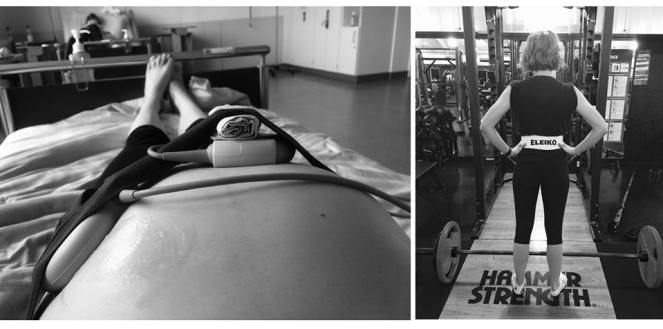
Left: Black and white photo of pregnant torso with monitoring equipment Right: Black and photo photo of the author in the gym standing in front of the bar

by Nanette Ryan

On July 20 of this year I gave birth to my beautiful, healthy baby boys, James and Alec.  My pregnancy was not easy.  The first three months saw lots of queasiness, naps, and trial and error with foods that I could stomach.  In the second trimester I was hit by a cyclist while walking and rushed to hospital, and in the third contractions started too early and so I was back in hospital for monitoring, bed rest, and treatment.  For 20 days I was almost constantly on an IV of anti-contraction medication, I had 5 blood tests a day, injections, CTGs sometimes three times a day, and frequent invasive exams.

After 20 days in hospital I was briefly taken off my current anti-contraction medication to make time to prepare for the next round.  My boys wasted no time, and in half an hour I was in full labour.  As I was wheeled into the delivery room, exhausted and in horrible pain, I said to the midwives ‘I need something! Any thing!’  ‘What do you mean ‘you need something’?’ they said.  (I want a freakin’ stroll in the park, what do you think I mean!?).  ‘Something for the pain!’ I said.  ‘Drugs! I want the drugs!’  But there was no time, the babies were coming and I had to push.  And so I did.

As it was my first pregnancy I did a lot of reading and research leading up to the birth.  I practised breathing, did my kegels, and (naively) talked to other mums about what kind of birth I should ‘go for’.  The thing that prepared me most for giving birth, however, was something that none of the birthing books, conversations, or women’s health resources talked about.  It was weight training, and in particular, barbell squats and deadlifts.  Before I became pregnant weight training dominated my workouts, and I continued to weight train for as long as it was safe and comfortable when pregnant.

These exercises helped me in a number of ways.  Despite my extended stay in hospital, it gave me the physical strength to do what I needed to do.  It allowed me to trust my body, and it gave me the confidence to do it.  I had pushed my body, and so I was confident that I could push these kids out, like when you walk up to a squat rack with a higher weight than you’ve lifted before and think, ‘I’m going to fucking do this!’

Like so many things for women, the focus on women’s health and birth preparation is on the gentler side of things; focused breathing, gentle stretching, and light cardio.  Don’t get me wrong, these things have their virtues, including distracting women from what can be the horrors to come.  But birth, however you do it, is not gentle.  Women are not snowflakes, and the sooner we start emphasizing this the better.

Nanette Ryan is a PhD candidate in Philosophy at Georgetown University. She is primarily interested ethics, moral psychology, and feminist philosophy.

Image description: black and white photo of baby twin feet in rompers