competition · femalestrength · weight lifting

CFP: **Strong A(s) F(eminist): Power in Strength Sports**

**Strong A(s) F(eminist): Power in Strength Sports** 
Noelle Brigden, Melissa M. Forbis, and Katie Rose Hajtmanek are seeking contributors to an edited volume on strength sports.

“Despite sports being a powerful site of social control and resistance in most parts of the globe throughout modern history, they have too often been ignored by scholars. Situated within this context of ongoing political struggles, and building on a literature that explores the intersectional politics of embodied practice and physical culture, this edited volume takes up the importance of sport, and analyzes the unique potential of strength sports as a site of gender contestation to the existing order.

Recognizing the importance of this radical understanding of empowerment for the future of strength sports and its potential to disrupt white supremacist patriarchy, we welcome intersectional feminist analyses of gender in strength sports, beyond a singular focus on women’s participation. This volume defines strength sports as activities in which the competition outcomes depend exclusively on the individual capacity to move weight, including but not limited to: functional fitness training, powerlifting, weightlifting, kettlebells, strongman/woman, highland games, and historic feats of strength.”

aging · competition · fit at mid-life · running · training

The Half Marathon I’m Dreading

One month ago, I signed up for the Shape Half Marathon in New York on April 14. I haven’t run a regular road half-marathon in about a decade. I do still participate in the occasional trail running event, but some years ago I decided that I’d run enough road races. To compound my dread going in, I knew I wasn’t even going to be able to start training until March 14th(literally only 30 days before the race). Sure, I would be cross-country skiing for the weeks before then, so not out of shape, but certainly not in running form. I only signed up because a friend asked me to. The race is on her birthday, so … Before I could second guess myself, I registered.

Well, I’m remembering why I don’t do road races anymore. My head. My head. My head. I know I’ll be slower than my last half-marathon, yet I don’t want to know. I’m aging. I didn’t start running seriously until I was in my late 20s. It took me a while to find my strength. Which means that I had the good feeling of beating my younger self until I was well into my forties. Not so anymore.  A lot of days I don’t think anything of my generally slower pace. When I’m not training for a race, I’m able to think: How lucky am I to still be running? How good does it feel to travel on my own two legs? How strong am I? But these days, when I’m out for a training run, I think: Why am I so slow? Why am I so tired? Where’s my spring? Where’s my lightness? My zip? 

Pile of old wooden wall clocks, by Jon Tyson on Unsplash

The looming race screws with my sense of self-worth. My mind turns on me and I can’t access my gratitude. Sigh. There’s no joy in the training. Thank you, Sam, for pointing out earlier this week thatwe are not always going to have fun in our workouts. Though I want, as Tracy pointed out, to have some kid-like funwith my body. I am not having fun with this training. I’m having frustration and self-recrimination instead. 

Also, I did not ease into my training. I decided that with only a month to train, I’d start with a 14-mile run. You don’t need to tell me how ridiculous that was. Plus, I wore not just new running shoes, but a new kind of running shoe I’d not tried before. So smart. Turns out the new shoe style did something nasty to my calf, which has taken a full two weeks to almost heal. Two weeks during which I continued to run haphazardly, because how could I not do at least four 2-hour runs before the race? More like 2-hour lopsided slogs through a haze of discomfort. Last week I was only able to run once after my long run, because my body was in pain and exhausted. And I’m not even sure that my “long” run was actually a long distance, because I was in Illinois, running somewhere unfamiliar, and I don’t track distances. All I know is that I was running for more than 2 hours; who knows how far or not far. 

You get the picture. I’ve done a lot wrong to prepare for this race. I might have done better to rest for the full month and then run on the day in my old, familiar running shoes. Am I self-obstructing so I have an excuse (other than time and years) for a poor result? And by “poor” I just mean relative to my own past results.

I’m writing this with 10 days to go before the race. Here’s where I’m at: I know I can run 13.1 miles. That’s not the challenge. The real obstacle is my thinking. I’m competing with my younger self and that’s a losing battle. I need to make the mind shift. As one of the guided meditations I often listen to asks, “If I am not this body, who am I?” Or, I could just keep being disappointed in my physical self for the whole rest of my life (!). But that doesn’t seem like a wise choice. I know that how I think and what I think are choices. That’s step one. Step two is actually implementing that knowledge. 

So hard. Working on it! 

Anyone else slowing down? I’d love your thoughts and insights on how you’ve come to peace with the new normal.  

competition · cycling

Undeniably Young

“In 1936, NORA YOUNG, a 19-year-old force of nature and multi-sport athlete, breaks into the wacky world of Six-Day biking in a historic women’s race. Will she win the race and change history?”

The plan is to make a short, animated film about Nora Young, Canadian cyclist, force of nature, and athletic pioneer.

The film maker Julia Morgan writes, “When I first met Nora, I knew right away there was something special about her. And as I got to know her more, I discovered that not only was she a force of nature with an incredible love of life, but she also had been a TOP athlete, in many sports, during something I’d never heard of – the Golden Age of Women’s Sports (1920s and 30s) in North America – of which Nora was an extremely important example. And then when my team and I began filming Nora – she was 95 – I was wowed by the sheer number of her amazing, historically significant athletic achievements, particularly in cycling, her favourite sport. She was one of Canada’s most important early female competitive cyclists – if not the most important. “

You can support the film project here.

And read more about it here: Toronto Star: Toronto’s audacious ‘girl cyclist’ left riders — and stereotypes — in the dust


NORA YOUNG, 1936, AGE 19

Public Domain. Credit: Estate of Nora Young/UndeniablyYoung.ca

competition · eating · food

Competitive Eating: Is Excelling at This Good for Women? Good for Anyone? #tbt

We are in the middle of a deep freeze here and I’m drawn to this past post to totally take my mind off of it. Here, I considered the case of competitive eating and whether it’s something we should be impressed with.

I confess that I love the idea that this 120 pound woman can scarf down a 72 ounce steak and all the accompaniments in record-breaking time because it challenges stereotypes. It’s also fascinating (that’s the best word i can come up with) to watch her in action.

But my thoughts about competitive eating haven’t really changed. Of the various things we can aim to be good at, shoving down as much food as we can in as little time as possible doesn’t seem like the most worthy of pursuits. And could even be dangerous and is almost certainly bad for one’s health. Nevertheless, here you are. Draw your own conclusion. And Go, Molly!

competition · Fear · fitness · racing · Rowing

Maybe I’m not actually in it to win it

Have you ever believed a thing about yourself, just fervently believed and adamantly defended it, and then one day you’ve woken up and realized that perhaps what you’ve believed and defended has… changed? Or perhaps was never quite true – not in the way you had imagined, anyway – in the first place?

The-Race-Poem-Children-Race-To-Win

An image of six boys running on a school track; it looks like nearly the end of the race. The boy in the foreground is racing to win; the image is in sepia tone. What does this have to do with my post? Read on.

This story begins back in spring, when I hopped back into the scull at Leander, my new boat club in Hamilton, Ontario, full of keen interest. My bum was not even on the slide yet when I realized that the women I was now training with were experienced, serious, committed, and out to win.

Not that they are not completely amazing humans, balanced and sane and gorgeous, and not that they are not fun, or out to have fun. They are all these things too. And, OF COURSE, not that there is anything whatsoever wrong with wanting to race to win. On the contrary: I love winning. I LOVE WINNING!

Or so I thought.

Rowing with these women started to freak me out pretty much immediately. I was painfully aware that, while I’m strong as hell, my technique in a scull is not honed enough yet to be easy or natural; this is another way of saying that I kept yanking our boats off course because I’m strong enough physically, but still weak enough technically, to be something of a liability. I was hugely embarrassed about this from the get-go, because I knew these women needed an able and consistent teammate. I wanted to be that teammate. I did.

Or I thought I did.

I told myself: I’ll improve over the summer. It will come in time. There’s time! Training consistently will help! I will do the training required.

Then summer rose high, and I had (as usual) lots of work travel. (This is why I rowed much more casually back in London, Ontario, with my delightful and equally casual and fun teammate Jen. For us, the water was pure joy. PURE JOY. More on this later.)

So: despite my best self-talk, I got out to Leander’s regular masters practices much less over the summer months than I’d hoped. Or that I had told myself I had hoped, anyway.

I wasn’t in the boat enough to be improving, and I realized that; I chose not to sign up for regattas in the expectation that I would not be ready.

It all seemed sensible and logical enough in my head: just not quite ready, not yet.

After a while, and a chat with Cate, it dawned on me that something else might be going on – other than me being super busy.

My-Big-Duh

A large “Duh!”. Because, Kim, come on. DUH.

I realized I might be finding lots of excuses not to go to rowing practice, because actually I was scared of going to practice.

I was scared of letting my teammates down. The pressure to improve was destroying the pleasure, the pure joy, rowing held for me.

When I thought about it more, as the summer passed, I realized that I actually hadn’t been all that busy, not really. Actually, I had chosen not to go to many practices, or sign up for regattas, because the thought of racing was making me crazy nervous. The idea of getting to the race was making me nervous. The idea of spending a day at the race was making me nervous. The idea of driving back from the race was making me nervous.

Not because I didn’t want to win a race; don’t be silly. I LOVE TO WIN. But because … well, I didn’t actually want to race.

I realized: I. Did. Not. Want. To. Race. Not like this, anyway. Not now, anyway. Maybe not… ever.

Surprise, self. Surprise.

Autumn arrived, and then my teaching schedule and family commitments meant I could only reasonably commit to one practice a week. And then family health problems arose and made me so tired, so exhausted from the thought of even trying to row, that I just emailed my head coach and stopped. I should have done this long before, of course, but finally I had an excuse that was legit. Or that I thought was legit. “Family crisis!” sounds so much better than “Really just not enjoying it!”

But the truth is, crisis or none, after I emailed Greg I felt immeasurably better, lighter.

I want to be clear here that I’m not suggesting that racing is bad – hells no! If it is your cuppa, please head straight for the starting line! I also want to be clear that I’ve thought a lot about the mixed and complex feelings I was having around rowing practice over the last few months, and I’ve concluded that the cloud of expectation I felt around me about racing was really, powerfully, hampering both my love of the sport (which is real) and my desire to be better at it (which is real, too). I started out telling myself that of course I was going to race, and of course I was going to commit to all the things in order to make that happen. No excuses! But it turns out that hyper-motivator of a phrase was the opposite of motivating for me.

Early in the autumn, the head of the women’s crew and I found ourselves in calm water in the double one Sunday morning. She knew I was struggling but I doubt she knew the depth – almost certainly not, since I had only just begun to admit it to myself. We started talking about the club, its culture, and then I asked her about the Rec program: was it super loosey-goosey and frustratingly disorganized like Rec rowing often can be?

No! She told me. She sang the praises of the coaches and the structure and the fun of it. She told me it was how she had gotten interested in racing, inspired to leap up to masters. I suddenly realized that maybe I could grasp again the joy and fun of the learning that goes into rowing by dropping down to a low-pressure, no-stakes, but still structured and technically focused environment next season. Maybe I could actually develop a true, heart-felt, joy-filled desire to race one day.

Soon, we spotted a heron on the shore and stopped hard for a look. We commiserated about the heat building and the sweat beginning to ripple on our arms. Greg came by in the coach boat to chat about his new super-wicking shorts; we had a laugh and took away a pro sartorial tip. And I remembered the pleasures I take from the boat, when the pressure to perform eases off.

2207933758

A young woman half-sit in her single scull along a lakeshore, looking into a cloud-filled, orange sunrise. She is wearing a white sport top, blue sport shorts, and looks to have her hair in a braid across her right shoulder. This is not me! But maybe, next season, it might be.

See you next season,

Kim*

*This will be my last regularly post for a while. That family health crisis I speak about above is actually, really, a crisis, and I’ll be turning my attention there for now. I hope to write again before too long, though. Thanks for reading.

competition · Fear · feminism

Running into my mojo

photo-1526398977052-654221a252b1
Mic on a floor stand in front of soft focus room full of people

I’m giving a talk in Nashville this weekend at HT Live! The topic is identity alignment and authenticity, so that has been much on my mind these last days. I wrote about it here. A topic like authenticity forces the speaker to confront her own inconsistencies (okay, even hypocrisies). As the talk gets closer, I think, “I’m a fraud.” I think, “I’m no expert.” My confidence starts to tank.


This is the moment when I remind myself of the manner in which men claim expertise in so many domains without a second thought. I recall interviewing Jane Blalock for my book, Run Like A Girl: How Strong Women Make Happy Lives. She’s a former golf pro who, among other things, offers golf clinics for women. She told me how women come to her to brush up on their golf game, because they are worried about a business-networking event. Only to discover, the men are not nearly as good golfers as they claim to be.

Lack of confidence plagues women from puberty. How Puberty Kills Girls’ Confidence, in a recent issue of The Atlantic, covers a range of studies that expose the inflection point, somewhere between 12 and 14-years old, when girls’ sense of self worth plummets. Interestingly, one of the things girls say is this, “I feel that if I acted like my true self that no one would like me.” 

Girls think that if they are authentic, then no one will like them. No wonder I’m having confidence issues around this speaking topic! It’s a double whammy. Because, as The Atlantic points out, once girls’ confidence gets killed off, it often never rebounds back to the same level as boys’ and men’s. I remember my father once saying to me that he didn’t understand why I wasn’t more confident. He told me that his memories of me as a child were of a happy, outgoing, even brash little girl. He was right. And he had missed the moment that went south.

Lest I get the idea that at least things have gotten better for girls than in my day, there’s social media to thwart progress. As the article points out: There’s no distance anymore—only constant, instant, and public condemnation or praise.

What to do? I go to my Tuesday morning aerial Pilates class and I don’t give up on the push-ups-in-plank series as I usually do. I go for a run Thursday morning and push a little harder than usual. I literally recoup my confidence through the strength of my own body. I run into my mojo. As if it’s somewhere out there, ahead of me and I just need to catch up to my own confidence, my own better self.

photo-1517036391698-b004444390fe
Lioness head

The Atlantic article says this: Some of the most compelling data links participation in sports to professional success. A study from the accounting firm EY and espnW, ESPN’s women’s site, found that 94 percent of the women currently with C-suite jobs in the U.S. played competitive sports. It’s not only through athletics that young girls can gain confidence; sport is simply an organized and easily available opportunity to experience loss, failure, and resilience.

I never played competitive team sports and I came late to competing in running races and triathlons and cross-country ski marathons and such. But even my belated participation has been a boon in my life.

I know. Sports aren’t enough. And sometimes our sports aren’t available, because we’re injured. I’ve been there, many times! But when we have sports in our toolbox of confidence-builders, what a loyal friend. Getting red in the face resets my perspective. Sweat exhales bad energy. And those endorphins are an excellent, non-prescription, chemical pick-me-up.

Do I feel 100% go-get-em about my talk now? Not quite. But I’m focusing on the final preparation now, instead of my right to be at the front of the room. I belong there.

Uh oh, I’m backsliding. Even writing those last couple of sentences and stating my self-worth feels nerve wracking.

photo-1512242712282-774a8bc0d9d3
Neon sign with red lettering: I AM BOLD


Do you have these crises of confidence? How do we pitch in to make things better for girls?

charity · competition · running

Mudmoiselle 2018 (Guest Post)

Biopsy. It’s not a great word. The first time I heard it directed at me was six weeks after a reprehensibly bad gynecological procedure done by a horrible male doctor. I had always believed doctors infallible. This guy changed my mind. And so, after refusing to return to him when the going got awful, my new doctor requested the biopsy. In contrast to the previous fellow, she was lovely. The biopsy, on the other hand, not so much.

Out of an abundance of caution, we proceeded with treatment as if the results came back positive. A week later, when the results returned inconclusive, I was glad we had. It took another six months before we could repeat the biopsy. Mercifully, it came back negative. There are certain moments in life when you realise you haven’t been exhaling properly. That day was one of them.

I was fortunate that my results came back as they did. I’ve known too many others for whom things turned out differently. I won’t pretend I have the eloquence to capture the toll cancer has taken on the people in my life. It’s a nasty, pernicious, destructive thing.

For me, six months wondering gave me time to think and time to prioritise. I walked away from the experience knowing that I would do my best not to take my health for granted again. I was also determined to be a better advocate for my own self-care…and to punch cancer in the face every chance I got.

Mudmoiselle Guelph was an opportunity I fanatically embraced. The event, run by the Canadian Cancer Society, is held annually at Cox Creek Cellars just to the north of the city of Guelph. It is a 5km obstacle course designed for the moderate to advanced athlete. (They recommend you train for at least six weeks in advance.) The event does allow Mudmonsieurs, by the way, though anecdotally, I’d say most of this year’s 500 participants were women.

41897064_2168570783408862_4031679650362032128_n.jpg

(Image of me covered in mud wearing a Mudmoiselle medal.)

My team of five intrepid Mudmoisellers called ourselves “The Flailings.” Our team slogan: “Let’s get ready to FLAIL!” None of us had participated in the event before, so we figured t-shirts would be handy to help us pick each other out in the crowd. Obviously, a flailing air dancer was a perfect mascot. (Even if it did end up looking like a weird, ghost-like creature according to my five-year-old.)

41423514_276472159744655_8480139431024525312_n.jpg

(Snapshot of the back of our team t-shirt with the words “The Flailings” and “Mudmoiselle, Sept 15, 2018.” A neon green flailing arm dancer is the centre image.)

Our team was a part of a mid-day heat. The organisers had us begin by reciting the “Mudmoiselle oath,” a moment of sobriety that, I fear, only heightened my team’s sense of giddiness at the ridiculousness of five grown women running around a vineyard in the scorching heat. I don’t honestly remember many of the obstacles that we ran through, though some are etched in my mind forever. First among them, the second obstacle, which was true to the event name.

This memorable obstacle was nothing less than a giant pit of fenced in, man-made, oozing mud. I suppose I give Mudmoiselle credit for putting it so close to the beginning, because if you’re going to get muddy, you had better get to it sooner rather than later. And, of course, the only way to get to the other side was to crawl through the goo. By mid-day, participants had established two parallel ruts, one on the left-hand side of the pit and one on the right. I looked at my team members beside me. We cheered a good cheer. And then I made the only possible decision: go down the middle.

Throughout the remainder of the two-hour experience, we launched ourselves over hay bales, scaled muddy inclines, walked through bogs (while, obviously, singing “Stand By Me” and praying for a lack of leeches), and swung from tires. By the end of it all, I had rope burns, ripped knees, purpling bruises, and exhausted triceps. I also had a blast. I do not remember the last time I cheered on strangers, particularly as they muscled themselves over questionably stable wooden walls. We were all there to help one another along, because goodness knows for many of the participants these obstacles were symbolic of so much more.

(I crouch on my hands and knees on top of a large hay bale.)

There is something unique about the sense of community that emerges out of a group of people dragging themselves through the mud together. At the end of it all, my team and I sat at a table, marvelled at our crusty, sore bodies, and shared stories of people we knew who were touched by this awful disease. We raised a glass to those we had lost.

On the car ride home, with multiple towels draped over my seat to protect the car, the children moaned about mommy’s awful smell. And all I could think was, yes my dears, that’s the smell of being alive…and bog water. Actually, it’s mostly bog water.

(I walk sideways along a wobbly wooden plank while holding on to a guide wire.)

Kimberly Francis is Acting Associate Dean of Research and Graduate Studies at the University of Guelph, where she is also an Associate Professor of Music and a passionate feminist musicologist. She’s not ashamed to say that Taylor Swift, Guster, and many, many tracks from Big Shiny Tunes can all be found on her workout playlist.

competition · fitness

Wow. Just wow. Sam watches Canadian women’s records being broken.

Sunday afternoon Sarah, my son Gavin, and I stopped by the Fergus Highland Games Festival.

Lots of the competitions are new to me. Tug of war is familiar, of course. But I was glad to realize, after my second or third time hearing it, that this competition was “sheaf tossing” not “sheep tossing.”

We really just wandered in to see what it was all about, hoping to catch some of the women’s competitions.

And we lucked out. We got to see Sultana Frizell, set the new women’s Canadian record in light weight for distance. The record is now 85 feet, 2.5 inches.

Later this amazing athlete set another record in the hammer throw.

I loved watching the different shapes and sizes of the competitors and seeing all of their different techniques too.

I don’t have a photo from the events yesterday but here is Sultana at the Commonwealth Games.

Photo from http://m.zimbio.com/photos/Sultana+Frizell/20th+Commonwealth+Games+Athletics/v0dWPHr0koN

Just as rugby and roller derby and power lifting are on my list of sports I wish I’d tried, so too are the lifting and throwing competitions associated with the Highland Games. This blog’s Sandi does it and I love hearing her talk about it.

It’s also a lot of fun to watch. I recommend it!

Here’s Sultana talking about the stigma of being a woman who throws heavy things. She laments not being seen as an athlete but rather looked at through the lens of normative femininity. People are often commenting not on her throws but on, given her size and strength, how remarkable it is that she looks like a girl/woman.

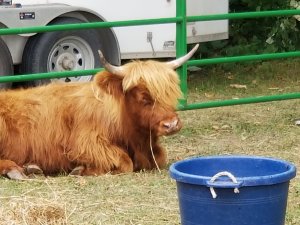
After we watched the women’s competitions on Sunday we also wandered over to see the animals on display.

They look a little overheated. We were too.

boats · competition

Sam and Sarah’s first night of snipe racing!

Amid all the moving, new job busyness, and dealing with my busted knee, I’ve also taken up Snipe racing. See Sam tries something new: Snipe Racing

The snipe is a small, two person boat and there’s a healthy racing fleet of them up at Guelph Lake. Jeff’s been teaching Sarah and me how to sail and race the Snipe over the past month or so and Tuesday night we got to make our debut. There was no Jeff. He’s off on his big boat and you can read about his adventures here on his own blog.

How’d we make out?

We didn’t die, capsize, crash into any other boats, or drown.

We (mostly) successfully rigged the boat.

We got the boat into the water, and ourselves into the boat, and vice versa at the end. As with rowing there are times when this feels like the trickiest part of the whole thing.

We made all of the mark roundings.

The winds were tricky. It was great that it was neither dead calm nor blowing all the boats over but the winds were really shifty. Because the weather was unsettled we were happy to see that there were only a dozen or so boats out. Sometimes there can be twice that number and it gets a bit hairy at the start. In the end, it rained but only for about ten minutes. We got damp but not soaking wet.

From my point of view, we safely followed the fleet around the course at a respectful distance. In our last race we nearly came second last but the other boat got by us on the final run up to the finish. It was a confidence building experience. It was fun and we’ll definitely do it again.

Sarah had the much harder job of skippering. I was just crew. But we’re learning to work together, to communicate better, and next time we’re hoping to mess it up with the boats at the back of the pack. It’s good to have something that’s new, with a lot to learn, to distract me from all the things I’m not doing this summer because I can’t.


https://www.youtube.com/watch?time_continue=7&v=HdgeuHOT7CY

competition · fitness · Guest Post · racing · running

Compare and Despair: Help, I’m so cliché, why do I keep doing it? (Guest Post)

Do you have a particular someone in your life with whom you compete or whom you envy? For me, it’s my partner. Not surprising. We are most likely to compare ourselves to those closest to us. Love and envy are flip sides of the same coin. In my case, the bar is high. My partner is super smart, engaging and well-liked, successful in his work and (this is the part I’m going to get into in a moment) he’s physically gifted. That’s why I love him. That’s why he is a source of more frustration than I ought to admit.

I train harder and faster than he does and when we get to the starting line of an event, some inner switch flips and he often performs better than me. I should also add, he’s eleven years older than I am. WTF? Well That’s Fantastic, as a 9-year old friend of mine says.

Back in May it was the North Face Endurance trail half-marathon event near Bear Mountain in New York. At mile 8, he breezed past me. My mind switched to Radio Self-Laceration; the volume at level 11. Life is too unfair. Why do men have it so much easier in the world? Why do I try at all? What’s the point of even training? I’ll never be good enough. And so on. I pulled myself together enough by the finish line, so that I didn’t melt down (as I’m embarrassed to say I have done in the past, and, okay, in the past month on a run with several much younger mountain goats, who had the same starting line motivational effect on my partner).

My partner has pointed out that my competitive streak means I’m rooting against him. I want him to be slower than me, so that I can feel good. True. I’ve tried nuancing. I want us both to do the best we can, but my best be better. This line of logical reasoning is not a credit to me. Being competitive is not a bad thing, as Sam and Tracy point out in their book. But it’s not so healthy, when I can’t respond with the same aplomb whether I win or lose, following tennis great Chris Evert’s counsel.

This past weekend, we did another long running event. The Sierra Crest 30k –technical mountain trails; at altitude; and lots of climbing. For the week before the run, I was in mental prep mode. Counseling myself to just let it go. Let go of my competitive desire to do better. Let go of my idea of fairness. Let go of my tendency toward self-sabotage.

Easier said than done.

Race day. The smoke from California forest fires is the worst it’s ever been (some volunteers at aid stations are wearing face masks). My partner gives me a hug and kiss before we start. I press play and start listening to Krista Tippett podcasts, something I’ve never done before during an event. Off I go, ahead. After a few miles, David passes me. Off he goes, leaving me in the dust. I will not fall apart. I will not fall apart. I’m listening to a podcast about love in politics. I see my partner far ahead of me up a hill. I am overwhelmed by the small heartedness of my competitive streak. How can I not just be proud of his strength? I want to catch up to him, so I can say, “Have a great race. You’re amazing!” But he’s too far away. I feel lighter. Like maybe I’ve let go.

At the first aid station, I see that he’s refilling his camelback. I was never planning to refill, so I keep going. Besides, I always worry that if I stop, I won’t be able to start again. A couple of miles later, on the steepest downhill switchbacks, he waves to me from one switchback above me. He’s so cheerful. I’m already pretty spent. I use his imminence as incentive to keep going. Not because I want to beat him anymore. I’ve accepted that’s not possible and it’s fine. I just want to do my own best time.

Two more grueling hours pass on the trails. Mostly I’m alone. Three men pass me. None of them are my partner. I pass two of the men back. I catch a woman. We chat about the smoke. She unearths some new zest and takes off with one of the men who passed me. I never see either of them again until post finish line. I listen to interviews with Cory Booker, a US Senator I’ve long admired; with Robin Wall Kimmerer, a botanist whose specialty is moss; with Luis Alberto Urrea, a writer and poet; and with the great cellist, Yo-Yo Ma.

I finish in 3:53. I’m second in my age group (same as at the North Face run) and 10th among women. My partner finishes 8 minutes later.

How do I feel? Relieved. Surprised. Pleased. Competitive. Displeased with my competitiveness. Uncertain about whether I actually let go.

When it comes to my partner, finding the balance between my competitive spirit and the ability to let go of an outcome is as challenging as the rockiest, tree-rooted trails.

Please tell me I’m not alone in this. How do others solve for this balance?

Summit of Castle Peak on a training run

Mina Samuels is a writer, performer, fableog-ist, citizen, traveler, enthusiast and author of Run Like a Girl: How Strong Women Make Happy Lives and other books.