I loved all the snow and the sun and the smiling faces.
We’re going into this winter knowing it’s going to be hard. And I find regular falls challenging. See here and here and here. Oh, and here! It’s a bit of a theme on the blog and in my life. Lol
The reporting about winter in the time of COVID-19 is gloomy and hard to read.
See A Canadian coronavirus winter is looming — and it could ‘amplify loneliness’: “But winter is coming and, according to experts, so too is the accompanying seasonal woes. And this time, it will be “amplified” by the confines of the coronavirus, according to Roger McIntyre, a psychiatrist and professor at the University of Toronto. An epidemic of loneliness long preceded this pandemic. And just by the nature of winter, people are less likely to come in contact with others. It’s a realistic concern.”
Since March, Canadians have been told to stay apart to stop the spread of the virus. The ability to be outdoors has provided safer alternatives to exercise, recreation, commuting and dining, among other things. In the winter, those options will dwindle. Experts have warned the risk of transmission also increases indoors.”
So what’s my plan? Because it’s clear that I am going to need a plan. I’m trying to remind myself of all the things I like about winter. I’m fending off anticipatory sadness with thoughts of snow biking and winter camping.
So far my plan has four parts but the fourth is still a bit sketchy and needs the details filling in. There’s time.
First, more time outside, including winter riding.
Second, I’m bringing home my SAD lamp from my university office and I’m going to use it in my home office.
Third, I’m following Catherine’s advice and getting a small warming fireplace for my deck so I can visit with friends outside even during Canadian winter.
Fourth, I used to joke about Canadians who went south in the winter. The truth is though between riding in Florida, Arizona, and North Carolina for the past number of years (I’m not even going to check to see how many!) I’ve become one of those people. It’s only ever been for a week at a time but this year that won’t happen at all. I’ve already booked some time in a yurt for winter outdoor sports. And I’m still scheming about what else I might do.
Suggestions welcome!
How about you? Are you in a northern climate heading into what looks like a long, lonely winter? How do you plan to keep body and spirit moving?
Canoe filled with stuff in the foreground. Sam and Mallory swimming in the background.
My last time out in my canoe, Sarah and I had a big adventure. YMMV, of course, but it was plenty adventurous for me. Each day we packed up camp and paddled to a new location. We paddled down rivers, over beaver dams, and did some long (muddy, hilly) portages. It was extra challenging because Sarah carried most of the stuff and the canoe and I did it with my knee that’s now just waiting to be replaced. I carried the food for six days and five nights. We slept in a teeny tiny ultralight tent. It was fun but it wasn’t exactly restful.
Next year, now we know we can carry all that food, I’m lobbying for a rest day in the middle!
Luckily our next canoe trip, just two weeks later, was of the more low key variety.
Sarah, Sam, and Mallory
This past weekend Sarah, my daughter Mallory, and I paddled to just one place after a couple of short, reasonable portages. We made camp on Ralph Bice Lake where we paddled some more just because, played cards, read books, ate yummy food including the traditional s’mores for dessert, and because Mallory was along, swam lots. We took the big tent and actual camping dishes. No more using the pot lid as a plate and sharing a titanium spork! We even packed some books and our Kindles.
Eleanor Oliphant is Completely Fine
It was the kind of trip that had room for basking on rocks and reading whole novels, I really enjoyed Eleanor Oliphant is Completely Fine. Thanks Meg for recommending!
Here’s some more photos of our canoe and our tents.
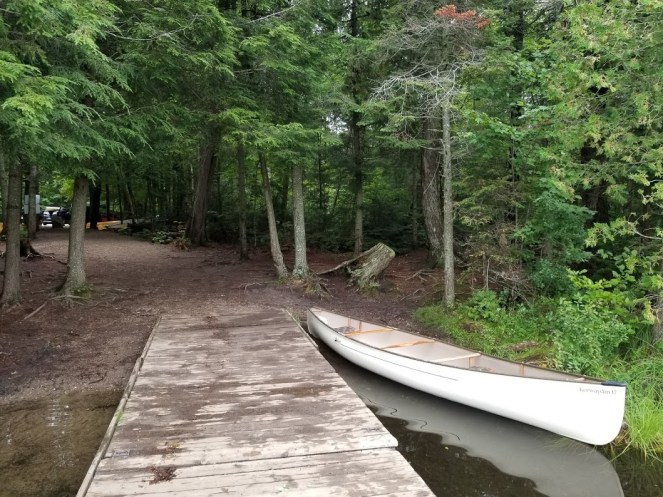
Canoe in snug harbour
Our luxurious tent
Mallory’s hammock tent
Here’s the card playing. Mallory won, of course. She almost always does but we enjoy playing anyway.
Mallory playing cards on a rock
Wizard cards on a rock
And there was a lot of swimming!
Mother and daughter swimming
Happy swimming!
We’re talking lots these days about various ways of getting ready for the long hard winter we expect is ahead.
Cate wrote recently, “August is made for this kind of elastic time, this kind of intuitive listening, this moving for play and exploration, not repetition and discipline. Looking into the fall and winter we’re expecting, I ponder how to keep this elasticity alive. How to keep nurturing this kind of active emptiness. What about you? What are you finding restorative right now? How are you planning for fall?”
Time outdoors, with loved ones, swimming and reading and playing, is part of my answer. For me this year is a bad combo of empty nest and Covid-19. I had imagined more family dinners and visits but it isn’t always possible.
This weekend felt important. Martha wrote about finding her happy place. Salt Spring Island seems like it’s definitely Cate’s happy place. This is mine. I’m back at my desk today with a bit of sun on my face, some bug bites on my calves, new muscles from paddling, and feeling just a little bit better about what’s ahead this year.
In most ways, this year, the year of the COVID-19 pandemic, has been for me a year of doing less. I’m riding my bike outside now but no big distances. There’s (obviously) no big summer travel. Normally my summers involve academic conference travel, usually in Europe, with vacation tacked on to the beginning or end. Not this year. In 2020 my holidays have been low-key, close to home.
The year of doing less has had one notable exception: Our big Algonquin canoe tripping adventure. I love Algonquin Park. It’s so beautiful and so close to home for me. Yet, in busier years I’ve only had time to go for long weekends. This year is the opportunity to do more.
Since my canoe came into my life in 2015 (thanks Jeff!) what I’ve done are back country canoe trips where you paddle to a place, make camp, stay there for a few days, and paddle around some minus all the gear. Lots of us here at the blog do this kind of adventuring. You can read all the canoe stories here.
Susan has done some longer trips. Sarah too. They’ve done the kind of trips where you start out a place and keep moving to a new campsite each day, eventually ending back up where you started. That’s a new adventure for me.
But I wasn’t sure I could, physically speaking. I was worried about my knee. I was worried about carrying stuff through long portages.
Two things made it possible. First, Sarah’s careful planning (see below). Second, her acquisition last year, when we were talking about hiking and camping, of ultralight weight camping gear. Thanks Sarah!
Here’s what we did:
Day 1
Canoe on the roof of Sarah’s car
Sarah and wooden bear outside Kearney Office
Sam and wooden bears outside Kearney Office
In our usual fashion where work never seems to end or stop, we worked until the last possible second on Monday, piled everything into the car, zoomed north, and arrived at the park office in a bit of a rush. Friends who know us will laugh at this bit of the story. We even stopped several times on the access road to Lake Magnetawan for the final few bars of cell phone signal.
And then we parked, unloaded the car, and loaded up the canoe.
Our canoe awaits!!
That’s all we took! For 6 days!
We paddled through Magnetawan then Hambone, and then made camp on Ralph Bice.
Day 2
We paddled and portaged our way from Ralph Bice to Little Trout and Queer Lake where we stayed for the night.
Even in the woods, gender is the universal sign for toilet.
Canoe settled in
Sam on a lovely wide portage
Canoe waiting
Trees!
Ready to paddle again
Day 3
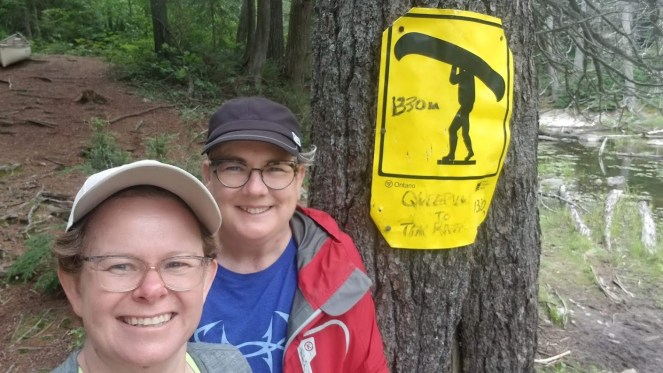
This was the first big day, with long portages. 1330 m isn’t that long but it is when you are carrying a lot of stuff! Also, it feels long when there are big hills, ankle deep mud, and narrow paths. But paddling on the Tim River was fun. I got to learn about steering in a downstream current. Less fun was arriving on Shah, our stopping point just as a storm was brewing. We had a bumpy trip across the lake and rejected the first campsite as too grown over. Luckily we got the tarp up fast and stayed dry through dinner.
Portage #1 of the day, still smiling
Sarah carrying the canoe
We wore our PFDs on the river
Portage #2
Stormy night
Portage path
More portage paths
More portage pathways
Day 4
We paddled from Shah to Misty to Little Misty, where we were the only campsite on the lake.
Pretty lake
Sam basking on a rock
Marshes
Day 5
We paddled from Little Misty to Daisy via the Petawawa River with portages to bypass rapids. There was also some scrambling over beaver dams with the canoe.
Trees and rocks and water
The river from above
Sam paddling
Day 6
No photos because my phone ran out of charge but we paddled from Daisy to Hambone to Magnetawan. We were very happy to have left clean clothes in the car for the trip home.
What did I learn on this trip? Here’s six things.
That even with my miserable, painful, stiff knee I can do trips like this and enjoy myself. I babied my knee. I took ibuprofen. I stretched. I walked carefully and slowly on the portages. Some mornings I’d wake up and think, “wow, this is it, they’re going to have to air ambulance me out of here” and then I’d stretch and walk around a bit. And then I was fine. Deep breaths, Samantha, you’ve got this. And I did.
2. Paddling on the river–which requires active involvement of the person in the bow–takes skill but it’s fun. I like learning new things. Even when things go wrong–like when we landed in the shrubbery on the side of the river–the worse thing that happened is we got covered in yellow furry caterpillars. Navigating the beaver dams also took skill and effort but in the end it was all pretty low stakes. When I messed up one beaver dam the current just took us back and we tried again.
3. Lightweight camping gear–if you can afford it–is an amazing thing. I was shocked at how little the tent and the sleeping bag etc weighed. We had very lightweight gear even down to the titanium spork!
4. The weather spanned from too hot to brrrr! (at night) and I should have brought a warmer layer and possibly even (no joke) gloves. I always forget that about camping in Algonquin.
5. I was concerned about food and about carrying six days of food but we did well. I learned that a warm meal at night goes a long way and that even mac and cheese over the camp stove tasted pretty good.
6. If I were doing it again, I’d book a day off in the middle, a rest day, where we’d stay on one campsite two nights and maybe even bring a book!
Next up? I’m looking at route maps and planning for next year. Now I know we can do this I’m going to do it again. In light of the great squirrel attack on our food bag on the last night, I’m considering more secure food storage and a good pack for me to carry it all in.
Sarahon planning
This year’s planning was made more challenging by the fact that Algonquin was as busy as I’ve ever seen it. Lots of folks spending summer vacations in a tent instead of a cottage. When selecting a route between the few available sites, I used a few rules of thumb. Wanting to have lots of time to rest and explore, I limited the distance traveled to about 5 km on the map each day, and a maximum of 2,000m of portaging. Of course the actual distance paddled would be more than that – we move through the water at about 4 km/h – but there’s a fair bit of time spent wandering toward pretty rocks or out of the wind, stopping mid-lake to pump water, paddling from site to site looking for one that’s free to camp on, etc. It also takes time to get in and out of the canoe at each portage.
In order to reduce the strain on Sam’s knee, we decided that she would carry only her clothes and the food pack (which is not too heavy and gets lighter as we go) for the portages, along with our water bottles, paddles, and PFDs. This meant being minimalist in our packing to bring down the weight of the “house” pack (including my clothes) to a manageable 32 lbs (14.5 kg). When combined with 48 lbs of canoe, this comes in right at the 80 lbs (36 kg) maximum weight this “weekend warrior” can safely carry in the backcountry. We made choices like : a tiny, lightweight backpacking tent; a down quilt instead of sleeping bags; one set of clothes (plus warm and waterproof layers), using pot lids as plates. We also needed to be minimalist in our food, bringing only enough dry, lightweight calories to keep us going, and enough sweet snacks that it still felt like vacation. And two full Ziploc sandwich bags of coffee, because there are some things that one cannot do without!
What did Sarah learn on this trip?
I’ve done nearly all parts of this year’s trip in previous years, so the things I learned this time were largely around food:
Naptha fuel to cook breakfast and supper for 2 people = 200 mL per day
One serving of oatmeal or pancake mix = 125 mL (1/2 cup)
One serving of maple syrup for oatmeal or pancakes = 50 mL (even if we have more, we don’t actually use it!)
Unless it’s a rest day or half day, budget for both lunch (sandwich) and a protein bar.
We don’t actually eat salty protein snacks like nuts or trail mix except buried in other meals. Better to bring more protein bars and peanut M&Ms.
Double check not only the count of meals but also the meal type. We were somehow short one breakfast but had an extra dinner(?!)
Oh, one more thing we learned, the sleeping quilt is toasty down to 6 C. But it works best if no one steals the covers!
My Facebook status from Sunday night reads, “Driving home, with a heart full of memories of a special place, canoe strapped to roof of the car, listening to Tragically Hip. #PeakCanadian#Killarney “
There’s something special about back country camping in the autumn. Yes, it can be cold. And it’s dark early and that restricts how much you can paddle. But the colours are spectacular. The parks are less crowded. I also find there’s something extra special (and maybe I confess, just a little bit sad) about that last gasp of outdoors holidays. Though I am trying to tell new stories these days, I’m a person who finds the fall just a little bit sad. Paddling helps, so too does sleeping in a tent under the stars.
I went canoe camping thirteen years ago in the fall with my friend Laura: Camp Dragon with Laura 2006 . That was even later in the season, mid October, definitely cold and dark but bright with the orange, yellow, and red leaves.
I got my own canoe for back country exploring and camping four years ago. But lately other boats have been taking up my time. I know “too many boats” isn’t really a thing to complain about but I have been missing my canoe. Last year I didn’t get out canoe camping at all. We had booked a Killarney trip but that fell through for complicated reasons. See Jeff’s series of posts on running aground. We got a day trip in but that was it. I was worried this year was going to be the same. This year we’ve been racing the Snipe on Guelph lake. And I’ve also been visiting the big sailboat some weekends too. But no canoe trips in June, July or August.
All summer I’ve been looking forward to getting out in the canoe and it finally happened this past weekend. It was a quick trip but that’s okay. It was beautiful and restful and I’d go back in a heart beat. I mentioned the fall colours, right? So beautiful. Bright red leaves against the white rocks look extra special.
What else to tell you? I got to try my very first lift-over. That’s when you run into a beaver dam with your canoe, get out, lift the canoe over the dam, and get back in again. I was nervous about it because of my bad knee and was worried about getting out the canoe in those circumstances. This was an ideal time to try since there was an alternative on the map, an extra long portage. But we did it. My knee behaved just fine. Thanks knee!
We also tried out some new lightweight gear which made it possible for us to do the portages in one trip. Sarah took one pack and the canoe. I carried the other, heavier pack that contained our food, as well as the PFDs and the paddles. We declared the new tent and sleeping pad a success and it gave us hope for longer trips even with more food. By the end we were feeling ready for bigger adventures even with my misbehaving left knee.
I was amused at all the bear signage in the park. I’m always surprised that people need reminding that there are bears in Canada. There were even signs warning us that the bears were back for the fall. I didn’t even know they went anywhere for the summer. In the end, we didn’t see any bears–phew!–but we did have a trio of trash pandas (aka, raccoons) hop up on the bench besides us and grab our food bag. They made off with all the food (except snacks) for the weekend. I screamed but Sarah, more sensibly, took off after them and got our food back. My hero!
Our trip involved three lakes–George, Killarney, and OSA–one pond, three portages, and one liftover, lots and lots of paddling. We were lucky with warm days and nights, highs in the low 20s and overnight lows still well in the double digits. The day we paddled out was very rainy and windy but we were just very happy that there was no thunder and lightening and we didn’t have to hunker down and stay put.
Here’s a lot of photos from our trip. Sarah brought a real camera so we took lots of pictures.
Those are the two questions people ask about the Friends for Life Bike Rally, usually in that order, the second following quickly the heels of the first.
Here’s my answer to the first: It was tough. For an excellent description of the nature of the kind of tough, read this from our team co-captain, known in the blogosphere though not on the bike as The Yarn Harlot.
Personally the riding on any one day wasn’t challenging. I regularly ride more than a 100 km in a day. And I’ve been riding long distances with groups for awhile. But the accumulation of those days is what makes it tough. Also, Day 2. It would have been tough on its own. Wind, rain, cold–not to mention starting wet and cold with very little sleep.
It was also really wonderful in ways I hadn’t expected. I really liked getting to know people over the course of the rally. I liked riding with different people on different days, some fast, some slow, some chatty, others not.
That’s the nice thing, you’re not doing it alone. There are almost as many crew as riders. They’re involved in planning and preparing food, transporting gear, setting up each new site, route management, road safety, bike fixing and more. Oh, and giving massages. Loved that. There’s a very strong team atmosphere that’s part of the bike rally. I thought our team co-captains did an amazing job.
I’m sure many of you have imagined what it might be like to do something like this. It’s staggering. The sweat, the tears, the exhaustion – camping in the rain, riding 660km, bathing in the lake… it is all balanced in the end with love, and generosity, and kindness. In these hours before we leave, it’s that love, and generosity and kindness that I want to write about. I know I’ve said it before, and I really mean this: Riding your bike to Montreal does nothing to help sick people. Nothing. You could do it a hundred times, and without the support of people like all of you who donated, it wouldn’t change one little thing about the world, or the way it can be for people who are suffering. It is what all of you have done – your generosity, that turns the action we’re all undertaking into real change. Real kindness. Real love.
My team raised note than $150,000. See here. The rally as a whole raised more than a million dollars. I’m happy to have chosen to mark my 50th birthday by contributing to this beautiful effort. I’m proud of, and thankful to, all the friends and family who sponsored my ride.
There were also some beautiful roads and terrific riding though gorgeous parts of the country. See photo below.
Could you do it?
Sure. Buy a bike if you don’t own one, start training now if cycling is new to you, and follow the spring training plan and you’ll be fine.
I actually think that most people could do the distances required by the rally. There are morning and afternoon breaks and people ride at a wide range of speeds.
Training well means you can ride faster, get to camp earlier, and feel strong the next day. I was happy with the effects of all the bike riding I’d done in advance. Most days I arrived at camp mid afternoon thinking I could have ridden a bit more, if need be. And I woke up each morning ready to ride again, not sore. (Again, I’m ignoring Day 2 the way people who’ve given birth choose not to dwell on the worst of it.)
Different people find different aspects of an event like this challenging, other than the riding. I love camping, think the indoors is overrated, and I own some pretty nice camping gear. 🙂 I sleep happily and well in a tent and when I’m tired noise doesn’t bother me much. But I got the sense that not everyone shared my love of the great outdoors.
One friend who did the rally in years past said he found the social demands challenging. It was too much like summer camp, he thought. I’m a nerdy professor and spent time alone with books quite happily and no one dragged me out of my tent.
Now another friend who loved that aspect of it said it was like the queer summer camp he never had as a kid. That made me smile. I’d say the sexual orientations of the rally participants, riders and crew, were all over the spectrum. If you’re curious there were quite a few opposite sexual couples. But it was a totally lovely experience for me, as a bisexual, to be in a place where the majority of people were gay and assumptions weren’t made about sexual orientation status.
I’m proud of succeeding at the physical challenge and proud to have been part of this event.
Oh, I also loved our triumphant arrival into Montreal. See the storify version here.
I’m very happy with my choice to mark my upcoming 50th birthday by riding in Friends for Life Bike Rally in support of the People with Aids.