body image · fitness

One question that leads to body love

Over the past couple of years, a psychology research article from 1997 has made its way into the popular press.  Its topic is an irresistible one:  36 questions to make you fall in love with someone.  Wow– now that’s what I call some powerful science…
Screen Shot 2016-02-21 at 8.10.38 AM

Seriously, though, the research is about how to foster closeness and intimacy and trust.  A New York Times article summarizes it below:

[The study asks whether] intimacy between two strangers can be accelerated by having them ask each other a specific series of personal questions. The 36 questions in the study are broken up into three sets, with each set intended to be more probing than the previous one.

The idea is that mutual vulnerability fosters closeness. To quote the study’s authors, “One key pattern associated with the development of a close relationship among peers is sustained, escalating, reciprocal, personal self-disclosure.” Allowing oneself to be vulnerable with another person can be exceedingly difficult, so this exercise forces the issue.

This idea has taken off; there are even apps for going through the 36 questions (too many to link to).  They’re mainly about disclosure and vulnerability, which is supposed to stimulate warmth and trust and closeness.

So of course I got the app and checked it out.

Screen Shot 2016-02-21 at 8.23.51 AM

(Note:  All of these “woman smiling while… fill in the blank… images are a good topic for another blog post sometime.)

One question really struck me:

19. If you knew that in one year you would die suddenly, would you change anything about the way you are now living? Why?

My first thought upon reading it was, “oh, I’d stop worrying about my weight”.

I’D STOP WORRYING ABOUT MY WEIGHT.

STOP. WORRYING. ABOUT. MY. WEIGHT.

Oh. Wow. That’s a thought, isn’t it?

My fuller answer to this question was along the lines of, “well, I’d want to spend more time with friends and family, ride my bike more, be active in the ways (old and new) that I like, work (a little), read, write.  And I would stop worrying about diets and body image and the fact that I have clothes in my closet I can’t wear and how I look in a bathing suit and how (not) fast I am on a bike.  And I’d forget about renovating my kitchen.”

Of course this question is silly and unrealistic, and I don’t think for minute that it has anything to do with how we would feel if any of us were in the position of knowing we were closer to death.  What it did do for me, though (and I was very surprised about it) was focus on a big burden I carry with me that I’d really like a reason to shed.

That big burden isn’t (or need not be) my actual weight.  It’s rather my feelings of guilt, fear, shame, anxiety, anger, self-hate, romanticism, idealism, etc. about what my body is and could be in some other possible world (not this one).

In this world, my body cycles, paddles, swims, does errands, cooks food for others, thinks interesting or frivolous thoughts, gives hugs to friends and family, pets all dogs, dresses up in bright colored clothing, cries when it’s sad or very happy, and creates blog posts (among other things).  That’s pretty awesome, once I think about it.

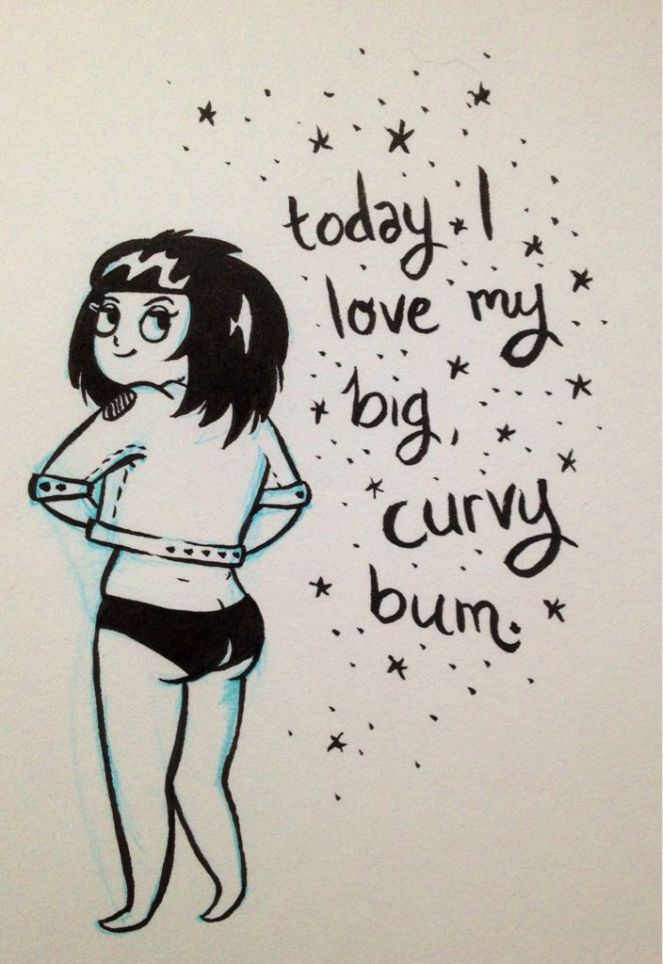
So I guess the study worked– I am feeling closer and more loving to myself, more inclined to trust me and love my own body as it is.  Because it’s rather gorgeous.

Screen Shot 2016-02-21 at 8.48.51 AM

body image · fitness

Sam has fun at body positive burlesque

I did something fun and out of character and way out of my comfort zone this past weekend. I attended a burlesque workshop at my favourite London clothing store, Renegade.

Why? Partly a challenge from a friend and partly I thought it might make a fun blog post. It’s amazing what we’ll do for blog fodder. Oh, and to be honest, I was curious.

So what did we do? Practically, we learned how to take off gloves sexily and do fun things with boas. Life skills I’m not sure I’ll ever need but it was fun to play.

The context and the theory of burlesque was more interesting to this academic. We heard all about burlesque archetypes like the vamp and the coquette. We also learned about humour and burlesque. If you’re going to trip while taking off your clothes, have fun with it. Be deliberate. Own the trip and stumble. I loved learning about nerd burlesque, combining my interest in Star Wars and Lord of the Rings with taking off clothes on stage. See Nerd Girl Burlesque, for example. Fun.

We also talked lots of body positivity and owning the things that make you feel good.

What’s the fitness connection? There’s not one really. But there is a body image connection and body image and fitness are closely tied.

Body image is connected to fitness in a bunch of interesting ways. It’s both the motivation for lots of women to pursue physical activity. I’ll solve my body image issues by improving my body! Body image anxiety is also the reason lots of women don’t exercise. I can’t go to the gym. I’m too fat!

I think the best route to health and fitness is loving the body you’ve got. Love is a much better motivator than hate. Loving your body doesn’t mean thinking it’s perfect or better than all the others. Loving other people sure doesn’t mean that. And if feeling sexy helps with that, and it seems like it would, and your kind of sexy includes bumping, grinding, twirling and teasing, then give burlesque a try.

(There are classes and workshops with a more direct fitness connection. See Burlesque fitness: learn to tease as you get toned in the Toronto Star: “Burlesque has been titillating audiences since the 17th century, but more recently the dance has been heating up the fitness scene. Think of burlesque dancers as a blend of strippers and showgirls. It’s a strip tease (emphasis on the tease — it’s not about what you take off, but what you leave on) with a big focus on outlandish performances on stage. It’s also an effective workout. The repetitive moves are great for the core and legs, while the dance portion offers up a solid way to get the heart pumping.”)

Oh, and our instructor Belle Jumelle was terrific. Belle is a queer femme from small town Ontario now residing in Toronto after a summer in Yellowknife. She’s a lot of fun. I’d had a few tough weeks and she made me smile. Rumour has it she’s coming back to London and even though burlesque remains something I’d rather watch than do, I’d go again for the fun. I was too shy this time to do anything in front of the class. But next time. Maybe.


image

Event description: With over 8 years of performance experience under her belt, Toronto based Burlesque Performer Belle Jumelles is a confident woman who has perfected the art of the tease, she has mastered the bump and grind, and wants to share her secrets with you. You have two opportunities to join her at this Renegade edition of Burlesque 101, taking place in the comfort of your favourite retail establishment. This workshop is eye opening, confidence boosting and full of fun! She will cover burlesque history, character types, glove peels, boa teases, moves and shakes that will leave you wanting to shimmy all the way home.

People from all backgrounds are encouraged to attend. Whether this is your first time thinking about burlesque, you have been looking for some inspiration to get you going, or you’d just like to feel awesome in your skin, this course will be informative and insightful. Belle Jumelles believes that all people and body types are beautiful and will help students feel empowered with the confidence to perform, whether onstage or at home. There will be no requirement for nudity in these classes, only confidence boosting moves.

Please come dressed in anything that makes you feel sexy and comfortable. Belle will be providing boas and gloves to borrow in class. But, if you have anything you would like to play with or learn how to use as a prop or costume piece, feel free to bring it with you.

body image · diets · fitness · weight loss

Are People Really Happy for People Who Lose Weight?

This topic of weight loss has come up quite a bit lately, even though we are a blog that professes (rightly) not to be about weight loss and definitely not about dieting.

I can’t even count the number of posts we’ve written over the years that say fitness is not measured by weight loss (recent case in point: Sam’s musing yesterday).

And anyone who knows me knows well that I do not compliment people on weight loss. Pretty much never, since that time Sam and I both remember all too well when we complimented someone who, in fact, had indeed lost lots of weight — because she had cancer! Yes, that ranks up there with the times in my life I wanted to crawl into a hole and hide.  And of course, Sam’s recent weight loss has a lot to do with having her thyroid removed because she had surgery for thyroid cancer in the summer.

I’ve said it before and I’ll say it again: “you’ve lost weight! you look great!” is not a compliment. Granted, lots of people are trying to lose weight. And, granted, those people probably like it when people notice (maybe?) because heck, they’re trying. Why isn’t it a compliment? Because it implicitly says, “and you used to look like shit, and guess what? I noticed that too!” And it implicitly assumes that everyone wants to lose weight, that losing weight is a good thing in and of itself, that being fat is not good (and looks awful), and that people are entitled to monitor the size of others’ bodies. And all of that is crap that we shouldn’t be assuming and doing.

But here’s something: I wonder whether people are actually happy when someone they know loses weight (not because of cancer, but because of effort)?  The reason I wonder is that at any given time, I would say a good 50% of the people I know are trying to lose weight or thinking about it, and more than 50% of those aren’t successful (not surprisingly, given this and this and this and this and oh so much more!).

So I’m going to go out on a limb here, and it may be a lonely limb that reveals me to be petty and small-minded: a lot of the time, people aren’t actually happy for you when you lose weight. First, there are the killjoy feminists like me who don’t really notice anymore when the people around them lose weight.  I consider the not noticing to be a personal accomplishment of mine.

But even more than that, there are those people who are battling the odds when the odds are heavily not in their favour. That would be the majority of people on a diet or weight loss program, actively trying to lose weight. I’m going to venture that a good portion of those people actually feel a little screw turn in their gut whenever someone they knows beats the odds and actually “succeeds” at that elusive goal: weight loss.

Seeing people who, for whatever reason (sometimes cancer, sometimes dieting, sometimes grief, sometimes — though not nearly as often as we’d like — exercise) drop pounds can start an internal monologue that, far from being thrilled for the person, quickly turns inward to self-flagellation and a sense of failure: If she can do it, why can’t I? What am I doing wrong? What’s wrong with me? I’m such a failure.

I’m happy for you if that’s never you. But if that’s sometimes you, join the club. Because I do go there, still today–my non-weight loss noticing-self can go there.

So I’m just going to put this out there and be totally frank. I really can’t stand it when people talk about their weight loss. I don’t care what the reasons. I don’t care if you’re trying or not trying. I don’t care if it’s for performance or for looks or just because that’s what friends, family, and strangers like to talk about.

You know, you can dress it up any way you like. But to me it’s such a personal thing that our social world has made into a public thing. And I’m always stumped about what we’re supposed to say. “Good for you!” even when someone is trying just goes against everything that feels right to me. It’s like encouraging something that I see ruin the lives of perfectly excellent people who think that weight loss will afford them something they need in order to feel good about themselves (or better about themselves). I just can’t have the conversation anymore, with anyone. [I like Carly’s suggestion of saying, “how does that feel for you?” but those don’t feel like my words]

So this brings me back to the question of whether people are really happy for people who lose weight. If you’re like me, you’ve read lots of stuff on dieting and weight loss in your time. And they always talk about the saboteurs. Those are the people who want you to eat another helping because they cooked it, or a piece of cake because it’s a special occasion, or chocolate because it’s Valentine’s Day, and therefore thwart your efforts at weight loss. Are they happy when their loved ones lose weight? Sometimes, the literature says, they feel threatened.

And then there are those people who are trying and getting nowhere. Are they happy for you? I’m not so sure. But I think it’s complicated. And that’s because successful weight loss is hard to square with the reality of how difficult it is to lose and maintain weight loss. And so when someone achieves it, we may be a little happy for them (maybe some people are super happy for them), but lots more people just use it as another reason to get down on themselves. And that’s the painful truth for many.

I don’t mean to be saying that that’s the only reason, or even the main reason, I don’t like to talk about weight loss (yours or mine). But it’s not a neutral subject, and it’s loaded with all sorts of cultural meaning that hooks into horrible attitudes that I don’t like to encourage. And even when someone’s reasons aren’t about that stuff, it’s still highly personal and that makes it at the very least an odd thing to advertise and go on about.

I can’t control what others want to talk about, but over the last little while, after a few conversations (with a few different people) that made me squirm and feel uncomfortable, I know for certain that I’m not taking part anymore. And for all of these complicated reasons, I’m going to be totally honest and say I’m happy for people about all sorts of things, but not super happy for someone simply because they’ve lost weight. I realize that makes me sound grumpy and petty, but there it is.

body image · fitness · Guest Post · weight loss

not my resolution; thoughts on January weight loss from a cheerful chubster (guest post)

I celebrate not only the Gregorian new year, but the Jewish one, plus the all the new moons and witch holidays. I love an opportunity to reflect on how things are going, and to think about what I’d like to shift. I have planted my intentions with seeds, and watered them with wishing well water. I have written myself notes and ceremonially burned them. I have mailed myself letters for the future. I have gotten tattoos to remind me of lessons I am still working on learning.

All this to say that New Years resolutions should be right up my alley…but they’re not, because more often than not, the way the dominant (white, North American) culture approaches these resolutions is through stunning self-effacement.

I will erase myself and overwrite a better version of me (who I am is wrong)!

I will stop all my bad habits (stop employing my coping mechanisms)!

I will become better, faster, and stronger (suddenly demand more of my body than ever before, and expect it to cooperate without injury or protest)!

I will lose weight I will lose weight I will lose weight (I am too much)!

In truth, I believe in body autonomy over nearly anything else, so I actually think it’s fine to want to lose weight (or gain it! or change your body in other ways!); and you sure don’t need my permission to make a resolution for yourself.

What I want is for us to get value-neutral about body size and about food. I sometimes err on the side of YAY FAT because the opposite voice is so loud and omnipresent, but legit what I think would be the best is if everyone got to decide for themselves what felt right and good and healthy and hot for their own body, and we got to be less fettered by literal constant messaging that thin bodies are sexy/healthy/desirable/virtuous and that fat bodies are lazy/unhealthy/unloveable/a project that can never be abandoned. My body is not a problem to be solved. It is not a disease, and I need no cure. I’m just fat (and honestly, I’m kind of into it).

I do workshops about body image with young people at a TRULY AWESOME summer camp. As an opening exercise, I give everyone paper and a pencil, and I ask them to make a list, as long as they can, of things they love about their bodies. I give an additional prompt that folks can think about a) how their body looks, b) how their body feels, and c) things their body can do. Then we sit in silence for a few minutes and I watch these strong, smart, powerful, visionary youth struggle to think of something, anything, they like about their bodies (I promise the workshops get less depressing from there).

Here is a short list of a few of the things I love about my own body, to use as reference or inspiration in case you decide to try this exercise for yourself (and I recommend that you do)!

soft belly/ juicy butt/ impressive armpit hair/ truly amazing for being the little spoon/ summertime freckles/ cute little feet/ dexterous fingers let me knit fast/ my eyes change color/ multiple orgasms/ strong legs/ strong bones (never broken one)/ general sturdiness/ great lips (for coating in lipstick)/ soft skin/ cool hair/ tattoos/ being a shorty means I always have enough leg room on trains on in the backseat.

I could go on (it miiiiiight get a little more NSFW if I did).

At this time of year, it seems like there is a big, resounding WE ARE ALL IN THIS TOGETHER thing ringing through the air about disciplining our bodies into something different, and folks, I am not in this with you. This is not a universal project. It can be yours; but don’t you dare suggest that it should be mine.

This doesn’t mean I love everything about my body all the time. I sure don’t. But I want to love most of it most of the time, and I am way more interested in working towards that goal than towards the utterly Sisyphean one of making my body conform to the standards expected of me.  Not only is that unattainable, it’s not actually what I want! I have come to love the physical power that comes with living in a larger body, and I don’t want to give it up. My body is extremely well suited to standing firm, holding fast, and comforting people I love. These are precious gifts.

If you want, even as a tiny thought experiment, to try on body positivity or body neutrality, or whatever words you want to give to the deliberate shifting of how you evaluate and understand bodies (yours and other people’s), here are some ideas of ways forward. YMMV, and I support you in the struggle, however it goes.

1. If someone you care about announces that they have lost weight- instead of leaping to congratulate them, first ask- “how does that feel for you?” (or something like that) and listen to the answer.

2. Don’t talk shit about your own body. See what happens if for 24 hours, or a week, or a month, you don’t speak out loud (even when you are alone) a single disparaging comment about your body (it can hear you). You may even owe it an apology (or several million of them). Might that be delivered by a massage? A pie? A love letter to your abundant thighs? A thank you note for every orgasm you’ve ever had? A long slow run through a wooded area? Several glasses of cool water with lemon? Acupuncture? Doritos? A nap? What is your body asking you for?

3. Make whatever choices feel right to you about what you eat, but don’t then coat them in a veneer of virtue. Your food is not “clean” (my food is not dirty). Your food is not “good” (my food is not bad). Your food is right for you, and that is awesome. Avoid the “cupcake? I couldn’t possibly!”s and the “I’ll have to work this off later”s. Eat what you eat, don’t eat what you don’t eat, and don’t shit on someone else’s pulled pork sandwich.

4. Try taking an appreciative approach to your body. What are the things you love about it, and how can you cultivate those (rather than trying to erase or modify the things you hate). This might lead you to the same actions- for example – if you want to be smaller, you might decide to dance more. If you love how your body feels when you dance, you might decide to dance more. Even with the same result, I promise doing the thing will feel differently if you’re doing it from a place of cultivating love and connection with your body rather than punishing it for existing too much.

5. Fake it. Fake that you think you’re hot as fuck. Fake that you “can pull off” that dress. Faking is actually doing, in a lot of circumstances, and eventually it might not feel like faking.

6. Make a change to the kinds of images of bodies you are exposed to. Find a blog or an instagram account or a porno (or twelve) that shows different kinds of bodies (fat bodies! hairy bodies! genderqueer bodies! disabled bodies! bodies with scars! bodies with stretch marks! bodies like yours) like, having fun. Wearing cute shit and going to the aquarium. Wearing sexy things or doing sexy things. Doing sports or dancing. Notice your own judgements, and try to let them go.

7. Get mad! Get mad about little kids who refuse to eat because their fear of being fat is so visceral. Get mad about the multi-billion dollar weight loss industry that is SO INVESTED in us hating ourselves. Get mad about Oprah repping Weight Watchers. Get mad about the misogyny that is embedded in a deep societal hatred of bodily squishiness. Get mad about how much we could all accomplish if we spent as much energy learning Russian or ASL or solving mathematical equations or cuddling our small humans or making soup for our sick friends or starting a small business or dismantling the prison industrial complex as we did picking apart our bodies and planning their (partial) demise.

Good luck with whatever goals you set for yourself; I’m already proud of you.
carly
Carly is a 32 year old white genderqueer femme. She is a freelance workshop facilitator in Toronto, mostly working on community building, body autonomy, intersectionality, queer sexual health, trauma survivorship, and keeping people alive. She likes roasted vegetables and bitter foods, and hates cantaloupe and anything gelatinous. She thinks that leopard print is a neutral and that prisons should be abolished. She is also a tarot reader- think of it as single session therapy, with a witch! Find out more at www.tinylanterntarot.net.
body image · fitness

You Do You

image

I’m not actually a plus size woman these days but I am big. I do like that there’s a bit more variety around these days in terms of bodies represented as sexy. Recent efforts mostly focus on including larger women, but I still hate all the comparing.

What kind of comparing?

Well, this.

And this,

But you can celebrate diverse beauty without invoking comparisons. You do you.

I do like this!

And this,

Pride:

And this,

body image

OMG It’s the Darn Photo Contest Again

Why, Precision Nutrition, why?  I know Sam already said how much she detests the PN photo contest. And I’ve already said how they lost me when they spent a month getting us all prepped for the final photo shoot.

Both of us attest that there are some good things about the PN program. But the photo contest certainly isn’t one of them. This week, we both got links to the women’s and the men’s finalists’ before and after shots so we could vote on the most amazing “transformation.”

Some of them do appear to amazing. But what’s so irritating is that all through the program they say it’s not about the numbers on the scale or even about the way you look — it’s a change in attitude and approach.

What’s the big change? It’s a habit-based program. And what it really encourages us to do is take up healthy habits. I know that for a lot of people the reason to take up healthy habits is to lose weight and get lean. It is, after all, called “The Lean Eating Program.”

So what did I expect? What’s so bad about a photo contest? Why do I despise before and after shots?

First of all, if you know anything about “before” and “after” shots, it’s that they’re not always indicative of the truth. There was that thing awhile back where people took “before” and “after” shots within minutes or hours of each other.

Remember the Australian personal trainer, “Mel,” who did a 15-minute “transformation”?

Andrew Dixon wrote “Seduced by the Illusion: The Truth about Transformation Photos” for The Huffington Post, where he talks about marketing campaigns that use before and after photos as a major selling point (sound familiar?):

Before I claim it’s all bullshit, I want to make it clear that there are definitely some very impressive, genuine physical transformations out there. What I do take issue with are the transformations that are manipulated with Photoshop, professional lighting, postures to degrade or enhance their look, pro tans, sucking in or pushing out a bloated belly or flexing muscles vs. not flexing to obtain an optimal look.

This is just the sort of thing PN encourages (not necessarily the gut sucking and so on, but definitely the professional photo shoot.  Dixon decided to experiment:

I decided to take my own transformation photos to see what was possible with just a few easy tweaks. About six months ago I was around 185 pounds and about 16 percent body fat. I was feeling particularly bloated on the day, so I asked my girlfriend to take a before shot. I then shaved my head, face and chest and prepared for the after shot, which was about an hour after I took the before shot. I did a few push ups and chin ups, tweaked my bedroom lighting, sucked in, tightened my abs and BOOM! We got our after shot.

Or there’s this instructional video about how to fake your before and after shots.

What this says to me is: be skeptical. Be very skeptical.

I’m not saying that no one in PN changes and that it’s all smoke and mirrors. But there is a lot of information missing from the contest. Like are they repeat-customers (“VIPs” as PN likes to call them)? How did they do with the habits?

And the million dollar question: maintenance. This is where so many people hit the wall. When the focus in largely on weight loss, that’s sort of the easy part. The struggle is keeping it off. The merit of a habit-based program is that you are supposed to be developing new habits for life. So you would think that the main indicator of importance would be how well those habits stay once the program is over. Or do we have to keep paying hundreds of dollars a month to keep up with those good habits?

I also don’t like the fact that PN uses the photo contest as its main marketing tool. It’s free advertising for them and they spend about a month trying to get the clients, who are already paying hundreds of dollars each month, to shell out for a professional photo shoot.

Of course photos from a pro shoot are going to be more flattering than the photos everyone took on day one, with their smart phone camera, at the beginning when they felt crappy about themselves.  I don’t know. That part really gets to me — the way they kept telling us “it’s worth it” and “you’re worth it” when really, more than anything else it’s worth it for them when their clients get the pro-shots and turn them over to PN for inclusion in the photo contest. We pay, they get to use the pics to get new clients.

I didn’t get a professional shoot and I didn’t give them permission to use any “after” shots. In fact, for me, the monthly photos were the worst part of the program because I was trying to get away from using appearance as a motivation for healthy habits.

So here we are again with the photo contest. And it happens to coincide with the “pre-sale,” which is an early sign-up that gives you 20% off of an unspecified amount and enables you to register a day earlier than everyone else for the January program.

My cynicism is not just because a year after the end of my PN experience I’m still struggling with the same stuff as I always have. It’s not just because I feel the need to find other bench marks because getting leaner eludes me. And it’s certainly not because I myself wouldn’t have ever been a finalist even if I had wanted to be considered for the contest.

It’s more because I wish there was a way of selling healthy habits without selling appearance-based “transformations” and without taking advantage of everyone’s susceptibility to being “seduced by the illusion.” I also think it’s just kind of embarrassing, in a way I didn’t used to, to put yourself out there to be judged on your appearance and your weight loss by countless strangers.

For all the pronouncements that it’s “an inside job,” the final photo contest just makes the program seem sort of shallow and the contestants desperate for a stamp of approval from others. Really? Do we have to keep doing this?


body image · fitness · gender policing · Guest Post

Breast cancer is turning me into a man. And I’m kind of okay with that. (Guest post)

IMG_7019

I was diagnosed with breast cancer this summer, and since then have had a double mastectomy and two courses of chemotherapy that have left me breastless and bald. For a woman who had large breasts and long hair, it’s been a big change. But I’m finding I’m strangely comfortable with my new appearance, shocking as it may be to others.

I’ve written on this blog about how I was really looking forward to my double mastectomy, and I followed up with this post after my surgery about how much I love my post-mastectomy body. The latest change in my appearance came from my chemo. My hair started falling out three weeks after my first treatment, and was a patchy mess when I went in for my second. Shortly afterwards I had a friend buzz my remaining hair off with barber’s clippers, leaving me bald.

IMG_6940

I thought I was ready for it (I’d had the same friend buzz my hair in a very short pixie cut before my chemo started), but it was still a shock. Bald heads are a sign of maleness in our culture; very few white women willingly go bald, and are considered outliers if they do. Long, thick, shiny, straight hair on women is prized by people of European descent. The few times in my life when I’ve purposefully cut my hair very short, I’ve been chastized for it, by both women and men. Bucking the cultural norm is definitely not okay, and even makes news.

And yet I really love my bald head. Many of my friends have commented that my skull is a nice shape. The artist in me thinks I’m more beautiful than I’ve ever been in my life, since going bald. I love looking at my head, and touching it. Part of me wishes I could keep it bald, even after my hair starts growing back. It’s so easy to care for, so minimalist.

My struggle has been going out in public since losing my hair. Until recently I was still working full-time, as a fundraiser for a nonprofit. I felt physically well, but didn’t want people to assume I was sick. (I figured they’d guess I had cancer as soon as they saw the bald head.) Before my first business meeting after my hair was gone, I vacillated: should I wear a scarf on my head? A hat? Did I need to explain my appearance? To be honest, most of the time I forget I look different – I still feel like the same old me on the inside.

(The business meeting? I wore a hat because it was cold out, but took it off as soon as I got inside. I explained that I was doing really well physically. It seemed to be a non-issue.)

Then one night I was passing by a mirror in my apartment, and caught sight of myself out of the corner of my eye. I was shocked – I really looked like a man. To be honest, I thought looked like my dad, who had been bald. My mom affirmed it when I posted this photo on Facebook.

IMG_7002

For many women going through breast cancer treatment, this part – losing the external signs of womanliness – can be very hard. At every step along my cancer journey, health care professionals have assumed that I wanted to mitigate this loss with prosthetics and wigs. And I’m not diminishing that need that some women may have. But I’ve been very clear with myself and others since my diagnosis: if anything, I want to be the poster girl for normalizing the realities of breast cancer treatment. I want it to be okay to be breastless and bald if you’re a woman. I want it to be okay to work through illness, if that’s what you want to do. I want it to be okay to be who and what you are, to be flexible in the moment, and do what you need to do to be well and whole (be it a take a nap, or go for a walk, or have a good cry.)

But I can’t deny it’s been fascinating – and a little disconcerting – to explore the emotional and spiritual landscape of ambiguous gender appearance. I feel like our culture has become more open to considering gender identity since celebrities like Chaz Bono, Laverne Cox and Caitlyn Jenner have shared their transgender experiences. But each of those celebrities seems to have settled on a gender appearance that puts them very squarely within the norms of their identified gender. I wonder if society is ready for people who are openly gender-ambiguous, even if only in appearance.

I guess what I’m trying to say is, I’m a woman and I love being a woman, but I’ve been wondering what it would be like to live the rest of my life in the No-Man’s (and No-Woman’s) Land of asexual appearance. Where I could be mistaken for a man (or transgender, or a lesbian) sometimes, and that would be fine.

I also wonder if I would feel differently if I were younger, or in a relationship with a conservative partner. Maybe part of my comfort with ambiguous gender appearance comes from being near menopause and single – and happy with both of those conditions. I was already knowingly entering a part of my life where my appearance and desirability were becoming less important. I’d heard from older women that you become invisible after “a certain age”. That didn’t seem like a bad thing to me. There’s a reason that contemplatives take a vow of celibacy – the pursuit of sex takes up a lot of energy. What if looking gender-ambiguous saves me from superficial and superfluous flirtations and drama? What if I can focus more time on my work and my creative projects? What if I can have more authentic relationships where people look past my exterior and value the person I am inside?

Part of me still worries about being labelled strange, however. About being ostracized for being different. If I were another 10 years older, I would laugh it off, because by then I’d be facing my 60s, and I know it really wouldn’t matter what I looked like. But I’m finding I’m thankful for activities like aikido, where everyone (male and female) dresses the same for practice.

Honestly? Breast cancer isn’t turning me into a man – it’s turning me into a pre-pubescent girl. (This will become even more true when I begin taking hormone-blocking drugs after my chemo.) And if I remember correctly, my 10-year-old self was pretty awesome. Who could complain about that?

___

You may also be interested in these blog posts by Michelle about her breast cancer experience:

Michelle Lynne Goodfellow works in nonprofit and small business communications by day, and also enjoys writing, taking photographs, making art and doing aikido. You can find more of her work at michellelynnegoodfellow.com. Michelle has also written about her breast cancer journey on her blog, Kitchen Sink Wisdom.

advertising · body image · fitness · Guest Post · health

Fitness as process, not destination (Guest Post)

I think it is safe to say that most women, regardless of background, have at some point come across those ads commanding us to do something about our bodies.

It used to start in March or April, with the terror inducing demand we get started on making our body bikini-ready for summer. Then weddings got in on the trend, and as part of the ceremony planning, nutrition and body-shaping sessions were booked along with the photographer and the caterer.

Winter vacations were not to be left behind, so then the ads started clamouring for us to become beach ready or cruise ready in January. But perhaps what really took the dessert plate was the ad I saw a couple of years ago that said it was time to get Christmas-dress ready … in September.

Today it seems the demand to alter, shape, change, tweak our physical selves is year round, and there is always some part of our bodies that needs adjustment: chest, arms, legs, waist, butt. The list is endless.

One of the ways we are supposed to make our bodies fit the image of the desirable female is through exercise. I should note fitness isn’t necessarily part of the foundation for this effort, but it is the basis of much of the marketing behind the countless programs on offer.

I will wholeheartedly admit that one of the reasons I did not announce my fitness strategy was because I wanted to stave off the questions and comments about weight. I’ve always been a bigger girl/woman and while there were many times in my life when weight loss was a huge focus for me, once I hit 40, I realized I wanted to get off that train once and for all.

It was my work with a non-profit network focused on promoting positive body image that started me reading about the principles behind the Health At Every Size (HAES) approach. It led to a significant change in my thinking about how we define health and how we use fitness as the prop (or stick) to achieve health.

When I first met with my trainer, he asked me what my goals were for starting training. It was a useful question. The fact was I didn’t care about body shaping/toning and I wasn’t worried about “bulking up” as a result of any effort in the gym with weights. Since weight loss was not a goal, what was left for a woman who wanted to be fit and not hurt herself in the process?

As a communications professional, I look to quantifiable results for my work. I establish measureable objectives and then evaluate the success of my program. The key measureable results offered to women who embark on a fitness journey are pounds and inches lost. The goal there is to be skinny, thin, svelte etc – that is smaller than when you start.

When I applied my communications planning approach to my fitness work, I realized my goal was to live well and as healthily as possible. That meant I wanted to be able to move without assistance (now and in the future), to live free from injury, and to make activity a regular and enjoyable part of my life.

It wasn’t easy though shaking off some of the attitudes about what makes for an appropriate shape for women. Working with a trainer who focused on form and correct execution led to my looking at outcomes differently and finding the new measures that would help assess my progress in the gym.

Today, one of things I most appreciate about working towards achieving my goal to live well and be healthy is the fact that you are always working towards fitness. Fitness is not a six-week effort to achieve a better fit for your dress or swimsuit. It’s not a destination where you say “here I am, I am fit” simply because you can wear a bikini or a body-hugging sleeveless dress. Fitness is a process, and a way of life.

But if you want to be swimsuit ready, here’s a hint: put the swimsuit on. Now you are ready.

Martha Muzychka is a writer and consultant living in St. John’s, NL.

body image · fitness

Fat Scuba Diving—Reflections on weight stigma 40 miles out on a coral reef

Fat stigma is pervasive in sports. I wrote a while back about fat kayaking and Samantha has written about Big women on bikes and also fat yoga. Tracy wrote about fitness and fatness through running here. What is our message? Despite fat stigma, we can be athletes, a fit and competent (or even superior) sports participants and be fat at the same time.

Weight matters in different ways depending on what sport you’re doing. It’s an advantage for me going downhill on a bike and creating my own defensive space on a squash court. It doesn’t seem to affect my balance or weight shifts on cross country skis or for partner dancing. And it does hamper my speed and raise my heart rate going up a steep hill, either on foot or on two wheels.

But who knew that people might think that weight would be an issue underwater? Really? My experience is just the opposite. I feel buoyant in the water, able to swim and glide, almost weightless under the water, able to maneuver easily. Like this.

manta

When I went out on the Great Barrier Reef a couple of weeks ago (I blogged enthusiastically about it here) I did have some size-related worries about snorkeling or diving. We had to wear stinger suits to protect us against the life-threatening sting of the box jellyfish—here’s me in one of them below.

stinger suit.png

I was worried about fitting into one, but it turned out they had them in a bunch of sizes, and the one they gave me was actually a bit big on me. So once I got over that hurdle, I felt like the rest would be easy.

But then I looked at their safety information card for snorkeling and scuba. Here it is:

safety

I noticed that it included a chart that depicted snorkeling risks by weight. Here it is:

weight

There was also a chart that depictured snorkeling risks by age. It’s here:

age

As soon as I saw these, I thought, “they totally made this up.” It turns out that some public health researchers, at a conference in Cairns, were also on the boat, and I pointed it out to them. They agreed—they didn’t think there was any reason to think snorkeling would be more risky for folks with BMIs over 30, or for folks over 40 years old.

However, I was curious to see if there was actual information about this anywhere. Of course there is. I did some cyber-poking around and found a study on scuba and snorkeling drowning deaths in New Zealand. In the study, the mean age was 34 years old. Also, less than 10% of the drowning deaths from scuba and snorkeling were people over 50 years old. So age may not be not much of a risk factor in this study.

What about weight? In coroners’ reports, weight was not mentioned as a variable. And in a table looking at health factors potentially contributing to the 184 deaths in the study, “gross obesity” (not defined there) was listed for only 3 deaths. One gender note on this study: women constituted only 11% of the diving/snorkeling fatalities.

So, overall, I would say that my risk, as a healthy, fat, 53-year-old woman who is a good swimmer, was pretty low. But until I explained to the diving staff on the boat that I was indeed: a) a good swimmer; b) super-comfortable in the water in general; and c) a regular active sports participant, they were cautious and condescending about my signing up for the recreational dive.

When they fitted us out with our gear (vest, tank, regulator, other doo-dads), the diving instructor gave the two other folks weight belts. One of the other two people diving was a burly male fire fighter who I’m certain outweighed me. But I wasn’t given a weight belt. She just put a few lead weights in my vest pocket, pointing out that I didn’t need the weight belt, suggesting that I needed less weight than the other two divers.

This seemed intuitively wrong to me. I hadn’t had any instruction other than the few minutes they spent putting our equipment on at the back deck of the boat. But I know that diving weights are really important, as they help you regulate your buoyancy to be able to orient yourself underwater and also control your movement more easily.

And of course the instructor was wrong. As soon as I got in the water and deflated the air in my vest, heading down under water, I had all sorts of problems with being too buoyant. The instructor had to fetch more weight from the boat and come down to me and put more in the vest. This happened not once, but TWICE—on each of my dives that day, despite my repeated requests for a weight belt. Maybe this was simply bad instruction and poor preparation on her part, but I also think that preconceived notions about fat divers played a role here.

I did some looking around online about weight and diving and risk. I found a few opinion pieces claiming that obese divers (BMI>30) had a higher risk of decompression sickness.  However, when you look at data on diving-related deaths here in detail, BMI doesn’t play a causal role.

After these two recreational dives in Australia, I decided that I’d like to get PADI certified so I can dive with confidence, knowledge, more control and more pleasure. And knowledge and experience will provide me with ways to fight fat stigma wherever I go, even underwater.  And I can’t wait to see more of this, too.

Screen Shot 2015-12-14 at 12.04.57 AM

body image · fitness · weight lifting

A feminist perspective on barbell training (Guest post)

by Fran Mason

Women in parts of the world have been training hard and testing their physical abilities recently, in larger numbers and more systematically, than ever before. You can find stories and photos of women athletes and bodybuilders going way back in time (here’s a list of some women’s sports), but competitive sports were rare for women. Women training for strength were controversial at best. For example in the 1940s at Muscle Beach, at least a few women trained with weights and competed in meets, even though “People used to say that if women worked out, they would become masculine-looking or wouldn’t be able to get pregnant,” said Abbye Stockton, pioneering female weightlifter. (See past post on Abbye Stockton here.)

In recent decades, increased opportunities for women in athletics didn’t erase the demand that girls grow up to be traditionally feminine women. Femininity was and still often is pretty narrowly defined. In my gym, my most rewarding work is teaching women to lift barbells and to lift heavy. But even today in 2015, it is common for women to resist the idea of lifting “real” weights because they might develop visible muscles (“bulk up”). It’s even more common for women to say they want to be thin, and to use “skinny” as a compliment.

I’ve been training women in CrossFit since 2006, so I’ve heard these expressions a lot. These women are sophisticated, empowered, up to date, educated, whatever you’d call it, and they love to exercise hard. But thinking that thinness is something to strive for through exercise, using “skinny” as an extra-special compliment, and failing to know that “toned lean muscle” (desirable) and “bulking up” (undesirable) are virtually the same thing — these are straight out of Fifties Frumpy Femininity just like the Stockton quotation above.

The bottom line(s) — keeping in mind that Strength Is Desirable:

  • If you achieve toned, lean muscle, you have gained muscle (a good thing) and lost fat, and you have a metabolism (hormones) that, at the moment, allowed that to happen.

  • If you adopt the most efficient type of strength training (barbell lifting), you may or may not get visibly bigger muscles than you gained from a different type of exercise, for example, big arms. But you’ll definitely be stronger and more resistant to injury (a good thing). And if you do get visibly bigger muscles… it’s a good thing. This is very healthy.

  • Lifting heavier weight requires fewer reps, and won’t usually bulk a person up; people who want to bulk up dramatically lift very differently than the type of strength training I recommend.

  • If you are naturally trim, you will probably stay that way, but get stronger (a good thing) — maybe even a lot stronger (a good thing) — and look a bit more broad-shouldered and tight-waisted.

  • If you are naturally heavier, you will probably already be stronger from the outset (a good thing) than the slender person, and you’re more likely to gain relatively more strength in the long run (a good thing).

  • If you are naturally heavy you might never be “skinny” even if you lose some weight, and that’s a good thing too. Skinny is weak, and weak is not healthy. Skinny is not a compliment. As a heavier person, if you adjust your nutrition the right way for you, and if you stick with barbell lifting, you are likely to develop a tighter waist enhanced by broad shoulders and good posture (from strength — a good thing), visible hamstring muscles that look awesome in leggings, and a tighter, muscular butt. (All good things, because they came from strength.)

  • If you start lifting weights and you haven’t been doing ANY kind of strength training, your appearance may change more dramatically than I’ve described here, because you’ll be starting with less muscle-size at the outset.

I can’t even express how much I love to look around my gym and notice the different body types and how every single one of them has improved their strength and fitness. This is the new femininity. As a feminist strength and conditioning teacher, I long for the day when women walk into my gym and say, “I want to learn to lift heavy weights because I can’t wait to see how strong I can get!”

Truly, humanity doesn’t know the physical potential of women. Now that it’s being explored, trained, and tested in larger numbers in methodical ways, we’ll learn more, and beliefs about women’s capabilities will keep changing. Our physical achievements are starting to be acknowledged in some of the toughest places.

fran

Bio: I’m very proud to be, as a woman of age 51, helping adult women and men learn to train their bodies. I’m a Level 2 CrossFit Trainer, a Starting Strength Coach (barbell lifting), and a personal development coach. I’ve also been a writer, a project manager, a helpdesk technician, a gardener and homemaker, a genealogy hobbyist, and an avid reader of books: mainly literary fiction, business biographies, history, and self-improvement.