A friend wrote recently about one of the few true aphorisms in her credo – that Nothing is Ever Wasted, Nothing is Thrown Away. She talked about methods of living, and her inability to commit, and how that generated the useless side effect of inertia/indecision in non-critical matters.
“Non-critical means not to do with work, family needs, food, groceries, or paying bills, but stuff like housework, hobbies, and overall the right use of personal time. It’s created a kind of motivational paralysis, trying to decide the next best thing I should do at any given moment while being painfully aware of opportunity costs.
But the aphorism reminds me that it doesn’t matter what I pick because the effort expended, the task I choose, will go to good. Because the things I do are worthy. Even if it’s just petting a cat for five minutes. Relentlessly applying logic/exercising triage on my personal choices isn’t necessary.”
I suffer from anxiety/executive function paralysis all the time, and thought this was a brilliant insight. I think I’ll go pet my cats.
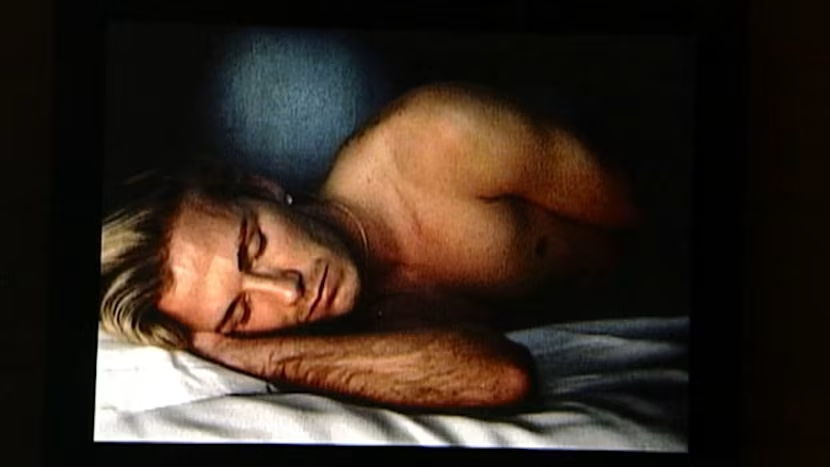
In 2004 British artist Sam Taylor-Wood (now Taylor-Johnson) made a short film of the footballer David Beckham asleep. You can watch all 107 minutes of it on her website. Beckham lies on his side, dimly (and flatteringly) lit, hands adorably tucked up by his face, his then-blond hair in a cowlick, as he occasionally stirs and the covers slide to reveal a glimpse of pec. As the title of a popular sleep podcast would have it, Nothing Much Happens.
Nonetheless, a friend of mine told me that when the film was shown at London’s National Portrait Gallery, there was a very long queue of would-be viewers, mostly women. Watching someone sleep is a form of intimacy and a rather opaque window into their private life. This artwork also provided an opportunity to witness Beckham in bed, which is perhaps where many people imagined they would most like to encounter him.
Less often remarked on is the fact that “David” (as the film was simply titled, in an obvious nod to Michelangelo) was filmed in the middle of the day in a Spanish hotel room. Beckham was at the time playing for the elite club Real Madrid, and following a morning training session the players were expected to take a long siesta. Getting adequate rest has long been a feature of best practice in training, with athletes advised to take regular days off for recovery, and—a bit more recently—to get plenty of good quality sleep. Elite athletes probably face some challenges that the rest of us don’t: the average weekend warrior isn’t jetting across three North American time zones for Stanley Cup finals, or being forced to get up before dawn to fit training for the Olympics around a day job. Nonetheless, increasingly sleep is recommended for the average fitness enthusiast, rather paradoxically, as an integral part of a physically active lifestyle.
In the sleep medicine literature, sleep is often represented as a period of “recovery” following physical and mental exertion—even if just the cognitive exertion of being awake. Exactly what we are recovering from or how this process happens is still not well understood. Some evidence suggests (rather unsurprisingly) that sleep deprivation has a negative effect on performance, so if you are in the biz of working out, focusing on sufficient and consistent sleep is wise, and, conversely, regular exercise is shown to improve sleep duration and quality.
So far, so good. By now we all know that good sleep means going to bed (and getting up) at a consistent time, not using blue-light devices before bed, avoiding caffeine and alcohol, sleeping in a dark and cool room, and a host of other common-sense “sleep hygiene” steps. Sleep trackers can only capture crude measures—evaluating self-reporting of bedtime and wake time; keeping track of your temperature, blood oxygen levels, heart rate, and respiration; or measuring body movements at night to gauge your sleep cycles. This kind of data is nothing compared with the neurological information a sleep tech would gather in a sleep lab.
Nonetheless, now, apparently (h/t Fit is a Feminist Issue), there are also apps to optimize your sleep for your workout:
A young white woman takes a twisting yoga pose in a living room that is dimly lit. It’s dark outside and the clock indicates 11:30. The company being advertised is GOWOD and the text is headed “Sleep: The Secret Workout.”
The language here is telling, and exceeds the technological promise of the app, moving into existential territory: sleep is “not just downtime, it’s part of the workout.” It’s “about more than just ‘rest.’ It’s when your body goes to work repairing muscles, regulating hormones, consolidating skills learned in training, and restoring the energy you’ll need for tomorrow’s effort.” The makers of GOWOD “think of sleep as a hidden workout – an invisible lever that can unlock your best results if you choose to use it.”
Here’s another way of thinking about sleep. As “David” shows, even for one of the world’s most visible and successful athletes, the sleep that is a central part of his training is something private and mysterious, not typically available to public scrutiny. Whatever “recovery” is happening while we sleep is, for now, hidden from view. Sleep tracking may quantify some proxies for sleep, but it doesn’t, in fact, tell us all that much about sleep itself (whatever that is), which is perhaps why it is so easy to claim it is “part of the workout.” I’m not against athletes (or anyone else) getting better sleep—far from it. But the incorporation of tonight’s sleep into tomorrow’s effort negates its inherent value and instrumentalizes it. Instead, let’s think of sleep as a part of our experience that may not be 100% available to quantify and deploy in the service of waking life, but as necessarily a tiny bit ineffable and existentially sacred—something you would line up to watch for 107 minutes and wonder at.
I knew my 16-day trip to Egypt with 3 midlife friends would be a fun, budget-friendly adventure, but it also became a test of stamina and strength for me.
We had no tour big bus providing a comfy, air-conditioned bubble. Rather, our ambitious travel schedule took us through half the country, hauling our backpacks up modest hotel staircases and navigating every natural and human-made obstacle in our path. Although we had quiet evenings, including a few days by a rooftop pool, by day our bodies were moving in lots of ways.
Our first of many tomb and temple visits, the burial chamber of Bannentiu, 26th dynasty (Roman Era) in the Baharia Oasis.
Bodies in Motion
In the desert near the Baharia Oasis we climbed up (then surfed down) sand dunes. In downtown Cairo, the honking cars, uneven pavement, and throngs of moving people in the street demanded constant physical manouvering. We toured ancient sites out in the hot sun, including Luxor’s Avenue of Sphinxes and Aswan’s Forgotten Obelisk. We also used steep ramps and narrow tunnels inside multiple tombs and pyramids, crouching under low ceilings carved over three and four thousand years ago!
Folks climbing a ramp in one of the Giza Pyramids, built for Pharoah Khufu in the 2500s BCE. Kim said the ramps were put in after her visit 16 years ago: before it was just dirt.
As well, we hiked three silent, stunning canyons in the South Sinai region that shimmered white, red, and multi-coloured in the sunshine. The next day, after a caravan of camels and their handlers got us most of the way up Mt Sinai, we used 750 steep steps to get up to its peak.
Riding Asfour (the Second), a 7-year old camel up the first 3000 steps of My Sinai was a highlight. And although Asfour did most of the work, my legs were still sore the next day!
Later, it was a relief to float face down in the salty water of the Red Sea over the most beautiful coral and schools of fish I have seen. We snorkelled twice: off the beach in Sharm El Sheik and off a glass-bottom boat in Hurghada. But even in and near the water, I had to be thinking about dehydration and sunburn.
Kimi and me snorkelling just off the beach in the Red Sea. Video by Lisa Porter.
Getting hurt could mean getting stuck. I nearly did a few times, once when I mildly rolled an ankle in the Coloured Canyon and when I jammed a finger on a tomb doorway at the Saqqara necropolis. But it felt good to keep moving. At least twice we saw a tourist who seemed unprepared or was having great difficulty getting through the tomb shafts.
Kim and Lisa going down the low-lit ramps in what I think was the Step Pyramid, built for Pharoah Djoser in the 2600s BCE. Video by Kimi Maruoka.
We covered thousands of steps per day, even on our 2- to 7-hour travel days. At the last minute I decided to leave my fitness tracker at home, and I’m glad I did. It helped me to make sense of how I was feeling in my body rather than by stats on a screen.
Rope repelling, then a rebar ladder, just to get down into the White Canyon. Our guide admitted he used this to judge hikers’ readiness for this canyon.
Caring Co-Travellers
And my body did feel many things, as I was under the weather for a good part of the trip: first menstrual cramps, a head cold that turned to cough, then mild heatstroke after the first time snorkeling, and finally a stomach bug. On my worst night, I laid awake shaking with chills, sipping tepid tablet-purified water, and waiting for dawn (or death, I had thought self-piteously).
A short video of Cairo’s downtown streets at night. Our group kept close watch on each other to avoid getting lost or run over.
But I survived. As a white, English-speaking tourist with a credit card and travel insurance on a holiday, I was never really in serious danger. I saw many Egyptians who may have been facing economic hardships and health risks I will never have to deal with as a middle-class Canadian.
Nevertheless, I am so grateful for my three travel buddies, who showed each other constant care throughout our journey. We divided snacks, each bought rounds of water, shared everything from tissues to electrolytes, and carried the mood for each other until someone sick (usually me) recovered.
A cat next to my day pack and water bottle. I stayed hydrated with old and new friends!
Kim, who had planned the travel and booked the local guides and drivers, happily made last-minute arrangements to help me join later when an early morning tour of Isis Temple in Aswan wasn’t possible for me. This caring company was the heart of my trip.
Me in a feeling-better moment, making silly Instagram poses with the backdrop of the Red Canyon behind me. Photos by Kimi Maruoka.
Proof of Life
I believe that our greater exertions paid off in greater fun. In exchange for living out of packs and in our sore, dust-covered bodies, we got to see and sleep in neat places, including under the desert stars, where we felt extremely lucky to be there, together and alive.
Our remarkable view of the white desert at night. This photo was not taken with a black/white filter.
There’s a certain idea of midlife that says to slow down, be careful, rest more. This trip refused that. It demanded and invited all kinds of motion, reminding me how much the body can still do when it must. It turns out that I was strong enough for Egypt.
Lisa and Elan racing (falling?) down a sand dune in the White Desert. Photo by either Kim or Kimi.
And by the end of the trip, I used nearly every pill I’d packed and every muscle I had. But getting over everything became part of my adventure story. I came home with a mildly sprained finger, hardwon but still overpriced souvenirs, and a feeling that my flawed and frustrating body could still bring me much, much joy.
Our fearless foursome trekking in the desert. To borrow a phrase from Kimi and her sisters: “We did it!!”
One thing I do in my not-so-copious free time is scan medical journal tables of contents each week. This way I get at least a glimpse at what is going on in medical research at the moment, sometimes provoking a deeper dive into a study or sub-discipline of medicine.
Last week in JAMA (Journal of the American Medical Association), the top article caught my eye for its very particular area of inquiry: Respiratory Gas Shifts to Delay Asphyxiation in Critical Avalanche Burial– A Randomized Clinical Trial.
Yeah, that’s niche.
The researchers were testing a gadget that facilitates increased air flow to a person trapped under snow in an avalanche. TLDR: it worked very well. So that’s good.
The study subjects (24 in total) were about equally divided between men and women.
In that week’s editorial, titled “A Breath of Fresh Air”, the editors of JAMA offered historical context for this new research result. They also said that the researchers should be applauded for narrowing the gender gap in this type of research.
Applauded.
Applauded?
Yes, they said “applauded”.
As in:
A lot of people applauding, captured by Hanson Lu for Unsplash. Great job, Hanson!
I’m afraid I don’t agree here.
I beg to differ. Yes, I used this phrase last week, but what can I say? it just keeps coming up
Increasing representation by gender, race, ethnicity, age, etc. in medical research has been and continues to be a big project, with lots of players contributing to small shifts in research participant selection. And I’m glad to see that this study included women as research participants; after all, women as well as men engage in back-country skiing, so it’s important to test out potentially lifesaving devices on all relevant populations.
Do the researchers deserve our thanks? Yes, for working hard as scientists. But for including women in their study? No. They’re just doing their job. They may be doing it well, but it’s their job to do so.
The movement to make human scientific and medical research truly representative isn’t finished yet. I’m glad to see widely-read medical journals paying attention. But I think they can hold their applause.
Last week, when I wrote my list of ‘10 activities for the 10th Month‘ I made sure to create a mix of ‘easy’ activities and slightly more challenging ones.
And my definition of easy and challenging is not just limited to the physical effort involved.
Physical effort is one factor, of course, but on any given day my ADHD brain might toss up some extreme resistance to anything that requires turning on the computer or changing clothes or asking someone to shift a plan.
And the really annoying thing is that I might not be consciously aware of the details of my resistance. My brain will just kind of slide over the idea because it is ‘too hard’ and unless I make a point of focusing on why I can’t seem to do that specific task, I’ll just kind of have the impression that there’s a logical reason why I’m not doing it.
Yes, in case you were wondering, that is all just as fun as it sounds.
So, I was prepared to face some resistance to starting my tasks, no matter how easy I had initially thought they would be but I hadn’t prepare to face continued resistance once I got going.
After an unexpectedly busy week last week I finally got around to choosing something from my list on Sunday.
Because I had plenty of time, I decided to do two things – journaling while sitting on the floor and a yoga video that was at least 30 minutes long.
The journaling was pretty easy and I enjoyed sitting on the floor to write for a change.
I had already rolled out my yoga mat to sit on and I had already picked out a video to do so I thought I had removed any obstacles to my practice.
By the way, this is the video I chose:
A YouTube video from the channel ‘Yoga with Bird’ called 30 Minute Restorative Yoga for Stress and Relaxation.
I was totally wrong about the obstacles.
It turns out that my brain did NOT want to do a 30 minute yoga practice that day.
In fact, it didn’t want to do any kind of yoga practice at all and it threw every thought it had at me.
‘You have other things you should be doing.’ – I did not. This was the time I had picked for this specific task.
‘You aren’t really up for a long practice today. You can stop here and do a long practice tomorrow.’ – There was no physical reason why I couldn’t do my chosen practice on Sunday. And there was no reason to believe that I would be suddenly more able to do it on Monday instead.
‘This is too hard for you right now. Maybe just do some alternate poses.’ – Sure, some of it was a little out of my range right now but there wasn’t anything especially difficult for me in the practice.
‘Maybe you should stop this and do some drawing or reading instead. It’s way harder to find time to do that stuff – you can do yoga any day.’ – This is a straight-up lie. It’s harder to find a time when my brain will let me do 30 minutes of yoga than to find a time when I can read or draw.
I think I know what was going on there.
My brain knows that my capacity has varied WILDLY over the past few years and it wanted to protect me in case I actually couldn’t – mentally or physically – do the practice.
If I CHOSE to do something else, to switch or shorten my practice, to be creative, then it would feel like self-care.
If I COULDN’T do the practice then it might end up feeling like a harsh reminder of the challenges I have been facing. It might even feel like failure.
No wonder my brain was trying everything to get me to change course.
But I chose to keep going.
I didn’t do it by white-knuckling it and forcing a sort of gritty, ‘no-excuses!’ style of self-discipline.
Instead, I just gently kept going – giving myself permission to stop if it felt like too much.
One of my drawings for ‘March of Robots’ back in 2019 – it seemed to match the vibe of this post. Image description: a drawing of a small grey and purple robot sitting on a metal box with its legs folded and its hands together as if in meditation. Some text at the top is supposed to be a from an instructor and it reads ‘relax your circuits, return to the bolts’ and text at the bottom reads, ‘Robot meditation…it’s hard to let go of your programming, even for a few minutes!’
I didn’t force anything – I tried to do that yoga thing of ‘meeting yourself where you are’ – and to just find some ease in one movement and then in the next.
I don’t think I found a lot of flow and I definitely didn’t get into any zone.
I had to choose to keep going over and over again and that kept me in a self-conscious, hyper-aware kind of space that was really not ideal.
But I knew that even if I wasn’t having a ‘perfect’ yoga experience, I was having an honest one, and my body was going to benefit from it all the same.
I was right – my body felt much better when I was done than it had felt when I started.
I always know when it’s coming because past Failure Day posts start to show up in the blog stats.
What’s Failure Day?
“International Day for Failure is a unique celebration that happens every year on October 13. It originated in Finland in 2010, started by a group of university students.
The day encourages everyone to view failures as setbacks and essential steps towards success. It’s a day to embrace mistakes and learn from them, promoting growth and courage.
The importance of this day lies in changing how we think about failure. Typically seen as something negative, International Day for Failure helps shift that perspective to something more constructive. It teaches us that failures are part of the journey to success.”
Alison wrote recently that she’s strength training, if she has to. She didn’t ask for advice but I couldn’t help myself. I quickly jumped into the comments section sharing all the things I love about lifting weights and training for strength. I ended with, “Sorry! I just love strength training and want to share the love. Hope you find enthusiasm for it.”
By the time I was done, it pretty much was a “Sam’s six things” blog post.
Sam’s “cultivate strength” tshirt with a wild looking raccoon on the front
So here’s the six things I love about strength training.
🏋️ How quick strength gains come in the early days. It’s very gratifying. I find running and cycling fitness slow to build but strength training isn’t like that for me.
🏋️ It’s also a bit vain, but I prefer the way I look when I’m more muscular. I pledged not to body shame thin runners, but for myself, I still like the way I look when I’m lifting weights.
🏋️ Strength training is super efficient. You don’t need a full hour to workout. That’s very much unlike running, swimming, and cycling, where the long efforts can take hours.
🏋️I love feeling powerful, and the way that strength translates to real life. Let me move that heavy appliance for you! See Sam lifts heavy things in the wild.
🏋️ Strength sticks around longer than running fitness. You can actually take time off without big losses.
🏋️ It’s cool how much strength training helps me on the bike.
And a bonus thing, you don’t need to be small to be strong. In fact, there’s lots to be said about big women and strength. See here and here.
Sam doing weighted walking lunges at the gym.
How about you? Do you love, loathe, or tolerate strength training? Why? Chime in in the comments below.
October is an extra-busy travel and research month for me. I’m giving four talks and flying to two conferences, one in Hamilton ON and one in Portland OR. I also have to decide what to pack for Portland, as the peaceful and creative citizens of that lovely city have broken out the Halloween costumes early in response to incursions by masked ICE teams and National Guard troops. The main choices seem to be frog or chicken suit:
A guy in a chicken suit looking up at Kristi Noem, who is surrounded by National Guard troops with nothing to do.Civilians in work casual and froggy attire gather peacefully outside a Portland, OR ICE facility.
As you can see, there’s a lot on my plate this month. However, in the brief lull beforehand, I found myself last Friday with room for some self-care. Herewith, my trifecta of attention to reducing stress and increasing yummy feelings of well-being.
Stop one: physical therapy.
I’ve been in PT since August for sciatica, and am recovering, albeit slowly. The last thing to get better is my ability to climb stairs without pain or weakness in my right hip. It’s improving, but not there yet. So, the PT bros at my great physical therapy practice have me working with weights, from farmer’s carry to asymmetrical weights for stepping up and down stairs and such like. Also, I’m doing one-legged leg presses (which are harder than I expected, but good for me) in addition to regular leg presses. And of course core and stability stuff. All good and good for me. I felt thoroughly worked out by the end of the 60-minute session.
Stop two: acupuncture.
I have been getting acupuncture for musculo-skeletal pain for many years now, and I really like it. There’s ample evidence for its effectiveness– look here, for example, for a review of studies. I also find that I’m super-duper relaxed after a session, due to addition of ear points (see here for an interesting case report), dreamy music and a heat lamp on my knees. My only wish is that someone would show up at the end of a session to escort me to the back of their station wagon and drive me home… However, I did manage to get in my car and get back to my place with no problems. Once home, I did some reading and then fell asleep for a 30-minute luscious nap.
Stop three: restorative yin yoga.
After waking up refreshed from movement and chill stillness, I did some light housework (dishes, laundry, and a little cooking) before heading out to my local yoga studio, Artemis in Watertown, MA, for evening restorative yin yoga. Norah had saved a spot for me up front, and I gathered up an armload of blankets, a long round navy-blue bolster, and blocks, depositing them in my little space. There was slow, chill music playing, and I settled in for 75 minutes of stretching and relaxing. Here are some yin poses, including several we did Friday night:
Our yin teacher, Liz G (there are multiple Lizzes teaching at Artemis) apologized for not having a yin bus parked outside to take us all home afterwards. We agreed that this would be a welcome addition, but we happily toddled off to our respective homes after class.
Optional stop four: the Great British Bake-Off
Once I got home, I remembered that there was a new episode of Bake-Off, so I woozily watched the contestants labor over pastries. However, I felt no stress at all, either on their behalf or mine. Not too long after, I shuffled to bed, sleeping like a log, perhaps dreaming of elaborate confections.
Unsplash calls this pastry, although it’s possibly a hybrid? It’s exquisite, in any case. Thanks VF for the photo.
So readers, what are your favorite chill modalities when you have some time to shift into the slow lane? I’d love to hear any suggestions.
We are currently in the season of bright days, brisk mornings and chilly evenings, warm afternoons, and brightly coloured leaves. In the early-morning and evening light, it looks like the trees are on fire. It’s pretty spectacular.
I love riding my bike in this weather. I enjoyed what was likely my last ice cream of the season the other day, at the Boathouse in Guelph. They’re on their last week of the season, open until 8 pm in the evenings.
By the way, that’s a kiddie size. It’s dairy-free peanut butter and chocolate.
It’s also great weather for walking Cheddar the dog. Both of our older dogs, Cheddar and Charlie, are much happier walking in the autumn cool.
That’s my mum, fit feminist Kathleen, walking her dogs above. We all love this weather but none of us enjoy the dark, wet days to come so we’re all making sure to get out and enjoy the autumn sun.
How’s your October going so far my North American and European friends? (I have lots of family and friends in Australia and New Zealand and I know it’s spring time there!)
It’s the Canadian Thanksgiving long weekend. I kicked it off with taking Friday off for my birthday.
In the run up to my birthday my colleagues got me a card and this giant donut from Boxcar Donuts.
A donut the size of your head with orange frosting. There are brown, yellow and orange sprinkles on the sides. “Thankful” is written in chocolate frosting. It has a whip cream filling. Delicious!
What does a fit feminist do for her fifty-first birthday? Shake things up!
Usually we would host our kids & their partners for Thanksgiving dinner. This year my youngest and her girlfriend are in British Columbia. My oldest son’s beloved is on deployment.
I thought it might be a bit, well, sad to be home and just the three of us.
So I reached out to good friends and asked if they wanted to chip in on an AirBnB. I found one with a hot tub on a river with kayaks. They agreed!
Michel and I are continuing our Total Strength 2 workouts on Peloton with Andy Speer.
My “heavy” dumbbells are now 15 lbs, up from 10 lbs. The classes are feeling good.
Today is a rest day and I’m putting on a big spread. I like serving up our big celebratory meal early in the weekend so we can enjoy lots of leftovers.
On Sunday Michel and I hit 29 years of marriage. We will be calculating our “years of bliss”. Spoiler, it’s NOT 29. There were tough years but thankfully the balance tips towards bliss.
Here’s to a weekend filled with food, fun and friends. 51 is off to a grand start.
The Ausable River and dock of our weekend stay. The water is light brown due to the sand.