body image · competition · fitness · Guest Post · health · injury · race report · racing · running

Couch to 21.1 km (Guest post)

by Jennifer Burns

Content warning: Body image 

Last Sunday, I ran my first race. I’ve been running for eleven years (and are my legs ever tired!) but I’ve never run any kind of a race before. Mainly because I’ve just never been much of a one for races. I even dropped out of the rat race a few years ago, because – as a funnier and wiser woman than I once pointed out –  even when you win, you’re still a rat. 

So naturally, for my very first race ever, I chose to run a half-marathon. Because why not? 

Actually, it was Andra’s idea. Andra is my physiotherapist, and a former competitive swimmer and volleyball player. She takes no shit from anybody, least of all me. 

I’ve been working with Andra for over three years now. For two of those years, I wasn’t running at all. She helped reconfigure my body after my last pregnancy downloaded and installed some updates that I don’t ever remember clicking “OK” on. 

The thing is that, apparently, for most of my adult life, I’ve been walking around with an undiagnosed case of scoliosis: a bent spine. Mine curves from side to side, creating a posture somewhat reminiscent of one of Tom Thomson’s windblown jack pines. I always knew I was a bit off-kilter, but I never knew until three years ago that I had A Condition. 

Apparently (don’t quote me on this) if you have scoliosis, one pregnancy is OK, but subsequent pregnancies can worsen the spinal curvature. Much hilarity ensues. Like, if you’ve ever wanted to recreate the Grand Canyon between your rectus abdominis muscles, scoliosis plus pregnancy can totally help you with that. 

Now, I did not want the Grand Canyon, but it ended up being part of the whole post-partum package-tour I embarked on back in 2016 (you really gotta read the fine print on these things). In addition to scheduled stops at Sleepless Gulch and Hormone Crash Hill, there was also plenty of commentary from the locals: “Already pregnant again!?” “Is this one of those weird twin pregnancies where they’re born weeks apart?” “Wow, I forgot how long it takes to look normal after giving birth!” etc etc. 

Worst trip ever. But at least, after the magical “six weeks pp” were up, I’d be “allowed” to run again. Right? Right?!

[Ron Howard’s voice: “She was wrong.”]

In September 2016, I found out that not only did I have scoliosis, but it had also probably worsened during the pregnancy, turning the area under my ribs into a veritable pressure-cooker and creating a gaping 12cm/6-finger separation between my abs. This separation, together with the scoliosis, was setting me up for even worse alignment problems that could result in spinal deformities, disc herniation, urinary incontinence and – everybody’s favourite – pelvic organ prolapse. 

And so, given this, I should give up running, forever, and take up race-walking. (If my life were an episode of Friends, this would be the one where Chandler Byng quips, “Because race-walking is such a ordinary, everyday activity that doesn’t make you look ridiculous or stand out AT ALL.”). 

Oh, and also? My abdomen would never be flat again without at least ten-thousand dollars’ worth of plastic surgery, followed by a two-month recovery and almost inevitable chronic and incurable pain from nerve damage. Pretty much the best thing I could do, in this strange, new, disloyal, and no longer conventionally-attractive body, was “be grateful” I was a “mama”, and “embrace” my “journey”, along with my “battle scars” and my “tiger stripes”. 

I am still mildy amazed that I didn’t “drop-kick” the “physiotherapist” right there and then, but forgive me, my reflexes were pretty shot from lack of sleep. 

That was Physio No. 1. Physio No. 2 was Andra. Who, in her no-nonsense, does-not-suffer-fools-gladly, clipped Romanian way agreed with Physio No. 1 that my situation was “not good” (“It feels like gummy bears in here, it feels like a trampoline” she said, prodding my abdomen). 

Then she uttered life-changing words: “We will fix this.”

If I’d known, sitting in a tiny office up the street from the Reference Library on a dreary winter afternoon, that the path to “fixing this” was going to involve a two-year slog through electro-accupuncture, progressive core-activation exercises, swimming endless laps, tedious floor work, before finally graduating to modified workouts with a trainer at the gym – I’d have crumpled to the floor. This piece, written then, knowing that, would have been entitled By the Toronto Reference Library I Sat Down And Wept, and I probably wouldn’t be running today. Actually, I’m not sure – I’m a stubborn old cuss when you get right down to it. But knowing that entire years lay between me and me getting back to my preferred – at the time, my only – sport, would have been devastating. Andra was smart. She didn’t say anything about how long it could take. She just said we would fix it, and I believed that we could so I was ready to show up and do the fricken work. 

And if you’d told me that in less than three years, I’d run a half-marathon – me, who had never run any race, ever, who had run a continuous 20K exactly one time, in three hours, four years ago – me, always picked last on teams in gym class – me, lugging this living cautionary-tale of a postpartum body around, a “Here Be Dragons” warning made flesh – me? Run in a marathon? I would have laughed so hard I’d probably have busted a gut. (Except it was already busted, so no worries there). 

But. Reader, I marathoned. OK, I half-marathoned. I ran the Scotiabank Toronto Waterfront Half on October 20, 2019. My goal was modest: sub 2:30. I crossed the finish line at 2:27. 

A year ago, almost exactly, I was running one minute and walking five. I was glad to be running again, even if only for a minute at a time, but I was finding it really, really hard. I had so little endurance, despite all the work I’d put in over the past two years. And when winter came, I quickly got bored of running on the indoor track at the gym. So I took up skating instead, because if you can’t beat Winter, you may as well throw your arms wholeheartedly around it while also leaping around frozen surfaces on sharp blades.

When the ice melted, I moved the skating indoors, but I also went back to running. With Andra’s endorsement, I registered to run the STWM half. I didn’t commit to seriously training for it until June, which is when I made the total rookie mistake of upping my daily mileage by 6K in one day and made the fascia around my right hip “angry”, in Andra’s words. My hip’s temper tantrum set me back weeks.

Nevertheless, I persisted. Andra’s advice plus a tennis ball and a foam roller got me back on track. By September, I was running 10K easily.  Then 12, then 14, then 16, and finally my last three long runs before the race were just over 18K.  

Seasoned runners joke that running a marathon is simply a matter of putting one foot in front of the other. So too was my recovery. Except, I stopped looking up while I was doing it, because every time I looked up, I scanned for a horizon I couldn’t even see, much less imagine, and this made me angry and scared and sad. So, I just kept my eyes on my feet and kept moving them forward. One foot, then the other. Physio, swimming. The gym, my bike. The stairs in High Park, and then the hiking trails. Run one, walk five. Skate a bit, run a bit more. One foot, then the other. I just kept showing up. I went to the gym and to the rink and to physiotherapy (thank you childcare, part-time job, supportive partner, and generous spousal health insurance coverage!) and somehow, somehow along the way on this metaphorical “journey” (*makes flourishing air quotes with hands*) I upgraded from the all-inclusive Occasional Runner package, to some kind of Choose Your Own Jock Adventure deal. And that’s an upgrade I’m more than OK with. 

Jennifer is a writer, mother, wife, runner, cyclist, skater (ice and inline), and non-profit administrator. She lives in Toronto. 

fitness · running

Sweaty, Sore and Slow

I completed another half-marathon this past Sunday. When I added my medal to the other ones, I counted 12 (2 for full marathons), but this was the first half marathon in about 5 years. I felt tired but happy. Each race inspires me to continue running despite the highs and lows throughout training and the race itself. It’s never not worth it in the end for me.

My training went pretty well. My version of training this time included one long run every Sunday. I did a couple shorter hill-training runs early on, but mostly, during the week, I went to the gym for my conditioning and strength training. A couple of weeks ago I reached 19k, on schedule.

However, last week I had a bit of a head cold. And my back hurt. I think I pulled it picking up a couple of kettlebells at the gym the day before. And now it felt a bit like there is a knife in the left side of my lower back, going into my butt. But, as is typical, time and stretches, helped and it felt mostly better by the weekend.

I was feeling a little low-level anxiety the day before the race. I’m pretty sure my husband noticed I was a bit testy! But I concentrated on carb loading (yay!), had some delicious pumpkin, coconut pasta for dinner, and went to bed early.

On the morning of race day, I enjoyed an Americano and got my gear together. I played around with my bib until I had it properly secured and not lopsided. I applied my Body Glide to all the parts of me that rub together and cause chafing over the long run.

I left on schedule to take the streetcar to the start line. Still clearly pumping out a bit of anxiety, I thought I’d walk to the start line, then realized part way that I wouldn’t get there “10 minutes” before the first corral start time, as required, so I got on a streetcar and then realized the diversion wasn’t going to help with time, so I hopped into a cab with another person on their way to the race.

Then I made my way through the crowds. I am not a big crowd person. At the same time, I can appreciate the festive, supportive atmosphere, I get stressed trying to make my way through the slow walkers/spectators/baby strollers/smokers(!) trying to figure out where my corral was (2nd from last).

Once I found my corral, I decided I had time, and needed to pee, so I went to the dreaded Porta Potty and made my way back to the corral. I listened to Mayor Tory congratulate us all for being there (thanks, Mayor Tory, can you bring back the Relief Line over the Ontario Line?), and then the first corral was off at 8:45. Then we all fidgeted on the spot and tried to stay warm until our corral was allowed to start at about 9:10. We were off!

I felt OK, starting slow and steady. I hadn’t had any liquid while waiting, but lo and behold (probably nerves) I had to pee urgently about 1km in. At the first 2km pit stop, I reluctantly got in line to pee (at least 3-4 min off my time right??). Back on the road, I felt OK, but stiff. Started repeating the motto in my head “I am doing great. This is probably the best part of my day!”. Before the pit stop I was pretty close to the 2:20 pace bunny but I couldn’t see her anymore.

What I could see was my fellow runners. One thing I like about running is that at a race, it is always evident, that it is available to everyone. Fit seniors, curvy, tall, skinny, male, female, those wearing signs that they are kind of injured, but doing it anyway. Those inspiring people can also be slightly annoying throughout the race too. The random throat clearing spitters, the random stoppers without warning,
the space weavers who have no sense of the space around them. This race was surprisingly dense throughout. Good for camaraderie. Requires more motto chanting for me.

About halfway through, I was feeling pretty sore in my butt/lower back, but I popped a Motrin and repeated my motto over and over. I also stopped to stretch briefly (2 minutes off my time right?). I learned in my training this time, that a running gel helped with leg stiffness about halfway through. But I didn’t bring any, figuring there would be some at the race, but the one and only gel station was fresh out of gels by the time I got there (except for the sticky discarded packages on the ground).

I was sure my motto for this race was going to be “Sweaty, Sore and Slow”. I was certain I was running slower than ever. But, I was shocked when I got to the finish line, within my usual time – 2:26 (about 2:20 minus the pee break and stretch right??).

Overall it was a decent race. The weather was glorious. My husband was waiting for me at the end and I was very happy to see him (and be on our way to brunch at Impact Kitchen). A friend (Hi Seanna!) said hi to me about a 1/3rd of the way in and it gave me an extra pep in my step. I also ended the race with the conviction that I will continue my longer runs through the winter and try to incorporate more speed work.

It’s been mentioned by many that running is a great metaphor for life – sticking through the hard times and enjoying the benefit at the end, and all that. Running a race is a good reminder of these benefits.


fitness · menstruation · soccer

Marginal gains and menstruation

I love the idea of marginal gains. See Tracy’s blog post about the idea here.

I first heard about in the sports content reading Faster, Higher, Stronger: How Sports Science Is Creating a New Generation of Superathletes–and What We Can Learn from Them which, by the way, is a fun book about sports performance.

The main idea as I recall it was that when you are working with elite athletes at the top of their game you aren’t going to be able to make big changes and see big improvements. All the athletes are working at near capacity. Instead you focus on making lots of small improvements in all areas.

My favourite example concerned cyclists and sleep quality. It turns out, not surprisingly, that athletes sleep better at home. How to replicate those conditions on the road? The coach had them bring along pillows and blankets from home.

But coaches traditionally haven’t much attention to women’s menstrual patterns. Until now.

See Ending period ‘taboo’ gave USA marginal gain at World Cup.

” One emerging issue in women’s sport is the menstrual cycle and its impact on performance, player health and injury risk,” explains Dawn Scott, the USWNT’s fitness coach, exclusively to The Telegraph. “I’ve known about these effects, the research, for a long time – but working with 23 players, I had always struggled to know how to accurately monitor that and how to individualise strategies for players.”

It’s a great story. Go read it! But what I love is that the coaching team decided to be open and talk about it–not keeping the competitive edge a secret.

““We want to end the taboo,” says Scott. “At the elite level, but also for teenage girls. They should feel comfortable talking about this with their coaches.” Bruinvels admits that awareness and improved education are key motivations for her work. “Often we are afraid of discussing this because we don’t really understand it,” she says. “I feel particularly for male coaches, who wonder how they would start this discussion.”

Open air stadium with soccer field

 Kota Jakarta Pusat, Daerah Khusus Ibukota Jakarta, Indonesia
cycling · fall · fitness · season transitions · snow · winter

The seasons of cycling

When I first started riding a bike as an adult, I commuted in the winter but recreational riding came to an end with the snow and the cold. Fun riding was summer riding on my road bike with skinny tires in the sunshine. I trained indoors all winter but I did it for the sake of summer riding.

Over the years I’ve changed, as a cyclist, and I’ve come to appreciate the change of seasons for the different kinds of riding it brings.

For me fall means the return of my adventure road bike and fun riding on gravel. It’s my go-to commuting bike but it’s also good for weekend country rides. We dial back the distance and go out for an hour or two on bike trails. It’s relaxing to ride with no cars in sight. This past weekend Sarah and I did some riding in Turkey Point. See the gallery below.

I’ve got my eyes on the Guelph to Goderich rail trail too.

But it’s not just the fall and cyclocross/gravel riding. I’m also looking forward now to the winter and to riding in the snow on my fat bike. It’s a fun and joyful way to play in the snow on bikes. Check out my smile!

I think I’ve honestly come to love all the seasons of cycling. They’re different things, each with their own kind of pleasure.

Some road riding friends don’t get it. They question the fitness benefits of fat bike riding. They ask about my heart rate and training zones. I say that’s not the point. I don’t fess up that I am not even wearing a heart rate monitor. I’m doing it for fun and for mental health benefits. I need to be outside in the winter. I love riding through the woods. Fat bike riding makes me feel like a kid again as I ride over all sorts of obstacles in my path.

I still ride inside all winter. I put a road bike on a trainer and ride virtually in Zwift. That’s fun too and that I do do for fitness reasons.

Fat biking? That’s for fun and the love of riding a bike.

I’m now the kind of cyclist who loves all the seasons of cycling. See you out there in autumn, winter, spring, and summer!

How about you? Do you ride year round? How many seasons of cycling do you like?

fitness

While Cate went running, we went singing! La la la..

As readers of the blog know my running days are over. Mostly I’m okay with that but not at stressful times like this election season. Today’s the big vote here in Canada. Yesterday, I was super stressed. Anxious, grumpy, and a bit panicky.

I read Cate’s post about running and election anxiety and felt jealous, adding that to my range of unpleasant emotions. I’ve written before about comfort eating and the US election in defense of food that makes us feel good but I was away from my kitchen and it’s home cooked food that makes me feel better usually.

Instead, I did something new. I sang. Sarah and I went to the Big Sing with my daughter Mallory who is a singing regular. She’s a member of the Karen Schuessler Singers and conducts a children’s choir as well.

What’s a Big Sing?

“Big Sing London! is an event where a couple hundred people get together to just sing. It’s not a concert—we do all the singing ourselves! With our need to come together and engage in community, what better activity could there be to do that than singing?” says KSS Artistic Director and Conductor Karen Schuessler.

The songs we’ll sing will be all kinds—traditional songs. Songs that unite us. Fun songs. Inspiring songs. Simple songs. Songs we can just sing out and not worry if we’re singing too loud—because we’ll all be singing loud! We’ll use word sheets so everyone can join in.

Bernie Gilmore is a well-known folksinger, singer-songwriter, guitarist and banjo player right here in London. Bernie is passionate about the power of community singing and the right of every person to be able to sing. He loves leading Community Sings! You can be sure he’ll get the whole room rocking!

As he says, “Get the heck off your favourite chair at home and out from in front of the big screen. If you love to sing great songs come on out to Big Sing London! for an afternoon you will thoroughly enjoy—and get ready to sing your socks off!”

I’ve written before about the fitness benefits of singing. I can’t actually hold a tune so it’s not something I usually do. But yesterday I sang, Canadian folk songs mostly, and I felt just a little bit more relaxed. I think it’s the breathing. Thanks Mallory for having us along!

fitness

Running my way through election anxiety

Today is a federal election in Canada.  It’s a tense time for progressives.  Our relationship with our high school boyfriend Justin didn’t survive the first few weeks of university — he kept drunk-texting us and not showing up when he promised — and we were ready to break up with him by Thanksgiving.

But the alternatives aren’t obvious.  There’s your tough, smart and committed aunt who’s off doing fabulous things and doesn’t make it to the family holidays, your sister’s mean and sullen boyfriend, the nice guy your cousin is bringing to dinner for the first time, the brother who is always off in the other room playing some super complex strategy game, and the drunk racist uncle who won’t shut up.  Canadians seem to be all over the map, it’s been a pretty ugly campaign, and the only thing for sure is that on Tuesday morning, we won’t feel anymore like the only major western country that can sit comfortably (and slightly smugly) knowing that we’ve resisted the tension and polarization that’s shaped politics for the past four years.

There is a lot of anxiety swirling in the air.  So how do we breathe through it?

Well, my first thought was yoga.  I haven’t been doing as much yoga lately, being obsessed with my feminist cross-fit style gym, punctuated by a couple of runs a week.  But the day before a tense election seemed like the perfect time to re-engage with Iyengar yoga.  So I looked up the schedule for the studio across the street, paid for a new set of class passes (ignoring the pang over realizing that my last set expired with a couple of unused classes), and trotted on over, mat over my back.

IMG_1286

I signed in, collected the pile of props iyengar usually demands, and lay down to quiet myself.  A few minutes later, I suddenly became aware that the room was filling up with people who weren’t grabbing mats, and then one of the studio owners came over to check in.  “Isn’t this Iyengar?”  “No, Cindy’s away.  This is a EATT training workshop.”  I stared, stupidly — “but I signed up online?”  “The website was wrong.”

(Note I’m not even sure he apologized — he’s not the reason I go to that studio).

The person at the desk did apologize and said they were giving me an extra class credit, and I slunk out of there, my mat under my arm, feeling foolish.  Nothing like lying on your back in the wrong class to bring back all the high school angst.

So much for breathing through the election tension.  But lesson learned:  there will be frustration, and unexpected detours, and moments where I’m going to have to bite my tongue.  Got it.

An hour later, that lesson showed up for real, when someone in my life told me they’d voted conservative in the advance polls, parroting a reactionary discourse about too many immigrants, liberals limiting free speech and giving in to identity politics, and oh, the debt!  “Why would you do a thing like that?” I said mildly.  Direct and clear.

I had work to do, but the angst was still swirling. It was the perfect October day, about 12 degrees, windless, sunny.  My body was a little sore from all the squats and suchlike all week, but I decided a run would shake out the anxiety.  I mentally planned just half an hour, just enough to breathe in some oxygen.

I started running and then…  I just kept going.  Over to the valley, and up through the secret pathway through the city.  I felt strong and I felt present.  The ground was under my feet, and my body and my soul let me put one foot in front of the other.  Step, step, step.

At my turnaround point, there was a lesson on the bridge:  LOOK BOTH WAYS.

IMG_1298

Got it.  There’s more than one perspective.  Other people have reasons for the choices they make.  Vilifying them isn’t going to help anything.

I let the familiar rhythm of running overtake me until an hour and 11 km had passed.  The longest run I’ve done in a few months.  Me, at my essence.

I ran up from the valley trail at Queen Street, where the Bridge of Wisdom had another lesson:  “the river I step in is not the river I stand in,” it says in comforting iron.  Every moment will pass. No moment will be the same as the one before:

IMG_1301

Got that lesson too.  Whatever happens, it will pass.

I got home, knees sore, body tired, and sunk into the tub.  Grateful for my body, grateful for my neighbourhood and my city, grateful to be reminded that I have the fortitude and clarity I need for anxious times.

(And PSA for Canadians still undecided:  this site aggregates different projections and identifies the best way to vote in your riding if you want to vote strategically:  https://votewell.ca/ Vote well!

**

Fieldpoppy is Cate Creede, who voted in the advance polls, and changed her mind just before she made the X.

dogs · fitness

Can fit be a canine issue, too? Dogs and human health

This week, a couple of “having a dog is good for your health” studies came out. One of them , a systematic review of medical studies on associations of dog ownership with health, found a 24% reduced mortality risk across various groups in studies done in several countries. The other one other one found a 21% reduced mortality risk (risk of death from any cause) for people with heart disease. Here’s a bit more detail about this study from the journal commentary:

The effect was remarkably consistent across various demographic subgroups but was modified by the number of individuals in the household: single-person households with dogs were associated with a markedly greater reduction in all-cause mortality than multi-person households. Interestingly, the effect appeared to be somewhat larger for owners of more active breeds like pointers and hunting dogs, possibly due to their need for greater physical activity.

This stands to reason. If you live alone and have a dog, you have to take care of it– feed, walk, play with, throw chew toys around with, etc. And if you have a more active dog, that dog will want and need more stimulation and activity. So you get the same as you take care of your dog. And this is good for you.

Of course, you may be asking the question: does finding an association mean that have a dog causes better health? No. The journal editor made this clear:

… Pet owners tend to be younger, wealthier, better educated, and more likely to be married, all of which improve cardiovascular outcomes… individuals who own a dog may have higher disposable incomes than those who do not. High incomes are in turn associated with a lower prevalence of tobacco use, diabetes, and obesity in the population, so the observed relationship between pet ownership and outcomes may be partially due to socioeconomic factors… Finally, the association between dog ownership and good health may even be reverse causal because adults with excellent physical health are more likely to adopt a dog than those who are too ill or frail to care for a pet…

But, the editor continues, it’s consistent with what we know about human biology that dog ownership has all sorts of positive physical effects on people. And,

…the most salient benefits of dog ownership on cardiovascular outcomes are likely mediated through large and sustained improvements in mental health, including lower rates of depression, decreased loneliness, and increased self-esteem. This may explain why the effect appears to be larger for individuals living alone than those in multi-person households.

The upshot, for me, is this: I should get a dog.

I’ve wanted to get a dog for years. I’ve hemmed and hawed and dragged my feet and trotted out excuses– I’m too busy! I travel too much! My life is already full! I’m not a morning person!

All of these things are true. But I keep coming back to this imperative: Catherine, you need a dog in your life. I do think that, once we (my future dog and me) get settled into a routine, I’ll wonder why I didn’t do this 30 years earlier. (I did grow up with dogs, so I know what I’d be getting into).

Dogs are not fitness accessories like gym memberships or shiny new bikes. They’re creatures with wants and needs who are utterly dependent on us. The seriousness of taking on the care of another creature is what’s given me pause all these years. But I keep coming back to the question: should I get a dog now? How about now?

My inner conversation hasn’t gone anywhere yet, except to endless online perusing of rescue dog sites and breed information gathering. But I am putting this out there as a step forward in the process.

Question to you, dear readers: what are some ways having a dog has affected your health or fitness? Have there been changes? I’d love to hear from you.

fitness

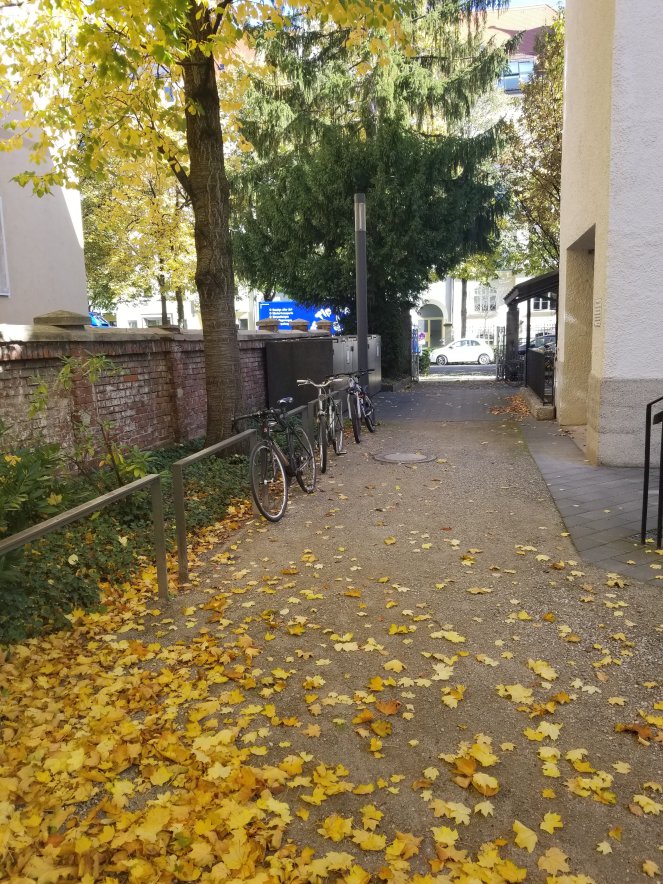
Sam is waking up in Munich to bikes in the sunshine and beautiful bright leaves

Sure I’m still jetlagged and sleepy. But today I started to feel a little bit more alive. I asked questions in the talks at the conference. I sat outside in the sunshine and smiled. I’m having a wonderful time in Munich. There are really good papers at this conference and really interesting people here presenting. I’m meeting colleagues from all over the world. And I got excellent feedback on my talk which I’ll be rewriting as a chapter in the edited volume we’re putting together. Exciting.

There are also little things to enjoy such as delicious apples and salads in glass jars at lunch time. Since Martha asked, I’ll tell you, the dressing was also in little glass jars. No plastic in sight.

What else is making me smile? There are brightly coloured leaves everywhere. There are also bikes and bike lanes (so many bikes!) and I’m already thinking I need to come back. Maybe I’ll bring my Brompton next time.

I’m not moving here though despite what social media thinks.

First LinkedIn offers me German health insurance for my big move. Now all my Facebook ads are for German classes.

The latter might come in useful.

Bis zum nächsten Mal!


Alcohol free white beer!
fitness

test test test

By MarthaFitat55

I remember the day it happened. One day I was overweight; the next day, I was obese.

No, I didn’t consume a tandem load of Girl Guide cookies. Nor did I suddenly get a new scale with ultra-accurate technology.

What really happened was the insurance companies got their way and the range for the Body-Mass Index shifted upward.

Systems recalibrate all the time. But in 1998, large groups of people went from having a slightly concerning (or none at all) issue with their weight to one in which massive interventions were required to stave off an earlier than desired departure from this mortal plane.

So you couldn’t colour me surprised when I read this article in the Medium about the racist origins of the BMI. But I was taken aback to see this quote:

While Quetelet’s work was used to justify scientific racism for decades to come, he was clear about one aspect of the BMI: it was never intended as a measure of individual body fat, build or health. For its inventor, the BMI was a way of measuring populations, not individuals — and it was designed for the purposes of statistics, not individual health. medicine.

Think about that: it was designed for the purposes of statistics not individual health.

And yet today, health media abounds with stories of how BMI is being used in grade schools to measure childhood obesity, on an individual level.

In the gym, I measure my success individually, but with precise tools. I didn’t start out lifting 230 pounds but overtime I and my trainer built up my endurance, my strength and my skill. The BMI is never used because it’s an inappropriate tool. Even the Centre for Disease Control in the US provides guidance to health practitioners on how to use the tool.

With the changes in the ranges for risk for BMI, people’s health status changed overnight. For many, they went from having little, or some risk, to a lot. What does that mean in practical terms?

When I became pregnant, I went from a low pregnancy risk category to a high one. When I was having a minor procedure a couple of years ago, the nurse sent me for a surgical risk screening based solely on what my BMI said: not what my blood pressure, my strength, or my general level of fitness showed.

It’s good to manage risk, but you have to do it properly. Using a flawed tool does not minimize risk. In fact, it may increase your level of risk for inappropriate treatment or intervention. It’s time we talked in greater detail on the issues surrounding BMI and understood more how fitness through regular activity can reduce risk rather than applying some numbers.

— MarthaFitat55 lives in St. John’s.

fitness

Should I be worried about vaginal atrophy?

Last week I wrote a post about how the Bot Ad Overlords and my friends crowdsourced me a new anxiety: incontinence. I alluded to another worry that’s coming close on its heels: vaginal atrophy.

Or, as the New York Times recently called it, “the incredible shrinking vagina.”

What exactly is vaginal atrophy?

Essentially, as your estrogen levels drop during menopause, the “skin of the vulva and vagina become thinner with a loss of elasticity.” Labia minora can also shrink. And all of this is commonly accompanied by dryness, or, other symptoms during sex, “loss of lubrication, an uncomfortable sandpaper-like sensation, pain, difficulties achieving orgasm and even tearing of the vagina or vulva. There is also an increased risk of urinary tract infections.” Oh — and also according to the NYT — “as estrogen is crucial to maintaining the bacterial colonies of the vagina, there can also be a change in the type of bacteria, which can lead some women to notice a change in their typical smell.” This delightful array of symptoms is formally known as “genitourinary syndrome of menopause” — or GSM.

I think I speak for all of us when I say:

So what to do? What to do?

That link to the NYT piece has some basic suggestions, including obvious things like unscented soap, lube and vaginal moisturizers. But these are about managing symptoms — to try to do any prevention, you need to explore with your doctor about whether different pharmaceutical options, like vaginal estrogen creams etc., are a possibility.

This is where the feminist piece comes in for me: short of asking me “are you still having periods?” my doctor has never raised or mentioned anything about peri-menopause, my aging uterus or dwindling hormones — let alone my shrinking vagina. (I’m working hard here not to start to mentally distance myself from my discomfort here by using terminology like “my petrifying pussy” or “languishing ladygarden.” I never use those kinds of terms, but my inner voices are all like, eek must make this a joke!) It’s one of those not-talked-about things.

We were talking about this NYT piece the other day and Susan pointed out that if things are going to shrivel, by the time you become symptomatic enough for a doc to treat it as a thing, things are already shrunken, and you’re managing symptoms, not preventing anything.

So this is my little feminist rant for this: older vagina-having people are sexual beings, and it’s a perfectly reasonable thing to want to preserve your juiciness. Docs aren’t going to offer anything until it’s a problem. Topical estrogen seems to be a (relatively, of course) safe option to prevent shrinkage. Seize your own destiny on this.

What’s up next in the “Icky Things my genitals might do” series?

Fieldpoppy is Cate Creede, who lives and ages and frets in Toronto.