fitness

Sam starts to swear: “That’s bulls**t”

When social media quizzes ask for “unexpected facts about you” or “10 things about me that would surprise my Facebook friends” one fact I’m often tempted to supply is that I don’t swear.

I mean, on a very rare occasion it does happen that I swear, when something really bad happens, yes. Then I can and do swear.

For example, on a certain evening in November 2016 things looked they weren’t going very well for the Democrat’s candidate for President. I thought it was just a blip. I needed to get some rest. So I said to Jeff, “Just wake me when Hilary’s won.” He didn’t wake me. My alarm went off in the morning at the usual time. I woke up and looked at my phone and the news of Trump’s election greeted me. I swore then.

That gives you some idea. Things need to be “Trump election bad” before I swear.

Why don’t I swear? There’s some background here, of course. I was taught by nuns, educated in Catholic school. My father didn’t think swearing was ladylike. I’m from England. (An aside: A younger me was once cut off from drinking in a pub in my home town in Northern England for swearing. The bartender said, “What did you say, young lady?” I genuinely thought he didn’t hear me so I repeated it loudly. “It’s f**king cold in here.” Also, it was.)

And I know people who share a lot of these traits and who swear up a storm so it’s not a complete explanation. But it’s a start.

There was a brief swear-y time of life. I also had an 80’s punk haircut and tried to scowl. It didn’t take though. I’m an inveterate smiler and I don’t swear.


_________________________

I even have a philosopher’s explanation about why. One day the CBC radio show DNTO (Definitely Not The Opera) called the philosophy department looking for someone willing to go on air to talk about what, if anything, makes swearing wrong. I couldn’t think of answer and so passed but I kept thinking and came up with an answer.

My answer is connected to the problem tenants in my house at that time. We had just bought a side-by-side duplex with plans to take over the whole thing but it had tenants in one half. They were a group of young women who all worked for the phone company and who liked to have parties on the weekend. I didn’t mind them but I did mind their boyfriends. In particular what I minded was the drinking on our front lawn that involved yelling and swearing.

So what makes swearing wrong? It signals to people that you’ve crossed a line. You’re outside the norms of polite discourse. What’s next? Threats? Actual violence?

If you have a background where you associate swearing with alcohol and loosened attachments to rules and norms, swearing might make you flinch.

It signals a willingness to break rules of polite interaction.

I’m still thinking about this. If you’re a male professor reading this and you think swearing in the classroom makes you seem young and hip and rule break-y keep in mind that not all of your students hear it the same way.

So that’s my history and a brief bit of ethics.


_________________________

Next up: Why does a fitness blog care?

This story:  Could swearing make you stronger at the gym? Maybe.

See also Swear More To Boost Muscle Power In The Gym, Study Suggests.

And  Swearing makes you stronger so stop f***ing around and start lifting.

You get the idea. Dozens of blog readers and Facebook page followers and friends sent it to me.

Here’s the study:

Psychologists at Keele University conducted a series of experiments, including putting two groups of participants on exercise bikes. One group cycled for 30 seconds while yelling out all kinds of profanities while the others were only allowed to let out neutral words.

And they found that the swearers’ peak power rose by 24 watts on average.

The next task they got everyone to perform was a single hand-grip test.

Again, those who muttered obscenities throughout upped their strength by the equivalent of 2.1kg.

‘In the short period of time we looked at there are benefits from swearing,’ said Richard Stephens – one of the psychologists from Keele.

Swearing has also been found to lessen pain.

I’ve looked for detail of the study. Most of the stories tell us that the participants are volunteers and they are at a university. They are said to be 21 years old.  I assumed they were male. And I worried about that as a weakness of the study.

But no, there were roughly equal number of men and women in these studies.  And you got to choose your favourite swear word. Nice!

_________________________

Oh and then there’s the “smart people swear more” stories that friends love to share.  See Intelligent People Use More Swear Words, According To Study.  And stories about women swearing more than men, Women use the F-word more than men, according to new survey.

So I’ve been curious about whether I can get over my aversion to swearing. My teenagers occasionally try and they love to laugh at my efforts.

Recently, spending time with Sarah in Toronto, I’ve noticed that she often says, of traffic, of other peoples’ parking, of contractors who don’t follow through, “that’s bulls**t.” It turns out that’s one I can manage. The other day I was describing the traffic on a stretch of road on a bike rally training route where cars were whizzing by too fast, too close and I said it was “bullsh**t.” Since then Sarah’s been prompting me. “What would you say about the lack of vegetarian food in this restaurant?” Turns out that there are many of these opportunities.

Also, Cate and I agree: Gaining 8 lbs over the winter while working out lots and eating the same as usual. That’s bulls**t!

So, progress?

I’m pretty sure it won’t help my cycling or my lifting but maybe I should try it the next time I go in for fitness testing on the bike.

_____________________________

How about you? Do you swear? Do you swear when you’re racing or lifting or trying to do physically hard things? Does it help?


fitness · weight loss

Followup on “Fit but Fat” research news

This week the mainstream news media rushed to publicize a conference paper given at the European Congress on Obesity that argued that there’s no such thing as “fit but fat”. I posted Wednesday night with some immediate reactions and questions– you can see them here. Many of my questions were about the details of the study, for which we must wait until an article is published.

However, since then, I’ve been thinking more generally:  What does this mean, the idea that there’s no such thing as fit if you’re fat?  Is this right?  And how does all this affect people with a BMI >30 (like me)?  So let me address each of these questions, and you can tell me what you think about my answers.

First, questions about meaning (sorry, it’s the first place philosophers tend to go, but I’ll keep it short):  What does “fit but fat” mean?

When medical professionals say this, they’re generally talking about people with BMIs over 30 (or even over 25), who don’t have any problems like high blood pressure, cholesterol or blood sugar readings, or various markers of potential future heart disease or potential future diabetes.  That is, fit but fat people are healthy people who weigh more than the BMI scale says they should.

Just for fun, when I looked up google images for “fit but fat”, I got this gorgeous picture of two sumo wrestlers locked in a lovely balletic grapple.  Wow.  Don’t they look great?

Two sumo wrestlers locked upside down, grappling, with legs in arabesque position.

But there’s the “but” to deal with in the “fit but fat” message.  Why the “but”?  Why not “and”?  “But” is signalling that someone is fit, BUT all is not well– that person is also fat (which is not normal or good or healthy or… fill in the blank here).  Even we we say it about ourselves, we are putting ourselves down, as “fat” is often associated with being unhealthy or defective or sub-optimal in some way.  So being fit but fat is not exactly a position of great positivity to begin with.  And now it’s being challenged by this study (to be fair, there are other studies with similar results– BUT there’s not medical consensus on the issue).

And it gets worse.  Saying that it’s not possible to be both fit and fat seems to mean that BMI trumps ALL other factors (genetic, environmental, psychological, etc.) when it comes to determining health and risk for (weight-related) disease.  Is this right?  No– not as stated there.

What medical researchers say holds for a population or group overall does not necessarily hold for particular individuals.  As we say, your mileage may vary.  A lot.  Here’s what the researchers said (this is from Pub Med Health, which doesn’t make money from splashy headlines; for a clear and undramatic account, check it out):

Of the 3.5 million people in the study, 766,900 (21.9%) were obese – of whom 518,000 (14.8%) were obese with no additional risk factors (metabolically healthy).

The researchers found that, compared to people of recommended weight, metabolically-healthy obese people were:

  • 50% more likely to get heart disease
  • 7% more likely to get cerebrovascular disease
  • twice as likely to get heart failure

Metabolic risk factors raised the chances of getting any of these conditions, in addition to obesity.

Compared to recommended weight, metabolically-healthy people, those who were obese and had all three risk factors (diabetes, high blood pressure or abnormal blood fats) were:

  • 2.6 times more likely to get heart disease
  • 58% more likely to get cerebrovascular disease
  • 3.8 times more likely to get heart failure
  • 2.2 times more likely to get peripheral vascular disease

The researchers say their figures were statistically significant; however they were unable to supply the full data with confidence intervals, so we can’t check this.

We don’t know if this research is largely correct.  I have a whole bunch of technical questions about the study (all of which have to wait for the data and the article to be published).  Their work coheres with some studies and conflicts with others.  As always, we will have to wait to see how things go.  Science is complicated.

Now to my last question:  how does this result affect people with BMI > 25 and > 30?

In my view, there may be good news and bad news in answer to this question.  Shall I go with the bad news first?  Okay.

Uptake of the message that you can’t be fit if you’re fat could lead to more weight stigmatization, more fat shaming of people who seem larger than some idealized notion of a person.  This could lead to eroded relationships with healthcare providers and more money spent on useless diets and weight loss programs.  But most importantly:  it could mean less physical activity in the population, which translates into generally lower levels of standard health markers and lower levels of all sorts of features of well-being.

That’s my biggest problem with the news so far.  We don’t know if these researchers got the details right, and we don’t know how to interpret them if they did.  But what we do know is this:  studies consistently show that physical activity is a great predictor of health and a great mechanism for achieving and maintaining lots of features of well-being (e.g. less depression, better sleep).  And unlike body weight, physical activity (which isn’t the same as fitness, but hear me out) is something that a lot of us have some modicum of control over.  Becoming fit (in the various ways we understand that word) has a lot of benefits.  It’s not the only useful life goal, and it’s not of interest to everyone; fair enough.  You do you.  But I don’t want to see its value drowned out amidst the shouts of studies trumpeting the importance of having a lower body weight.  Especially since medicine offers no remotely effective tools for lowering and maintaining body weight over time (except gastric bypass, which as I’ve said many times isn’t designed or an option for most people).

Now to the good news:  if it turns out that scientific consensus develops around this idea– that the main thing that matters to my health (at least some features of it) is my body weight, then this might put pressure on governments to do something about our obesogenic food systems and infrastructure.  They could, for instance:

stop subsidizing corn production;

fund and promote public transportation;

tax sugar-sweetened beverages;

restrict food advertising targeted at children (or anyone, for that matter);

to name a few.

Are any of the actions above going to happen because of one research article?  No.  But it’s worth noting that as we learn more about the science of body weight and its relation to our health, we may find that more players are involved, giving us more options for promoting health and wellness in many ways.  Hey, an aspiring to be fit feminist can dream, can’t she?

a girl in tones of blue and silver, sitting on a cloud, gazing at a blue-gray hazy mountain top and sky.


fitness · nature · race report · racing · running

Seaton Soaker 50k (Guest post)

This Saturday is the first one in months that I haven’t been out the door at the crack of dawn (oh, okay, 7:30 am is hardly the crack of dawn, but it’s certainly earlier than I leave the house on a weekday!) to go for a long run.

That’s because last Saturday, May 13, I finished the race that I had been training for since January: the Seaton Soaker 50k.

race2.jpg
Stephanie running the Seaton Soaker 50k.

I’ve blogged about running Seaton before, but for shorter distances. This was my first time doing the 50k distance — my first time doing an ultramarathon.

I’ve done the Scotiabank Waterfront Marathon for the past three years, so I’m no longer a stranger to long distances and months of training. The last marathon was the first time I had a time goal in mind. I wanted to break 4 hours, 30 minutes, but a combination of undertraining and unseasonably warm weather meant that was not to be. I felt awful at the end of that race. Physically, I was destroyed. Everything hurt more than any other marathon I’d done before. Mentally, I was a bit bummed that I’d trained so long for no improvement on my time.

It was time to do something new. Enter Seaton.

I had actually signed up for the 50k two years before. I’d put in two months of solid training in January and February of 2015 before my workplace went on strike and my training fell to the wayside. This time, I hoped, things would work out better.

And they did. My partner, Kevin, signed up (he, too, had been intending to run in 2015), as did my friend Casey (read her race report here!). Both Kevin and Casey ran their first marathons in 2016, so I’d say they’re a heck of a lot braver than me to sign up for a 50k the very next year!

prerace
Kevin, Stephanie, and Casey before the race. Can you see the terror in Stephanie’s eyes?

The three of us did a lot of training together, although Kevin is much (much!) faster than Casey and I. We ran through the snow in the winter and through the rain in the spring. We hit the trails whenever we could, including the Seaton trails where the race would be held.

Training went about as well as could be hoped for. Nobody got terribly injured (though Kevin struggles occasionally with Achilles issues, and I had the spectre of a calf injury rear its head on our longest training run of 38k). Nobody missed very many training runs.

On race morning, I was very emotional, but I didn’t quite pinpoint why until later. It had been three and a half years since I’d run a new distance. This was big!

prerace2
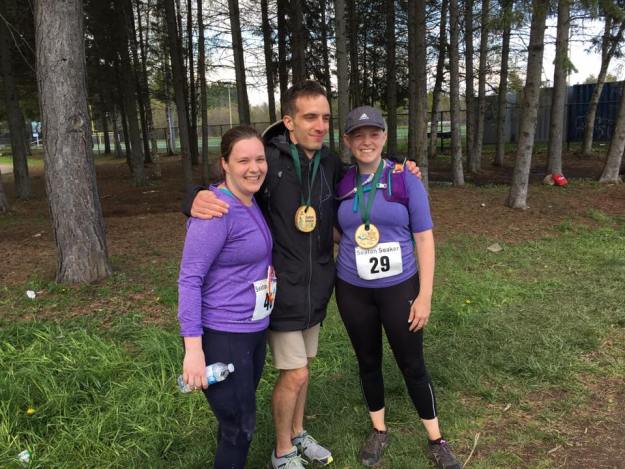
Casey and Stephanie before the race. The matching purple shirts were coincidental, but turned out to be great fun as the volunteers would shout “here comes team purple!” when we came into view.

The course is a 12.5km out-and-back, meaning that we could leave bags at the start/finish with snacks, a change of clothes, more water, etc. We stashed our things and set off.

Kevin started near the front, because, as I said, he’s fast! Casey and I were content to hang near the back of the pack. Our only goal was to finish, ideally before the cutoff time of eight hours.

About 2k in, we hit a beaver dam that we had been warned about. It was wet, messy, and muddy, with planks and pallets plunked into the mud for a makeshift pathway. Some runners tried to stick to the pallets – others forged through the muck, sometimes falling. It was a great example of the difference between trails and roads.

race1
Stephanie and Casey fairly early in the race.

After that slowdown, the pack thinned out as people settled into their paces (most faster than Casey and I). We kept trucking along, hiking up the hills, flying down the hills, and slogging through the muddy patches. We tried to be mindful of the fact that we would be out for a long time, so we didn’t want to go out too fast.

We hit 12.5k at about 1:51, which was great pacing for being under eight hours, but not too fast to be unsustainable. The first leg is a net uphill, so it’s a net downhill on the way back.

I tried to be good about my nutrition, which is something I can struggle with on long runs. I ate my gels in the first half of the race because I knew that they wouldn’t go down well in the second half. My other fuel of choice is stroopwafels and Honey Stinger chews.  The aid stations had a nice spread of food as well, from chips and guacamole and boiled potatoes to peanut butter sandwiches and gummy bears. The most appealing thing to me was watermelon, which I ate at almost every aid station.

On second leg (back to the start/finish, the halfway point), the course diverts so that runners have to cross a river (hence the name “Seaton Soaker“). There are firefighters and a rope to help people across. I love the river crossing! We shuffled right in to the icy water, which felt pretty good as the day grew warmer.

race3
Crossing the river at 23k.

From the crossing it’s only about 2k back to the finish, or halfway point. We hit a big, deep, steep muddy culvert that was difficult to climb out of. I slipped and pulled my bad calf, but after walking it off for a minute I felt good enough to keep going.

We reached the halfway point at 3 hours and 30 minutes. My mother was waiting to cheer for us there, which was really great. She and a helpful volunteer (huge shoutout to all the volunteers, who were fantastic) helped us refill our hydration packs. I debated changing into a short sleeve tee, because it became clear that we weren’t going to get the rain that the forecast had called for and the sun was coming out. I stayed with my long sleeve mostly to avoid potential chafing issues. Changing socks/shoes was right out of the question – mine were caked on with mud!

midrace
Stephanie devouring watermelon halfway through the race.

We set out on our second loop, briefly making a wrong turn. A fellow runner corrected us, thankfully! We realized we were pretty much at the back of the pack, but that didn’t trouble us at all. We were just in it to finish.

We wondered whether we would see Kevin on this lap, and we did! He came hurtling down a hill as we were walking up it. Judging from the number of runners we had seen before, I shouted, “Are you in third?!” He said he was in fourth, and that he was feeling pretty good. Yay!

It started to feel much harder on the second loop, as expected. Our legs were tiring and both Casey and I tripped a few times on roots. Mostly we managed not to fall, but Casey took a pretty decent nosedive into some leaves and dirt at around 30k. She hopped back up and brushed herself off and took off like a champ. Casey is one of the most stubborn, determined runners I know. Running with her is very motivating!

At the turnaround, we calculated that we had about 2 hours and 30 minutes to make it to the finish — plenty of time! It was slow going, but we just kept running, usually only walking when we hit a hill. We knew that if we stopped, it would be very hard to start again.

At the second water crossing, the firefighters and rope were already packed up. We weren’t impressed with that, but we made it across safely and stayed to make sure another runner behind us was able to cross as well. (Edit: We contacted the race organizer the next day, and he didn’t realize the firefighters had packed up early. He promised to make sure it didn’t happen that way next year. The race really is a lovely, well-organized one!)

Our families were waiting for us as we came out of the woods to run up to the finish line, and Casey and I both started getting a bit teary and emotional from seeing them and from realizing we were about to finish.

We crossed the finish line in 7:32, well under the 8 hour cutoff! Casey and I exchanged our homemade medals that we had crafted for each other (this year the race opted to give out finisher buffs instead of finisher medals). We took very different approaches to making our medals, but we both love them! Mine is a unicorn barfing up a rainbow, and it reads “#1 Majestic Beast.” It’s perfect.

finish4
I love the medal! I also loved being finished!

We discovered that Kevin had finished in 4:42, coming in 5th overall, and 1st place in his age group…not bad for his first 50k! We joked that he could have done a whole other lap in the time it took us to finish, to which he replied, “No, I definitely could not have.” He gave it his all!

finish2.jpg
Stephanie, Kevin, and Casey after the race.

Casey and I placed 9th and 10th in our age groups. That sounds pretty impressive, but it was out of 10 people! Hah! We were 71st and 72nd out of 76 runners (though I think about 80 signed up, so a handful of people may have dropped out before or partway through the race).

I was quite sore after the race, but not as sore as after my last marathon. I was also able to eat some food a couple hours later — a good sign, as long races usually destroy my stomach. The sore muscles mostly faded after a couple of days, and by Wednesday I was able to try a short run again. I made it 4km before deciding that my muscles just weren’t ready yet — but I don’t think I’d ever tried to run just four days after any previous marathon!

finish5.jpg
Stephanie’s very muddy shoes.

So would I do it again? Yes, I think I would. I love running on trails. It’s not as hard on the body, in some ways, compared to the repetitive nature of road races. Plus, the scenery is beautiful and the people are super nice (even the leaders would say “Great work!” to us as they passed us). The training is certainly a commitment, though. Maybe we’ll try to get faster one day… but hey, maybe not. Back of the pack isn’t so bad.


Stephanie is an astrophysicist, writer, photographer, sometime triathlete, and now an ultramarathoner.

fashion · fitness · weight lifting

Moving from involved to committed

By MarthaFitat55

Image shows two bent tubes of neoprene fabric in black with red accents
Martha’s new gear! Image shows two bent tubes of neoprene fabric in black with red accents

What’s the difference between being involved and being committed? The business fable uses bacon and eggs to explain: the pig is committed, while the hen is involved.

When we talk about fitness, it’s a bit of both. This week, I made the leap from involved to committed. I bought a pair of knee sleeves.

For the last three years, my fitness clothing has been nothing fancy. I originally started with a pair of ratty yoga pants and a tee shirt. Then I graduated to a pair of capris found on the sale rack.

Occasionally when it gets superwarm in the gym during the summer, I rescue one of my old rowing tanks. And while I’ve always invested in good footwear, when a friend offered a pair of deadlift shoes at a discount, I bought them to save her the hassle of returning them. Luckily they turned out to be a good fit, and if I ever decided to stop lifting, they could probably work for something else.

So my approach to workout gear has been minimal at best; involved if you like.

But these knee sleeves are the first thing I have thought about, tried out, and decided to expend the funds necessary for me to have my very own pair so I can lift well and with the proper support.

That’s because these sleeves are simply miraculous, and I don’t use that word lightly.

This winter, my trainer and I have been working on developing greater depth for my squats. I have a regimen of exercises to strengthen my hips, and over time, I have been able to drop lower and lower.

It’s been all good. Except when I watched videos of fabulous women lifters getting their “ass to grass” in squats, I admit I felt a wee bit jealous.

During a cold spell last month, my knees became cranky. My trainer suggested I try the sleeves when we reached higher weights on the bar. I borrowed a pair for the session, and I did not want to give them back. As I worked my way through the sets, I began scheming how these sleeves would be mine.

Since I like the owner, I decided they should stay where they belonged. I did borrow them again a couple of times to be sure they were as good as they felt the first time, and this week, I went online and committed.

The sleeves provide a level of support I did not think was possible, and yet, when I wear them during squat sessions, I have no hesitation standing up after dropping down. Though they are working on the knees, the sleeves send a message to my hips that the knees are in charge and stability is the goal. And while I’m not as close to the level as I see on the training videos, I am achieving very creditable squats that pass the form test quite well for depth and control.

I see you grass and I am coming for you.

— Martha lifts and writes in St. John’s, Newfoundland.

fitness

Alkaline water is a thing (but is a thing we should care about?)

close up of bottle pouring water on glass
Image description: bottled water pouring into a glass. Photo by Pixabay on Pexels.com

A friend tagged me the other day to draw my attention to a post about the alkaline content of different kinds of bottled water. There are loads of reasons to be skeptical about bottled water (like the environment and the amount of landfill space the bottles take up if they even make it to landfill, the availability of perfectly good tap water in lots of places, the commodification of a resource that is a basic necessity for humans to live). But alkaline content was a new one for me. This may mean I’ve been inattentive to something that really matters. I don’t know. But it’s news to me that some water has more alkaline than other water, that low alkaline water is acidic, and that (here’s the assumption I didn’t know what to do with) acidic water isn’t good for you.

This was the video in question (from September 2016, which was a time in the history of the world that many people were preoccupied with other things):

What I noticed most about this video was that though they talked a lot about the lower alkaline water being acidic, they didn’t give a lot of info about what’s wrong with that. So I did some reading.

In “Is Alkaline Water Extra Healthy or a Hoax?” Jess Baron outlines the purported health benefits:

Many alternative health experts say that alkaline water — whether purchased in bottles or created from your own tap with a pricey do-it-yourself ionizing purifier — is an extra-healthy type of water to drink, with claims that it slows the aging process, increases energy, helps people with fertility issues, regulates your body’s pH level and prevents chronic diseases like cancer.

I know many people are into the views of “alternative health” experts and have found solutions for their various ailments by following their advice. If that’s their experience, fine. I’m a bit more science-based where my health is concerned, and it seems to me that these are big claims that need to be supported by evidence.

I’m a big believer in the health benefits of water. I drink my share of it, usually from the tap because I am fortunate to live somewhere where clean drinking water reliably flows. I’m all for staying hydrated and drinking the recommended 6-8 8oz. glasses of water per day.

The first question I had about the recommendation of alkaline water was: “what is the reasoning?”

In “Alkaline Water: Beneficial or Bogus,” John Berardi explains the thinking (before he subsequently subjects it to critical scrutiny):

The concept with alkaline water is this: Tap water contains different dissolved elements that influence its pH level. Pure water has a pH level close to 7. Alkaline water has a pH above 7. So the idea is that to create a more alkaline balance in your body, you should drink water with a higher pH.

Baron quotes the Budwig Centre, an alternative cancer treatment facility in Spain:

Alternative medicine proponents such as the Budwig Center, an alternative cancer treatment clinic based in Spain, believe that our bodies need to be strictly maintained at 7.4 pH in order to achieve and maintain optimal health and to fight cancer. “If you have ever maintained a swimming pool, you will have had to verify the pH of the water on a regular basis and have had to add different chemicals to keep it at pH neutral,” it says on the Center’s website. “Our bodies are in effect like a swimming pool, as we are 80% water and our pH needs to be kept at 7.4 neutral to be healthy.”

Berardi says that there are a few problems with the basic reasoning behind the strategy of drinking higher alkaline water to increase the body’s ph level:

First of all, each organ system has a unique pH range, and our bodies naturally do a fantastic job of maintaining blood pH within each respective range.

Secondly if your pH is out of balance, it’s important to get to the underlying cause. Without knowing the cause, you can’t determine whether alkaline water will really help you.

What’s more, focusing on the pH level of our water is sort of besides the point. Because if alkaline water is helpful, that might be due to the minerals it contains rather than its pH level, per se.

Also, keep in mind that overall body alkalinity isn’t always a good thing. For example, if you have a kidney condition, or you’re taking a medication that alters kidney function, some of the minerals in alkaline water could start to accumulate in your body. In this case, high alkalinity might lead to negative side effects.

My skepticism kicked into high gear when I read (in Baron’s article):

While anecdotal evidence suggests that alkaline water might be beneficial to health, so far, it’s important to note that there’s not a lot of solid data.

So far there are no peer-reviewed studies demonstrating that consuming alkaline water can reduce a person’s cancer risk or help them to better fight cancer. Additionally, the American Cancer Society does NOT make a recommendation for consumption of alkaline water.

While its cancer-prevention and anti-aging properties are in question, some researchers suggest that higher alkaline water can protect your gut from dangerous micro-organisms and reduce acid reflux.

There is also some suggestion that it could benefit endurance athletes:

Drinking alkaline water might enhance the body’s buffering capacity and temper the acidity, thus improving our performance.

Note that mineral supplements (calcium, magnesium, potassium) decrease cardio-respiratory stress and blood lactate responses, while improving power output in endurance athletes. That’s why long-distance runners sometimes supplement with sodium bicarbonate. Alkaline water may work similarly.

Until there is more information, I’m putting alkaline water in the same category as detoxes and clean eating, two other fads that have their devotees who swear by them because of personal experience with feeling better. Maybe. I’m not one to discourage people from doing things that they enjoy.

When it comes to food choices, I’m all about moderation and the basics. Trendy fads don’t draw me in. Alkaline water strikes me as a trendy fad (at this point — I would welcome and consider more research) whose proponents are making ambitious claims that are not supported by any hard evidence.

Do you drink alkaline water? If not, would you? If so, why?


fitness · weight loss

Late breaking FFI news: episode 658 of “Don’t believe the headlines”

We at the Fit is a Feminist Issue news desk are committed to bringing you up-to-the-minute news, commentary and perspective on a variety of topics– no matter the day, no matter the hour.

So when co-editor-in-chief Samantha FB messaged me to get on this story, I got straight to it (after eating my dinner, that is; you can’t do good investigative journalism on an empty stomach).

The story is– what are we to make of the mainstream news stories claiming that “Fat but fit is a big fat myth”?  This was the headline of a BBC article, out today.  What’s the deal?

Here’s the upshot: At this year’s European conference on obesity, researchers from the University of Birmingham gave a paper suggesting that the notion that people could be obese, metabolically healthy, and therefore not at increased risk of heart disease and diabetes is false.

This reporter will dig into more detail for Sunday’s blog post, but for now, I’ll tell you what the news article says, and then what questions I have (as an academic who researches and writes about this medical and scientific literature).

First, here’s what an article by the Guardian has to say about the new study (which is not even in article form, much less submitted, much less reviewed, much less accepted for publication, much less published):

Several studies in the past have suggested that the idea of “metabolically healthy” obese individuals is an illusion, but they have been smaller than this one. The new study, from the University of Birmingham, involved 3.5 million people, approximately 61,000 of whom developed coronary heart disease…

The scientists examined electronic health records from 1995 to 2015 in the Health Improvement Network – a large UK general practice database. They found records for 3.5 million people who were free of coronary heart disease at the starting point of the study and divided them into groups according to their BMI and whether they had diabetes, high blood pressure [hypertension], and abnormal blood fats [hyperlipidemia], which are all classed as metabolic abnormalities. Anyone who had none of those was classed as “metabolically healthy obese”.

The study found that those obese individuals who appeared healthy in fact had a 50% higher risk of coronary heart disease than people who were of normal weight. They had a 7% increased risk of cerebrovascular disease – problems affecting the blood supply to the brain – which can cause a stroke, and double the risk of heart failure.

The article then goes on to foment panic among health care providers and consumers.  Well, I think the tone is a little frantic.  See what you think:

Susannah Brown, senior scientist at World Cancer Research Fund, said the study’s finding, “emphasise the urgent need to take the obesity epidemic seriously.

“As well as increasing your risk of cardiovascular disease, being overweight or obese can increase your risk of 11 common cancers, including prostate and liver. If everyone were a healthy weight, around 25,000 cases of cancer could be prevented in the UK each year.”

Right.  Now, let’s all take a deep breath.  As some of you know, I’ve posted often about how real science is complicated, so we should not take sensationalist news headlines as telling the truth about new, or controversial, or counter-intuitive, or nuanced research results.  So here are some questions I have:

When the researchers talk about increased risk that people with BMIs over 30 have for various illnesses, are they showing statistically significant increases or clinically significant increases?   What I mean here is this:  a researcher can find a shift in risk that ends up being irrelevant to the real-life clinical likelihood of developing particular conditions (this is complicated but important).  We don’t know, as there is no paper yet.

What sorts of risk profiles did the researchers find for people with BMIs under 25? under 20?  When one peers at the fine print in the data tables in medical and epidemiology papers (as I am wont to do), one finds interesting and potentially reportable risks for folks who are co-called underweight–  BMI under 18.5.  Are there increased risks in those groups?  Are they comparable to the risks in the BMI> 25 and >30 groups? We don’t know.

What about the same BMI in different age groups?  How do those risks vary over the life trajectory?  It turns out that at various life stages, different BMI groups have very different risk profiles for medical conditions and death due to medical conditions.  For instance, men in their 50s with BMIs <18.5 have a pretty high all-cause mortality risk (generally from cancer).  We don’t know anything about this yet.

Then there’s how they defined their terms.  Sounds pedantic (and yeah, it is, but this is my job), but it’s important to know very precisely how the researchers defined metabolically healthy in terms of blood pressure, cholesterol, blood sugar (e.g. Hemoglobin A1c), and then what clinical end points (that is, records of diseases people in the study ended up having) or surrogate end points (e.g. blood pressure, cholesterol, blood sugar) they used.

And last (until Sunday; consider yourself warned): it seems to me (and lots of scientists agree) that the jury is out, sooooo out, on a clear understanding of the ways in which both genetic and environmental determinants of human metabolic processes contribute to body weight change and maintenance.  Topics currently being investigated include:

  • the role of body fat
  • the role of body shape
  • the role of abdominal fat
  • the role of visceral vs. subcutaneous fat
  • how visceral fat and trigliceride levels interact
  • the role of body weight variation over the life trajectory
  • what science and medicine can do about the body weight of the population (since so far medicine has come up with nothing effective other than gastric bypass, which has its own problem)
  • And much much more.

One last comment: the standard view in medicine and medical research is that having  a BMI over 25 is bad for people, and a BMI over 30 is much worse (and don’t even get me started on over 35, over 40, etc.) Studies and articles that have come out challenging that assumption have been pilloried by a lot of public health and medical experts.  But, like any scientific paradigm, there’s research on the edges, and sometimes that research gives rise to a new paradigm.  I don’t know if we’re on the way to a new paradigm, but I know that the current paradigm has left a lot of important and foundational questions unanswered.  Of course, that doesn’t make for good headlines.

Three women reading the newspaper with shocked looks.


competition

Lyndsey feels excitement, pride and just a bit wistful about Women’s Aussie Rules Football (Guest post)

Image of women playing football from the AFL site, http://www.afl.com.au/

Earlier this year was the inaugural Australian Football League Women’s (AFLW) season. It was an 8-week season, with eight teams from across Australia competing. The Grand Final was a close and exciting game, won by a narrow margin by the Adelaide Crows over the Brisbane Lions.

For those unfamiliar with the game, Australian Rules Football has been officially around since the 1850s, when it was first codified, with the first league founded soon after in the 1870s. It is a highly skilled game, and is played with a uniquely-shaped ‘prolate spheroid‘ ball. Australian Rules Football is the world’s oldest football code, and is particularly beloved in its home town of Melbourne where huge crowds flock each week to watch the game, and newspapers regularly have football ‘news’ stories splashed across the front pages… followed by football ‘sports’ stories in the actual sports pages. Even during the off-season! There is now a public holiday prior to the Grand Final, and it is quite acceptable for Melbournians to wear their football scarves to the office in the finals season.

The history of women playing AFL football goes back to the early 1900s, and women have been able to play football as juniors for quite some time. As a high school student in the 1990s, I played for my school’s women’s team against other local schools. Playing the game was very physical and hard, but it was a lot of fun, and I still have very vivid memories of the games I played in. But it never occurred to me that it was something I could play outside of school – I wasn’t aware of any local women’s leagues at the time. There was certainly no visible profile of the sport as something that women could play. Instead I played basketball and later, in my twenties, got involved in road cycling. Playing football was more of a novelty at the time, and it was a great honour to play for my school team, which was known as the best in the region.

This year, I watched several games of the AFLW, including the Grand Final, with a mix of excitement and pride, but also wistfulness. All the games were free to attend, and the crowds were beyond the AFL’s expectations. As a viewer, what delighted me the most was the normality of watching the women play. The players wore the same style of uniform as the men (no skirts or bikinis here!), and the games were very physical and tough, with hard tackling, exciting goals and thrilling marks. There was no attempt to make the game ‘sexy’, ‘cutesy’ or a novelty – to me it was just watching fit, skilled people (who happen to be female) playing a good game of football.

The inaugural season has inspired more women and girls to get involved in playing the game, with new regional leagues starting up, and plans to expand the national league in 2019. Over time, as the players become more professional and are able to devote more time to training and playing at a high level, and as the game at junior and amateur levels develops, the pace and skill of the women’s game can only increase.

The wonderful normality of the women’s game extended into the post-season celebrations in a way that men’s league is yet to achieve. The Best and Fairest Awards were held after the Grand Final, with the players and other attendees dressed in their finest for the dinner and speeches. When Adelaide Crows premiership player Erin Phillips was announced as the winner of the Best and Fairest award, she leaned over and kissed her wife, Tracy. Erin Phillips became a professional basketballer after being told at the age of 13 that she couldn’t continue to play football with the boys. Being able to return to football all these years later – and win the Best and Fairest award – made for a sporting fairy tale, which the media loved. The fact that Erin attended with her wife, and thanked her in her speech, was treated in the media as normal, and was nothing to be surprised or shocked about. Perhaps one day soon there will be AFL male players who feel comfortable enough to attend the Brownlow Medal awards (the men’s equivalent best and fairest awards) with their male partners as well.


This is a selfie of Lyndsey and Watson on the water. Lyndsey is wearing a hat and a bright yellow PDF. Watson, is peering over her shoulder.
Image description: This is a selfie of Lyndsey and Watson on the water. Lyndsey is wearing a hat and a bright yellow PDF. Watson, is peering over her shoulder.

BIO: Lyndsey is an ecologist from Melbourne, and enjoys walkies with her dog Watson, bike riding and bush walking… and watching the football.

fitness

How FOMO drew me back to another summer of counting steps

Virgin Pulse tracker still in its orange package. Underneath the oval shaped grey tracker gadget it says, in white block letters, "LET YOUR ADVENTURE BEGIN."
Virgin Pulse tracker still in its orange package. Underneath the oval shaped grey tracker gadget it says, in white block letters, “LET YOUR ADVENTURE BEGIN.”

“FOMO” means “fear of missing out.” I hate missing stuff. Even stuff I don’t particularly love but others are excited about. And so: I have signed on for another summer of step counting in the Virgin Pulse Global Challenge (known last year as the Global Corporate Challenge but it has since, obviously, found a new corporate sponsor).

Last summer I went from excited (see for yourself) to uncertain (see the beginning of the downward spiral) to “never again” (okay lesson learned: never say never). In fact, in the Freudian slip of the year, I accidentally flushed my tracker down the toilet at my doctor’s office about a week prior to the end of the challenge.

One of the things I disliked most was the tracking element, considering my unchanging views about tracking and the panopticon. I also found limitations in the over-focus on step-counting (there is more to fitness than hitting your step target!).  But one of the things that made it hardest to stay motivated was that over time, it became clear that some of my team mates just weren’t into it.

As I said in my re-cap post, being on a team only works if the whole team is into it. My whole team wasn’t into it. The organizers really promote the team thing. And here’s where my FOMO kicked in this year: Maybe, just maybe, if I had a team that was into it, it could be fun!

I like group things. This is an evolution since the early days of the blog when I was more of a solo type. Now I enjoy the camaraderie of being part of a team or a group. It feels good to be a part of something that others are also invested in. It feels good to join with others in something that has benefit for the individuals and the group. And it feels awful to be on the outside looking in when everyone else is excited and a part of a thing that you’re not (FOMO).

So not only am I doing the Challenge again this year, but I’m the captain of a team. We came up with our team name last week: Oh, the Humanities! One of our members is a roller derby-er who is assigning derby names to anyone who wishes to have one. I’m Associate Dean Smackademic (though it was a toss up between that and Too Fast Tofurious, which literally lost in a coin toss).

I’ve got my new tracker. I’ve downloaded the new app. I’ve already sent a rah-rah email to my team. And I’m moderately geared up to exceed last year’s average of 16,000 steps a day.

I’m trying to go in with an attitude of “this is fun!” rather than being hyper competitive and feeling the weight of obligation. I’m going to use it to motivate myself and, I hope, lightly motivate others, to walk instead of drive, run a bit further instead of cutting it short, or have walk-and-talk meetings with those who are able. I have no illusions that Oh, the Humanities! will be able to rival our Faculty’s “curated” team, which I’m not on and which was carefully constructed out of high-achieving athletes, built to be competitive. Sam’s on that team. I think it would just stress me out.

Here’s hoping my FOMO hasn’t led me into something I’m going to regret.

Has FOMO ever got you to do something that you quickly regretted having committed to?


fitness

My new cycling dress: Complicated thoughts on feminity and athletic pursuits

As you know, I have mixed feelings about dresses for sports. But last week I did the TD 5 Boro Bike Tour and they had a bike expo before the ride where they were selling all the things.

All the things was an incredibly diverse collection of bike clothing, including plus sized stuff and lots of clothes by and for women.

There was this dress. I loved the colour and the cut. So I bought it.


I also liked this one, from a Canadian company, KSL.

But they didn’t have my size at the Bike Expo.

What makes them bike dresses? Athletic fabric, rear zip pockets, and they’re the right length. The pink one I bought has an adjustable length. You still need bike shorts. You just wear them underneath.

I like mine. I do. But I still have some reservations about riding in dresses. They’re some of the worries I had about running skirts. I own one of those too now but I just use it for running errands, not actual running. See Running skirts and sexism.

I started riding in dresses a couple of years ago, when commuting to work. See Riding bikes in skirts and dresses. And I’m not judging anyone else’s clothing choices. This is all about me. I’m almost, in all things, a fan of  you do you.

Here’s me at the Tweed Ride in 2015, riding pretty comfortably in a dress, bike shorts, and my SPD sandals:

Okay so what’s my worry? I wore my new cycling dress one day last week and the next I just put on regular cycling shorts–you know the figure hugging, black, sports fabric kind I wear all the time–and a t-shirt. I looked at myself in the mirror and for a few brief seconds the thought flashed in front of my mind, should I be going looking like this? I didn’t feel fat. It’s not that. It wasn’t a body image thing. It was more that the bike shorts showed too much, were too tight, that they weren’t okay for a ride in public.

(But where else do we ever ride but in public?)

Maybe I need another cycling dress! But no..

It was fast and then it passed. But for a moment I got a taste of what lots of women think and feel about wearing sports specific fitted clothing. We’ve written here about athletic clothing as a barrier to women’s participation in sports. See No way am I wearing that! Whether it’s bike shorts, or the uni-suit required in rowing or tight race swimsuits there are issues for women athletes about clothing. There’s a tension between what we think we are supposed to wear and how we are supposed to look and what sports require us to wear.

I could see how if I started wearing cycling dresses all the time, that would become the new normal and the bike shorts would start to feel too skimpy, too tight, too much. And that’s not what I want.  See Fit and Feminist’s defense of skimpy running clothing,

So I love my new cycling dress and when I’m commuting I’ll sometimes ride in dresses but I want to leave lots of room for riding in fitted performance oriented cycling clothes too.

Here’s me in my new cycling kit from Sweet Ride Cycles in Mahone Bay, Nova Scotia. (Thanks Sarah!)

More in the series of Sam frowning at signs on the bike path. This time for inappropriate use of quotation marks.

And here’s the the rear view of me on the 5 boro ride:

Sam from behind on the Queensboro Bridge, NYC

And here’s me on the Leslie Street Spit:

Always frowning at signs, this one for the bike speed limit

fitness

What should we eat? A weekend on food and ethics

This weekend I write to you from lovely Burlington, VT, where I’ve been attending and presenting at their annual Food Ethics Workshop.  It’s run by the philosophy department and supported and attended by food systems, nutrition, sustainability, law and other interesting folks.  It’s also even publicized by their local coop food market; that’s how Burlington rolls.

A poster of the University of Vermont Food Ethics conference, MAy 12--13, 2017.

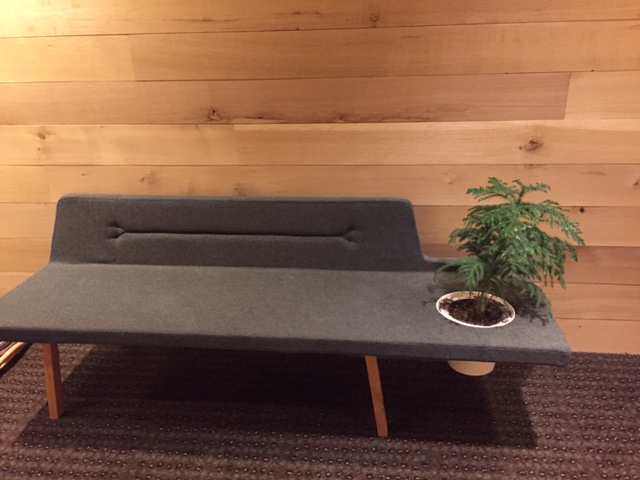
In addition, I stayed at a hotel where they combine seating and plant cultivation in one handy location.  That’s cool.

A gray fabric covered bench, with a small potted plant embedded in it.

My talk was on problems with the notion of “intuitive eating” and the values involved in so-called “unhealthy” eating.  Tracy and I have both blogged about this issue (here and here); these posts have been among the most-commented-on for the blog.  So there’s something compelling that draws peoples’ attention to moral values attached to foods.

For now, I’ll defer discussion of my paper and also a fine paper given by Laurie Ristino of Vermont Law School on using systems and design theory to help solve food sustainability problems.

The two other papers in the workshop,  given by Alexandra Plakias of Hamilton College and Bob Fischer of Texas State University, focused more directly on moral (and other sorts of) responses to certain kinds of eating.  Alex was looking at how our reactions of disgust work– are they just visceral “Ewwws” or do they indicate some moral stance with respect to the thing we’re disgusted by?  One issue that we may all be facing sometime in the Earth’s future is entomophagy.  What’s that?  The practice of eating bugs.

You should now silently thank me for not inserting a photo to illustrate; you’re welcome.

Correct me if I’m wrong, but the idea of eating insects provokes for loads of people a strong disgust reaction.  However, there are at this moment startups (see here and here) and research groups figuring out how to make insects a regular part of our protein intake, given the need to feed billions of people sustainably, now and in the future.  In trying to understand what disgust reactions are about, Alex was opening up some space for thinking about possible other attitudes we could take about some things we may be currently disgusted by.

Bob ‘s paper was also concerned with the morality of eating– in this case, eating animals.  He’s written a ton about this topic (check out his website if you haven’t already) and is a very strong advocate for not eating animals.  He recounted in his paper how, in his philosophy courses, that students sometimes respond to the discussion about treatment of animals by saying “I see that eating meat is wrong, but I’m not going to stop.”  How does one continue a moral conversation when that happens?

Well, we can use other means, like telling stories, talking about lots of concerns that make for meaningful lives.  Bob talks about Jonathan Safran Foer’s book Eating Animals and how Foer uses stories to convey strong and resonant messages about what’s important to us (in addition to information about factory farming, etc.) to make a case for not eating animals.  I will definitely use Foer’s book (and some of Bob’s work too) the next time I teach my philosophy and food course.

So that’s the upshot on my very pleasant philosophy of food weekend.  Some final thoughts to share with you, dear readers:

I don’t eat insects.

I do eat meat.

For now, I’m not feeling compelled to start eating insects.  But I am (and have been for some time) troubled about eating meat, for the very good reasons that are out there.  I have a host of reasons for not changing my eating habits, but they’re seeming a bit excuse-y right now.  I’ll be blogging more about my shifting relationship with meat as food.  For now, I’d love to hear from you:  what is your comfort level with meat eating (if you are a meat eater)?  No judgment– I’m just looking to hear your thinking and feelings on the subject.  Thanks as always for reading, and see y’all next week.  I’ll leave you with a lovely view of Lake Champlain…

view of Lake Champlain in Burlington VT on a sunny day with blue skies and a few clouds