athletes · stereotypes

Media Culpa: Why Focusing on Sexy Sports Moments and WAGs Isn’t Helping Women’s Sports

A recent study by University of Louisville researchers of Sports Illustrated covers reveals, unsurprisingly, that women athletes are seriously under-represented.

According to the cited study:

Despite females’ increased participation in sport since the enactment of Title IX and calls for greater media coverage of female athletes, women appeared on just 4.9 percent of covers. The percentage of covers did not change significantly over the span and were comparable to levels reported for the 1980s by other researchers. Indeed, women were depicted on a higher percentage of covers from 1954–1965 than from 2000–2011.

Not only that but:

when women athletes were featured as cover models, they were often sharing the cover with a male athlete, representing traditionally “feminine” sports or depicted in “sexually objectifying” poses. “Of the 35 covers including a female,  only 18 … featured a female as the primary or sole image,” the researchers wrote, reported Pacific Standard. “Three covers included females, but only as insets (small boxed image), or as part of a collage background of both male and female athletes.”

Considering Sports Illustrated still insists on its popular swimsuit issues, it should come as no surprise that it fails to take female athletes as seriously as male athletes.

This fact about it is disturbing, considering it is at the top of the list of best-selling sports magazines. On one such list, it is described as follows:

Sports Illustrated magazine is a weekly magazine that is the sports authority for American sports. SI magazine features quality photographs and news articles inclusive of all sports–college and professional, men’s and women’s.

Remember, Anna Kournikova? She made the cover but you’d never know from the picture that she played professional tennis.

This tendency not to take women seriously as athletes permeates popular mainstream sports media.  RantSports.com is an unbelievable website that first caught my attention for its article, The 15 Sexiest Sports Moments from 2012 Will Blow Your Mind. [sic]

I thought, “Sexy sports moments. Really?”  The article turns out to include not fifteen but twenty-four “sexy sports moments.”  Twenty-one of them have to do with sexy female athletes, sports reporters, and WAGs (Wives And Girlfriends).  Four are more generic, including a moment offensively called “Kevin Durant and the Old Lady,”  in which the basketball player kisses an elderly woman who was hit by the ball.

The commentary includes several gems.  For example, one of the sexy moments is the moment Kerri Walsh and Misty May-Treanor won gold at the Olympics in beach volleyball.  This caption is typical of what you will see throughout the article:

It’s hard to believe but this team keeps cranking out gold medals. The duo brought gold home from London this summer and they looked amazing in the process. I know I took time out of my day to watch them compete.

And when soccer player Alex Morgan saves the day against the Canadian women’s team?

Morgan is probably the most popular lady on the USWNT. Her goal against Canada saved the match for the team and it was a great moment. It was even better because Morgan is a stone cold fox.

Links to other articles offered to people who land on the sexiest sports moment page include: Best-Looking Female Athletes in Bikinis; 20 of the Hottest Athlete WAGs You’ll Ever See; and The 50 Hottest Female Olympians.

What’s so relevant about the Wives and Girlfriends (I had to look up WAGs) of professional athletes. It’s proof that:

…professional athletes have it made. The gorgeous women that grace this list are among the most beautiful athlete wives and girlfriends we have ever seen. They are models, tennis stars, Olympians and much, much more. It would be easy to lose an entire day, flipping back and forth through these photos.

This focus on the sexiness of female athletes, on the wives and girlfriends of professional athletes, on the hot-factor among the elite women athletes who compete in the Olympics is a major contributor to their inequality of representation in major sports media.

Their athleticism takes the silver to their gold medal sex appeal.  There is nothing wrong with being sexy, but when being sexy is the only thing that can gain us recognition, there’s a real problem.

Male professional athletes are more often than not depicted as actively engaging in their sport of choice. They are shown as competitors first and foremost.  If women were given equal air time and press in the same manner — taking their athleticism seriously — then the occasional comment about their beauty or sex appeal wouldn’t be undermining.

But when that’s the overwhelming focus of attention, indeed, practically the only way they can get attention, it’s just a sad state of affairs for women in sport.  It’s why, sadly, Sam’s blog post on crotch shots and upskirts is among the most popular posts on this blog. People literally search the internet for pictures of female athletes in action so they can peer up their skirts and look at their crotches.

Is it any wonder, then, that women’s sports aren’t taken as seriously as men’s by the top sports magazines and the popular sports websites?

One of the single best things we can do for women’s sport would be to promote media coverage and representations of the athletes in action, pursuing their sport, the way we do with men’s sports.

I realize that sport is big business, and can already hear people saying that if we didn’t play up their sexy factor, women’s sports just wouldn’t sell.

But then we need to ask the further question of “why?”  Why in 2013 do women still need to bring their sexuality to the table if they want attention in realms where their sexuality is not relevant?

We can add that question to the list of things to say to people who challenge the view that feminism still has an active role to play in today’s world.

fitness

Get your ass to grass: Squats and functional fitness

My first weight training efforts were in the late 1980s when I took a university PE class as a graduate student. We had tuition waivers, gym memberships were pricey, and so we philosophy PhD students went wild. I also took sailing but skipped riflery. The class, Fundamentals of Weight Training, was taught by a kinesiology graduate student who was also Illinois’ college level drug free, deadlifting champion. And it was from him I first learned to squat and to bench press. At the time though we were told to not go beyond a ninety degree angle when squatting and to keep our thighs parallel with the floor. Things have changed since then.

The squat is one of those weightlifting  exercises your typical gym goer doesn’t do and that serious weightlifters like powerlifters do do. The former thinks these moves are hard, exotic, and for advanced weightlifting pros. But these exotic moves are actually weightlifting basics and they aren’t so exotic after all. They are key to full body strength and functional fitness. I’ve written about deadlifting here, Why deadlift? I mean, besides for the cool socks. Today though I want to talk about the squat. Along with deadlifting and kettlebell swings, I love the squat in its many variations. I like the overheard squat the best and I can’t manage a pistol squat at all so it would be my least favourite variation. The front squat is somewhere in the middle.

This morning at CrossFit I managed a new I rep max on the front squat though it’s not particularly impressive. (A one rep maximum, or 1RM, in weight training is the maximum amount of weight one can lift in a single repetition. You don’t just go for it. You work up to it gradually in a session.) I eked out 61 kg, just 1 kg over my previous 1 rep max. I can back squat a lot more and I can squat more if I don’t meet the CrossFit measure of how low you ought to go for the squat, ass to the grass, as CrossFitters say. The days of ‘no more than 90 degrees’ are over.

I’ve always liked whole body exercises, such as the squat, partly for how functional they are. It’s not good having super strong arms and legs, exercised in isolation, if you don’t have the whole body strength to support it.  People worry about squats and deadlifts hurting their backs but I think what really hurts your back is having significant strength imbalances that come from working just specific body parts. The seated bicep curl is a good example of this. How often do you sit down and lift heavy things from your waist to your shoulder? You’ll end up with good looking biceps but that’s not why I lift weights.

In a nutshell when lifting weights you can train for looks or for strength. Lots of isolation exercises are the mainstay of body building where the goal is to have a certain physique. I’m not criticizing that but it’s not my approach. In training for strength you want whole body movements because that’s how we actually move things around in the world, with our whole bodies.

In a great article Everything You Know About Fitness is a Lie (it’s a great rant if a bit over the top in its hyper masculinity, be warned) Daniel Duance passes on the following description of the problem with isolation exercises:

“Every big joint in your body, Brown explained, has what are called prime movers, meaning big muscles that govern the main action, like the biceps and triceps. But every joint also has a bunch of little stabilizer muscles. Sedentary lives, camped out in office chairs, allow those stabilizers to atrophy, raising two problems: First, if you have powerful prime movers from doing muscle-isolation machines at the gym but weak stabilizers because you rarely get to play a sport, you can’t access all your strength when you, say, bang off a mogul on a ski hill. “It’s like trying to fire a cannon from a canoe,” Brown told me. The prime movers fire big, but the strength dissipates en route to the core. Second, and worse still, the strength of the prime movers can shred your unstable joints.”

Okay, so let’s stop with the isolation exercises. But why squat? Here’s a description of the purpose of the squat from What is CrossFit?

“For example, the squat is the single most important exercise one can do, it is a functional movement. Anyone who cannot squat cannot engage in normal daily activity, and must have some sort of care provider, whether a hospital, nursing home, assisted living facility, or being a shut-in. CrossFit insists on working to perfect the squat and other foundational, functional movements. It doesn’t matter whether you can squat while holding a load overhead that is twice your body weight, or just do a few “air” squats—doing squats properly and frequently builds overall fitness in a way that is ignored by most people, and ignored by many other fitness programs.”

The squat’s functionality is nicely described here in 8 Reasons to Do This Misunderstood Exercise:

“Functional exercises are those that help your body to perform real-life activities, as opposed to simply being able to operate pieces of gym equipment. Squats are one of the best functional exercises out there, as humans have been squatting since the hunter-gatherer days. When you perform squats, you build muscle and help your muscles work more efficiently, as well as promote mobility and balance. All of these benefits translate into your body moving more efficiently in the real world too.”

And here’s my fave person in the weight room, Krista Scott Dixon, from Dork to Diva, on the squat.

“The squat (sometimes referred to as the back squat) is one of the queens of exercises. It hits your entire body, particularly your legs, butt, hips, and lower back. Learn to do it well and your body will reward you with a fabulous (and strong) set of gams.

Don’t believe the heathens who tell you that the leg press is a substitute for the squat. The leg press is but a pale and petty imitation. Not only does the squat demand (and teach) strength, but also balance, coordination, endurance, and power.

The simple act of standing up under a weight is intensely demanding for your whole body. After a set of squats, even light squats, you may feel dizzy, nauseated, temporarily deaf, light-headed, or simply a powerful need to sit down. This is normal, and means that you are challenging your body in a way that few other exercises can. This effect should diminish over time. Beginners often find squats very demanding until they are well conditioned. Be patient and persistent.

If you ever want to see a real pro squat, watch a toddler. If they find something on the floor that they want, they just squat right down with perfect form to get at it. As we get older and do more sitting instead of squatting (at least in North America), we forget this very natural movement.”

Resources:

Precision Nutrition All About the Squat

addiction · body image · diets · eating

Feminist Reflections on Extreme Eating and Extreme Not Eating: Feeders, Pro-Anas, Pro-Mias

I first saw the story of Tammy Jung, a young woman who is intentionally gaining weight in order to attract an internet audience, posted on the Feminism subreddit. Tammy’s main audience is the “feeder” audience. Feeders (from what I understand based only on what I’ve garnered from the internet), including her boyfriend, gain sexual pleasure from over-feeding their partners and making them gain weight.

In the scheme of “feeders,” Tammy and her boyfriend are small potatoes, with her weight at around 250 pounds at the moment of the article. According to this report, Susanne Eman, 728 pounds, is eating 22,000 calories a day in an attempt to become the Guinness Book of World Records heaviest woman in the world.

The person who posted the story originally asked: How do you tell someone like this they are wrong without fat-shaming or is this okay?”  A flurry of subreddit discussion followed.

Granted, the original source was the UK’s Daily Mail, which I take it is — ahem — not a highly regarded news source.  I found more on the Huff Post “Weird News” site. So yes, I know, I know, this is not the most well-researched post you will find on our blog.  But bear with me because I find the original poster’s question to be worth thinking about, first, for its assumption that Tammy is doing something wrong, and second for its concern that to call her out on it might be fat-shaming.

I want to think about that, and also to think about whether this raises any other relevant feminist issues.

But first, let me put something else on the table as contrast, something so disturbing that, like the thigh gap stuff that’s out there, I can’t bring myself to include the link.  It’s the world of the pro-ana and pro-mia communities, that is, communities that are pro-anorexia and pro-bulimia and think of these not as diseases but as lifestyle choices.

Taken together, Tammy Jung’s intentional quest for obesity and the pro-ana and pro-mia followers’ intentional quest for thinness via starvation present an interesting study in contrasts.  They are the equally disturbing ends of the eating as a form of body-modification (or body-control) continuum.

The discussion about Tammy Jung and fat-shaming on the feminism subreddit had some interesting dimensions to it, but a lot of them side-stepped the fat-shaming question altogether in two polar opposite ways. On the one hand, lots of people said that it’s her choice, she gets to do what she wants, and no one has a right to challenge her goal of becoming 420 pounds.  On the other hand, other people criticized her decision on health grounds, saying that she is intentionally killing herself, and she shouldn’t have a right to health care insurance.

One person said that if we saw a similar story about a young woman intentionally starving herself on the internet to make money and satisfy men’s sexual fetishes, we would have more to say about it.

I have mixed feelings about her quest.  I like that she feels sexy despite being, or even because she is, obese by society’s standards. I like too that there are people out there who find that sexy. Her desire to be paid for her weight gain by admirers who fetishize it is a form of sex work, broadly construed. I have no strong reservations about non-exploitative sex work and believe that it is possible to engage in sexual activities and pursuits for money (i.e. as work) without being exploited. That is not to say that exploitation never happens, but it isn’t an inherent feature of sex work (see philosopher Martha Nussbaum’s fabulous chapter on sex work in her book Sex and Social Justice for a compelling discussion of why sex work ought to be considered work).

It’s a simple fact that from a health perspective, what Tammy is doing is very likely to shorten her life. Her doctor has said as much.  But it’s not clear to me that we have an imperative to be healthy. And it’s also not clear to me that resorting to a claim about health risk isn’t a covert way of fat-shaming.

We’ve seen in past posts that the assumption that people who are larger than average are necessarily unhealthy or unfit is false.  Moreover, do we really have a right to judge people for making choices that don’t promote health or longevity, or that involve risks?

Despite my concern about invoking health as an imperative, I confess that it is the slow suicide, bad-for-your-health feature of anorexia and bulimia that make it so difficult for me to read “tipsheets” that outline in painstaking detail how to starve yourself or how to make yourself vomit — and in both cases how to hide this from friends and family.

Beyond the physical health of it, I see both extremes as fostering psychological obsessions with food and body. Whether the obsession is with gaining or with losing extreme amounts of weight, the pre-occupation with food and body is not healthy. In fact, both anorexia and bulimia are regarded as eating disorders, illnesses requiring treatment.  The same might be said of extreme overeating.

The choice issue enters into the picture because the women themselves frame their behavior as chosen. Let’s say for the sake of argument that they are engaging in this behavior by choice. Do we have a right to pass judgment on these choices? That is, is it correct to assume that there is something wrong with those choices?

Eighteenth Century philosopher Immanual Kant argued that among our moral duties included duties to self.  He believed that suicide was wrong and that, on a more positive note, we had duties to “promote our own talents.”  So, according to Kant, not only is it wrong to kill yourself, it’s also wrong to do things that hinder the development of your personal gifts. Roughly, Kant believed that no one could consistently engage in self-defeating behavior (this really oversimplifies his point, I confess, but that’s the gist of it).

I disagree with Kant that suicide and not developing our talents are morally condemnable. But I do think that we can back off from the moral judgment while still recognizing that there is something disturbing or even just plain sad going on when anyone engages in behavior that fosters obsession and is overtly self-destructive.

Do I want to go so far as to say that these women should not be able to make choices about how to treat their bodies?  Is it not a significant part of feminist ideology that women are in control of their own bodies and ought to be permitted to choose as they see fit?  Absolutely.

There are all sorts of choices that women ought not be denied and that yet, at the same time, do not help the cause of women’s equality. Think of these choices not so much in terms of their impact on the individual women who make them but rather in the broader context of social structures that systemically disadvantage women and stand as obstacles to women’s equality.

Starving ourselves as a lifestyle choice promotes a bodily aesthetic that puts women’s lives in peril. Much to the misfortune of women living in the Western world at this historical moment, that aesthetic is represented in media as normative.  Therefore, if starvation for women is indeed a lifestyle choice, then it’s a choice that is just plain bad for women as a group because it buys into rather than challenges normative femininity as ultra-thinness.

On the other side of this, force-feeding ourselves in order to gain attention and for the express purpose of appealing to men with a particular fetish also puts women’s lives in peril.  In this case, the systemic issue is less that it promotes a normative aesthetic (clearly, obese women’s bodies are not normative in the present cultural context) than that it promotes the idea that we should shape our bodies according to male desire.

I do not mean here to be negatively judging men who find large women attractive. Instead, we need to question the idea that women need to take extreme measures to modify their bodies so that said bodies are attractive to men.

Ultimately, then, to the extent that these extremes are defended as choices, I believe they are (a) choices women have a right to make and (b) choices that are bad for women in general because of the social messages they perpetuate.  They can make them, but for the sake of all of us, I really wish they wouldn’t.

[photo credit: MSU Grad Life]

cycling

Tips for beginning cyclists who want to go faster

To be clear, this isn’t a post for fast cyclists who want to go faster. It’s aimed at the beginning rider who wonders how other people are able to go so much faster than she can and offers suggestions for picking up speed.

If you’re an experienced cyclist–look away–chances are these are all things you already know.

First, get more comfortable on your bike.  How is this connected to going faster? Feeling safe and comfortable is a real barrier to speed. Master the basic skills and you’ll pick up speed. Trust me. What skills should you master?

  • How about riding with no hands? Pretend you’re a kid again. Can you ride your bike with no hands? Probably not yet but riding comfortably with one hand should be a goal. My kids used to ride around the provincial park while doing the Macarena on their bikes. Think like them and make it fun. Try one hand first, and then the other. The goal is to be very comfortable taking one hand off the bars to signal, grab food, drink water etc.  Advanced moves below: bicycle ballet!

https://www.youtube.com/watch?v=eFIQlM-ax5o

  • Shoulder checking, for sure. You should be able to look back for traffic and keep the bike moving in a straight line forward. Going fast means passing safely and on a bike, as in a car, that requires shoulder checking. This was drilled into me riding a track bike at a velodrome but it’s been very useful riding in traffic and on the bike path.
  • Braking at speed. I’ve done this drill lots and I’m amazed at how well my bike comes to a stop. Partly this is about finding out about your bike’s abilities and limits. But you hope it’s also about discovering how well you can stop from speed and not come off the bike.
  • Cornering while going fast is something else cyclists who want to go fast practice. You naturally lean into the corner and you want your outside foot, the one furthest away from the pavement, to be in the low spot so you don’t clip your inside pedal. The goal is to gauge your speed so you’re not braking going into the corner and then you want to accelerate out of it. Don’t look at your front wheel. Always look where you want to go. Trust me, that works. (Thanks Lee.) U-turns, or hot dog turns as they say down under, are more tricky and again before you ever want to do one when speed matters, you’ll want to practice. I discovered when riding in Australia and NZ that years of riding on the right side of the road meant I was only good doing u-turns in one direction.

Now you’ve got some of the basics of comfort and safety, here’s a few more things you can do that will help with speed:

  • Stop coasting. You can read the posts of the late Sheldon “Coasting Is Bad For You” Brown and he’ll try to talk you into riding a fixed gear bike. With a fixed gear bike you can’t coast and it certainly breaks the habit. But you could just try coasting less without going that route.
  • Once you’re not coasting, keep your cadence constant and high. Why? Think of your pedalling as the engine revving in a car. Now imagine what happens when you try to shift and the engine is revving too low. Right. The motor bottoms out and maybe even stalls. You want to be pedalling fast before you shift so you can keep that cadence up in the new, harder gear. This is the same reason you downshift at traffic lights so you’re not left trying to start off in a gear that’s too big.
  • Shifting while going uphill is also something you’ll need to practice. Again, your goal is to keep your cadence high and shift as needed. Bikes designed for speed allow you to keep pressure on the pedals while shifting, more cruisy style bikes require that you back off a bit, shift and then start again. This wiki-how on hill climbing basics is pretty good.

If you like speed, you’ll eventually want a road bike, a bike built for going fast. I used to wonder why I couldn’t get in a great biking shape on my hybrid. It was heavy and a lot of work to make go fast. My fast road bike weighs nothing and flies. Why is the latter better for speed training, I wondered. The answer is that it rewards effort. The speed gap between not much effort and all out effort on my hybrid isn’t that big. But my road bike feels amazing.


aging · athletes

Three books about inspirational older athletes

Tracy has written about the need for more images of physically fit people across the life span. In her post Inclusive Fitness? she writes that we need to see people, above the age of 30, competing in sports and training at the gym.

Age is one of my complaints about the imagery associated with CrossFit. I wrote a bit about this in my post The women of Crossfit. I love the pictures and the story of the CrossFitting grandma  but those kind of stories can be hard to find.

Here are three books I’ve looked at (and in some cases given as gifts) but they are all a few years old. Does anyone know of any new books about older athletes?

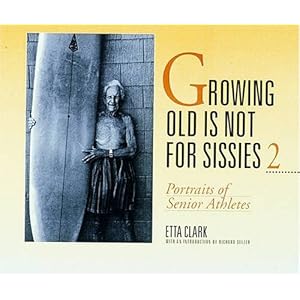
Growing Old Is Not for Sissies: Portraits of Senior Athletes Volumes 1 and 2 by Etta Clark

See Older Athletes Turn Heads in a New Book by LA Photographer

Other posts on aging:

On not growing old gracefully

Is Aging a Lifestyle Choice?

TV shows, fitness, and weight loss: Love and hate

Aging and the myth of wearing out your joints

fitness · motivation

Well being, health, and vitamin P

I was amused last week when Precision Nutrition posted the following message to Facebook:

*** ARE YOU GETTING YOUR VITAMIN P? ***

Did you know that research has shown real health benefits to pet companionship, including lower cholesterol, improved blood pressure, decreased depression, and improved blood vessel function?

Post a picture of your Vitamin P today and share the furry love.

I’m doing the Precision Nutrition Lean Eating program and every few weeks they add a new habit to our checklists: eat protein with every meal, eat veggies with every meal, eat to 80% full, etc. And now a new one, I thought, Vitamin P. What the heck is that?

Luckily I also looked at the picture and saw a coach running along the beach with her dog. Phew. “P” is for pet. I’ve got that one covered. I’ve written here about how dogs keep you active no matter what. Bad weather? They don’t care. They just love to fun and frolic outside and it’s contagious. See Injuries, exercise, and thank God for dogs.

Here’s the health benefits of Vitamin P:

  • Increase longevity after heart attacks

  • Lower cholesterol and triglycerides

  • Improve blood pressure

  • Reduce irregular heartbeats (arrhythmias)

  • Improve blood vessel (endothelial) function

  • Increase physical activity and functioning

  • Reduce medical appointments and minor health problems

  • Predict seizures

  • Alert to hypoglycemia

  • Decrease depression

  • Raise self-esteem

  • Boost levels of exercise and physical activity

  • Improve alertness and attention among elderly people who have pets

From Vitamin P: The Secret to Health and Longevity.

And then this morning I saw this in the New York Times, Owning a Dog Is Linked to Reduced Heart Risk.

“The nation’s largest cardiovascular health organization has a new message for Americans: Owning a dog may protect you from heart disease.

The unusual message was contained in a scientific statement published on Thursday by the American Heart Association, which convened a panel of experts to review years of data on the cardiovascular benefits of owning a pet. The group concluded that owning a dog, in particular, was “probably associated” with a reduced risk of heart disease.

People who own dogs certainly have more reason to get outside and take walks, and studies show that most owners form such close bonds with their pets that being in their presence blunts the owners’ reactions to stress and lowers their heart rate, said Dr. Glenn N. Levine, the head of the committee that wrote the statement.”

If you’re bored of the usual, walk, run, throw with dogs here’s a workout for you and your canine companion: A New Year, A New Way to Exercise With Your Dog.

Here’s my source of Vitamin P: Please, please take me for a walk? Who could say no?

image

image

diets · eating

Vegan versus plant strong redux

Recently I blogged about the different terms people are coming up with to describe a diet that excludes animal products. I was wondering about the differences between being ‘vegan’ and ‘eating a plant based diet’.

I thought that the plant based diet description had the advantage that it could come in degrees. You can eat a mostly plant based diet but it sounds odd, to my ear, though I do say it, that you eat a mostly vegan diet. I thought the plant based diet might also lack the vegan concern for animal welfare and focus more on human health. As Vegan Soapbox notes, plant strong folks can wear leather and engage in other practices that harm animals. It’s all about human health and what you eat.

But now just after posting, I’ve noticed a third difference. Vegans can eat junk food consistently and still follow a vegan diet. Oreos, pop tarts and Doritos are all vegan foods. Vegans for ethical reasons might not care about their own health. No animals were harmed during the making of these scary foods. They contain long lists of nasty sounding chemicals but no animal products.

But they’re not plant strong. This is the sense in which plant strong is more demanding. Thinking about it this way, there’s plant strong, on the one hand, and merely vegan, on the other. For a great discussion of this, from the plant strong perspective, read When Vegan Is Not Enough!

As a friend once said, I’m a vegan, not a health food nut, but the thought of vegan junk food rarely occurs to me since the thought of junk food rarely occurs to me. I don’t eat fast food and foods like pop tarts don’t hold any appeal.  I haven’t spent time with junk food vegetarians since grad school when for some of my classmates becoming a vegetarian just really affected what went on the pizza.

diets · eating · soy

The Great Soy Debate

Image description: edamame close-up. Photo credit: cotonbro studio, pexels.com

As a vegan (for ethical not health reasons), I need good quality plant protein.  Soy delivers the most plant protein and in a variety of different forms than any other single source I’m aware of.  Bottom line is, I eat a lot of soy products: soy milk, tofu, soy hot dogs (I know–not much better for you than “real” hot dogs), tempeh, edamame.

I first heard rumblings about the risks of eating soy from another vegan friend who tries to avoid it. Whenever I asked why, she said it was because of “all she’d read.”  What she’d read were reports that linked soy to breast cancer.

As explained in this article (and many others), soy contains natural plant compounds (phytochemicals) called isoflavones. These are chemically similar to estrogen. This article talks about the link between estrogen and some cancers in women:

It is well established that estrogen is linked to hormonally-sensitive cancers in women, such as breast and endometrial cancer.  Breast cells contain estrogen receptors, and when the “key” (estrogen) joins with the “lock” (the estrogen receptor), a series of signals are sent which can spur on estrogen-receptor (ER) positive breast tumor growth. Common risk factors for breast cancer include conditions that involve longer exposure of breast tissue to estrogen.

These risk factors include having children late, not having children, or post-menopausal obesity. I qualify under the second one of these since I have never given birth.

If soy acts like estrogen and estrogen is linked to these forms of cancer, then soy is also linked to these forms of cancer, right?  Not so fast.

Studies on rats and mice seemed to suggest risk, but the consequences for humans are not easily read from these studies because they apparently metabolize isoflavones differently than humans.

And also here is more about isoflavones:

Isoflavones behave like very, very weak forms of the body’s own estrogen. Isoflavones compete for the same place on cells that estrogen does. That means isoflavones can affect the action of estrogen in your body, but not increase the level of estrogen.

For example, since isoflavones can bind to estrogen receptors on breast cells, they prevent a woman’s own, more potent, estrogen from taking that spot. Some of the risks of excess estrogen, including breast and uterine cancer, are thought to be lowered in this way.

This makes it sound like soy is a good thing that can lower the risk of cancer in women.  It appears also to lower the risk of prostate cancer in men:

…a study conducted in more than 12,000 Californian men found that those who drank a soy beverage daily, compared to those who never drank it, were 70 per cent less likely to develop prostate cancer. It’s thought that isoflavones can help keep testosterone levels in check (prostate cancer cells feed off testosterone). Soy beans also contain other phytochemicals that have cancer-fighting actions.

Large studies in Asia seem to suggest that women who consume soy have a lower incidence of breast cancer.  But since soy consumption patterns differ between Asian women and North American women, it’s not clear how well these results translate over for non-Asian women. In other words, lifelong soy consumption might yield different results.

Most of what I read suggests that, at the very least “soy foods, such as tofu, tempeh, edamame and soymilk, are safe and do not pose cancer risk.” The question then becomes: “is including soy foods as part of your healthy eating habits ‘neutral’ in effect, or will it actually help reduce breast cancer risk? The answer, it seems, may be ‘it depends’…”

Variables include quantity of consumption, at what time in a woman’s life the soy is consumed (pre- or post-puberty, pre- or post-menopause), and genetic differences between people that have an impact on how they metabolize soy compounds.

I’m less concerned with whether soy reduces risk of breast cancer than I am with whether it poses a health risk.  My primary reason for consuming in it the quantities that I do is because I am seeking a sound source of protein, not because I am seeking cancer prevention.

Based on what I’ve read so far, no study shows that soy poses a risk for humans and no link between soy and an increased risk of breast cancer has been established. This comes as a great relief to me. I will continue to enjoy the soy products that I’m consuming, and will also continue to monitor the latest research for any significant new findings.

Source materials:

Really? The Claim: Eating Soy Increases Risk of Breast Cancer (by Anahad O’Connor)

Soy and Breast Cancer: Where Are We Now?  (by Karen Collins)

The Bottom Line on  Soy and Breast Cancer Risk (by Marji McCullough)

Is Soy Milk Suitable for Men? (by Leslie Beck)

aging · athletes

Aging and the myth of wearing out your joints

As I approach 50, as a very active person, I’m noticing aches and pains where I haven’t had aches and pains before: right knee, left shoulder, both hips.

I have an excellent sports medicine clinic I call my second home. I love them. They see me as an athlete, albeit a recreational athlete, and they always ask what I’m doing, what I want to keep doing, and how much it matters to my quality of my life. I think it helps that they are home to a research centre on activity and aging!

This place is quite unlike various family doctors who have tended to give versions of the following sorts of advice: rest, ice, and take six weeks off activity and come and see me again if the pain is still with you. The Fowler Kennedy crew are more thorough, more proactive. I’m assigned physio and I do it. I see a massage therapist. I try to take care of myself. If someone tells me to make sure I warm up my shoulder and make sure it’s fully mobile before it bears any weight, I do as I’m told.

I love watching all the young varsity athletes there and play a game of guessing their sport by their build. I’m getting good at it. The kinds of injuries they have are also a clue. They heal so fast these young people. They’re like starfish. I think they could grow whole new limbs if need be.

I’m not a starfish but I am a good patient and I appreciate the help I get st the Fowler Kennedy. But last fall, as a result of their investigations, I got some bad news. Soccer associated running pain got me in the door and I learned that my knee pain is likely caused by early stage osteoarthritis. (Very early, really it’s no big deal, and no knee surgery required.)

Does this mean I should stop running, I asked. I’ve already mostly given that up due to stress fractures but what about soccer?

“God no,” they said, “keep moving.” Inactivity is far worse for your joints than activity, they insisted.

What about the idea that running (biking, etc) wears out your joints? I’ve heard that from well meaning friends and family.

“Oh, that’s a myth.”

The “wear and tear” theory of aging is a hard myth to kill. Lots of people subscribe to it. Here’s the about.com entry on it.

“Perhaps one of the oldest theories of aging is called the rate of living theory. This theory states that people (and other creatures) have a finite number of breaths, heartbeats or other measures. In ancient times, people believed that just as a machine will begin to deteriorate after a certain number of uses, the human body deteriorates in direct proportion to its use.”

I think some people believe a version of this myth that’s like the ancient Greek idea about heart rates. Aristotle thought a low heart rate was good because each life contained only so many heart beats. Best not to use them up. I sometimes joke about Aristotle and my decision not to drink. You’re only allowed so many drinks in a life time. I started early and so I’m done.  Not the full story but I like it as a line. So like Aristotle and heart beats, some people seem to think that you can only run or walk so much in a lifetime and then you’re done.

I was happy then to read this in the Globe and Mail, reporting on research that shows that activity is good both to prevent osteoarthritis and even to lessen its effects once it has set in.

“All of this suggests that the results of another new study, to be published in Medicine & Science in Sports & Exercise, shouldn’t actually be surprising. Dr. Paul Williams of the Lawrence Berkeley National Laboratory in California has been following a huge cohort of runners and walkers since 1991, and his latest study analyzes osteoarthritis risk in 90,000 of them.

In brief, he found that those running more than 12 kilometres a week were 18.1 per cent less likely to develop osteoarthritis and 35.1 per cent less likely to need a hip replacement during the study’s 7.1-year follow-up, compared to those running less than that amount. Even those who ran considerably more – there were 863 subjects who ran more than 96 kilometres per week – had similarly reduced rates of osteoarthritis.

“The evidence seems to suggest [running] is good for you,” Aspden agrees. “Even when osteoarthritis has started, the suggestion is to keep exercising, albeit preferably low-impact – but gentle jogging isn’t ruled out.”

Williams’s study can’t determine whether it’s the lower weight or the fat-induced inflammation that’s more important; it will take years for scientists to reach any definitive conclusion in that debate. But the epidemiological evidence is already clear: Avoiding physical activity – even high-impact activities like running – in order to “preserve” your joints is a losing strategy.”

Read more here.

So keep moving. I get that. I like moving. Lots. But what about the pain? What about when moving hurts?

The answer turns out to be something like, toughen up buttercup. Yes, stay active as you can tolerate it. It’s good for you. I wondered about the connection between inactivity and aging in an earlier blog post and asked Is aging a lifestyle choice? That’s because research is showing that lots of problems associated with old age actually stem from inactivity. Why do older people move less? One answer is that it hurts to move more.

Tracy has written about intuitive exercise, Intuitive eating? Yes! Intuitive Exercising? Not So Much and this is another case where we’d do well to ignore our intuitions. Yes it hurts, now move anyway.

I’ve written before about pain and pain killers and aging athletes, see Bye bye Vitamin I?.

“After caffeine, iburprofen is the drug of choice of my midlife athlete friends. We go for long bike rides, stop for brunch, and out come the plastic baggies filled with cell phones, mini tubes of sunblock, credit cards, cash, and inevitably a stash of pills. Vitamin I, we call it. Without which us aging athletes wouldn’t function. Or so we think.”

But now there’s some debate about the damage it does to your small intestine and how effective it is anyway at managing workout related pain.

This makes it even harder to tell from the feeling of pain just what you ought to do. Some people are very tentative and stop moving at the slightest discomfort and it turns out that might be as a much of a mistake as muscling on through pain caused by damage or impact. Tracy has written about telling good pain apart from bad pain, see Good Pain, Bad Pain, but this is a third sort. It’s neutral pain, and needs to be ignored.

I love Louis CK on turning 40 and athletic injuries. If you haven’t seen this, and you’re an over 30 athlete, it’s worth watching.

As Bette Davis said, old age is not for sissies. I’m not old, yet, but I’m aware of myself as ‘not young’- as ‘no spring chicken’ as my partner and I joke.

diets · eating

Diets Disguised as “un”-Diets and the Food Police Strike Again!

wheat field from pexels.com
Wheat field (pexels.com)

The other day, Sam forwarded me a couple of posts (she is wonderfully savvy at keeping up with the massive volume of information that this world has to offer!) she thought would be of interest to me.

The first headline was about Evil health foods: “The so-called ‘health foods’ that are probably killing you.”  The second, from a committed intuitive eater who blogs at Not Much to Lose was about diet anxiety.

I’m not sure if Sam meant me to draw a connection between them, but oh how quickly it became clear to me that evil foods and diet anxiety go together like a trip to my favorite vegan restaurant and eating their outstanding triple chocolate cake  [not a link to their recipe, the code for which friends and I are attempting to crack].

First, to the evil “health foods.”  Of course, I have already gone on record to say that food is beyond good and evil.  I thought for sure this article was going to tell me that my blueberries were killing me in my sleep or that broccoli, against all odds, would give me cancer.  Why? Because when I think of health foods, I think of blueberries and broccoli, kale and cauliflower, green tea and green drinks, lentils and legumes.

What a relief to find that none of these were on the list. No, instead, it’s the fruit juices, “healthy” oils, whole wheat, agave nectar, sports drinks, anything low fat or fat free, any gluten-free junk food (confusing how anything identifiable to the ordinary person as “junk” food should be on a list of what we used to think was healthy but isn’t), energy bars, low cal “junk” food (there’s junk food again on our healthy list), and “healthy” breakfast cereals.

Maybe it’s just me, but I don’t see any of these foods as something that people eat lots and lots of on a daily basis except perhaps whole wheat, which, in the scheme of things, is a lot better for you than refined flour products (and trust me, I believe there is a place for crusty white baguettes and strawberry short cake too).

I’m not sure anyone considers sports drinks and energy bars to be health foods. Pretty much no one thinks of “junk” food — gluten free or not, fat free or not — as health food.  The healthy oils they talk about are overly processed vegetable oils (not including olive oil, which the author describes as “good for you!”). Again, it’s not clear to me that these are considered health foods in the first place.

So my reaction to this list was (a) relief that I could continue eating blueberries and broccoli without worrying about imminent death, (b) that not many people consider these things to be health foods anyway, and (c) that even the things on this list can take a moderate place in our lives without killing us. Killing us!  Hyperbole for sure.

Lists like these are just another way for the food police to monitor and ban and regulate, making people do things like stop you from ordering fresh squeezed orange juice when you go out for breakfast (because you’ll die).

So what does a list like this have to do with diet anxiety?  By design, it is meant to make us worry about what we’re putting in our bodies and base our food decisions on something other than what we feel like eating at the time.  It’s the opposite of intuitive eating.

When the Not Much to Lose blogger blogged about diet anxiety, she had just purchased a new book called The Undiet. She started to read this book. It’s full of information about healthy eating — what to eat and what not to eat. She began to get anxious:

The moment I start thinking about what I should be eating, it brings back all the internal dieter’s thoughts.  I was reading along thinking, when I would start eating this way, and when I would start eliminating the non-negotiable foods that she mentioned. (NO!  Not my veggie hot dogs!!)  Even though there is no calorie counting involved, it felt like reading a diet book complete with meal plan ideas, etc.  And planning the meals for the week.  I think the planning could work for some people, but how do I know on Wednesday night what I’m going to feel like eating on Sunday night?  Not very intuitive.

I can really relate to what she says here. The more I think about what I should and shouldn’t be eating, the more likely I am to eat more than I need of foods I don’t really want.  Intuitive eating is not about that. Yes, we can make choices for health, but we need to get in touch with ourselves first.

How hungry am I? Would my hunger be best satisfied by something sweet or savoury, salty or spicy, hot or cold, crunchy or smooth, hearty or light?  When I used to diet, I never — not once — used to ask myself these questions. It was more about what was on the menu plan for that night. It might not have even been a plan I made (for many years it was some variation of poached fish, vegetable, salad with no dressing OR plain chicken breast, vegetable, salad with no dressing OR egg white omelet, vegetable, salad with no dressing).

Diet anxiety is the anxiety that comes along with having your choices be guided by what you’ve read, completely independently of any kind of checking in with yourself to determine what you need and want. Lists like that “healthy foods that will kill us” list generate diet anxiety.  Books that divide foods up into those that are good for you and those that must be avoided at all costs (soy is the latest culprit — more on that in a future post).

Lots of people go running in the opposite direction when they hear the word “diet,” not just those trying to follow the intuitive eating approach. Even Weight Watchers avoids the word “diet” as much as it can, always stressing that “this is not a diet.” Why? Because diets have come to be associated with deprivation and, much worse for potential consumers of diets programs and products: failure.

You can dress it up any way you like, restricted food plans (like WW) and food lists with forbidden foods (like the undiet) and lists of health foods that are killing you all promote the diet mentality and encourage us to police what we (and maybe even others) are putting in our mouths.

Anxiety seems like a perfectly reasonable response to that message, especially when it’s sneaking its way into our lives in stealth mode, packaged as the opposite (that is, as NOT a diet).

We’re not so easily fooled anymore.