running

Six things I love about running and six things I wish I could change

Running and I have a bit of a love-hate relationship. Or maybe it’sbest described as unrequited love. The way it works is that I love running but it doesn’t always love me back.

Actually, if running and I had a relationship status on Facebook it would say “it’s complicated.” These days I’ve been running quite a bit, racing even, and loving it, but I need to watch out that I don’t love it too much. When you read these lists you’ll see why.

Here’s my list of what I love about running and what doesn’t work so well for me.

Loves:

1. Simplicity: I love that all running requires is a good pair of running shoes. (And even that’s debatable, read To go barefoot or to wear “foot coffins”? Searching for a middle ground….) I mean I also have an iPod, some fancy winter running gear, a reflective coat, and running specific shorts and t-shirts and bras. But it’s easy when you’re traveling to bring that stuff along. Running works well with traveling, unlike swimming (finding pools in far away places is tough)and biking. While I have traveled with my bike a fair bit I never bring it along for work trips.

2. Seeing new cities when I travel: Walking is nice but it’s slow. I love arriving at a hotel in a new city asking the concierge for a good running route and then heading out to see some of the sights.

3. How friendly other runners are: Runners are really really nice to other beginners. Lots of smiling, waving, and encouragement. You’ve got to love that.

4. Accessibility: It’s also a form of physical activity whose practitioners go out of their way to make it easy. You can’t shake a stick in our small city without hitting a group of people out doing a “learn to run” clinic. The entry level for fitness is generally pretty easy, wonderfully easy I’d say. Walk one minute, run one minute? Count me in. I’ve taken 5 km and 10 km clinics and volunteered at a few of them too.

5. Winter running: I love running in the winter. I love snowflakes landing on my nose. I love the crisp crunchy feel of snow underfoot. I love the quiet. But most of all I love being able to be outdoors when it’s Canadian winter cold. This was a wonderful surprise to me. Over the years I’ve found the cold harder to bear but when I’m running I’m delightfully warm. Only Winnipeg was cold enough to put me off running. The hotel concierge was right. It was too cold to run out there even with all my cold weather gear. I went back to my hotel in a taxi, with frost bite. I had a really great Santa Shuffle run one year with a friend and philosophy colleague (Hi Rob! ) and we had deep snow up over our sneakers. Everyone thinks you’re so tough but really it’s the best kind of run that there is.

6. I love running with my dogs. I especially love running with dogs on trails through the woods. Actually I love these things independently too but then I’d be over six! Tracy, have you done any local trail running? Running through the woods is glorious. Remind me to take you to Komoka Park sometime.

So far so good, right? Running and I were made for each other. Clearly. Here are photos of me running through the years and a bit more of my running story. A dear friend, an avid cyclist, says he prefers riding to running because runners never look happy. Not me. I smile while I run.

But here’s the sad part of the story…

1. Running gives me evil stress fractures. Evil because they take two months of inactivity to heal, serious inactivity, not even walking is okay. I had a disabled parking permit even while they were healing. And it’s not bone density. They tested that and I’m a bone density rock star, the goddess of bone density. Both times it started out as shin pain that went away while running and hurt like hell after. I’ve had gait analysis done and no good advice there. So now I’m just committed to running short distances slowly.

2. Related to the above, I’m not a natural “take it easy” kind of person. Running short distances slowly is nice and all but I like being fast. I have fond memories of hill repeats and speed work at the track. I know how to get faster and it is very hard to hold back. Now “fast for me” isn’t fast really. At my fastest my speed work still equaled my best friend’s easy day, though he was a guy and a former competitive runner. I’ve tried to reconceptualize what I do as not running but rather “jogging with dogs” and that helps a bit. I’ve also stopped running with my heart rate monitor. That’s strictly now a biking thing.

3. As much as I love winter running, I’m not so keen on sweaty summer running. Heat stroke, sun burn, needing to carry lots of water, and sweat. Ugh. I’m not a fan. But I think that’s true for lots of larger runners.

4. Runners are an evangelical lot. Theirs is the one true way. I’ve met so many runners who only run, who fear lifting weights, and who hold other athletic pursuits in contempt. They’re such purists. Read Is there life after running?

5. Related to the above fear of weights and sports, there’s also the cult of distance. It’s hard to avoid. I’ve been there. If 5 km is good, 10 km must be better. Next, a half marathon. It’s the leap between ten and the half that resulted in stress fracture two summers in a row. So many runners have marathons as their goal and I’ve never really gotten it. Speed, yes, but long slow endurance running makes me yawn.

6. Running shoes: Debates about running shoes and proper running form drive me batty. So too does the cost of high end running shoes. You need two pairs if you’re running regularly. I’ve tried barefoot running and I like it on athletic fields. I’m not sure if I’ll ever run barefoot on pavement like my daughter but I’ve moved to more minimalist footwear for some of my dog jogging.

So that’s the ledger, the pros and the cons of my short running career. I can say for certain that my life holds no marathons but I’ve wondered about getting fast again at shorter distances in the 5 to 10 km range. The good thing having gone down the shin stress fracture road twice is that the feeling is familiar. I can stop before I get hurt. I might try it this winter when my outdoor options get limited, no rowing or biking in the snow!

body image · diets · eating · fat · fitness · running · swimming · weight lifting · yoga

Reflections on Setbacks

Disappointment concept.
Image decription: “Road sign” that says “Welcome to disappointment. Don’t stay too long!” (credit: Bigstock licence)

I had a demoralizing experience at the bod pod earlier this week. The bod pod measures body composition (lean mass to fat ratio).  I went once before, in September.  And since getting leaner is one of the goals I have, the bod pod is a good way to get an objective measure on that.  Tuesday’s result: I’ve lost 2 pounds of lean mass and gained 4 pounds of fat since September.

I had some reservations about going to the bod pod at all. First, I’ve been following the intuitive eating recommendation of staying away from the scale. This has been a great freedom for me and has released me from years of obsession with food and weight. That alone is a great success for me, not one I will trade in, even for a few pounds.

Second, I know for a fact that I’ve fallen out of routine lately, with both my running and my weight training suffering for it.  Backing off of the weight training is likely a key explanation for my loss of lean mass.

Third, I don’t think I’m getting enough protein. As explained in my last post, I’m making an effort to get more.  That post yielded some good advice. I’m tracking protein for a little while anyway, until I get on track. I’ve got some distance to go. Yesterday I fell short of my 100 grams/day goal by 24 grams.

So I have the explanation for why the decline in lean mass and increase in fat.  Today I’m feeling okay about it but I have to say that on Tuesday and yesterday I felt pretty discouraged.  I remember that feeling from when I used to weigh myself regularly.  Given that I’ve fallen out of my routine, I probably didn’t need the bod pod to tell me that my lean mass hasn’t increased and that my fat has increased. In fact, that little voice in the back of my head was telling me to cancel the appointment.

The thing was all made worse by the fact that the bod pod guy assumed that I would feel discouraged and went into a long list of suggestions about what I should or could do about it.  These ranged from relatively sound advice about working with a sports nutritionist or following the Precision Nutrition plan, to eating all of my food within a six hour period each day between 4 p.m and 10 p.m. (!!).  I really just wanted to get out of there at that point, but he’s a nice man and I didn’t want to be rude. At the same time, I wasn’t seeking his input, just the results of the test.

I only enjoy wallowing in the negative for a short time.  So I spent that evening and yesterday feeling discouraged and demoralized, a little bit hopeless and a little bit helpless, frustrated and sorry for myself. I shared my tale of woe with Sam, who is always great at lending an empathetic ear and seeing the positive side of things.

What good can I glean from this setback, if that’s even what it is?  The first question is of course this: is doing a bod pod measurement a useful thing for me to do, given my aspirations to stick with intuitive eating?  I’m not so sure it is. I think for the time being I would do better not to monitor my “progress” in this manner, but instead to stick with a few performance goals that I can feel good about.

To that end, I’m getting back on track with my running now that the weather is a bit better. I start a clinic with a local running group this evening.  It’ll be my first experience running with people and I’m kind of excited about it.

The other issue is my resistance training.  I’m not pushing myself as hard as my trainer used to push me. That’s I guess the main reason we hire trainers, isn’t it? But I’m not interested (at the moment, anyway) in going back to the training studio.  It’s a lot of money and I have enough knowledge to figure out my own workouts. It’s the motivation factor that I need to get back.  I’ve got to mull that one over a bit. I could start training at the Y again. I have a membership already because of the pool, and I have fond memories of the camaraderie of the gym.  Maybe.  If I can’t get my home routine back on track over the month of May, then the Y is an option.

And then there’s the issue of what IS working. Sam reminded me that, for me, getting over the food obsession and letting go of the scale are significant changes.  The bod pod result made me question everything for a short time. I started to think that intuitive eating wasn’t “working.”  I even felt drawn to go on some sort of diet, but then remembered that diets don’t work. The fact is, intuitive eating is working just fine.  Other than that I now feel it’s time to focus a bit more on high protein choices, I’m doing well with the intuitive eating approach.

A brief reflection on “what went wrong” yields that the main issue hasn’t been food (other than that I could get more protein) but training.

Being fixated on the numbers that the bod pod gives me isn’t much different from fixating on the numbers on the scale.  I’ve learned that it’s really difficult for me to react well to a reading that isn’t as “good” as I wanted it to be.  Yes, it’s information, but is it the sort of information that I really need to have in order to achieve my fitness goals?  I’m not so sure about that.

Re-grouping, I plan to stick to my original commitments: running 3 x a week; resistance training 3 x a week; yoga 3 x a week; swimming 2 x a week; leaving the car at home more often, opting to walk or cycle instead.  That’s a good re-start.

Once I have the routine back in place, I can think about upping my performance goals.  I like the strategy of gradual progression, adding just a little bit each day or week.  For example, instead of swimming for 25 minutes, swim for 30; or make a few of the laps sprints. Instead of doing 20 kettlebell swings, do 22.  That sort of thing. Subject matter for a future blog post.

For now, I’ve got to be somewhere soon, and if I’m going to walk instead of drive, I need to hit the road!

[image from Bigstock]

body image · diets · eating · fat · fitness · health · running

Thinking Critically about Obesity

Philosophers looking for excellent examples to use in critical thinking classes might be well served by our thinking about overweight, obesity, and weight loss. “Myths, Presumptions, and Facts about Obesity,” published in the New England Journal of Medicine today reviews shoddy reasoning abut obesity and asks why it is we continue to believe things to be true on the basis of little or no evidence in their favour or even with substantial evidence against.

Here’s Gina Kolata writing about the article in the New York Times,

“Myths and unproven assumptions about obesity and weight loss that have been repeated so often and with such conviction that even scientists like David B. Allison, who directs the Nutrition Obesity Research Center at the University of Alabama at Birmingham, have fallen for some of them.Now, he is trying to set the record straight. In an article published online today in The New England Journal of Medicine, he and his colleagues lay out seven myths and six unsubstantiated presumptions about obesity. They also list nine facts that, unfortunately, promise little in the way of quick fixes for the weight-obsessed.” Myths of Weight Loss Are Plentiful, Researcher Says

The myths, “beliefs held true despite substantial evidence refuting them,” are:

“1. Small sustained changes in energy intake or expenditure will produce large, long-term weight changes

2. Setting realistic goals in obesity treatment is important because otherwise patients will become frustrated and lose less weight

3. Large, rapid weight loss is associated with poorer long-term weight outcomes than is slow, gradual weight loss

4. Assessing the stage of change or diet readiness is important in helping patients who seek weight-loss treatment

5. Physical-education classes in their current format play an important role in preventing or reducing childhood obesity

6. Breast-feeding is protective against obesity

7. A bout of sexual activity burns 100 to 300 kcal for each person involved”

The six presumptions, believed to be true but without evidence in their favour, are:

“1. Regularly eating (vs. skipping) breakfast is protective against obesity
2. Early childhood is the period during which we learn exercise and eating habits that influence our weight throughout life
3. Eating more fruits and vegetables will result in weight loss or less weight gain, regardless of whether one intentionally makes any other behavioral or environmental changes
4. Weight cycling (i.e., yo-yo dieting) is associated with increased mortality
5. Snacking contributes to weight gain and obesity
6. The built environment, in terms of sidewalk and park availability, influences obesity”

Why do we, where that includes many health care professionals, believe things to be true when there is no evidence in their favour (the presumptions) or worse when there is evidence against them (the myths)?

In the section of the article called “Knowing and Not Knowing” Allison discusses various sorts of biases that influence our thinking about health and weight. Writes Allison:

“When media coverage about obesity is extensive, many people appear to believe some myths (e.g., rapid weight loss facilitates weight regain) simply because of repeated exposure to the claims. Cognitive dissonance may prevent us from abandoning ideas that are important to us, despite contradictory evidence (e.g., the idea that breast-feeding prevents obesity in children). Similarly, confirmation bias may prevent us from seeking data that might refute propositions we have already intuitively accepted as true because they seem obvious (e.g., the value of realistic weight-loss goals).”

The 9 facts are less interesting, as facts tend to be! Diets don’t work in the long term. Exercise does help keep weight off. Heredity is important but is not destiny. Weight loss is greater with programs that provide meals. Some prescription drugs help with weight loss and maintenance. Weight-loss surgery is a good solution for some people. For overweight children programs that involve the whole family work best. Exercise is good for your health regardless of its effect on your weight. And in order to maintain a new lower weight you need to continue the conditions that led to weight loss.

Reference:

“Myths, Presumptions, and Facts about Obesity”

Krista Casazza, Ph.D., R.D., Kevin R. Fontaine, Ph.D., Arne Astrup, M.D., Ph.D., Leann L. Birch, Ph.D., Andrew W. Brown, Ph.D., Michelle M. Bohan Brown, Ph.D., Nefertiti Durant, M.D., M.P.H., Gareth Dutton, Ph.D., E. Michael Foster, Ph.D., Steven B. Heymsfield, M.D., Kerry McIver, M.S., Tapan Mehta, M.S., Nir Menachemi, Ph.D., P.K. Newby, Sc.D., M.P.H., Russell Pate, Ph.D., Barbara J. Rolls, Ph.D., Bisakha Sen, Ph.D., Daniel L. Smith, Jr., Ph.D., Diana M. Thomas, Ph.D., and David B. Allison, Ph.D.

N Engl J Med 2013; 368:446-454 January 31, 2013 DOI: 10.1056/NEJMsa120805

cycling · fitness · motivation · running · yoga

On Doing Less

For a long time my main two fitness activities were Iyengar yoga and walking.  I wanted to establish a consistent yoga practice at home, not to replace my weekly class but to get the most out of it. In Iyengar yoga, students are encouraged to practice regularly on their own at home.

One weekend I had the opportunity to do a workshop with a senior teacher from another city.  When I spoke to her about my failed attempt to get a home practice going, she suggested I do less than I thought I should do.  “Set your timer for 20 minutes,” she said. “It’s hard to imagine that you don’t have 20 minutes.” She asked me if I could back down from my lofty goal of one hour of practice a day and instead commit to that for 30 days.  Even though I thought 20 minutes wasn’t nearly “enough,” I made and kept the commitment.

Every morning I showed up at the mat for just 20 minutes. For the first ten minutes I did whatever I felt like that day, and for the last ten minutes I did five minutes of headstand, five minutes of shoulder stand, and then added a couple of minutes of savasana.  The time flew by. Some days, I found myself wanting to do more. I did more. By the end of the 30 days I had a solid habit, and a dramatically stronger headstand.

It was the commitment to doing less that got me to the mat.

I’ve had similarly ambitious goals about writing and have learned that aiming to do too much doesn’t work for me.  When I recently met with publication coach, Daphne Gray-Grant, to get back on track, she immediately had me scale back the hours a day I thought I should be spending on writing.  Instead of 2-3 hours, she suggested I aim for 25 minutes. Instead of aiming for 2 hours a day working on a revision (that I was in fact avoiding daily), she suggested I spend an uninterrupted 15 minutes on it. Set the timer. Don’t work a minute more on it.

Scaling back like that made me feel as if was setting the bar too low.  But the more ambitious goals left me cold. I wasn’t doing anything when I aimed high like that.

Taking Daphne’s advice, I got a solid first draft of a paper written (25 mintues a day of new writing) and that dreaded project revised (15 minutes a day, no more, of editing/revising) in 10 days, with 2 consecutive days off from writing and plenty of time during the work days to do other things.

I needed her to remind me what I’ve known for a long time: my first instinct is to set  unreasonable goals, and I get more done when I set reasonable goals.  The yoga teacher and Daphne both brought me back to reality on that point.

The 25-minute increment comes from a wonderful time management tool called The Pomodoro Technique.  Whenever I am putting off anything, I can get right back on track with pomodoros — 25 minutes chunks of time where I’m focused on one task (no email, no phone calls, no getting up, no moving to another task, just for those 25 minutes). After that, I take a 5 minute break and then get right down to the next pomodoro (which might be a new task or continuing on the same one).

This can work well for activity. Like the yoga teacher I spoke with said — go for 20 minutes, not an hour. When I started running, I felt good if I could just get myself out the door for 15 minutes.  Even today, if I don’t feel like doing something, I give myself permission to scale back and do less that day.  Less is better than nothing. It keeps the habit in place, or helps to build a new habit, and doesn’t overwhelm me.

If a pomodoro is too much, you could think in terms of Sark’s “micro-movements.”  Sark says:  “I’m a recovering procrastinator and perfectionist and I have a short attention span, so I invented Micromovements as a method of completing projects in time spans of 5 minutes or less. I always feel like I can handle almost anything for 5 minutes!”   You don’t have to be a Sark fan to agree that you can do most things for 5 minutes.

Or even less than 5 minutes, as Samantha discusses in her post about the “thousand cuts fitness program.”

Now, it may be that 5 minutes isn’t enough to get a lot of benefits from exercise. But on a day when you feel like doing nothing, it’s something. And if you’re choosing activities you enjoy, it’s very likely that once you get past the initial inertia of doing nothing, 5 minutes isn’t going to feel like enough.  My experience with the yoga practice was that after a couple of weeks, I was routinely doing at least 30 minutes, often more.  And my experience with running has been similar. I want to do more.

The valuable idea here is that IF you are struggling to get motivated (you might not be! Yay for you! Go do some deadlifts!), then doing some shorter-than-you-think-will-be-helpful timed sessions of uninterrupted activity might be just what you need to get the flow going again.

This is not to say we should never set big goals.  But as we have discussed before on the blog, the big goal (I want to run a marathon by the time I’m 50) needs to be broken down into smaller performance goals (e.g. I want to run three times a week; I want to increase my distance to 10K gradually over the next three months). If we’re not meeting these smaller goals, chances are they’re too ambitious (for the time being).

Everything the Publication Coach says here about the kaizen method applies equally well to fitness goals.

It’s not every day someone will encourage you to do less, scale back, aim lower.  But it works. I’ve had great success with setting less ambitious goals in my writing.  I wrote a full draft manuscript of my book that way, using 30-minute increments of uninterrupted time, no more than 3 hours a day, 5 days a week.

Try doing less.

body image · fashion · running

Running skirts and sexism

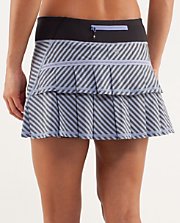
You’ve seen them, I assume. Maybe you even wear them. They’ve entered the mainstream, now available at Mountain Equipment Coop and Lululemon (complete with butt frills for added cuteness). You can browse them here at home of the running skirts where you can buy ruffly black tanks to go over your leopard print skirt.

Cute but I do think they make women look more cheerleader, less serious runner. Arguably I just need to change my view about what serious runners look like. And I do know that cheerleaders can be serious athletes too.

As you can see, I go back and forth on this issue…

In the end, I think they’re a bit much.  But are running skirts sexist?

The philosopher in me cringes at this question. Skirts aren’t moral agents, they aren’t even rules or regulations or states of affairs. They’re things. Can a thing even be sexist, just on its very own?

seems to think so. Here’s what she says in her piece Why Running Skirts Are Sexist And I Would Never Wear One

“While these skirts have been around for at least the last four years, apparently, it’s becoming more of a trend to want to look stylish when we work out (Runner’s World even nicknamed such females as “stunners”. Get it? Stylish runners?) But to me, nothing could be more detesting than trying to look cute when it comes to running. I just couldn’t take myself seriously while donning a frilly skirt all covered with sparkles and shit.

What’s even worse than the skirt itself (and I do get that some women swear these are totally comfortable), is the fact that they can create a sexist atmosphere on the road or at a race–places where women should be seen as athletes, not girly girls trying to look all adorable.”

Now I’m with Dunham on athletic fashion and preferences and I want to cheer her on when she asks, “When did running become all about body image and “hugging the right curves”? Can’t we just put all of that aside when we hit the road and embrace our bodies for what they do versus how they look? We’re not out there for others to gawk at. We’re out there to get shit done. And for me, that’s in a basic pair of black shorts and a tank.” And I’ve written as much here in my post Athletic versus Aesthetic Values in the Pursuit of Fitness.

But I recognize that lots of women do care about looking good while working out. See past posts on padded sports bras, and on body conscious sports performance attire as a barrier to entry for women in sports.

So here are my worries about running skirts:

  • I worry that they contribute to yet more pressure on women to look good at all times–even while running marathons.  Triathlete  Nicole DeBoom even won an Ironman competition in a skirt. Can’t athletic events and training be times for other values in women’s lives? Can we get a break from caring about our appearance? Please.
  • There’s also a note of modesty and body shame about them I don’t quite like. The ad for the tri skirt, in hot pink of course, says “Slide this one over a tri one-piece. It holds your race number and gives you the psychological edge of wearing something cute and carefree.” But it’s an added piece of clothing. Why not just run in your tri one piece? In transition between the swim and the bike, seconds count. No added function, just fashion and a bit of modesty.
  • And there are a few too many sports with skirts for the girls and shorts for the boys. Think about the recent debate about skirts for women’s boxing in the recent Olympics. Think netball in the UK, Australia. and New Zealand. Tennis, of course, too.

But I disagree with Dunham on two key points.

First, I start getting angry when I hear people claim that the skirts play a role in a sexist male behavior at races.  This sounds a bit like blaming men’s predatory behavior in nightclubs on the clothes of the female patrons. My clothes are my responsibility and if I want to have fun with them, I will. Your behavior is your responsibility. Let’s draw some clear lines here.

Second, I would also never judge another person’s choices of running attire. You want to run in an evening gown, a tutu, some fishnets? How about stilettos?  Go for it.

I’m also with the coach quoted in the New York Times article below who says if the skirts get more women out running so much the better.

In the end I’m happy pluralist. You want to run in a skirt? Cool by me.

Take the extra seconds to put it on in a triathlon? Fine.

I’m living by the Underpants Rule as explained here: “The Underpants Rule is simple: everyone is the boss of their own underpants so you get to choose for you and other people get to choose from them and it’s not your job to tell other people what to do.”

More reading:

The One Where I Revisit My Most “Controversial” Post Ever. On the blog Run Angry. Warning: very angry and lots of language your parents might not like

chi running · meditation · running

Om…Fitness Practice as Meditation

The first philosophical problem I ever encountered was the mind-body problem. The question: what is the relationship between mind and body? How do they interact with each other when the body is physical and the mind is mental? I returned to this problem many times as a philosophy
student, both in my undergraduate studies and graduate studies.

But it wasn’t until I started to practice meditation that the mind-body connection became meaningful to me as more than just a philosophical puzzle. A meditative approach to my physical activities has had a transformational affect on my experience of them and my performance at them.

I learned to meditate as a graduate student. I picked up a book called The Joy Within: A Beginner’s Guide to Meditation (by Joan Goldstein and Manuela Soares). I wanted to find a way to settle my spinning mind.

At the beginning, two minutes of sitting in silence with my eyesclosed (I wouldn’t yet call it “meditating”) seemed like an eternity. But using the exercises in the book, I eventually developed the capacity to sit for 20-30 minutes. For many years, practicing the techniques outlined in that book, I sat in meditation for 20-30 minutes every day.

Without me trying, the stillness and focus I achieved in meditation started to spill over into other areas of my life. If I was stuck in traffic, for example, it no longer bothered me. Waiting in line for the bank machine became an opportunity to rest instead of an occasion to get irritated. In general, I found myself to be in less of a hurry.

One day, while working out with weights in the gym, I found myself in what can only be described as a “heightened state of consciousness.” I picked up each weight with a sense of quiet, focused purpose. If I was doing bicep curls, I focused my attention on form, on the feeling of the muscle in my upper arm working, on my breathing, in pace with my movements. I felt totally present, as if the world had shrunk down to include only me and the weights I had in my hands. In short, that day (and from then on), approached my weight training with the mind of meditation.

By the end of the workout, I felt completely serene and at peace, much as I did whenever I meditated.

There are many forms of meditation, some associated with religious or spiritual traditions, some not. The most effective meditation course I’ve encountered is on mindfulness meditation. It was developed specifically for Westerners and isolates the practice of meditation from any spiritual or religious context. You learn simply to be present and in silence for extended periods of time (from about 15-20 minutes and longer).

A few years ago, I took such a course — Mindfulness Meditation for Stress Reduction — with Dr. Kate Partridge (London, Ontario). One of the first techniques we learned was the body scan. This is a guided meditation where the guide (either in person or recorded) talks you through a body scan, focusing attention on specific body parts one at a time. In class, Kate always had us engage in mindful movement (yoga lite) before we lay down for the body scan. This physical activity prior to the meditation brought our awareness to the feelings in our bodies.

By the middle of the eight-week course, the body scan exercise became my favorite. It’s the one I think is most useful for athletes. The reason is that it seriously heightened my ability to direct my awareness to very specific parts of my body (e.g. the big toe on my left foot). Doing the body scan brought me back to that experience I had in the gym that day and for many days afterwards. Having gotten away from weight training for some years, I’d forgotten that sense of focus that careful attention to the body can bring. At the end of a complete body scan sequence, I feel completely relaxed and at peace.

Having worked with meditation for so many years, I have taken it into my fitness practice in many different ways. Apart from the experience with the weights — something that I cannot capture when working out with a trainer or a partner, as I am doing these days — I have used swimming, walking, running, and yoga as meditation practices. The capacity to focus on the body that I learned in the mindfulness class is one way of bringing meditation into these activities.

Another common meditation technique is to focus on the breath. This too brings wonderful awareness to physical activity. When I am swimming or running, the combination of focusing on my breath and the rhythm of my stroke or footfalls takes me into a meditative, almost thought-free state where I lose all track of time.

Since I’ve started to practice the technique of chi-running, I have used the body scan to check my form. Keeping my awareness on form in that way also has a meditation affect, bringing the awareness of body into sharp focus in the mind. Approaching running or yoga or swimming or weight training (or anything physically demanding) from the perspective of meditation has the added bonus of making it easier to endure the hard parts (I even use it when I’m undergoing a root canal at the dentist, or getting a new tattoo). One of the gifts of meditation is that it teaches us to stay with difficult feelings instead of fleeing from them. Much like changing my experience of being stuck in traffic or caught in a long line-up, meditation changes my experience of my training when I choose to use it.

I do not always choose to use it. For example, lately I have been experimenting with music while running. It too helps me endure the hard bits, but in a totally different way.

Meditation focuses attention and draws me strongly into the experience, almost as an observer or a witness; in contrast to that, music is more like a distraction. I similarly distract myself when I choose to read on the cross-trainer. No such distraction presents itself when I do laps in the pool. Or when I turn off the music while I’m running (which, for at least part of every run, I do).

Note that, for me, it doesn’t take the place of periods devoted solely to sitting in silent meditation.

For all my experience of the mind-body connection through meditation and physical movement, I have not come any closer to solving the philosophical mind-body problem. But I do know that, for those who are engaged in athletic pursuits, getting the mind focused through meditation can be wonderfully transformational.

Right now I’m enjoying an excellent book, Running with the Mind of Meditation by Sakyong Mipham. And I’m just about ready to turn off that music while I’m running!

[Image credit: JordanD]

athletes · body image · cycling · fashion · triathalon

No way am I wearing that! Body conscious clothing as a barrier to entry to women’s sports

A tri suit–good for swimming, biking, and running

There are quite a few advantages to having grown up with a body outside the norm and to having lots of comfort with the size and shape one is.

One of the times it really hits me is when considering some sporting activity that requires tight fitting, shape revealing clothing.

“But it makes me look so fat,” shrieks the thin to normal size woman on seeing herself in a fitted bike jersey and cycling shorts. (Don’t get me started on the reaction of said person to a skinsuit worn in time trials in both road and track cycling.)

“I’m not wearing a unisuit until I absolutely have to,” said one of the women I do Masters’ indoor rowing with. No one looks good in those things, she went on to explain. Another rower, former university athlete, said the unisuits explained the lack of sexual tension/romantic attraction between rowers. I laughed.

When I joined a Masters’ swim team and went to order a team swimming suit for racing, the coach automatically ordered a size down. It’s your race suit, she said. They’re supposed to be very tight. You don’t want any excess fabric. It will slow you down.

The worst of all might be the bikini tri suit, a two piece affair you’re supposed to swim, bike, and run in. I’ve never worn one of those but not for modesty or body shame, more worries about thigh rubbing and discomfort. Okay, and the belly jiggling while running might be distracting! 🙂

But I don’t really worry about being seen as fat in sports specific clothing because lots of people think I’m fat no matter what I wear. If you’ve been seen as fat in regular clothing, sports clothing is less worrisome, more life as usual.

I wasn’t aware of what a barrier fear of ridicule and feeling fat is to women’s participation in sports and outdoor activities until I read the results of a study on the reasons why women choose not to exercise. The whole story is quoted below but here’s the one number that got me and that counts against both cycling and rowing: “67% of women say they wear baggy clothing when exercising in order to hide their figure.”

If that’s right then unisuits and cycling shorts (tight fitted, worn alone, no underwear underneath them) might rule out rowing and cycling.

Mountain bike shorts and baggy bike jerseys have their place, I think, and that place is a nice stretch of single track, when riding a mountain bike.

On a road bike it’s much more aerodynamic not having excess fabric flapping in the breeze.

I guess there are two very different responses one could have to this clash between women’s body self consciousness and sporting attire.

One is to encourage women to adopt athletic as opposed to aesthetic values. (See my earlier post on the difference between athletic and aesthetic values.) This is a case where having athletic values makes a huge difference.

But the other response, and I admit I’m not that comfortable with it is to see what we might do to make performance oriented athletic clothing more attractive on a wider range of women’s bodies.

Looking good isn’t the prime purpose of sports performance wear and that is likely much more of an issue for women than for men. I think gender and the need to look good while working out is a topic for a later post. Happily, for me I actually like the way I look in cycling clothes. I feel most like me and that makes me smile.

Of course, if you do suffer from extreme body anxiety or you are modest for religious and/or cultural reasons, let me recommend Aikido! We wear very baggy white pajamas that cover skin from ankle to wrist and reveal next to no details of our shape.

Nine in ten women over 30 scared to take part in outdoor exercise, says mental health charity Mind

Low self-esteem among barriers to getting active as charity highlights benefits of walking, cycling and other pursuits

The charity Mind says that lack of self-confidence and low self-esteem causes nine in ten women aged over 30 to avoid taking part in outdoor physical exercise such as cycling, and has launched a campaign to encourage females to overcome barriers that are potentially harmful to both their spiritual and mental wellbeing.The study, based on a survey of 1,450 women, was carried out as part of the ‘Feel better outside, feel better inside’ campaign from the £7.5 million Ecomind initiative, run by the mental health charity on behalf of the Big Lottery Fund.

While initiatives such as the Cycletta series of sportives, endorsed by Victoria Pendleton, and British Cycling’s £1 million National Women’s Cycling Network, launched last year, both aim to get more females on two wheels, the findings of Mind’s research suggest that for the vast majority of women there are huge barriers to doing any kind of outdoor physical activity, let alone cycling.

According to the survey, nearly all respondents – 98 per cent – were aware of messages telling them that getting involved in exercise would help their mental and physical health, however Mind said that low confidence in their bodies, low self-esteem and other barriers to exercise prevented many from getting active.

Its research found that eating comfort food or finding a way to be alone, both at 71 per cent, going to bed, at 66 per cent, or spending time social networking with a response level of 57 per cent, all ranked higher than taking part in physical exercise.

The charity highlighted some of the specific barriers that prevented women from taking part in exercise:

  • 2 out of 3 feel conscious about their body shape when they exercise in public
  • Many doubt their own ability compared to others; 65% think it’s unlikely they’ll be able to keep up in an exercise group and almost a half feel they will look silly in front of others as a result of being uncoordinated
  • 60% are nervous about how their body reacts to exercise – their wobbly bits, sweating, passing wind or going red
  • 2/3 feel that if they joined an exercise group, other women would be unwelcoming and cliquey, with only 6% feeling they would be very likely to make new friends.

It also highlighted some of the ways in which women who did participate in exercise sought to overcome what it described as “the risk of embarrassment”:

  • Over 50% said they exercised very early in the morning or late at night solely to avoid being seen by others
  • Almost 2/3 of women choose to exercise in a location where they’re unlikely to bump into anyone they know
  • Over 50% don’t leave the home when exercising, so as not to be seen in public – even though exercising outside is more effective for lifting mood then inside
  • 67% wear baggy clothing when exercising in order to hide their figure.

Beth Murphy, head of information at Mind, commented: “We all know that walking, cycling, even gardening are good for our mental health, however for many of us exercising in the great outdoors can be incredibly daunting, especially if already feeling low and self-confidence is at rock bottom.

“At these times you can feel like the only person in the world experiencing this, but Mind’s research highlights that far from being alone, 90% of women are in exactly the same boat,” she continued.

“It’s time we start talking about how exercise makes us feel. We urge women to take the first step, invite a friend on a nature date and begin to support each other in taking care of our mental wellbeing.”

Mind cited the positive impact that taking up outdoor exercise had brought to the life of one 37-year-old woman, who said: “I have been taking anti-depressants since last February, but honestly feel that exercise has a more noticeable effect than the drugs.

“I can’t believe I am saying this, but discovering outdoor exercise changed everything. I was petrified, I knew I would sweat, go red, have trouble keeping up and that everyone else in the group would be super fit. I was so incredibly scared and thought I’d be humiliated.

“However – the other people in the group were all normal – all different shapes and sizes – and no one cared what you looked like or did.

It was the most liberating experience ever. My initial reason for exercising was to lose some weight, but from that first session I realised just how good it could be for my state of mind. From there my confidence grew,” she concluded.

The Ecominds section of the Mind website contains a variety of hints, tips and online tools aimed at encouraging women to become active by helping the overcome some of the issues discouraging them from taking part in outdoor exercise.

family · running

Families and fitness

I hear lots of parents complain that they don’t have time to exercise but by and large my kids have been a force for good in my fitness adventures.

When they were little we discovered the Y’s drop in childcare and that was perfect for attending a group fitness class. After we’d swim together at the family swim. Later when they did swimming lessons of their own we’d use that time to work out. I would see other academics in the Y’s waiting area grading papers but that was never my approach. I’m not sure why exactly but I always felt that if my kids were being active, then that’s what I ought to be doing too.

We’ve always been an outdoorsy family. My daughter went camping and hiking (in a backpack of course) for the first time when she was just 2 months old. Since then we’ve spent a lot of time together as a family hiking, biking, swimming, paddling, and camping.

My children grew up seeing their parents as active. We both rode bikes and pulled them in the trailer. ‘Go faster mum!’ I felt so fast on the weekend when I unhitched the 2 child, max load 100 lb trailer. Whee! Weekends were for hikes in the woods. London is a terrific city for family friendly trails. And as they’ve grown up, each with their own interests and agendas, physical activity has been a big part of my relationship with my children.

My daughter, now 20, and I have vacationed together twice on cycling holidays, once in Quebec on the rail trail, “Le P’tit Train du Nord” and once in New Zealand on The Central Otago Rail Trail. Love rail trail holidays and strongly recommend them to people who want an active holiday and like the idea of being in nature, away from cars. It’s so safe and relaxing. We camped when we did the Quebec rail trail but it’s in ski country and there’s loads of bed and breakfasts. They’ve even turned the old railway stations into coffee shops and bike stores. No shortage of espresso and ice cream on that rail trail.

My daughter and I also do Aikido together. (It started as something all the kids did. You can read about that here.) Next summer we hope to complete the Kincardine Women’s Triathalon together too. In years past we did it as a relay: me on the bike, my daughter on the swim, and my sister in law on the run. See photo below.

The daughter is a keen outdoor adventurer and I look forward to more active vacations together. Latest scheme: Hiking in England.

My youngest is the biggest team sports person in our family, playing rugby, football, and basketball at a fairly competitive level. I don’t think he’s met a team sport that he hasn’t liked. I love it that he encourages me to take up women’s rugby and basketball.

He’s also my everyday gym companion, a fellow early riser. We head out at 6 am most mornings and then when done, I drive him to school for 8 am. When he has rugby practice I take my bike out to the field and usually get in a good 50 km on the country roads near the club while he practices. (My rule is I watch games but not practices.)

I once asked if he minded the ‘mum in lycra with road bike’ appearing at the rugby field and offered to keep my distance. I was so proud of his answer. He said he thought the mums in lawn chairs reading fashion mags were more embarrassing but really he thinks I ought to be playing rugby with the women.

My middle child is the best dog hike companion. We’ve taken dance classes together too. His interests are the hardest for me to share. He’s a terrific dancer, ballet, jazz and modern. He also roller blades rather than bikes. And he loves rock climbing.

I think the people who struggle but who can’t manage to fit it all in are exercise compartmentalizers who think of working out as something extra you do, one more thing that happens after kids go to bed or with a babysitter helping out, not something you do with children. (I explain the distinction between integrationists and compartentalizers here.) In our case physical activity is a big part of the fabric of our family life and I can’t imagine it any other way.

The above photo was taken about 10 years ago, during my literal run up to 40. It was the Santa Shuffle, kids did the mini event (.5 km, I think) and adults did the 5 km. Fun! The photo below is from the Kincardine Women’s triathalon.

relay

fitness · racing · running · training · triathalon · weight loss

Fittest by Fifty? Who’s the Competition? She is!

If it’s my goal to be my personal fittest by fifty, then I need to know where the bar is set. Who do I have to beat?

As Tracy and I have mentioned neither of us had particularly athletic childhoods. We have no sports trophies gathering dust or teenage personal bests to conquer. Thank God.

For me, there are two possible candidates for my competition.

Here’s contender number 1. Meet the me that resulted from my last fitness run-up to a significant decade. It’s me at 40. Say hello to Sam, circa 2004, photos below.  She’s in the yellow tank, wearing a number on her chest, no shoulder tattoo yet. She’s thinner and fitter than I am now, if we use running as a measure of fitness. I think she’s probably slower on the bike. She’s certainly not as strong nor as muscular. Shhh. But either way she’s not as fit as I will be at 50.

No thinness goals this time round. From 2002 to 2004,  I went from 230 to 160 lbs but while I stayed reasonably fit I didn’t manage the keep all the weight off. This time my focus is fitness. Though like Tracy, I’d also like to have a better fat-muscle ratio. (Read why here.)

I love these photos because it was such a happy day. I came 14th out of the 40 women in my age group at the Waterloo duathlon. What a terrific race. 5 km run, 40 km bike, 3 km run. Much better than the one I’d done before which ended with a 5 km run. Like all duathletes who turn out to be really be cyclists, I loathe the 2nd run.

A few other things about that day stand out.

I competed with my good friend Martin with whom I’d trained for the race. We actually sort of cheated, just a little bit. He was in the wave ahead of me and so when he’d finished he came back and ran the last run again, with me, for moral support.

You are not supposed to do that, no outside help allowed, and it’s true his nagging– “See that girl ahead in the blue shorts, you can pass her”–helped. If it makes you doubt my ethics, and I’m an ethics professor (geesh), it might help to know that I had no idea this was breaking a rule at the time. It was my second duathlon and it was all new to me.

The hills were also my kind of hills, rolling, steep and short. I could power up and over them without much need to change gears and I’m happy to aggressively pedal down them.

But I’m not sure running is a good way for to measure fitness now, two stress fractures later. That said, in a combined run/bike/run event, I think I could take her by 2014.

Contender number 2 is cycling me, me after 10 months of training with the Vikings Cycling Club in Canberra, Australia and a lot of racing: road races, time trials, and criteriums. She’s below in the blue and white bike jersey, looking very happy just having finished a race. I use a photo from that era as main image on this sight for inspiration. Those were very happy, and very fit, times. I miss the Stromlo Crit course and the weekly club level racing. Miss all the women cyclists and all of my friends on bikes, both there in New Zealand. Need to get more women riding here and I wish we had more recreational racing but that’s a  problem and a post for another time. I was very bike fit by July 2008 when I came home from Australia and I’ve got loads of good data to use in a comparison.

Maybe I’ll need to beat them both but we’ll see how my running holds out. This project would be seriously setback by another stress fracture.


Aikido · diets · martial arts · Rowing · running · team sports

In praise of rest days

Fridays are my new rest days and I’m liking it. I’m a bit of a weekend warrior (running, cycling, rowing, soccer, AikIdo!) and it’s nice to start out Saturday fresh. Traditionally I’ve rested on Mondays–post weekend–but now I’m doing Crossfit that doesn’t quite work with my schedule.

I’m looking forward to a weekend of active fun. I’m doing test review in Aikido and I enjoy the intensity and focus of that process. My indoor soccer team plays our 3rd game Sunday afternoon and so far we’ve lost one and won one and I’d like to kick the stats back into our favour.

I’m especially happy today that it’s a rest day because I did a bit more than I bargained for on Thursday. Crossfit included rowing and then rowing practice included weights. Too many deadlifts!

It’s also a sleepy, grey rainy day with snow in the forecast.

What does this mean for me? First, I get to sleep a bit later (though not this morning, spouse’s early morning train to Toronto alarm woke me up, followed by a phone call from teenager at basketball practice who’d forgotten a much needed item.) Second, I try to eat very well on recovery days, lots of protein and colourful veggies. And third, I do keep moving but just regular stuff like walking the dog, housework, stretching etc.

In the spirit of feeling good about rest and recovery days, I thought I’d read some other women fitness bloggers on the practice of rest days:

Sit yo ass down! The importance of rest  by Krista Scott Dixon at Stumptuous

What does rest day mean to you? by fitknitchick

Focus on rest days by Fitnessista

How To: Incorporate Rest into Your Fitness Routine by Fitblogger

Enjoy your Friday! I will. Back on the mats at Aikido tomorrow morning.