diets · eating

Intermittent fasting and why it might not work as well for women

You’d have to be living under a rock not have noticed the latest diet trend, intermittent fasting.

It’s gone from making the rounds in the Paleo community (see Intermittent Fasting And The Paleo Diet) to mainstream with the 5-2 diet. See British 5:2 diet craze heads to the US. See also When you eat key to intermittent fasting (CBC).

The basic idea of the 5-2 version is that you “fast” for two days and then eat whatever you want for the remaining five. It’s not strictly speaking an actual fast because you do eat about 500 calories on the “fast” days.

There are many versions of intermittent fasting (or IF as many fans call it) from some that sound just like skipping breakfast, to others that have a more complicated structure throughout the week, to some that are geared to a very specific purpose such as avoiding jet lag.

The evolutionary basis of this approach to eating seems obvious. Humans have evolved to do well in feast and famine conditions. The problem with the contemporary North American diet is that it’s all feast, all the time. Many cultures around the world practice fasting and seem to suffer no ill effects from periods of fasting, followed by periods of feasting.

It’s striking how much IF deviates from the regular feeding, three meals + two snacks, of most other nutritional plans for athletes, including fitness competitors and body builders. On those plans you eat regular small meals, not going more than three hours without food.

But arguably the fasting habit isn’t for athletes. As you might imagine there’s been controversy over this. For the argument against IF for athletes, see here. The argument against relies on the large amount of data we have on the performance of Muslim athletes during Ramadan. Short version: athletic performance suffers. Also athletes need fuel to train. See that argument against here.

And of course, some athletes and coaches think it’s terrific, if done right, read more here if you’re interested.

Regardless most advocates and fans of intermittent fasting don’t have athletes in mind. The 5-2 diet is described as being perfect for the average person, no big changes in what you eat required, except of course on the two fasting days.

Is this just the latest fad diet? You should read what Tracy thinks about fad diets and the meaning of success here.  Does it work? Again, as Tracy says that depends on what you mean by work. She’d likely tell you to try intuitive eating instead. Intermittent fasting is kind of the opposite of intuitive eating. Rather than noticing and hunger and eating when you’re hungry, on a fasting diet you follow the clock, not your stomach. You learn to notice hunger and then ignore it.

There are lots of versions of IF out there.  Anthony Mychall does the Warrior Diet–one meal a day. He writes about it in this blog post, How to Start Intermittent Fasting and Kick Hunger Aside. How to cope with hunger? “The best way to forget about hunger is to literally put yourself in a position to forget about hunger. Keep active during your fasting window and put yourself in a situation where you can’t eat. Hell, sleep in if you have to.”

What about more extreme versions? In Inhuman Experiment: An experimenter in search of prolonged youth we read about another IF propocol. This one requires 24 hours of fasting as it’s based on alternate day feeding, called ADF, of course. See the blog post, Intermittent Fasting: Understanding the Hunger Cycle for more about hunger: “The feelings of hunger during intermittent (24 hour) fasting vary with time. The one thing to keep in mind is that, in my experience, the most difficult part is near the 20th hour into the fast. That’s when the hunger is replaced by a general lack of energy and focus. This feeling will, however, pass in an hour or so, after which fasting becomes much easier again.”

I’ve often thought of intermittent fasting as one tool in the careful eater’s bag of tricks. I do a version of IF I suppose (though I’ve never called it that) when I decide to not eat after dinner, thus lengthening the period in the day when I go without food. I do this on days when I’m not working out in the evening. I go to bed a little bit hungry but since I always wake up hungry no matter what there doesn’t seem to be any other change in my desire for food.

A few years ago on the advice of a personal trainer I experimented with morning workouts on an empty stomach but that was a bit of a disaster. See comments above on waking up hungry! Halfway through my morning run I was prepared to go knock on doors in search of breakfast.

I’ve had more some success with eating lots less when I travel. It’s a good time to experiment since the food options are crappy and expensive. I haven’t tried IF as a way of combating jet lag though I might the next time I head to England or British Columbia.

On jet lag and fasting. read more here:

But one thing seems clear about these various eating schemes, your mileage may vary: what works for some doesn’t work for others. If regular  intermittent fasting is successful for you, great, but there are concerns it doesn’t work as well for everyone and very specific concerns that it doesn’t work as a nutritional strategy for women.

I read Shattering the Myth of Fasting for Women: A Review of Female-Specific Responses to Fasting in the Literature and was shocked that for all I’d heard IF touted as good for people, most of the research supporting IF had been done on men. Surprise, surprise. For the effects of fasting specifically on women you need to read about studies with rats and mice, and the news isn’t good. Women, it seems (well at least female rats and mice) don’t get the same benefits from fasting and they suffer some additional ill effects.

Yet, I’ve had intermittent fasting recommended to me by several young men, heavily involved in fitness and nutrition.  In light of these experiences, I was thrilled to read a terrific rant (she gives the best rant) by Krista Scott Dixon, at Stumptuous.

In “The First Rule of Fast Club” she  rants about and aims fury and righteous rage in the direction of lots of things including the following: why intermittent fasting may not be the cure all for women’s weight woes, why in general what works for young men won’t work for women, and why women shouldn’t listen to young, thin, male personal trainers.


“The first rule of fast club is: Don’t talk about fast club.

The second rule of fast club is that skinny guys no longer get to tell me what to do. (Although I love you guys. You look so cute with your pants falling down!)


I come not to bury young male ectomorphs, but to praise them. In fact, I married one. They are a fascinating species. I have observed my own specimen for years, like Jane Goodall amongst the chimps.

Here are some interesting facts about these wonderful creatures.

1. Many of them can live on fumes. Craving neither food nor drink, these hominid hummingbirds apparently draw nourishment from the air. They sup on dew and dine on dust.

2. When they are stressed out, they don’t eat. Actually, when they aren’t starving, they don’t eat. Which is to say, most of the time. Can you believe not eating when you’re stressed? I know! Ha ha! Crazy! I keep trying to explain to my specimen that giving a loaf of bread a butter enema then dipping the whole thing in chocolate and rubbing it all over your esophagus will always make you feel better. Thus far I have failed to convince him.

3. When they do eat, it doesn’t seem to matter. Have you seen the food these guys can put down? It’s like they encode for some MAKE_ABS1 gene. In their bodies, somehow cookies turn into tummy bumps.

4. To lose weight, they do crazy shit like give up drinking so much beer. I hear women from all over the globe gnashing their teeth at their partners’ superhuman abilities to get riptshizzled with no effort. I’ve been busting my ass and I lost 1 lb in a month! That jerk’s doing my nutrition plan along with me and he’s lost 40 lb in the same time, just by eating one less strand of spaghetti a day! I hate him!

I hear ya. My home dinner table conversation sometimes goes like this.

Me: Ugh, I feel the estrogen demons again. I feel like an inflated wet sponge. The only thing that fits me is the Snuggie my grandma gave me last Christmas.

Him: I don’t feel so good myself. I had a whiff of anxiety today and dropped 5 lbs. Then my shirt tore itself on my abs.

Eeyup.

There there ladies. Cry it out.

And here is point #5, which may be the most obvious:

5. They are not us.”

Go read the whole thing here.

Here’s a very useful resource if you’re thinking about giving intermittent fasting a try: Precision Nutrition, Experiments in Intermittent Fasting.

Have you tried Intermittent Fasting? What do you think? How did it make you feel?

body image · diets · eating · overeating · sports nutrition · weight loss

Intuitive Eating: What It Is and Why I Love It!

Recently I wrote about my (personal, not for everyone) decisions not to get further sports nutrition counseling and to stop weighing myself.  I committed to re-acquainting myself with two books that helped me a lot back in the early nineties when I was a compulsive dieter and exerciser with a diagnosed eating disorder (that I didn’t believe I had because I wasn’t skinny enough).

The books were Overcoming Overeating: How to Break the Diet-Binge Cycle and Live a Happier, More Satisfying Life by psychotherapists Carol H. Munter and Jane R. Hirschmann and Intuitive Eating, Third Edition:A Revolutionary Program That Works by nutritionists Evelyn Tribole and Elyse Resch.  You can find my review of and experience with Overcoming Overeating here. There I say that while I liked a lot of the principles, Intuitive Eating resonates much more strongly with me.  So today’s post is about this approach and why it’s working for me.

Intuitive Eating (IE) is based on ten principles, to each of which the authors devote a full chapter:

  1. reject the diet mentality
  2. honor your hunger
  3. make peace with food
  4. challenge the food police
  5. feel your fullness
  6. discover the satisfaction factor
  7. cope with your emotions without using food
  8. respect your body
  9. exercise: feel the difference
  10. honor your health with gentle nutrition

The authors introduce the concept of IE. They identify a number of different eating “personalities” who have an unhealthy relationship with food–the Careful Eater who is obsessed with nutrition, the Professional Dieter who is perpetually on a diet, and the Unconscious Eater who pairs eating with another activity, such as watching TV or reading, or just generally eats mindlessly because they are too busy, vulnerable to the presence of food (like the cookie jar or the donuts at meetings), or they don’t like to waste food (they’d rather clean their plate and then move on to their children’s or spouse’s plates), or they use food to cope with emotions.

The Intuitive Eater, by contrast, has what the authors consider to be a healthy relationship with food. They “march to their inner hunger signals, and eat whatever they choose without experiencing guilt or an ethical dilemma.” The authors believe children are born as intuitive eaters, but that social messaging leads many people to develop an unhealthy preoccupation with nutrition, weight loss, and food. The goal of the book is to help people who, in their words, have “hit diet bottom” become Intuitive Eaters.

The first four principles help to change the diet mentality, where food is the enemy and needs to be controlled and restricted to reach the ideal weight.  Principles 5 and 6, feel your fullness and discover the satisfaction factor, nudge us in the direction of a more intuitive relationship to the food we eat. Principle 7 addresses the issue of emotional eating and offers alternative modes of self-care that are more successful.  Principle 8 calls upon us to stop body-bashing, and, as Samantha has recently urged, respect the body we have.

Principles 9 and 10 are introduced last for a reason. The authors think that both exercise and attention to nutrition (The Careful  Eater) can be used as covert ways of implementing The Diet Mentality.  Not only that, many people with a history of dieting and food obsession have negative associations with exercise in particular. They strongly suggest that people work with the first 8 principles to become comfortable Intuitive Eaters and only then pay close attention to exercise and nutrition.

I can’t go into the principles in detail, but I want to say a bit more about my favourites.

Of course, I love the idea of rejecting the diet mentality. I’ve spoken of it here, here, and here.

Feeling your fullness (Principle 5) is the one that challenges me the most and that I have worked with most closely since I started this approach back in early January. The authors claim that “the ability to stop eating because you have had enough to eat biologically hinges critically on giving yourself unconditional permission to eat (Principle 3: Make peace with food).

In order to feel your fullness, the authors recommend conscious eating. Instead of moving into autopilot, they suggest paying attention, eating without distraction, pausing part way through a meal to register whether the food still tastes good and whether you’re still hungry. Samantha is doing the same thing with her recent attention to mindful eating. They introduce the idea of comfortable satiety, where you’ve had enough to eat but are not overstuffed.  Respecting your fullness means stopping at comfortable satiety. In order to achieve this, you need to eat engage in mindful or conscious eating.

Their approach to both exercise and nutrition focuses not on weight loss but on how good both make you feel and how they act as methods of self care.  In fact, the authors note that exercise is a great stress buffer.  A good relationship with exercise, when it is a part of your life that you actually enjoy instead of see as an obligation, can go a long way to curbing emotional eating.

The IE approach appeals to me for so many reasons.  I am convinced that diets don’t work for long term weight loss and I despise food tracking and monitoring.  So the idea of learning to identify and respond to my body’s natural hunger signals provides an exciting alternative and a reason for optimism. Since I started focusing on mindful eating and respecting my fullness I have been much more capable of eating when hungry and stopping at the point of comfortable satiety.

I am eating foods I enjoy, engaging in exercise I enjoy, and have no hard rules around the foods I choose.  My tendency is towards nutritious foods anyway. I love salads, legumes, soy, whole grains, and fruit. I have a sweet tooth which I satisfy with a whole range of things, from medjool dates and dried pineapple to my favourite vegan chocolate cake and home-baked coconut cranberry chocolate chip cookies.  I have discovered a few things too, like I prefer mangoes to french fries. I have total permission to eat either, depending what I feel like.

The recommendation to toss the scale, found both here and in Overcoming Overeating, has been the single most positive change for me.  I love not weighing myself and instead tuning in with how I am feeling.

On my recent sailing trip to the British Virgin Islands, I maintained an easy level of activity with snorkeling, kayaking, and swimming with a few push-ups and burpees thrown into the mix, ate when I felt hungry and stopped when I felt satisfied, and drank one totally indulgent virgin cocktail (I don’t drink alcohol) a day.

I am sure that I gained no weight and quite possibly lost some (of course I can’t be sure). What matters most is that I feel really good, like I took care of myself, ate well, and kept moving during my vacation. Though I experienced a bit of self-consciousness in my bikini at the beginning (I adjust more quickly to being totally nude than being in a bikini, as explained here), I respected my body and didn’t engage in body-bashing.  After a day or two I felt good.

A couple of other things about the book.

Since the original edition came out in the early nineties, there have been quite a few studies on the approach to gauge its success as a health strategy. The authors have included a chapter about the science behind the IE approach. The chapter adds scientific validity to the author’s suggestions and makes a strong case that Intuitive Eaters experience both mental and physical health. Moreover, they cite studies that show it as a viable solution for the prevention of eating disorders and obesity.

It includes chapters on raising children to be intuitive eaters, and on using the IE approach to treat eating disorders. It also has a Q and A appendix to answer common questions about Intuitive Eating, such as “If I let myself eat whatever I want, won’t I eat uncontrollably and gain lots of weight?” The authors do not believe this will be the case because “when you have made complete peace with food and know that what you like will always be available to you, you’ll be able to stop after a moderate amount. If you’re only giving yourself pseudo-permission, it won’t work, because you don’t really believe you’ll always have access to food. So check out how genuine your permission-giving is.”

Finally, the book has a really helpful appendix that outlines strategies for implementing each of the principles.

I’m a total convert to this approach to eating.  I don’t think about food all the time and don’t spend a lot of time planning my meals and snacks. I just make sure there I’ve always got lots of good food that I like on hand for when I am hungry. I do pay attention to nutrition though I am not a slave to it, and I am as active as I want to be, minimally doing at least one weight training or yoga session a day and one “cardio” activity a day.

I never track and I no longer weigh myself.

If you are ready to do something different and truly willing to commit to never dieting again, I highly recommend that you read this book.

body image · diets · eating · fat · fitness · motivation · sports nutrition

“Nutrition is the foundation of health and fitness. You simply cannot out train a poor diet.”

The quotation above is from Greg Glassman, the founder of Crossfit. I’ve been thinking a lot lately about the relationship between nutrition and fitness and thinking about where there’s room for improvement in my efforts to be the ‘fittest by fifty.’

Unlike my co-blogger Tracy who has decided that sports nutrition counseling isn’t for her and who has stepped away from the scale, I’m continuing with habit based nutrition counseling. I’m a numbers geek, I like tracking, and I’m looking forward to getting leaner in the year ahead.

It’s not about hating the body I’m got, I’m quite fond of it thanks, and it can do amazing things, but I need reminders to give it the love and attention it deserves. With three kids and a busy career, I sometimes struggle to take care of myself. I’m not quite the opposite of the food obsessed dieter but it’s true that for me, more often than not, convenience and the needs of others, take precedence over my own food choices.

Whether it’s a banana and a protein bar before Crossfit, a drive thru coffee and bagel on the way to rowing, a pizza slice post Aikido or instant oatmeal as a warm bedtime snack, some of my food choices aren’t the best. And given the demands I place on my body, I need to do better.

For some reason, for me, physical activity is easy. I love it, can’t get enough of it, but nutrition is another matter. And yet, eating well supports everything else I do. And I do a lot so I need to eat very well. So I’m setting out to work on the foundation this year, to try to pay as much attention to nutrition as I do to other aspects of sports performance. I’m trying to think of eating as part of sports training. Nutrition counseling helps serve as a reminder that this matters.

I’ve blogged here about my reasons for wanting to be leaner but I need to balance that goal with making sure I eat enough to support my physical activity.

I just did another check in at the Bod Pod this week and I’m happy with my progress so far. I’ve lost another 4 lbs overall but more importantly, as part of that overall, I’ve also gained 2 lbs of muscle since my last check in, and so my per cent body fat is down 2%. Yay Crossfit! Yippee new muscles! I’ve joined Tracy in the merely “excess fat” category, heading towards “moderately lean.”

I’m also now following the Lean Eating program at Precision Nutrition.

You’ve probably read a few wonderful rants I’ve linked to by Krista Scott Dixon. Here’s my faves:

In addition to having put together the best women’s weight lifting site on the web, and having a PhD in Women’s Studies she’s also the Coaching Program Director for Precision Nutrition.  I’m actually working with another Precision Nutrition Krista though. Krista Chaus is another woman with a pretty impressive bio.

“Since beginning her competitive career as a strength athlete 10 year ago, Krista has become one of the Canadian Powerlifting Union’s Top 20 Female Powerlifters. She is also a National champion, provincial record holder and two times Commonwealth Championship medalist.

Recently, Krista has turned her competitive attention to the physique side of the industry, capturing 7 overall finishes in bodybuilding in 2008 and placing 5th at the 2009 Arnolds Amateur Bodybuilding Championships.  She’s currently working towards a National bench press record with the Canadian Powerlifting Association.” from her PN bio

It’s not a diet, in terms of short term change. Instead, I’m trying new habits on for size and trying to make them part of my life. The first big change for me is that one will sound familiar to those who’ve been following the blog: slow mindful eating.

There’ll be no vibrating forks for me though. I’m hoping to pay more attention to my food and less attention to electronic gadgets at the dinner table.

Anyway, wish me luck.

diets · sports nutrition

Chewdaism and vibrating forks

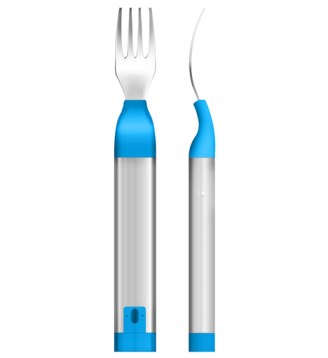
HAPIfork by HAPILabsChewdaism is the theory that chewing food slowly and thoroughly delivers health benefits.
I first encountered this idea while reading AJ Jacobs’ Drop Dead Healthy: One Man’s Humble Quest for Bodily Perfection. It’s one of the healthy ideas he tries out during his year long experiment with improved exercise and nutrition habits.

Chewdaism is obviously a portmanteau (a combination of two words and their meanings) of the words “chew” and “Judaism” though there isn’t any connection that I can see between the idea and Jewish dietary laws.

According to Jacobs, Chewdaism is a kind of food mindfulness. The central tenet of Chewdaism, is that chewing your food 100 times  before swallowing it makes you healthier. Jacobs aimed for just 50 chews and found even that a challenge. He describes a night where his family abandoned him at the table, and left him chewing away into the wee hours.

“They say chewing will cure stomachaches, improve energy, clear the mind, cut down on gas, and strengthen the bones,” Jacobs writes. “Those claims are overblown. But chewing does offer two advantages: You can wring more nutrition out of your food. And more important, chewing makes you thinner, as it forces you to eat more slowly.”

Eating slowly and paying attention to your food, mindful eating as they say, seems obviously to be a good idea. But how to tell if you’re eating slowly enough? Don’t worry. There’s now a fork that monitors your eating speed.

Food tracking which Tracy and I have both blogged about here may turn out to be small potatoes as far the Panopticon goes, given the new food health and nutrition apps and gadgets that are on the way. You can log your steps with a pedometer, of course but new versions of Google on your android phone estimate how far you’ve walked and biked based on the movement of your phone.

“Google Now continues to try and improve our daily lives one little step at a time, and the latest addition seems to be doing just that. Some users are reporting this card now appearing when they open up Google Now, which reports on the distances you walked and cycled in the last couple of months, with a comparison of the two. Pretty nifty, and while not quite at the same level as an actual pedometer, those of you who like to keep active will no doubt find it useful.  How accurate it actually is — especially for the cycling — remains to be seen. Presumably this relies on having your location data, so turning this off should disable it if you’re not too keen.” Read more here, Google slips a walking and cycling tracking card into Google Now.

But back to the smart fork, pictured below. The vibrating fork doesn’t count your chews exactly but it does vibrate if you eat too quickly. Luckily, I don’t eat M and Ms or ice cream with a fork. From the article HapiFork Vibrates if You Eat Too Fast:

“The fork is, well, a fork. But inside it has a capacitive sensor that knows how long it has been since you have taken your last bite. Say you take a bite of that piece of fish, chew it and then go for another bite within 10 seconds. The fork will know that and gently vibrate to tell you have been eating too fast.

The fork also pairs with HapiLab’s iPhone app so you can see how long your meals are, how long you are pausing between bites and even track the number of times you bring the fork to your mouth. The app will also let you track your food intake”

I find myself thinking they could just have it give you mild electric shocks too while they’re at it. Slow mindful eating is good but this seems a bit much monitoring even by my standards. And I like good tracking!

Read more about Chewdaism and about vibrating forks:
Chewdaism: Chew Your Food! on the blog The Jew and the Carrot
diets · sports nutrition · traveling · weight loss

Hunger and Nutrition

There’s a lot of talk about hunger in the literature about making food choices. It doesn’t matter whether your focus is sports nutrition, weight loss, or ‘making peace with food’ and ending dieting, most books in these areas talk about hunger. It’s clear that hunger is something we need to recognize and to which we need to respond. We need to listen to our bodies and to eat when we’re hungry.

I struggle a bit with this because I’m often not hungry when I know I need to eat–during long, intense bike rides is the most common example–and at other times I’m famished even when I know there’s no need for extra calories (after long bike rides when I’m often hungry for the rest of the day and into the next one even after I’ve refueled.)

I was interested to read recently that part of my confusion may be connected to our misunderstanding of hunger.

In Hunger. What it is and what you can do about it Richard Feinman writes:

“We grow up thinking that hunger is somehow our body’s way of telling us that we need food but, for most of us that is not usually the case.  Few of us are so fit, or have so little body fat, or are so active that our bodies start calling for energy if we miss lunch.  Conversely, those of us who really like food generally hold to the philosophy that “any fool can eat when they’re hungry;” passing up a really good chocolate mousse just because you are not hungry is like … well, I don’t know what it’s like. “

When I was focusing on sports nutrition last year, I played a bit with the feelings of hunger in an effort to make peace with them. In situations where I know I’ve had enough to eat, and it’s just a feeling that I can choose to act on or not, I tried to live awhile with hunger and see if I could just let the sensation be. It was interesting experiment and it served me well to realize that the world doesn’t end. I needn’t binge at the next meal. Sometimes it’s okay to live with hunger and wait.

These days I use that to my advantage on traveling days. Yes, I pack food but if I run out it’s not the end of the world.

I hope I don’t have to use that trick as I travel home from Atlanta, site of the 2012 Eastern Division Meeting of the American Philosophical Association, today.

the hunger

That’s the 1983 film The Hunger, of course. My first vampire movie starring Catherine Deneuve, David Bowie, and Susan Sarandon.

addiction · training

Coffee, the best tasting performance enhancing drug

I’m planning on teaching a course on sports ethics in the near future and one of the hot topics in that field is performance enhancing substances and the criteria we use to ban such substances in sports competition.

I’m very happy though that my favourite performance drug doesn’t run afoul of any of the rules.

Like many athletes, both recreational and pro, I love my cup of coffee before riding a bike, running, rowing…

Here’s two of my favourite exercise science reporters for the NY Times on the ability of caffeine to enhance athletic performance.

How Coffee Can Galvanize Your Workout

Gretchen Reynolds: Scientists and many athletes have known for years, of course, that a cup of coffee before a workout jolts athletic performance, especially in endurance sports like distance running and cycling. Caffeine has been proven to increase the number of fatty acids circulating in the bloodstream, which enables people to run or pedal longer (since their muscles can absorb and burn that fat for fuel and save the body’s limited stores of carbohydrates until later in the workout). As a result, caffeine, which is legal under International Olympic Committee rules, is the most popular drug in sports. More than two-thirds of about 20,680 Olympic athletes studied for a recent report had caffeine in their urine, with use highest among triathletes, cyclists and rowers.

It’s Time to Make a Coffee Run

Gina Kolata: Caffeine, it turns out, actually works. And it is legal, one of the few performance enhancers that is not banned by the World Anti-Doping Agency. So even as sports stars from baseball players to cyclists to sprinters are pilloried for using performance enhancing drugs, one of the best studied performance enhancers is fine for them or anyone else to use. And it is right there in a cup of coffee or a can of soda. Exercise physiologists have studied caffeine’s effects in nearly every iteration: Does it help sprinters? Marathon runners? Cyclists? Rowers? Swimmers? Athletes whose sports involve stopping and starting like tennis players? The answers are yes and yes and yes and yes. Starting as long ago as 1978, researchers have been publishing caffeine studies. And in study after study, they concluded that caffeine actually does improve performance. In fact, some experts, like Dr. Mark Tarnopolsky of McMaster University in Canada, are just incredulous that anyone could even ask if caffeine has a performance effect. “There is so much data on this that it’s unbelievable,” he said. “It’s just unequivocal that caffeine improves performance. It’s been shown in well-respected labs in multiple places around the world.”

body image · diets · gender policing · health · weight loss

Three Amazing Rants about Food, Nutrition, and Weight Loss

Must be something in the air…

  • Krista Scott Dixon at Stumptuous in Rant 66 December 2012: The First Rule of Fast Club rants about and aims fury and righteous rage in the direction of lots of things including the following: why intermittent fasting may not be the cure all for women’s weight woes, why in general what works for young men won’t work for women, and why women shouldn’t listen to young, thin, male personal trainers.

Most lean young guys giving fitness and nutrition advice are basing that advice — in part — on their own bodily experience. Which won’t match yours. (See above.)

Most lean young guys giving fitness and nutrition advice have not seen a sufficiently diverse client base. Hey, that’s what happens when you’re young. It’s not bad. It’s just the math of reality. In a few decades, then they’ll be Dave Draper and have some awesome yarns to spin. And then maybe I’ll take their advice.

Food Villain Mythology is usually supported by a handful of (cherry picked) scientific studies and an elaborate and sophisticated web of logical fallacy. The resultant construct usually holds that the Food Villain in question is the root cause of either modern society’s obesity and diabetes epidemic, or the root cause of an individual’s obesity and illness. There is usually some kernel of truth in the claim. Take wheat for instance: it is true that wheat can be problematic for some individuals who have an allergy or intolerance, and for anyone who consumes it in excess or to the exclusion of other foods that would provide a more well rounded nutritional foundation. There are other issues with wheat too, involving its cultivation, processing, ubiquitousness and nutrient profile. But Food Villain Mythology has taken those issues and created what amounts to mass hysteria in some circles, with an entire mythology centering on wheat’s Magical Ability to single-handedly drive obesity and disease. Scary stuff.

Points, at first, were a fun game to follow, and they did make me more aware of the amount of vegetables and healthy foods I was consuming. Just like in my middle-school WW years, I carefully controlled my caloric intake, I joined Jazzercise (which, to this day, I love — fit is it!), and I ate Weight Watchers-sanctioned aspartame gummies (1 point, entire package, ingredients unpronounceable) nearly constantly. Fuck an apple, those fools were two points, and points were valuable, like precious gold. Or something even better because you can’t eat gold.

I’m working on my own Weight Watchers rant and will post it here in the near future. Til then, enjoy these.

Aikido · diets · martial arts · Rowing · running · team sports

In praise of rest days

Fridays are my new rest days and I’m liking it. I’m a bit of a weekend warrior (running, cycling, rowing, soccer, AikIdo!) and it’s nice to start out Saturday fresh. Traditionally I’ve rested on Mondays–post weekend–but now I’m doing Crossfit that doesn’t quite work with my schedule.

I’m looking forward to a weekend of active fun. I’m doing test review in Aikido and I enjoy the intensity and focus of that process. My indoor soccer team plays our 3rd game Sunday afternoon and so far we’ve lost one and won one and I’d like to kick the stats back into our favour.

I’m especially happy today that it’s a rest day because I did a bit more than I bargained for on Thursday. Crossfit included rowing and then rowing practice included weights. Too many deadlifts!

It’s also a sleepy, grey rainy day with snow in the forecast.

What does this mean for me? First, I get to sleep a bit later (though not this morning, spouse’s early morning train to Toronto alarm woke me up, followed by a phone call from teenager at basketball practice who’d forgotten a much needed item.) Second, I try to eat very well on recovery days, lots of protein and colourful veggies. And third, I do keep moving but just regular stuff like walking the dog, housework, stretching etc.

In the spirit of feeling good about rest and recovery days, I thought I’d read some other women fitness bloggers on the practice of rest days:

Sit yo ass down! The importance of rest  by Krista Scott Dixon at Stumptuous

What does rest day mean to you? by fitknitchick

Focus on rest days by Fitnessista

How To: Incorporate Rest into Your Fitness Routine by Fitblogger

Enjoy your Friday! I will. Back on the mats at Aikido tomorrow morning.

diets · sports nutrition

Another perspective on tracking

My co-blogger Tracy explained why she despises tracking food and doesn’t do it these days. When we first talked about this blog we agreed that it might be fun to share some of our differences in approach to fitness. I offer up my different perspective on tracking not to counter Tracy’s experiences of finding it oppressive but rather to share my own experiences with food/exercise tracking. This isn’t a for/against kind of thing. Rather it’s different experiences of the same phenomena. Unlike my co-blogger, I do track what I eat.  Most days anyway. But I don’t do it because I’m concerned with writing down every morsel I consume with an eye  focused only on eating less and getting smaller. I try to do from the viewpoint of ‘sports nutrition’ not ‘dieting’ though like Tracy I recognize that’s a fine line. I’m much more concerned with seeing that I get enough to eat and that I eat the right foods to support my very active lifestyle.  At different times in my life I’ve tracked different things, usually for my own purposes though I’ve sought feedback from some excellent sports nutritionists over the years. (Right now it’s Jennifer Broxterman but in the past I’ve worked with Tim and Deb at Synergy Wellness and Precision Nutrition’s Krista Scott Dixon .) These days I mostly track with an eye on protein, healthy fats, and veggie intake. I also care about calories and sometimes even count them. But again my focus is usually both on making sure I’m eating enough on my active days and on scaling back when I’m not so active. Hunger has never been a very reliable guide for me.

Here’s another take on why calories matter and why we should track food from one of my favourite fitness blogs Go Kaleo: “Calories DO matter, but most of us can eat a lot more than we think we can if we’re making good food choices and getting regular exercise. Tracking calories is NOT about restriction, and reaching/maintaining a healthy weight is NOT about being hungry and denying ourselves proper nutrition. Quite the contrary, it is about feeding ourselves adequate amounts of nutritious foods that support health, energy and vitality. Here is a tool that will help you determine how many calories your body needs to function properly (I’ve found that the calorie tracking websites, while good for tracking, tend to give a calorie target that is too low for most active people I’ve worked with). Many of you will be surprised at how high the number is. Mine is 3500 a day. Hardly restrictive.”

While I like the idea of listening to my body and eating what I feel like eating but I’m afraid  our natural impulses get it wrong in both directions. Mine do anyway. Our urges to eat were developed in times of feast or famine, when stocking up on high calorie foods was a requirement of survival, so often what we want to eat isn’t good for us and the portions we want to eat are too large. But also I often don’t feel like eating as much as I need to do when I’m training hard.  Without calories you can’t win races, build muscles. or recover  well. So I plan meals, I count grams of protein, and I track. Mostly it feels liberating. Sometimes it feels like a chore.  But in a hectic busy family with lots of meals, snacks, and groceries on the go my food log often serves as a way to remind me that what I eat matters. For me, it’s much more about making sure I take care of myself.