challenge · fitness · holiday fitness · holidays · rest · traveling · vacation

Strong Enough for Egypt Vacation

I knew my 16-day trip to Egypt with 3 midlife friends would be a fun, budget-friendly adventure, but it also became a test of stamina and strength for me.

We had no tour big bus providing a comfy, air-conditioned bubble. Rather, our ambitious travel schedule took us through half the country, hauling our backpacks up modest hotel staircases and navigating every natural and human-made obstacle in our path. Although we had quiet evenings, including a few days by a rooftop pool, by day our bodies were moving in lots of ways.

Our first of many tomb and temple visits, the burial chamber of Bannentiu, 26th dynasty (Roman Era) in the Baharia Oasis.

Bodies in Motion

In the desert near the Baharia Oasis we climbed up (then surfed down) sand dunes. In downtown Cairo, the honking cars, uneven pavement, and throngs of moving people in the street demanded constant physical manouvering. We toured ancient sites out in the hot sun, including Luxor’s Avenue of Sphinxes and Aswan’s Forgotten Obelisk. We also used steep ramps and narrow tunnels inside multiple tombs and pyramids, crouching under low ceilings carved over three and four thousand years ago!

Folks climbing a ramp in one of the Giza Pyramids, built for Pharoah Khufu in the 2500s BCE. Kim said the ramps were put in after her visit 16 years ago: before it was just dirt.

As well, we hiked three silent, stunning canyons in the South Sinai region that shimmered white, red, and multi-coloured in the sunshine. The next day, after a caravan of camels and their handlers got us most of the way up Mt Sinai, we used 750 steep steps to get up to its peak.

Riding Asfour (the Second), a 7-year old camel up the first 3000 steps of My Sinai was a highlight. And although Asfour did most of the work, my legs were still sore the next day!

Later, it was a relief to float face down in the salty water of the Red Sea over the most beautiful coral and schools of fish I have seen. We snorkelled twice: off the beach in Sharm El Sheik and off a glass-bottom boat in Hurghada. But even in and near the water, I had to be thinking about dehydration and sunburn.

Kimi and me snorkelling just off the beach in the Red Sea. Video by Lisa Porter.

Getting hurt could mean getting stuck. I nearly did a few times, once when I mildly rolled an ankle in the Coloured Canyon and when I jammed a finger on a tomb doorway at the Saqqara necropolis. But it felt good to keep moving. At least twice we saw a tourist who seemed unprepared or was having great difficulty getting through the tomb shafts.

Kim and Lisa going down the low-lit ramps in what I think was the Step Pyramid, built for Pharoah Djoser in the 2600s BCE. Video by Kimi Maruoka.

We covered thousands of steps per day, even on our 2- to 7-hour travel days. At the last minute I decided to leave my fitness tracker at home, and I’m glad I did. It helped me to make sense of how I was feeling in my body rather than by stats on a screen.

Rope repelling, then a rebar ladder, just to get down into the White Canyon. Our guide admitted he used this to judge hikers’ readiness for this canyon.

Caring Co-Travellers

And my body did feel many things, as I was under the weather for a good part of the trip: first menstrual cramps, a head cold that turned to cough, then mild heatstroke after the first time snorkeling, and finally a stomach bug. On my worst night, I laid awake shaking with chills, sipping tepid tablet-purified water, and waiting for dawn (or death, I had thought self-piteously).

A short video of Cairo’s downtown streets at night. Our group kept close watch on each other to avoid getting lost or run over.

But I survived. As a white, English-speaking tourist with a credit card and travel insurance on a holiday, I was never really in serious danger. I saw many Egyptians who may have been facing economic hardships and health risks I will never have to deal with as a middle-class Canadian.

Nevertheless, I am so grateful for my three travel buddies, who showed each other constant care throughout our journey. We divided snacks, each bought rounds of water, shared everything from tissues to electrolytes, and carried the mood for each other until someone sick (usually me) recovered.

A cat next to my day pack and water bottle. I stayed hydrated with old and new friends!

Kim, who had planned the travel and booked the local guides and drivers, happily made last-minute arrangements to help me join later when an early morning tour of Isis Temple in Aswan wasn’t possible for me. This caring company was the heart of my trip.

Me in a feeling-better moment, making silly Instagram poses with the backdrop of the Red Canyon behind me. Photos by Kimi Maruoka.

Proof of Life

I believe that our greater exertions paid off in greater fun. In exchange for living out of packs and in our sore, dust-covered bodies, we got to see and sleep in neat places, including under the desert stars, where we felt extremely lucky to be there, together and alive.

Our remarkable view of the white desert at night. This photo was not taken with a black/white filter.

There’s a certain idea of midlife that says to slow down, be careful, rest more. This trip refused that. It demanded and invited all kinds of motion, reminding me how much the body can still do when it must. It turns out that I was strong enough for Egypt.

Lisa and Elan racing (falling?) down a sand dune in the White Desert. Photo by either Kim or Kimi.

And by the end of the trip, I used nearly every pill I’d packed and every muscle I had. But getting over everything became part of my adventure story. I came home with a mildly sprained finger, hardwon but still overpriced souvenirs, and a feeling that my flawed and frustrating body could still bring me much, much joy.

Our fearless foursome trekking in the desert. To borrow a phrase from Kimi and her sisters: “We did it!!”
body image · fitness · Guest Post · illness · weight lifting · yoga

Before and After: A personal reflection on exercising with chronic illness

by Christine Junge

Image description: Outside shot of a woman (Christine) with dark medium long hair and wearing a short-sleeved shirt, holding a young boy while he climbs on a rope climber in a playground, with dappled light, a fence, and a tree in the background. She is looking up at the boy and the boy is looking up at the next rung of the rope. Photo credit: Viceth Vong.

“Why aren’t you doing another triathlon this year?” an acquaintance asked.

I gulped. “I’m having some, uh, health issues,” I said. I was keeping things vague out of necessity—I had no damn idea what was happening, only that I had a constant (and I mean 100% of the time) headache that reached an unbearable level by the time I left work for the day. I went to sleep pretty much as soon as I got home—not only because being in pain is exhausting, but because sleep was the only time I didn’t feel awful. My life goals had gone from: publish a book, rock my career in publishing, and finish a tri even though I can barely swim, to: get through the day.

In the year after the pain started, I had test after test. They all came back negative, which was a good thing on the one hand (who wants to have a brain tumor or Lyme disease), and utterly frustrating on the other. After each of my appointments at Boston’s various prestige medical clinics, I wanted to scream, Why can’t you just tell me what was wrong with me?

Eventually, through a process of elimination, they diagnosed me with occipital neuralgia (nerve pain in the upper neck) and idiopathic chronic migraines (idiopathic just means that they have no flipping idea why it’s happening.) I tried treatment after treatment (Botox injections, handfuls of pills, various psychologic therapies) but the headaches wouldn’t budge. I was in bed for the vast majority of most days. The body I toned through hours of training atrophied.

Eventually I went to the Cleveland Clinic for a three-week “headache camp,” as a friend called it. There they tweaked my medications but more importantly, they taught me more than I could’ve imagined about headaches and how to maneuver your lifestyle to live with—and hopefully eventually prevent—them.

One of their prescriptions was to get back to exercising. I had all but stopped as the pain consumed me. There were a few scientifically backed reasons for this recommendation: exercise has been shown to reduce the severity of pain in people with many chronic pain conditions; it also greatly helps with the anxiety and depression that often hits people with chronic illnesses of all stripes (and that certainly hit me).

For me, it also allowed me to get back in touch with that former triathaloning self. I started with walking—an exercise I still love. I added yoga and light weight training. Slowly but surely, I started to feel better physically and emotionally. Now, I walk for an hour a few times a week, do pilates at least once a week, and I’m currently attempting to reintroduce weight training after that fell out of my routine. On days I exercise, I feel less achey—and also like my body is my friend again, not something that revolted against me. I feel, too, that I am strong—I hadn’t realized how upsetting it was to my sense of self to think of myself as weak. Now, I am not just someone with a disabling condition, I am someone who can keep up with her son on the playground, who can squat down and lift his four-year-old body, who doesn’t have to fear the idea of trudging around a theme park all day. 

I have greater exercise ambitions, too: I plan to conquer a ten-mile hike in the next few months, and an even longer one by the end of the year, with the eventual goal of walking 100 miles or so on Europe’s El Camino Santiago. I have no thoughts of trying for another triathlon, but thanks in part to regular, light exercise, I’m doing much more than just getting through the day now. 

If you have a story about exercising during or after illness, we’d love to hear it!

Christine Junge is a writer living in San Jose, CA. She’s currently working on a novel, and blogs about parenting with a chronic illness/disability at ThanksForNothingBody.substack.com


fitness · injury

Sam’s sad knee saga: A struggling system meets the pandemic

I’ve been seeing physiotherapists and sports medicine doctors about knee pain and function since my mid forties. I’m 57 now. It’s been a while.

Advanced knee osteoarthritis has ended my time as a soccer player first, then running, then CrossFit, then cross country skiing, and then Aikido. My sports world has narrowed considerably. I still lift weights and do yoga and ride my bike, but I can only walk short distances and I’m in pain a lot of the time. Lately it’s started to affect my sleep. Wordle helps. Thanks Wordle.

Years of physio, injections, canes, and braces later, in 2018, a sports medicine doctor recommended me for total knee replacement and referred me to an orthopedic surgeon. It was time.

Image description: A photo of Sam just outside Central Park. I’m wearing black leggings, sandals, a sleeveless black jumper and a purse over my shoulder. Also, a knee brace. I’m smiling and the sun is shining.


In August 2019 I went into the hospital and met with the surgeon and his assistant and talked about what the surgery involved, how much recovery I would need etc. Since then pretty much radio silence. There was the usual wait. In Canada it’s a year to 18 months depending on where you live. But then there was the pandemic.

Some friends had knee surgery during the pandemic. Why them and not me? I’m not sure. One had both knees replaced at the same time and while that sounds brutal it has a kind of economy of scale and risk that sounds attractive. Would I be eligible for double knee replacement? I have no idea.

Last summer in 2021 I reached out to the referring physician to check in. I started to have those kind of worries that arise in this sort of situation. Could they have the wrong number? Maybe they lost my file?

The sports doctor has a memorable name. It’s one of those names you can’t quite believe isn’t a joke. It’s “Getgood.” He’s Dr. Getgood at the Fowler Kennedy Clinic in London, Ontario. New xrays determined that now both knees need replacing. They can’t do any more injections because in case I do get called in for surgery that would make surgery not an option. You need to wait months between last injection and surgery.

The clinic said that the hospital kept operating on young athletes throughout the pandemic, less worries about covid I guess. Once things opened up again, there were hundreds of seniors with zero mobility who needed joint replacement. And I see why they need surgery before me. Still, being stuck in the middle and waiting isn’t much fun.

So here I am. As covid continues, the surgical backlog grows. American friends are puzzled. People keep think I’m putting off the surgery because I’m nervous. Not true. I mean, yes I’m very nervous but that’s not the issue.

I’m just waiting.

I’m learning about how waitlists are maintained.

I’m learning about Quebec’s two tier system.

I’m finding the opacity of the system frustrating. I’d like to know where am I on the current surgeon’s waiting list. I’d like to know what the criteria are. I feel like I could make better decisions about my life if I had more information.

Friends suggest I change waiting lists, change hospitals but I’m not sure. Does that mean I go back to the end of the line? Can you be on multiple surgeons’ waitlists? None of this is clear to me.

Through my family’s varied health crises, and we’ve had some dramatic ones, I’ve been proud of the Canadian health care system. But I’m not happy and I’m not proud of where we are right now.

Listen to this episode of The Current if you want to hear more.

“There are thousands of Canadians whose surgeries have been postponed because of the strain COVID-19 is putting on health-care. Matt Galloway talks about addressing this health-care issue, with Dr. Jean-François Joncas, an orthopedic surgeon and president of the Association d’orthopédie du Québec; and Dr. Danielle Martin, a family doctor and the chair of family and community medicine at the University of Toronto.”

At the moment I’m on an airplane. My first flight since the pandemic began. There’s a lot of standing and walking in airports. I’m starting to consider the mobile cart to the gate. I’m staying in the conference hotel to avoid walking too much and I’m telling friends who I’ll see here that I need to eat in or near the conference hotel or take taxis.

Update: It’s very pretty here and I’ve walked a fair bit so far.

Vancouver in bloom

There’s also a 24 hour Peloton Studio at the hotel and bike rental nearby. Don’t worry. I’ll keep moving on two wheels. There’s also a pool, a hot tub, and yoga. I’m a naturally cheerful, optimistic person but if you get the sense that this is starting to wear on me, you’d be right.

Dressed for travel 2022 style

The early mornings are nice here too.

Boats, water, and grey sky with sun just starting to rise
fitness · swimming

Meet our newest Fit is Feminist Issue regular blogger, Bettina!

Following my first post, I’m excited to return on a monthly regular schedule! Sam asked me to make this post an introductory one, so here goes.

My name is Bettina, I’m 33 and from Germany. I live in Heidelberg, a university town south of Frankfurt, with my scientist husband, who is originally from the Basque Country. I always joke that we’re here because of him, not because of me, and it’s true – I would’ve happily stayed abroad after finishing university. As it turned out, I ended up earning my PhD in Political Science back in Germany, having spent the last two years of high school and most of my undergraduate years in the UK, plus a year in Spain.

While working towards my PhD, I realised I didn’t want to pursue a traditional academic career. Slowly but surely, I moved into research management. Three jobs later, I am Senior Project Coordinator at a European research funding and enabling organization in a field that has nothing to do with my own – the life sciences – and loving it.

Fitness has always been a part of my life, but not to the degree it is now. When I was in primary school, my mother got worried about my bad posture and put me in the local swimming club. With short interruptions, I’ve been swimming regularly ever since. It’s my meditation, my favourite way of clearing my head after a long day. I love doing laps in the pool. Lots of people find it boring, I find my zen in the back-and-forth.

I’ve tried lots of other sports, many of them water-related. I love surfing and kayaking, but since there are no large enough bodies of water close to home, these are currently not often on the sports menu (sigh). Being outside is always good, so hiking is another favourite. I’ve done lots of yoga, which nowadays happens mostly at home, right after getting up in the morning, with Youtube tutorials.

Fitness has taken on another dimension for me over the past year though: a year ago to the day, I was diagnosed with Auto-Immune Haemolytic Anemia (AIHA), a condition where your immune system breaks down your red blood cells. Many things can trigger AIHA; in my case it was probably the flu. It’s pretty serious but treatable, and I’m in remission now.

But while I was in treatment, exercise became a way of feeling like I had some control over what was happening to me, full of all sorts of medicine and shocked as I was by this experience that was entirely outside both my control and my comfort zone. Incidentally, exercise is also a pretty good barometer for a relapse, which can happen at any time (or not – there’s a large suspense factor with this condition): one of the first things to go is your stamina, which was also how I started noticing I was sick in the first place when I could no longer keep up with my swim mates.

Since my diagnosis, I’ve started running much more regularly in addition to swimming twice a week if I can. Having been a rather reluctant and irregular runner before, I’ve done a 10k and an 8k since last September. I’ve also taken up a new sport, bouldering, which is different from anything I’d ever done, and which I love for its community spirit (Lynette recently wrote about it here and here). And it’s so empowering when you’ve figured out a tough route!

Empowerment is also where fitness and feminism intersect for me. Both are, in a way, about feeling strong and being entitled to that, no matter who you are or what gender you identify as.

There’s still a lot to fight for in terms of feminist fitness. Athletes who are not straight males continue to be on the receiving end of everything ranging from condescending advice to discrimination and hatred. We’re overlooked, spoken over, not taken seriously, judged for our looks rather than our athletic achievements, objectified, and ridiculed.

Feminism in fitness, to me, is about considering how a feminist lens can change our thinking about fitness and what a “fit woman” looks like. It’s about what the needs of women practicing sports are and how they’re different from those of male athletes. It’s about what we can do to make women of all ages, shapes, and abilities feel welcome in the world of sports and encourage them to discover it.

Bettina, looking distinctly wet but happy, in hiking gear at the summit of Skiddaw in the Lake District, UK

fitness

Music for lesbians, “old lady luxuries,” and you should sit if you need to

I’ve got a thing for some of the women whose music was the soundtrack of my youth. I love Stevie Nicks (saw her in concert with my son last year and a few years ago in Canberra, Australia), Madonna, kd lang, Ferron, and Chrissie Hynde. Lots of others to love too (Kate Bush, Joan Armatrading, the Parachute Club, and more) but these are all women I’ve seen in concert.

So I couldn’t resist a chance to see Carol Pope when she played in Toronto recently. I was shocked to realize she’s now 70. She makes 70 look pretty good. Pope is still tearing up the stage. She was part of a concert she’d organized called “Music for Lesbians.” I rounded up some friends (all bloggers here, Hi Sarah, Hi Susan, Hi Cate!)  and though none of us are lesbians (bisexuals all) we had a great time.

Love that Carol Pope shared the stage with Rae Spoon too. Here they are on stage together.

Okay, you’re thinking, what’s any of this got to do with fitness?

As you know I’ve been sick recently. As of the date of the concert I was still tired by the evening and coughing up a storm at night. I debated not going but it was a date with friends and I’d hate missing out. I was certain I wasn’t contagious. I was just suffering from a cough that hangs around after.

Anyway, I looked at the tickets and was thrilled to discover that I’d paid extra for us four to have seats in the balcony. There’d be no need to stand around. Yay!

But other friends were in the regular section and I felt guilty. I couldn’t hang with them and I couldn’t dance. I had to sit. Jokingly friends referred to where we were as the luxury section for old ladies. (Yes, the tickets cost more.)

This feeling of being aware of my needs being different than the needs of others was new to me. It made me realize how privileged I am that this is usually not true for me.

When these piece came across my newsfeed that same week, What a Dolly Parton Concert Taught Me About Living With Chronic Illness, it resonated in a way it might not have before.

“The next time anyone gives me drama about sitting down or bowing out of a standing room-only event, I’m just going to remember Dolly. What would Dolly do? She’d probably smile graciously, keep singing her heart out in all her rhinestoned finery and completely ignore those criticisms. You do what you need to do to look after yourself. That’s something I constantly tell myself, and Dolly helped remind me of it.”

I know I’m frequently the person on the blog who advocates standing over sitting, and moving over keeping still, but yes, sit if you need to. I did. And Dolly does too. No guilt. No shame.


fitness

Sick, sick, sick, and sick of it. Hack. Cough. Wheeze. Blerg.

Image result for coughing cold memes workout

Image result for cough medicine memes

I took my FitBit off this week in disgust. There is nothing good to report. I’m not moving much because when I move I start coughing. I’m also not sleeping particularly well, because coughing.

ARGH.

I’m trying to keep my spirits up. I’m vaguely happy that it’s snowing because I can’t do anything anyway.

This morning’s Facebook status update: “Okay, yes it’s snowing. But I’m still sick and can’t do much anyway. Highs in the teens over the weekend. High of 20 in the forecast for next week. The snow will melt. I will stop coughing. And I will ride my bike again.”

And yes, I’m doing all the things. Drinking hot tea with honey, eating soup, resting, I promise.

When you have a cold and lingering cough, what’s your preferred ‘feel better’ thing to do? Last time I was this sick I see it lasted a month. Yikes.

(Apparently I like to Google image search for “too sick to work out” and “missing my bike.”)

Image result for cough sick memes


Related image


Image result for too sick to workout memes

Image result for my bike misses me too


Guest Post · holidays

It’s easy to get lazy! Return to training during or after a cold? (Guest post)

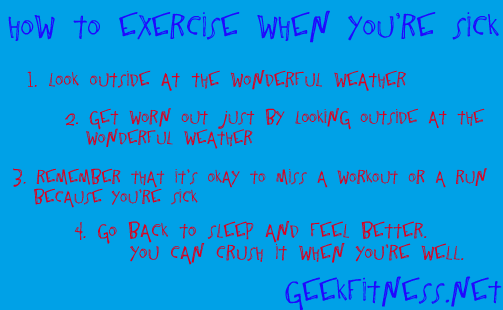
Over the holidays I was hit by a pretty bad cold. 7 days straight of very high fever, sore throat, congestion, and coughing. My immune system is hyper-reactive and the nukes were out to destroy the bug. But it did not work this time. It lasted its full 10 days. And now beyond the 10 days I still feel somewhat congested.
Despite all signs, I went out running on day 5. Admittedly, I did not have any fever that morning and thought “That’s it, I am winning this!” This was a very slow run even if I felt like I was pushing. And at the end of the day I could tell by how I was feeling that it had been a mistake to go out. Did it extend my cold? Who knows. This is hard to say. And advice out there on whether one should run or train with a cold is sometimes contradictory. Most will say if you have fever, don’t. But unless one has a working and reliable thermometer (I don’t) it can be hard to tell (add to the mix the occasional hot flashes induced by peri-menopause and, voilà! Is it fever? Is it a hot flash?)
So after that 5th day outing, I waited another 4 days before engaging in any training. During that time, one wonders: am I just being lazy? Surely I could (should?) push myself and do it. When I did train, it was indoors because I was still somewhat feverish and did not feel like running outside in the wet cold. So I did weight training and leg exercises. I thought: “good plan! This won’t go against my less than optimal oxygen intake because of my congestion.” That was without thinking about muscular weakness caused by the cold. I don’t think I have ached like this in a very long time! I went out for a run the next day and pulled something in my thigh. Good job! But again, I was questioning whether I was just being lazy. It is so easy to get lazy, right? Stay warm inside and lounge on the couch, reading stuff and watching some TV (and doing work on the computer). One gets maybe too comfortable? So out I went to run a 7km!
But there are times when your body just needs to be lazy. It needs you to rest and fight what it has to fight. While you are reading, watching TV, killing time on Facebook, your body is hard at work fixing itself. It may be easy to get lazy but it may be necessary at times. This was one such time and I did not listen to my body.
Training is fun and exciting. I know I like it. But I have to learn to be patient with myself when I am sick and need my energy to fight whatever is assaulting me. Mostly, I have to shut up that narrative that makes me think I am just being lazy and should suck it up. I have to go back to working out in a way that does not throw me back into illness. This means a gradual return, testing the waters so to speak. So I need to be more patient with myself. Oh! And I also need to get myself a proper thermometer!