body image · fitness · weight loss

What Women Weigh

The morning after the presidential election I had my regular quarterly checkup with my rheumatologist, a wonderful south Asian-Canadian woman who treats my Ankylosing Spondylitis. I was already reeling from exhaustion and sorrow and rage because, you know; then I remembered that I would have to get on the schmancy digital scale the nurses trot you past before taking your blood pressure and making you wait. Cue… feelings.

I don’t own a scale and I don’t mind them all that much, to be honest. I know what I weigh, for training purposes, and I know when my body feels strong and comfortable in my favourite outfits. (I am a clothes horse, for which I thank my fantastically hedonistic psychotherapist.) But I get anxious getting on the scale all the same; this is learned anxiety. I grew up fearing my weight – fearing being weighed. I grew up fearing the scale’s gaze, like so many of us did and do.

000005_5_2
Me at 10. I found this roll of film in my mom’s old camera three years ago. Our dachshund was called Nancy; my friend was called Francesca.

I was a chubby kid. I didn’t exercise much until university, and I ate the menu at home – hearty German fare. When I moved out on my own I moved in with a long-term partner, and together we did the thing most couples do when they hit the comfort zone: we gained weight together. At my heaviest I was extremely unhappy in my body, my relationship, and my life. That was about 15 years ago.

Today I love my body. It has taken work on my psyche (see above, re hedonistic therapist), on my past, and on my relationships with loved ones. It’s thanks to my feminist support network, and to the sports I adore, but I am now at a place where I do not really care much what the scale says. Other things matter more to me.

Which is why, when I stepped on the schmancy digital scale at the specialist’s office on 9 November and it read 172.8lb, I did not feel much bother. This was a number I had not seen in many years – I’ve been hovering between 160 and 169 since about 2003 – but I understood its origin. I’ve been working with a personal trainer for 16 months; I have gained enough muscle in that time to be able to do body-weight pull-ups and many other badass things. I’m also substantially faster on my bike than I’ve ever been despite the added weight. So I knew it was largely muscle I’d gained, which mitigated the feeling I would have expected to experience at seeing that number:

Shame.

The doctor helped further. (Did I mention how awesome she is?) She entered, looked at me, looked at my chart, and said: you look just great. How do you feel? (At which point a tearful conversation about the election ensued. Suffice to say my weight was soon forgotten!)

I left feeling buoyant. And then I got to thinking about why I was feeling these feelings, even though the scale had just told me something ostensibly fearful – because women fear weight gain, always. Right? I felt good because I had gained lean mass, and that was my goal. I felt good because my doctor saw the same lean mass gain in my shape and on my chart and knew it was a positive – for me and for my wellness.

I felt good because I understood what I weighed and why I weighed it. Because the number, in fact, matched my expectations – my own goals, not the social message about what weight is, or should be, for women.

I felt good because I saw the true correlation between my weight and my body – the human female body I know and love – perhaps for the first time, ever.

Women are told from a young age to stay small and thus be beautiful: the less of you the better. The scale is your enemy: unless it registers LESS than expected, you are a failure.

blogger-image-206202879

I spent my childhood knowing this; key numbers were taboo. (180lb was THE ULTIMATE TABOO. I remember this well. Mom, do you?) So I fought to lose weight. I fought to shrink my body. I fought to shrink my expectations. I fought to take up less space in the world.

Sound toxic?

It sure as hell is.

This is one of the reasons Tracy firmly believes in dumping the scale – and she’s not alone. Get rid of it. Get rid of those shrinking expectations! But I have an ongoing relationship to my trainer’s scale, for training purposes, and to the one at the doctor’s, and thus I don’t wish to ditch. Instead, I have decided to use my new feeling of buoyancy (weight + knowledge = light-heartedness) as a teaching and learning tool.

This past Monday, I hatched a crazy plan: to run a “guess my weight” game on Facebook.

I wanted to test a theory: that very few people know what a human female actually weighs. We know what she “ought” to weigh, according to the toxic mainstream messages we are fed constantly about female embodiment: 110lb-140lb, maybe ever so slightly more if tall and (of course) slim – but I was betting we mostly had no clue about real weights in the real, badass, girl world. And I think we freaking should.

cbp0ahjwiaapsyr
70kg is 154lb. This image has some issues… but it was the best I could do after a lot of searching. Enough said.

Why? Because: real women weigh stuff. Real women take up space! If we understand this, really get it, maybe we can make some real progress.

This is what I did. I posted three recent images of myself (below), in which I weigh (from bottom right, counterclockwise) 161, 167, and 172.8lb respectively (the final photo is my #pantsuitnation photo, from election day. SOB). I asked friends not to share on FB feeds (no trolls, please), but to share the pictures with friends and family privately and ask all and sundry to guess. The more guys and kids the better!

I got dozens of responses. While they varied widely, they ranged from roughly 140lb (mostly guys) to roughly 180lb (mostly my athlete, female friends). In the aggregate men guessed low; I don’t know if this is because they feared embarrassing me by saying what they really believed I weighed (I’m thinking this isn’t that likely – these are guys I trust and care about), OR because they don’t actually know what human females generally weigh, even though they love us and have all the best intentions in the world (this one is my bet).

Women guessed much closer on the whole. True, my FB feed is filled with feminists and athletes, but even so I was surprised. And more: I was heartened, and made genuinely happy. And I felt empowered! I’ve got to be honest: even though I know why I weigh what I do, and am totally happy with it, I somehow expected everyone to look at me, guess 150lb, and then be profoundly shocked and appalled when I revealed my true weight. The fact that so many friends came properly close, easily and with generosity, told me something I did not know before: other women also weigh what I weigh. Other women also take up this much space. Other women know…

THIS IS NORMAL.

Now, I know that I’m coming at this as an athlete; my weight is different from weight based on lots of non-lean mass, and all the social stigma attached to that. But two caveats here.

First, I’m not all muscle, people. I’m 42. I like wine A LOT. And cheese. And chocolate. Some of that weight has nothing to do with climbing hills and crossing finish lines. Plenty of that weight is healthy, normal, female fat.

Second, it doesn’t actually matter that much! What matters, to me, is this: I said my (substantial) weight out loud, to a bunch of random people (to all of you!), and I did not die. Nobody looked at me sideways and decided I was too gross to live. In fact, a bunch of people I love and trust guessed damn close, and in the process told me that a) we look terrific, and b) we weigh a lot.

Why have we not told each other this stuff before? Because, ladies, listen up. If more human beings knew what – and SHARED what – human females actually weigh, the space we actually take up in the real world… maybe we could run more of that dumb-ass world ourselves.

Pitch your scale if you want: you have all my love and respect.

But if you keep it: say the number. Out loud. To friends and kids and loved ones. Be not afraid. You’re just taking up the space in the world that you deserve to own, every last bit of you.

And you’re freaking beautiful.

Kim


fitness · gender policing · health · inclusiveness · media

Vacuuming as exercise, and other myths about women’s mobility

For some time now women have been told that housework chores can count as exercise, but for reasons unknown I’ve only just cottoned on to this self-help trend. Vacuuming, gardening, washing the floor, hauling the laundry up and down stairs… is it exercise? Some say yes (click here for a representative, if slightly condescending, example); some say no (this example comes from Women’s Health, and is actually even more condescending than the Weight Watchers example.)

I have two replies to the question, personally.

Is housework exercise? HELL YA. Have you ever hauled three loads of laundry up the stairs in between pulling out dead perennials and cleaning up after the dog? It’s a lot of fecking hard work, and I sweat through it weekly.

Is housework exercise? HELL NO. Because it’s WORK, people! It’s unpaid labour for many women, and poorly paid labour for many others. Don’t condescend to us by equating it with self-care. That way madness lies – and nothing but patriarchal double standards.


So what to do with this information then? How to learn from the “housework as exercise” trend, and the arguments underpinning it?

In my job as a humanities scholar, I spend a lot of time with students parsing popular culture and the discourses that drive it. This isn’t just something we do to pass the time in class and prepare for essays that will eventually go in the bin, forgotten; parsing public language is an essential life skill, a citizenship skill. It teaches us to be skeptical of the messages we get everyday from the world around us.

(Think about it: if everyone had some basic message-parsing skills, would Donald Trump be the Republican candidate for president? Or would we be witnessing a proper, grown-up campaign for the most important political office in the world?)

article-1298543-0A974684000005DC-136_306x653.jpg
Is the campaign trail exercise, Hilary? Um, DUH. It’s also HARD WORK.

In the two short articles I link to above, my trained parsing brain reads the following embedded assumptions:

  • women should always be focused on weight loss; this is typically dressed up as “exercise” in the press to make it more modern and palatable;
  • “exercise” is something women need to make time for; if they don’t have time because of housework chores, they shouldn’t worry about it, but rather repurpose their housework as “exercise”, or even as “me time” (doing squats while waiting for the microwave! As if!);
  • housework is not work, because it’s “exercise” (aka “me time”);
  • women snack too much when they work hard! Stop snacking, ladies! Next time you grocery shop – because of course YOU grocery shop for your family, right? – be sure not to buy so many salty, fatty snacks that you enjoy!
  • women have no impulse control (see directly above), and therefore need to be reminded both to exercise and not to snack;
  • housework is a fact of life. Get over it, ladies.

What’s common among all these assumptions? Basic gender divisions: it’s not men doing the housework in the images in these articles; it’s fit, able-bodied, white, pretty ladies. There’s no notion here that you might, um, ask your partner to help with chores, or simply let the dirt accumulate a bit so you can do something else you enjoy, move your body in some other way. Instead, there’s a blanket assumption that you have to do the chores (it’s natural! It’s the way life is for us gals!), and you obviously have to exercise (keep young and beautiful, if you want to be loved!), so what else to do? (Just don’t eat any crisps while you’re at it, because then you’ll get fat and your husband won’t want you anymore…)

What’s the alternative to this coercive set of barely-spoken assumptions? I want to propose a totally different way of talking about the issue of how housework impacts women’s lives, and what that has to do not with exercise, but with mobility.

I’d like to suggest instead that, as women, whether single or partnered, disabled or non-disabled, in traditional relationships or in non-traditional ones, we all spend some time this week not squatting in front of the microwave, but rather thinking critically about how we move each day, how and why our movements are circumscribed, and how we might find ways – with the help of partners, family, friends, employers, or others – of becoming more mobile, on our own terms.


Here, I want to stress that it is not our job alone to become more mobile, or to overcome socially-driven mobility constraints; we live in a world in which institutional constraints actively work to limit women’s mobility, especially non-white, disabled women’s mobility; those institutions must change in order for mobility to become more broadly equitable for everyone. Mobility is a societal responsibility, not an individual one.

But part of that work needs to be activist on our part, needs to be about us making noise; it needs to start with all of us recognising and deconstructing where and how we are, and are not, freely mobile, and to complain, loudly, when our mobility is unfairly limited – whether because of wheelchair access barriers, or because of media messages that tell us to keep doing that laundry, it’s good for us!

I challenged myself to keep tabs, for a week, on my own daily mobility, to see where I’m free to move in ways that I wish, and where I’m not so free. Here are my findings from last week, generalised a bit to a normal term-time week:

  • I usually wake up between 8am and 9am; I’m lucky to have a job that works with my circadian rhythms, so I recognise here I’m very privileged to get up without an alarm clock at least 4 times per week. That means I’m better rested and more energised.
  • next, I walk the dog; she insists, but it’s not like she’s the boss. I could say no! But I enjoy my three walks a day with her, again because I’m privileged to have a flexible schedule.
  • on teaching days I cycle to my campus office around 11am; I live in a walkable, ridable city (more privilege). I teach between two and four hours a day twice a week; I’m on my feet for half of these, sitting down for the other half. No choice there. Often I’ll wear high heels for teaching, though this is largely my choice; nevertheless, I feel compelled to present as broadly feminine in the public sphere, so it’s not all my choice. The heels can produce standing discomfort and occasional hip pain.
  • a good portion of the rest of my weekly labour (teaching prep; administration; research – profs work a lot, and teaching is just part of it…) is at a computer, sitting; I’m lucky to have good chairs and the freedom to get up and move around a lot during this work (see dog walking, above).
  • late afternoons / evenings I usually cycle or row for up to two hours at a time. This represents remarkable freedom of movement, as I have no partner or children demanding access to my time or body at home.
  • evenings I often work at my computer at home, catching up on things dropped in the day. I can stand up and move around during this work but often I don’t. Because I have no partner or children pressing on my time or mobility, I often forget to get up and stretch. This is a mixed blessing.
  • weekends include housework, cleaning, gardening, marketing. These are my choice, but I feel social pressure to keep a neat house and garden, so they are not all my choice. Even more because I have no nuclear family (IE: I’m not “heteronormative” in my living conditions), I want to appear “normal” to my neighbours, and so maintain the outward appearance of a middle-class professional woman in all of my “front stage areas” (this term comes from the ethnographer Erving Goffman).
  • on Sundays I often see my parents, who are elderly, and support my mom, who is in a wheelchair. Because her mobility is so limited I become a surrogate body for her while I’m helping out. This is the closest I come in my daily life to understanding what so many women who are caregivers for children, parents, or partners go through all the time. Taking orders from mom, and moving her around the world using my body, are a lot of work; I compromise my control over my own mobility in order to give her a bit more freedom. I am so lucky to be fit and strong, because the physical demands on me in this labour are tremendous.

It’s obvious from the above that I’m very, very lucky with my mobility in general: it is largely my own to determine. Kids don’t demand I be here or there at this or that time, or that I give over my bodily movement to their needs; ditto with a partner. I have a flexible job and can do what I want when. But socially, I’m still constrained as a middle-aged woman who lives under the glare of heteronormativity. Weekend chores mean less time overall for relaxing – which impacts my health a bit. And, as a result of not having a partner (partly due to the fact, I’m afraid, that I’m in my 40s and have an advanced degree and a professional, intellectual job… intimidating for a lot of guys), I also don’t get regular sex; that’s a key way in which I do not move that I wish I could move more often.

How about you? In what ways is your mobility constrained, and in what ways are you free to chart your daily and weekly course? Try the tracking exercise and share your findings; I’m keen to hear about others’ experiences.

Finally, let me stress once more: this is not about changing ourselves; it’s about charting how institutional and other pressures in our lives keep us from moving freely – and how that impacts, among other things, our ability to exercise and to rest our bodies how we want, when we want.

Kim

accessibility · fitness · yoga

Yoga as comedy! Yoga as pleasure!

I’ve been doing yoga for about 10 years now. I began, somewhat skeptical, because others I knew were doing it; I got serious when a great new studio opened in my neighbourhood. (The Yoga Shack is now a London, Ontario institution, but it’s almost exclusively devoted to hot yoga, which I do not love. See below…)

I then tried a lot of things. I did what we might call “conveyor belt” yoga – the kind sold by  chain studios that run a pre-planned, branded “flow”– until I realised that the goal of CBY was to pack as many supplicants into the room as possible, in order to turn a profit. As a result I was getting no individual coaching – as if the instructors at those particular studios were likely to be able to coach me effectively anyway, given my challenging, specific needs (Ankylosing Spondylitis, isolated muscle strain from cycling and rowing), and the limits of their training and experience.

(Do I sound bitter? Sorry if I sound bitter. I know some CBY instructors are amazing teachers stuck on the conveyor belt. I do. But many – MANY – are not.)

Then I began practicing at a studio in east-end Toronto. My teacher there was Terrill Maguire, and she taught me three things I won’t ever forget:

  1. Yoga is for all bodies, all ages, wearing all kinds of clothing. There were physically and cognitively disabled people in our class, as well as people wearing sweatpants and T-shirts (I was one of them). There were younger people and older people. There were elderly people. Everybody was included and all bodies were considered “normal” and treated with respect and specific care.
  2. Props are useful; use them! This is, admittedly, an Iyengar Thing; the practice involves the use of props to get form right. Doing yoga incorrectly can lead to injury, just like riding a bicycle badly can lead to crashing (or, less extremely, to wasting energy and not getting enough positive benefit). Props help form; if you can’t reach the floor, no big: use a block! The normalisation of props in Terrill’s class reminded me how ashamed I secretly felt in CBY classes when I decided *not* to strain to reach the floor. And how utterly wrong that entire scenario was…
  3. Yoga can be a place of laughter. It should be a place of joy! When stuff went wrong we giggled about it. We tried again, of course, but the laughter broke the tension, loosened our bodies, lifted our hearts.

I left Toronto (and Ontario) in 2012 to move to the UK. Once settled there, I joined a chain fitness club that had, remarkably, some really great, independent yoga instruction attached to it. I found a class that I can’t describe as anything other than challenging: it involved me learning to do Crow for real, and at one point I almost did a tripod headstand (the “almost” is the key bit here). There were no props in this class, and the instructor was neither funny nor forgiving; this wasn’t chain yoga of any kind, though, and I learned from the class to push my practice to a new level of challenge and start attempting inversions.

Last year, I took a fresh leap of faith and spent 10 days in an ashram in Kerala, practicing 4+ hours of yoga a day. I had never before been the kind of person who could imagine herself at an ashram, let alone at one in India; I soon realised, though, that the regimented  days married to an otherwise relaxed life-way suited me well. I quickly befriended my roommate, another woman unaccustomed to the ashram life (a lawyer from Mexico City), and we worked together on aspects of the house yoga practice we found difficult, supporting each other as yogi partners in the open-air main hall.

(It was moving, and spectacular, and peaceful, and the food was simple but incredible. I’d go back anytime – right now in fact.)

When I came home (which is now the OTHER London, in Ontario), I realised I needed my practice to continue growing, and growing in the right directions, but that the options in LonON were limited. There was CBY, which I’m never going back to, and there was a pretty good independent studio, the aforementioned Yoga Shack, but it was now committed to hot yoga serving a primarily student demographic, and I just do not agree with hot yoga as a practice.

It doesn’t suit my body type, for one. I sweat a lot when I work out, and hot yoga is designed as a workout above all. When I do hot yoga, I’m instantly uncomfortable; I find holding poses properly to be difficult because my body is slippery with moisture.

For another, well – I could (and may yet) write a whole other post on the ways hot yoga encourages the mirage of weight loss on the mat (thanks, sweat!), and the detriment that causes to both yoga and the humans (especially young, female humans) who practice it.

Where to go, then? I turned to Tracy, who has been doing yoga for ages, and ended up at Yoga Centre London, an Iyengar studio with all the features I remembered from Terrill, and more. This year, I’m in a regular Friday class taught by Sue Brimner, and Sue has reminded me of all of the things I learned from Terrill were true but underappreciated in North American yoga practice on the whole:

  • That it’s about many different bodies working in harmony toward their individual needs;
  • That there will be loads of props, and that is part of the pleasure of it;
  • That sometimes – in fact, OFTEN! – we’ll laugh at how hard it is, we’ll laugh at ourselves, and then we’ll try anyway. And then we’ll laugh some more.

My favourite thing about my new practice at YCL is the extent of the accommodation available. Anyone injured, or struggling with chronic pain, is accommodated instantly, and as a matter of course. There are bolsters and planks and trestles and blankets everywhere, and instructors begin each class making sure students in special need have everything required set up perfectly for them. I’ve lost a bit of skin on both elbows recently as a result of bike injuries, and I cannot do a traditional headstand without significant pain. But no problem! YCL has a rope wall, and so I just hang, fully supported, in the inversion instead, sparing my skin the ache and strain. Best of all, we ALL hang sometimes, during our restorative practice weeks, when it’s understood that all of our bodies need a break and a bit of R&R.

And did I mention how much we laugh together? Because bodies are funny old beasts: smelly and gangly and awkward and hard to bend to the will of the titans. Iyengar yoga gets that, and gets that every body deserves the benefits of stretching and strengthening as part of a community of imperfect, normal bodies.

I couldn’t have imagined such a thing when I did my first corporate “flow” 10 years ago – and I just hope the young women in those classes now snoop around a bit, and discover that yoga is so much more than expensive stretchy pants, competitive triangles, and awkward reaches. In fact, that’s not yoga at all.


accessibility · disability · family · fitness

Shopping is my cardio (no, really!)


73eeefdf687751eed432ee48cffeb331

My mom, Linda, has lived primarily in a wheelchair since the spring of 2014; she suffers from an illness called Normal Pressure Hydrocephalus. Before her diagnosis, the disease caused her already-developing dementia to become rapidly worse; on one horribly memorable night in February 2014, while I was over from England visiting my parents, she literally forgot how to walk. (NPH causes both dementia and mobility problems.) It was nightmarish to watch.

That visit was the last time I would see her not living in a wheelchair.

Since then, mom has been through the health-care wringer: she has a neurologist, a neurosurgeon (who performed the life-changing surgery that allowed her to learn to walk again – he never doubted her), a community care access coordinator, an occupational therapist, a regular caregiver paid for by the Ontario government… the list goes on. We live in a small university town in a wealthy province, and we benefit from three major teaching hospitals and a dedicated geriatric facility all within a few minutes’ drive. So mom was set up to bounce back from the worst NPH could throw at her, and she did.

Still, she spends most of her days in her wheelchair, even now. The time it took to reach the NPH diagnosis, meet the neurosurgeon, decide on a care approach, have the surgery, and then go through rehabilitation was long, and in that time she lost a large amount of muscle strength in her legs and hips. Her long-term back condition also got much worse. These days, she walks regularly with her walker in the house as a rehab exercise, but she isn’t comfortable using the walker too frequently. She fears falling – very understandably. And she won’t walk with it outside (not yet).

This poses a challenge for her, and for my dad (her primarily caregiver), from a wellness point of view. Not walking = not walking! Not moving from the waist down, not observing the wide world around, missing out on stimulation both physical and mental. This is the primary health issue we deal with these days: how to help mom exercise, within her comfort zone, both her body and her brain.

Needless to say, we’re working on a variety of approaches. One of her favourite, though, is going shopping.

20140528_231950_fedhgga
Carrie Bradshaw: she said a lot of crap, but this ain’t a bit of it.

Back in the day, my mom was a massively active woman. When I was too lazy to get out of bed at 6am (hey! I was, like, thirteen!), she took over my paper route. She walked the dog three times a day, every day, around our neighbourhood in North Edmonton. She walked long distances without the dog, just for fun. She gardened constantly, skipping and hopping and singing her way through her chores. She was not just active, but lively.

She also liked to shop. Like, a lot. Out at the mall or the big-box grocery stores, she’d walk miles while browsing the aisles. I hope that doesn’t sound condescending, because it shouldn’t – it’s not. Shopping includes walking, bending, lifting, the bodily contortions required to change in and out of potential outfits in badly designed, teeny-tiny change rooms, and so on. There is actually a huge amount of physical labour involved in “going shopping” – among other forms of labour, too.

08f50ea97948a06040e15f520e890935

The women in the image above have tongues in cheeks, but make no mistake: our culture mocks the idea of shopping as anything more than frivolity in part in order to mock the women whose primary job it is, and has always been, to shop for their families (or for the families of those for whom they work). Our culture trivialises those women’s labour and pretends that labour isn’t integral to the workings of free-market capitalism. In fact, women as consumers have always formed the backbone of Western capitalism. And shopping has always been great physical and mental exertion. In the early days of the department store and what we might now call shopping-as-usual, the freedom to browse and buy gave women the attendant freedom to be out alone, or in small groups, on city streets without being accused of being sex workers. Really. In other words, shopping, at the beginning of the modern period (roughly circa 1900), literally gave women the freedom to walk, unmolested, in public near their homes.

(Curious to learn more? My friend Marlis Schweitzer has written a terrific book that takes up this issue, and more. Check it out here.)

All this to say: shopping is now a regular workout for mom, with me as personal trainer, and I’m thrilled about it. She gets a challenge when we get into and out of the car: this is a transfer she completes herself with the help of a portable handle that can be inserted into the side of any car door frame. She gets another challenge anytime we try on clothes, which I insist we do (even if she claims to know her size in every single outfit we pick! Every personal trainer knows that trick…). Last week, she stood up, sat down, and otherwise shimmied and manoeuvred into three different pairs of trousers while we shopped for the right fit – after climbing out of her chair and into the totally wheelchair-inaccessible change room. (Thanks, Hudson’s Bay Company. Sort of.) That was quite a bit of ab and leg work for someone who largely sits all day.

Sometimes, too, we bring her walker with us, park ourselves in a small shop or section of a department store, and she lifts herself out of her chair and browses a bit using the walker as her aid. If she becomes exhausted and cannot continue, she either sits on her walker’s built-in seat for a moment, or I simply bring the chair to where she is and she takes a break.

As important as this physical work is for mom, the mental stimulation of shopping is even more valuable. Her memory’s decline was slowed by her surgery, but it continues; she is living with dementia, which means she needs to find basic ways to be challenged, mentally, every single day. At the shops all the neat stuff for sale offers plenty of useful stimulation, as does thinking about prices and whether or not something is worth the splurge. (She’s an elderly woman in a wheelchair who worked hard all her life! I always say the splurge is worth it. Sometimes she agrees with me.) Last week we encountered a really helpful sales assistant at the perfume counter, and she gave mom a host of samples to investigate. That olfactory stimulation, too, was mental exercise.

In my first regular post on FFI a month ago I wrote about the “We’re the Superhumans” campaign for Team GB’s paralympians. Mom isn’t about to pole vault, swim, or cycle her way into any record books, but who cares? Like many of the ordinary people in that campaign’s trailer, she is carrying on with her life as she lives it now, seeking gymnastics where she can find them and hoping to enjoy herself along the way. For her, exercise has become about living as well as she can, in her body as she finds it each day, making opportunities happen when she can, and taking pleasure in the ride as much as possible (especially when I’m driving).

In fact, that’s probably what exercise should be about for all of us.

photo
My mom, Linda Solga, rocking her new autumn outfit. (Photo by Dieter Solga)

Until next month!

Kim


accessibility · equality · inclusiveness · Olympics

Who are you calling superhuman?

Feminist friends, hello! This is my first regular post for the blog, although I’ve been guesting for Sam and Tracy for a while now. I’m honoured to have been asked to join the community, and will be contributing on the last Friday of every month.

(I also write weekly at The Activist Classroom, my own teaching blog. If you are a teacher, if you’re a performer, or if you’re just interested in issues in higher education, please check it out!)

For today’s inaugural post I’ve been inspired by the debate ongoing on the blog this week about disabled and non-disabled experiences in relation to fitness and wellness. Tracy shared some thoughts on this on Tuesday, and invited responses to the question of whether or not this blog, fitness-forward, is inherently biased toward non-disabled bodies. A range of compelling commentary has emerged.

I am a non-disabled amateur athlete (cycling and rowing) and professional theatre scholar at Western University; for me, the overlap between work and sport happens when I think critically and politically about how bodies perform, are received, and are expected to behave in social space. (Sport is, after all, a form of spectacle, a kind of performance!) So when performance work related to sport crosses my desktop or TV screen, I get especially excited, and I want to share my thoughts about it.

This week, serendipitously, exactly such a performance appeared in my Facebook feed: it’s Channel 4’s trailer for Team GB (Great Britain) ahead of the Rio Paralympics, titled “We’re The Superhumans.” Here it is:


I was living in London during the 2012 Olympics when the first “Superhumans” campaign emerged; for that year’s Paralympics, the slogan was “Meet the Superhumans”. (Channel 4 was the official broadcaster of the 2012 games and the agency 4creative was the marketing brain behind the campaign.) This earlier campaign was designed to address, head on, the ablest stereotype that disabled bodies are “freaks of nature”; here is a description of the project’s ethic, which comes from a case study of the campaign prepared by the advertising association D&AD (the campaign won an award from D&AD):

In August 2010, two years before London 2012, Channel 4 broadcast a documentary called ‘Inside Incredible Athletes’ – its first Paralympic-themed programming. This was supported by a marketing campaigned called ‘Freaks of Nature’ designed to challenge perceptions of disability in sport and encourage viewers to question their own prejudices.

“The intention was to change people’s attitudes and to do that we needed to take them on a journey,” Walker says. “‘Freaks of Nature’ was intended to challenge by turning the meaning of the phrase on its head. The idea was that if great athletes are considered exceptional and different, why not apply the same standard to Paralympians?”

The concept and the attitude it encapsulated provided an important part of the foundation for the campaign that would become ‘Meet the Superhumans.’

I remember feeling incredibly ambivalent about “Meet the Superhumans”, billboards for which were plastered all over London during the summer of 2012. (Although, notably, they didn’t start appearing in full force until the “main” Olympics had closed.) On the one hand: what a great idea, to reclaim the idea of the “freak” and rebrand it with the kinds of superlatives we reserve for only the most powerful among us. On the other: to call someone “superhuman” is necessarily to imply that, on some level, they are not entirely human. It’s a double-edged sword – especially for those who have historically battled the gross prejudice that they are indeed not quite human.

Meet the Superhumans
A still from the original “Meet the Superhumans” campaign, 2012.

Obviously, the first campaign had its heart in the right place, and I salute it for that reason. But I am also glad Channel 4 didn’t stand still when it returned to the “superhuman” handle for 2016, and instead chose to rethink some of the first campaign’s assumptions.

What do I like about the new campaign? A couple of things.

First, I love that it’s jazzy, warm, enormously fun. (Damn, it makes me want to dance!) Singer Tony Dee belts out the Sammy Davis Jr. song “Yes I Can” with tongue in cheek and twinkle in eye as 140 disabled people, athletes and not, pass across the screen, dancing their way through life, sport, art, and more. In case you thought you might want to pity these folks, well, don’t. Don’t gasp in awe, either! They know that’s your impulse, and they have no time for it. They are too busy swinging and grooving – and getting on with doing stuff.

Second, I appreciate that the emphasis in the new trailer is not only on exceptional sports figures, but on humans of all kinds doing ordinary human things, from brushing teeth to flying a plane to bouncing a baby. The affection the camera produces for these quotidian acts isn’t sentimental, either: the pace and the cheek (lots of winking!) of the music balances a certain amount of awe with plenty of “whatever”. (As a non-disabled person, I’m astonished to see a disabled person fly a plane – just because I never have before. Now I know!) In fact, the music yanks us quickly from “awe” to “whatever” and back again deliberately, as it punctuates the shifts with pauses and percussion, drawing attention to them. That call-and-response style has the effect of reminding us to stop being so awed already, and instead to regard all the stuff we see in the trailer as, well… pretty normal for the people on the screen – who are all pretty rocking human, after all.

2813
Tony Dee grooves it out. Channel 4 spotted him on Youtube!

What doesn’t work so well for me? I would really like to see a couple of vignettes in the trailer that include both disabled and non-disabled bodies working together. The trailer rightly makes disabled bodies its focus, but it doesn’t take the opportunity to show collaboration across bodily difference, which is a shame. (The only non-disabled body in the piece, as far as I can see, is the cranky headmaster who tells the young wheelchair athlete he “can’t” – only to be proven definitively wrong, of course.) If we are to think more globally about access to and opportunities in social space for all human bodies in the future, representing cross-ability collaboration is essential. It gives the firm impression that all human bodies count equally, and helps to demonstrate that equal access doesn’t mean “the same thing for all of us”, but rather “different stuff according to our needs that lets us all do the same things to the best of our abilities”.

There’s a “fait accompli” feel to the trailer that is, of course, part of its jazzy, groovy feel, but that also covers up access issues in troubling ways. It’s reasonable to argue that it’s not Channel 4’s job to show us the complexity of ability politics in a trailer that is designed to get a predominantly non-disabled population to regard bodies with other abilities more positively and fairly; one thing at a time. But it’s also reasonable to argue that it *is* their responsibility not to make disabled lives seem somehow “naturally” easy in a world biased toward non-disabled subjects and their bodily experiences. Because that just ain’t true.

So that’s my verdict on “We’re the Superhumans”: better than last time, inspiring and loads of fun, but not perfect – and more work remains to be done. (Luckily, the 2020 Paralympics are just around the corner!)

I offer this reading in full awareness that, as a non-disabled woman, I’m part of the demographic Channel 4 is targeting and trying to warm-and-fuzzy, and that my embodiment makes my position as a reader partial and imperfect in any case. Which is, of course, why I’d love to hear YOUR take on the trailer, too. Please share in the comments below!

Kim

cycling · Guest Post

Where are the women? Apparently, on Box Hill! (Guest Post)

Sam has been writing lately about the lack of a women’s Tour de France, and the general lack of visibility of women’s pro cycling (see here for more, and here for some great links). I share her frustration, as I’m sure most female cyclists, amateur or pro, do; I want to be inspired by amazing riders, and while Mark Cavendish and Nairo Quintana can do the trick sometimes, I also want to be inspired by amazing riders who look like me, and who experience similar challenges on the bike as me. (Yes, women who ride and men who ride are physically different – not always enormously different, but usually different enough to matter when it comes time to share advice and best practices.)

Back in 2012, I moved from London, Ontario to London, England; that’s when I first got seriously into road cycling. (I think the longest ride I’d done to that point, on my ex husband’s borrowed Trek, was about 30km along Toronto’s lakefront.) It was the summer of the London Olympics and Team GB were everywhere; Bradley Wiggins had just won the Tour de France, the team cleaned up on both road and track, and Lizzie Armitstead, the current women’s world champion, took the silver in her road race, in a massively gutsy ride through rain and cold that announced her presence on the world cycling stage. I watched that race on my computer, knowing Lizzie and her rival, the reigning champ Marianne Vos, were chasing each other through the big royal park just kilometres from my house in Balham, and I marvelled at their astonishing skill, strength, and talent.

_61882960_149480400
Lizzie rocking the 2012 women’s Olympic road race, in the driving rain.

The 2012 Olympic road races went out through West London, via Richmond Park (the aforementioned royal park, where wild deer roam and amateur cyclists race each other on a smooth 10km loop almost daily), to Box Hill in Surrey, a gorgeous national trust site with a terrific switchback climb called Zigzag Hill. Zigzag isn’t a big-time alpine climb like Ventoux or Avoriaz, but it is rated Category 4. It stretches for about a kilometre with an average gradient of 4%, maxing out around 13%. It takes both power and endurance to get to about the 3/4 mark in good time, when the grade levels out briefly; then, to make it to the top, you really need to push at the last turn. That’s where the steepest part of the hill appears, but because it’s short, it’s worth it to get up and sprint if you can. (This is my strategy, anyway.)

box-hill-winter-2
This is roughly the 3/4 point of the Zigzag climb. And yes, the writing on the road is maintained by the national trust – and really helps with the motivation!

What happened after the Olympics? Box Hill became the place to ride to from London, the Surrey destination of choice for amateurs looking to test their skills against the pros. (Many of the pros are not on Strava, but some of the best amateur riders in England most certainly are.) Best of all, it became a major, badge-earning challenge for men and women alike. Jarret (my ex) and I certainly made it our challenge; we have done the Zigzag time trial multiple times, separately and together. My best time for the portion of the ride that begins at the turn onto Zigzag and ends at the cake stop at the first summit (technically the end of Zigzag, but not the end of the Box Hill climb) is 8:00, and in June 2014, when I hit that PR, that was good enough to land me #175 out of more than 2000 women on Strava who had completed the ride.

I go back to England two or three times a year and I bring my bike with me. (HINT: British Airways will not charge you to bring a bike as a piece of your luggage allowance on overseas flights.) I do Box Hill every time, sometimes more than once. This past journey (last month) I did it twice; I did not hit my PR, but when I uploaded my results I nevertheless peeked into Strava to see where my PR stood on the segment to date.

Here’s the amazing thing: I’m now at #333…

…out of 6392 women.

Let me say that again, a bit differently:

In the TWO years since I set my PR, the number of women who have ridden Zigzag, and uploaded that ride to Strava, has TRIPLED.

To what might we attribute this increase? First, there’s a terrific event that now happens every summer in London, called RideLondon 100, and it goes up Box Hill (as well as up the rival Leith Hill, also good and challenging); it’s a full century and increasingly popular with people of all genders and ages. That’s going to have added to the numbers for sure. But honestly, I think the rise comes primarily from the increased visibility of cycling as a sport in the UK post-2012; even in the city, on the big, wide blue lanes marked for cyclists, there’s been a huge increase in bodies over the last couple of years. Men still outnumber others by far (for ex: I am 13701 /57505 total athletes up the Zigzag – which means over 50,000 riders identified as men have recorded riding the climb, compared to 6400 women). But women are increasingly visible, on road bikes and in road gear, both on London roads and outside the capital. This is amazing to see – especially for new women out on the road. It’s a comfort (MAMIL culture is pretty macho, after all) and, yes, an inspiration.

I salute and celebrate every one of the women who has climbed Box Hill, and especially the amazing QOM, India Lee. I’m thrilled so many more women are on their bikes today, and I know, given the enduring popularity of cycling in Britain, even more will join the ranks of Surrey hill climbers this summer and autumn.

But I also cannot help but wonder what would happen to these already robust numbers if women’s pro cycling was as visible now as it was during that golden (well, soggy, but also amazing) summer of London 2012, when Lizzie showed us what an athlete is truly made of – and proved that women’s racing is every bit as chill-inducing as the other kind.

Box-Hill-Amazing-Views
This is the view just past the cake stop; I usually pause here for a drink and a snack before finishing the gentle climb up to Box Hill village.

OriginalPhoto-488638310.326034
Here I am, doing just that (and taking a selfie, obv), in June 2016.


dogs · health

My 2016 resolution: work less and live more (Guest post)

Two weeks ago I made a New Years resolution, sort of by accident. It was the end of the semester, I’d just finished a pile of grading and was looking ahead to ten days of panicked administrative work, with a shoehorn or two of panicked research labour shoved down the sides. I suddenly realized it was Christmas time – aka, the winter BREAK – and I was about to be in a situation where, in the words of the great Dr Seuss, no break would be coming.

That’s when I REALLY started to panic.

I’m one of those lucky women who, at least on the surface, appears to have a really flexible life. My job’s only set hours are the time I spend in the classroom and in my office hours. I can ride my bike in the middle of the afternoon whenever the weather permits, and I can spend Monday mornings at yoga with a group of older women who are mostly retired. But there’s a catch: not having set hours, while sporting a type-A academic’s personality, means I’m hard on myself: I take on a lot of work and I value doing it thoroughly. So when I’m not in my campus office or in the classroom I am inevitably working from home, or racing between meetings with colleagues and artists across Southwestern Ontario. (I teach theatre and performance, and run the theatre studies major and minor at Western University.)

I also have no children, and currently no partner. Which means I feel added pressure to take on labour that consumes time which might otherwise be filled with child care or nurturing a relationship. That’s not to say I am unduly pressured or compelled by colleagues who are parents; for me, it’s also a coping mechanism. If I’m working I’m not thinking too much about the things in my life that are missing.

Because I’m relatively free of responsibilities at home (my dog is an exception; she is an old but sporty girl, and likes a nice walk, or two, or three, or four in a day…), I can spend a lot of time doing the sports I love.

Emma in Stratford (where's my swan??)
IMG_0158

(Like many singles, I’m obsessed with my companion animal. Emma visits the swans in Stratford, ON, and the Olympic rings in London, UK.)

I ride three times a week; I row twice a week (more in season); I swim, try to stand on my head at yoga, garden, and walk a lot (see above, re sporty dog). Like Nat Hebert, who writes in this space on Saturdays, I know my sporty lifestyle is a huge privilege, economic as well as social.

And I’m grateful for it, believe me. As a feminist, I am hyper-aware that women in particular often get short shrift in mixed households when it comes to sports time. I ride with a cycling club that is easily 90% men; our long ride is scheduled for Saturday mornings. I’ve often wondered aloud what the wives of my fellow (male) riders are doing while the guys cycle 100+km and have breakfast with their friends. Typically this musing is greeted sympathetically, but most have been quick to point out that the ride is scheduled early on Saturdays so that the married men in the club can head home for childcare and other household duties. Which is marvellous – but it also sidesteps the basic good fortune most men in the club share: the ability to leave the house at 7:30 on a Saturday, while their partners take the first childcare shift.

So my free sports time is a wonderful privilege for me, to be sure. But it can also be a burden emotionally.

How’s that? Isn’t sport a great emotional release? Without a doubt. But for me – and even more for working moms and dads I know – it’s easy to convince myself that sporty time is ME time, and thus I ought not to grouse about not having other time for me in the week. In other words: I tell myself that I should work hard when I’m not sportsing hard, because I’ve already taken this huge chunk of time for me, for my sports. That turns, perversely, into negative self talk, where I insist to myself I should buckle down twice as hard, nose in the screen, because lucky me has just been out for a three hour ride. Isn’t that more than enough “me time”?

No, it’s not. And thinking it is is not a healthy attitude, either. The three hour ride is a pleasure and a blessing, but it does not, and should not, substitute for “having a life”. It’s a great PART of my life – just like cooking, eating, walks with the dog, reading books, watching great TV, seeing friends, and sitting quietly with a cup of coffee or tea are all part of my life, or should be. Having a healthy life means prioritising all these things, not feeling guilty about enjoying them, and not worrying while enjoying them that I should really be working.

Which means, of course, that having a healthy life means working less. More than that: it means being conscious of overwork, addressing it, and then choosing to work less. Or, when required, insisting on working less.

We live in a world that now insists, perversely, on overwork as a norm. Everyone is working more for less; the unluckiest among us work all the time and are not even paid enough to feed, clothe, and house themselves and their families properly and safely.

(This is a feature of the economic system under which most Western governments operate today: neoliberalism. It’s a system in which the shareholder is the most important beneficiary of human labour, and workers are valued only insofar as they can generate greater shareholder profit. Banks and the wealthy benefit most from this system; most other human beings are the underpaid and undervalued cogs in its machine. Governments today depend on shareholder profit and bank-sector stability for their own budget success [and thus electability], and so generally support this system at the expense of workers’ rights.)

I fully understand that not all of us have the privilege that enables us to insist on working less – but that’s all the more reason for those of us who DO to insist, when we can, publically and actively, that all human beings should work only as much as is fair and feasible, and should be paid a living wage when they do.

Because it shouldn’t take a New Years resolution to have a life. Work-life balance is a human right. Somehow our culture, here in North America, has forgotten that. My hope in 2016 is to remind myself and all those around me of this basic fact.

A happy and healthy 2016 to you all!

Kim


fitness

Back in the boat

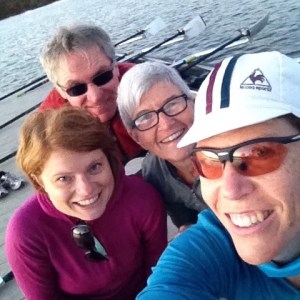
Kim with some of her Masters Rowing friends.

Back in the spring I wrote about being incredibly inspired by the women of the Oxford and Cambridge rowing teams, who competed for the first time ever in 2015 on the Thames Tideway course that has been reserved for men for… well, forever. They got amazing publicity, thanks to their unadulterated awesomeness (and the novelty of it all), and I know I was not the only athlete out there moved by the sheer joy I saw on the faces of the Oxford squad when they won, or harrowed by the expressions of the strong and amazing Cambridge women who had to settle for second place.

Yet the tideway race (the first of many) moved me in particular because I was once an aspiring rowing champ, too. I was part of the University of Alberta crew in 1994-5, during my third year as an undergrad. I rowed starboard in a sweeping eight, though we came to very little glory and my time on the crew is tinged with the bitter memory of a coach I recall favouring the blond and the beautiful over the chunky but strong. I was heavy, really powerful, but a mess technically; for me, it was a classic case of scoring high on the erg test but failing miserably at translating that strength into success in the boat. I sensed (rightly or wrongly) that the coach didn’t want to spend time or energy on me, and so I left.

Then, this spring, the Oxbridge women helped me to remember how far I’ve come since those days, and how able an athlete I am now. They arrived on my computer screen just at a moment when I needed a fresh challenge, something to stop me obsessing 24/7 about my performance on the bike; I was also in need of something to help me move beyond a very hurtful breakup with my longtime partner.

So I went online – to the London Rowing Club.

I queried the president about my options, and I heard back quickly; the Master’s lead, Wendy, was excited to hear I was a former rower (to this day, she overestimates both my memory and my skill!) and told me I shouldn’t bother with the “learn to row”, even after 20-some years on dry land. I should just come on down to the lake and get back in the boat.

And thus, my friends, began my summer of rowing – again.

The first few trips out were hard, I’m not gonna lie. Sculling is not the same as sweeping: in a sweeping boat you work only one oar, in league with four or eight others; the boat is large, and you have a coxswain (a tiny person at the front, facing you, wearing a race radio) helping you to manoeuvre and steer. In a scull you handle both port and starboard oars for your seat on your own, and must therefore coordinate your hand positions, hand height, and sweeping posture with the others in the boat AND with your own “other half”. Plus, no cox: the person rowing bow seat steers, which means a fair amount of turning around to make sure you aren’t going to run into anybody as you cruise up the river/the lake/the shore. (Remember: in a rowing shell you face opposite to the direction in which you’re moving.)

As a not-that-well-coordinated human I struggle to make left and right play nicely, so moving to the scull was both challenging and terrifying for me. And forget bow seat – I also can’t judge distances that well! So those first few rows saw me in two seat in the quad scull, or stroke seat (facing the horizon) in the double, trying hard to keep my oars level and my catches under control. I found myself sweating not from exertion (you can’t pull hard if you aren’t yet pulling smart) but from a mix of worry (about how I was doing) and shame (that I wasn’t doing better yet. After all, I’ve done this before!).

As a teacher myself, though, I found the challenge of grasping sculling technique both provocative, and also humbling. I felt compassion for the more experienced women in the boat (usually sitting in bow, steering with ease!) who took it upon themselves to remind me of basic techniques that had gone far, far out of my head in the years since uni. They were patient as I struggled beyond my comfort zone and slowly started to learn the rhythms, patterns, and tricks of a quad, and then a double scull (oh my god; so much tippier). At the same time, I kept my frustration under control (most of the time) by reminding myself that I ask my students constantly to move beyond comfort, into challenge, even if that means risking failure; it was the least I could do to follow them there.

The spring was filled with endless mistakes, but the summer passed in a blur. First I was in the boat, embarrassed at all I’d forgotten: trying to stop dead at “let it run”, to keep my arms level in the boat and the crabs at a minimum. Then  I was off to India, for another comfort zone-pushing adventure at the Sivananda ashram in Neyyar Dam, Kerala. Then I was back in London, having apparently forgotten everything I learned on the water in spring (and ripe for a meltdown about it – see under control, but only mostly, above); and then, finally, I was settling into a pattern, and into a double with first one, then two consistent partners. The leaves changed colour; the air grew still and the birds landed on the lake in droves. I rowed with joy through the peace of our small, earthly heaven, leaving surprised seagulls in my wake.

I’m now excited for next season; we’re off the water for winter but I’m already making plans to race, at least next autumn, with a fellow female rower who fits me beautifully and might even let me sit stroke (a dream!). London is – believe it or not – the home of Rowing Canada, so there is a tonne of expertise on my doorstep, and the London Rowing Club is blessed with plenty of ergs, weights, and even a tank for winter training (it’s a splashy pleasure to jump in and work on the technical stuff I sorely neglected all those years ago). And of course I’ve not stopped riding; cycling and rowing are terrific cross-training partners, and I’m more excited than ever to be on my bike because it’s not my only game now. I know there’s a boat waiting for me at the finish line.

The Oxford women's rowing team, rocking it out!
The Oxford women’s rowing team, rocking it out!


charity · cycling · fitness · Guest Post

One Run, One Ride: Rocking the cause (Guest post)

I have an ambivalent relationship to charity rides and races. I’ve done them – you can check out my posts about my craziest charity challenge ever, the Scope London-to-Paris 24-Hour ride I did in 2013 – and have enjoyed the riding/racing part, but I find the fundraising really tough. I like to give my time and effort to causes I believe in, and because I’m lucky to have a well-paid, salaried job I happily donate money every month to charities that represent my core community values (the Daily Bread food bank and Humane Society in Toronto; Women’s Community House in London, Ontario). But asking friends for money, over and over? Organising events to raise money, usually inviting the same friends to attend? Huge respect for people who do this well, but I find it really hard.

So this year I did not sign up for the One Run charity ride, a spin event at a local gym here in London that supports the amazing annual breast cancer fundraiser powered by survivor Theresa Carriere. One Run is a superb event that funnels the money it raises mindfully into three causes: a patient assistance fund, a research and tumour biobank, and an awareness/education program, all in London, Ontario. (For those from away: London is a university town with internationally known clinical and research facilities, part of Western University and the London Health Sciences network.) Theresa, meanwhile, is a total inspiration: HER part of One Run, in addition to marshalling her numerous volunteers and managing many, many fundraising events, is to run 100km in one day, from London to Sarnia, Ontario (on the Michigan border) as part of the charity’s marquee event. You can take part in loads of One Run’s great fundraisers simply by contributing a donation fee (please check out all of its awesomeness here; if you don’t live in Ontario note that you can also donate on the web), but stuff like the 100km group ride encourages participants to fundraise too. So even though I’ve enjoyed riding this event in the past, this year I balked. Too much on my plate right now to think about asking friends for cash.

Then I had a series of really bad days. An accident at home, the result of anxiety-fuelled sleepwalking; a car accident (nobody was hurt, thankfully!) on a major highway far from home. I posted some stuff to Facebook, trying to keep it light but alerting friends to what I was going through. (See here for my post about reaching out – I believe in asking for help from loved ones when, or ideally before, you need it.) And then I got a message from my friend and spin guru extraordinaire Michelle Kerr.

There was a spare bike for the ride, the next day; did I want to come out for some sweat-it-out love with her, and my other gym/spin gurus extraordinaire Lore Wainwright and Rachel Skinner?

Hells ya.

I was planning on heading out on the road with Sam and our club, the London Centennial Wheelers, for my first ever Saturday Tour, but suddenly I felt the overwhelming need to be in the hot-house studio with my longtime friends and more than 50 other cycling buddies. So I jumped on Michelle’s spare bike, and I was not disappointed.

The amazing thing about the simulated 100km ride event (like all One Run events I’ve attended) is the atmosphere: it’s a vivacious, hilarious, supportive community that welcomes all comers, all body shapes and sizes, all levels of experience. In the back, a “team” of friends in matching kit road their own road bikes on their trainers. In the middle, loads of us on the many extra spin bikes brought in for the event wore everything from T-shirts, shorts and runners to full-on cycling gear. Some sported pink feather boas and other festive attire. A mass of volunteers refilled our water bottles and offered fruit and granola bars for fuel at regular intervals. Every 45 minutes or so we slowed, rode easy, snacked, and waited for another prize draw. (I won a waterproof iPhone case – hooray!) We whooped and shouted and cheered each other through tough drills, as some of our favourite spin instructors took the stage in teams to guide us through. Michelle made her usual mix of corny jokes and inspirational cat-calls; Rachel kicked everyone’s ass; Lore talked us through a tough endurance drill; and Theresa rode us home.

Photo credit: Sharon Wilson. Michelle and Lore taking us into hour #2.

It might seem kind of weird, for regular readers of this blog who know me as the girl who likes to ride major distances and up killer hills (see here if you’re interested), to imagine me inside, in a windowless gym warehouse, on a sunny Saturday morning when I could have been out with the club. But I’m one of those cyclists who loves all forms of riding, because what gets me most worked up about the sport is the incredible, supportive community of men AND women it attracts. Yes, there are gendered differences we are still working through: there are more women than men on stationary spinners at the gym, and more men than women on road bikes, helping to propel the sport’s “Mamil” culture. But events like the One Run 100km ride remind me that we are all strong, and all capable of being loving, accepting, and supportive toward each other: after all, it takes all kinds to make a sporting community.

Working hard (I’m in the blue headband near centre)

There might not have been sun, but this year’s One Run ride was exactly what I needed. Thanks, Michelle.

Theresa takes us home (half an hour to go!)

body image · fitness · Guest Post · Rowing

Strong and beautiful women are “heavy” women – for real! (Guest post)

I’ve been inspired to write this post by two amazing feminist-forward events in the last seven days – one of them local, and one of them global.

LOCALLY – as in, right here on this blog – the smart and beautiful Sage Krishnamurthy McEneany, who is seven years old and also wise beyond her seven years, wrote a moving post about wanting to be “strong” rather than a pretty princess, because princesses NEVER get the chance to save themselves, and because strong is pretty freaking beautiful in a woman. I cannot tell you how much I loved this post, and how much I admired Sage for writing it. Please check it out if you missed it!

GLOBALLY, the (EXTREMELY STRONG AND THEREFORE VERY BEAUTIFUL) female rowers from Oxford and Cambridge Universities made history last Saturday when they competed in the first ever women’s Boat Race on the Thames Tideway, alongside their male counterparts (who have been rowing that storied race for decades, without any commentary on how improper or unladylike such a competition would be). I’ve written a post on my blog, The Activist Classroom, about the awesomeness of the eight Oxford women who won the race – please check it out. Meanwhile, however, and in light of Sage’s wise post, I would like to blow your mind for a moment with an important statistic.

Here is a photograph of the eight Oxford women who crewed the winning boat last week:

boat1

Don’t they look strong and trim and fantastic? Which, for women raised in the world in which I was raised (North America circa the late 20th century), means: They look thin! Which, again, means: they look so small/light/I bet they weigh nothing!!

Look at the image again.

The LIGHTEST woman in this photograph (for the record: Maxie Scheske, who rows in the bow because she is the lightest) weighs 66.6kg – or 147 pounds.

Read that again: the SMALLEST woman in this photograph weighs one hundred and forty seven pounds.

The HEAVIEST woman in this photograph (for the record: Caryn Davies, a two-time Olympic gold medalist, who rows stroke because she is the most powerful and experienced woman in the boat) weighs 78.4kg – or 173 pounds.

That is right. Read it again. ONE HUNDRED AND SEVENTY THREE POUNDS.

It’s true, folks: strong women weigh, like, more than you think. Because muscle is heavy. And every single woman in the above photograph is full of glorious, beautiful, heavy muscle – that is why they row so fast! Here they are again, in case you could not believe your eyes the first time around:

boat2

Growing up, I was tyrannised by the idea of being too heavy. My mom, who struggled with her weight for most of my childhood, was ashamed when she was overweight, and she was in no way alone – every woman I knew was trying to eat as little as possible so she could take up as little space as possible. (As if taking up space is a bad thing!! ONLY if you drink the patriarchy juice, ladies.) I grew up believing girls should weigh less than 100lb, and grown women less than 140lb (at the most!!), and trust me – I failed this particular test multiple times. So I grew up feeling ashamed, too – even though I was probably a relatively normal weight most of my young life. Today, I am lean, fit, and strong – but my BMI is just shy of 25 (the “cutoff” that signals “overweight”). Why? Because I am an athlete with a lot of gorgeous heavy muscle – not a wasting princess who waits around for a stronger boy to save her.

Ladies, hear me when I say that the eight women who rowed victorious into history last Saturday – along with their eight very formidable adversaries from Cambridge – are the most beautiful women I have seen in a long time. I keep returning to the photos I’ve posted here, because they look so great and I so want to emulate them, in their strength and power and resilience. I ALSO want to emulate them in weighing enough to be strong, powerful, and resilient like them – which means I need to weigh a lot more than you would think I need to weigh in order to be “pretty”. Weight is strength. Strong is beautiful.

Kim