Once upon a time there was an Internet troll who thought that he had found some magical fairy dust called testosterone that would make him stronger, faster, and smarter than any woman in the world. So he thought he could just claim that he could beat any female MMA fighter out there who was in the same weight class as him. Luckily for us, some fine folks set up a match between him and Anna McCauley Dempster, an amateur mixed martial arts (MMA) fighter out of Oregon, to take place on January 6th.
Now, while it seems obvious that this particular troll is just asking to get knocked out, as he attempts to channel the ghost of Andy Kaufman, much less extreme versions of the claim he makes are pretty common. Lots of people do think male fighters in general have an advantage over female fighters, even correcting for things like relative size. Weirdo internet trolls aside, most people with any kind of experience doing fight training, in mixed gender contexts, will know that there are women who are better fighters than many men they train with. But that doesn’t mean the playing field is level.
On a personal level, I’m as committed to both feminism and martial arts as anyone I know, but hesitate at the thought of genderless divisions. I suppose I do agree with the view that male fighters have an advantage, but I hesitate to say that it’s just a simple physiological fact (e.g. more testosterone). I know, I know. Testosterone is advantageous, and that’s why it’s used as a performance-enhancing substance. Testosterone Replacement Therapy (TRT) is banned by the Ultimate Fighting Championship (UFC). But it can’t be the whole story. After all, “Bigfoot” Silva, who has acromegaly, naturally has testosterone levels that are well below average, but has had to fight for many years without TRT.
One thing I think we can’t rule out, though, to explain differences in ability, is the role of gender socialization. Spend some time hanging out with kids, especially when they’re doing physical stuff, and take note over time of how differently little boys and little girls are treated. A lot of what we supposedly know about hardwired differences between male and female brains can plausibly be chalked up to what Cordelia Fine has called neurosexism. Could something like that be going on with physical ability? Well before puberty and many of the more significant developmental differences, lots of people don’t seem to expect little girls to be as physically capable as little boys, much less encourage them to be physical in the same ways. It seems weird to think that kind of thing wouldn’t affect them as they get older, even if they’re active athletes.
But I think that if we want to encourage people to be athletic, and to take part in athletic competitions, we need, as a sporting society, to sort out just what we think the important differences are to make competition fair. Not everyone’s gender identity fits neatly into a binary, and many trans and intersex athletes have been subjected to a great deal of discrimination. It just doesn’t seem as though gender segregation along a binary is doing the trick these days, and maybe it’s time to consider whether there are any viable alternatives.
“You’ve achieved the March of the Penguin badge for lifetime steps!”
I got a notification on my phone the other day from Fitbit, congratulating me for walking 112km since I got my fitbit. Apparently this is the distance that penguins march in Antarctica. (I think I watched part of a documentary about this once on a plane. It’s a blur). I just got the fitbit in a burst of Black Friday greed, and I’m weirdly enamoured of all of the little artifacts of accomplishment.
As no one close to my life will be surprised to hear, I’m highly motivated by counting things. I actually bought the fitbit because the integration of my iphone with the carrot rewards app was clunky and insufficient, and I got annoyed with the recent iphone health app “upgrade” where steps are only updated every 10 minutes or so. If I’m counting steps, I want real time data. And, it turns out, I get a little burst of swelling accomplishment equivalent to some mini-high when I hit my carrot step target in a day and get my 2 aeroplan points. And don’t get me started if I get the extra 50 points for hitting the target 10 days in a row.
This is the same reason I went for short runs four days last week in the final run up to hit my 217 workouts in 2017 goal. I was on track, then was sick for 5 days, and don’t want to trip myself at the finish line. I’m at #210.5 and determined to find another 7 in the next two weeks.
I’m long-established as a bit of a “completist” — I notoriously rode my bike 30 km up and down a bike path in the rain to get myself to my 150 km on Canada Day when my fellow riders had stopped earlier for various reasons, and I never stop 2 or 3 km short of a round number. I like to count the number of countries I’ve been to, and adding to the list is one motivator in my choices of where to go. And in my long-ago running past, people mis-interpreted my pleasure in hitting certain time goals as “competitiveness.” It isn’t — I don’t care how I finish against someone else. What does give me pleasure is beating my own times, or ticking off a desired distance goal.
I started to notice that this pleasure is both conceptual – yay me! — but there is a physical element to it. A little spike of hormones coursing through my body when the fireworks go off on my wrist telling me that I’ve hit my 10,500 step goal for the day.
Do you remember the episode of Star Trek: TNG where Riker brings back a game from a planet where he’s holidaying, and everyone starts wearing visors and dropping disks into funnel-like receptors by manipulating their eyes? And every time the disk drops, they give a little mini-orgasmic sigh?
And of course, ultimately, this game is a way for the bad aliens to try to take over the Enterprise, with everyone entranced by their optically-induced orgasms?
Yeah, my counting thing is a bit like that. Without the aliens.
It’s well established that exercise releases endorphins, seratonin and dopamine, which contribute to feelings of well-being and happiness, can help keep depression at bay, and can boost productivity. It turns out that for me, because I’m so rewards-motivated, I get a double hit of dopamine, which is also known as the “reward hormone.” I feel the surge o energy from exercising, then I get another hit of well-being from feeling rewarded for exercise.
Taking up a Quest for More Dopamine is not without its dark side. There has been a lot of noise recently about screen “addiction” being fed by dopamine released by pings or likes on social media or levelling up on video games. I know I have been aware of this phenomenon when raising money for the project I work on in Uganda — I get the dopamine surge when I see the telltale email address that notifies me of a new donation, which is a little disconcerting.
Knowing that counting steps and workouts, getting little badges, aiming for distances keeps me motivated isn’t a bad thing. I’ll take some extra floods of dopamine as I navigate the dark and busy time of year. But it’s good to keep Riker and his little visor in mind and not let that penguin march right over me without question.
Fieldpoppy is Cate Creede, who lives and works in Toronto. She writes for this blog on the second Friday of every month and other random times when she has something to say.
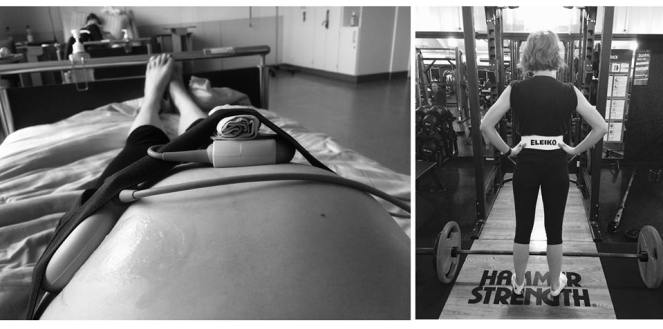
Left: Black and white photo of pregnant torso with monitoring equipment Right: Black and photo photo of the author in the gym standing in front of the bar
by Nanette Ryan
On July 20 of this year I gave birth to my beautiful, healthy baby boys, James and Alec. My pregnancy was not easy. The first three months saw lots of queasiness, naps, and trial and error with foods that I could stomach. In the second trimester I was hit by a cyclist while walking and rushed to hospital, and in the third contractions started too early and so I was back in hospital for monitoring, bed rest, and treatment. For 20 days I was almost constantly on an IV of anti-contraction medication, I had 5 blood tests a day, injections, CTGs sometimes three times a day, and frequent invasive exams.
After 20 days in hospital I was briefly taken off my current anti-contraction medication to make time to prepare for the next round. My boys wasted no time, and in half an hour I was in full labour. As I was wheeled into the delivery room, exhausted and in horrible pain, I said to the midwives ‘I need something! Any thing!’ ‘What do you mean ‘you need something’?’ they said. (I want a freakin’ stroll in the park, what do you think I mean!?). ‘Something for the pain!’ I said. ‘Drugs! I want the drugs!’ But there was no time, the babies were coming and I had to push. And so I did.
As it was my first pregnancy I did a lot of reading and research leading up to the birth. I practised breathing, did my kegels, and (naively) talked to other mums about what kind of birth I should ‘go for’. The thing that prepared me most for giving birth, however, was something that none of the birthing books, conversations, or women’s health resources talked about. It was weight training, and in particular, barbell squats and deadlifts. Before I became pregnant weight training dominated my workouts, and I continued to weight train for as long as it was safe and comfortable when pregnant.
These exercises helped me in a number of ways. Despite my extended stay in hospital, it gave me the physical strength to do what I needed to do. It allowed me to trust my body, and it gave me the confidence to do it. I had pushed my body, and so I was confident that I could push these kids out, like when you walk up to a squat rack with a higher weight than you’ve lifted before and think, ‘I’m going to fucking do this!’
Like so many things for women, the focus on women’s health and birth preparation is on the gentler side of things; focused breathing, gentle stretching, and light cardio. Don’t get me wrong, these things have their virtues, including distracting women from what can be the horrors to come. But birth, however you do it, is not gentle. Women are not snowflakes, and the sooner we start emphasizing this the better.
Nanette Ryan is a PhD candidate in Philosophy at Georgetown University. She is primarily interested ethics, moral psychology, and feminist philosophy.
Image description: black and white photo of baby twin feet in rompers
A couple of weeks ago, a new study came out, comparing forms of vegetarian diets with forms of meat-eating diets; the study itself is found here. Probably all readers of this blog are automatically a little skeptical when they see a splashy headline with new, strong advice that goes against the prevailing wisdom in fields of health and nutrition. Not that the so-called “prevailing wisdom” is always wise, or even prevailing– there’s lots of dissent and several conflicting theories about nutrition and health.
However, in the case the comparative benefits of vegetarian diets, compared with meat-eating ones, there is prevailing wisdom: vegetarian diets are generally better for us on multiple health and nutrition fronts.
After thoroughly reviewing the accumulated scientific literature, a Working Group of 22 experts from 10 countries convened by the IARC Monographs Programme classified the consumption of red meat as probably carcinogenic to humans (Group 2A), based on limited evidence that the consumption of red meat causes cancer in humans and strong mechanistic evidence supporting a carcinogenic effect. This association was observed mainly for colorectal cancer, but associations were also seen for pancreatic cancer and prostate cancer.
So, meat is probably carcinogenic to humans. Well, that’s not good. Of course, real science and real science policy are nuanced, so here’s their summary recommendation:
These findings further support current public health recommendations to limit intake of meat,” says Dr Christopher Wild, Director of IARC. “At the same time, red meat has nutritional value. Therefore, these results are important in enabling governments and international regulatory agencies to conduct risk assessments, in order to balance the risks and benefits of eating red meat and processed meat and to provide the best possible dietary recommendations.
This is not really news, but of course good to hear from a knowledgeable and trustworthy source.
But then comes this new study, which was reported like this:
Caption: New study shows a vegetarian diet is associated with poorer health
What? How could this be? Here’s what the news report said:
Interestingly, while there were positive benefits associated with vegetarianism, the group concludes the following:
Overall, our findings reveal that vegetarians report poorer health, follow medical treatment more frequently, have worse preventive health care practices, and have a lower quality of life… Our results have shown that vegetarians report chronic conditions and poorer subjective health more frequently.
They also discovered “significantly higher” incidences of cancer in vegetarians, as well as increased rates of anxiety disorder and depression, although they note that this is inconsistent with other research. They did point out another study which shows an increased risk of mental disorders in vegetarians. In general, vegetarians suffer from more chronic conditions and take more medication than even occasional meat eaters.
Wait a minute. Did the study REALLY show all this?
No. Not if you’re asking me. Or, rather, not if you’re asking some friends of mine who are much more familiar with the research on vegetarianism than I am (thanks, Angus and Bob!) One sent me a laundry list of problems with the original Austrian study. Here’s his list:
Problems with this study include:
Small sample
Questionnaire-based
Lack of distinction between vegetarians for ideological reasons (e.g. animal suffering and environmental reasons) v those that may be vegetarian on medical advice or due to self-treatment due to pre-existing health conditions
Many data points are subjective (self-declared)
They make some weird claims (a Veg diet is ‘related to’ less frequent alcohol use)
There are a huge number of confounders given the association of other factors related to veggie diets – I don’t think they are able to fully account for these – especially given sample size.
The other friend sent me these comments:
First, there is — as the authors suggest — evidence pointing the other direction with respect to each of their specific conclusions. So that should adjust our confidence level a bit.
Second, it’s pretty plausible that because foods aren’t fortified in a way that assumes that people are going to eat vegetarian or vegan, some less health-conscious vegetarians and vegans are going to suffer from nutritional deficits that will negatively impact their health. It isn’t clear how much of the effect this would explain, but it helps us think about the fact that there are political realities that are relevant to these nutritional studies.
Third, the authors don’t consider the fact that some people may be switching to vegetarian vegan diets for health reasons — that is, because they have some health issue they are trying to address via dietary change, which suggests that they may well be less healthy than the average member of the population to begin with.
Fourth, and most importantly, the authors of the study lump together strict vegans, vegetarians, and pescatarians. Given that many vegetarians and pescatarians eat diets that are still fairly heavy in animal products, it wouldn’t be surprising if any health benefits of a strict vegan diet were invisible in the data.
All of us immediately thought that this was an underpowered study whose results were questionable in large part because of the odd (to us) was the researchers chose to divide up the study groups: vegetarians; sometime meat-eaters who eat lots of fruits/veggies; regular meat-eaters whose fruit/veggie intake we don’t know about; meat eaters who (probably, but who knows) eat lots of meat.
And as for the results, all of us know that there are lots of confounders here— that is, there are lots of explanations for the data that involve known factors that have nothing directly to do with meat/veg intake.
You may still be wondering: what’s the most healthy way for me to eat? Hmmm. That’s a hard one, in fact too hard for any one study or even group of studies to answer. We’re all working on eating in ways that seem healthy-to-us based on the best scientific evidence available, taking into account our constraints of taste, cooking abilities, time, money, culture, physical activity needs, ethical principles, etc. No one has all the answers. But I do have an answer to this question: do we now have good reason to think that vegetarian diets now associated with poorer health?
So yesterday on Facebook friends were complaining about “broga.” What’s broga, you ask. Yoga for dudes, of course. And yes, it’s a thing. See here and here. Judging by all the commentary it’s been around for awhile but looks like it’s a recent arrival in Ontario. We’re a bit behind the times. We have lots of yoga with goats but not so much yoga with dudes.
Why broga? To persuade men of the benefits of yoga. Because they’re scared away from regular old non-gendered yoga because of its association with all things feminine.
There’s even Broga ™. On their website there are men saying that they’ve done regular yoga but broga is better, in a class all of its own.
When is the last time you saw a guy in your yoga class? Yoga is one of the fastest growing fitness trends, with nearly 20 million students practicing in the United States. But 85 percent of those yogis are women. So why don”t men take yoga?
According to the founders of Broga, the industry has failed to develop classes that take into account male physiology and social conditioning. They developed a program that combines core work, muscle strengthening exercises, cardio, and stress-reducing yoga postures geared specifically for men.
Am I wrong in thinking that in addition to needlessly gendering physical activity, this is also just a little bit racist? It’s like there’ve been no men in the history of yoga. I guess Indian men don’t count as bros? They’re not buff enough?
A couple of weeks ago, I was helping* with a belt testing for Taekwon-do and watching the other students tests for belts ranging from yellow stripe to black stripe was really encouraging for me.
I spend entirely too much time with my eye on my next belt, on learning the next thing. It is all too easy to forget how much I have already learned, how far I have come. I mean, obviously, I know that I have more skills than I once did but since those skills are part of my knowledge base now, I end up focusing a bit too much on the skills I don’t yet have.
It’s a natural development of a graduated learning system. You are always aware of what you don’t know because that is what is between you and your next belt. I can always tell you what I need to know for my next test and how much of it I have already learned.
This is me, right after my yellow belt test in 2010. I’m proud of my past self but I have LOTS of advice for her.
It’s a sensible approach for skill development but it can be a bit overwhelming sometimes. Even though I generally feel challenged rather than discouraged, I am still very aware of the areas in which I fall short. And I know that can be the case with any sort of goal, particularly fitness-related ones.
That’s why the belt test was so encouraging for me. In the course of a single afternoon, I was able to see my skill development at each level mirrored by the students who were testing. I could see what I must have looked liked at my first test – determined, yet uncertain, with my skills just beginning to grow. I could remember myself at each level, what I felt like I knew then, and how I must have been better than I realized.
Seeing how the students’ dexterity, strength, power, and speed increased at each belt level was an excellent reminder and a boost to my ego. I have followed that path. I am still on it. My skills are improving all the time and I’m sure that senior students can note that when they are watching me. That’s a good thought to keep tucked away for when I get frustrated with myself as I practice for that next test.
It’s good for me to have that test in my future – it helps to focus my practice and it gives me something to work toward. However, I can’t just keep my eyes on that prize, I have to take some time to glance back at my yellow stripe self, my green belt self, my red belt self and celebrate how much I have accomplished already.
I’m grateful that assisting at the belt test gave me such a direct opportunity to see how I have refined my skills over time. I’m not sure that I would have thought to do it otherwise.
Do you often take time to note how far you have come from where you started?
If so, what do you do?
*To be clear, I was *not* testing these students, I am not qualified to do that yet. I was just helping to keep the test running smoothly and assisting where needed.
Every time you wash your yoga pants, gym clothes or any other garment made from synthetic material, you’re shedding microscopic plastic fibers — called “microfibers” into natural waterways, which eventually make their way to the ocean.
University of Florida researchers are now discovering that more than 80 percent of the the micro-plastics found in the ocean are actually micro-fibers from synthetic clothing:
Funded by the National Oceanic and Atmospheric Association (NOAA), the researchers launched a two-year study earlier this year to discover the source of the micro-plastic pollution accumulating in the Gulf of Mexico.
When they set out they expected to find mostly micro-beads, tiny brightly-colored plastic balls found in body washes, face scrubs and other bath products, until the U.S. Government banned them in 2015, because they were harming fish and other sea life.
Instead, they found the majority of the pollution, 82%, is originating from our closets — stretchy yoga clothes, sweat-wicking athletic wear and synthetic jackets.
Now this is bad. It’s awful. We’re killing the planet. I teach a course on Fashion so the clothes link is no big surprise. Fashion is pretty high on the list on polluting industries, equal to livestock. We watch the movie True Cost in my class and it shocks my students.
Still, there was something about the yoga pants story that was bugging me. I couldn’t put my finger on it until a friend on the internet shared it with this comment: “Wow, that’s horrifying. It’s also depressing, though, that the headline and the article repeatedly go on about yoga pants in particular when, as it also says, the problem is simply “anything that’s nylon or polyester.” It has literally nothing specifically to do with yoga pants. Someone would have to own an impossibly massive yoga pant collection to be a bigger problem than me, with my hockey stuff, cycling clothes, gym clothes, thermal fleeces, etc. It’s kinda gross how concerns about plastic pollution still have to be wrapped up in a handy single reason to both use a hottie pic as the cover shot and have a central theme that shames women for their pretensions to fitness and activity.”
Right? Right! Why pick on yoga pants? The story combines environmental concern with mocking women for fitness pursuits and uses a photo of a conventionally attractive woman doing yoga on the beach.
Also, how shocking is this?
Another friend chimed in: “Yes, and you’d also think they wouldn’t write in such a “plastic turns out to be plastic!” tone. No, I would NOT think that spandex and lycra clothing would be made of recycled organic etc. The credulity makes my eyeballs itch.”
But picking on yoga pants and leaving out all the other sports gear strikes me as picking on women in particular when the point is a general one about synthetic fibers.
A couple of months ago, my trainer bought a Halloween skeleton as a joke. She posed it in different machines with appropriate captions. One of the pictures featured the skeleton on the Jacob’s ladder, a climbing machine that can go at different speeds.
I don’t like the machine; in fact, I avoid it at all costs. When I learned it was not working, I expressed an immoderate amount of happiness. My trainer, who is as perceptive as she is focused, asked what the issue was. I told her I despised the jake and furthermore I was afraid of it. Her response: “If you genuinely hate it, we can leave it out. If it’s fear, then when we face it is your call.”
That comment stopped me in my tracks. While I might not like a particular exercise (go away Bulgarian split squats), I usually complete them and do the best job I can. It never occurred to me to think about why I was afraid of that machine and why I hid the fear behind the more innocuous phrasing of “dislike” or the even stronger word “despise.”
My dictionary defines fear as “an unpleasant emotion caused by the belief that someone or something is dangerous, likely to cause pain, or a threat.” I’m not afraid of many things, but two I know for sure: heights and small spaces. The first is a consequence of mid-life hearing loss but the latter I have always had as did one of my parents. My claustrophobia is not limited to small spaces, but also includes masks which cover my face.
While I haven’t figured out what is at the root of my fear of the Jacob’s ladder, I know it is more than dislike. It is also not a function of mechanics. Once I am shown how to do something, I am usually pretty good at managing the parts involved in executing the action.
I know I am not ready to train on the bar by myself without a spotter, and that’s a safety issue. My arthritis sometimes makes my grip weak; with the greater weights I’m using now, I am not confident I can hang on to them, especially when I get tired.
Fear is a pretty complex emotion. It can stop you from trying new things or maintaining others. While I am not ready to tackle the Jacob’s ladder, I do have other cardio-intensive activities I can choose to replace it.
Since I have started thinking more about the difference between disliking something and being afraid of it, I wonder what role fear plays in women choosing certain forms of activity compared to others. Last month in my column for our daily newspaper, I looked at how our fear of assault and harassment can limit our activities:
“… how we live our lives as women is very different from how men live their lives. Dr Fiona Vera-Gray, Durham University (http://www.bbc.com/news/world-41614720) has spent the last five years looking at the choices women make to manage their fear of sexual harassment and assault. Her work is echoed by another piece of research in which more than half of the 42,000 women surveyed reported limiting their activities out of fear.
Another researcher, Liz Kelly, talks about this as “safety work”, the conscious and unconscious strategy development we do every day to make sure we don’t put ourselves at risk. As Ver-Gray puts it, “Despite how common it is, or perhaps because of it, we rarely even think about the routine choices and changes we make to maintain a sense of safety.””
But I’m also thinking about my trainer’s comment that when I am ready to tackle the ladder, we will do it on my terms. That the decision is in my hands makes the fear more manageable. I can approach it when and where I choose. Having that element of control matters hugely, even if it also seems contradictory. After all, I go to a gym and work with a trainer precisely because I want someone to tell me what to do and when.
I’ve concluded the best thing I take away from incorporating fitness in my daily routine and gaining strength through powerlifting is how I maintain my own sense of power and agency. It also means learning how to face your fears and embrace them for the teachings they offer.



 the skeleton on the Jacob’s ladder, a climbing machine that can go at different speeds.