My watch beeped with a ba-bing! My walk with Lucy had just posted to Strava and the notification read “You reached a 2 year streak!”
A screenshot of my Strava feed showing my morning walk with Lucy on Sep 7
I guess that means two years of having a smart watch. My love of my watch’s data gathering and analytics ebbs and flows.
I value the heart rate monitoring. I’m annoyed by the calculated secondary measures as well as the word soup “analysis” both Strava and Apple Health provide.
A screenshot of my September Strava calendar showing 104 weeks of tracking and 1,225 activities
I do appreciate the effortless logging of steps, breathing rates, hours of sleep – as well as the swimming, cycling and strength training tracking.
Since all of that requires no additional effort from me, I have reliable data and am able to analyze my own trends, thank you very much.
Ignore the sleep analysis
Aside from telling me how long I slept, and even that is suspect, I want to find a way to turn off the sleep narrative.
I know what time I went to bed, that I fell asleep quickly, or not, if I was awake for long periods and when I got up.
I absolutely despise the chastising about what time I went to bed. Worse, the tone about my “awake time”, as though it is something I can directly control is annoying.
A graph of my sleep score on a given night. The text reads “Your recent score was a 77 due to the number of times you woke up.”
I wake up at night, every night. Hot flashes, sleep apnea and toilet breaks. It’s my normal. I’m looking for variations from that norm, not a measure against a made up goal of not waking up.
There are reports of people going to their doctor with their smart watch sleep analysis because they think something is wrong.
There is no magic REM, deep sleep or core number to hit. Plus these are calculated and derived from other metrics. Having been to a couple of sleep clinics, I can tell you that the number of sensors required to truly analyze your sleep cycles is staggering.
Aggregate numbers are impressive!
1,225 activities in 2 years means I’m recording, on average, one or two activities a day. This is the active lifestyle I’m looking for.
While I strive for 2 to 3 activities a day, there are some with none and that is ok. My goal is over my lifetime, not 1 day or even a week.
In early June I drove down to New Brunswick and back. A solid 5 days of not doing much other than driving or resting and I’m ok with that.
Celebrate!
So here’s to 2 years of reliable metrics. Yay!!! It’s important to take a moment when you accomplish something.
Recommended Soundtrack: Celebrate by Kool & The Gang
I don’t know why but walking makes me think of penguins. They walk a lot! So here’s a picture of 6 penguins walking towards you on a sandy beach. there’s a nice rolling sea in the background. These penguins aren’t remarkably fancy or big or anything. They are your everyday kind of penguin. But I think they’d be fun to party with.
It’s one week into the new year and I’m reflecting on the small victories I experienced in 2021 and these first few days of 2022. I’m always amazed at how tiny changes can add up to small and sometimes huge victories.
Walking….walking…walking
My average daily step count in 2021 was 12,511 steps. That’s up significantly from 2020’s 9,200 and 2019’s 8,100. Wahoo!
That translates to just over 7 km a day or a whopping 2,500 km last year. Folks, I could have walked from London, Ontario to McAdam, New Brunswick and half way back. HOLY HECK.
Looking at what has contributed to maintaining a higher daily step count, there are a few tiny changes that tipped the balance.
Add just a bit more
When we got our puppy we had to go for many, very short walks of half a block to train her. As Lucy grew we added a bit more to each walk. We made 10, 20, 30 and 45 minute loops in our neighborhood.
My body adapts
Over 18 months those little loop changes added up. Plus I got faster at walking so I now cover in 30 minutes the distance that used to take 50 minutes.
How about right now?
Those loops became our coffee break, lunchtime, morning and evening walks. Over the day we walk a combined 90 minutes to two hours. If a regular scheduled walk can’t happen I grab the dog between calls for 10 minutes. My beloved and I check in if we have busy days. Sometimes we simply ask “how about right now?”
Take a tiny bit of time
Since the walks were woven into our day it was easy. Do I have less time at lunch? A 10 minute loop is enough to refresh myself and get Lucy the movement she needs. Dinner is baking and I know if I sit down I’m not going anywhere. I can take a tiny bit of time. Feeling TOTALLY BAGGED? I can at least do 10 minutes, for Lucy.
A bit of momentum
Often once I’m out the door my feet keep me going. So if my schedule allows that 10 minute walk could stretch into 30. Especially on weekends we tend to just head out and meander since we’ve few timings to meet.
Variety
I got to walk to all kinds of places last year. Downtown to my favourite bookstore or restaurants. In and around McAdam over the summer. Through new trails in London. With my partner, my sister, friends, my kids and alone. Switching up walking partners also keeps it fresh.
Low effort
I bought all slip on footwear. My coats are filled with dog bags, treats. No prep required. I use my phone’s built in step counter. No additional tracking required. I work from home so I can dress comfortably and with the weather in mind so the time to transition from my desk to outside can be seconds, at most 5 minutes.
It’s ok to take a break
If it’s truly a downpour I’m ok walking just enough to get Lucy to do all the things she can do. That might be just 20 minutes that day. It’s ok. I’m dispassionate about not hitting a daily target. When I’m sick I walk if it feels ok but I don’t over do it.
Ask for help
My children happily take their turns in my stead walking Lucy when I am not available. The family has agreed they do the dishes after dinner so I can head out. We negotiate who can do what and when. Without this I don’t have the time to walk.
Celebrate!
Looking back at those tiny changes over a long period of time they morph into small victories. Yay! And that added up to quite a big uptick in my step count. YAY!
Reality Check
So you may think that upping my steps has lead to an amazing physical transformation. Uh. Nope. I look the same. Weigh the same. Wear the same sized clothes.
SURELY my blood pressure improved. Gah. Nope. It’s actually increasing and I’m working with my doctor to address it.
But how about strength? Flexibility? Resting heart rate? Nope. Not changed.
What HAS changed?
As a result of all that walking …I’m much better at walking. I can walk longer at a faster pace.
My mood has been good. I’m feeling more resilient in the face of stress do when the tough times come I’m recovering well. And. Wow. That is a mighty impactful thing worth celebrating.
How about you?
Looking back is there a tiny change you’ve made that had impacts over time?
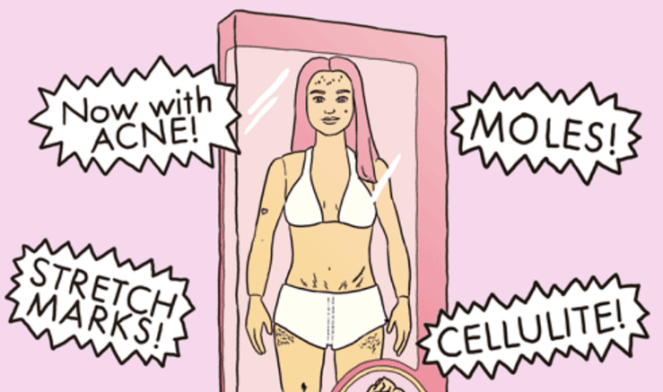
Toronto’s free paper, NOW Weekly, releases a “Love Your Body” issue every January to promote body positivity, pushing back against the prevalent weight loss goals that tend to flood the mainstream in the new year.
They recently put out a call for participants for their 2018 issue, in which individuals participate in a photoshoot and share their stories about their bodies and thoughts on body positivity more generally. On Wednesday I put in an application.
From a past year’s NOW Love Your Body Issue, which features various individuals posing nude. Each issue shows both men and women with different body types, different body sizes, individuals of different physical abilities, tattoos, no tattoos, and even women who have had mastectomy’s.
“Body Positivity” can sound like very a broad category. Much of what I see online (especially through body positive Instagram accounts such as @bodyposipanda, @bodypositiveunicorn, and @bodypositivememes) is a kind of fiercely positive attitude about one’s body no matter what that body might look like.
This reframing about diverse bodies is nice to see. It can also act as a salve for all the uniform bodies we tend to see in other media outlets.
But for me personally, at least sometimes, I find Internet Body Positive Culture a little alienating.
I would consider myself body positive, and was raised in a very female-friendly (all-ladies) household with a supportive, creative and free-spirited mother. My sister and I were strongly encouraged to be ourselves and to seek ourselves, whatever that might look like.
Sometimes I wonder if the current stream of body positivity almost pushes back too much, so as to go against any questioning or frustration one might have with one’s body over the course of a life. Isn’t it okay to admit that sometimes my body frustrates me? Or grosses me out? As if I must ALWAYS feel intensely positive about my body, and if I don’t, I have somehow fallen victim to body shame?
My sister, a feminist visual artist, has always been a big fan of the body’s “grossness.” This is the focus of much of her work: using blood, hair and teeth in her artwork. Instead of following the language of body positivity, she chooses instead to celebrate the body’s gross aspects, like the various liquids and pusses and goops that might come from the body.
Some might argue that this is body positive art. But I’m not so sure. Much of the Internet Body Positive stuff I see is about proclaiming that everything about bodies is beautiful. And honestly, I feel like it can get a little tiresome. What if not everything about the body is beautiful? AND that’s okay? What if there are lots of gross things about the body—AND that’s okay too?
Is it more important to say that everything is beautiful, or that it’s okay when things aren’t?
In a recent post by Instagram Body Positive activist, @mandas_muffintop, she writes, “You can love yourself and change yourself at the same time. . So many people have it engrained in their mind that to be a part of the body positivity community, especially here on IG, they aren’t allowed to change. Some BoPo community members shame those of us who decided to change our bodies for our health, or to just be more comfortable in our own skin. I’m here to tell you that you are allowed to do WHATEVER you want with your body, and still love it. It’s YOUR body, YOUR life- not anyone else’s. So don’t let anyone shame you. Don’t let anyone shame you into changing if you don’t want to. Don’t let anyone shame you into staying the same if you want to change. SHAME IS NOT OKAY ON EITHER SIDE OF THE SPECTRUM.”
In my application to participate in the 2018 NOW Love Your Body Issue, I wrote:
“Like many women, my body fluctuates in both pounds and clothing sizes, and this is something that is a point of continual frustration for me. (I often feel like it has a mind of its own.) Yet even though my body frustrates me, sometimes even disgusts me, I love it. I love it very much, in fact. I suppose throughout this, I have been learning that self-love/body-love is something that evolves and moves and changes—it is not static. Much like how our bodies are not static entities, but are incredibly dynamic.”
I believe there is room for questioning, frustration, and even disgust with our bodies WITHIN Body Positivity. Some might disagree with me. What I feel with the current culture of Internet Body Positive is a pushback against traditional standards of beauty—and I think that does need to happen…and I look forward to a celebration of grossness soon.
I think I am beautiful. But I also think sometimes I am gross. And that that’s okay too.
Like many of my friends I’ve been taken with the idea of minimizing, of owning less. It’s a rich person’s task, I know. I’ve been reading The Life-Changing Magic of Tidying Up: The Japanese Art of Decluttering and Organizing by Marie Kondo. She dubs her technique the KonMarie method. If you’re interested in tidying, and in organizing, you’ve likely heard of it.
I have a house stuffed to the gills with belongings and I want to own less of it all. Mostly it’s not my stuff and it’s the teens and twenty something’s stuff that gets to me. I’ve tried to persuade them that our continued happiness all living together depends on them treating it more like a rooming house, where your stuff stays in your room, but in a three story house there’s a certain inertia to stuff staying on the first floor.
But I’m doing my bit. Most of my excess stuff falls into three categories: aspirational clothing (not too small, not aspirational in that sense, but aspirational for a lifestyle I don’t have, lots of party dresses, not enough parties), sporting goods, and books. I’m keeping the party dresses and asking for more parties, and the books? Well, I’m a professor and we’re a family of big readers so most of the books stay. But the sporting goods for sports I no longer do? They’re going.
Key to the KonMarie method is the idea that you should get rid of things that don’t bring you joy and that you should celebrate who you are today.
Here’s her advice about the clothes you should ditch:
“I’m not talking clothes that are a little tight, or things that you might be able to wear if you lost five pounds. I mean clothing that you’re hanging onto from years and years and years ago, that you would need a whole new body type to wear. Getting rid of old things is a part of making peace with who you are now.”
“Keeping only what sparks joy helps you realize who you are right now. As you’re saying no to certain clothes that don’t spark joy, you’re also often shedding what and who you were — or who you thought you wanted to be. You get a stronger sense of and appreciation for who you are. It’s a healthy exercise in self-reflection and a gentle but powerful letting go of the past.”
I warmed right away to the “joy test” and the idea of celebrating who you are now.
The athlete I am now doesn’t play soccer. I’ve said goodbye to soccer.
So bye bye soccer cleats and shin pads and socks. Bye bye soccer ball.
A friend who used to row competitively let go of some of her old lists of rowing contacts. She realized she was already still keeping in touch with the people who had remained friends.
I’ve got a full bureau of cycling stuff with my helmet, shoes, and Garmin on the top. That stuff brings me joy, though I did weed out some cycling jerseys, so it (mostly) stays.
Can you let go of the athlete you once were and celebrate the athlete you are now? If you did, what you let go of and what would you keep?