fitness · Guest Post

New York, New York! (Guest Post)


By Alison Conway

I love everything about riding the subway. I love being part of a public transit system. I love dropping down into the depths of a city in one spot and popping back up in another. I love to people watch. Mostly, I love immersing myself in the great sea of humanity. On the subway, I feel the deep connection that binds humans as we hurtle toward our various destinations, material and existential.

Lately I’ve been reading philosopher Kimberlee Brownlee, who argues that social connection is a fundamental human right. We need to be able to rely on others and to know that we can support them, in turn. Among other social dynamics, Brownlee describes to the “micro-moments” of connection that support our physical and psychological well-being—the kind of connection made by body language, for instance, that signals friendliness or kindness. Brownlee’s work dovetails with the work of psychologists and physicians such as Vivek Murthy, whose recent study, Together: The Healing Power of Human Connection in a Sometimes Lonely World, documents the costs of loneliness to human health and community. Research shows that we need to sustain a variety of relationships—from intimate partnerships to community bonds—to avoid the deadly effects of social isolation.

Which takes me back to the subway and on to the New York City Marathon, which I ran last Sunday. I arrived in New York a nervous wreck, worried that the 26.2 mile distance would prove too much after a serious injury and three years of aging since my last marathon. The weather forecast predicted a race day far warmer than I like for any kind of distance. What if I didn’t finish? Etc. etc. etc. But the moment I landed on the curb of Newark Airport, an alternative narrative unfolded alongside the story of failure that was running through my head. That other story, not mine, featured the young man who helped me figure out which platform to stand on for the train into the city. It involved the woman who looked up the C schedule for me when it seemed like my subway would never arrive at Penn Station and shouted “Good luck!” as she jumped on her A train. It was about all the folks on the street in Brooklyn where I came up into a beautiful fall evening, heading home or out for their meals at the end of the day. Across the river, the Manhattan skyline shone in all of its beauty. New York, and New Yorkers, were going to get me though this somehow.

How the Big Apple works this magic is what makes the New York City Marathon an experience like no other. The race starts on the majestic Verrazzano-Narrows Bridge, which links Staten Island to the south end of Brooklyn. Setting out with the other 10,000 runners in my wave, I felt part of something monumental, like the bridge itself. There was the rhythm of the marathon cadence, footfalls and breathing, and the views on either side stretching into the distance. As we descended from the quiet of the bridge I entered an alternate reality altogether, as the roar of the crowd waiting on the streets below reached up and pulled me into the beating heart of the neighbourhood.

I had been told that New Yorkers would line the streets of the course, that there would be bands and choirs and drummers. But nothing can prepare a runner for what awaits her on that route! It was like riding the subway: the whole world was there, jammed together for the journey. The shouts of encouragement, the signs (“This is For All the Women Runners!”), the bells and the whistles…. It was—how to say it?—something else. The route gave the marathon a rhythm, for me: through a borough, over a quiet bridge, back into the crowd. The long Queensboro bridge marked the beginning of the end, as we paced ourselves down onto First, where thousands lined the avenue leading up to the Bronx. Over another bridge, then over the last and back into Harlem, before the final climb up Fifth Avenue and into Central Park. Along the last stretch, flags from around the world lined the path to the finish line.

I can’t say why the marathon has become an unofficial holiday for New York. I can’t say why thousands and thousands of people, including my daughter, Hannah, from all over the globe, have decided that this is the day they should gather in the streets together. When I scanned the crowd for Hannah’s face, at mile eleven, I only saw one massive, cheerful crew, urging me on. All of those individuals were suddenly transformed into a collective body wanting one thing: movement forward.

We need a steady heart badly in these days of strife and pain. But it can’t be the heart of a solitary runner, striking out on her lonely path. Rather, the steady heart we need—that we have, if we know how to look for it—beats collectively, sustaining us over the miles that we all have to run, together, before we sleep.

Alison Conway and fellow marathon runner Lisa Bycynski, before the start of the race. They met while waiting for a bus.

Alison Conway lives and works in Kelowna, British Columbia, on the traditional and unceded territory of the Syilx Okanagan people.

fitness · habits · Seasonal sadness

Sam’s five November resolutions

I know, it’s a bit late for November resolutions but I’ve been sick and November is off to a rough start.

1️⃣ I will go for a short walk after each meal–that’s breakfast, lunch, and dinner. What’s short? 10 minutes.

2️⃣ I will put my anti-SAD lamp on when I get to my office for 20 minutes. (I have the best less expensive lamp on this list.)

3️⃣ I will practice some of my physio kneeling exercises and getting up from the ground every morning and every evening.

4️⃣ I will complete my November cycling challenge that’s a fundraiser for the Canadian Cancer Society.

5️⃣ And I will try one new class at the gym. Possibly Zumba. I think I need some dancing in my life right now!

Dancing Muppets
fitness

Taking Time to Retreat

Last fall I went on a solo retreat. I was at the tail end of a busy period at work and trying to carve out time to put the final touches on a years-long research project. I have a history of high writing productivity when traveling and/or staying at with friends, and I hoped that getting away for a few days would spark the same results. I’m not usually fussy when it comes to lodging, but after thinking through what I needed to be most productive I allowed myself some amenities: a full kitchen, a pretty view, and a soaker tub.

Before I left I also mapped out the closest walking trail and was happy to discover it was in the same area as my rental. As an over-planner I may have mapped out a few other trails as well. At the last minute, and on the threat of rain, I threw some resistance bands into my travel gear and called it good. I had a long list of goals for these 4 days away and I felt some guilt going into the trip. It was an investment in myself, my work, and my words that I am not used to making. I felt guilty for spending money on a rental and I felt guilty for not being able to “just do it” and finish the project with my normal day-to-day schedule. The part of my brain that loves to tell a good “imposter syndrome” story got a lot of mileage out of that guilt and I went into the weekend feeling anxious that I wouldn’t reach my (sort of unrealistic) goals.

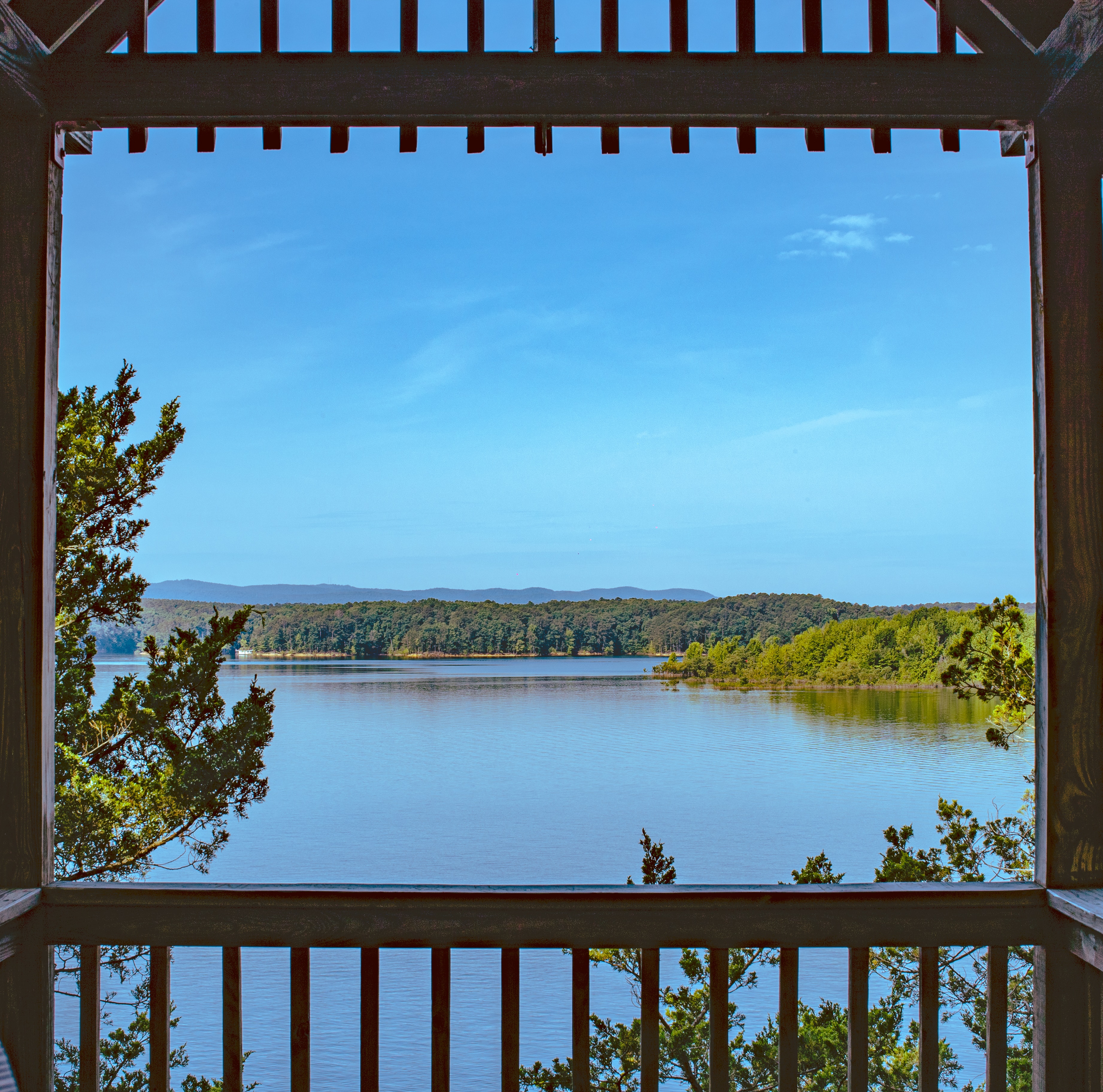
Photo of a lake surrounded by trees taken from a deck or wooden porch.
Photo by Oliver Graham on Unsplash

The first afternoon I unpacked all of my work gear. Laptop, notecards, books, notebooks, pens. The resistance band landed right next to all of that on my workspace. And then I climbed into that big soaker tub and let the little hamster in my brain tire herself out on the thought-wheel. I quickly realized that what I needed was rest. Deep and true rest. Time away from the pressure and stress of the everyday to be still. I worked on believing that even if a single word didn’t get written the retreat would still be a “success.” It wasn’t easy, but I let that need for stillness be my guide.

I spent the rest of that time being gentle with myself. I napped. I soaked. I stretched. I did yoga. I watched some high-drama tv. I read (fiction and non-fiction). And I wrote. I did not walk. I barely made it further than the deck or driveway most days. I made time to catch up with a friend living overseas. I soaked more. I napped again. And I wrote.

Clearing up the clutter and removing the never-ending chores list of daily life gave me the space and the freedom to do what my body needed. Rest. Think. Create. Breathe. Any movement that happened was intentionally slow, focused on breath work and the mind-body connection. I wish I could say the words poured out of me, but that isn’t my typical experience with writing (though I remain hopeful!) I left with an almost complete document and a solid outline of the remainder, and being so close to finished made it easier to carve out the remaining time needed by the impending deadline.

More important than finishing that project (which was pretty darn important) was learning a little more about myself and what restores me. I went into that trip thinking it was a “one and done” experience, focused specifically on that task. Instead I left knowing it would be an experience I would repeat. I leave in a few days for this year’s retreat and I’ve already mapped out the nearest walking trails and packed up my creative/writing project. It isn’t as time-sensitive as the last one, but I hope it will be even more fulfilling.

Do you plan a solo getaway when you are able? What is your focus on those retreats? Any recommendations on great destinations?

Amy Smith is a professor of Media & Communication and a communication consultant who lives north of Boston. Her research interests include gender communication and community building. Amy spends her movement time riding the basement bicycle to nowhere, walking her two dogs, and waiting for it to get warm enough for outdoor swimming in New England.

fitness

Is Enough Abundant?

As the holidays and 2024 approach, I declared the start of my personal new year on October 28th. The day after the one-year anniversary of my mother’s death, in a year of substantial loss—in addition to my mother there was the loss of my beloved 17-year-old cat, the loss of my 28-year marriage, the loss of my home and financial security and the (thankfully temporary) loss of my health. All of which I’ve written about here during the course of these last months.

I want to look forward. And, I’m struggling to feel like I’m enough, that my life is enough and, to put it bluntly, that I have enough resources. What does enough even mean? And how about this business of abundance? Abundance is one of the words of the moment. I feel inundated by invitations to reframe my thinking, to have an abundance mentality. Most days now, I fail to have an abundance mentality. Enough feels like a stretch goal.

Recently, I’ve been listening to Beautiful Chorus chants when I meditate. One of my current favourites is I Am Enough, which I often follow with their chant Abundance. After all, I’m not against abundance. I would like to have an abundance mentality. I just can’t seem to achieve it. I notice the chants feel different. My body yearns toward enough, as if my cells know that I’m enough and want me to know that I’m enough. And my body often resists the abundance chant, as if my cells don’t believe that abundance is possible, or that the whole notion of abundance is just a quick fix fad or worse abundance is greedy.

Egg carton from Abundance Acres Farm with sunflowers from the farmer’s market, too. It turns out I’ve been buying abundant eggs.

Or, are enough and abundance actually the same thing? Maybe if I could truly feel like I am enough, then I would have achieved that elusive abundance mentality. Are they both just different ways of expressing a feeling of wholeness?  This is a philosophical cycle that could end up with me dancing on the head of a pin with the angels. My mother used to say that when my father would come back from synagogue with a story of an extended debate about, say, whether using a light switch was allowed on the sabbath. She’d say, “Now it’s just angels dancing on the head of a pin.” And, as I wrote this, I wondered, where did her saying come from, only to learn that it refers to tedious religious controversies from the middle ages.1

Enough with the angels. Let me get concrete.

I’ve faced some health challenges lately. So, I’m even more acutely sensitive to my level of energy when I run, or really do any physical activity. Over the many months of slower and slower runs, as my energy depleted, I had re-calibrated my expectations. Just getting out was enough. At first, as the medication returned me to the energy level that I was accustomed to in the past, every drop of extra ease and speed in my body felt like abundance. Now, only a few weeks later, as I settle back into the new-old normal, I notice that feeling of abundance recalibrating back to enough. In other words, I see my mindset shift. As if abundance is an unstable state and enough is the stable state. Abundance is an overreach. I couldn’t possibly merit abundance and anyway it’s a fickle, fair-weather friend. I’m scared that if I relate to my energy as abundant (versus enough), then it will be taken away.

To which the universe offered me this: Feeling frisky on a recent run, I picked up my pace, only to ping my hamstring. Really? The universe can’t let me have a quick run? I need to be put in my place that fast? As if proving my point about the unreliability of abundance.

Sigh.

And then I noticed that right behind the frustration was another feeling. Oh the joy, to be running fast enough to ping my hamstring. There was a part of me reveling in the privilege of the ping. And I had a glimpse of the abundance mentality. Being alive and running strong is enough and abundant. The universe invited me to let the feeling fill me up. And then reminded me not to get attached.

Maybe that’s the difference between the two—I am enough, even if I don’t know it all the time. Everyone is enough. As they are. Right now. We can’t be attached to enough. We are. It is. Whereas abundance happens in the moments we notice that we are enough or that what life has delivered to us is enough. Noticing that causes our cup to run over. To know I am enough, or that what is is enough, is abundant. And it’s hard to feel so fulfilled and not get attached and want that feeling of enough-ness to last. That’s the slipperiness of abundance.

Or not. I may still be dancing with the angels.

Three examples:

  1. I accept a 25% pay cut to continue doing work I love, that feels meaningful, because the company is in a tight spot until it finds more investors and/or earns more profits.
  2. I get the news that my kidneys are functioning normally, after months of alarming blood tests.
  3. I arrive at the Citibike stand, needing an e-assist bike, because the ride home is long and I’ve already danced for 2 hours. There are plenty of e-bikes docked at the stand, but all are red lighted and unavailable, except one, which also has enough charge for the distance I need to go. I cruise home in the autumn sunshine.

Enough or abundance?

  1. ↩︎
fitness

Urbanism and Active Transit

Last year I started volunteering with Bike Ottawa, a group that advocates for better cycling infrastructure to keep the increasing number of people on bikes safe.

It turns out that when you start thinking about what makes people on bicycles safe, you quickly start thinking about how similar changes can make the lives of pedestrians safer. And that leads to how we design our streets to make them more accessible for people with mobility issues (and other disabilities). and then how all those things connect with public transit (or more to the point, how much better public transit needs to be both in terms of service and in terms of connectivity to bike paths and sidewalks, and providing benches and shade for people waiting).

I have been connecting with all sorts of people who know lots about these issues, and it has been a great year of learning – about how to get around my city more effectively, how much I am capable of on foot or by bike, and how to spot and (occasionally) fix problems. I am now a master of Guerilla construction signage adjustments to clear sidewalks and bike paths.

That culminated this weekend with a lovely walk around anOttawa neighbourhood that has been in the news a lot this year because of big, sometimes expensive, questions about how to use some public spaces.

I biked there, met up with other people I know from various cycling groups plus the guy who now leads an urbanist book club and some complete strangers. We were led on our walk by a woman who walks everywhere – an average of 120 km per week.

We talked about the environment, smart density, desire lines, the importance of consultations with users to ensure designs work (hello Flora Street pedestrian bridge with your incredibly sharp turns and unploughed stairs in winter).

Flora Street Bridge in Ottawa, showing the ramp on left, with cyclists and pedestrians, and stairs on right, with people climbing them or walking by. Image on left is from canadianconsultingengineer.com and the one on the right by Scott Norsworthy.

It was a lovely way to spend the afternoon, and it reinforced my view from earlier this year that infrastructure is a feminist issue.

We are already planning our next walk, ideally to a suburban area to look at the challenges for people who want to get around without a car.

Until then, we will be dreaming of active transportation and urban spaces that look more like this:

Clockwise from top left: Alexandra Bridge in Ottawa, with many pedestrians; a bike lane that goes right through a mall in Singapore; a bike lane in England being used by someone in a wheelchair. She is protected only by flexiposts as large vehicles drive by; the very busy pedestrianized Rue Mont Royal in Montreal.
dogs · fitness · walking

Sam is going to take on an interesting walking challenge

For years, I’ve begrudged all the good that’s supposed to come from walking. That’s because I haven’t been able to walk for any distance. So when it comes to all the stories about the good that comes from walking, especially when it comes to thinking, writing, and other intellectual and emotional goods, I’ve just looked away. Lalala. Not listening.

I can’t hear you, Ernie

Surely riding a bike is just a good?

I know, likely not, but I’m just being honest about my reaction.

Now I can walk, regularly and reasonable distances, I’m coming around.

This week, I shared on our Facebook page, a story about the virtues of walking, even short distances, after each meal. And I’ve been thinking about giving it a go. Cheddar will be very happy. A quick walk around the block after breakfast, before work, and another quick walk after dinner. At lunch, I’ll have to walk on campus, but I often have time for a short walk.

What are the five main benefits of walking after eating?

It’s a pretty convincing list– Heart health, sleep, digestion, blood sugar, and, of course, weight loss. I’m not personally convinced about the last one and I also don’t really care.

But evening out blood sugar and digestion are the biggies for me.

Once I’m well I’m going to give it a try and report back. Cheddar will be very happy.

Cheddar
dogs · fall · fitness · health · self care

Bad Day, Good Dog

This isn’t what I planned to write about today but here I am.

I’m writing this on Monday evening after a day full of the kind of small challenges that wear you down.

None of these things were a crisis on their own but the cumulative effect had left me feeling down and disheartened.

You know that kind of day, right?

I kind of wanted to just sit around and drink tea and just feel my feelings but Khalee needed to get outside.

So, I decided that I would take my feelings for a walk too.

I was grumpy about it but seeing as I was going to have to feel those feelings anyway, I might as well get some fresh air and exercise at the same time.

You know how this turns out, right?

Yep.

Like the meme implies, that stupid walk was good for my stupid mental health.

It didn’t make everything better but it did help a lot.

Maybe Khalee didn’t *plan* to help me by needing a walk but she’s a very good dog so perhaps it was a very clever plot on her part.

A photo of a light-haired dog standing on some grass looking alert.
It’s really hard to get a good photo of this good pup when there are so many interesting sniffs to be sniffed. Image description: Khalee, a light-haired medium-sized dog wearing a harness and attached to a neon yellow leash, stands on some grass with autumn-yellowed plants in the background. This is a side-on view and she was moving when I took the photo so her back legs and haunches look disproportionate to the front part or her body. She looks alert and interested in something off to one side.
fitness · movies · swimming

Saturday Night with Nyad

It’s Saturday night in the big city, and what are three slightly sick, still recovering from the lurgy, fit feminists to do?

Why, how about watch NYAD, and write a short and snappy group review it for the blog?

Sam

What I loved

The soundtrack is great. And given that these are the songs Diana Nyad sang to herself while swimming for hours and hours, they had better be good. 

I totally got caught up in the drama,  the “will she make it?” of it all even though I knew the answer.  Given how boring hours and hours of swimming can be,  I think they did a pretty good job making that gripping.

What I didn’t like so much

Diana Nyad herself is extremely annoying and there’s just no getting around that. 

Swim training is only so exciting to watch.

Overall 

I’m turning 60 this year and while I’m tempted by the idea of various athletic challenges,  Nyad has persuaded me that long distance ocean swimming won’t be it.  Lol. 

I learned a lot.  I’ve never thought about seasickness while swimming and I thought box jellyfish were purely an Australian problem. 

Sarah

What I loved

The film seemed to be reasonably faithful to Nyad’s life, personality and experience. While the dialogue was a little wooden at times I felt the actors did a good job portraying complex real-life characters. 

The film started a little slowly but overall I felt the directors did a good job maintaining interest and pacing despite the marathon, repetitive nature of the subject matter. Their experience in documentary filmmaking shone through in their effective use of archival footage and they managed to keep us on the edge of our seats even though we know how everything turns out in the end.

I enjoyed learning more about Nyad’s years-long journey to her record-setting swim, and the team that surrounded and supported her. 

What I didn’t like so much

There were definitely a few scenes and bits of dialogue that came off a little stilted, and it sometimes felt like they weren’t sure if the film was a documentary, a relationship drama, or an adventure movie. I was charmed but unmoved by the animated hallucination sequences.

While I understand why they kept the on-water team to a single boat for dramatic effect, it was weird not to represent the larger team and flotilla of boats that followed Nyad from Cuba to Florida.

The film sometimes loses its way when trying to capture Nyad’s abrasive personality and single-minded focus on her goal. The result appeared to imply a certain level of neurodivergence, or at least obsession with her “destiny”, underlies Nyad’s efforts, rather than highlighting her as a driven athlete who focused on achieving and stay in peak condition for weeks at a time waiting for the right conditions required for a successful swim, and the cost to both herself and the team around her.

Overall

Overall this was an entertaining and inspiring movie, warts and all. Definitely worth checking out, albeit with a content warning for the vivid and repeated portrayals of several traumatic events in Nyad’s history.

Catherine

What I loved

There was a total transformation into characters by some well-known actors. I loved that it was done by, uh, just acting– not prosthetics, heavy makeup, or body padding.Their skill was sufficient. I no longer saw Jodie Foster or Annette Bening or Rhys Ifans; I saw these personages, all caught up in this quixotic enterprise spearheaded by Diana Nyad.I believed it and was also caught up in the drama, despite the fact that I already knew how it ended. 

The filmmakers and writers were very creative and clever, which they had to be in order to make several attempts at a 100-mile swim (spoiler: she swam 110 miles) seem compelling. They used special effects to play out several colorful hallucination experiences Diana had during long hours in deep water. I enjoyed the ways they depicted them and how Bening as Nyad reacted to her watery delusions. 

What I didn’t like so much

Even though I really enjoyed the characters as built by the actors, sometimes it seemed like they were trying to act like old people– crotchety, stubborn, single-mindedly irrational. However, those moments were fleeting.  

Overall 

I came away from this film about Nyad’s stupendous athletic achievement feeling impressed by her focus and ability to tolerate pain in order to reach this goal. But I also feel like the completion of this goal doesn’t at all relate to more ordinary physical goals or programs we non-professionals take on, fail at, complete, or make progress toward. It took hundreds of thousands of dollars, a team of many dedicated people, and a lot of time– resources that almost none of us have. 

I don’t see her as an athletic role model; I see her as an extraordinary and unusual athlete with a very special set of skills and unusual personality. That said, this film is really worth seeing. I got to see inside the mindset and pressures of one world-class athlete who did at 64 what no one had done. 

Did you watch it? What did you think?

fitness · swimming

Could I ever be a lifeguard?

I’ve taken some steps to being certified as a spin instructor. I started that because I thought I could help out with the bike rally winter, indoor, training sessions. See here and here.

I’ve also done some teaching with Chris Helwig, Coach Chris, in his basement.

For the certification, I’ve done the class and just need to do the practical part, co- teaching and then leading my own spin class.

It seems likely that I’ll do this after dean-ing!

But in the meantime, there’s a flurry of activity among senior lifeguards. A lot of programming is being canceled because of the lack of lifeguards, and friends near or past retirement are re-upping their life guarding credentials to help out.

My daughter Mallory, who teaches people to be lifeguards of all sorts, thinks I should give it a go, too. It would certainly give me a focus for swimming. But she did all of her Bronzes as a teenager. The idea of swim training with teenagers doesn’t really appeal to me.

I might look around for adult classes. I’m a strong, steady, but not very speedy swimmer, and I know one of the things I’ll struggle with is the timed endurance swim. I sometimes wonder why it’s needed. I don’t think pool lifeguards ever swim 400 m to rescue someone.

Yes, beach lifeguards might, but that’s its own separate qualification. That test also involves running, so it’s a definite no for me.

I am good at treading water, and I’m good at getting bricks from the bottom of the pool.

Are you a swimmer? Have you thought about getting your lifeguard credentials? I know Diane is on it! If you ever were a lifeguard, I think you just need to recertify. Me, I’d need to start from scratch.

Still thinking about it! How about you?

Outdoor swimming pool
fitness

Imposter syndrome and bicycle face

Thanks Reshma Saujani and thanks Victoria for sharing.